The sales team is chasing every form fill as if it were a buying signal. Marketing is publishing content that attracts attention but produces few identifiable contacts. For a quarter or two, the dashboard looks active. Then the sales pipeline thins out, follow-up costs rise, and leadership asks why all that activity hasn't become revenue.
This is the practical tension behind lead generation vs. demand generation. Lead generation captures identifiable prospects when interest already exists. Demand generation creates awareness, teaches buyers how to think about a problem, and builds preference before they're ready to talk. Treating the two motions as interchangeable creates the wrong expectations, the wrong metrics, and often the wrong sales handoff.
Introduction Why This Comparison Matters Now
A B2B team can have a lead problem, a demand problem, or both. Those problems look similar in a CRM, but they need different responses.
Suppose a software company has a new category and a capable outbound team. Sales wants meetings immediately, so marketing gates every useful asset and directs traffic toward demo forms. The forms produce contacts, but many visitors don't yet understand the category, the implementation requirements, or the business case. Sales receives names without sufficient context, while the wider market remains unfamiliar with the company.
The opposite situation is just as common. A known provider has a strong reputation and steady website engagement, but quarterly pipeline is weak. The company doesn't need another broad awareness campaign first. It needs a focused way to identify active accounts, qualify intent, and create conversations with the right stakeholders.
The distinction is operational. Demand generation creates the conditions for future purchase. Lead generation captures and qualifies existing interest. HubSpot's 2026 marketing statistics report that content marketing helped generate demand or leads for 74% of marketers, nurtured subscribers, audiences, or leads for 62%, and helped generate sales or revenue for 49%. Those figures support a useful interpretation: content can support several funnel jobs, but demand creation happens before direct conversion.
B2B buying also rarely belongs to one person. Demandbase buyer research identifies 72% of B2B purchases as involving multi-stakeholder buying groups, while 77% of buyers prioritize integration capabilities over standalone features and 84% say self-service tools are critical (Demandbase buyer report). A contact form captures one person. It doesn't automatically capture the committee, the internal objections, or the evidence needed to secure consensus.
The operating question isn't which motion sounds more productive. It's which motion matches the buyer's current state and the pipeline problem you're trying to solve.
The comparison below treats lead generation and demand generation as complementary systems. The right mix depends on market education, sales urgency, buying-group complexity, and the quality of evidence your prospects can access without speaking to a representative.
What Lead Generation and Demand Generation Do
A buying group may read product pages, compare vendors, and consult peers before any member completes a form. Self-service research and AI-assisted discovery make that path less visible to vendors. Lead capture records one person's action, but it does not necessarily reveal the committee, its objections, or the evidence required for agreement.
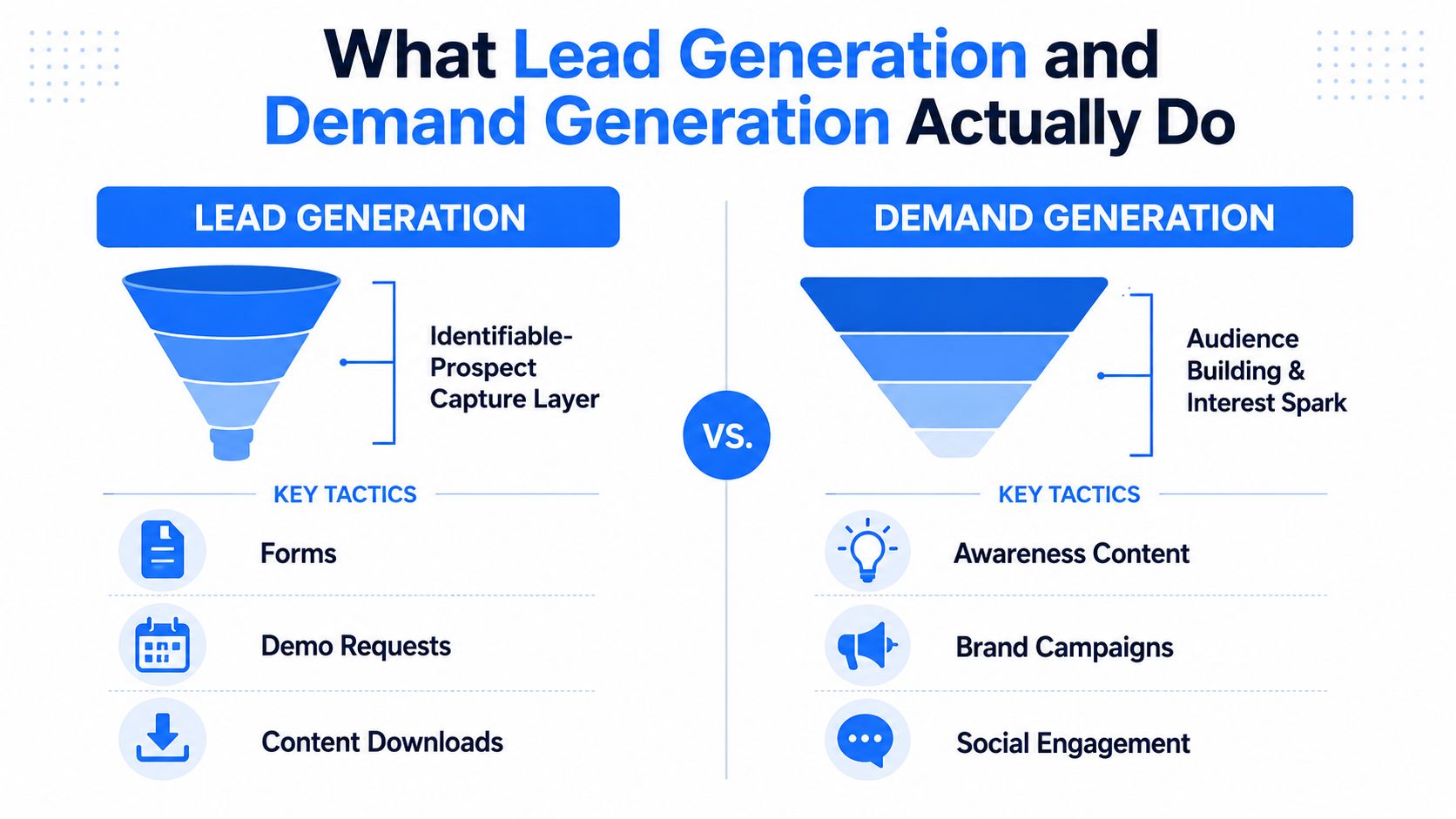
Lead generation captures identifiable prospects who show enough interest to create a sales or marketing follow-up. Common actions include submitting a form, requesting a demo, downloading a gated resource, registering for a webinar, starting a trial, or responding to targeted outbound outreach.
These actions usually indicate an active problem or evaluation. The prospect may be comparing vendors, defining requirements, or seeking a conversation. Lead generation shortens the path from observable intent to a sales interaction, but it works best when the buyer is already willing to identify themselves.
Demand generation creates familiarity and understanding before that point. Educational articles, ungated research, webinars, brand campaigns, social engagement, events, and practical tools give buyers reasons to examine a problem or category without requiring contact information. This matters when AI-assisted discovery and peer research shape consideration before a vendor enters the conversation.
The audience mindset differs:
- Lead generation: “I'm interested enough to exchange information or discuss a solution.”
- Demand generation: “I'm learning, comparing ideas, or deciding whether this problem deserves attention.”
The tactics may overlap, but the exchange does not. Demand content prioritizes access and trust. Lead-generation assets request an action that creates an identifiable record. A form is therefore an instrument for capturing existing interest, not proof that the wider buying group is ready.
Yalc's guide to B2B lead generation strategies connects individual capture tactics to a broader acquisition process. Sequencing matters. A form produces more useful signal when surrounding content has established relevance and credibility.
Demand generation widens and warms the audience. Lead generation converts intent into an identifiable sales opportunity.
Marketing usually leads demand creation because the work covers positioning, education, audience development, and distribution. Lead generation requires closer sales coordination, since routing, response timing, qualification, and meeting quality determine whether captured interest becomes pipeline.
Neither motion should be judged by the other's immediate output. Demand programs may create future demand without producing many forms in the same period. Lead programs may produce contacts quickly without improving market preference or buying readiness.
Side by Side Comparison Across Goals Tactics and Timelines
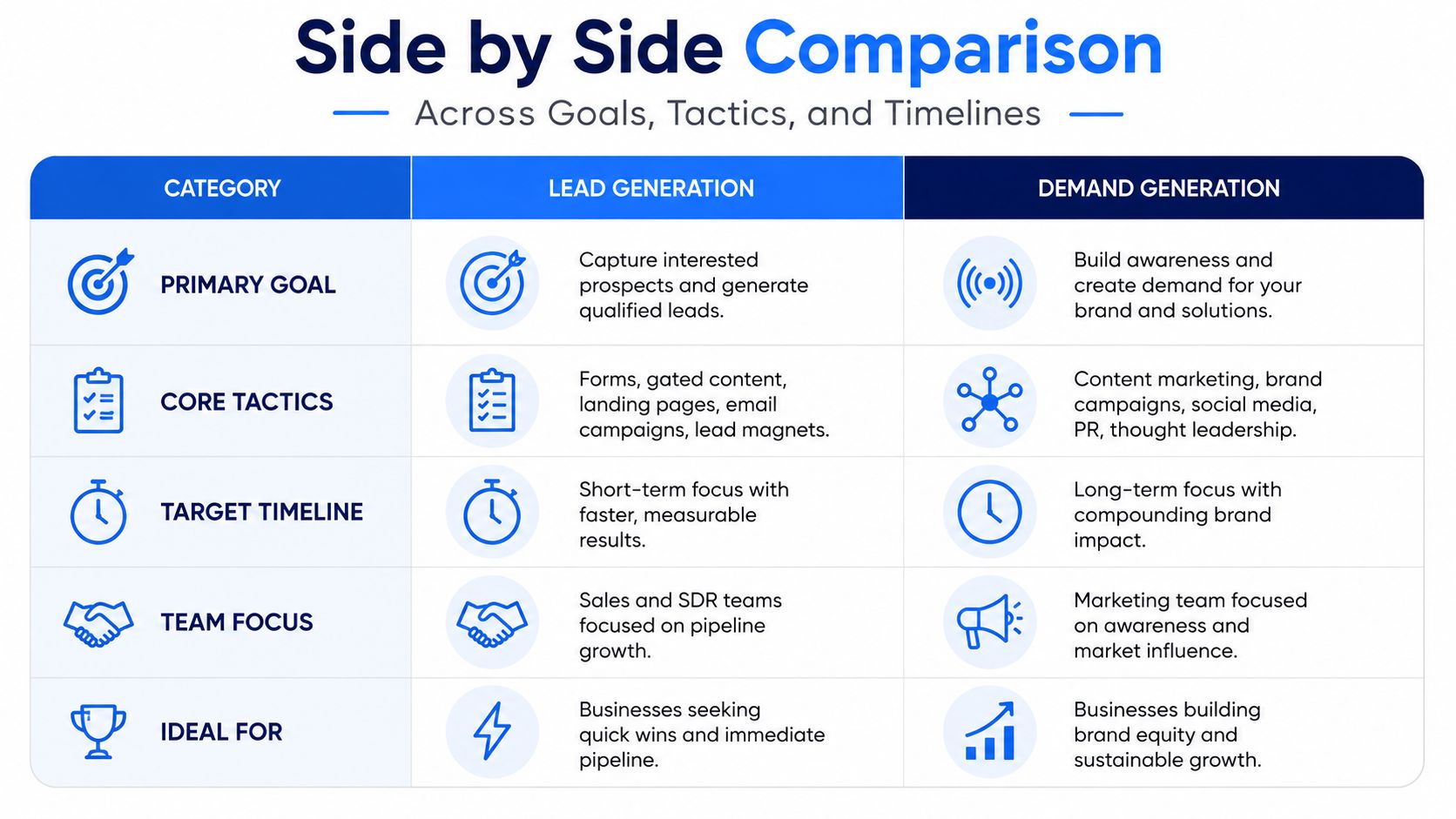
A side-by-side view makes the trade-offs easier to manage. The following table is a strategic guide, not a claim that every company should separate the motions into different departments.
| Criteria | Lead Generation | Demand Generation |
|---|---|---|
| Primary goal | Capture identifiable prospects and create sales conversations | Build awareness, educate the market, and create future buying interest |
| Core tactics | Forms, demo requests, gated assets, trials, targeted outbound, webinar registrations | Educational content, brand campaigns, events, social engagement, ungated tools, category education |
| Target timeline | Usually oriented toward near-term contact and qualification | Builds preference and intent over a longer buying horizon |
| Team focus | Sales and marketing coordination around routing, qualification, and follow-up | Marketing ownership of positioning, audience development, education, and distribution |
| Ideal for | Established demand, urgent pipeline gaps, high-intent accounts | New categories, new markets, complex buying groups, and weak brand familiarity |
Goal and audience
Lead generation focuses on recognition and response. It performs best when the prospect already understands the problem and can see why a conversation, resource, or trial is worth the exchange of contact information.
Demand generation focuses on market creation and preference. It helps a company become familiar before a buyer enters active evaluation. This matters when competitors are better known, the category needs explanation, or the purchase requires agreement across technical, financial, operational, and executive stakeholders.
Tactics and handoff
Lead generation usually places a clear conversion event at the center of the experience. A visitor sees a relevant offer, provides information, and enters a defined follow-up path. Sales can act on that signal, provided the team has agreed on qualification and response standards.
Demand generation distributes evidence across multiple touchpoints. A buyer might consume educational material, attend a webinar, encounter social proof, and use a self-service tool without filling out a form. The absence of a contact record doesn't mean the absence of influence.
Timeline and ownership
Lead generation can show activity sooner because the conversion event is explicit. That doesn't guarantee fast revenue. A benchmark summary reports an average B2B lead conversion cycle of 47 days, with 30% converting within 30 days and 25% taking 60 days or more (B2B lead generation benchmarks).
Demand generation compounds through repetition and memory. It needs marketing to maintain consistent positioning and sales to feed back objections, account intelligence, and lost-deal patterns.
Lead generation gives sales a name to contact. Demand generation gives that contact, and the wider buying group, a reason to care.
The video below offers another visual treatment of the distinction and how the two motions fit into a broader revenue process.
How Success Is Measured for Each Motion
Using one dashboard for both motions creates predictable confusion. Lead generation has visible conversion events. Demand generation often influences the conditions that make later conversion possible, including problem awareness, category understanding, and vendor preference.
For lead generation, useful operational indicators include visitor-to-lead conversion, cost per lead, lead acceptance, speed to follow-up, meeting creation, and lead-to-opportunity movement. Independent benchmark summaries put average B2B website visitor-to-lead conversion around 2.35% to 2.9%, with top performers reaching about 3.2% (B2B lead generation statistics). These benchmarks are directional, not a universal target, because intent, offer type, traffic source, and sales cycle change the meaning of any rate.
Demand generation needs a wider scorecard. The most meaningful indicators include pipeline contribution, MQL-to-SQL conversion, customer acquisition cost, and sales velocity, rather than raw lead volume. Industry benchmark guidance places MQL-to-SQL conversion at roughly 10% to 20% across B2B, with 20% to 40% described as healthy in more mature programs (B2B demand generation metrics).
The dashboard should follow the job
A lead-generation report should answer:
- Capture efficiency: How many relevant visitors become identifiable prospects?
- Qualification quality: Which contacts meet the agreed sales criteria?
- Sales execution: How quickly and consistently does the team follow up?
- Pipeline movement: Which leads become accepted opportunities?
A demand-generation report should answer a different set of questions:
- Audience quality: Are the right accounts and stakeholders engaging?
- Message resonance: Do channels and content attract meaningful interaction?
- Funnel efficiency: Do engaged audiences progress into qualified conversations?
- Revenue influence: Does the program contribute to opportunities, pipeline, and closed business?
For channel-level analysis, benchmark guidance considers LinkedIn Ads CTR around 0.3% to 0.5% typical for B2B and above 0.6% strong, while webinar attendee-to-MQL conversion is often targeted at 20% to 40% (demand generation measurement guidance). A high CTR still doesn't prove commercial value if the audience is poorly matched or sales rejects the resulting leads.
Quality beats volume
The measurement problem is becoming more visible. A 2025 benchmark survey found that 31% of demand-generation teams were shifting from lead volume and MQL generation toward higher-quality leads, with lead quality ranked ahead of conversion improvement and reaching the right stakeholders as a priority (2025 demand generation benchmark survey). The same source reported that only 35% of organizations measured demand-generation success by pipeline and revenue rather than lead volume.
That gap matters because a contact isn't the unit that buys. An opportunity, account, or buying group is closer to the economic reality. Teams evaluating outbound economics can also use the Lead Printer ROI calculator to connect campaign inputs with appointment and pipeline assumptions.
When to Prioritize Each Approach in Real B2B Scenarios
The right motion depends on what buyers must understand before they can act. A familiar product sold to a defined audience may benefit from earlier capture. A new category, unfamiliar operating problem, or complex buying group usually needs demand creation first.
A new B2B SaaS category
A new SaaS product often faces a category education problem before it faces a lead volume problem. Prospects may not know the terminology, understand the cost of inaction, or agree internally on who owns the issue.
Demand generation should lead with practical education, comparison frameworks, implementation guidance, and integration evidence. Demandbase research says 77% of buyers prioritize integration capabilities over standalone features and 84% consider self-service tools critical (Demandbase buyer report). Those requirements affect the whole buying group, not only the person who eventually fills out a form. A demo request placed before this evidence asks buyers to trust the vendor before the vendor has addressed the questions needed for internal agreement.
After the market recognizes the problem, lead generation can capture evaluation signals through technical consultations, assessment tools, trials, and account-specific outreach. Teams selling SaaS can review Lead Printer's B2B SaaS outbound approach when deciding how outbound should support, rather than replace, market education.
A services firm with an immediate quota gap
A professional services firm with a proven offer, recognizable expertise, and near-term revenue pressure may not need to wait for broad awareness to mature. It can focus lead generation on a carefully defined account list, relevant decision-maker roles, business triggers, and a clear reason to begin a conversation.
Demand generation still supports the motion through proof, useful diagnostics, and content that helps several stakeholders evaluate the service. Capture and sales execution deserve more attention when the market already understands the problem and the constraint is insufficient conversation volume. In that situation, demand content should strengthen outreach rather than become a separate awareness program.
A manufacturer entering a new region
A manufacturer expanding into a new European market faces more than a list-building task. Buyers may need localized proof, language-appropriate messaging, compliance context, distribution clarity, and confidence that the supplier understands regional operating conditions.
Demand generation builds that local relevance. Lead generation then identifies accounts showing fit or active interest. A cold sequence that ignores market language and buying context can produce activity without creating trust. Localized demand assets give sales outreach a credible foundation and help different stakeholders assess the supplier on their own terms.
Why AI-assisted discovery changes the sequence
Buyers increasingly begin their research with AI assistant queries, surfacing category explanations and vendor comparisons before visiting a vendor site. They may also use those systems to frame integration questions and share an initial shortlist with colleagues.
Lead capture cannot measure this invisible research. Demand generation must make the company's evidence easy to find, understand, compare, and share internally. The strongest capture motion starts after those self-service questions have been answered, not before. For complex purchases, the first useful conversion may be internal agreement within a buying group, while the form submission comes later.
Building an Integrated Engine That Uses Both
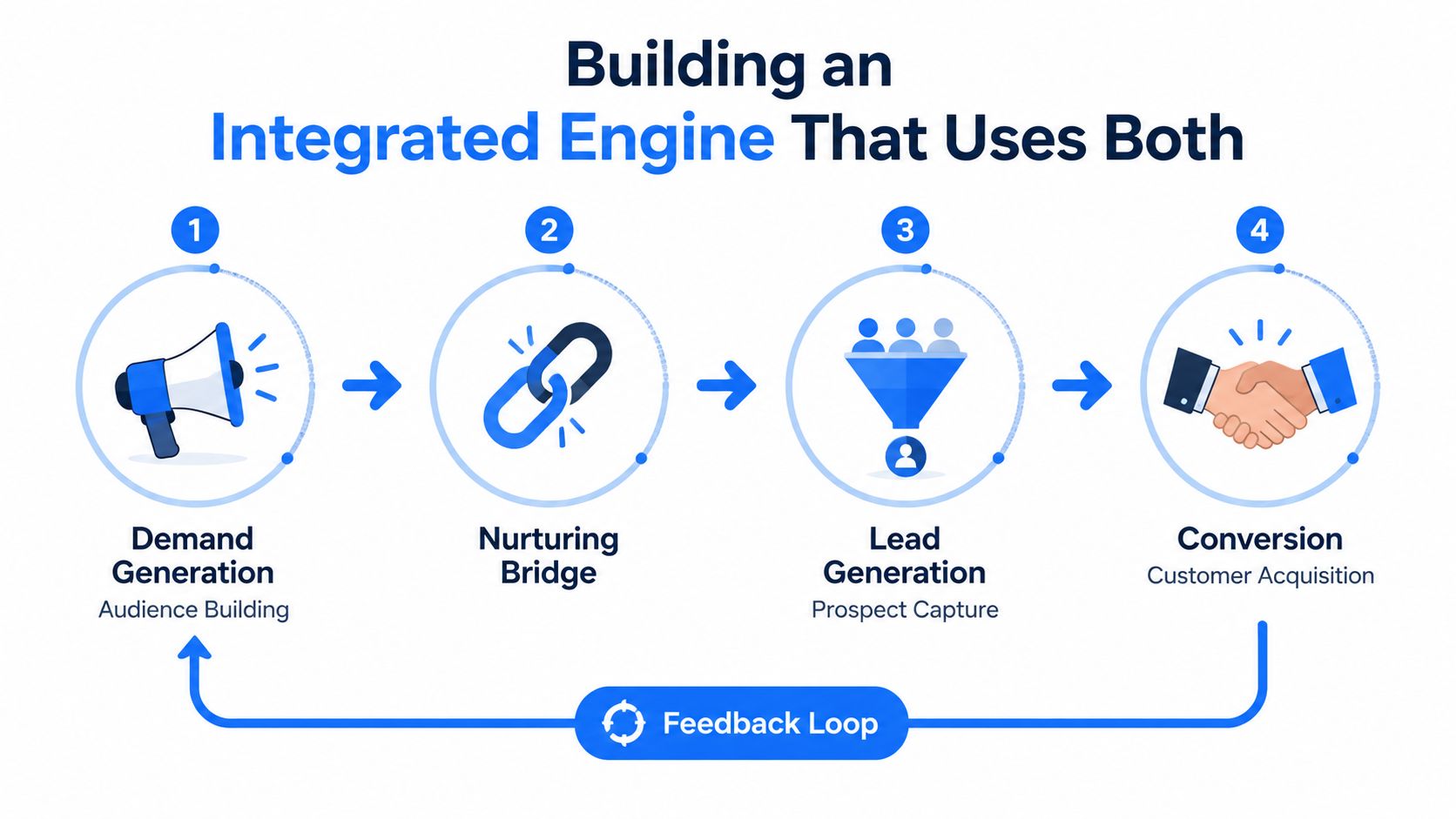
An integrated revenue engine doesn't run demand generation and lead generation as parallel campaigns with separate definitions of success. It treats them as connected stages with explicit handoffs.
Start with the account and buying-group model. Define the industries, company characteristics, roles, technical environments, and business situations that matter. Then map the evidence each stakeholder needs, from problem education for an operational leader to integration detail for a technical evaluator and commercial justification for an executive sponsor.
Build the bridge before the handoff
The nurturing bridge connects anonymous interest with identifiable intent. It can include relevant follow-up content, webinar invitations, product education, account-specific proof, and sales outreach triggered by a meaningful change in behavior. The bridge shouldn't just repeat the same offer. It should reduce uncertainty.
Lead generation enters when the prospect has a reason to exchange information or speak with sales. Marketing and sales need shared rules for what counts as a qualified signal, how quickly the team responds, and what happens when the prospect isn't ready.
Tools that help marketing teams organize research, feedback, and content workflows can fit into this operating layer. For example, teams can evaluate Surva.ai for marketing teams as one option for gathering and structuring customer insight that informs messaging and campaign decisions.
Create a feedback loop
Sales should return more than a lead status. It should report which objections appeared, which stakeholders were absent, which integration questions blocked progress, and which messages earned a response. Marketing can use that information to refine demand content and improve the relevance of future capture offers.
The operating rhythm should connect:
- Audience building: Reach the right accounts and explain the problem.
- Evidence delivery: Give stakeholders self-service material that supports internal evaluation.
- Intent capture: Offer a clear next step when interest becomes actionable.
- Sales qualification: Confirm fit, timing, stakeholders, and business need.
- Revenue feedback: Feed objections and outcomes back into targeting and content.
Teams looking for practical B2B campaign and outbound perspectives can also review the Lead Printer blog as part of their research process. The technology matters, but the workflow matters more. A complex CRM cannot repair an undefined handoff or a lead score that rewards activity instead of buying relevance.
Making the Right Choice for Your Pipeline Goals
A team can generate plenty of leads while the buying group remains unconvinced. The choice should start with the pipeline constraint, then account for how B2B buyers now research through self-service content, multiple stakeholders, and AI-assisted discovery.
Prioritize lead generation when sales needs qualified conversations soon, the market already recognizes the problem, and the offer is easy to explain. Tighten the account list, sharpen the offer, improve qualification, and hold follow-up accountable. The target is not a larger contact database. It is more accepted opportunities from relevant buying situations.
Demand generation should lead when prospects do not understand the category, competitors control awareness, or several stakeholders must agree. Publish evidence that answers pre-meeting questions, including outcomes, integrations, risk, and implementation. If buyers can research independently or use AI to compare options before speaking with sales, a form alone will miss much of the evaluation process.
Use these questions in the next planning cycle:
- Is the market educated? If buyers already search for the solution, capture can work efficiently. If they do not recognize the problem, education comes first.
- Where is the pipeline failing? Low awareness requires demand creation. Strong engagement with weak conversion requires lead-generation and sales-process improvement.
- How complex is the purchase? A multi-stakeholder decision needs evidence that can circulate across the account, not only a form completed by one contact.
- What can the team sustain? Demand generation requires consistent investment and distribution. Lead generation requires data quality, disciplined messaging, deliverability, qualification, and follow-up.
- Which outcome will leadership fund? Report demand through account engagement, opportunity creation, pipeline, and revenue influence. Report lead generation through qualified contacts, meetings, accepted opportunities, and conversion efficiency.
A practical allocation is a ratio, not an either-or decision. Shift it toward lead capture when pipeline urgency is high and toward demand creation when market understanding or buyer confidence is weak. Revisit the balance when sales feedback, opportunity progression, and account-level engagement show that the bottleneck has changed.
For teams whose immediate constraint is filling the pipeline with qualified conversations, outbound execution can complement the demand assets buyers need before engagement. Lead Printer is one option to assess alongside the team's targeting, messaging, qualification, and follow-up process.