You're probably in the familiar spot where the pipeline looks fine on paper and ugly in the CRM. The team says they're busy, marketing says the leads are there, and sales keeps asking for “better prospects,” which usually means one thing, not enough qualified meetings are landing with the right buyers.
That's where B2B prospecting services come in, and where most buyers get it wrong. They're not just a list vendor, not just an outsourced SDR, and not just a writing shop. A real prospecting service is an outsourced operating system for pipeline creation, built from data, infrastructure, messaging, sequencing, and handoff so your reps spend less time hunting and more time talking to people who can buy. The demand science benchmark found that 51% of respondents chose email as their primary outreach channel and that reps spend an average of 13.4 hours per week researching prospects, which is exactly why modern prospecting shops don't just send messages, they remove research drag and qualification waste first (DemandScience report).
The purchase decision shouldn't start with “Do they do LinkedIn?” It should start with “What's broken in my pipeline right now, and what am I buying?”
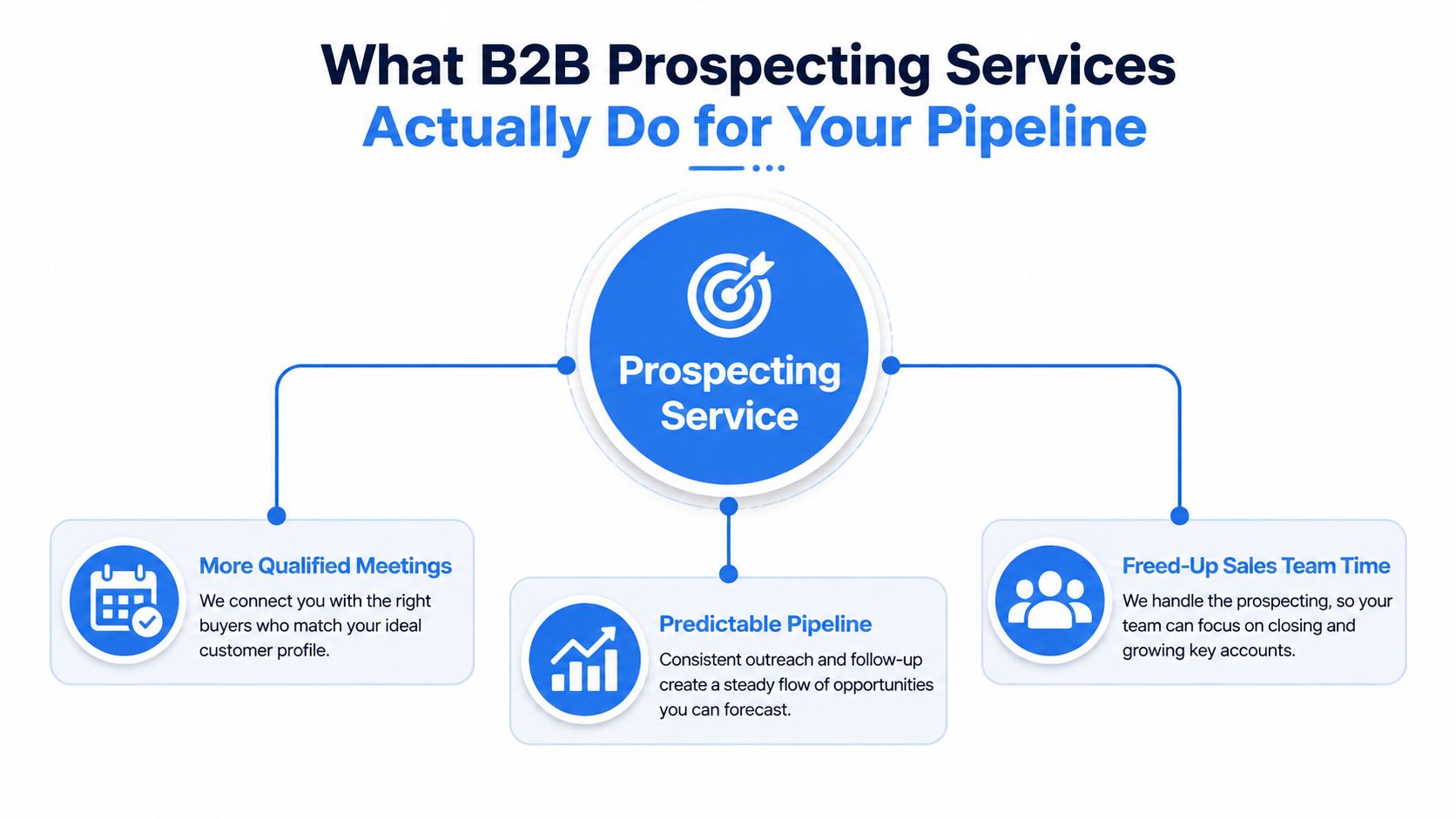
What B2B Prospecting Services Do for Your Pipeline
Monday morning usually starts with the same mess. Closers need meetings, SDRs are buried in research, and the CRM shows activity without enough real opportunities. B2B prospecting services exist to turn targeting and outreach into a repeatable pipeline function instead of a weekly scramble.
A real prospecting service is an outsourced operating system for pipeline creation. It combines ideal customer profile definition, data sourcing, enrichment, sequencing, deliverability, and qualification, then hands off conversations worth a salesperson's time. That matters because the work is split across too many moving parts for many teams to run cleanly in-house without distraction or drift.
A lead list vendor gives you names. A marketing agency may create awareness. An in-house SDR gives you control, but also salary, ramp time, management overhead, and uneven execution if the playbook is weak.
Prospecting services sit in the middle. They are built to create sales-ready conversations without forcing you to assemble the system yourself.
Practical rule: if a vendor cannot explain how they move from target account definition to booked meeting, they are selling activity, not pipeline.
The buying decision should start with the problem in front of you. If your sales team knows what to say, but the right people never hear it, you have a prospecting problem. If leads are arriving but not closing, the issue is probably positioning or sales execution. If market fit is weak, no service will cover that up.
The question is cost per meeting. A vendor with a small guarantee can look cheap and still waste time if the list quality is thin, the messaging is soft, or deliverability is poor. A larger operation may cost more upfront, but it can produce a steadier flow of qualified meetings if the process is built to hold up under volume.
The first 30 days should be used for setup, ICP alignment, list building, copy review, and technical checks. The next phase should show live testing, reply patterns, and early meetings if the offer is clear. By the time the service has enough signal, it should be tightening segments, improving messaging, and separating real buyer interest from noise.
Do not buy instant scale if the ICP is still fuzzy. The first month tells you whether a vendor can operationalize your market. It does not tell you whether they can write a clever email.
The Four Layers of a Modern Prospecting Operation
Most bad vendor demos sound the same. They talk about “full-service outreach” like every layer is interchangeable. It isn't. A modern prospecting operation only works when each layer supports the next, and when the bottom layer is weak, the whole thing wobbles.
Layer 1, data and ICP definition
This is the foundation. If the wrong accounts go in, the whole campaign produces polite rejection or no response at all. Good operators use firmographic, technographic, role, and geography filters to sharpen the ICP, then segment by what changes buying intent. Bad operators skip this and blame the copy.
Layer 2, technology and automation
Once the list is right, the technical stack has to protect sending reputation and keep the workflow clean. That means inboxes, routing, sequencing tools, and controlled automation. It also means the team doesn't throw every account into the same blast and hope for the best.
Layer 3, multichannel outreach
Email still matters, but it doesn't do the job alone. In practice, outreach often needs to move across email and LinkedIn so the service can reach different stakeholders in a buying group without relying on a single touchpoint. The point isn't channel hopping for its own sake. The point is more chances to create a relevant conversation without sounding like a machine.
Layer 4, optimization and analytics
Good teams separate from lazy ones. They watch which segments reply, which templates stall, which domains underperform, and which personas convert into meetings. Without ongoing optimization, even a strong launch decays.
| Layer | What good looks like | What failure looks like |
|---|---|---|
| Data and ICP | Tight segmentation, verified contacts, clear qualification logic | Generic lists, sloppy targeting, noisy replies |
| Technology and automation | Stable systems, clean routing, controlled volume | Broken handoffs, inconsistent sending, avoidable errors |
| Multichannel outreach | Coordinated touches across the right channels | Random follow-up, over-contacting, no sequence logic |
| Optimization and analytics | Weekly learning, segment-level changes, meeting-focused reporting | Vanity metrics and no campaign improvement |
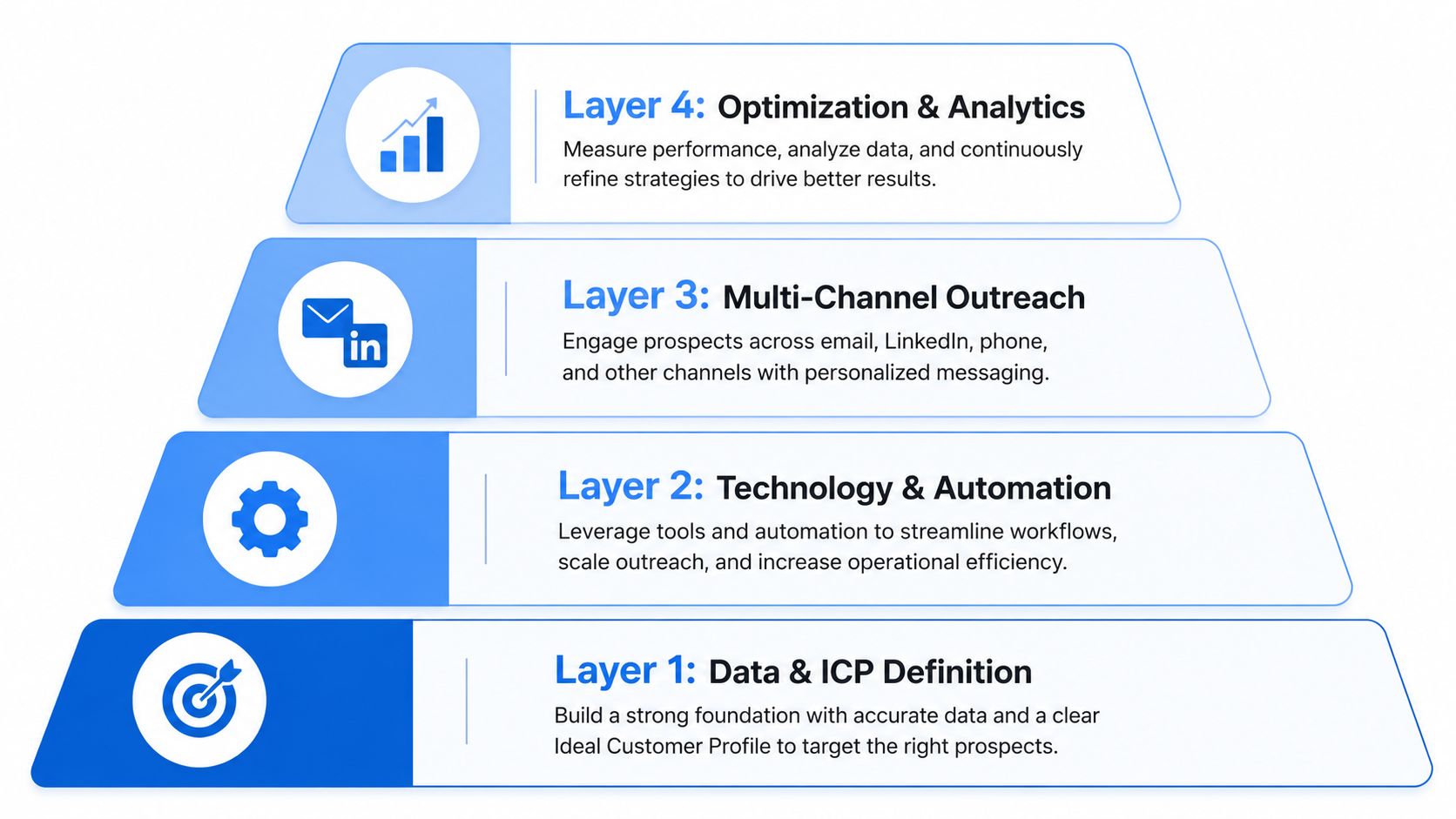
If a vendor is strong on copy but weak on data, you'll feel it fast. If they're strong on infrastructure but weak on segmentation, the campaign will look busy and produce junk. The only proposal worth taking seriously is the one that treats all four layers as a system.
Why Deliverability Is the Bottleneck for Cold Outreach
Most buyers blame targeting or copy. Those matter, but the gating issue is whether prospects ever see the message. Recent benchmarks make the buying math plain. One 2025 report put global inbox placement at 84.6%, while another found only 66% of emails reached a visible mailbox location even when delivery looked fine on paper (Validity benchmark report).
A 5-point swing in inbox placement is not a small operational detail. If a service is sending at scale, that gap changes how many replies, meetings, and qualified conversations you can realistically buy from the same list and the same copy. A vendor that ignores this is selling activity, not pipeline.
More volume can make the problem worse
More sends are useless if sender reputation is already slipping. Once inbox placement drops, each extra wave can burn list quality faster than it creates opportunities. That is why serious prospecting services focus on authentication, gradual warm-up, stable send patterns, and channel mix. Those controls keep the domain healthy and the campaign visible.
Another benchmark places average B2B sender deliverability around 80% to 85%, with stronger operators aiming for 85% to 90% to the primary inbox and elite teams pushing 95%+. The commercial takeaway is simple. If the message does not land where buyers can see it, cost per meeting rises fast because the same campaign output produces less usable demand (Martal guidance).
Higher send volume can destroy usable pipeline if it damages sender reputation. The right question is not how many emails you can send, it is how many relevant messages buyers actually see.
What to demand from a vendor
Ask how they monitor inbox placement at the tenant level, how they enforce authentication discipline, and how they reduce volume when performance softens. Ask how they balance email with other channels when deliverability gets shaky. If a vendor shrugs at those questions, they are gambling with your domain.
The benchmark data also explains why deliverability keeps showing up in buying conversations. Recent reporting says 67% of B2B teams see deliverability as a major barrier to prospecting success. That is why the better services treat inbox visibility as an operating problem, not a side issue (Validity benchmark report).
A strong campaign does not start with “How many messages can we blast?” It starts with “How many relevant messages will buyers see?”
Deliverability red flags buyers should not ignore
- No authentication discussion: If the vendor skips SPF, DKIM, and DMARC hygiene, they are not serious about sender health.
- Volume-first language: If the pitch is all scale and no inbox protection, your pipeline will pay for it later.
- No monitoring cadence: If they cannot explain how often they check domain performance, they are flying blind.
Buy carefully. Loud marketing does not fix hidden messages. You are not buying sends. You are buying visibility.
How a Campaign Runs From ICP to Qualified Meeting
Start with the target, or the rest of the campaign gets fuzzy fast. A good service narrows the ICP by role, company type, geography, and buying context, then turns that into segments that are specific enough to message without sounding generic.
The workflow behind the scenes
Research usually starts with LinkedIn Sales Navigator, Google Maps, business registries, and enriched data workflows. The goal is a list that is relevant and usable, not just large. Weak enrichment leads to vague messaging. A segment that is too broad produces noisy replies that waste sales time.
Sequence writing comes next, and it has to match the segment, not some imagined version of it. Tech stack references, competitor context, job title, and geography all shape the message. A founder at a small software company and a procurement leader in manufacturing do not react to the same angle.
Then the campaign moves into email and LinkedIn orchestration, with testing on subject lines, hooks, and follow-up timing. Replies get triaged, qualified, and passed to the client's closers when there is real buying intent. The handoff matters as much as the outreach. If the transfer is sloppy, momentum dies on the spot.
If you want a practical view of how agencies package this workflow, Lead Printer's agency overview is a useful reference point.
What to ask before a campaign launches
- Start with segmentation. Ask how they split the ICP and why those cuts matter.
- Press on qualification. Ask what counts as a qualified response, and who makes that call.
- Check reply handling. Ask who reads responses, how fast they route interest, and what happens to weak intent.
- Clarify handoff ownership. Ask who sends the meeting to sales and who keeps nurturing when a prospect is early.
Practical rule: if the campaign cannot be described as a workflow from data to calendar booking, it is just a loose collection of tasks.
The teams that win do not worship opens or reply volume. They move qualified prospects into a conversation, then let sales close.
Engagement Models, Pricing, and What Each One Really Costs
The buying model can make a decent service look weak. Per-qualified-lead pricing looks clean until the vendor starts chasing easy meetings. A monthly retainer can work, but only if you define progress and ownership up front. Choose the model based on your sales motion, your stage, and how much control your team wants to keep.
| B2B Prospecting Service Engagement Models Compared | |||
|---|---|---|---|
| Engagement Model | How Pricing Works | Best Fit | Key Trade-off |
| Per-qualified-lead or per-meeting | You pay for meetings or qualified leads delivered | Teams that want direct output accountability | Quality can drift if the vendor optimizes for count |
| Monthly retainer with a lead guarantee | Fixed monthly fee plus a minimum lead commitment | Teams building predictable outbound with budget stability | You still need clear qualification, routing, and follow-up rules |
| Fully embedded outsourced SDR pod | The vendor acts like an extension of your team | Companies that need an outsourced prospecting function, not a tactical campaign | More coordination is required, and the client still owns the offer and handoff |
Match the model to the revenue problem
If you need proof that outbound can book meetings before you commit to a larger build, a smaller guarantee makes sense. If you are scaling a motion that already works, a retainer with clear reporting usually gives you better continuity. If you do not have the staff or process to run outbound well, an outsourced pod reduces hiring risk and gets you moving faster than internal recruiting.
The actual cost is not the invoice. It is what the model does to pipeline quality, team time, and your ability to learn from the market.
Use a calculator before you buy. The Lead Printer ROI calculator forces the conversation back to meeting value instead of vanity volume, which is where the decision belongs.
Compare vendors by the kind of meeting you are buying, how much control you keep, and how much time your team loses managing the work.
Service packaging also matters. Published agent employee subscription fees show how some providers separate labor, tooling, and access. That helps you spot when a vendor has bundled those costs into one number that hides where your money is going.
A useful test is simple. If a vendor cannot explain how they move from target account definition to booked meeting, they are selling activity, not pipeline. If they can explain it cleanly, then the price becomes a real business question instead of theater.
Reading Vendor Case Studies Without Getting Misled
Case studies are where prospecting vendors get slippery. Big numbers look impressive, but a headline result says little about repeatability, qualification, or relevance to your market. Buyers should care less about volume and more about the mechanics behind it.
What the published results reveal
Lead Printer's published outcomes include 687 warm leads for one client, €40k in revenue and 237 qualified leads for another, 7 new clients and 106 sales opportunities for a third, and a scale-up from about 50 to about 300 leads per month for a fourth. Those results matter only if you inspect the offer, target segment, sequence length, deliverability environment, and what happened after meetings were booked.
Use that lens on every vendor. A 200-lead month can be weaker than a 50-lead month if the larger month fills the calendar with poor-fit meetings and drains the sales team. A smaller month with tighter targeting and cleaner handoff often creates more revenue.
Questions to ask on every case study
- What was being sold? Some offers are easier to open than others.
- Who was targeted? Industry and persona matter more than vendor decks admit.
- How was success measured? Reply rates are not the same as qualified meetings.
- What happened downstream? Meetings that do not convert tell you something important about fit.
If a vendor shows only one metric, they are probably cherry-picking. If they can explain the full chain from outreach to outcome, they are taking the work seriously. A reply that doesn't become a qualified conversation is noise. Revenue comes from meetings that hold up after handoff.
Onboarding Checklist and KPIs to Put in the Contract
A clean contract prevents arguments before the first send. If the terms are vague, your team ends up debating definitions instead of improving performance, and the vendor gets room to hide weak execution behind busy reporting. Strong onboarding keeps everyone honest and gives you a firm way to judge whether the campaign is creating pipeline.
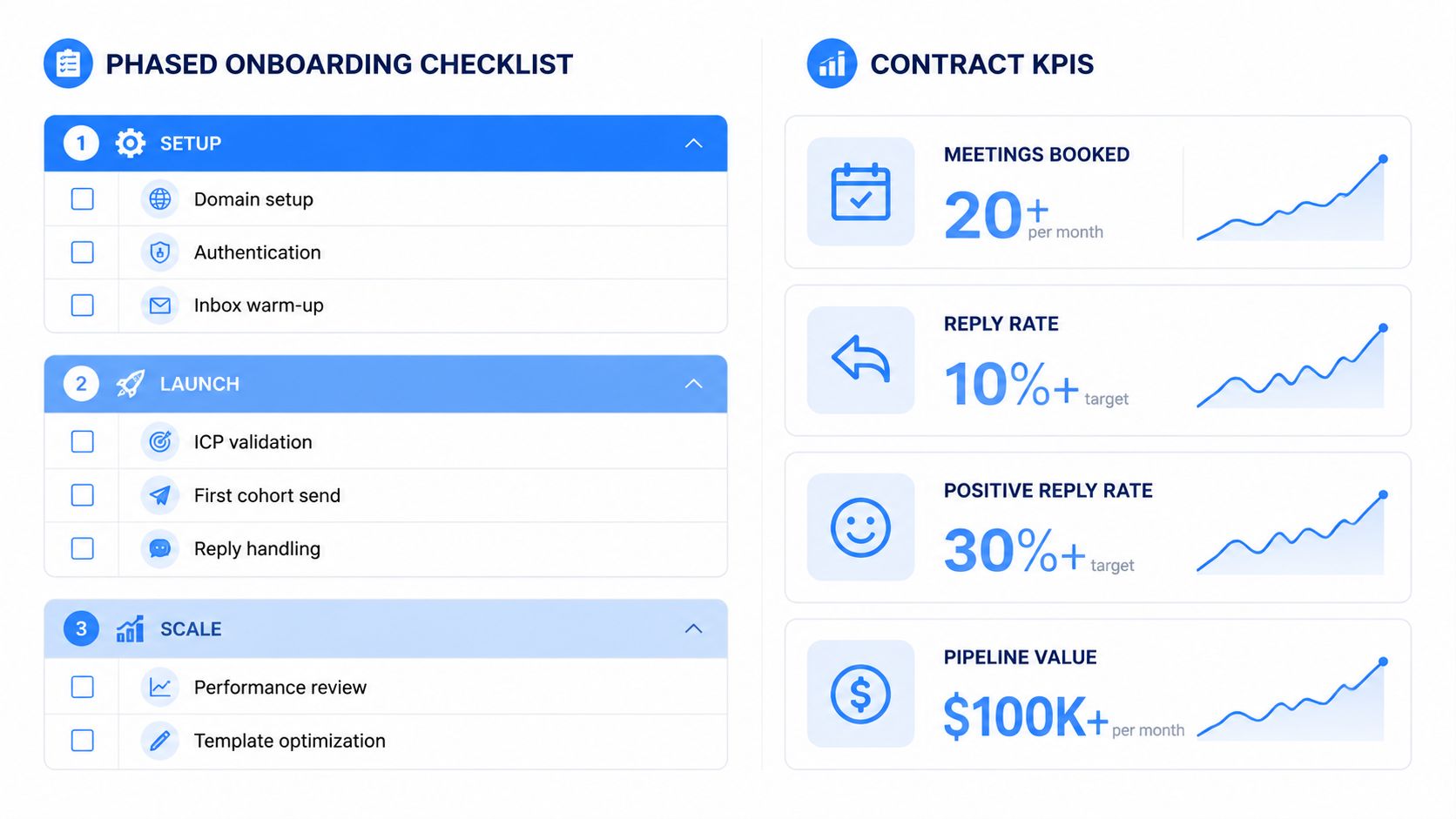
Put these phases in writing
The setup phase should cover domain setup, authentication, inbox warm-up, and ICP validation. Launch should cover first-cohort sending, reply handling, and calendar routing. Scaling should require regular performance reviews, template optimization, and deliverability monitoring, because once volume rises, weak process shows up fast.
Measure what matters
The contract should track meetings booked, qualified meetings held, pipeline influenced, cost per qualified meeting, and deliverability by domain. Those are the numbers that tell you whether the service is producing commercial value or just activity.
If the vendor only reports reply rate, push back. A reply that never becomes a qualified conversation is a noise event, and noise does not pay quota.
Weekly operational updates and monthly performance reviews work best. Weekly is for fixes, monthly is for decisions, and anything less leaves you managing the engagement by gut feel.
Contract rule: if a metric cannot be tied to a sales outcome, it belongs in a dashboard, not in a success guarantee.
Put these definitions in the contract before the first send goes out. That prevents renegotiation disputes later.
Choosing the Right B2B Prospecting Service for Your Stage
The right partner depends on what you need most right now. If you need pipeline immediately, choose a service that can launch fast and hand meetings to a closer who follows up. If you're building for the long term, choose a partner that can refine the ICP and evolve the motion with you. If nobody on your team can convert meetings, fix that first.
The decision filter that matters
Start with three questions. First, do you need this to complement an in-house SDR team or replace one you don't have yet? Second, can your sales team convert meetings without long internal delays? Third, what's the minimum level of lead quality you'll accept before the campaign becomes theater?
If you're comparing broader outsourced options, CallZent's lead generation services are one more example of how vendors package outbound support around appointment setting and outreach. Use that kind of comparison to judge model fit, not to chase the loudest promise.
For SaaS buyers, the internal context matters too. A service aimed at B2B SaaS needs tighter segmentation, stronger messaging discipline, and a sales handoff that respects the speed of the category. If your provider can't explain how they adapt to that reality, keep looking.
The minimum guarantee matters, but only if the service can also prove data quality, deliverability discipline, and a clean handoff. A guarantee without operational control is just a marketing line.
If you want a prospecting partner that builds the data, infrastructure, messaging, and multichannel execution around qualified meetings, take a hard look at Lead Printer. The offer matters less than the system behind it, and that's exactly where most outbound motions fail. If you're tired of paying for activity instead of pipeline, visit the site and judge the process against your own buying math.