One in six legitimate marketing emails never reaches the inbox. Validity's benchmark data puts global inbox placement at 83.5% in 2024, with Gmail at 87.2%, Yahoo and AOL at 86.0%, and Apple at 76.3% (Validity benchmark coverage). That means email marketing lead generation can lose pipeline before a prospect sees the subject line, evaluates the offer, or decides whether to reply.
The practical lesson is straightforward: copy is only one layer of outbound performance. Deliverability, list quality, segmentation, sequence design, and channel coordination determine how much of your potential audience becomes a real sales conversation. A strong campaign starts with infrastructure, not clever phrasing.
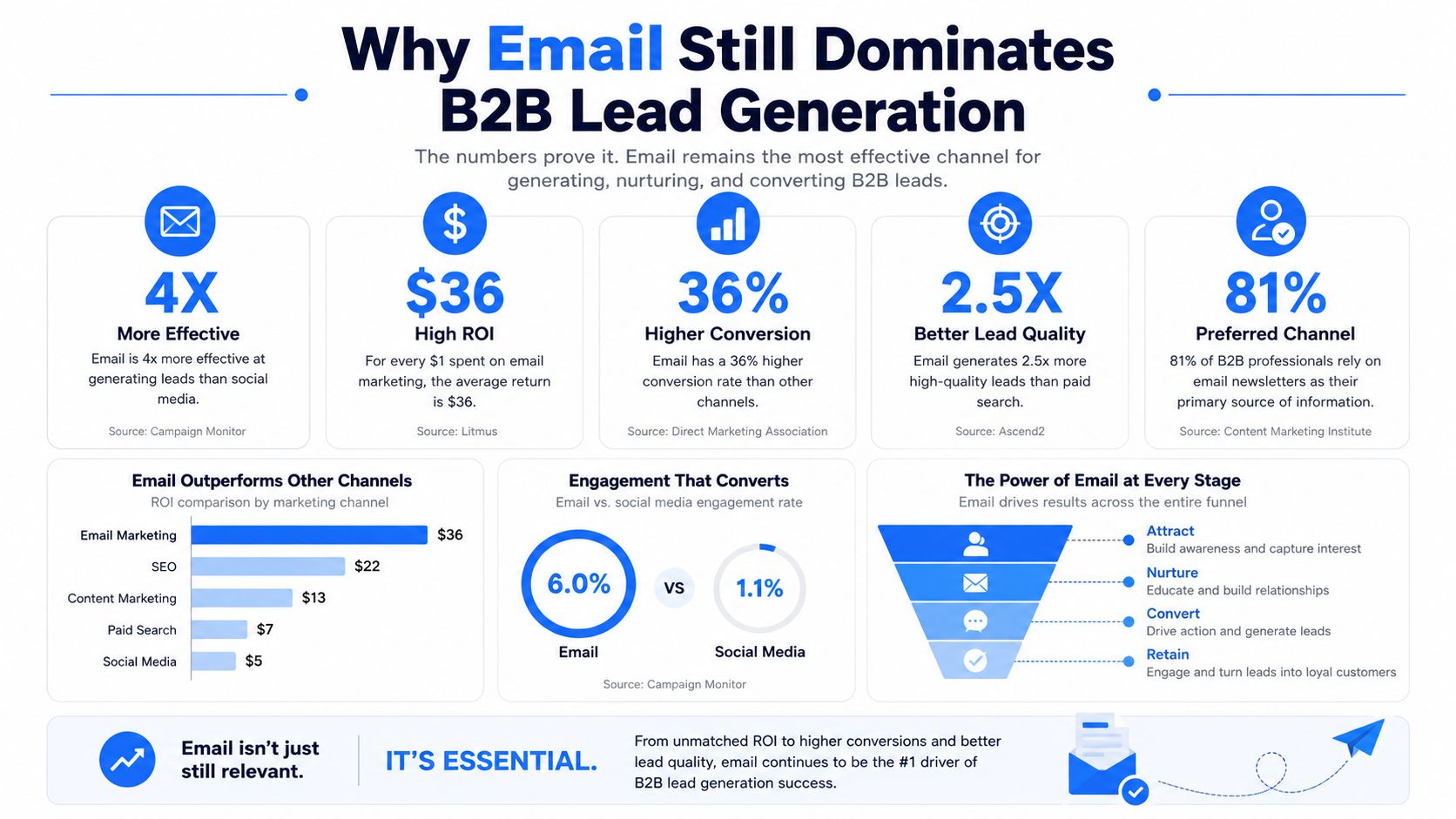
Why Email Still Dominates B2B Lead Generation
Benchmark data from large-scale industry studies puts the average campaign open rate at 37.93% across industries, with the top 10% reaching 54.78%. Automated flows average 48.57%, while the top 10% reach 65.74% (email open-rate benchmarks). These figures do not establish buying intent. They show that email still earns attention when the sender, audience, and delivery conditions are sound.
Open rate is also a diagnostic signal, not a complete performance metric. A weak result can point to an unconvincing subject line, poor list fit, or inbox placement problems. If opens fall across several campaigns while the offer and audience remain stable, investigate authentication, sender reputation, spam complaints, and provider-specific delivery before rewriting the copy. If opens hold but replies remain low, the subject line may be doing its job while the message, offer, or call to action is failing.
B2B marketers continue to use email for pipeline creation. 83% of B2B marketers say email marketing is important for generating leads, and 59% of marketers identify email as the most reliable channel for driving leads (B2B email lead-generation benchmarks). The channel gives teams control over audience selection, message, cadence, testing, and response routing. That control is useful only when the underlying sending system keeps messages visible.
Engagement creates room for qualification
Lead generation requires more than contact volume. A prospect must notice the message, recognize its relevance, and take an action that helps sales assess timing, authority, need, or fit. Email supports that process through structured follow-ups, educational content, event invitations, and direct meeting requests.
A first email should establish relevance rather than carry the entire sales argument. Later touches can add context, address a different objection, or offer a clearer next step. Automated flows help nurture prospects who are not ready to speak, provided the audience, trigger, and exit condition are defined.
Practical rule: Treat every email as one step in a qualification system, not as an isolated attempt to close.
Email also gives teams ownership that algorithm-dependent channels do not. Social platforms can extend reach, but distribution and audience access remain controlled by the platform. A permission-based database, sending reputation, consent process, and CRM workflow are assets the business can manage directly.
That control creates accountability. An inaccurate list, incomplete authentication, or overly broad audience can turn apparent reach into wasted sends and weaker inbox placement. Email produces repeatable pipeline when the infrastructure, targeting, and qualification process work together. Copy matters, but it cannot recover opportunities that never reach the inbox.
Building the Deliverability Foundation Before Writing a Single Word
Configure SPF, DKIM, and DMARC records before provisioning your first sending domain. SPF identifies the systems authorized to send for your domain. DKIM adds a cryptographic signature to each message. DMARC defines how mailbox providers should handle authentication failures and gives your team visibility into those events.
A missing or misaligned authentication record can send legitimate outreach to spam, regardless of how relevant the copy is. Verify alignment across the systems responsible for sending, tracking, and replies before building a sequence. Document who owns each record and who investigates failures.
Sending architecture should limit operational risk. Many B2B teams place outbound activity on dedicated sending domains or separate inbox groups instead of exposing the primary corporate domain to every experiment. The right structure depends on your sales motion, compliance requirements, and technical environment. The operating principle is consistent: protect the domain that carries your core business correspondence.
Warm up deliberately
New domains and inboxes need a controlled ramp. Begin with genuine, relevant exchanges and modest activity. Increase volume only after engagement and authentication signals remain stable. Sudden bursts from new infrastructure can resemble abusive behavior even when the list is legitimate.
Warm-up does not repair weak targeting. Validate addresses before launch, remove hard bounces quickly, suppress invalid or persistently unresponsive contacts, and monitor spam complaints. A warmed inbox that sends irrelevant messages can still lose sender reputation.
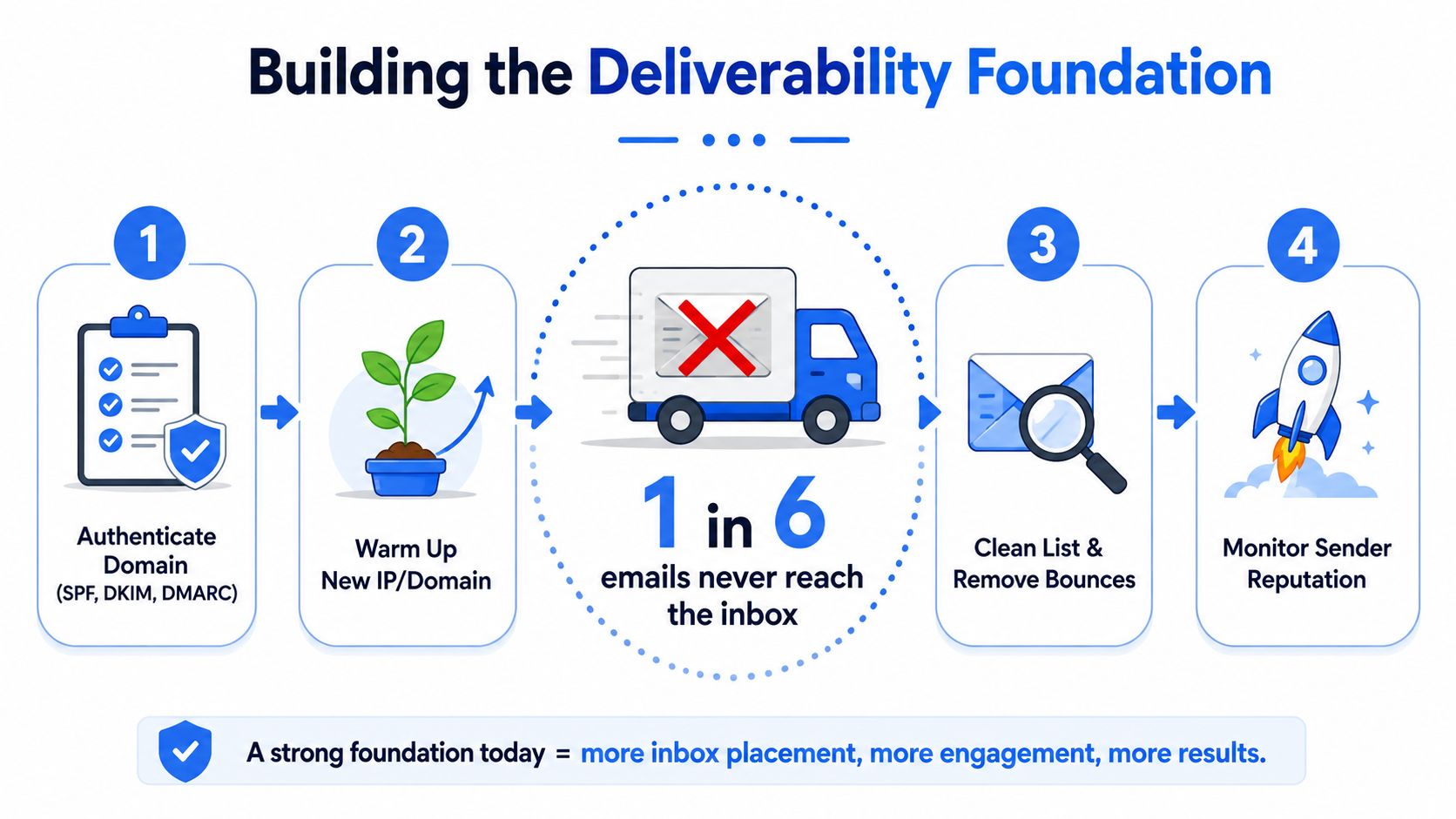
Mailbox providers do not produce identical delivery outcomes. Gmail, Yahoo, AOL, and Apple can place the same campaign differently, so review results by provider rather than relying on one account-wide average. A provider-level view can reveal an authentication, reputation, or formatting problem before it affects the entire program.
For implementation guidance, teams can review the Lead Printer outbound resources while documenting authentication ownership, inbox provisioning, warm-up rules, bounce handling, and escalation procedures. The sequence should remain paused until someone knows who monitors each control and what action follows a decline in placement or engagement.
Infrastructure comes first. A persuasive message cannot recover an email that never appears where the prospect looks.
Prospect Research and Precision List Building
The list determines who gets the opportunity to respond. A generic database may contain many contacts, but it won't necessarily contain the people who own the problem, control the budget, or influence the buying process.
Start by defining the ideal customer profile in operational terms. Identify industry, company size qualitatively, geography, business model, role, current technology, trigger events, and exclusions. For SaaS, a relevant signal might be a visible technology stack or a hiring pattern. For manufacturing, it might be a product category, facility type, export market, or procurement structure.
Build from multiple evidence sources
LinkedIn Sales Navigator helps identify roles, reporting structures, company changes, and professional context. Google Maps can uncover local operators and facilities that broad business databases miss. Targeted websites reveal product lines, service pages, leadership teams, partner ecosystems, and language preferences. National business registries can provide a more formal view of company identity and location.
Clay can then enrich and organize those records. Use it to combine firmographic attributes, technographic signals, website observations, and role data into usable segments. Custom scraping can support research on public pages, but it should respect applicable laws, platform terms, privacy requirements, and suppression rules.
When a website contains relevant public contact information, Agenty's email extraction tutorial can help teams understand the mechanics of extracting addresses from websites. Extraction is only one step. Every address still needs validation, permission and compliance review where applicable, role verification, and a clear reason for contact.
Use a research checklist
A prospect should enter a campaign only when the record answers practical questions:
- Role fit: Does this person influence the problem you address?
- Company fit: Does the organization match the commercial and operational profile?
- Trigger: Is there a current reason your message could matter?
- Evidence: Can you point to a public detail without pretending to know more than you do?
- Contact quality: Has the address been validated, and are bounce and suppression checks complete?
- Routing: If this person isn't the buyer, is there a credible path to the right stakeholder?
A narrow list with clear evidence beats a large list assembled from assumptions. It also improves personalization because the writer has something specific to say beyond the recipient's first name.
Segmentation and Personalization That Lift Reply Rates
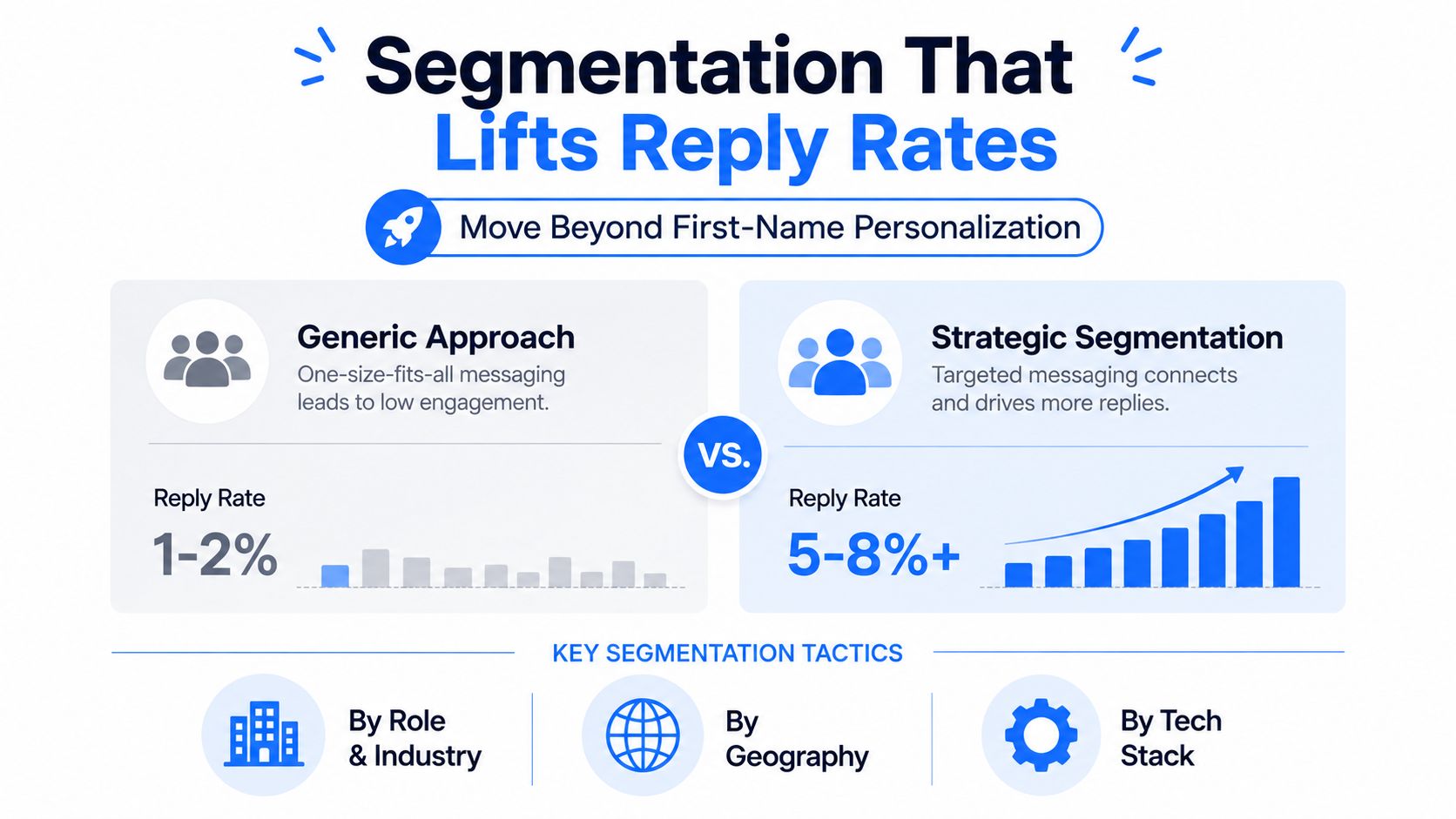
Personalization begins with deciding what changes between audiences. A first-name merge tag adds little relevance when the rest of the email could go to anyone. Segment definitions also affect inbox placement. When one message targets a narrow, engaged audience, engagement signals are easier to interpret and poor-fit contacts are less likely to generate complaints or bounces.
Cold email reply rates commonly cluster around 3.43% to 5% across industries, while top-performing segments can exceed 10%, according to current benchmark coverage (cold email reply-rate benchmarks). Results below 3% can indicate list-quality, inbox-placement, or offer-market-fit problems. 5% or more is generally strong, while 10% or more reflects unusually tight targeting and disciplined sequencing. Treat these ranges as diagnostic guidance, not promises.
Segment around buying context
Role changes the problem. A founder may care about growth capacity and speed. A revenue leader may focus on pipeline quality and conversion. An operations executive may prioritize process reliability. The offer can stay similar, but the opening observation, proof point, and CTA should match the recipient's responsibilities.
The constraint isn't list size. Ask whether segment definitions answer three questions: who owns the problem, who controls budget, and what trigger makes the issue relevant today? If the answer is unclear, personalization becomes decoration rather than useful context.
Geography changes context as well. Outreach to the US, UK, and EU may require different references, timing, spelling, regulatory considerations, and language choices. Localized messaging requires more than translation. It should reflect how buyers describe the problem and how businesses operate in that market.
Technology and competitive context add another layer. A prospect using a specific platform may need an integration angle. A company hiring around a known capability may be preparing for a workflow change. A business serving a particular customer segment may respond to a use case that generic industry copy would miss.
The customer segmentation examples from Call Loop show how audience distinctions can support relevant campaigns and help teams boost ROI with customer segments. Keep segments small enough to support distinct messaging, but large enough to produce meaningful learning. Track performance by segment rather than allowing strong results from one audience to hide weak deliverability or poor fit elsewhere.
Email-only outbound is also losing some impact. Recent industry summaries report that single-channel outbound generates about 30% fewer leads year over year, while multi-channel and AI-personalized approaches outperform baseline cold email reply rates (B2B email and outbound trends). (See reply-rate benchmarks in the segmentation section.) Use segmentation to decide which prospects need LinkedIn context, a webinar invitation, or localized follow-up. Adding channels without that logic creates more activity, not necessarily more pipeline.
Keep the copy short. Lead with a specific observation, connect it to a plausible business issue, and use an interest-based CTA that asks whether the topic is relevant, offers a concise example, or invites the prospect to compare approaches. The message should earn the next exchange while protecting the sender's reputation through relevant targeting.
Sequence Design and Multichannel Orchestration
A sequence should feel like one conversation unfolding across channels. Each touch needs a distinct job, and every channel should respect the prospect's previous interaction.
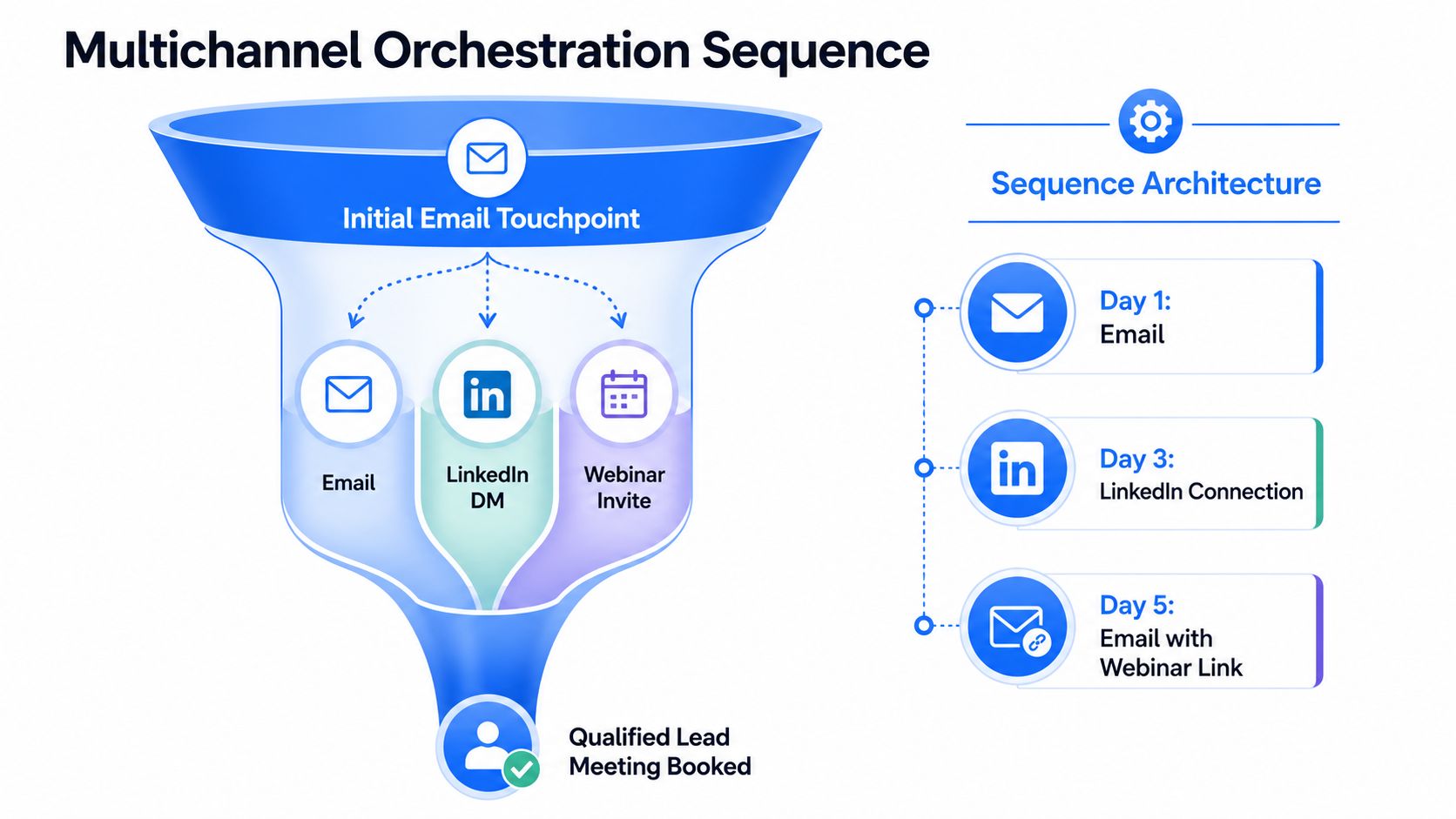
Begin with a focused email that establishes the reason for contact. If the prospect engages with the company or accepts a connection request, LinkedIn can add familiarity without repeating the full pitch. A webinar can serve as a lower-friction mid-funnel step when the subject requires education, demonstration, or several stakeholders.
Give every touch a different purpose
A practical architecture might look like this:
- Initial email: State the observed business context and ask a low-friction relevance question.
- LinkedIn connection: Reference the professional context, not the entire email, and avoid sending a duplicated pitch immediately.
- Follow-up email: Add a specific use case, operational implication, or short resource.
- Webinar invitation: Offer an event that addresses the problem without requiring a sales conversation first.
- Post-event follow-up: Connect the event topic to the prospect's situation and invite a focused discussion if interest is apparent.
The timing should follow the audience's working patterns and the urgency of the trigger. Use the sequence calendar to prevent multiple channels from contacting the same person on the same day. Stop or change the path when someone replies, opts out, books a meeting, or signals that another stakeholder owns the issue.
A webinar works best when it has a clear audience and a concrete outcome. “Learn about growth” is weak. A session focused on evaluating a particular workflow, reducing operational friction, or selecting an integration gives prospects a reason to attend and gives sales a useful follow-up context.
Localization matters across the EU. Adapt language, examples, business references, and sending windows to the market. Confirm that consent, privacy, and outreach practices match the applicable requirements. English may be appropriate for some multinational accounts, while local-language messaging can be more credible for regional buyers.
Orchestration rule: Never make a prospect repeat their context because your email, LinkedIn, and webinar workflows aren't connected.
Use CRM fields and sequence logic to pass engagement data between channels. A person who ignored the initial email shouldn't receive a LinkedIn message that claims they showed interest. A person who attended a webinar deserves a different follow-up from someone who never opened an invitation.
Measuring What Matters in Email Lead Generation
Open rates show engagement patterns, but they are not the final score. Send volume is weaker still when viewed alone. A campaign can send successfully and appear delivered, yet create little pipeline because messages reached spam folders, secondary tabs, or poorly matched contacts. Inbox placement determines how much of the written message prospects can evaluate.
Measure the funnel in layers, then diagnose the narrowest constraint.
| Metric | Benchmark range | What it diagnoses |
|---|---|---|
| Campaign open rate | 37.93% average, 54.78% for the top 10% | Subject relevance, sender recognition, and initial engagement |
| Automated-flow open rate | 48.57% average, 65.74% for the top 10% | Trigger quality, timing, and nurture relevance |
| Global inbox placement | 83.5% | Authentication, reputation, provider filtering, and placement |
| Cold email reply rate | 3.43% to 5% average, above 10% for top segments | Targeting, offer fit, copy, and sequence quality |
| Meeting-booked rate | No universal benchmark | Conversion from positive replies into sales conversations |
| Pipeline contribution | No universal benchmark | Commercial value created after qualification and handoff |
Diagnose before you optimize
Weak delivery points to authentication, list validity, bounce behavior, sending patterns, or domain reputation. If delivery looks healthy but inbox placement is poor, inspect provider-level results, spam complaints, content patterns, and engagement signals. If placement is acceptable while replies remain weak, review the ICP, role fit, trigger quality, and CTA before rewriting every subject line.
Open-rate benchmarks can provide context, but provider changes and privacy features make them directional. Judge performance with delivery, placement, qualified replies, meetings, and pipeline together. A high open rate with few positive replies may indicate curiosity, weak targeting, or an offer that does not match the prospect's problem.
A/B testing works when one meaningful variable changes at a time. Test audience definition, the opening observation, offer framing, CTA, or follow-up logic. Keep the comparison fair, record segment and provider mix, and evaluate qualified replies and meetings rather than opens alone.
For a broader reporting model, teams can understand multi-touch attribution basics to assess how email, LinkedIn, webinars, and sales activity contribute to one opportunity. A practical ROI calculator for outbound campaigns helps translate qualified meetings and pipeline outcomes into a business case stakeholders can review.
Industry-Specific Playbooks for SaaS Ecommerce Services and Manufacturing
The infrastructure stays consistent across sectors, but the reason to reply changes sharply.
SaaS: Segment by current technology, role, product maturity, and visible operational triggers. A sequence can open with a workflow observation, follow with a short use case for the relevant stack, and close with an invitation to compare the prospect's current process with an alternative. A free-trial or technical review CTA may fit a product-led motion, while a demo request suited to the specific needs fits a more complex sale.
Ecommerce and fintech: Focus on merchants, payment operations, conversion friction, reconciliation, or integration complexity rather than generic growth language. Separate ecommerce operators from finance leaders because they evaluate risk and value differently. Email can introduce the merchant-specific issue, LinkedIn can establish context, and a short product or integration webinar can address objections before a sales call.
Professional services: Buyers often need evidence of judgment before they discuss an engagement. Use a thought-leadership sequence built around a narrow business problem, then invite qualified prospects to a webinar or private discussion. Segment by service need, firm size, geography, and decision-making role. The CTA should offer perspective or diagnosis before requesting a formal sales process.
Manufacturing: Procurement, engineering, plant operations, and ownership teams don't respond to the same message. Build lists from company websites, business registries, maps, and industry-specific evidence. Lead with specifications, production requirements, lead-time considerations, or regional availability, then follow with a relevant product detail and a practical qualification question. Teams selling physical products can use manufacturing lead-generation support when they need structured research and localized outreach.
Avoid forcing every sector into the same volume expectation. A short-cycle software offer may produce faster responses than a specification-driven manufacturing sale, while services often need trust-building before qualification. Set targets around verified conversations, qualified opportunities, and pipeline contribution, then tune cadence and content to the buyer's actual decision process.
Lead Printer builds the infrastructure, verified prospect data, personalized sequences, and multichannel workflows that support email marketing lead generation across SaaS, ecommerce, services, and manufacturing. If your team needs more qualified conversations without sacrificing deliverability or targeting quality, visit Lead Printer to discuss a campaign built around your market, buyer roles, and sales process.