You've got the demos calendar full, but half the meetings are with people who will never buy. Or the opposite happens, the pipeline looks thin, the team says outbound “isn't working,” and nobody can tell whether the problem is targeting, deliverability, qualification, or the handoff itself. That's the gap b2b appointment setting services are supposed to close, and it's also where most buyers get misled by vanity metrics.
The right partner doesn't just fill calendars. It builds the infrastructure, list quality, messaging, and follow-up discipline that turn contact attempts into held meetings, then into sales-qualified pipeline. If a vendor can't explain that chain clearly, they're selling activity, not outcomes.
What B2B Appointment Setting Services Actually Do
A real appointment setting service is a third-party outbound function that finds target prospects, contacts them, qualifies fit, and books meetings on behalf of your sales team. That is different from generic lead generation, which often stops at names, emails, or contact records. A meeting only matters when the prospect fits your ICP, shows up, and has enough buying intent to deserve sales time.
The service usually starts with your ICP definition, buyer personas, value proposition, and disqualification rules. From there, it builds outreach lists, writes messaging, sends sequences, handles replies, and passes only the right conversations to your reps. That workflow matters because the service is selling a disciplined process, not a calendar invite.
Practical rule: if a provider cannot tell you how many booked meetings become held meetings and then become qualified opportunities, they are optimizing for the wrong thing.
I use that lens on every vendor. A team can book meetings and still create no pipeline if the wrong accounts are targeted, if the meetings no-show, or if sales accepts weak handoffs. The question is not how many meetings were booked, it is how many were worth a seller's hour.
Buyers should inspect the operating system, not just the promise. If you are defining the outbound engine around SaaS motions, the Lead Printer B2B SaaS overview is a useful reference for comparing service structure to your own funnel. For campaign planning that starts from prompts, Prompt Builder's lead generation prompts can help teams turn ICP ideas into cleaner outreach inputs.
The End-to-End Operating System Behind Booked Meetings
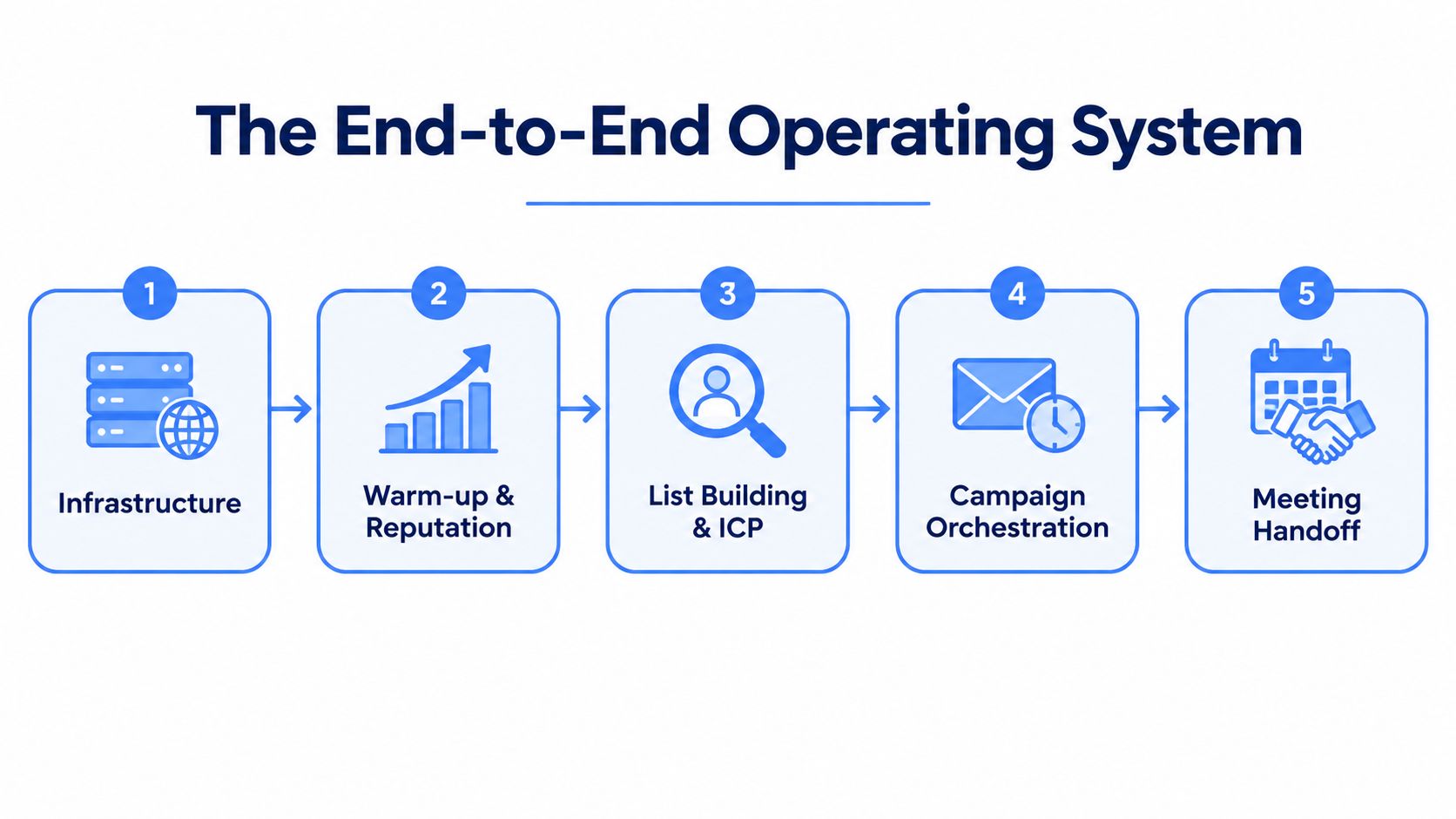
Infrastructure comes before outreach
A booked-meeting program starts with domains, inboxes, authentication, warm-up, and reply routing. That work is unglamorous, but it decides how much volume can reach a prospect. A fresh domain with no authentication can land only 25% of messages in inboxes, while a warmed setup with SPF, DKIM, and DMARC can reach 90%, which the benchmark translates into 250 inboxed emails versus 900 on the same 1,000-send volume and 3.6x modeled replies (deliverability benchmark).
List quality sits right behind that layer. Prospect data has to be built, enriched, and verified before send volume rises, because bounce quality and sender trust move together. A practical guide recommends pausing when bounce rates cross a 3% ceiling and rechecking list quality, with healthy reply rates in the 2% to 5% range for cold outbound (reply and bounce guidance).
Messaging and channels work as a sequence
Personalization should follow segment pain, buying context, and role, not just name tokens. That is where a lot of outsourced programs stay shallow. Copy can look customized while still sending the same pitch to three different personas.
A useful operating model layers channels instead of treating one as magical. Cold email does the heavy lifting, LinkedIn supports recognition, calling helps rescue warm intent, and retargeting keeps the offer familiar. For teams comparing how AI tools support that orchestration, the top AI task automation tools reviewed piece is a practical reference point for workflow design.
Qualification and handoff protect the seller's time
The last layer is the one buyers often skip in evaluation. A serious service uses BANT, MEDDIC, or a custom qualification frame before anything lands on the AE's calendar. Then it adds routing rules, SDR pre-briefs, and confirmation touches so the meeting is held, not just booked.
A meeting handoff lacking a qualification note signals shallow process, not strategic routing.
That is why the best services do not report their work in isolated parts. They show how infrastructure affects inbox placement, how inbox placement affects replies, how replies affect meetings, and how meetings affect SQL creation. The chain matters more than any single tactic.
Conversion Math That Separates Real Pipeline from Vanity Calendars
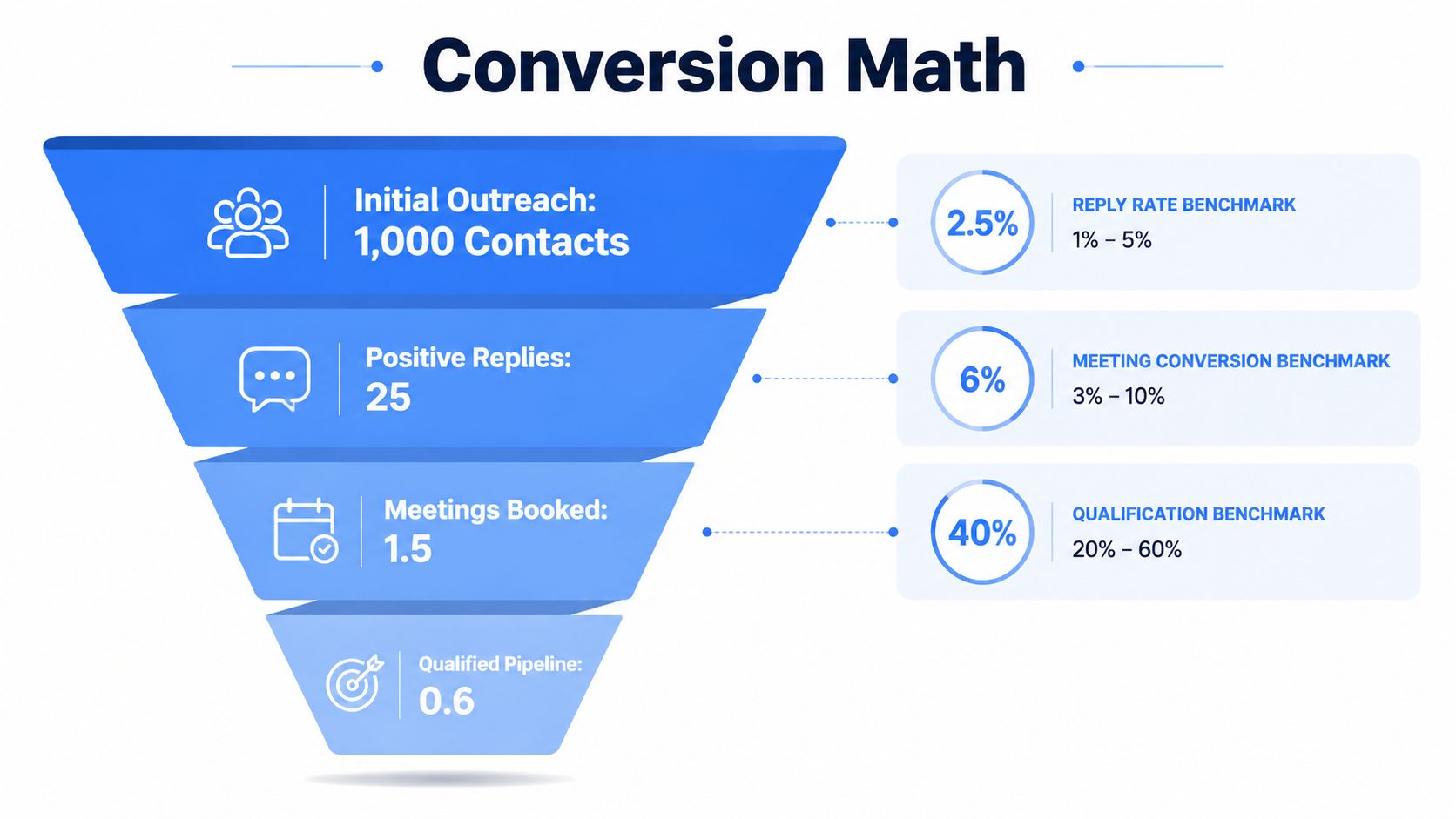
Buyers get burned when they price appointment setting off booked meetings alone. Cheap meetings can still be costly if they no-show, miss the fit bar, or never become pipeline. I care more about downstream movement than calendar fill, because that is where the economics show up.
The math starts with cold outbound benchmarks. Industry guidance puts contact-to-meeting conversion at about 4% to 10%, show rates at 65% to 80%, and meeting-to-qualified-opportunity at 25% to 55% (2026 benchmark set). The same benchmarks point to 6 to 12 touches for each booked meeting and 18 to 25 meetings per setter per week. Appointment setting rewards disciplined process over single-touch luck.
A simple forecast makes the leakage visible. If you reach 5,000 contacts and get 50 replies, you may end up with 20 meetings, 14 shows, 7 SQLs, and 2 to 3 opportunities. That is not a neat theory. It is what happens when each stage gives up a little volume.
The Lead Printer ROI calculator is useful because it pushes the discussion toward appointment cost and booking economics, not vanity totals. That is the right frame for vendor review.
Two campaigns can book the same number of meetings and still create very different pipeline. One holds a tighter show rate and cleaner qualification. The other fills calendars with weak fit and low intent. The calendar looks similar. The revenue result does not.
In-House SDRs vs Outsourced Appointment Setting
Hiring internally gives you control over messaging, coaching, and feedback loops, but it also means payroll, management overhead, and ramp risk. A standard in-house SDR setup often costs $130K to $160K fully loaded when you combine base salary and tools, and a rep usually books 8 to 15 meetings per month after 90 days. Outsourced models are commonly structured as $300 to $1,200 per meeting or $5K to $15K monthly retainers.
The question is what you need the team to do well. If your ICP is changing fast, you need tight feedback into product and positioning, and you want steady volume well past a pilot, internal usually fits better. If you need speed, test coverage, or a short-term motion while the offer is still being refined, outsourcing is usually the cleaner choice.
| Dimension | In-House SDR | Outsourced Appointment Setting |
|---|---|---|
| Cost | Higher fixed cost, often $130K to $160K fully loaded per rep | Variable, often $300 to $1,200 per meeting or $5K to $15K monthly retainer |
| Ramp time | Slower, because hiring, onboarding, and coaching all sit on your side | Faster, because infrastructure and process already exist |
| Control | Strong control over messaging, data, and product feedback | Less direct control, depends on vendor transparency |
| Specialization | Good if the ICP is narrow and evolving | Strong when you need outbound specialization quickly |
A hybrid model often works best for growth-stage teams. One internal SDR or marketing ops owner keeps messaging and feedback tight, while an external partner handles scaled prospecting and the deliverability-heavy work. That setup reduces the common failure mode where no one inside the company owns lead quality end to end. For teams comparing vendors, this agency directory is a practical place to review options without treating every provider as interchangeable.
I've seen the hybrid approach beat both extremes because it keeps strategy close to the business and execution flexible. It is not flashy. It is usually the most operationally sane way to run the program.
Pricing Models, Contracts, and KPIs Worth Negotiating
Pricing changes behavior fast. Per-appointment, retainer, performance-based, and hybrid contracts each reward different outcomes, and some of those rewards push the vendor toward calendar fill instead of fit. If a provider gets paid only for booked calls, the easiest path is to maximize volume and let your team sort the rest out.
The cost often sits outside the headline number. Setup fees, list rental, ICP discovery, and overage terms can make a clean-looking proposal much more expensive once the program is live. If the contract does not spell out who owns list quality, inbox setup, and warm-up, you are carrying more risk than the pricing sheet admits.
Practical rule: if the vendor controls the inboxes but you absorb the reputational risk, the agreement is out of balance.
Negotiate KPIs that protect downstream quality, not just activity. Push for language around show rate above 70%, SQL-to-meeting above 40%, and deliverability above 95%, along with clear ownership for list quality and technical setup. Those are the numbers that show whether the program is generating usable sales motion or just moving names onto a calendar.
| Pricing Model | Typical Range | KPI to Negotiate |
|---|---|---|
| Per appointment | Often $300 to $1,200 per qualified meeting | Show rate, disqualification rules, and refund terms for bad-fit meetings |
| Retainer | Often $5K to $15K monthly | Positive reply volume, SQL conversion, and transparent activity reporting |
| Performance-based | Variable, usually tied to outcomes | Define SQL, meeting quality, and payment triggers very tightly |
| Hybrid | Retainer plus capped meeting minimums | Minimum quality thresholds, ownership of data, and pilot exit terms |
Start with a 60-day pilot. The contract should define refundable meetings, exact disqualification criteria, and who owns the data after the test. It should also block the vendor from folding your prospect data into its own network, since that can create problems later even if the first campaign looks fine.
The Lead Printer agencies page is useful if you are comparing delivery models instead of just scanning price. The point is to compare operating assumptions, not to copy whichever package looks cheapest.
How Deliverability and Multichannel Touches Drive Real Results
The first failure point in outbound is often inbox placement, not copy. If the message never reaches a human, the sequence does nothing. Domain reputation, warm-up, inbox rotation, and authentication all shape whether a campaign has a chance to work.
deliverability benchmark shows the gap clearly, from weak placement on a fresh domain to much stronger placement once authentication and warm-up are in place.
Single-channel outreach runs into a wall quickly. Email, LinkedIn, calling, and light retargeting each solve a different part of the attention problem, and the mix matters because buyers rarely respond on the first touch. In practice, coordinated cadences usually beat isolated blasts in markets where cold email gets ignored.
Each channel has a job. Email opens the thread, LinkedIn makes the name familiar, phone can catch live intent, and retargeting keeps the offer visible between touches. That is why a cadence often runs 8 to 12 touches, with each step adding context instead of repeating the same ask.
A simple sequence shows the mechanics. With 5,000 contacts and 8 touches each, a campaign that reaches 4% reply rate can produce 50 conversations, 20 meetings booked, 14 held, and 6 SQLs. If list quality slips or deliverability drops, the bottom of that funnel tightens fast, even when top-of-funnel activity looks busy.
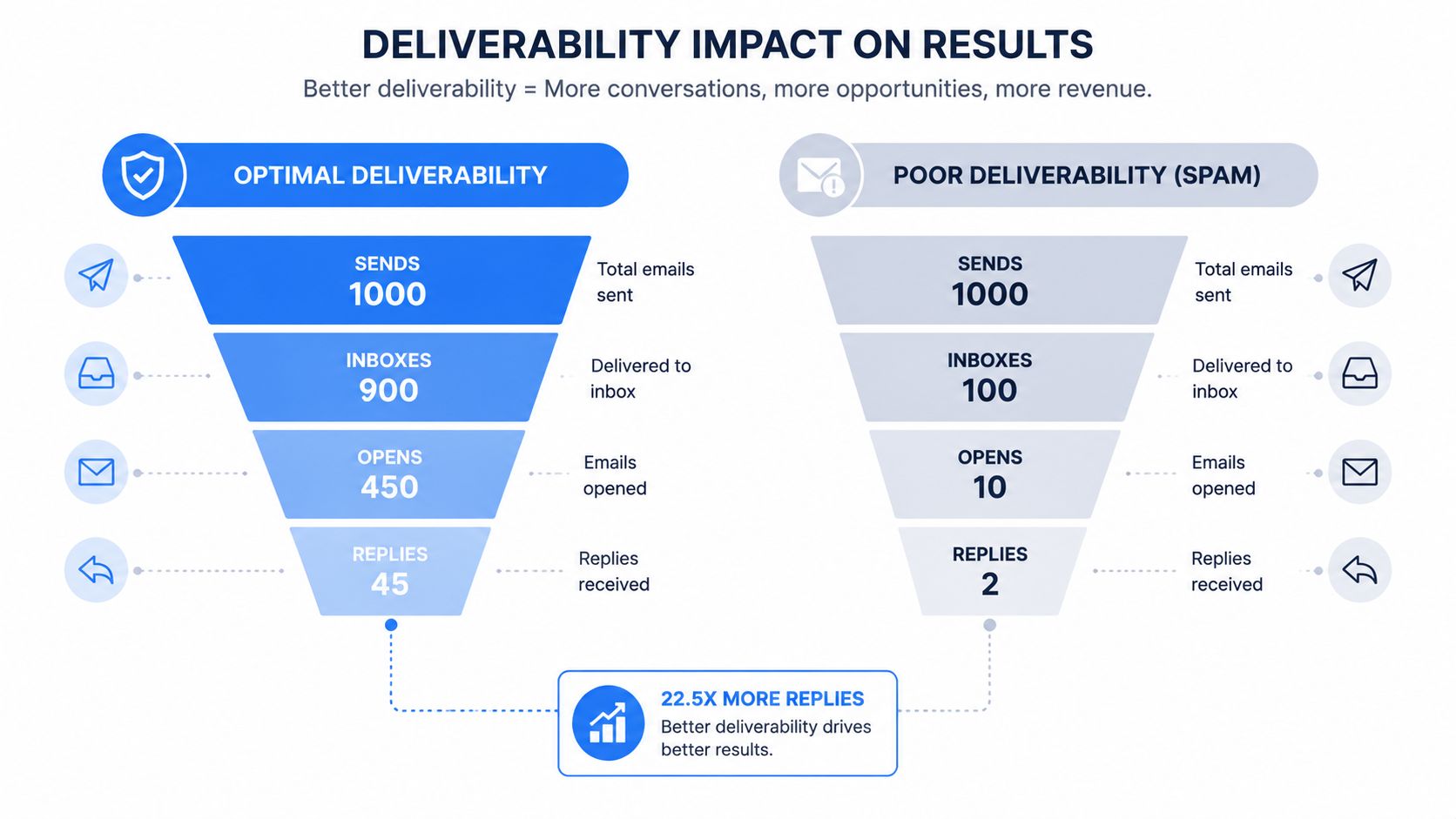
That is usually why one vendor books more meetings than another. The stronger operator is not just writing better copy, they are controlling the system that gets the message seen, read, and answered.
Vendor Evaluation Checklist and Red Flags to Avoid
A vendor call gets useful fast when you ask for the operating system, not the pitch. b2b appointment setting services live or die on deliverability, data quality, qualification, and handoff. If a provider cannot explain how those pieces work together, they are probably riding early campaign momentum rather than running a repeatable motion.
What to ask before you sign
- Deliverability ownership: Ask who creates and maintains domains, inboxes, warm-up, and rotation.
- Data sourcing: Ask whether lists are self-sourced, purchased, or scraped.
- ICP rigor: Ask for the exact criteria used to include and exclude accounts.
- Qualification framework: Ask whether they use BANT, MEDDIC, or a custom gate before booking.
- Pilot structure: Ask how the first 60 days are staged and measured.
- Reporting cadence: Ask how often you'll see positive replies, meetings, and SQLs.
- Calendar handoff: Ask what the seller receives before the meeting.
- Compliance process: Ask how they handle regional consent and privacy requirements.
- Creative ownership: Ask who owns the copy and the data after launch.
- Integration: Ask how the vendor connects with CRM, Slack, and calendar tools.
- Refund policy: Ask what happens to bad-fit or no-show meetings.
- Reference quality: Ask whether case studies include revenue movement, not just volume.
The red flags show up in the details. Guaranteed meeting counts with no ICP limits usually mean the vendor is optimizing for activity, not fit. So do undisclosed deliverability practices, third-party lists for every campaign, no client access to data, single-channel dependence, and pay-per-meeting deals with no show-rate or qualification gates. Those setups can fill a calendar and still leave sales with meetings that go nowhere.
A fast pressure test helps separate operators from storytellers. Run a 15-minute shortlist review this week. Ask each provider to walk one live campaign from list source to booked meeting, then make them show where deliverability, qualification, and handoff are controlled. If they cannot explain that path without hand-waving, keep looking.
Realistic 30-60-90 Day Expectations for a New Program
A new outbound program does not switch on all at once. It comes online in stages, and the first 30 days are usually infrastructure work, domain setup, warm-up, ICP and persona documentation, list building, sequence writing, and routing into CRM and Slack. If a vendor talks about meaningful pipeline before the plumbing is in place, that is a warning.
Days 31 to 60 are the ramp phase. Campaigns launch in waves, the first reply patterns show up, and the team starts tightening targeting, offers, and sequencing based on actual responses. That is the point where you see whether the vendor can iterate, or whether they only know how to launch.
Days 61 to 90 are the first honest read on business impact. By then, meeting flow should be visible, show rates should be settling, and the SQL count should be enough to estimate cost per qualified meeting with some confidence. Benchmarks for appointment setting typically put contact-to-meeting in the low single digits up to the low double digits, with show rates in the mid-60s to high-70s, so this is the right window to judge whether the motion is working.
The floor is simple. If a partner promises meaningful pipeline before day 60, they are either overselling or recycling meetings from an old list. A real system needs time to warm, learn, and compound.