Only 8.5% of cold emails got any response in a large 2019 outreach study covering 12 million emails, which means 91.5% were ignored (cold email statistics). That single gap explains why cold email lead generation fails when teams treat it like volume marketing instead of an engineered system. The winners don't just write better copy, they build better lists, protect deliverability, and design sequences that earn replies.
Why Most Cold Email Campaigns Fail
The average cold outreach program usually loses before the first reply ever has a chance to happen. Benchmarks show how tight the channel is, with reply rates often sitting in the low single digits, while stronger campaigns earn far more because they're built around precision, not broadcast volume (cold email statistics). When teams chase opens, clicks, or raw send counts, they miss the key bottleneck, which is whether the right person sees a relevant message in the inbox at the right time.
The three failures that break most campaigns
First, deliverability breaks. An email can be “sent” and still never reach the inbox, which is why delivery and inbox placement are not the same thing. A healthy-looking campaign can still underperform if filtering, reputation, or poor list hygiene keeps messages out of sight (email deliverability rates).
Second, targeting is usually too broad. A campaign aimed at “SaaS companies” or “manufacturers” sounds strategic, but it often lands as generic noise because the message doesn't reflect size, seniority, or operating context. The data-backed pattern is clear, the more segmented the audience, the better the response.
Third, sequence architecture is weak. A single send is rarely enough, because replies accumulate across follow-ups. In a 2026 benchmark report, 58% of replies came from the first email and 42% came from follow-ups, which means the sequence itself is part of the pipeline engine, not a reminder afterthought (Instantly benchmark report 2026).
| Cold Email Performance Benchmarks | Metric | Average Campaign | Top-Performing Campaign |
|---|---|---|---|
| Cold Email Performance Benchmarks | Reply Rate | 0.45% in a large high-volume dataset (cold email statistics) | 15% to 25% in benchmark guidance when targeting, personalization, and sequencing are tight (cold email response rates) |
| Cold Email Performance Benchmarks | Audience Fit | Broad lists | High-intent micro-segments |
| Cold Email Performance Benchmarks | Follow-up Dependence | Underused or inconsistent | Structured multi-step sequences |
A practical way to think about the channel is simple, cold email lead generation is a system of constraints. If the domain setup is shaky, the list is sloppy, or the message ignores the buyer's context, even strong writing won't save the campaign. For teams looking for tactical breakdowns, the how to guides collection is useful because it shows how process discipline usually beats isolated tactics.
Practical rule: fix the infrastructure and targeting before you argue about subject lines. Copy can improve a working system, but it can't rescue a broken one.
Engineering Deliverability and Domain Reputation
Deliverability is the part many teams underinvest in because it feels invisible. In reality, it decides whether your work lands in the inbox or disappears behind filters, and benchmark coverage shows that even when raw delivery looks healthy, inbox placement can still lag materially (email deliverability rates). That's why the sending stack has to be managed like infrastructure, not a one-time setup.
Authentication comes first
The first job is domain authentication. SPF, DKIM, and DMARC are the basic trust signals that let mailbox providers verify you're not spoofing or misrepresenting the sender. If those signals are weak or inconsistent, every other improvement becomes harder because reputation never stabilizes.
Then comes warming. New or restarted domains shouldn't jump straight into volume, because that creates suspicious patterns. A safer approach is to begin with a low daily send load, then ramp gradually while maintaining steady engagement and avoiding erratic spikes. The point isn't just to send more, it's to send in a way that looks normal to mailbox systems.
Monitor inbox placement, not just delivery
Many teams make a bad assumption. A message can be delivered and still not be placed in the inbox, which means open rates and replies can collapse even when the send logs look clean. Tools such as Mail-Tester and GlockApps are useful because they help separate delivery rate from inbox placement, and that distinction matters when campaigns scale.
The practical checklist is straightforward:
- Use secondary sending domains: Keep the primary brand domain protected when volume rises.
- Watch bounce behavior: Benchmark guidance treats keeping bounce rate under about 2% as a sane operating target, and separate deliverability reporting shows that overall bounce rates can still coexist with inbox-placement problems (email deliverability rates).
- Stay consistent: Irregular sending patterns make reputation harder to defend.
- Use seed tests: Check how messages behave across major inbox environments before ramping harder.
The technical side matters even more in high-volume programs. Benchmark guidance notes that senders crossing very large monthly volumes may need more deliberate infrastructure choices, including dedicated sending assets and careful reputation separation. That's why a company data workflow like what a company data API returns is useful in practice, because the quality of the data you enrich is only as good as the routing and segmentation decisions built on top of it.
Inbox placement is earned daily. A campaign that looks healthy in delivery reports can still be weak in the inbox if reputation gets sloppy.
Building Hyper-Targeted Prospect Lists
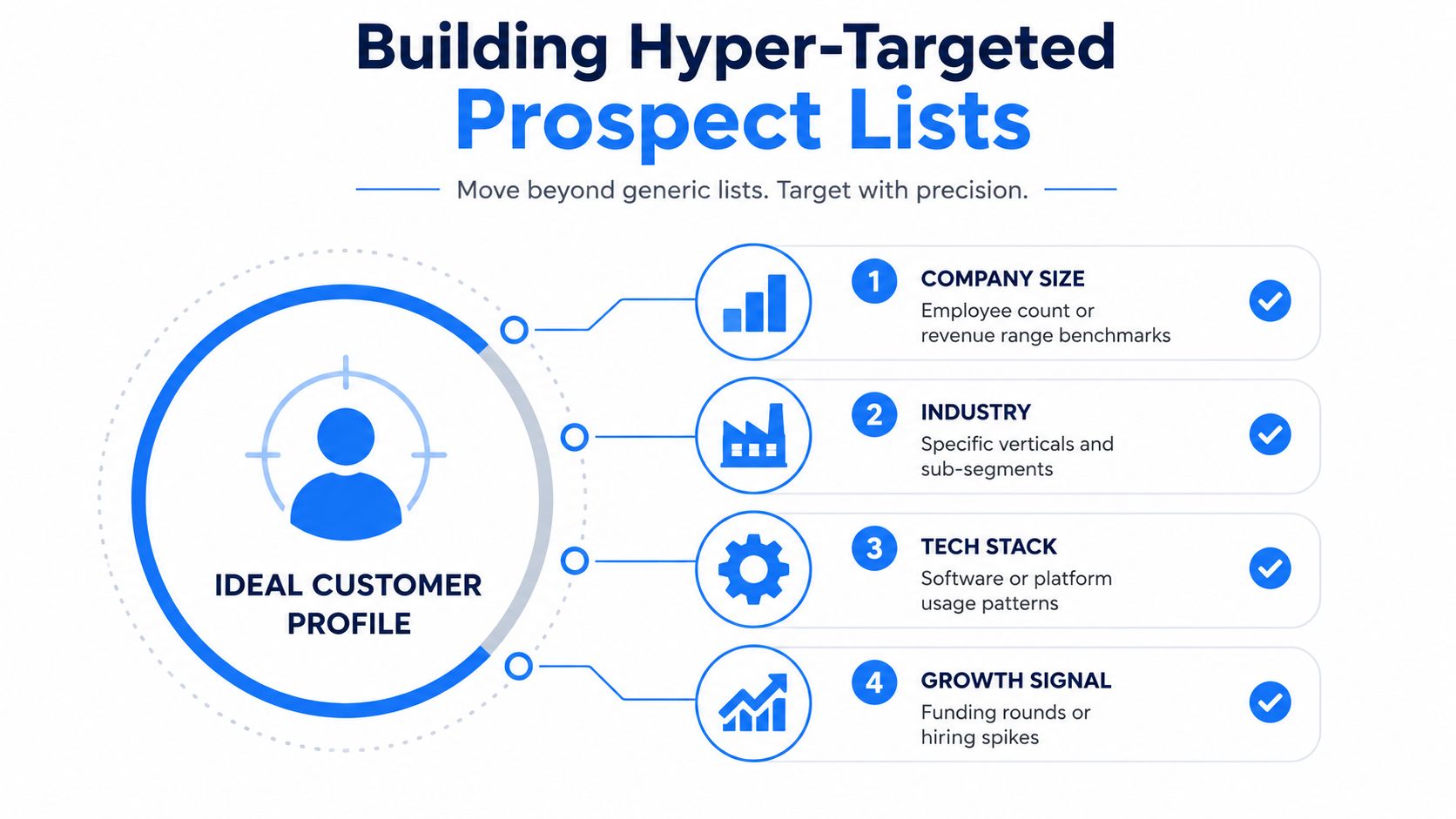
A strong list is more than a pile of contacts. It's a narrow definition of who should care, who can act, and who has enough context to reply without feeling like they were dropped into a generic sequence. The best-performing cold email lead generation programs build this layer first, then write copy that fits the segment instead of the other way around.
Start with a real ICP, not a broad market
The ideal customer profile should be specific enough to exclude most of the market. Company size is one of the most useful filters because it changes buying behavior, internal friction, and response likelihood. Benchmarks show that 11–50 employee firms replied at 0.49%, while 10,000+ employee enterprises replied at just 0.22% in one 2026 analysis (cold email statistics).
That doesn't mean large accounts are never worth pursuing. It means the message, timing, and follow-up logic must be different, because the buying process and inbox behavior are different. Role level matters too, since founders and owners replied at 0.57% in the same benchmark, which is a useful reminder that seniority is not just a title filter, it's a response-pattern filter (cold email statistics).
Enrichment turns a raw list into a usable segment
The data layer is where many programs either become sharp or stay vague. Tools like Apollo, ZoomInfo, and Clearbit help append job titles, contact details, and firmographic context, but the value comes from turning those fields into segment logic. A CTO at a scaling SaaS company doesn't care about the same problem as a plant operations lead at a manufacturer, even if both fit the same revenue band.
Use enrichment to build micro-segments around:
- Company size: Small, mid-market, or enterprise, because the operational pain is different.
- Role: CTO, VP Engineering, founder, operations lead, or procurement.
- Tech stack: Existing tools often reveal whether the prospect is a fit or a poor match.
- Trigger signals: Hiring spikes, funding activity, or a change in leadership.
A clean list also needs hygiene. Verify addresses, remove duplicates, and manage suppressions carefully so you don't keep hitting people who already replied, unsubscribed, or disqualified themselves. That kind of list discipline reduces waste and protects reputation.
Practical rule: 1,000 tightly enriched prospects usually outperform 10,000 generic contacts because reply quality is driven by fit, not list size.
If you want a deeper operational view of the data layer, the publisher's workflow for cold email campaign services covers how infrastructure, enrichment, and segmentation fit together in one system. The point isn't to chase more contacts, it's to make every contact easier to justify.
Designing Sequences That Actually Get Replies
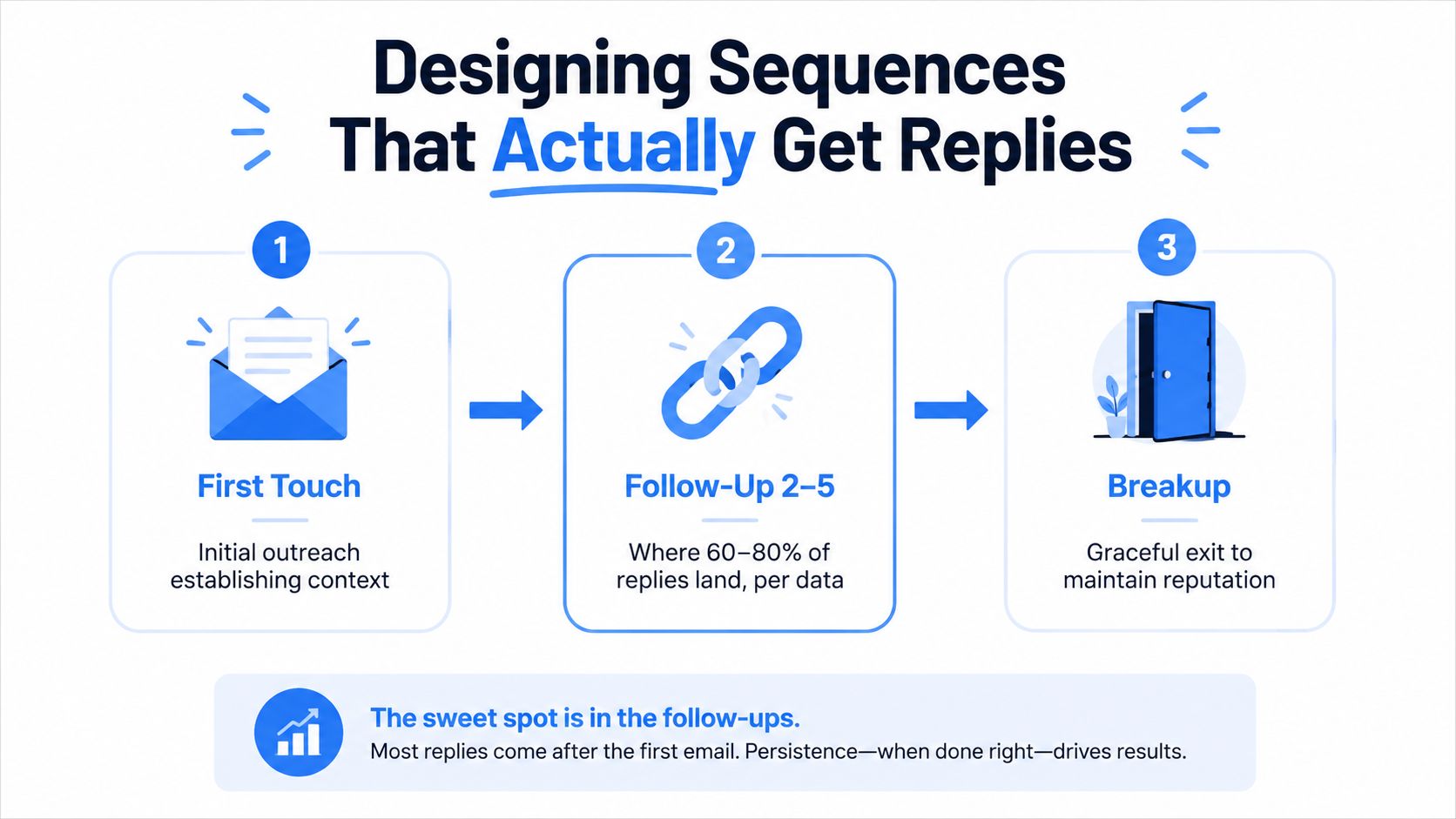
The sequence is where cold email stops being a one-shot pitch and starts behaving like a conversation. A 2026 benchmark report found that 58% of replies came from the first email and 42% came from follow-ups, which makes cadence design a core growth lever rather than a housekeeping task (Instantly benchmark report 2026). A sequence that feels repetitive won't help, but a sequence that adds context each time will.
Build the first touch to earn permission, not pressure
The opening email should do one thing well, create enough relevance for the reader to continue. That means tying the message to a real business signal, not stuffing the email with features. If the prospect recently hired, changed tools, or expanded into a new market, lead with that context and show why it matters.
Subject lines matter, but they're not the main event. The body should be concise, specific, and easy to answer. A low-friction CTA works better than a heavy meeting request because it gives the recipient a way to respond without committing to a calendar slot immediately.
Use follow-ups to add new information
Follow-ups should not feel like a reminder loop. Each one needs a different angle, maybe a new proof point, a different pain point, or a tighter use case for that role. This is especially important in manufacturing and SaaS, where the same buyer may need to see the problem framed from operations, cost, or workflow risk before they respond.
A simple sequence architecture usually works better than a crowded one:
- Initial outreach tied to a relevant trigger.
- Follow-up that adds a new reason to reply.
- Second follow-up with a narrower use case.
- Final breakup note that exits cleanly and protects brand tone.
The internal handoff matters too. If a reply says, “Send details,” that's not a win yet, it's a request that needs fast handling. A practical reference on response-writing and sequence closure is the guide on how to close an email, because even small wording choices affect how likely a thread is to continue.
Good sequences don't nag. They reframe the same opportunity from slightly different angles until the buyer recognizes themselves in the problem.
Personalization should be strategic, not ornamental
First-name merge tags don't count as personalization. Real personalization uses context, such as tech stack, geography, industry subsegment, or a hiring pattern, then ties the ask to a concrete pain. Overdoing it at scale can slow execution, so the better move is to personalize the first line and the value proposition, then keep the rest of the structure consistent.
The mistake many teams make is trying to sound custom in every sentence. That usually creates bloated emails that read like research notes. The better approach is targeted relevance, not theatrical specificity.
Testing and Optimizing for Meetings Not Opens
Open rates can be seductive because they're easy to watch and easy to inflate with clever subject lines. They're also a poor north-star metric if the goal is pipeline, not curiosity. The optimization work happens lower in the funnel, where replies, positive replies, meetings, and show-up behavior reveal whether the campaign is working.
| Cold Email KPI Hierarchy | Metric | What It Measures | Pipeline Correlation | Optimization Priority |
|---|---|---|---|---|
| Cold Email KPI Hierarchy | Open rate | Subject line and basic deliverability signal | Weak | Low |
| Cold Email KPI Hierarchy | Reply rate | Whether the message triggered any response | Medium | High |
| Cold Email KPI Hierarchy | Positive reply rate | Whether the response shows real interest | High | Very high |
| Cold Email KPI Hierarchy | Meeting-set rate | Whether interest converted into booked time | Very high | Very high |
The first tests should usually be simple. Subject lines, send times, CTA types, and body length are the easiest variables to isolate without muddying the result. But the test only matters if the sample is large enough to avoid false confidence. Declaring a winner after a tiny run is one of the fastest ways to lock in a bad pattern.
A better habit is to test in the order of impact:
- Targeting first: If the list is wrong, copy tests won't matter much.
- Offer second: If the pain is vague, the response will be weak.
- Sequence third: If the first touch is okay, follow-up structure can lift performance.
- Copy last: Only after the above are stable does wording become the main lever.
One trap worth avoiding is overreacting to a weak open rate while the reply quality is improving. A subject line that attracts the wrong curiosity can raise opens and hurt meetings. Optimization should always follow the metric that sits closest to revenue, not the one that's easiest to screenshot.
Qualifying Leads and Managing Inbox Handoff
A reply is only the start of the sales process. If the response sits too long, gets mishandled, or lands with the wrong owner, the value of the campaign decays fast. The handoff from inbox to qualification to meeting is where many teams lose the ROI they worked hard to create.
Separate real interest from polite noise
Not every reply deserves the same treatment. A quick BANT-lite pass helps classify responses into serious, maybe later, not now, or not a fit. That saves the SDR team from chasing low-quality replies and keeps the pipeline cleaner.
Common reply buckets include:
- Clear interest: Wants more information, pricing, or a meeting.
- Timing issue: Interested but not now.
- Wrong contact: Useful because it helps reroute the conversation.
- Soft brush-off: Polite but not engaged.
The fastest way to lose momentum is slow response handling. A reply that waits in an inbox for days becomes colder by the hour, and the prospect's intent drops. That's why the handoff between SDR and AE needs a clear service level expectation, so nobody assumes someone else picked it up.
Keep compliance and attribution tight
For EU outreach, GDPR discipline matters. Legitimate interest needs to be documented, opt-outs need to be honored quickly, and retention should be controlled. Multichannel campaigns also need attribution rules so the same person doesn't get duplicated across email, LinkedIn, and phone.
That coordination becomes especially important when outreach volume rises. A reply on one channel can invalidate another sequence if the team doesn't sync suppression logic properly. Internal process quality matters as much as messaging quality here.
The qualification layer is also where a practical tool stack helps. A working reference on the topic is what lead qualification means, because qualification isn't just a sales concept, it's the boundary between created interest and real pipeline.
Practical rule: if the reply isn't categorized and handed off within the team's process, it isn't pipeline yet.
Tracking KPIs and Proving ROI
The channel only earns budget when leadership can see how it turns sends into meetings and meetings into revenue. That means tracking the full stack, not just one or two vanity metrics. The reporting layer should show whether the engine is healthy at every stage, from inbox placement through to closed-won deals.
| Cold Email KPI Framework | KPI | Benchmark Range | Why It Matters |
|---|---|---|---|
| Cold Email KPI Framework | Reply rate | 0.45% in one large high-volume benchmark, with broader B2B ranges often cited around 1% to 5% (cold email statistics, cold email response rates) | Shows whether the message and targeting are resonating |
| Cold Email KPI Framework | Positive reply rate | Not standardized in the verified data | Separates real interest from noise |
| Cold Email KPI Framework | Meeting-set rate | Not standardized in the verified data | Shows whether interest turns into sales motion |
| Cold Email KPI Framework | Inbox placement | Lower than raw delivery when filtering intervenes (email deliverability rates) | Confirms the audience actually sees the message |
| Cold Email KPI Framework | Bounce rate | Keep it under about 2% as a practical operating target (email deliverability rates) | Protects reputation and list quality |
The cleanest ROI readout includes tooling, data enrichment, SDR time, and the ramp period before performance stabilizes. The program usually needs enough time to normalize before leadership makes hard calls, because cold outreach performance is shaped by sequence behavior, list quality, and deliverability discipline all at once. If one layer is weak, the whole funnel looks worse than it really is.
A good dashboard doesn't hide the bad news. It shows where the leak is, whether that's inbox placement, targeting, replies, or meeting conversion. That way, teams can fix the bottleneck that matters instead of celebrating an open rate that never became pipeline.
If you want a team that builds cold email lead generation around infrastructure, data enrichment, and sequence logic instead of generic blasts, visit Lead Printer. They build and run outbound systems that connect prospect research, deliverability, personalized sequences, and handoff workflows into one process.