Most advice on customer acquisition strategy B2B starts in the wrong place. It obsesses over channels, tactics, and content volume, then treats more leads as proof that the program is working. In practice, that's how teams end up with busy inboxes, weak handoffs, and pipeline that looks active but doesn't close.
The better starting point is pipeline economics. Across SaaS, the median New Customer CAC Ratio increased 14% in 2024 to $2.00, which means companies are now spending $2 in sales and marketing to acquire $1 of new ARR. Independent summaries also say B2B and SaaS acquisition costs are up 60% over five years and 222% over eight years (customer acquisition statistics). When acquisition gets this expensive, the key question isn't which channel produced the most replies. It's which channel produced the highest share of sales-accepted opportunities and downstream revenue.
Why Most B2B Acquisition Programs Underperform
The most common mistake is measuring activity instead of outcome. A team can celebrate replies, form fills, and booked meetings while sales rejects the bulk of them or stalls them after first contact. That's not acquisition. That's motion.
The economic pressure shows up fast when lead quality is weak. One benchmark compilation reports that 68% of B2B companies struggle to generate high-quality leads, and 61% of B2B marketers say generating traffic and leads is their biggest challenge (B2B client acquisition statistics). The same source says the average B2B lead takes 84 days to convert, and only 27% convert within 30 days. That's why programs that depend on one-touch outbound or a single download-to-demo path tend to look better in dashboards than they do in revenue.
The unit that actually matters
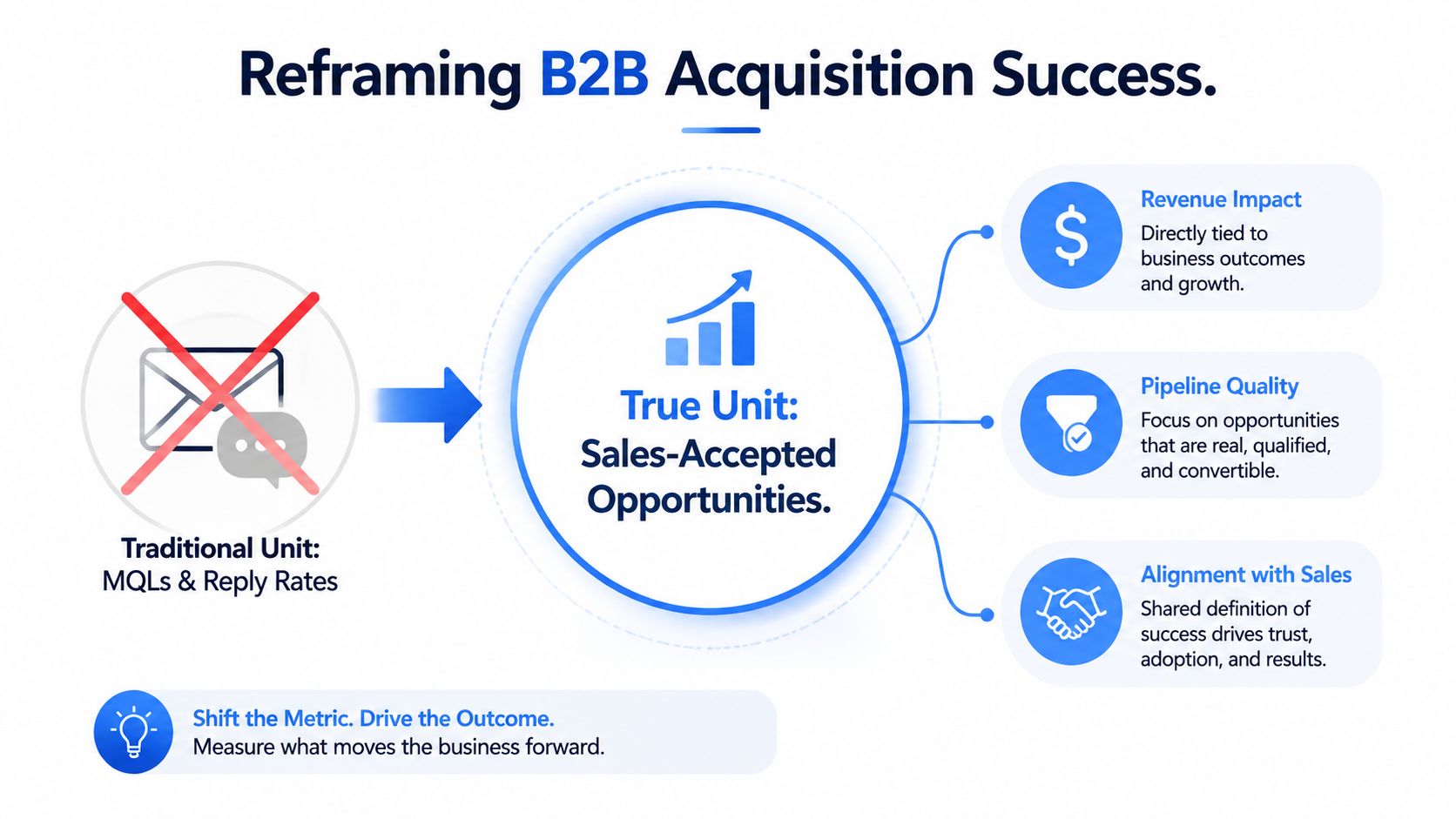
The healthiest programs treat sales-accepted opportunities as the primary checkpoint. Meetings are only useful if sales wants them, qualification is only useful if it predicts pipeline, and pipeline is only useful if it becomes revenue. That's why the same channel mix can produce radically different results across two companies.
Practical rule: if sales wouldn't be happy to see five more of that lead type tomorrow, the channel isn't healthy, even if the reply rate looks good.
The operating model matters more than the channel list. Segmentation discipline, qualification logic, and handoff quality determine whether spend compounds or evaporates. For readers looking at broader channel ideas, B2B lead generation tactics can be useful, but the primary filter is whether those tactics produce accepted opportunities, not just activity.
Building the ICP and Segmentation Foundation
A tight ICP isn't a branding exercise. It's the mechanism that makes personalization possible without destroying time or consistency. If the target list is vague, every channel becomes generic, and generic B2B outreach usually produces polite silence or unqualified interest.
Start with account-level filters
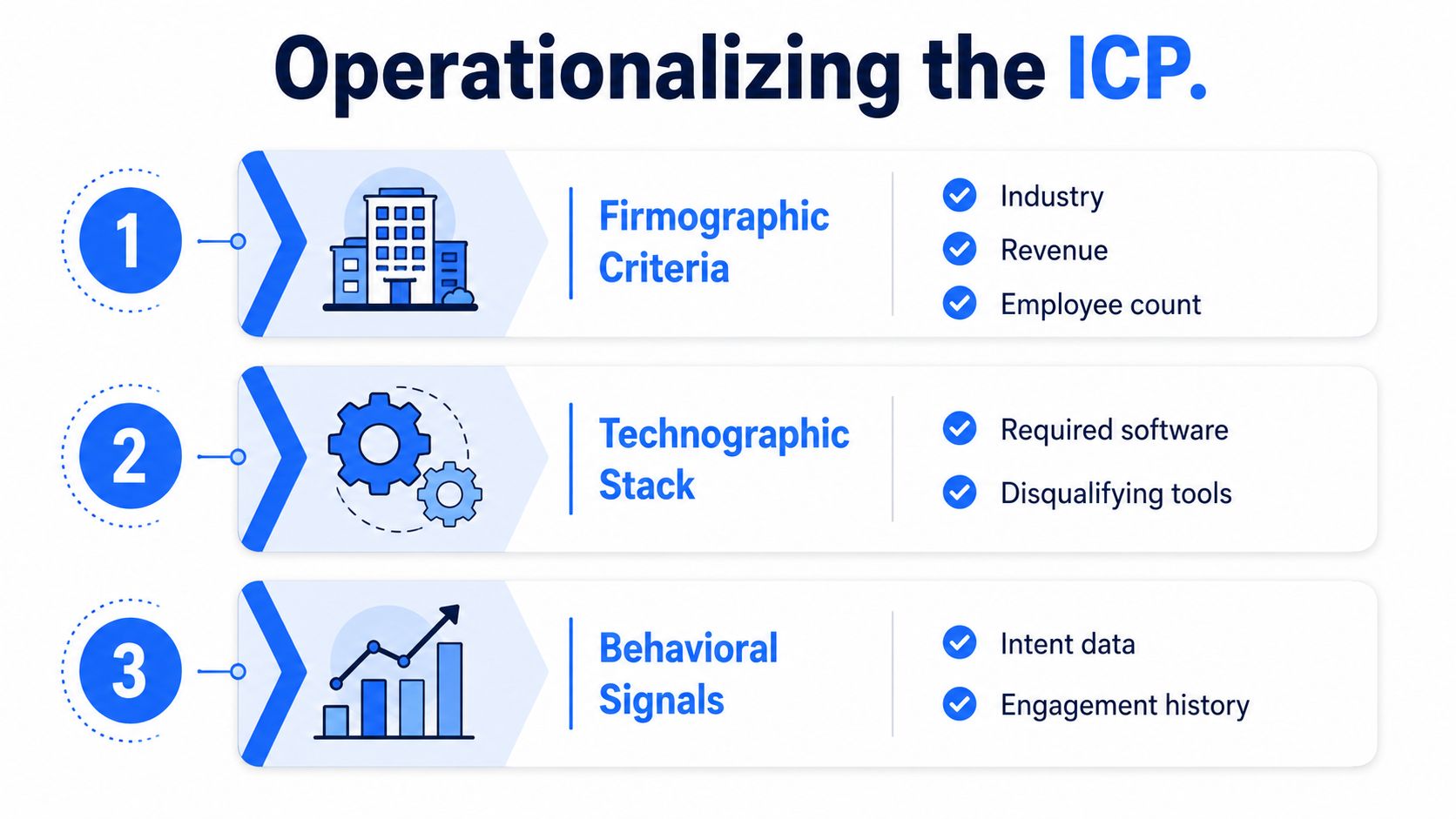
The first layer is firmographic criteria. Decide which industries, company sizes, and geographies are worth working. Then map the buying committee, because the decision-maker and the day-to-day user rarely care about the same pain points. A broad “mid-market SaaS” label does not give a rep enough signal to write a good first line.
Add technology and behavior
Next comes the technographic stack. Which tools must be present, which tools disqualify the account, and which stack combinations imply urgency? That layer is what lets messaging move beyond “we help companies like yours” and into something that sounds informed.
Then add behavioral signals. That includes intent data, repeated site engagement, and prior content interaction. Those signals tell you when to accelerate and when to stay quiet. A list without behavior is just a spreadsheet.
Use segmentation that changes the message
Shallow segmentation stops at industry. Useful segmentation goes deeper and supports distinct sequences by role, pain level, and stage. The point isn't to create more segments for their own sake. It's to make the messaging believable enough that the buyer feels the email or ad was written for their situation.
A simple checklist helps keep this practical:
- Firmographic fit: The account matches the size, market, and geography you can serve.
- Role clarity: The list separates economic buyers, operators, and influencers.
- Stack relevance: The account uses or lacks tools that affect the pitch.
- Behavioral evidence: There's real buying intent, not just list freshness.
- Sales usability: Reps can explain why the account belongs in the sequence.
For teams building the offer and list together, Lead Printer's B2B SaaS page is a useful reference point for how segmentation and outbound planning fit into one workflow.
Outbound Engine, Domains, and Deliverability
Outbound burns budget when infrastructure is treated as an afterthought. The best copy in the world can't fix a sender reputation problem, and a strong list can't overcome a weak warm-up process. At scale, deliverability is a direct CAC lever because it determines how much of your outreach reaches a human being.
Build the sending system before the sequence
The first job is domain authentication and reputation protection. That means the sending environment has to be set up so inbox providers trust the traffic. After that comes inbox warm-up, which should be gradual rather than aggressive. If a team jumps too fast, it can damage the very domain it plans to use for months.
Then comes list hygiene. Verified contacts, clean data, and sensible exclusion rules matter more than many teams want to admit. The hidden cost in outbound is wasted rep time spent chasing unverified or low-quality contacts, which increases CAC by consuming capacity instead of creating opportunities (B2B customer acquisition and deliverability).
Sequence across channels, not just inboxes
A working outbound motion rarely lives in email alone. It usually combines email, LinkedIn, and supporting content so the buyer sees the same idea more than once without feeling spammed. That matters especially in the US, UK, and EU, where inbox saturation and trust barriers are high.
A sequence should feel coordinated, not repetitive. If the second touch says the same thing as the first, the buyer learns to ignore both.
Testing matters too. Good teams don't rewrite everything at once. They test the subject line, the opening angle, the proof point, or the call to action, then watch which version brings in better-fit replies. The goal isn't just to increase response. It's to improve the share of replies that become qualified meetings.
For teams that want a done-for-you operational layer, Lead Printer's agency service page shows how prospecting, sequence design, and handoff can sit inside one outbound system.
To see how the moving parts fit together, this short walkthrough is useful.
Inbound, Content, and Compounding Demand
Outbound creates speed. Inbound compounds. The strongest acquisition programs use inbound to make future outbound cheaper, more credible, and easier to hand off.
Use inbound for intent, not applause
SEO and programmatic pages work when they answer buyer questions that already exist. If the content is built around search intent and commercial intent, it can feed qualified traffic into the funnel for a long time. If it's built around vague thought leadership, it often earns impressions without helping sales.
Original research and expert content serve a different role. They help a team shape the category, create citations for outbound, and give sales something concrete to reference in follow-up. Community-led growth works when the buyer already spends time in a niche space and trusts peer conversation more than brand messaging.
Route traffic into qualification flows
The biggest mistake is sending all that attention into a dead-end download. A good inbound system routes visitors into a next step that separates curiosity from buying intent. That can be a live demo request, an assessment, or a role-specific resource that leads to qualification.
If the internal team doesn't have the bandwidth to structure those automations properly, hiring a marketing automation agency is sometimes more efficient than adding scattered tools and hoping they connect themselves.
Practical rule: content should earn the right to start a sales conversation, not replace it.
Inbound also needs patience. It usually won't fix this quarter's pipeline gap, but it can lower future acquisition pressure by creating a steady layer of warmed-up demand. That's why the right question isn't “How much traffic did this page get?” It's “Did this asset help create assisted pipeline, or did it just attract readers?”
Paid Acquisition and Partnership Channels
Paid and partnerships sit between speed and compounding. Paid is fast to launch and easy to control, but it usually demands constant spending. Partnerships take longer to build, but they can fit a more efficient acquisition model once the relationship works.
Choosing the channel by sales-cycle fit
LinkedIn Ads, Google Brand, Google Competitor, and retargeting all play different roles. LinkedIn is useful when the buyer needs to be targeted by role or company profile. Google Brand captures demand already looking for you. Competitor search can intercept comparison traffic. Retargeting helps keep a known account in motion after the first visit.
Partnerships are different. Integrations, co-marketing, affiliate programs, and reseller arrangements work best when both sides already have overlapping audiences and a clear reason to trust each other. The risk is spending months on a partnership that never becomes operational.
| Channel | Typical Cost Profile | Best Sales Cycle Fit | Best Use Case |
|---|---|---|---|
| LinkedIn Ads | Higher cost, controlled targeting | Longer, consultative sales cycles | Role-based awareness and retargeting |
| Google Brand | Lower cost when demand already exists | Short to medium cycles | Capturing existing intent |
| Google Competitor | Variable, often expensive | Buyers already comparing options | High-intent comparison traffic |
| Retargeting | Usually efficient for repeat exposure | Any cycle with repeat visits | Re-engaging warm accounts |
| Integrations | Setup-heavy, then efficient | Longer cycles with product overlap | Embedded distribution |
| Co-marketing | Shared effort, lower cash spend | Medium to long cycles | Access to a warm audience |
| Reseller or affiliate | Relationship-driven | Longer cycles and repeatable demand | Channel extension and reach |
The decision rule is simple. Choose one paid channel that matches how your buyer researches, then choose one partnership bet that gives you access to a qualified audience you don't already own. Spraying budget across everything usually creates reporting noise, not pipeline.
Measuring Acquisition Beyond Cost per Lead
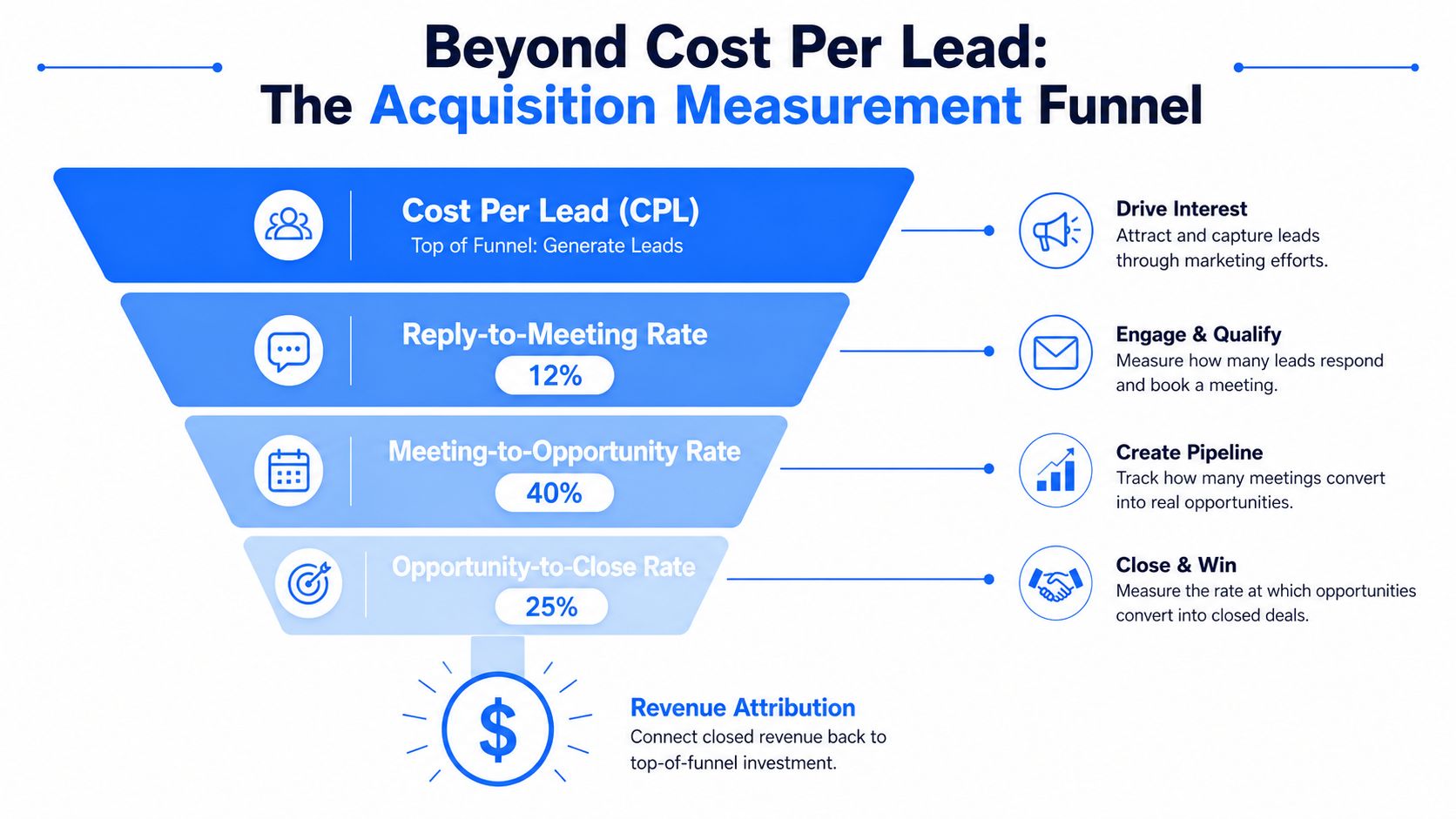
Cost per lead is too shallow to guide a real B2B program. It can tell you that something is cheap, but not whether that something becomes a real opportunity. Once a team starts tracking the full funnel, a lot of “successful” campaigns stop looking successful.
Track the handoff, not just the click
The measurement stack should include reply-to-meeting rate, meeting-to-opportunity rate, opportunity-to-close rate, pipeline velocity, and channel payback. Those metrics show where the leak is. A channel that creates replies but no accepted opportunities is a copy problem, a targeting problem, or both.
Keep attribution honest
Attribution is useful only if the data is clean enough to trust. In many organizations, disciplined source tagging and post-sale surveys are more reliable than a complicated attribution model that everyone argues with in every review. The point isn't perfect truth. It's decision-quality truth.
For teams that want a practical way to model these trade-offs, Lead Printer's ROI calculator is a useful internal benchmark tool for thinking about pipeline contribution rather than raw lead count. For analytics infrastructure more broadly, it also helps to compare tools that can handle source tagging and reporting cleanly, which is where Captapi's top analytics picks can save a team some time.
Weekly reporting should answer one question, which channel is creating qualified movement right now? Quarterly reporting should answer a different one, which channel is actually worth more budget?
If a campaign produces meetings but the opportunity stage stays empty, it's not a good campaign. It's an expensive way to create calendar activity.
Sequencing Channels Into One Operating System
Channels fail when they're run as separate projects. The SDR team sends email, marketing publishes content, paid media runs ads, and partnerships sit in a spreadsheet. Buyers experience one company, not four departments, so the motion has to feel coordinated.
The cleanest operating system separates demand creation from demand acceleration. Cold outbound and paid ads create visibility and identify intent pockets. Inbound, retargeting, and partnerships accelerate people who already showed interest. That distinction keeps teams from forcing every channel to do every job.
Build the handoff between functions
The handoff matters as much as the touchpoint. SDRs need a clear qualification model. AEs need to know which signals make an opportunity worth pursuing. Marketing needs closed-loop feedback so it can adjust copy, segment definitions, and asset choice.
A simple operating rhythm works better than a complicated one. Campaign data should move back into the ICP, into the list criteria, and into the message library. That way the program gets sharper every cycle instead of just busier.
The strongest programs don't look omnichannel because they use every channel at once. They look omnichannel because every touch has a job.
Pipeline economics become operational when the team knows which touches create accepted opportunities, allowing it to sequence the next ninety days around what the market already proved. That's a better system than chasing whatever tactic looks fashionable in the current quarter.
A 90-Day Plan and the Mistakes That Sink It
Weeks one through four should focus on setup, not volume. Tighten the ICP, define the buying roles, build the list, and confirm the outbound infrastructure. If the foundation is loose, later metrics won't be meaningful because the wrong accounts will distort everything.
Weeks five through eight are for launch and iteration. Send the first sequences, review which segments respond, inspect where meetings turn into real opportunities, and cut the worst-performing angles quickly. At this point, the goal is learning speed, not scale.
Weeks nine through twelve are for expansion and pruning. Increase volume only in the segments that are producing accepted opportunities, and retire anything that creates noise without creating pipeline. Capture the learnings in a shared playbook so the team doesn't forget what worked.
The usual failure modes are easy to spot:
- Vanity metrics: The dashboard looks healthy, but sales isn't accepting the leads.
- Channel hopping: The team abandons a channel before it has enough data to prove anything.
- No qualification model: Meetings are booked, but nobody can explain why they matter.
- Deliverability neglect: The sender domain gets damaged, and outbound gets slower without anyone noticing.
- Fake localization: Translation is treated as market adaptation, so the message lands flat in the UK or EU.
If week one is done right, the team should have a clean ICP, a verified list, a protected sending environment, and one simple way to score opportunity quality. That's enough to start.
Lead Printer builds and runs outbound systems that focus on qualified opportunities, not just activity. If you're working through an customer acquisition strategy B2B and need better list quality, deliverability, sequencing, and pipeline reporting, visit Lead Printer to see how the process is structured for US, UK, and EU campaigns.