You're probably staring at the same problem a lot of SaaS teams hit. Pipeline looks fragile, SDR output feels inconsistent, and the question isn't whether outbound matters, it's whether you should keep building it in-house or hand it to an agency that can run the motion without turning it into a meeting-booking mill.
The wrong way to buy an outbound lead generation service for B2B SaaS is to ask, “How many meetings can you get us?” The right way is to ask, “Can you create durable pipeline, prove it in CRM, and keep the economics sane?” That shift matters because the category has grown into a real market, not a side hustle. One industry estimate puts the global lead generation services market at $4.1 billion in 2022 and projects $9.9 billion by 2028, with a 17.5% CAGR. It also says 60% of B2B companies outsource at least some lead generation activity, while outsourced lead gen can produce about 33% more leads and reduce cost per lead by 43% on average versus in-house SDR operations, according to the same benchmark set in the brief. For SaaS buyers, that's the context.
| Buying question | Bad answer | Good answer |
|---|---|---|
| What are we really buying? | “Booked meetings” | Revenue-linked pipeline |
| What's the failure mode? | Vanity activity | Clean meetings that never convert |
| What should prove value? | Reply screenshots | CRM attribution and held meetings |
| What decides the fit? | Agency polish | ICP quality, reporting, and execution |
The Buying Decision Behind Every Outbound Engagement
A founder or growth lead doesn't shop for outbound because they want more email in the world. They shop because the forecast is shaky, the SDR team is underused, or the next region looks promising and nobody has time to validate it properly. That's the decision, build, buy, or do both.
The best buyers start by naming the constraint. If the issue is deliverability and data hygiene, an agency can solve that faster than a brand-new internal team. If the issue is still message-market fit, an in-house SDR sitting next to the founder may be more useful because you want raw market feedback, not polished reports.
What the buyer should decide before the first call
You need to know which of these jobs the partner must own. ICP definition, infrastructure, list building, outreach, qualification, reporting, or all of it. If you don't decide that up front, the agency will happily sell you the part of the motion that's easiest to demo.
Practical rule: buy the smallest outbound system that can still prove pipeline, not the biggest one that sounds impressive.
That's why this article is organized around decision points, not vendor hype. One section defines the actual deliverables. Another separates engagement models. Another shows how to inspect SLAs and case studies so you can spot the difference between competent operators and send-volume vendors before you sign anything.
What an Outbound Lead Generation Service Delivers
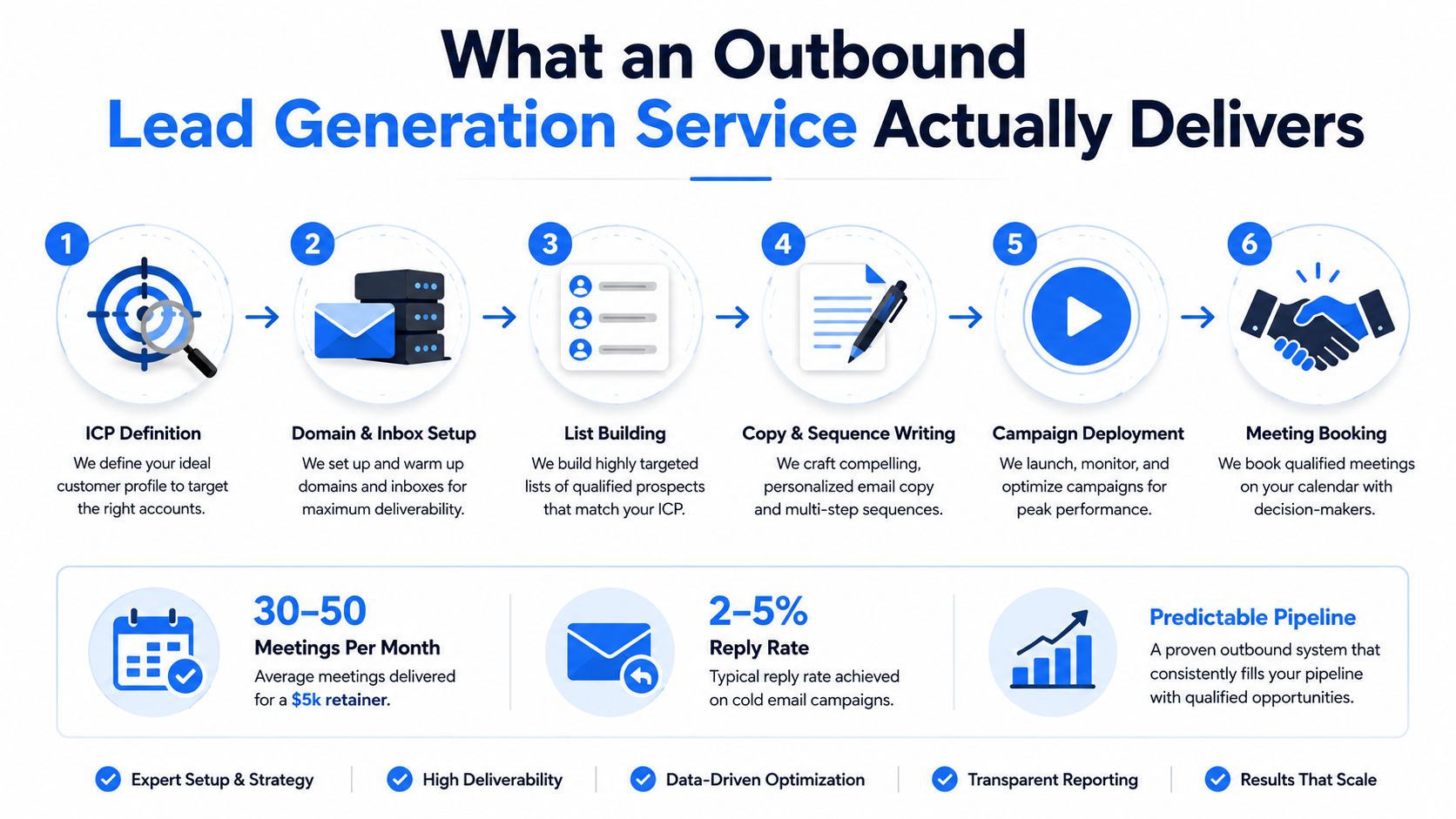
A serious agency does more than send email. It builds the operating system that makes cold outreach work without wrecking your domain, your list, or your team's time. That means ICP definition, prospect research, list building, enrichment, segmentation, copywriting, sequencing, testing, qualification, handoff, and reporting.
The better operators also own the unglamorous work. They set up domains and inboxes, handle warm-up, monitor deliverability, and manage inboxes so the campaign stays healthy. Those details matter because the market rewards precision and technical discipline, not raw volume.
What you are outsourcing
A competent agency usually owns a sequence like this:
- ICP definition and segmentation, so the list is built around the right accounts and titles.
- Infrastructure setup, so the campaign starts with clean sending systems and a stable sender reputation.
- List sourcing and enrichment, often with tools like Clay, Apollo, ZoomInfo, and LinkedIn Sales Navigator.
- Personalized sequence writing, where the message matches role, geography, and context.
- Multichannel orchestration, usually email plus LinkedIn, sometimes phone.
- Qualification and handoff, so sales receives meetings that are worth taking seriously.
That is a different job from inbound. Inbound compounds over time, but early-stage SaaS often does not have the traffic, authority, or patience for that to carry the quarter. Outbound makes sense when you need pipeline faster, you know your ICP, and you do not have the deliverability or data stack in-house to run it properly.
The in-house version is not free just because you pay salary instead of a vendor invoice. The brief estimates an in-house SDR at $68,000 to $95,000 per year in total employment costs, while outsourced lead-gen virtual assistant models can run $1,200 to $2,400 per month. Those figures do not mean outsourcing is always cheaper, but they explain why many SaaS teams buy the top of funnel first and keep closing in-house.
If you are comparing tools and automation layers around this motion, browse AI lead generation platforms is a useful way to see how the stack has shifted toward enrichment and orchestration.
Why SaaS Companies Are Outsourcing Pipeline at Scale
A SaaS team does not outsource pipeline because it wants less control. It outsources because the internal motion is too slow, too expensive, or too inconsistent to support the quarter. Once you are under pressure to create qualified demand now, outbound stops being a backup and becomes a working part of the revenue plan.
The economics explain why this keeps happening. The lead generation services category is already a large services market, and 60% of B2B companies outsource at least part of lead generation. That is a sign that teams are buying execution where they need speed, coverage, and repeatability, instead of trying to build every function in house before they can move.
Why outsourcing keeps winning budget
For B2B SaaS, outbound wins budget when it solves several problems at once. It can speed up pipeline creation, reduce the burden of building a full SDR stack internally, and give you a cleaner way to test new regions or segments without committing to a full hire. It also fits complex sales cycles, where the buying group is larger and the message has to reach more than one person.
That matters because the buyer side is messy. Gartner's 2024 research, as cited in the brief, says B2B purchase decisions typically involve 6 to 10 stakeholders, and 77% of buyers describe their most recent purchase as complex or difficult. Agencies that sell outbound like it is a one-reply process are selling you fiction. You need sequencing, persistence, and a qualification process that understands committee buying.
Benchmarks also show why the motion has to be designed well. A 2024 benchmark cited in the brief says only 13% of marketing-qualified leads convert to sales-qualified opportunities across B2B SaaS, based on 5,500 sales professionals across 27 countries surveyed from February to April 2024. That is the filter. Meetings and replies are only useful if they turn into pipeline, and that is where weak operators get exposed.
The better agencies report on revenue movement, not just booked calls. Ask how they define qualification, how they route handoffs, and how they connect activity to pipeline in CRM. If you want a quick way to evaluate vendor quality before a sales call, use Lead Printer's agency directory to compare operators, then compare AI lead generation platforms on tooling and orchestration separately, because software can support the motion but it does not replace a team that knows how to run it.
Comparing the Main Engagement Models for SaaS
Outbound contracts change the risk profile. A monthly retainer gives you predictability and room to iterate. A per-lead model pushes more volume risk onto the agency. A performance hybrid looks safer on paper, but it still rewards bad bookings if the qualification bar is loose. An embedded pod behaves like an internal team, but you still need agency-level control over process and reporting.
| Model | Cost Predictability | Incentive Alignment | Best-Fit SaaS Stage |
|---|---|---|---|
| Monthly retainer | High | Moderate to high if SLAs are tight | Early to growth stage |
| Per lead or per meeting | Medium | Can drift toward volume over quality | Only if qualification rules are very clear |
| Performance hybrid | Medium | Strong on paper, weaker if definitions are loose | Growth stage with enough pipeline history |
| Embedded pod | High | Strong when reporting and CRM ownership are real | Growth to scale stage |
A retainer is the cleanest default if you care about stable execution and room to adjust the motion. You are paying for pipeline work, not just booked calls. That lets the agency test lists, messaging, and channels without pretending every campaign should be judged only by meeting count.
Which model usually fails first
Per-lead pricing breaks first when the agency chases easy bookings. The calendar fills, but sales rejects the calls because the prospects do not fit the ICP or the problem is weak. Performance hybrids can fall into the same trap if “qualified opportunity” is left vague.
Embedded pods make sense when you want external operators who work like an internal team. They fit best when your ICP is stable, the message is already validated, and you need execution depth instead of another strategy deck. They also work well when you are comparing agencies and need a faster way to shortlist credible operators, which is why a directory like Lead Printer agency directory can help you separate serious providers from send-volume vendors.
Use this rule: if the agency cannot explain how it blocks low-quality bookings, the pricing model is already broken. The model will not save you.
SLAs, Deliverables, and Reporting You Should Require
The contract is where competent operators separate themselves from send-volume vendors. The deck can look polished. The SLA tells you whether they will run a pipeline function or just spray prospects and hope something lands.
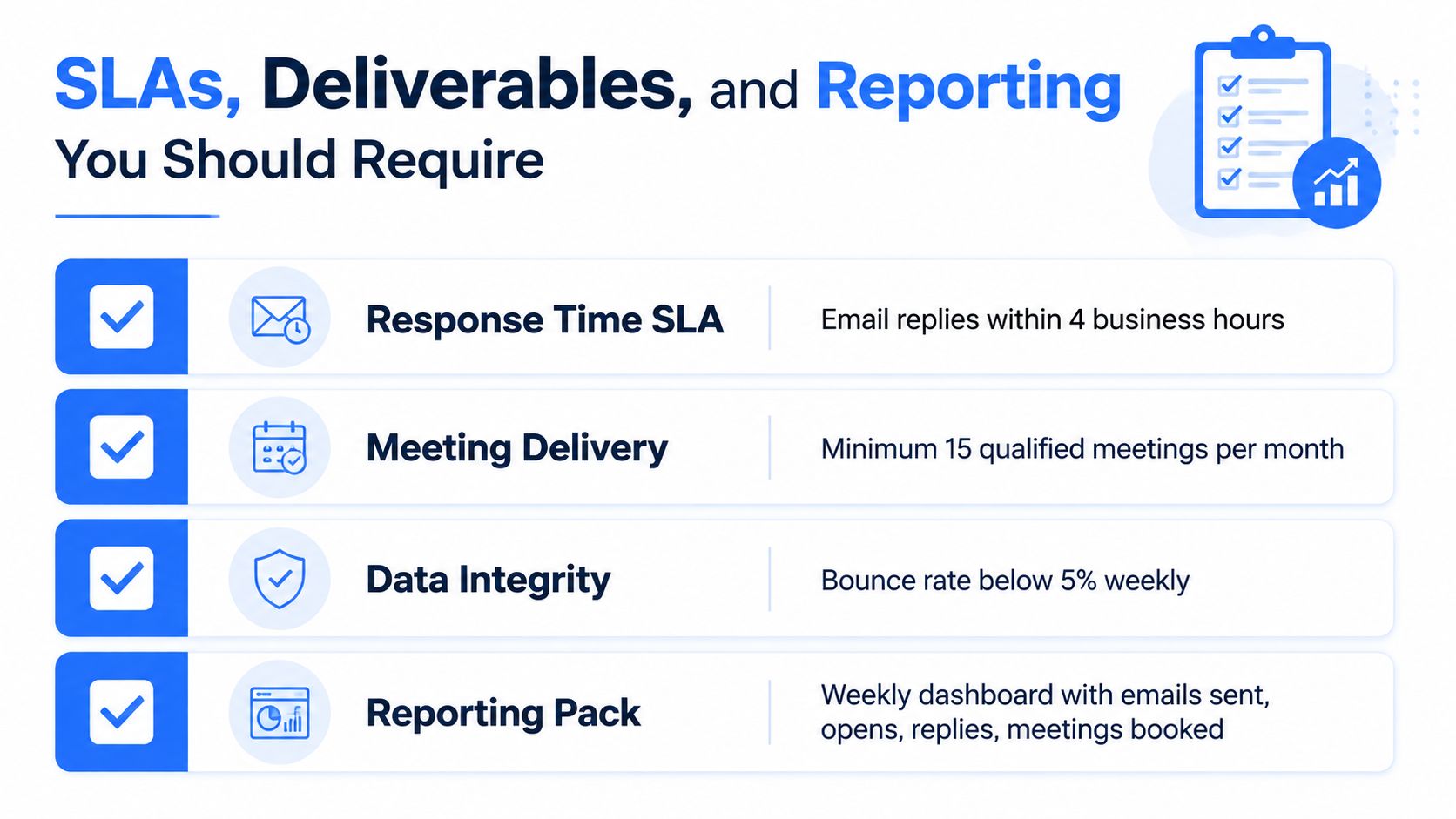
Start with the deliverables. You want the ICP document in writing, the list sources named, the copy approval workflow defined, the test cadence documented, and CRM integration spelled out. You also want the agency to own deliverability monitoring, weekly performance reviews, and the qualification handoff.
What should be in writing
The independent guide in the brief is blunt about this. Outsourced SaaS lead gen should include revenue-linked reporting and CRM integration, and the partner should be able to show a standard reporting dashboard before signing. That is the right bar. Opens and replies matter, but they are not the business outcome.
Demand clarity on these points:
- Qualified meeting definition. Ask what makes a meeting “qualified,” and who decides when it is not.
- Reporting cadence. Weekly is the minimum if you want to catch list or messaging issues early.
- Data freshness. If list quality slips, the entire motion degrades.
- Deliverability ownership. Someone has to own sender health instead of blaming the inbox provider later.
- Exit terms. If the agency cannot explain how you leave cleanly, the contract favors them, not you.
The best reporting pack shows pipeline movement, not just campaign activity.
The first call should be simple. Ask, “Show me the dashboard you will use to run this account.” If the answer is a slide deck, you are probably talking to a vendor. If the answer is a live reporting view tied to CRM and qualification rules, you are closer to a real operating partner.
For budget planning around tooling and services, the Lead Printer ROI calculator is a practical reference point when you want to sanity-check the economics before you commit.
Pricing and Cost Drivers for 2026 SaaS Programs
Pricing moves because an outbound lead generation service for B2B SaaS packages a lot of work into one monthly fee. You are not paying for sends alone. You are paying for list building, deliverability setup, personalization, testing, and the hands-on work required to keep the motion from breaking when a segment underperforms.
The pricing range in the brief gives a useful anchor. A done-for-you SaaS outbound program often sits in the low-five-figures each month depending on volume, market, and channel mix. The same brief also notes that data subscriptions can run $5K to $30K per user annually in some enterprise setups, which is why the tooling stack becomes a real line item instead of an afterthought.
What pushes cost up
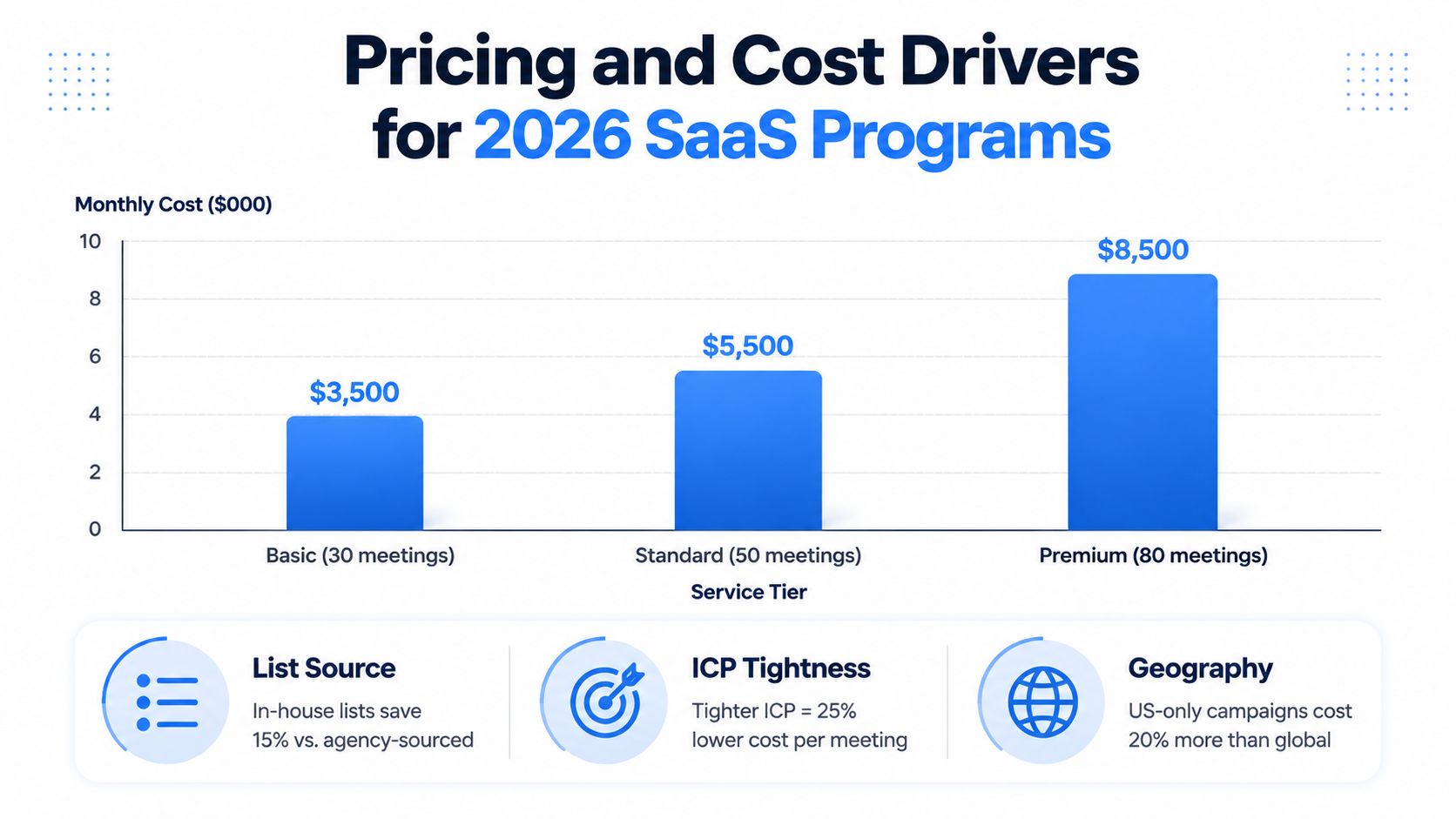
Three things usually move pricing fastest. First, channel count. Email only costs less than email plus LinkedIn plus phone. Second, geography. US-only campaigns often cost more than global campaigns because localization and targeting expectations are higher. Third, ICP complexity. If your buyer is hard to find or needs layered enrichment, the research bill rises quickly.
The brief's pricing chart also shows a practical shape in the market, with tiers labeled Basic, Standard, and Premium at $3,500, $5,500, and $8,500 monthly respectively. Treat those as directional, not universal. The point is simple, price should follow scope and operating depth, not inflated promises.
What to compare against an in-house SDR
Agency pricing should not be compared with SDR salary alone. An in-house SDR carries salary, benefits, tooling, management overhead, and ramp time. That is why an agency quote can look expensive until you price the full internal system.
Compare monthly cost against expected pipeline quality, not headcount vanity. If the agency can produce qualified opportunities faster and cleaner than your internal team, the price can make sense even if it feels high on paper. If it cannot explain the economics in CRM terms, stop there.
For a second check on your numbers, the Lead Printer ROI calculator is worth using before you accept any agency quote at face value.
Reading Case Studies So You Can Tell Signal From Noise
Every agency has case studies. Most of them are useful only if you already know how to decode the story behind the screenshots. A good case study tells you who was targeted, what the starting point was, how long the campaign ran, what counted as a lead, and whether the client looked like you.
The strongest pattern is simple. Real case studies name the qualification standard or at least describe the handoff clearly. If the agency says “meetings booked” but never says whether those meetings held, converted, or fit the ICP, that's not a proof point. It's a marketing asset.
Three patterns you can read fast
Strong pattern. The brief's examples from the research are useful because they show how results are tied to segmentation and context. One campaign split a database into distinct buyer roles and saw a concentrated response in the most relevant segment. Another used dormant CRM contacts and layered email with LinkedIn to reopen deals. Those examples matter because they show motion design, not just raw activity.
Mediocre pattern. A vendor shows a lot of booked calls, but the lead definition is vague. You get screenshots of inboxes or calendars, yet there's no mention of ICP fit, qualification rules, or downstream opportunity creation. That's a meeting factory, not a pipeline system.
Red-flag pattern. The agency leans on logos, not outcomes. If the only proof is a named client with no context, no time frame, and no reporting standard, assume the results are non-repeatable.
A useful case study should help you predict your own outcome, not just admire theirs.
The cleanest filter is to ask one question. “What would have made this campaign fail?” If the agency can answer that, they understand the mechanics. If they dodge the question, they're selling certainty they don't have.
Choosing the Right Service for Your SaaS Stage
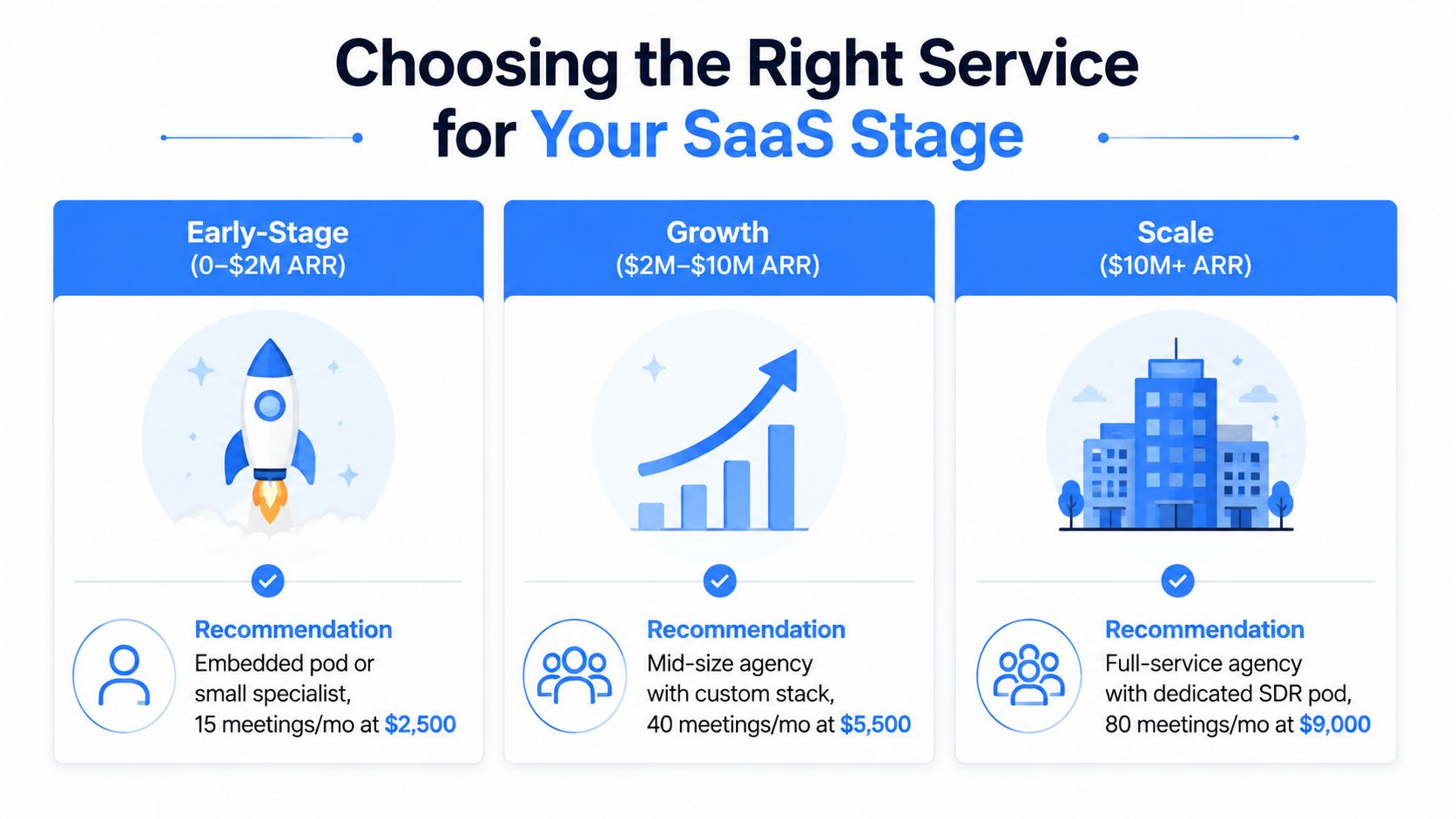
Early-stage SaaS should keep the operating surface tight. Buy an embedded pod or a small specialist retainer that can test messaging quickly, learn from reply quality, and avoid piling on tools you do not need. The agency should be able to show how it will improve list quality, targeting, and handoff discipline, because that is what keeps early outbound from turning into noise.
Growth-stage teams need a different setup. A mid-size agency should run multichannel sequences, work inside your CRM, and report on pipeline contribution, not just activity volume. If the vendor cannot connect outreach to opportunity creation, they are sending messages, not building a revenue system.
Enterprise SaaS raises the bar again. You need a partner that understands multi-stakeholder buying, localization, and the fact that one account can involve several decision-makers. Revenue-linked reporting and account-level thinking are not add-ons here, they are the only way to know whether outbound is creating durable pipeline.
The 30-minute shortlist test
Run every finalist through the same checklist. Ask for deliverables in writing, SLAs on qualified meetings, deliverability ownership, CRM integration, ICP documentation, case studies that resemble your stage, and a clean exit clause. Demand reporting that shows how meetings turn into opportunities and how opportunities turn into pipeline, because booked calls alone do not tell you whether the program is working.
For teams that need a structured B2B motion, Lead Printer's B2B SaaS service overview is a direct example of how an agency can package infrastructure, research, outreach, and reporting into one outbound function. If you want a sharper benchmark on prospecting inputs and data sourcing, compare that with unified social scraping APIs and see whether the vendor can explain where its data comes from and how it stays current. You should still compare options, but that is the right category of offer to evaluate.
Outbound lead generation is a pipeline function. Treat it with the same reporting discipline, clear ownership, and zero tolerance for vanity meetings that you would demand from any revenue team.