In a 2025 study of 602 CRM users and stakeholders across the United States, United Kingdom, and Australia, 76% believed less than half of their organization's CRM data was accurate and complete, according to BizProspex's data quality analysis. That single figure reframes prospect research services. You're not mainly buying more names. You're buying a process that proves which companies fit, which person still holds the role, and which facts can support personalization without embarrassment. Judge providers by freshness, provenance, and confidence when sources conflict, then by cost per usable opportunity. A shorter list that survives checking will usually beat a huge export that nobody can trust.
What Prospect Research Services Actually Include
A prospect database is like a city map printed once and left on a shelf while the city keeps changing. Roads close, shops move, and people change addresses. A research service is the team that keeps updating that map, marks the streets worth visiting, and tells you who is likely standing behind each door today.
Say a SaaS company sells inventory software to ecommerce brands. A plain list might contain thousands of stores, old operations managers, closed businesses, and companies too small to buy. Research narrows that universe to active brands in the right revenue and headcount range, finds current operations or ecommerce leaders, checks the technology they use, and records why each account might care now.
The Three Questions Research Must Answer
- Is the company a fit: Does it match your industry, size, geography, business model, and buying capacity?
- Is this the right person: Does the contact own the problem, influence the purchase, or control the budget?
- Why now: Is there a trigger such as hiring, expansion, new technology, funding, or a visible operational change?
That work matters because, in 2025, 90% of surveyed B2B buyers said they conduct research before speaking with a vendor, a figure Responsive published from a global survey of 350 B2B buyers. If buyers arrive informed, generic outreach built on guessed pain points looks lazy fast.
A purchased spreadsheet with no verification isn't research. Neither is a CRM export with no fit rules. Research produces a dated record showing company fit, person, evidence, source, and next action.
Typical buyers include SaaS firms building pipeline, fintech providers selling to merchants, consulting and accounting firms pursuing defined niches, and manufacturers selling to distributors or operators. The common thread isn't company size. It's a specific customer profile, a valuable offer, and enough target accounts to test without spraying messages everywhere.
Deliverables and KPIs to Expect from a Provider
Start with the handoff, not the pitch. If a provider can't show you a sample record, a reporting view, and the exact definition of a qualified lead, you're buying effort without a measurable output.
| Deliverable | What it contains | KPI to track |
|---|---|---|
| Target account list | Companies matching ICP firmographics and geography | Share of accounts passing fit rules |
| Contact database | Decision-maker records with source and verification date | Email verification rate and field completeness |
| Enrichment record | Tech stack, headcount, funding and trigger events with timestamps | Share of fields refreshed in the last 90 days |
| Personalized sequence | Copy tied to research points for each segment | Reply rate by segment |
| Meeting handoff | Qualified replies booked on the client calendar | Meetings booked per 100 contacts |
| Monthly reporting | Pipeline contribution, bounce and complaint rates | Bounce rate and spam complaint rate |
Read the table from left to right. A deliverable describes an artifact. The KPI tells you whether that artifact was accurate enough to create a commercial conversation. Record volume alone proves almost nothing.
That concern is wider than outbound. In a 2025 survey of 509 senior B2B marketing decision-makers at larger organizations, only 45% felt very confident in their ability to connect data across teams, and confidence in data accuracy and reliability was even lower, according to Demandbase's State of B2B Marketing report. Your provider's scorecard should close that trust gap.
Three KPI Traps That Hide Weak Research
- Counting records instead of verified records: Ask what share passed syntax, domain, role, and company checks, and what share still carries conflicting facts.
- Counting sends instead of replies: Sending is an activity metric. It doesn't show relevance, deliverability, or whether the right people were selected.
- Counting replies instead of meetings: Polite replies, referrals, and clear rejections aren't equal. Separate positive interest, qualified interest, booked meetings, and attended meetings.
Use a tighter vocabulary in the contract. Our guide to how lead qualification separates interest from sales readiness is a useful starting point when you define stages with a provider.
Capacity also sets expectations. We state that clients can expect 20 to 50 interested leads from their exact ICP every month, depending on industry and market size. That's not a license to force volume through weak lists. Each mailbox sends a maximum of 20 emails per day, which is a maximum of 60 emails per day per domain, because sender reputation is a finite asset.
Contract rule: Write the deliverable, owner, refresh date, KPI, and failure remedy into the agreement before the first send.
Ask for weekly operational metrics and monthly commercial metrics. Weekly reporting should expose bad segments, bounces, complaints, and slow handoffs while you can still fix them. Monthly reporting should connect verified contacts to replies, meetings, opportunities, and pipeline value. If those two views don't reconcile, the provider is probably reporting activity in one place and hope in another.
Data Sources and Quality Rules That Matter
Source choice drives most errors before copywriting starts. No single database is best for every field, so compare what each source proves well and what it routinely gets wrong.
| Source | Best for | Main limitation | Check before use |
|---|---|---|---|
| LinkedIn Sales Navigator | Roles, seniority and company changes | Profiles can be out of date | Confirm role and company on a second source |
| Google Maps listings | Local businesses such as clinics, trades and shops | Thin firmographics and few named decision-makers | Match listing to company website and registry |
| National business registries | Legal entity name, status and incorporation date | Limited role data and country-specific formats | Confirm status is active and entity matches the domain |
| Company websites | Services, tech signals and leadership pages | Pages change and marketing copy can overstate | Date every captured page |
| Enrichment platforms such as Clay | Combining sources, tech stack and firmographic fields | Each field inherits its source's errors | Sample records and track error rates by source |
| Client CRM data | Past customers, lost deals and existing contacts | Often duplicated or incomplete | Deduplicate on normalized company and contact IDs |
Teams comparing vendor shortlists can also review top sales lead research platforms from EmailScout, then test any platform against their own sample accounts. If you're replacing a large database, our overview of alternatives to ZoomInfo for targeted prospect data helps frame the trade-off between broad coverage and campaign-specific research.
Data quality isn't a niche complaint. In 2024, 57% of respondents in a dbt Labs survey rated data quality among the three most challenging aspects of data preparation, as Data Kitchen reported the figure. Prospect lists need the same discipline as analytics data.
Six Checks for Every Record
- Validity: Fields follow expected formats, such as a plausible email and domain structure.
- Completeness: Required attributes are populated rather than left blank.
- Accuracy: Values are checked against a trusted source.
- Consistency: The same person and company agree across sources.
- Uniqueness: Normalized names and domains don't produce duplicates.
- Timeliness: The delay between a real-world change and its appearance in the record is known.
These checks align with a technical quality model built around validity, completeness, accuracy, consistency, uniqueness, and timeliness, as Electe's data quality monitoring guide explains. Put plainly, a record can look complete and still be wrong, duplicated, or too old for outreach.
In our Research step, we build prospect databases using Clay and scraping from LinkedIn Sales Navigator, Google Maps, and targeted websites. Each source brings errors with it, so blending data doesn't magically clean it. Reject malformed email domains, require the contact domain to match the company domain where appropriate, and assign a freshness timestamp to every enrichment event.
When sources conflict, keep the value with the most recent verification date that a second independent source confirms. Mark the record low confidence until the conflict is resolved, and ask the provider to report how many low-confidence records appear each month. Demand field-level coverage, deduplication rate, verification status, source provenance, and age of last validation, not just a total record count.
How a Research Engagement Runs Step by Step
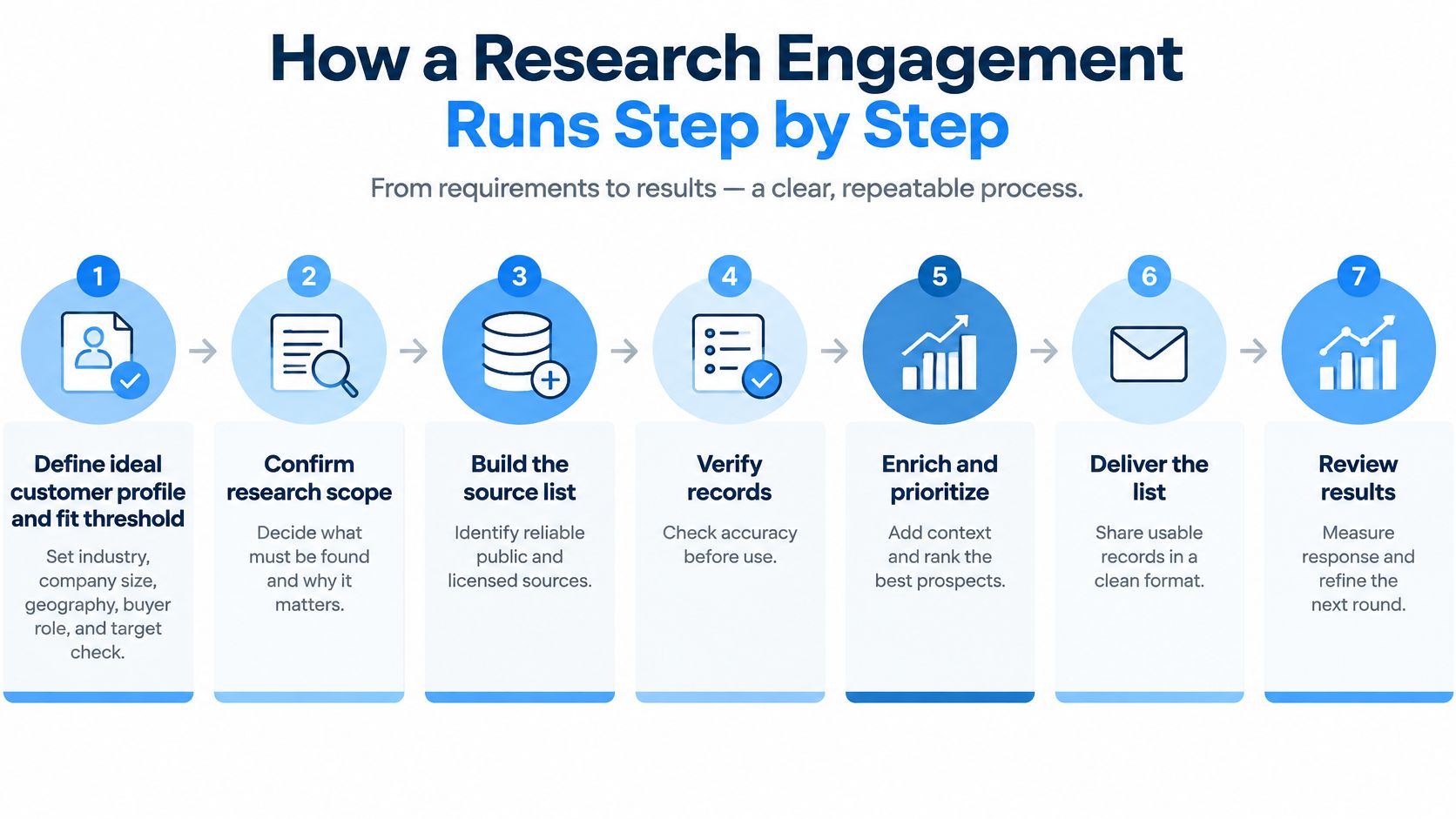
The process below shows where research decisions become revenue outcomes, and where shortcuts usually enter.
Steps One to Three Build the Right Universe
- Define the ICP and fit threshold: Set industry, company size, geography, buyer role, exclusions, and the evidence required for inclusion. Check that the market is large enough for repeated testing. We look for high-ticket B2B services with at least 5,000 people in the target market, because a tiny universe burns out quickly.
- Set up sending infrastructure: Configure domains and mailboxes, authenticate them, and warm them before campaign volume rises. This stage feels administrative, but it protects inbox placement and keeps a research win from becoming a deliverability loss.
- Build and enrich the list: Pull companies and people from LinkedIn Sales Navigator, Google Maps, business registries, and company websites. Add tech stack, current role, location, headcount, and trigger events, each with source and date. Teams researching public-sector buyers need a different discovery route, and FederalPipeline's guidance on how to find and qualify federal business opportunities shows how formal opportunity records change the workflow.
Our set-up period includes email infrastructure set-up and warmup, a strategy and onboarding meeting, copywriting, and building lists using web scraping and AI sales research automation. Replies can't arrive during warm-up because campaign emails aren't sending yet. Ask for a week-by-week timeline with named outputs, not a promise that leads begin immediately after payment.
This short walkthrough gives you a practical view of campaign preparation before the verification and launch stages.
Steps Four to Seven Turn Research Into Conversations
Verify and deduplicate: Validate email syntax and domains, match each company to its domain, merge subsidiaries into parent companies, and reconcile conflicting job titles. Request a sample from this stage. It's the clearest preview of campaign quality.
Write copy from the research: Segment by problem, role, technology, and market rather than swapping first names into one template. In our Copywriting step, we write personalized email sequences based on deep research, including technology stack analysis, mutual connections, and competitive intelligence. If a personalization claim can't be traced to a dated source, remove it.
Review and launch: Approve targeting, messaging, exclusions, and personalization logic. Screen contacts against customers, active opportunities, competitors, and suppression lists before activation. We start generating leads from day one after launch, followed by ongoing monitoring, performance analysis, and strategic guidance, but launch means after infrastructure and checks are complete.
Monitor and refine weekly: Read replies by segment, not just in total. A segment can produce many replies because the offer is relevant, or because the targeting accidentally captured students, agencies, or job seekers. Feed accepted, rejected, bounced, and unsubscribed records back into the research rules, then refresh stale fields before the next cohort.
Ask about stage four first. A verified sample exposes the provider's standards faster than any sales presentation.
Watch for handoff friction too. Decide who reads replies, who qualifies them, who books meetings, and how quickly prospects hear back. Good research loses value when an interested reply sits unread for two days or lands in a CRM without the evidence that prompted the conversation.
Pricing Models and Whether the Spend Pays Back
Pricing tells you who carries the risk. It also tells you what the provider is incentivized to optimize, which may be volume, speed, meetings, or retention.
| Model | How it is billed | Suits | Watch for |
|---|---|---|---|
| Monthly retainer | Fixed fee for ongoing research and outreach | Teams running a continuous pipeline | Fee continues when results drop; check exit terms |
| Fixed-term campaign | Fee for a set period, plus any set-up fee | Testing a new segment or region | Set-up fees may be billed separately; confirm the total |
| Per-list or per-record | Price per verified contact or account | One-off list builds | A record price does not show fit or freshness |
| Project audit | One-time fee to map the ICP and estimate lead volume | Deciding whether outbound fits | Check whether the audit fee is credited to a campaign |
| Performance-linked | Fee tied to meetings or qualified leads | Buyers who want shared risk | Define qualified lead in writing before signing |
Our standard pricing charges only for the campaign period, when emails are going out and leads are coming in, and doesn't charge separately for the set-up period. Clients can commit to a one-month campaign instead, which includes an additional set-up fee. Ask which structure applies, what's included, and whether unused work carries forward before you sign.
A Worked Payback Example With Assumptions Stated
Use a hypothetical fee to test the logic before you insert a real quote. Say a $3,000 monthly fee produces 20 qualified leads. Your cost per qualified lead is $150. That number still doesn't prove value until you apply your meeting and closing rates.
We state that clients book meetings with every three or four leads and need 10 to 20 leads to close a sale. Under that stated range, 20 leads would imply roughly one to two closed deals. If your average contract value is $10,000, two wins return $20,000 against $3,000 of campaign spend before your internal sales costs.
The break-even test is simple. Divide the monthly fee by average contract value. At $3,000 divided by $10,000, the campaign must produce 0.3 of one deal per month to cover the fee, or roughly one deal every three to four months. Then ask whether the lead volume, meeting rate, and sales cycle make that plausible.
You can run your own fee, lead, and contract-value assumptions through our ROI calculator for outbound campaigns before comparing quotes. Change one assumption at a time. If the model only works when every rate is optimistic, the offer or market probably isn't ready.
Cost per usable opportunity beats cost per lead. Five well-fitting leads that enter real sales conversations can outperform forty weak leads that consume follow-up time.
Include hidden costs in the comparison. Your team still spends time reviewing targeting, handling replies, attending meetings, updating the CRM, and fixing bad handoffs. A cheaper provider can become expensive if every record needs manual checking. Conversely, a higher fee may be justified when the provider supplies dated evidence, excludes poor fits before sending, and reports enough detail for you to stop weak segments early. Pay for reduced waste, not decorative enrichment fields nobody uses.
Lawful Research Rules for EU and UK Prospects
A corporate email address doesn't, by itself, make outreach lawful. You need a defensible reason to process the person's data, a record of where it came from, and controls that stop messages when someone objects.
This compliance image points to the practical issue. Lawfulness lives in the record and workflow, not only in a privacy policy.
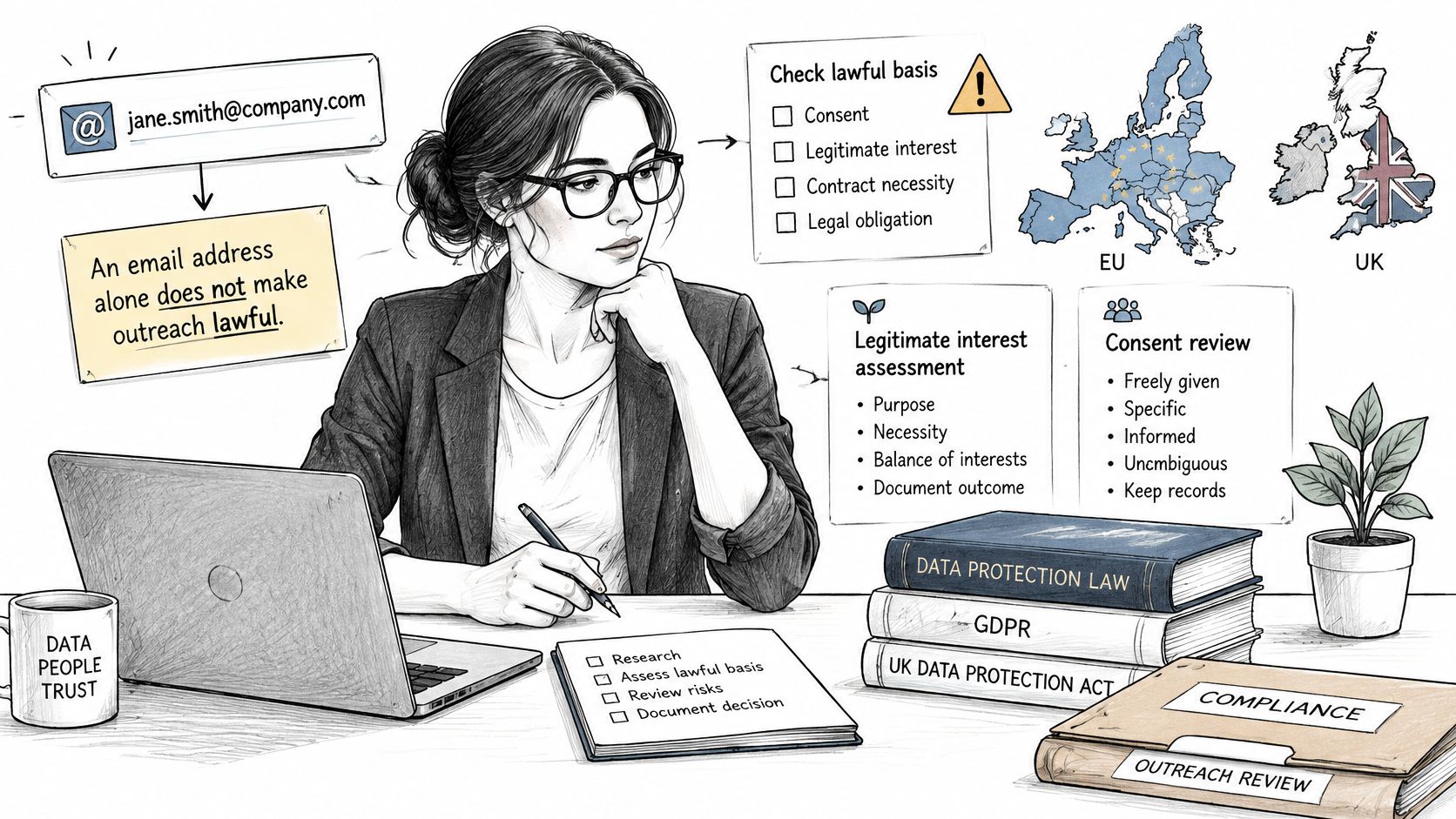
EU guidance recognizes direct marketing as a possible legitimate interest, but organizations must assess necessity and balance commercial interests against individuals' rights, keep databases current, honor objections, provide required information by the first communication, and comply with ePrivacy rules, as the UK Information Commissioner's Office legitimate interests guidance explains for the UK context. UK organizations must also identify the specific legitimate interest, demonstrate necessity and proportionality, and consider privacy impact and likely objections.
The Provenance Record Every Contact Should Carry
- Source: Where each person-level fact was found.
- Collection or verification date: When the provider captured or last checked it.
- Intended purpose: Why the contact belongs in this campaign.
- Lawful-basis assessment: The reasoning and balancing test used.
- Jurisdiction and channel: Which market rules and outreach method apply.
- Suppression status: Whether the person has objected, unsubscribed, or been excluded.
Segmentation has legal consequences. Corporate employees, sole traders, and partnerships may receive different treatment, and consent requirements can vary by recipient and channel. Don't hide those groups inside one generic business segment.
Before activation, screen every campaign against internal opt-out and suppression lists. Preserve evidence of the balancing assessment, include the information required at first contact, and provide a clear objection route in the first message and later communications.
Compliance also protects performance. Repeatedly contacting objectors or outdated records increases complaints, hurts sender reputation, and wastes the domains you spent time warming. Treat suppression and freshness as production controls, not paperwork after launch.
This is general information, not legal advice. Have qualified counsel review your lawful-basis assessment, especially when campaigns cross EU member states or combine several channels.
Case Examples and What the Results Show
Provider-reported results can be useful when you read them as claims to investigate, not proof that your market will behave the same way.
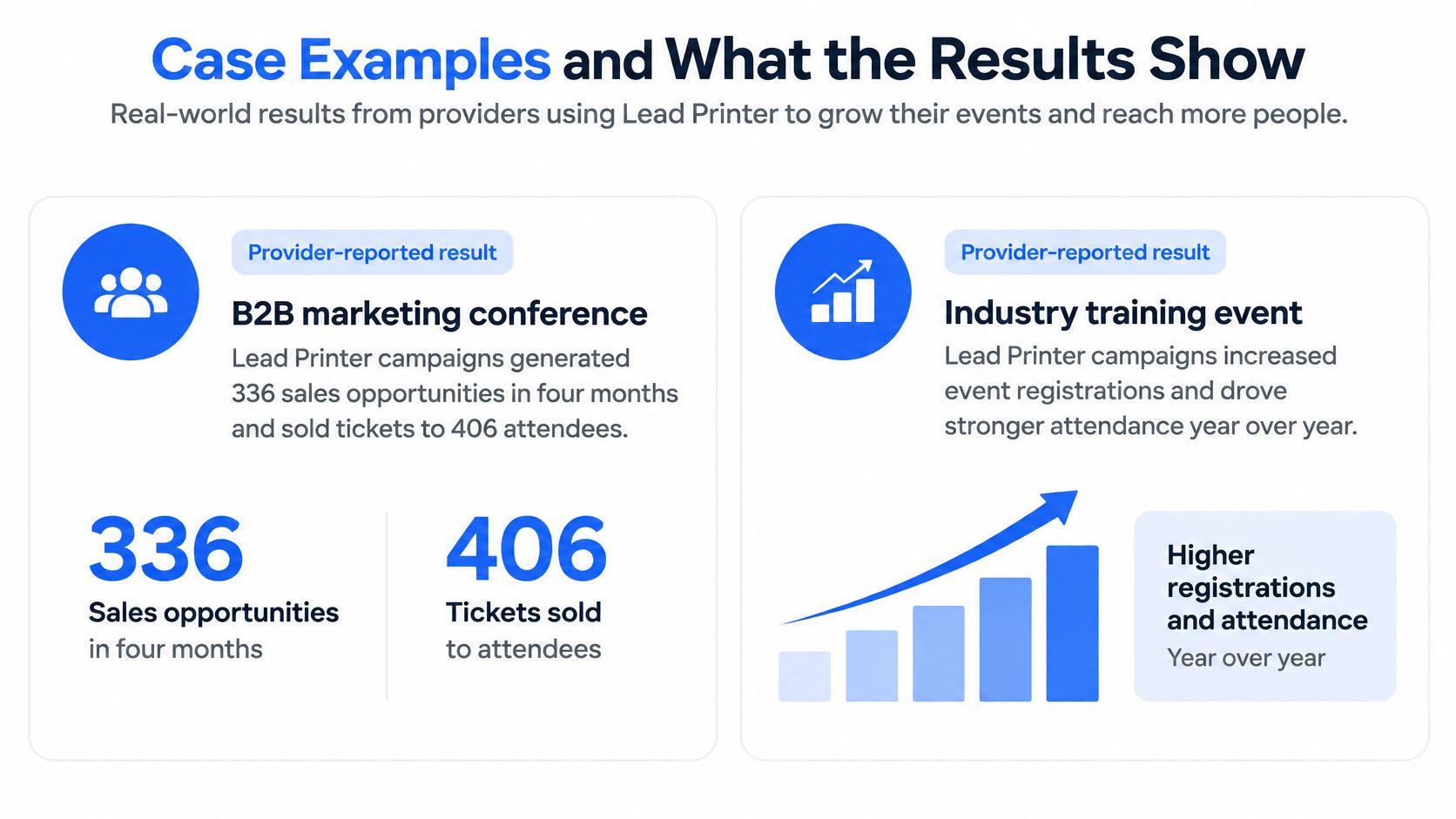
For Marketing Parrot's B2B marketing conference, Lead Printer generated 336 sales opportunities in four months, and tickets were sold to 102 people. For B2B Growth, its campaigns generated 237 interested leads and €40,000 in revenue. The important detail isn't just scale. Both outcomes connect research and outreach to a downstream commercial event, ticket sales in one case and revenue in the other.
Those two endpoints still leave questions. What counted as an opportunity? How many contacts were researched and verified? Which segments produced the revenue, and how long did buyers take to close? A headline result becomes evidence only when the provider can show the funnel behind it.
An Illustrative Test Without Invented Results
Say a mid-market accounting firm wants clients in two regions. It narrows the target to offices within a defined staff band, removes inactive registry records, verifies named partners, and writes separate messages for firms hiring accountants and firms opening offices. If replies improve after those changes, the team can argue with more confidence that fit and timing drove the lift. If the list had stayed dirty, bounces and wrong recipients would blur the result.
That's the analytical value of research. Clean inputs let you separate offer problems from data problems. Dirty inputs make every result ambiguous.
Questions That Turn a Headline Into Evidence
- ICP definition: Which firmographic, role, and geography rules included or excluded accounts?
- Lead definition: What exact reply or behavior counted as qualified?
- Time frame: How long did set-up, sending, and closing take?
- Segment mix: Did one segment produce most results while others failed?
- Sales capacity: How quickly did the client's team follow up?
- Revenue quality: Was revenue collected, contracted, or only estimated pipeline?
Ask for leads, meetings, opportunities, and revenue at each stage. Then request a reference call with a client in a similar market and sales cycle. A provider that can't explain a success usually can't reproduce it.
Choose a Provider and Start a Small Pilot
Use the same scorecard for every provider before you listen to a pitch. You're testing evidence quality, operational honesty, and how the provider behaves when a segment fails.
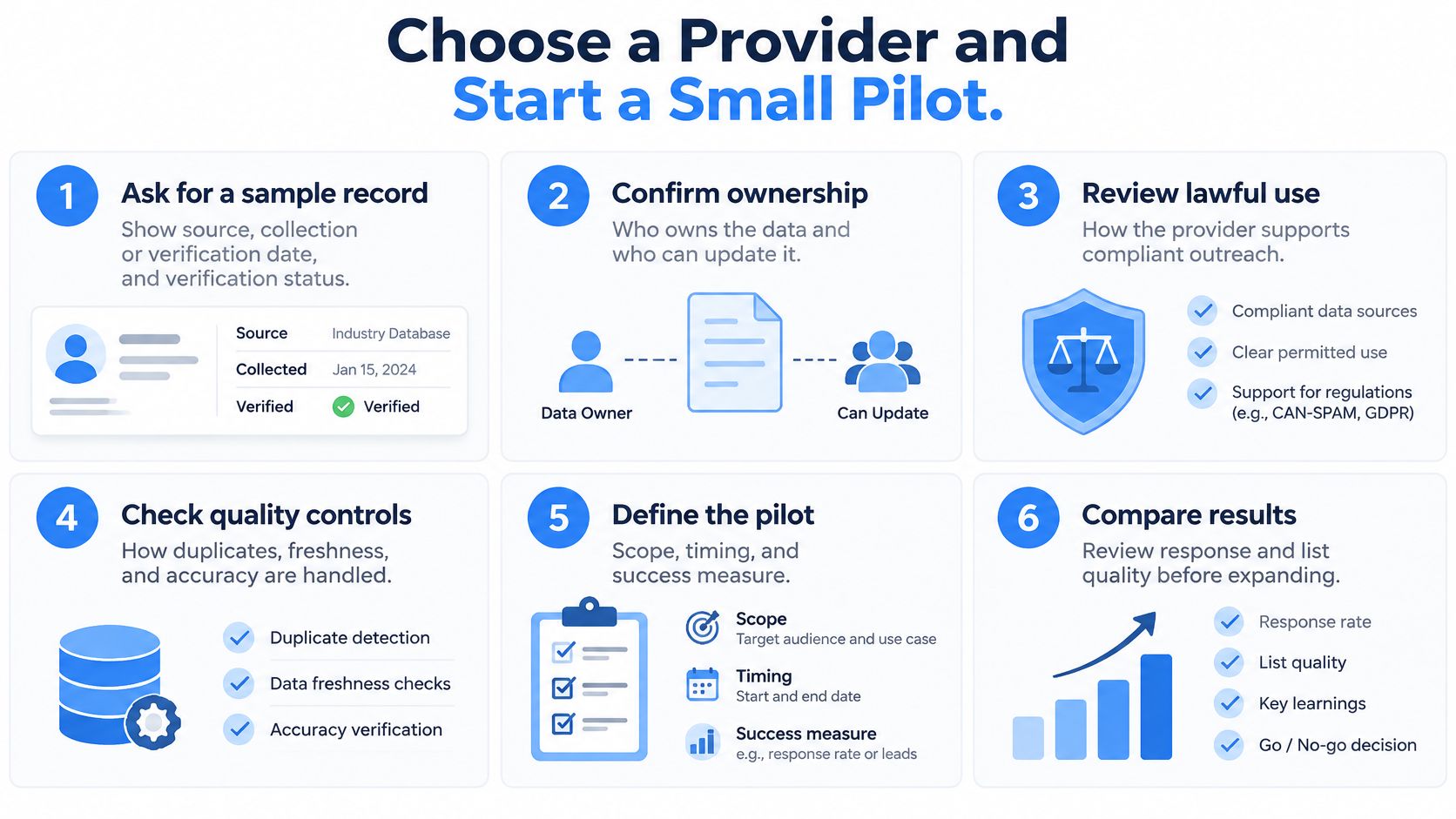
- Ask for a sample record: It should show source, collection or verification date, verification status, confidence notes, and the reason the account fits.
- Confirm data ownership: State who owns the researched data, who can export it, and what happens after termination.
- Get lawful use in writing: Review the lawful-basis process, suppression screening, objection handling, and retention approach.
- Review before launch: Approve targeting, messaging, personalization evidence, exclusions, and handoff rules before sending.
- Pin down commercial terms: Put billing, set-up fees, lead definitions, reporting cadence, and exit terms in the contract.
- Speak to relevant references: Choose clients with similar deal values, markets, and sales cycles, not only the happiest logo.
Buyers in adjacent markets can use the same evidence-first approach when they compare staffing outreach platforms from dreach, then score vendors on data ownership, workflow fit, and measurement rather than headline features.
Red flags are consistent. Watch for guarantees with no written definition of a qualified lead, reporting that only counts volume, purchased lists with no verification, missing source provenance, no suppression screening, and claims of buying intent with no underlying evidence. Refund promises mean little when the provider controls an undefined quality threshold.
Test our claims the same way. Lead Printer promises 20 or more qualified leads within 30 days or a refund. We also offer a free 45-minute pipeline audit that maps your ICP and estimates how many qualified leads outbound can bring each month, and we suit high-ticket B2B services when there are at least 5,000 people in the target market.
Run a 60-day pilot with two providers on the same ICP, one distinct segment each. Keep the offer and qualification rules constant, score both on verified fit, freshness, reply quality, meetings, cost per usable opportunity, and reporting clarity. Expand only the segment and provider that produce sales conversations your team wants to repeat.
If you want prospect research that shows its sources, dates, and fit logic before outreach begins, Lead Printer can map your ICP, estimate monthly lead potential, and build a pilot around measurable qualified conversations. Book an audit, bring your target market and average contract value, and leave with a clear view of whether outbound can pay back for your business.