Your pipeline is flat, the SDR hire you wanted is still in recruiting limbo, and marketing leads aren't enough to carry the quarter. That's when sales development outsourcing stops looking like a shortcut and starts looking like the only practical way to create meetings without waiting months for headcount, onboarding, and manager bandwidth to catch up.
The mistake many teams make is treating outsourced SDR work like a vendor line item. It isn't. It's an operating program with deliverability, list quality, qualification rules, and feedback loops, and if you don't manage those inputs, you'll pay for activity that never turns into revenue.
Why B2B Teams Are Outsourcing Sales Development in 2026
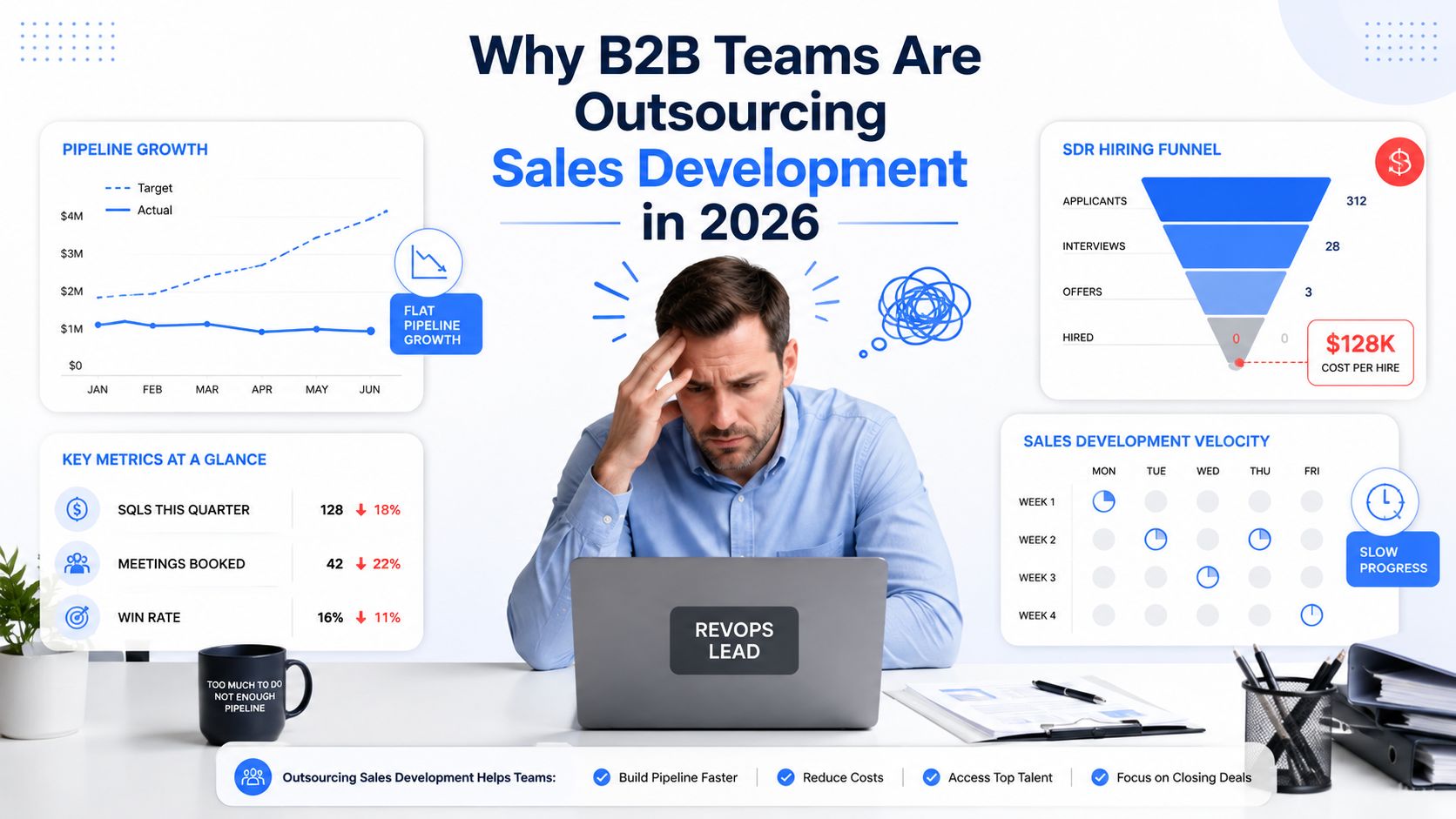
A RevOps lead usually doesn't wake up thinking about outsourcing. They wake up to a Slack thread about empty calendars, a hiring requisition that's been open too long, and a sales leader asking why pipeline still looks thin after another round of campaign launches. At that point, the question isn't whether to outsource in theory, it's whether the team can build enough outbound capacity fast enough to matter.
The market has already answered that question for a lot of companies. A 2023 industry report found that 86% of sampled tech companies used outsourcing suppliers for sales development, and the share of teams running sales development exclusively in-house fell from 53% in 2021 to 20% in 2022. The same report showed hybrid and outsourced operating models becoming dominant by 2022, which tells you something simple, the center of gravity has moved away from pure in-house SDR teams. State of B2B sales outsourcing market analysis
Why the shift is happening
The practical reason is speed. An outsourced function can often begin producing meetings while an internal hire is still ramping, and that matters when your quarter doesn't wait for recruiting. The other reason is infrastructure maturity. Deliverability tooling, enrichment data, sequencing platforms, and multichannel workflows have made outsourced outbound much less random than it used to be.
There's also a reality most leaders don't want to admit. If your team can't define the ICP tightly, can't monitor inbox placement, and can't review replies consistently, adding another internal rep won't fix the process. It will just expose the gaps faster.
If you're evaluating a partner who can support a focused outbound motion, Lead Printer's B2B SaaS approach is one place to compare how an outsourced program gets structured around pipeline instead of raw activity.
Practical rule: If you can't explain how a meeting gets from list build to handoff, you're not ready to buy execution. You're still designing the system.
What Sales Development Outsourcing Actually Means
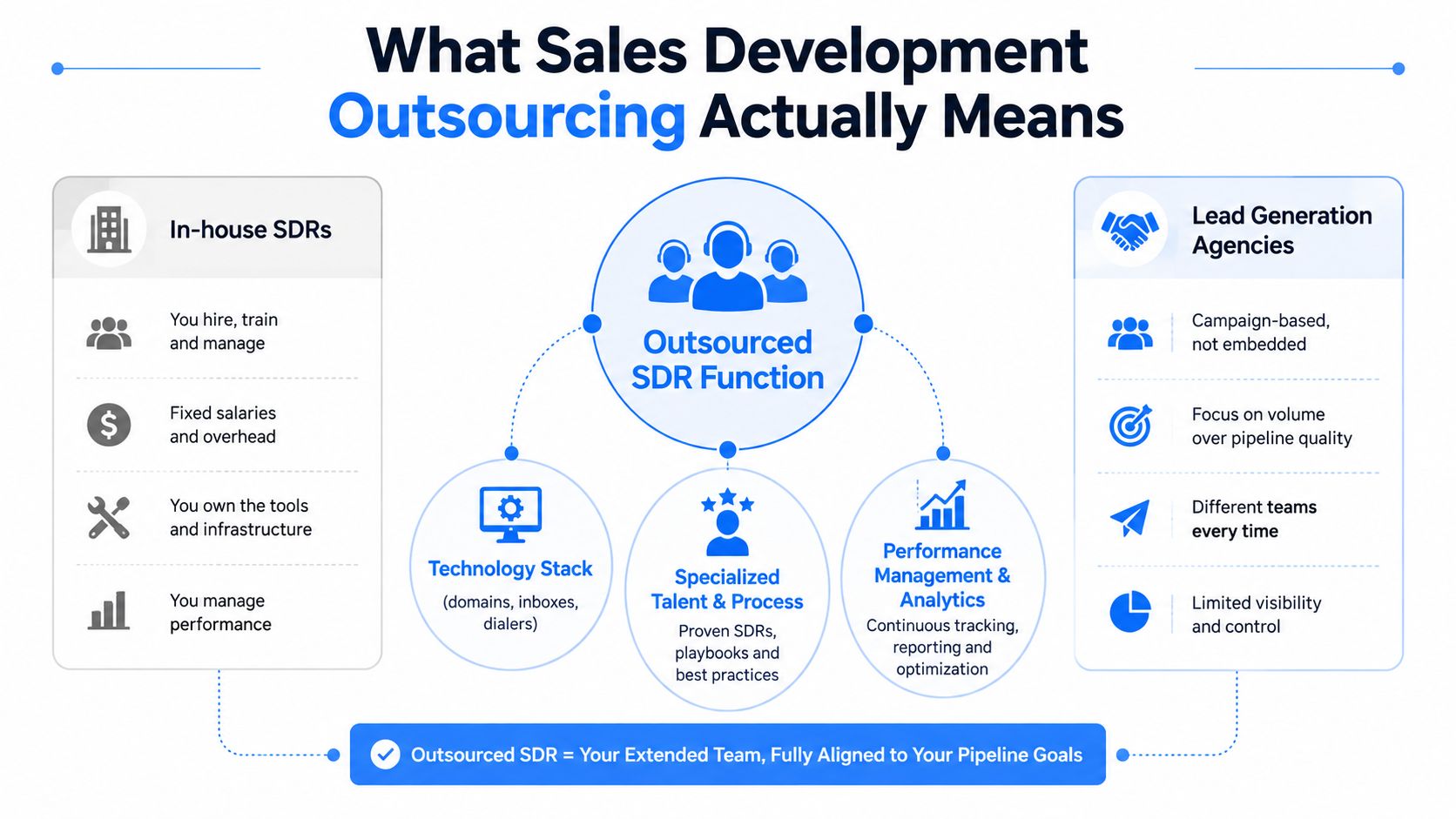
Sales development outsourcing is not just “someone else sending emails.” It's the delegation of the outbound engine that sits between strategy and booked meetings. That engine usually includes infrastructure, data, messaging, and execution, and each part has to work together or the whole thing underperforms.
What the vendor actually owns
A serious partner handles the technical and operational side. That means inbox setup and warm-up, list building and enrichment, segmentation, sequence writing, follow-up, qualification, and calendar handoff. If the provider can't explain who owns each layer, they're selling labor, not a repeatable program.
Contract manufacturing provides a helpful parallel. You keep the recipe, the quality standards, and the final approval, but the partner runs the machinery, manages throughput, and flags defects. That's the right mental model for sales development outsourcing too. You control the ICP and the close, the partner runs the prospecting line.
What should stay in-house
Keep account strategy, ICP definition, offer positioning, pricing context, and closing close to your own team. The vendor can't invent product truth for you, and they shouldn't be forced to guess at qualification standards. If your closers and marketing team don't feed back on reply quality, your outsourced team will optimize toward volume, not revenue.
For teams hiring distributed operators, remote sales development reps are relevant because they show how the role has shifted from a desk-bound function into a process-managed one.
The cleanest outsourced SDR setup is narrow, not broad. The vendor should own execution, but your team should own the rules that define a good opportunity.
The confusing part is that people mix this up with lead generation agencies. Lead gen can stop at contact discovery. Outsourced SDR work doesn't stop there. It carries the prospect through outreach, response handling, qualification, and handoff, which is why the operating discipline matters more than the label.
Benefits and the Risks Most Buyers Underestimate
The upside of outsourced SDR work is easy to understand. You get faster pipeline creation, less fixed headcount risk, and a team that already knows how to manage deliverability and outreach cadence. For companies selling across the US, UK, and EU, outsourcing also gives you geographic reach without forcing you to build local SDR coverage from scratch.
The better providers also bring process discipline that many internal teams never fully build. That includes inbox management, domain protection, segmentation logic, and localized messaging. In cross-border outreach, that matters because a generic sequence written for one market rarely performs cleanly in another.
The downside is usually organizational, not tactical
The most common failure is weak qualification. If the vendor books anything that answers the email, your calendar fills and your sales team starts complaining within weeks. The fix is not “more coaching” after the fact. The fix is a tight definition of what counts as a meeting before kickoff, plus examples of bad-fit replies that must be filtered out.
Another quiet failure is deliverability damage. If a vendor shortcuts domain setup, ignores list hygiene, or sends to poorly segmented lists, inbox placement drops and every metric downstream gets worse. Apollo's current guidance is clear that inbox placement is the primary technical KPI, with 85%+ treated as good performance and reply rate, positive reply rate, and meetings booked per 1,000 sends used as the more reliable operating measures. Apollo outbound benchmarking guidance
What buyers should do differently
Use the checklist below before you sign anything.
- Define qualification first: Write down exactly which replies become meetings and which ones do not.
- Demand deliverability reporting: Ask how the vendor monitors inbox placement, domain reputation, and list hygiene.
- Set a feedback cadence: Require weekly review between the vendor, marketing, and the closers who take meetings.
- Protect brand voice: Give the vendor real examples of good and bad outreach so they don't improvise your tone.
- Track handoff quality: Measure whether booked meetings arrive with useful context, not just a calendar slot.
A lot of teams lose money this way. They buy “meetings” and then spend the next two months cleaning up the fallout from poor targeting, bad fit, or handoff gaps. The vendor looked busy, the pipeline looked full, and revenue didn't move.
How Pricing Models Actually Compare
Pricing gets messy because buyers compare what they pay instead of what they carry in risk. A monthly retainer shifts more execution risk to you. A per-meeting model shifts more delivery risk to the vendor. A per-lead model looks cheap until you discover that cheap leads aren't the same thing as sales-ready conversations.
The right model depends on your deal size and sales cycle. If your average opportunity is high-value and your qualification needs are strict, paying for sloppy volume is expensive in disguise. If your offer is simple and your meeting definition is clean, outcome-based pricing can work better.
The four common structures
| Model | What You Pay For | Where Buyer Risk Sits | Best Fit |
|---|---|---|---|
| Monthly retainer | Program management, outreach, and execution time | Quality and conversion risk stay with the buyer if the vendor underperforms | Complex deals, longer sales cycles, strict qualification |
| Per qualified lead | Each lead that meets the agreed criteria | Definition risk, because a loose definition inflates volume | Clear ICP, strong internal follow-up, simple qualification |
| Per booked meeting | Meetings that meet the contract definition | Meeting quality risk, especially if the vendor optimizes for calendar fills | Fast iteration, direct pipeline targets, simple handoff |
| Hybrid | Retainer plus performance component | Shared risk, but only if metrics are written cleanly | Teams that want accountability without overpaying for setup |
A retainer can work well if the vendor is doing real program design, not just volume sending. A per-meeting fee is cleaner on paper, but it only works if the meeting definition excludes unqualified contacts and no-show bait. Per-lead pricing sounds efficient, but it often rewards the wrong behavior unless the qualification bar is strict.
If you want to sanity-check economics before a call, Lead Printer's ROI calculator is useful as a comparison point because it forces you to think about meetings, not just outreach cost.
The clauses that change the math
Read the contract language carefully. “Meeting” needs a precise definition, and “qualified lead” needs one too. Refunds or replacement guarantees sound good, but they only matter if the qualification criteria are aligned with your actual sales motion.
Decision rule: If your sales cycle is complex, don't buy the cheapest model. Buy the model that punishes bad targeting and protects your team's time.
Vendor Evaluation Checklist and SLA Metrics to Demand
A lot of vendor reviews are theater. Buyers listen to a polished pitch, see a few logos, and assume the rest will sort itself out. That's backwards. You should be checking the operational plumbing first, because the vendor's stack and process tell you more than the deck ever will.
What to inspect before you sign
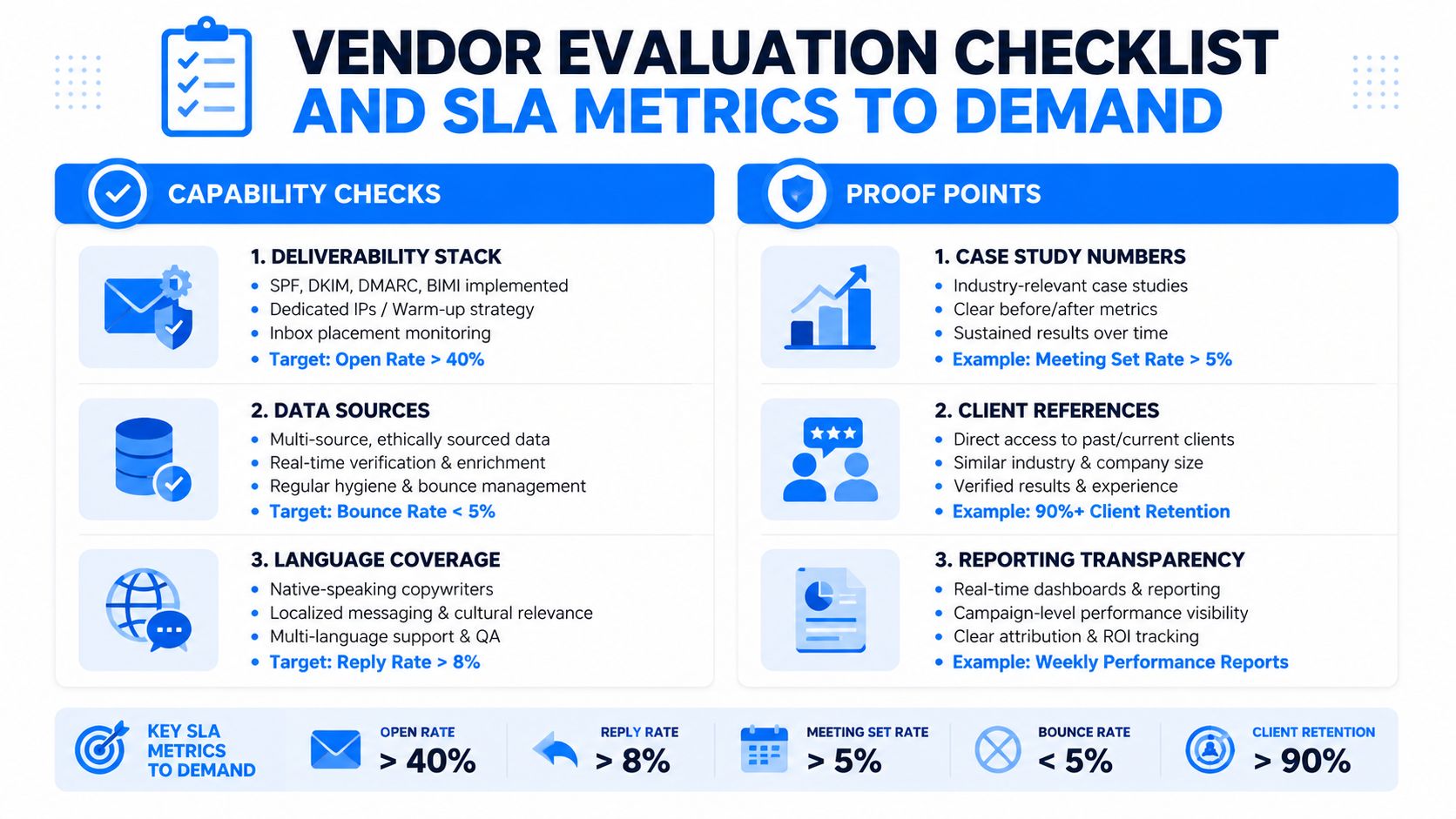
Start with capability, then move to proof, then inspect reporting. If the provider can't explain their deliverability stack, their list sources, and their language coverage, you're not dealing with a mature operation. If they can't show case-level evidence of outcomes, client references, or clear reporting discipline, the risk just shifted onto your team.
One more thing. Ask who owns the inboxes and who reviews replies. If the vendor says “our team handles it” and can't describe the feedback loop, that's not a system, that's a black box.
Use this checklist in an RFP or vendor call:
- Deliverability stack: Ask how domains, inboxes, and warm-up are managed.
- Data sources: Push for specifics on list building, enrichment, and segmentation.
- Language coverage: Confirm whether they can support localized outreach where needed.
- Proof points: Request actual outcomes, not vague claims.
- Client references: Ask for references that match your market and deal type.
- Reporting transparency: Require a sample report before contract signature.
- Reply handling: Clarify who qualifies responses and how handoff happens.
For teams comparing agencies, Lead Printer's agency overview gives a practical example of how a provider can present its service structure without hiding the operational pieces.
SLA metrics that belong in the contract
The contract should name the metrics you'll review, not just the activities you'll tolerate. Use inbox placement rate, reply rate, positive reply rate, meetings booked per 1,000 sends, and lead-to-meeting conversion. Also define what counts as a meeting, and explicitly exclude unqualified contacts from that count.
A video walkthrough can also help your team align on vendor expectations and measurement standards.
If the vendor won't put the measurement logic in writing, don't assume they'll manage it well after launch.
Implementation and 90-Day Ramp Plan
The first 90 days should look like a controlled rollout, not a leap of faith. If you don't stage the launch, you won't know whether a weak result came from the market, the message, the list, or the vendor. That's how budgets disappear without a clean diagnosis.
Weeks 1 to 2 set the base
Use the first two weeks to lock infrastructure, align the ICP, and confirm qualification rules. Domain setup, inbox readiness, list sources, and segmentation should get finalized before volume starts. If the vendor can't give you a clean target list and a draft sequence quickly, don't let them send at scale.
Weeks 3 to 6 test a narrow slice
Run a pilot sequence against a tight segment. Keep the audience narrow enough that the signal is readable, and watch inbox placement before you care about meetings. Apollo's benchmark says broad cold email campaigns are usually around 3% to 6% reply rate, under 3% usually signals a targeting or deliverability problem, and tightly segmented, highly personalized outreach can reach 8% to 12% or higher. Apollo cold email reply-rate benchmark
That means you don't scale because the vendor “feels active.” You scale because the data says the segment, list quality, and inbox placement are all behaving.
Weeks 7 to 12 decide whether to expand
By weeks seven through twelve, you should know whether the program deserves more volume, a message rewrite, or a segment change. If inbox placement is weak, fix deliverability first. If reply rate is weak, review targeting and relevance. If replies look fine but meetings don't, your qualification rules are the problem.
Ask for these first-week deliverables:
- ICP summary: A written version of the segment, exclusions, and buying triggers.
- Message map: The core sequence angle and personalization logic.
- Reporting format: The exact dashboard or weekly report the vendor will use.
- Handoff rules: What happens when a prospect replies positively.
- Pilot target list: The first narrow segment to test before scaling.
What Good Outcomes Look Like in Practice
The best results are boring in the right way. They come from a narrow ICP, careful deliverability work, and a feedback loop that keeps sales from accepting junk. The story usually looks different depending on the business, but the pattern is the same.
A company entering a new EU market often starts with local-language outreach and a small pilot list. If the messaging is relevant and the segmentation is tight, the vendor starts producing steady qualified conversations, not just vague interest. The win isn't raw volume, it's whether the replies match the market you intended to enter.
A SaaS company that wants scale usually cares about whether the partner can ramp lead flow without ruining targeting quality. Lead Printer, for example, positions its work around infrastructure, prospect data, and personalized messaging for clients across SaaS, ecommerce, services, and manufacturing. That kind of setup matters because process discipline is what keeps a faster engine from becoming a noisier one.
For teams that want a speed-to-lead benchmark in a different context, the Salesmsg webinar on HubSpot's speed-to-lead playbook is a useful comparison for thinking about response discipline and handoff timing.
A services firm usually benefits most from outsourcing as a hybrid layer. Marketing creates interest, the outsourced SDR team qualifies it, and closers handle the actual sales conversation. That model avoids the trap of asking a vendor to own the whole revenue motion when the product or buyer journey is too nuanced for that.
The Decision Framework Before You Sign
The decision is not in-house versus outsourced. It's what should stay inside your company and what can be run by a partner without weakening revenue quality. ICP clarity, qualification rules, and feedback loops stay on your side. Infrastructure, data, and outreach execution scale faster with the right partner.
If a vendor can't give you inbox placement reporting, can't define what a meeting is, or won't agree to a weekly feedback cadence, walk away. Those aren't negotiation points. They're signs the provider wants to sell output without accountability.
Carry this into the next call:
- Ask how they protect deliverability.
- Ask how they define a qualified meeting.
- Ask who reviews replies and how often.
- Ask what happens when a segment underperforms.
- Ask what they need from your team to improve quality.
If the answers are vague, the program will be vague too. If the answers are specific, sales development outsourcing can do what it's supposed to do, create qualified conversations without forcing you to build every part of the system in-house.
If you want a partner that runs outbound as an operating program, not a loose collection of sends, visit Lead Printer. They build B2B email and multichannel campaigns around data, infrastructure, personalization, and handoff, which makes them directly relevant to the sales development outsourcing decisions covered here.