You've probably felt this already. The inbox is full, the calendar is crowded, and a few “good” leads keep slipping into sales while a long tail of weak-fit contacts eats the day. Lead qualification is the process that stops that chaos from looking like pipeline.
Table of Contents
- What Lead Qualification Really Means in B2B Sales
- The Funnel Math That Makes Qualification Essential
- BANT, CHAMP, and MEDDIC Compared as Decision Lenses
- How Lead Scoring Models Turn Signals Into Routing Decisions
- Qualifying the Buying Group Instead of a Single Contact
- The Handoff Moment and How Leads Reach Sales
- Building a Qualification Layer That Actually Holds Up
What Lead Qualification Really Means in B2B Sales
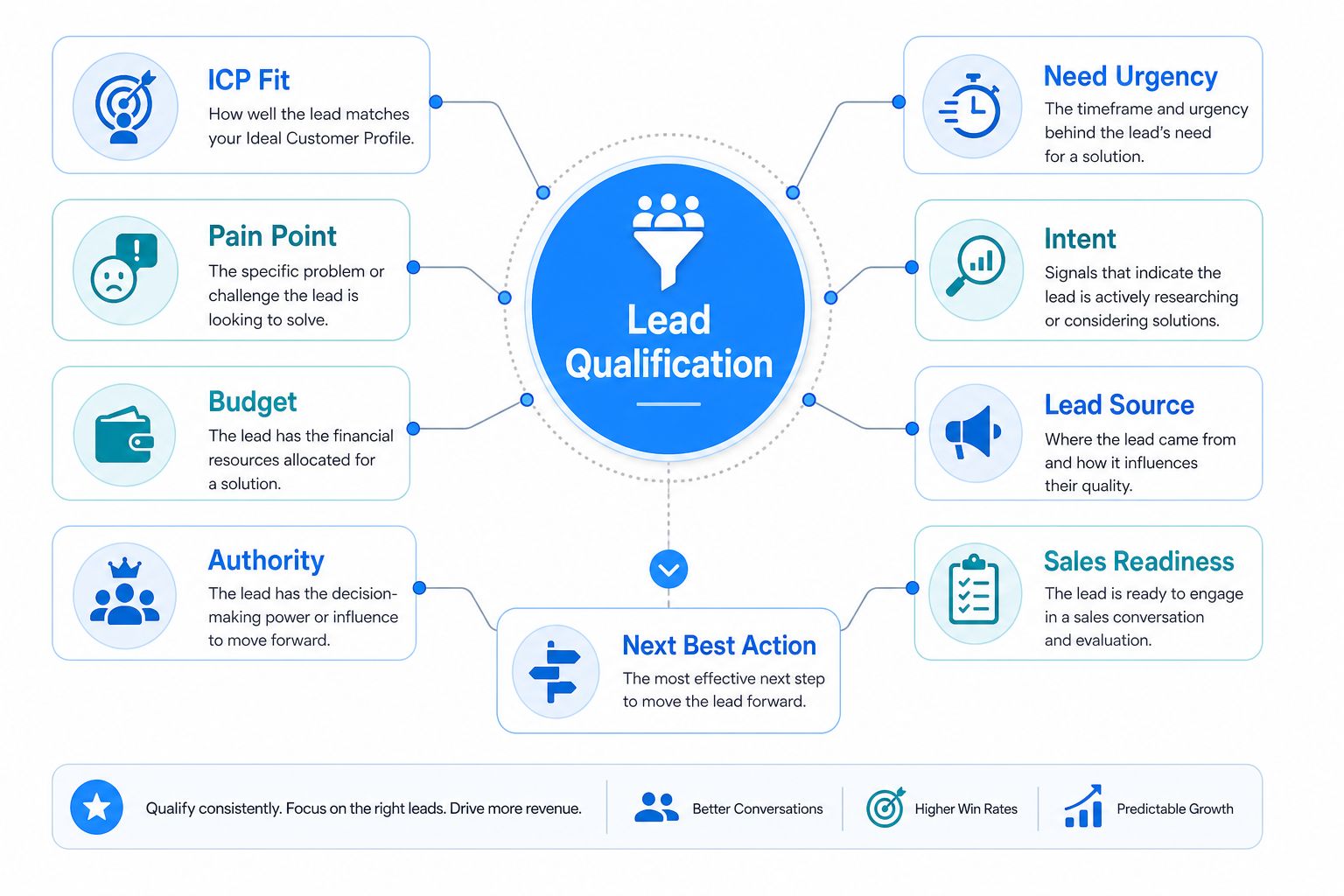
An SDR can have a full queue and still spend most of the day on people who were never going to buy. That's the core problem lead qualification solves. It's not a trivia game of budget, authority, need, and timeline, it's the filter that decides which prospects deserve sales attention and which ones should be routed elsewhere.
Lead qualification is a control point. It separates broad interest from sales-ready opportunity by checking whether a prospect matches your ICP, has a plausible path to purchase, and is worth a rep's time. That's why strong qualification protects calendar time, inbox focus, and forecast quality at the same time.
A lot of teams talk about qualification as if it happens inside a discovery call. That's backwards. The actual work starts earlier, when your system, your scoring rules, or your rep decides whether a lead should be passed forward, nurtured, or dropped. If that decision is sloppy, your pipeline fills up with names that look active but never turn into opportunities.
The numbers make the filter visible. Across industries, the average MQL-to-SQL transition rate is 13%, which means 87% of marketing-qualified leads do not become sales-qualified leads, according to a 2024 benchmark analysis built on Salesforce's State of Sales data covering 5,500 sales professionals across 27 countries (benchmark analysis). That's why a clean definition matters, but it matters even more to understand the routing decision behind it.
Practical rule: if a lead wouldn't survive a routing decision, it isn't qualified just because someone filled out a form.
If you want a straightforward companion explanation, Salesmotion's lead qualification guide gives a solid baseline definition. For SaaS teams, the broader routing logic also shows up in workflows like Lead Printer's B2B SaaS page, where qualification sits inside the path from outreach to booked meeting.
The Funnel Math That Makes Qualification Essential
A lead only becomes useful when the routing decision is right. If a team sends too many weak fits to sales, reps spend their day sorting through noise, forecast calls drift away from reality, and acquisition spend starts funding dead ends instead of opportunities. The higher the volume, the more every misrouted name costs.
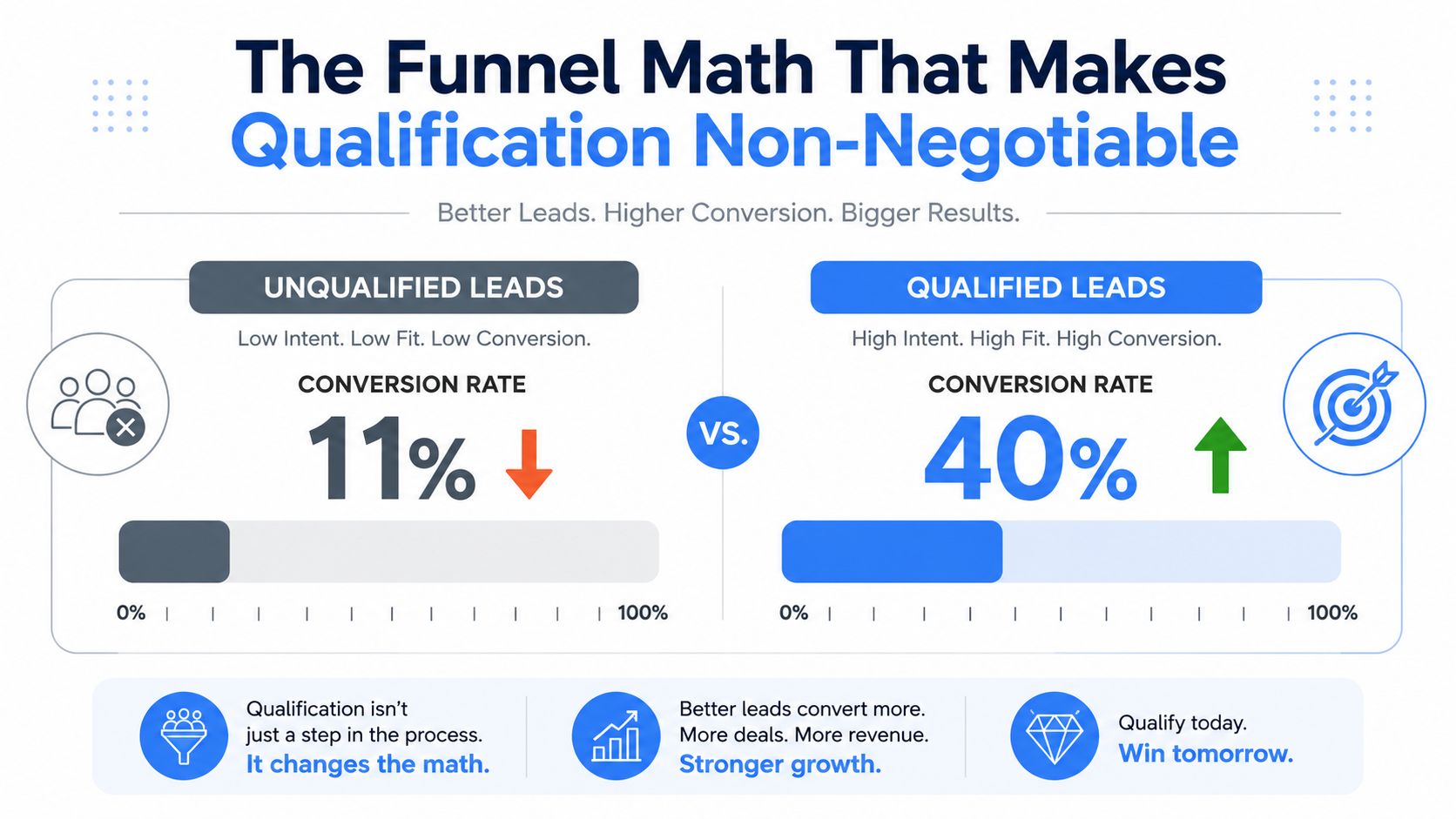
The conversion gap makes that tradeoff hard to ignore. Analysts in a 2026 industry analysis found that properly qualified leads convert at about 40%, compared with 11% for unqualified prospects (lead qualification statistics). The same analysis says 67% of lost sales stem from improper lead qualification and 79% of marketing leads never convert to sales. That does not point to a copy problem alone. It points to a funnel that is accepting too much noise and sending it forward too early.
What the math means for an outbound team
A rep who spends time on unqualified prospects does not just lose one deal. They lose the next few calls that should have gone to better-fit accounts. Qualification protects both pipeline quality and calendar time, which is why it belongs upstream of the rep's first real conversation. A cleaner handoff means less time spent trying to rescue leads after the fact.
A simple way to see it is through routing. If a lead meets the bar, it moves forward. If it does not, it gets nurtured or recycled instead of sitting in the queue and slowing everyone down. That is the difference between a working process and a pile of contacts.
Use this test: if a lead reaches sales but still needs basic fit validation, the qualification layer is doing the wrong job.
The same economics show up when teams try to forecast pipeline value before adding more rep capacity. A tool like Lead Printer's ROI calculator helps teams think through that tradeoff in concrete terms. And when the issue is not early routing but late-stage momentum, how to close the deal effectively is a useful next read, because qualification and closing are tied together whenever the funnel is too loose.
BANT, CHAMP, and MEDDIC Compared as Decision Lenses
Frameworks matter because they turn vague judgment into repeatable decisions. Without a framework, two reps can look at the same prospect and make opposite calls. That's how routing gets inconsistent and forecast confidence erodes.
The useful way to think about BANT, CHAMP, and MEDDIC is not as competing religions. They're three lenses for the same question, is this lead worth a sales conversation right now? Frameworks like these turn subjective judgment into repeatable routing rules, which is why operationalizing qualification as a scoring or classification layer improves pipeline quality and forecast confidence (framework guidance).
Where each framework fits
BANT works well when you need a fast check on whether a prospect has the basics in place. It's direct, compact, and easy for newer reps to remember. Its weakness is that it can feel rigid in deals where the buying process is spread across several people and the customer's timeline isn't cleanly stated.
CHAMP shifts the opening question toward the prospect's pain. That makes it more consultative, especially when the lead is warm enough to have a real conversation but not so hot that they're ready to buy immediately. It can still miss the complexity of bigger buying groups if the team treats it like a one-person interview.
MEDDIC is the best fit for complex deals. It gives you more surface area to understand how the purchase will happen, who influences it, and what criteria matter. The tradeoff is obvious, it takes more discipline, and it's overkill for a simple transactional sale.
BANT vs CHAMP vs MEDDIC at a glance
| Framework | Core Dimensions | Best Fit | Main Weakness |
|---|---|---|---|
| BANT | Budget, Authority, Need, Timeline | Fast qualification on simpler deals | Can feel too blunt and too one-to-one |
| CHAMP | Challenges, Authority, Money, Prioritization | Consultative conversations with warm leads | May underread buying-process complexity |
| MEDDIC | Metrics, Economic buyer, Decision criteria, Decision process, Identify pain, Champion | Enterprise and multi-step sales cycles | Requires more coordination and rigor |
The smart move is to pick the lightest framework that still matches your deal reality. Small teams often overcomplicate this and end up asking every question in every framework, which slows them down. Strong teams use a framework as a scaffold, not a script.
A framework should help a rep decide, not force them into a checklist conversation that sounds like a form reading itself aloud.
If your product sells into long procurement cycles, MEDDIC usually gives you more useful signal. If your team needs speed and consistency first, BANT or CHAMP can work as the first filter, as long as the routing rules are clear.
How Lead Scoring Models Turn Signals Into Routing Decisions
Frameworks tell reps what to look for. Scoring tells the system what to do with those signals. That's the key difference, and it's why lead scoring is the operational layer that makes qualification scale.
A good model combines explicit attributes and behavioral signals. Explicit attributes are things you can see in the record, like industry, company size, or role seniority. Behavioral signals are things the prospect does, like opening emails, clicking links, or replying to a sequence. The score is just the decision wrapper around that mix.
A simple scoring example
A VP at a 200-person fintech who opens several emails and replies to one message should not be handled like a junior marketing manager who downloaded a generic ebook. The first contact is closer to a sales path because the role, context, and engagement line up better. The second may be useful, but it's more likely to belong in nurture until stronger intent shows up.
That's why bad scoring creates two very different problems. Sometimes it routes junk to sales, which burns rep time. Sometimes it buries a strong lead in marketing because the model underweights the signals that matter to your motion.
What good routing looks like in practice
- Fit first: if the account doesn't resemble your ICP, the score should stay conservative.
- Behavior second: repeated engagement should matter more than a single passive action.
- Intent last, but not least: high-intent signals deserve a stronger route than generic interest.
- Thresholds matter: a score only works when everyone agrees what happens at each tier.
The point isn't to make scoring perfect. It's to make it consistent enough that sales knows why a lead was handed over and marketing knows why another one stayed behind. That consistency is what protects rep calendars and keeps pipeline hygiene intact.
For teams building the operational layer around this, Lead Printer's blog is one place to see how outbound workflows connect research, outreach, and qualification into one system.
Qualifying the Buying Group Instead of a Single Contact
Most old-school qualification advice assumes one contact can tell you enough. That breaks down fast in real B2B buying. Modern purchases are group-based, so the person who replies first is often not the person who can move the deal forward (B2B research on buying groups).
What changes when the buying group matters
A single champion can like your offer and still lose the deal. Procurement can stall it. A technical reviewer can reject it. An economic buyer can disappear until the end and reset the entire conversation. If qualification only measures one person's interest, you can mistake local enthusiasm for account-level readiness.
That's why account-level qualification needs to look for signals across roles. A cc'd decision-maker matters more than a lone enthusiastic reply. A second-thread conversation with a technical reviewer matters more than a polite “sounds interesting.” Even when the lead is cold, those patterns tell you whether the account is building internal consensus or just collecting information.
A qualified lead in enterprise sales is often an account signal, not a single-contact signal.
What to watch for in outbound work
- Multiple stakeholders replying: that usually means the conversation is moving beyond curiosity.
- Decision-makers joining late: that can indicate momentum, or a late-stage blocker.
- Role diversity in the thread: finance, operations, and technical contacts often signal real evaluation.
- One-contact enthusiasm with no internal spread: that usually means the deal is still fragile.
A lot of qualification playbooks stay too shallow. They stop at fit and budget, then call it done. In larger US, UK, and EU accounts, the critical question is whether the account, not just the contact, is ready to move.
The Handoff Moment and How Leads Reach Sales
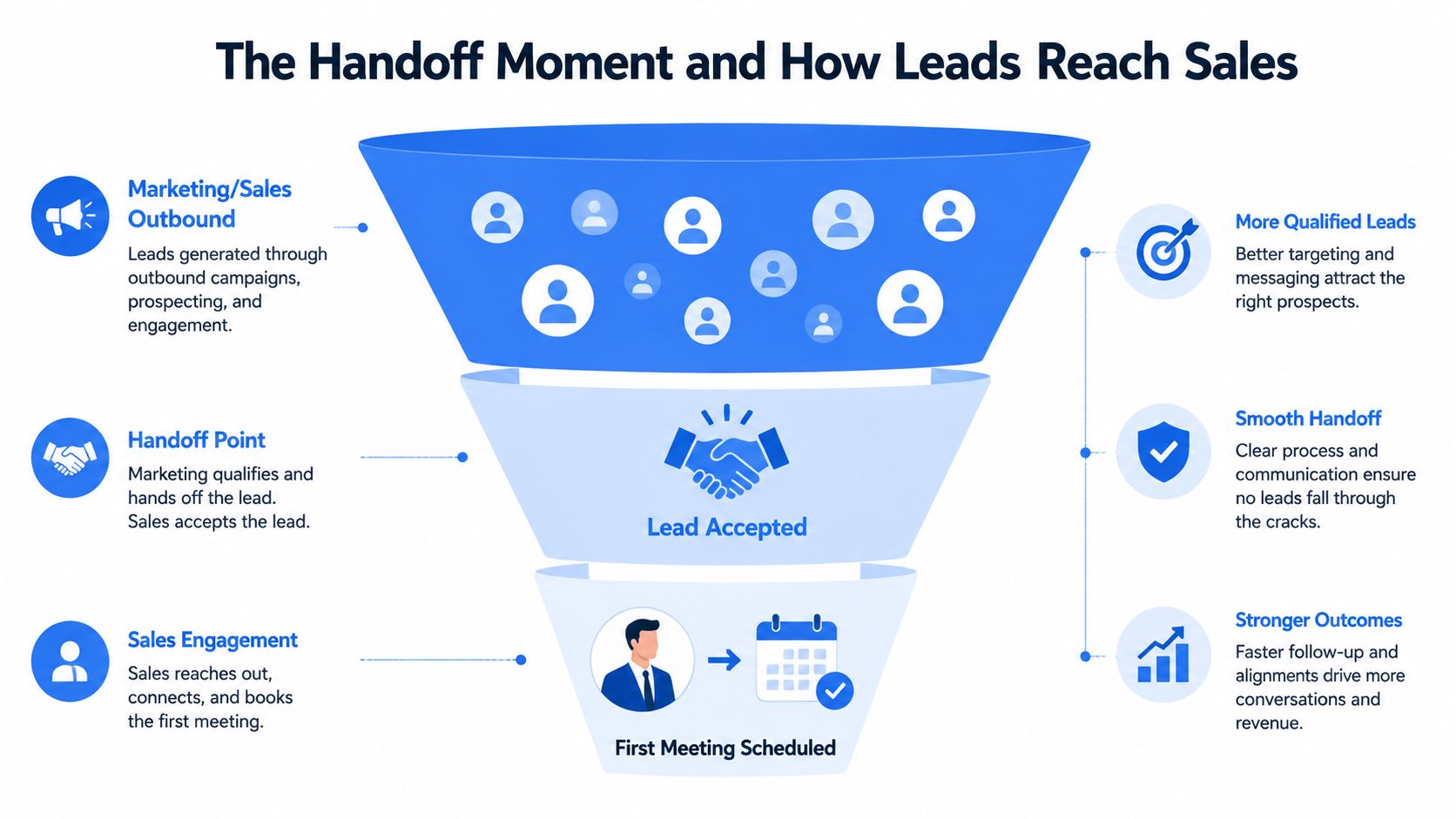
The handoff is where qualification becomes visible. A prospect replies to a cold sequence, the SDR checks fit and intent, and then someone makes the routing call. If the lead clears the bar, it gets booked. If it doesn't, it gets redirected before it can clog the rep's day.
What happens at the gate
The rep's job here is not to keep every conversation alive. It's to protect the calendar. A lead that matches the ICP, shows plausible intent, and has a reasonable path to purchase moves into discovery. A lead that fails those checks goes to nurture, gets recycled for a later date, or gets dropped.
That's why explicit handoff criteria matter. Without them, sales starts accepting leads that marketing considered “maybe,” and the team spends time chasing contacts that were never going to convert. The handoff isn't just administrative, it's where your process prevents waste.
A practical routing pattern
- Accepted to sales: clear fit, real need, and enough readiness to justify a meeting.
- Moved to nurture: useful account, but timing or priority is missing.
- Recycled later: there's a reason to revisit, but not now.
- Dropped: the account is wrong, unreachable, or outside the ICP.
The biggest mistake is treating acceptance as the end of qualification. It isn't. It's the first point where sales says, out loud or in the CRM, that the lead has earned more time. If that standard is vague, reps end up negotiating with their own process every morning.
Building a Qualification Layer That Actually Holds Up
A real qualification layer shows up in the same places every week. The MQL-to-SQL ratio stays understandable. SQL-to-opportunity movement stays stable enough to forecast against. Reps aren't flooded with bad meetings. Sales rejects are tracked and used to adjust scoring and routing.
The signals that tell you it's working
- Consistent routing: similar leads land in similar places, not random ones.
- Protected rep time: AEs spend less time on leads that should've stayed in nurture.
- Clear rejection reasons: sales can explain why a lead didn't move forward.
- Feedback loops: marketing and sales use the same rejection patterns to tune the model.
The failure modes are just as important. If your team over-relies on a single first-party signal, like a demo request, you'll miss the weaker but still useful cues that cold outbound produces. If the ICP goes stale, the scoring layer degrades. If thresholds are too loose, the system starts routing hopes instead of opportunities.
The hard part is that cold outbound often deals in probability, not certainty. You're inferring fit from noisy signals, not waiting for a prospect to raise their hand. That's why strong teams define when a lead goes to sales, when it stays in nurture, and when it should be ignored until the data changes.
Qualification works when it removes arguments from the handoff. It fails when every lead needs a debate.
If your team wants a cleaner outbound system, start with the routing rules, not the questions. Lead Printer builds data-driven outbound campaigns, lead qualification, and calendar handoff workflows for B2B teams that need meeting-ready opportunities, so if you're tightening that layer now, visit Lead Printer and see how the process fits your funnel.