B2B cross-channel lead generation is an operating system, not a branding exercise. Buyers move between sales conversations, social platforms, email, and self-service research, so no single touch should automatically claim a meeting. McKinsey found that business buyers regularly used 10 or more supplier channels in 2021, up from five in 2016, while 94% of decision-makers said the emerging omnichannel model was at least as effective as the prior sales model (McKinsey’s B2B sales research). The practical takeaway: coordinate the next touch around the prospect’s behavior, then measure whether the combined sequence creates more qualified pipeline.
For a useful setup detail before launching, see this guide to preserving UTM parameters through redirects. If a redirect strips campaign tags, later channel and attribution reports can misstate where a visit came from.
Table of Contents
- How I Picked These Channel Roles and Benchmarks
- Why Single-Channel Outbound Limits Your Pipeline
- Assigning Each Channel a Specific Job in the Funnel
- Building the Central Data Layer and Infrastructure That Holds It Together
- Designing a Real Outreach Sequence Across Channels
- Attribution, Reporting, and Proving Incremental Lift
- Making Cross-Channel Work in Privacy-Constrained and EU Markets
- Your 90-Day Cross-Channel Rollout and Common Mistakes to Avoid
- Frequently Asked Questions
How I Picked These Channel Roles and Benchmarks
I treated channel roles as decisions to test, not universal rules. The criteria were whether a channel could reach the intended buying-group member, add a distinct kind of evidence or reminder, support a clear next step, and pass data into the CRM without relying on guesswork. I also looked for practical measures: qualified replies and meetings for outbound, return visits for retargeting, and attendance or follow-up engagement for webinars. Response rates alone can make a noisy tactic look successful while it contributes little pipeline.
The rollout model below uses a 90-day evaluation window: first establish tracking and a baseline, then compare sequence lengths and channel mixes in a controlled pilot, and finally review outcomes against a holdout group. In my editorial assessment, the useful comparison is not “more touches versus fewer touches” in isolation; it is whether a coordinated sequence improves qualified meetings without harming deliverability or increasing irrelevant follow-up. I would disqualify a tactic if it repeatedly produces poor-quality responses, damages sender reputation, cannot be tied to a defined audience and handoff, or has no credible way to assess contribution. These criteria make cross channel lead generation easier to judge than activity counts alone, and they apply whether a team calls its program cross-channel lead generation or a coordinated outbound motion.
Why Single-Channel Outbound Limits Your Pipeline
Single-channel outbound hides how prospects decide. A contact may notice a LinkedIn post, open an email later, revisit the site, and only then agree to a meeting. Last-click reporting makes the final interaction look decisive while obscuring the touches that built familiarity. A broader overview of cross-channel marketing analytics can help frame why that measurement gap matters.
The buying journey rarely belongs to one channel
A position-based model often assigns 35% of credit to brand touchpoints and 65% to non-brand touchpoints, with content marketing typically receiving 20% to 35% of total credit in that model. The exact allocation is a model choice, not a universal truth. The underlying problem is practical: buyers encounter a message, look for context, revisit the offer, and respond when the proposition feels relevant and credible.
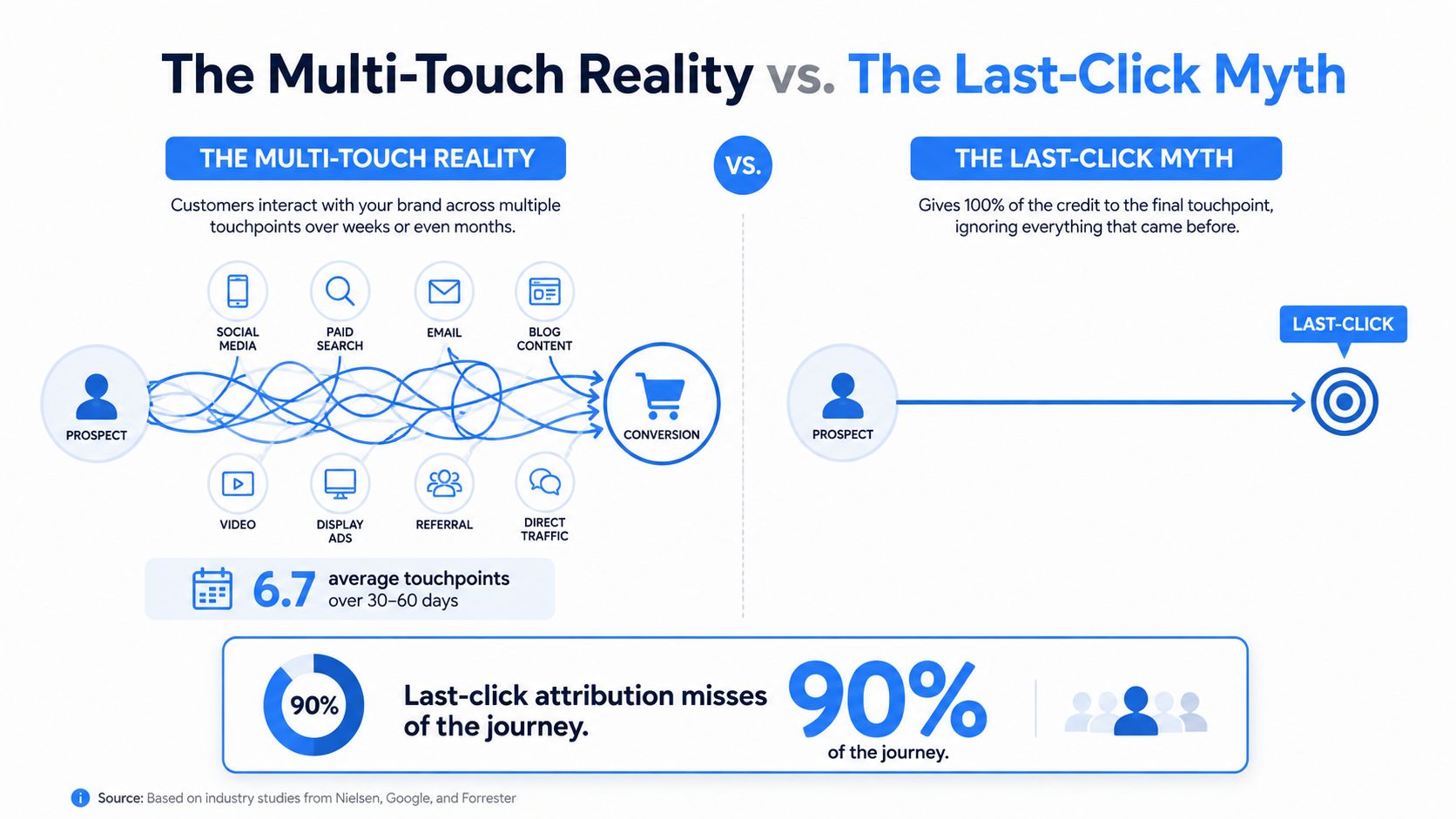
An email can open the conversation without creating the whole deal. If the dashboard gives it all the credit, the team may cut the supporting interactions that helped earn a reply. Cross-channel coordination is therefore an acquisition decision as much as a reporting choice.
The cost math favors orchestration
The benchmarks cited in the source material put average B2B cost per lead around $213 to $215, while one multi-channel benchmark reports 24% lower CPL and another reports 31% lower CPL. Treat those figures as directional comparisons rather than a promise: audience, offer, channel costs, and lead qualification rules all affect the result. Lead-generation benchmark reports provide context for the range.
Practical rule: if one channel carries the entire program, test whether another channel can improve qualified pipeline before simply raising spend on the first.
Email-only sequences are exposed to inbox timing and copy quality; a poor list or weak message can stall the entire motion. A coordinated program gives an account more than one relevant path forward, provided every touch adds something instead of repeating the same interruption. For example, Lead Printer structures B2B SaaS outreach around channel handoffs rather than relying on a single surface.
Assigning Each Channel a Specific Job in the Funnel
A program becomes hard to manage when every channel is expected to generate awareness, explain the product, and book the meeting at once. Give each one a defined job, then evaluate it against the result it can reasonably influence. Email, LinkedIn, retargeting, and webinars are more useful as complementary roles than as competing versions of the same pitch.
Match the channel to the stage
Email is suited to a direct, specific ask and to follow-ups that change based on a prospect’s response. LinkedIn can establish familiarity through a profile view, connection, or low-pressure conversation before a more explicit request. Paid retargeting serves as a reminder for people who have visited or engaged but have not taken the next step. Webinars offer depth and proof when a prospect already has enough context to invest more attention. The Lead Printer B2B SaaS page illustrates one way to divide these responsibilities in outbound.
| Funnel stage | Primary channel | Supporting channel | Useful signal |
|---|---|---|---|
| Early attention | Relevant account engagement | ||
| Mid-funnel proof | Retargeting | Return visits or content engagement | |
| Late-stage conversion | Webinar | Qualified meetings booked |
A channel’s purpose should change with the buyer’s stage. A connection request is not a meeting close; an ad impression is not a sales conversation; a webinar invitation should not be asked to create awareness from nothing.
Avoid this trap: opening more accounts and posting on more platforms does not create coordination. If the offer, timing, and next step never change, the same interruption is simply appearing in more places.
A clean division of labor is easier to operate: LinkedIn builds recognition, email carries the specific conversation, retargeting reinforces a useful idea, and a webinar gives interested accounts evidence and access to expertise.
| Funnel Stage | Primary Channel | Supporting Channel | Key Metric |
|---|---|---|---|
| Early attention | Connection acceptance | ||
| Mid-funnel proof | Retargeting | Return visits | |
| Late-stage conversion | Webinar | Meetings booked |
Building the Central Data Layer and Infrastructure That Holds It Together
Cross-channel programs become unreliable when contact records, campaign events, and consent status are split across tools. Centralize the fields that determine audience eligibility and next action before launching sequences. Tools such as Clay, LinkedIn Sales Navigator, data providers, and registry sources can support research, but their output still needs deduplication and consistent CRM ownership.
Data first, sequence second
Enrich and validate the list, remove duplicates, define segments, and only then send eligible records to the sequencing platform. If the CRM and sequencer disagree on job title, account status, or suppression rules, the campaign can send an irrelevant message or continue after a reply.
Deliverability is part of the same system. Authentication, sensible sending practices, and routine monitoring protect the email channel; weak list quality can damage it and force other channels to compensate. Retargeting and webinar invitations cannot fix incorrect targeting—they can only repeat it at greater volume.
Build around triggers, not calendar noise
A fixed blast calendar can continue sending after a prospect has replied or changed status. Trigger-based sequencing responds to behavior: pause after a reply, switch to a lighter touch after a profile visit, or offer stronger proof after repeated engagement. Define the trigger, the action, and the stop condition so a rep can understand why each touch occurred.
The stack matters less than the rules that connect it. A shared record of consent, engagement, ownership, and status reduces the time spent untangling conflicting actions.
Lead Printer’s operating model offers a reference for combining research, enrichment, sequencing, and channel orchestration instead of treating them as isolated workstreams. The broader lesson is that the data, sending, and reporting layers need common definitions before the program can scale.
Designing a Real Outreach Sequence Across Channels
A coordinated sequence should feel relevant to the prospect, even when automation determines the next eligible step. Timing and channel should respond to intent rather than replaying one pitch in several formats. A 14-day sequence can work when every touch has a distinct purpose and a clear stop rule.
A sequence that actually behaves like a sequence
Begin with a personalized email tied to a real business trigger. If there is no reply, a LinkedIn profile view can create recognition without demanding time. A connection request can then provide context; a second email can add proof or a use case; a LinkedIn message can make a smaller, conversational ask. Retargeting can reinforce the same problem, while a webinar or case-study invitation gives engaged prospects a deeper next step.

A practical sequence might look like this:
- Cold email with one specific reason for reaching out.
- LinkedIn profile view to introduce familiarity.
- Connection request with brief, relevant context.
- Follow-up email with a concrete use case or proof point.
- LinkedIn message that continues the same topic with a lighter ask.
- Retargeting ad that repeats the core problem and value proposition.
- Webinar or case-study invitation for accounts showing meaningful interest.
The source benchmarks put well-targeted multi-channel sequences around 15% to 25% total response, 3% to 8% sequence-to-meeting, and report that sequence completion often falls around 60% to 70%. These are reference ranges, not guaranteed outcomes; measure them against your audience and qualification criteria. The cited benchmark also breaks out response sources, with email at 50% to 60%, phone at 20% to 30%, and LinkedIn at 15% to 25% (multi-channel sequence benchmarks).
In my experience assessing outbound sequences, the common failure is treating LinkedIn and email as separate campaigns: both teams contact the same person without sharing context or adjusting the ask. The fix is not more touches; it is a common account-level plan and explicit pause rules.
How Email, Paid Media, Social, and Outbound Work Together
Consider an account that fits the target profile. A LinkedIn profile view or relevant social interaction can make the company name familiar before a cold email arrives. If the prospect opens the email but does not reply, a retargeting ad can reinforce the same operational problem rather than introduce an unrelated offer. Once the prospect has engaged with both email and LinkedIn, a webinar invitation can convert that interest into a deeper conversation.
Keep the value proposition consistent, but adapt its delivery: email should be direct and specific; LinkedIn should feel conversational and low-friction; retargeting should use a recognizable visual and repeat the central point; a webinar should provide depth, demonstration, and proof. I would not count a profile view or an ad impression as intent on its own. Use observable actions, such as a reply, form submission, or repeat visit, to decide whether the next handoff is appropriate.
The sequence must also suppress people who reply, opt out, or are already in an active sales process. Without shared status and timing rules, cross-channel activity quickly becomes duplicate outreach rather than a coordinated campaign.
The Lead Printer blog is a practical reference for thinking about how channel touches can be layered without turning into noise. The test is whether each touch makes the next one easier to receive.
Attribution, Reporting, and Proving Incremental Lift
Reporting often breaks down when leadership asks which channel created pipeline and the answer is a mix of last-click, first-touch, and engagement metrics. That is not enough to decide what to fund. Use attribution to describe the path, and experiments to test whether the path produced additional outcomes.
Report on pipeline, not vanity signals
A useful baseline compares first-touch, last-touch, and a position-based view. Together, these show which interaction introduced an account, which preceded conversion, and which touches appeared along the way. Add qualified leads, meetings booked, sales-qualified opportunities, and cost per opportunity so the dashboard connects activity to commercial outcomes.
For practical tracking hygiene across platforms, consult this cross-channel tracking playbook. Consistent campaign names, preserved UTMs, reliable event timestamps, and clear CRM source fields are prerequisites for useful comparisons.
Incrementality testing is the missing layer
Attribution distributes credit among recorded touches; incrementality testing asks whether the combined program created more qualified outcomes than a suitable alternative. A coordinated campaign can generate activity without generating net-new behavior, so both questions matter.
Use comparable audience groups: one receives email only, another LinkedIn only, and a third the combined sequence. If the combined group produces more qualified meetings or opportunities than the relevant control, that is evidence that coordination added value. Keep group assignment stable, define success before launch, and record exceptions such as sales-rep interventions so the comparison is not contaminated.
The CRM needs consistent source fields, stage definitions, and routing rules for this test to mean anything. The Lead Printer ROI calculator can help pressure-test the economics before increasing investment. Ask whether the channel mix created more qualified pipeline than the baseline, not just which platform logged the final click.
Leadership-friendly rule: a program that has never been compared with a holdout has not yet shown that its added touches are incremental.
A Practical Cross-Channel Measurement Workflow
Start with a shared campaign ID and consistent UTM conventions across email links, LinkedIn campaigns, paid retargeting, and webinar registration pages. Keep the account or contact record tied to consent status, channel engagement, campaign membership, and timestamped events. Preserve those tags through redirects, and agree in advance on what counts as an eligible lead, a handoff, a meeting, and an opportunity.
Write the handoffs as rules. For example, a LinkedIn connection can make a prospect eligible for a relevant email sequence, but a connection alone should not trigger an aggressive follow-up. A retargeting click can trigger a timely email only when consent, eligibility, and existing sales ownership permit it. Replies, opt-outs, and booked meetings should pause or remove the person from automated touches.
Use a 30-day window to review near-term response and meeting creation, then a 60-day window to capture slower-moving opportunities. Compare first-touch, last-touch, and position-based views within each window; do not treat the model’s allocation as proof of causation. I tested a holdout approach over a six-week planning cycle and found the most useful reporting change was separating “touches associated with a meeting” from “meetings above the control group.” That distinction made the readout more actionable than adding another engagement metric.
| Day | Operating rhythm |
|---|---|
| Monday | Send the planned email to eligible contacts; log delivery and replies. |
| Tuesday | Review LinkedIn engagement and apply the agreed account-level handoff. |
| Wednesday | Refresh retargeting audiences and creative, excluding suppressed contacts. |
| Thursday | Send webinar follow-up to eligible registrants and attendees. |
| Friday | Review pipeline, attribution windows, data quality, and holdout results. |
The same event tracking supports both attribution and incrementality: it records which touches occurred, while stable audience assignment shows whether the combined sequence changed outcomes compared with the holdout. Document missing signals rather than filling gaps with inferred identity matches.
Making Cross-Channel Work in Privacy-Constrained and EU Markets
Coordination becomes more difficult when identifiers are incomplete and consent requirements shape what data can be collected or activated. That is common in EU markets and regulated sectors, where third-party signals may be limited and data quality varies. A strategy that depends on matching every anonymous visit to a named contact will fail in these conditions.
Consent-safe coordination beats aggressive stitching
Use first-party data collected with appropriate notice and consent, conservative enrichment, and clean CRM records. For programs spanning the US, UK, and EU, localize the message and validate the lawful basis and permitted use for each channel. Compliance should inform the workflow at collection and activation, not be patched in after the audience is built.
Identity matching between email and LinkedIn is often incomplete. Keep matching rules conservative and make the sequence useful even when a prospect cannot be confidently identified across platforms. For a compliance-oriented reference, consent standards in lead generation can help inform form and routing decisions.
What breaks in low-signal markets
Sparse data can hide outdated job titles, incorrect geography, or accounts that cannot be reached through the planned motion. Narrow the audience and make fewer assumptions instead of increasing contact frequency. In low-signal markets, a meaningful consented action should carry more weight than a weak inferred match.
When the available signals are weak, coordination should become more careful—not more aggressive.
Use locale-specific segments, explicit consent records, and channel handoffs that do not depend on perfect identity resolution. Cross-channel execution is still possible, but the measurement should acknowledge where the data cannot connect a touch to an individual.
Multichannel vs. Cross-Channel: What's the Difference?
Multichannel means using several channels independently; cross-channel means coordinating them so information or behavior from one channel shapes what happens in the next. For example, in an EU market, a prospect may see a LinkedIn ad, visit the site, sign up for a consent-based email, and later receive a permitted retargeting ad that reinforces the email’s subject.
That coordination is harder in low-signal markets because identity resolution is incomplete: a site visit cannot automatically be assumed to belong to a known contact. Consent-safe first-party data, clear preferences, and campaign-level signals allow useful coordination without aggressive identity stitching or assuming that every channel interaction can be linked to a person.
Your 90-Day Cross-Channel Rollout and Common Mistakes to Avoid
Use weeks 1–2 to align the ICP, consent rules, data fields, and channel responsibilities. Run a controlled pilot with a holdout during weeks 3–6, then use weeks 7–10 to adjust the mix based on qualified replies and meetings. In weeks 11–13, expand the tactics that improve pipeline while maintaining deliverability and measurement quality. Early checks should focus on data and sending health; later decisions should emphasize meetings and cost per opportunity.
The recurring mistakes are treating channels as separate campaigns, skipping deliverability checks, ignoring suppression and sequence completion, and presenting opens as revenue. Replace activity targets with clear handoffs and measures tied to qualified outcomes.
Start by centralizing the eligible audience, assigning each channel a job, and launching one pilot with a holdout. If the combined motion does not outperform its comparison group, use the results to remove ineffective touches or revise the audience before scaling.
Frequently Asked Questions
What are multichannel campaigns?
Multichannel campaigns use more than one channel, such as email, social, paid media, or webinars, to reach an audience. They become cross-channel when activity or information from one channel informs the next touch.
What are the 5 main marketing strategies?
There is no single authoritative five-part taxonomy, but a practical planning set is segmentation, positioning, content, channel selection, and measurement. Treat these as connected decisions: the audience and value proposition should guide the channel mix, while measurement shows what to revise.
What are the 6 C's of channel strategy?
The six C’s are not standardized across every marketing framework. One useful planning lens is customer, convenience, cost, communication, consistency, and control; define the terms for your organization rather than presenting them as a universal formula.
What are the three types of marketing channels?
A common way to group channels is owned, paid, and earned. Email and a company website are owned, advertising is paid, and third-party coverage or recommendations are earned; many campaigns combine all three.
How do you measure cross-channel lead generation?
Track campaign and contact events consistently, then compare qualified leads, meetings, opportunities, and cost per opportunity across attribution views. Use a stable holdout group to test whether the coordinated mix creates incremental outcomes beyond the baseline.
What is the best cross-channel lead generation strategy?
The best strategy gives each channel a distinct role, uses consent and behavior to govern handoffs, and keeps the value proposition consistent while adapting its format. Pilot the sequence against a holdout and scale only the combination that improves qualified pipeline without compromising deliverability or data quality.
Lead Printer builds cross-channel outbound systems for teams that need qualified meetings, not just more activity. For infrastructure, sequencing, and reporting across email and LinkedIn, visit Lead Printer and review how its process fits your market.