
You're staring at a dashboard that says the campaign delivered, the inboxes are supposedly “healthy,” and yet the reply column is dead. That gap is why email deliverability rate matters so much in B2B, because the number often celebrated is the one least connected to meetings. A message can be accepted by the receiving server and still miss the inbox, land in spam, or disappear before a buyer ever sees it, which is why the practical question isn't “did it send,” it's “did it create a real chance to get read and answered.”
That distinction becomes even more important when your outbound motion scales, because a program built for AI email at scale still lives or dies on mailbox behavior, not just sending volume. If you're running a B2B sequence platform like the one described in Lead Printer's B2B SaaS use case, the right lens is simple, measure placement, not just acceptance, then tie every sending decision to engagement.
Why Email Deliverability Rate Matters More Than Ever for B2B Senders
A campaign can look strong on paper and still fail in the one place that matters, the inbox. That's the trap B2B teams fall into when they treat delivery as proof of reach. Mailbox providers do not reward acceptance alone, they reward behavior, and that makes the email deliverability rate a much more operational metric than most dashboards suggest.
The number that changes pipeline
Mailbox placement is where pipeline is won or lost. If the receiving provider routes the message to spam, Promotions, or quarantine, the send may count as delivered while the buyer never sees it. That gap is why outbound teams need to care about placement quality, not just server acceptance.
The practical risk shows up in the details. A campaign can post clean delivery logs and still underperform if Gmail, Microsoft, Yahoo, or AOL are filtering it differently. That is also why teams using AI email at scale still need to watch how each mailbox treats their mail, because volume does not repair weak trust.
Why B2B teams should think in placement, not send success
Mailbox providers judge sender trust through what happens after the message lands. Sender reputation, recipient engagement, and complaint behavior carry more weight than authentication alone. For outbound teams, the practical takeaway is simple, if the inbox does not trust the mail, replies will not follow.
Practical rule: treat deliverability as a revenue input, not a technical hygiene metric.
The point matters even more in B2B SaaS workflows built around Lead Printer's B2B SaaS use case. A sequence can be technically valid and still fail commercially if the provider sees low engagement or rising complaints. In that environment, delivery is only the starting line.
Delivery Rate vs Inbox Placement Rate
A clean delivery rate can look reassuring in a dashboard and still leave the pipeline empty. The mistake is treating delivery and inbox placement rate as the same signal. Delivery only shows that the receiving server accepted the message. Inbox placement shows whether that message reached the inbox, got filtered into spam or Promotions, or landed somewhere the buyer is unlikely to notice.
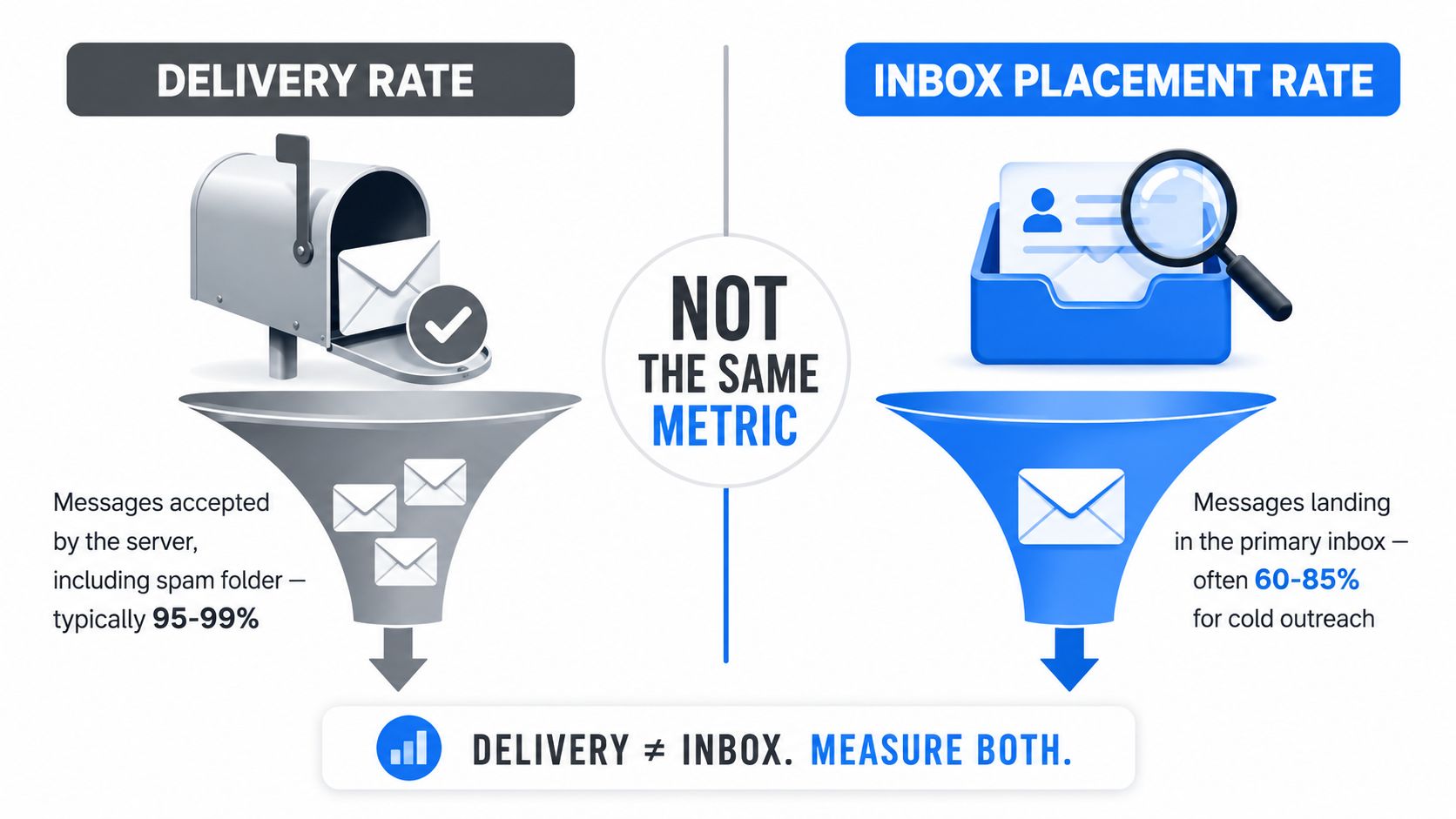
That gap matters in day-to-day outbound work. A sequence can post strong delivery logs and still generate no replies if mailbox providers route it away from the primary inbox. The sending setup may look healthy, yet the buyer never gets a fair chance to see the message. A program can even appear stable while its real reach erodes campaign by campaign.
What each metric proves
Delivery rate proves the handoff between your sending system and the recipient's mail server. It does not prove visibility, attention, or even that the message reached a place a buyer will open. Inbox placement carries more operational value because it shows where the message surfaced inside the mailbox experience.
This is also where the numbers can mislead teams that only watch one layer. In the 2024 EmailTooltester deliverability tests, placement varied sharply by provider, with Gmail, Microsoft, Yahoo, and AOL each behaving differently. That spread is the point. A single blended number hides how much the recipient ecosystem shapes outcomes, and an ROI calculator for outbound email is only useful if you feed it the right placement assumptions.
Why this distinction changes diagnosis
When delivery looks strong and replies stay weak, copy is not always the first problem to fix. Sometimes the sequence is technically sound, but reputation is uneven across mailbox families. Sometimes the list is too cold, the targeting is off, or prior complaint behavior has already pushed messages into a worse folder.
Mailbox providers now judge sender quality through what happens after acceptance. Sender reputation, recipient engagement, and complaint patterns shape future placement far more than authentication alone. In practice, that means a sender can clear the technical checks and still lose the buying moment if the mailbox trust signal is weak.
Delivery tells you the server accepted the message. Placement tells you whether the buyer actually had a real shot at seeing it.
That is the difference that keeps teams from optimizing the wrong problem first.
How to Measure Inbox Placement
Once delivery is no longer treated as the finish line, measurement has to get more specific. Placement is not something you infer from a single dashboard. It comes from combining real inbox tests, provider-level reputation signals, and what happens after the send, because each layer can point to a different failure.
The signals that give usable evidence
Seed-list testing is still the clearest read. Send to known test mailboxes across major providers and check whether the message lands in the primary inbox, spam, or another folder. That gives you a practical warning before a broader send turns into a reputation problem.
Provider tools add a different layer of visibility. Google Postmaster Tools and Microsoft SNDS show mailbox-level reputation and complaint-related signal, but they do not replace campaign analytics. Sender-score style tools can help with directional monitoring, and inbox-placement APIs can probe mailboxes programmatically to see how filters behave across providers.
The point is to separate the layer that moved. Sender reputation, list quality, content, and provider-specific filtering do not fail in the same way, and they do not recover on the same timeline.
What deserves attention first
Open rates used to look useful, but they are too noisy to steer deliverability decisions on their own. Complaint trends, reply behavior, and placement tests are more actionable because they show what mailbox providers and recipients are doing after acceptance. If those signals drift, the sending system changed somewhere, even when the headline delivery number holds steady.
For teams wiring this into forms or automations, Formcarry's Gmail SMTP setup guidance is useful context if you need a cleaner sending path for transactional or workflow mail.
The practical rule is simple. If you cannot check placement regularly, you are managing deliverability by memory.
A strong measurement setup tells you more than whether mail left the platform. It shows whether the right recipients had a real shot at seeing it, and whether engagement is strong enough to keep future placement intact.
Industry Benchmarks You Can Plan Against
Benchmarks only help if they're tied to the kind of mail you send. B2B cold outreach, retention mail, and ABM sequences don't live in the same environment, so a single “good” number is misleading. The right question is whether your program is operating inside the band that matches your vertical and audience intent.
| Realistic Inbox Placement Ranges by Industry | Healthy Range | Watch Range | Stop and Audit |
|---|---|---|---|
| B2B SaaS cold outreach | Strong performance is usually near the upper end of the market | Any sustained softness in placement needs review | If replies fall while delivery looks fine, audit immediately |
| Ecommerce retention and promotional sends | Healthy when loyal audiences keep receiving the mail consistently | Watch for drops tied to list fatigue or segmentation drift | Stop and audit when complaint behavior starts rising |
| Fintech and payment provider campaigns | Healthy when compliance-heavy messaging still reaches the inbox reliably | Watch for stricter filtering after content changes | Audit fast if placement becomes erratic across providers |
| Professional services nurture | Healthy when long-cycle nurture keeps steady placement and visibility | Watch when engagement falls even though sending volume stays stable | Stop and audit if new content shifts performance sharply |
| Manufacturers running ABM sequences | Healthy when recipient-specific outreach stays visible to named accounts | Watch if the same sequence underperforms across segments | Audit if placement weakens in one provider family |
How to read the table
Use the table as a triage tool, not a brag sheet. Cold outbound is usually the tightest environment because recipients didn't ask for the relationship, so even small placement problems show up fast in replies. Retention and nurture lists can tolerate more drift, but only as long as engagement stays healthy.
If you want to estimate whether your current motion is inside the right band, the Lead Printer ROI calculator is a useful way to connect placement quality to meeting outcomes without pretending the metric lives in a vacuum.
The threshold that matters most
For a B2B operator, the danger zone isn't just a low number, it's a mismatch between delivery and response. When one provider family underperforms while others stay healthy, that usually points to ecosystem-specific filtering, not a universal copy issue. When all providers soften together, list quality, reputation, or engagement signals are usually the more likely cause.
The Tracking Stack a Practitioner Should Stand Up
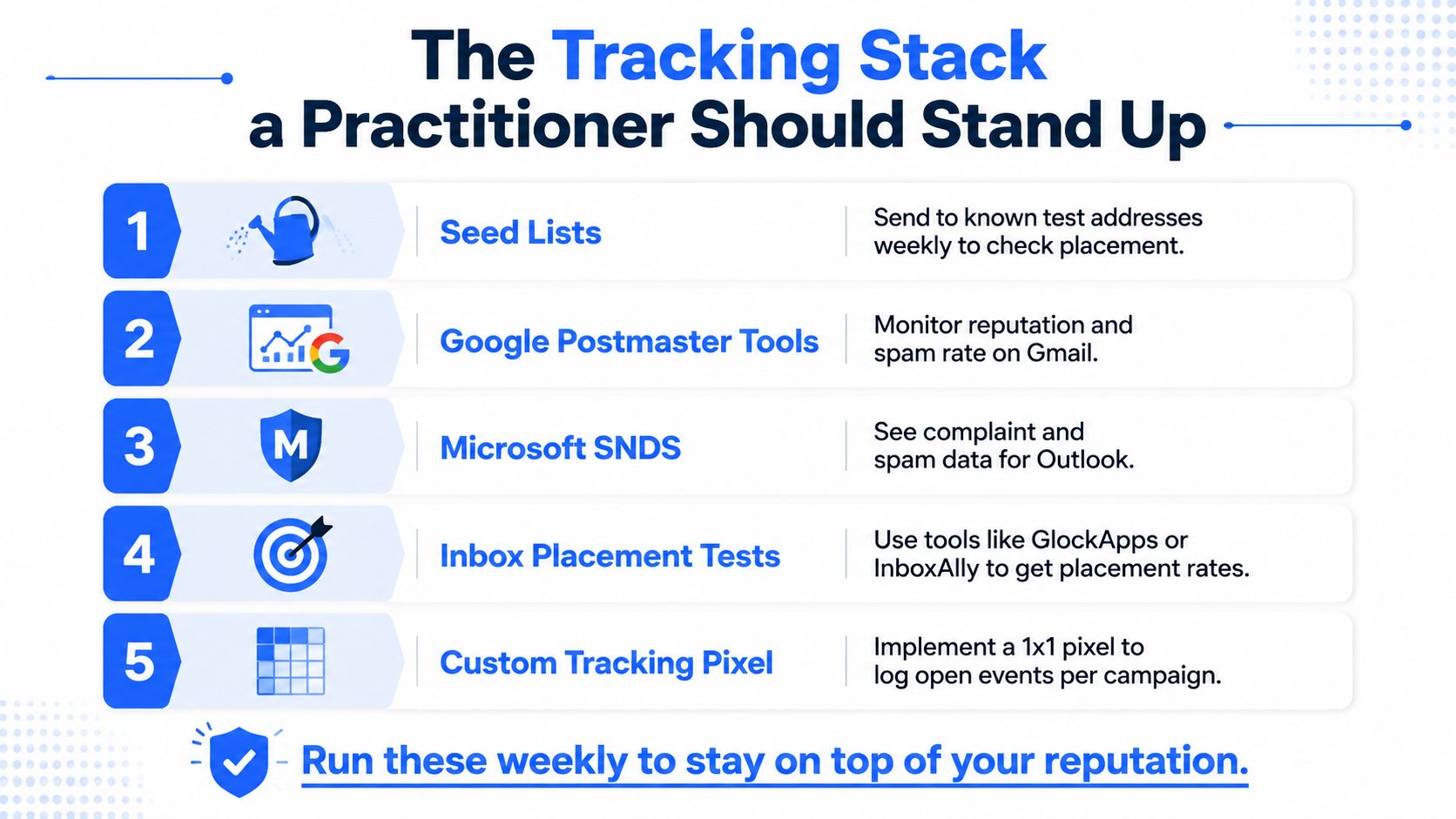
A serious outbound team does not need another dashboard. It needs a review cadence that ties placement, provider health, and reply behavior together before a bad pattern turns into a pipeline problem. The useful stack is the one that shows you where mail lands, how each mailbox provider is treating you, and whether real buyers are engaging in a way that supports future placement.
What to put in the weekly review
- Seed lists. Send to known test inboxes on a fixed cadence so you can see whether messages are still landing where they should before a full sequence starts drifting.
- Google Postmaster Tools. Watch Gmail reputation and spam-related signals there, because Gmail often shows trust problems before the rest of the program does.
- Microsoft SNDS. Use it to monitor complaint and spam data in the Outlook ecosystem, where placement can move differently from Gmail.
- Inbox placement tests. Tools like GlockApps or InboxAlly help you check where messages land across providers, which matters more than a single averaged deliverability number.
- Campaign reply tracking. Track positive replies at the sequence level, because replies are the closest operational signal to meetings and future sender trust.
That stack covers the measurement side. It also keeps the team from mistaking authentication for performance. A clean SPF, DKIM, and DMARC setup can still underperform if recipients ignore the mail, while a weaker technical setup can sometimes look acceptable until the engagement curve breaks. If you need a practical reference point for setup work, Gmail SMTP configuration for forms is a useful example of the kind of provider-specific configuration that reduces avoidable friction.
What to ignore and what not to
Raw open counts are too noisy to carry a deliverability decision by themselves. Complaint direction matters more, because a rising complaint trend tells you the audience is reacting badly even if the absolute number still looks tolerable. The same logic applies to reply behavior. Strong placement with weak replies usually means the mailbox provider is still willing to host your mail, but the message is not earning enough recipient action to protect that position for long.
Use the weekly review to answer one question first. Did placement change, and did replies change with it?
That pairing keeps the team from celebrating a technical green light while pipeline slips away.
Why Engagement Signals Now Outweigh Authentication Alone
Authentication still matters. SPF, DKIM, and DMARC remain necessary, but they do not guarantee placement on their own. Mailbox systems now look past the headers and judge how real recipients react after the message lands.
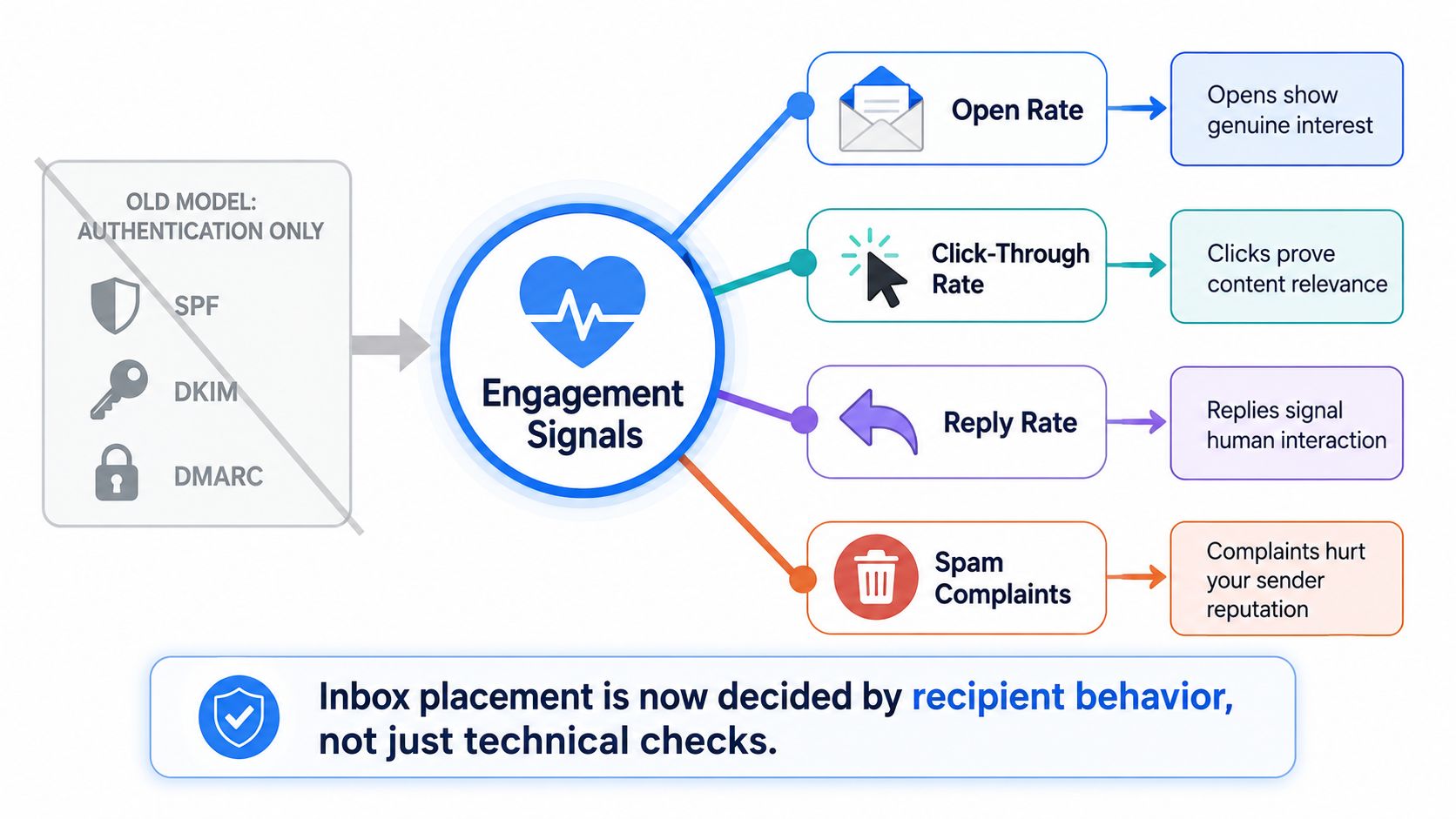
The shift in practice is simple to observe. A sender can pass every technical check and still lose placement if people ignore the mail, while another sender with less polished infrastructure can hold inbox access when targeting is tight and replies are steady. That is why modern deliverability work has moved toward recipient behavior, not just sender proof.
Analysts at InsiderOne recommend treating clicks and conversions as stronger success signals than opens, since opens are increasingly unreliable. They also point to reply rate and the direction of complaint-rate change as signals worth watching (InsiderOne 2026 email deliverability guidance). The practical takeaway is clear, technical compliance gets you into the conversation, but recipient action helps keep you there.
What mailbox providers are really watching
Clicks show relevance. Replies show human interaction. Complaints show rejection. Those signals carry more weight than a perfectly aligned authentication record when mailbox providers decide whether your next send deserves a strong landing spot.
Mailbox filters learn from behavior over time. If your list opens, clicks, and replies at healthy levels, placement is easier to defend. If engagement fades, the system starts to read the sender as less useful, even when the technical setup still looks clean.
Why this changes outbound strategy
Cold outreach cannot be managed like newsletter traffic. The message has to earn enough relevance for recipients to reply, click, or at least avoid complaint behavior. That puts targeting and offer quality beside infrastructure as primary deliverability levers.
Teams that only want a technical fix usually feel frustrated here. The mailbox provider is rewarding sender behavior that recipients validate, and that means the operational work has to include list quality, messaging fit, and follow-up discipline. If your email earns replies, placement is easier to protect.
The same pattern shows up in follow-up systems, which is why set up email follow-up triggers is worth studying as an operating pattern, not just a workflow trick.
A Prioritized Fix Playbook for Low Deliverability
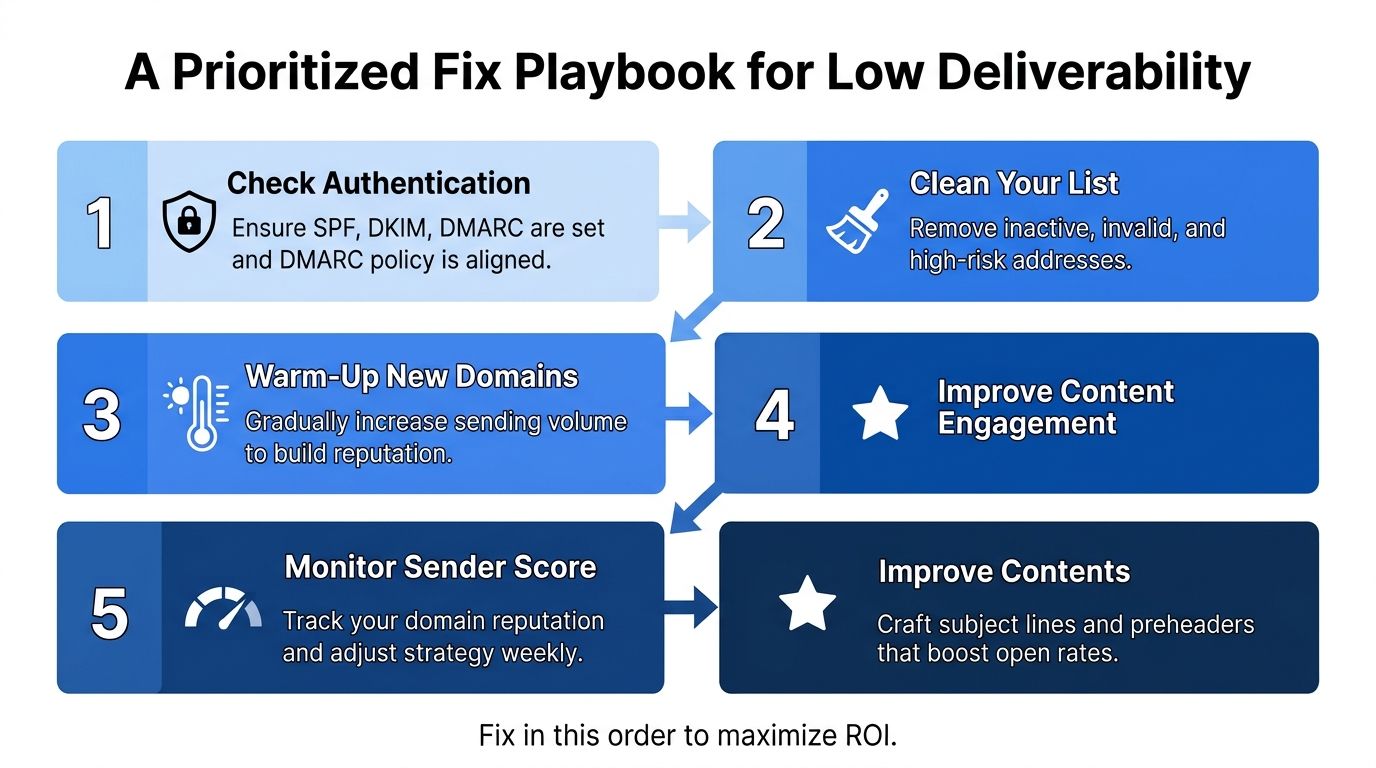
A campaign can look technically sound and still underperform in the inbox. That usually means the problem is not one thing, but a sequence of weak signals. Senior outbound teams fix the highest-probability blocker first, then move outward, because changing copy before the sender identity, list quality, or cadence is stable wastes time.
Fix the foundation first
Start with authentication. If SPF, DKIM, or DMARC is misaligned, every other diagnosis gets murkier, and mailbox providers have less reason to trust the send.
Then check reputation through postmaster tools and seed tests. If a provider already treats the domain cautiously, subject line edits will not repair that quickly. The common mistake is to jump into creative changes before confirming whether the sender identity itself is being watched closely.
Clean the list before you touch the copy
List hygiene usually pays back faster than message experimentation. Bad addresses, stale contacts, and weak suppression logic distort the signal mailbox providers see, especially in outbound where the audience starts cold. Keeping old leads in rotation because they are still in the CRM is a common way to drag a healthy campaign down.
Then review warm-up state and sending cadence. Sudden volume jumps create risk even when the content is decent. If a team is trying to automate the entire follow-up motion, set up email follow-up triggers is worth studying as an operating pattern because it forces cleaner sequencing and fewer messy send patterns. For teams building the operational stack around this work, LeadPrinter's deliverability resources can also help frame the next checks without turning the process into guesswork.
Improve the message only after the system is clean
Once the foundation is stable, rewrite the content for response, not decoration. The subject line, first line, and offer all need to make the recipient want to continue, because engagement is what mailbox systems ultimately reward. If copy is the first thing you touch, you are usually fixing the least important layer first.
High delivery does not equal high replies. In B2B outbound, the sequence has to earn enough relevance for recipients to reply, click, or at least avoid complaint behavior, and that is why message quality and targeting sit beside infrastructure as deliverability levers.
Best order: authenticate, verify reputation, clean the list, normalize cadence, then improve message quality.
That order keeps the team from chasing symptoms and makes the actual blocker show up faster.
Quick Reference Card for the Operations Lead
Use four weekly metrics. Watch inbox placement, provider reputation, reply rate, and positive reply rate. Those are the numbers that tell you whether the campaign is being seen, trusted, and acted on.
Ignore two metrics as decision-makers. Delivery rate without placement context can mislead you, and opens are too noisy to drive a serious decision on their own. They're inputs, not verdicts.
Three thresholds should trigger intervention. A sharp placement drop, a rising complaint trend, or a reply collapse across a campaign are all signs that something changed in the system. If one provider family breaks while the others hold, treat that as an ecosystem-specific issue first.
Ask one question before launching any new send pattern. If this lands well, will the recipient have a reason to reply? If the answer is fuzzy, the sequence probably needs more targeting or relevance before it needs more volume.
Frequently Asked Questions From B2B Outbound Teams
Warm-up usually matters most when the sending pattern changes, not just when a domain is brand new. If volume, audience type, or mailbox mix changes too quickly, reputation can wobble even if the infrastructure looks fine.
Shared IPs can still work for some senders, but they only make sense if the surrounding traffic is disciplined. If other senders on the same infrastructure are noisy, your program inherits part of that risk. Many B2B teams prefer more control because reputation is too important to leave partly to someone else's behavior.
A domain should be retired when placement, reputation, and engagement all stay weak after the obvious fixes. If only one layer is broken, salvage is usually possible. If every layer stays degraded, continuing to send from it just spreads the damage.
Benchmarks should be re-baselined whenever the audience, offer, or mailbox mix changes meaningfully. The safest practice is to keep a regular review rhythm and compare against your own recent history first, then compare to market norms. For more tactical reading, the Lead Printer blog is a useful place to keep up with outbound operations topics that sit close to deliverability.
Lead Printer builds and runs outbound systems that are designed around inbox placement, response quality, and meeting flow, not just send volume. If your team needs a cleaner path from deliverability to booked conversations, visit Lead Printer and see how a structured outbound program can support your pipeline.