B2B cross-channel lead generation isn't a branding exercise. A cross-channel attribution reference puts the average buying journey at 6.7 touchpoints over 30 to 60 days, which is exactly why one email or one LinkedIn DM rarely deserves full credit for a meeting. The fastest teams stop asking which channel “won” and start building systems that make every touch reinforce the next. Cross-channel attribution reference
Table of Contents
- Why Single-Channel Outbound Limits Your Pipeline
- Assigning Each Channel a Specific Job in the Funnel
- Building the Central Data Layer and Infrastructure That Holds It Together
- Designing a Real Outreach Sequence Across Channels
- Attribution, Reporting, and Proving Incremental Lift
- Making Cross-Channel Work in Privacy-Constrained and EU Markets
- Your 90-Day Cross-Channel Rollout and Common Mistakes to Avoid
Why Single-Channel Outbound Limits Your Pipeline
Single-channel outbound usually loses more deals than it can see. A prospect rarely converts because of one email, one LinkedIn touch, or one ad impression. They move through a sequence of touches, often across a month or two, and last-click reporting gives too much credit to the final interaction instead of the chain that created it. For a broader cross-channel attribution frame, see this overview of cross-channel marketing analytics.
The buying journey rarely belongs to one channel
A position-based model often assigns 35% of credit to brand touchpoints and 65% to non-brand touchpoints, with content marketing typically receiving 20% to 35% of total credit in that model. That matters because B2B buyers do not move in a straight line. They see a message in a feed, search for context, read a page, get nudged again, then respond when the offer feels familiar enough to trust.
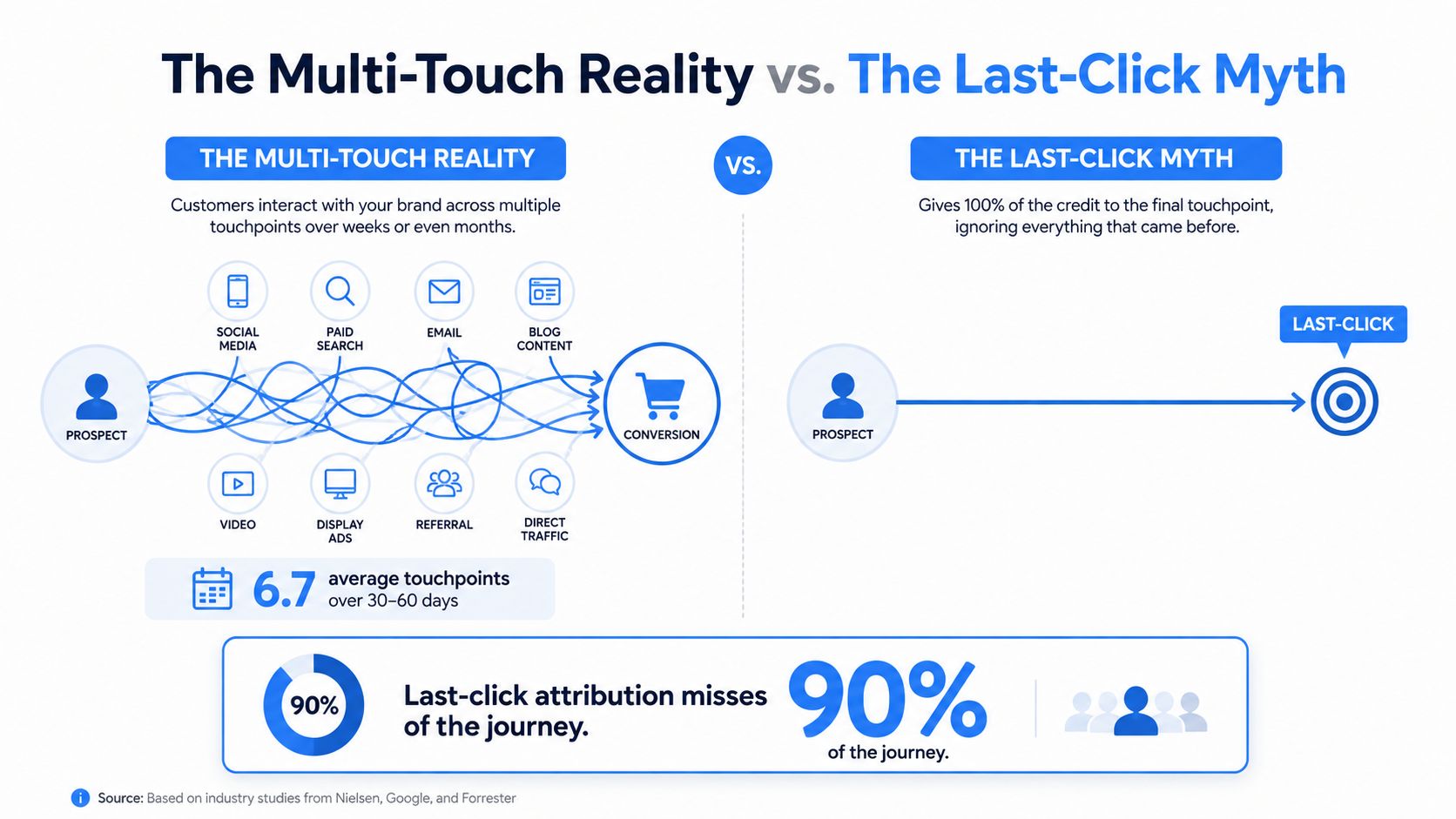
A single email can still open the door, but it rarely carries the whole deal. If your reporting says otherwise, the report is probably too shallow for the buying motion you are trying to measure. That is why cross channel lead generation is a margin decision, not a brand-awareness exercise.
The cost math favors orchestration
The economics are hard to ignore. Benchmark sources in the brief place average B2B cost per lead around $213 to $215, while multi-channel campaigns show 24% lower CPL in one benchmark and 31% lower CPL in another lead-generation benchmark. That is not a cosmetic gain, it changes acquisition efficiency in a way finance teams can feel. Lead-generation benchmarking reports
Practical rule: if one channel is doing all the work, you are usually paying too much for each lead and learning too little from the market.
Single-channel programs also hide operational problems. Email-only sequences depend on inbox timing and copy quality, so a weak subject line or a poorly timed send can stall the whole motion. Coordinated programs keep the account moving even when one surface is ignored, and value is not more activity, it is using each touchpoint to create the next one. A practical example is how Lead Printer structures B2B SaaS outreach around channel handoffs rather than one-channel pressure.
Assigning Each Channel a Specific Job in the Funnel
Cross-channel programs break when every channel is asked to do the same job. The cleaner operating model is to assign each channel a specific role, then judge it against that role instead of comparing it to the entire pipeline. Email, LinkedIn, retargeting, and webinars should support one another, not compete for the same responsibility.
Match the channel to the stage
Email is strongest when it owns primary outbound and behavioral replays. It handles direct asks, follow-ups, and fast copy changes, which matters when you are testing message-market fit. LinkedIn works better for warming an account through profile views, connection requests, and light DMs, because it lowers friction before a harder ask lands.
Paid retargeting is the reminder layer. It catches people who opened, clicked, or visited but did not respond, which keeps the account familiar without forcing another direct interruption. Webinars sit later in the journey, where a prospect already has enough context to trade attention for depth. For a practical example of how channel roles can be divided in outbound, the Lead Printer B2B SaaS page shows a direct version of that split.
| Funnel Stage | Primary Channel | Supporting Channel | Key Metric |
|---|---|---|---|
| Early attention | Connection acceptance | ||
| Mid-funnel proof | Retargeting | Return visits | |
| Late-stage conversion | Webinar | Meetings booked |
Channel assignment only works if the job changes by stage. A connection request is not trying to book the meeting. A retargeting impression is not trying to close the deal. A webinar invite is not trying to create awareness from scratch.
Avoid this trap: posting on more channels is not the same thing as assigning channel roles. If the message, timing, and offer never change, you are repeating the same mistake in different tabs.
The cleanest systems avoid cannibalization by giving each surface one purpose. LinkedIn opens the account. Email carries the conversation. Retargeting keeps the memory alive. Webinars convert curiosity into a real sales interaction.
Building the Central Data Layer and Infrastructure That Holds It Together
Cross-channel lead generation breaks fastest when prospect data lives in five tools and three spreadsheets. Before launch, centralize everything in one place, then let the sequence engine pull from that single source of truth. A stack built around tools like Clay, LinkedIn Sales Navigator, scraping sources, and registry data is useful only if the output lands in one consistent data layer before outreach starts.
Data first, sequence second
The workflow should be boring in the best possible way. Enrich the list, dedupe it, segment it, and only then push it into a sequencing platform that can handle email and LinkedIn together. If the CRM and sequencer disagree about job title, company name, or account status, the campaign will eventually route the wrong message to the wrong person.
Deliverability sits underneath all of it. Domain authentication, inbox warm-up, sender rotation, and basic deliverability safeguards are not side tasks, they protect every other channel from contamination. If the email side gets burned, the LinkedIn side starts carrying too much weight. If the list quality is weak, retargeting and webinar invites just amplify bad targeting.
Build around triggers, not calendar noise
Fixed-blast scheduling is a weak fit for B2B outbound. Trigger-based sequencing works better because it responds to what the prospect does, not to what the team scheduled in advance. That can mean pausing after a reply, switching to a lighter touch after a profile visit, or moving to a stronger proof asset after repeated opens.
The stack matters less than the discipline around it. Teams that centralize data, then sequence from behavior, usually spend less time untangling errors and more time learning what the market responds to.
Lead Printer's operating model is a useful reference here because it combines research, enrichment, sequencing, and multichannel orchestration rather than treating them as separate workstreams. That's the infrastructure lesson. Cross channel lead generation scales only when the data layer, the sending layer, and the reporting layer are built to reinforce each other.
Designing a Real Outreach Sequence Across Channels
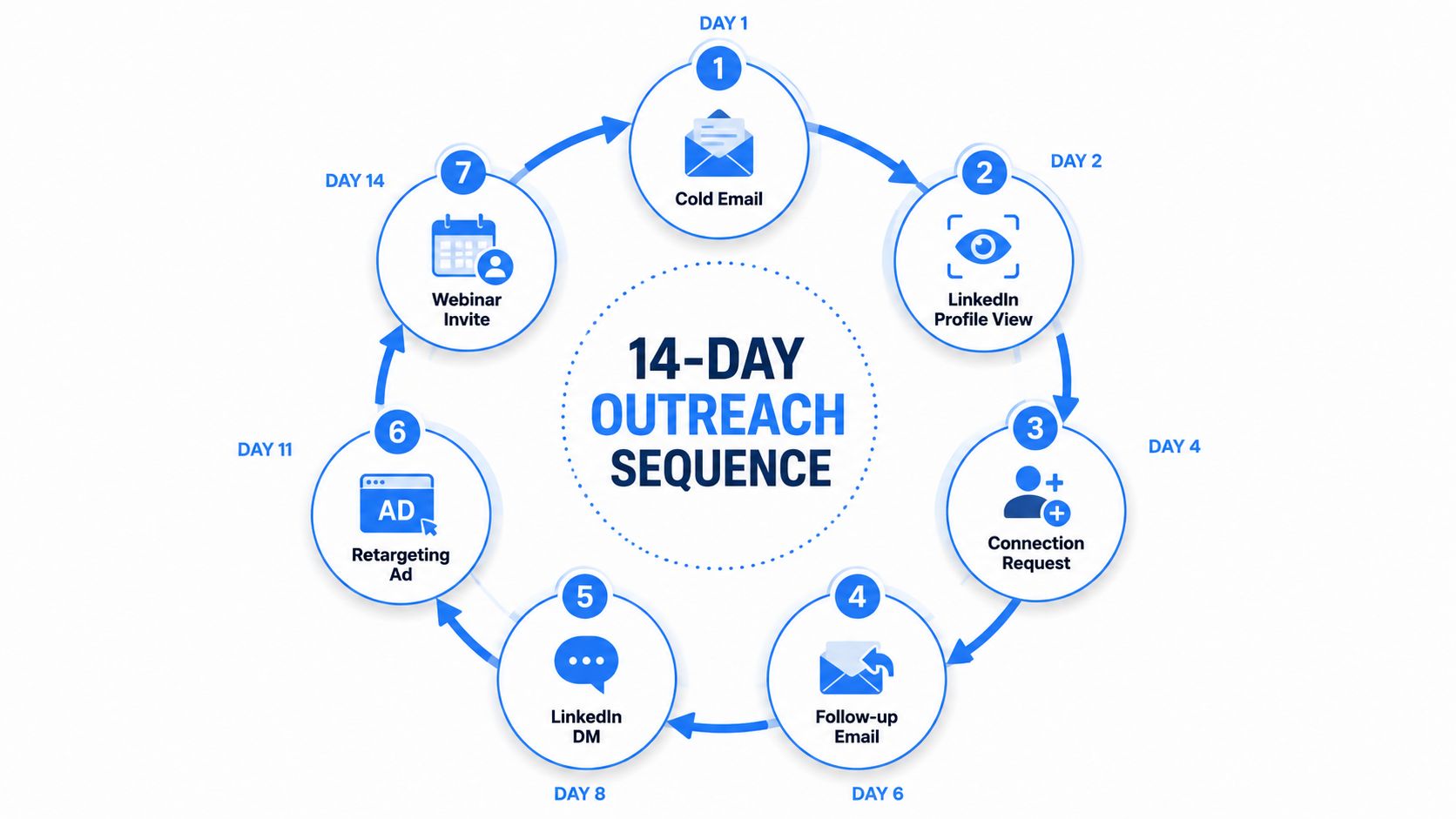
A working sequence doesn't feel random to the prospect, even though it should be behavior-aware behind the scenes. The cadence should shift by channel and by intent, not just repeat the same pitch in different formats. A 14-day run can do a lot if each touch has a distinct role.
A sequence that actually behaves like a sequence
Start with a personalized cold email. That first message should be short, specific, and tied to a real trigger, not a generic “thought you'd find this relevant” note. If there's no reply, a LinkedIn profile view can create familiarity without asking for time.
Then send a connection request, followed by a second email that deepens the proof. After that, a LinkedIn DM can reference the earlier touch and narrow the ask. A retargeting ad keeps the account warm while the final webinar or case-study invite turns attention into a more concrete next step.
The sequence below is the shape, not a rigid formula:
- Cold email with one clear reason for contact.
- LinkedIn profile view to signal recognition.
- Connection request with low-friction context.
- Follow-up email with a more specific use case.
- LinkedIn DM that mirrors the email theme.
- Retargeting ad to reinforce the same problem statement.
- Webinar invite or case-study invite for interested accounts.
The benchmark range to keep in mind is modest and realistic. Well-targeted multi-channel sequences tend to land around 15% to 25% total response, 3% to 8% sequence-to-meeting, and replies usually skew toward email at 50% to 60%, with phone at 20% to 30% and LinkedIn at 15% to 25%. The same source notes that 60% to 70% sequence completion is typical, which means people often respond or opt out before the final step. Multi-channel sequence benchmarks
The strongest sequences don't sound the same on every channel. Email can be direct. LinkedIn can be conversational. Retargeting can be visual and repetitive. The point is coherence, not copy-paste consistency.
Lead Printer blog is a practical reference if you're looking at how cross-channel touches can be layered without turning into noise. The test is whether each touch makes the next one easier to receive.
Attribution, Reporting, and Proving Incremental Lift
Most cross-channel programs get exposed in reporting. Leadership asks which channel created the pipeline, and the answer is often a weak blend of first-touch, last-touch, and a dashboard full of opens. That's not enough to manage spend or defend the program.
Report on pipeline, not vanity signals
A useful attribution stack starts with first-touch, last-touch, and a position-based view. That gives you a usable picture of who introduced the account, what closed it, and which interactions helped it along the way. But the dashboard has to go further and track SQLs, meetings booked, and cost per opportunity, because those are the outputs that matter to sales.
When you need a clean reference on what good tracking discipline looks like, the marketer's tracking playbook is worth reviewing. It's useful because it focuses on tracking hygiene before optimization, which is where many programs fall apart.
Incrementality testing is the missing layer
Attribution tells you where credit should go. Incrementality tells you whether the combined system creates more qualified pipeline than the channels would have generated separately. That difference matters, because a coordinated program can look busy without proving lift.
A clean test design uses holdouts. One group gets email only, another gets LinkedIn only, and a third gets the combined sequence. If the combined group creates meaningfully more meetings or opportunities than the standalone groups, you have evidence of lift. If it doesn't, one channel may be complementing the others rather than driving net-new behavior.
That's also why CRM setup matters so much. If your source fields, stage definitions, and routing rules are sloppy, the test gets contaminated before it begins. Keep the definitions stable, isolate the audience, and don't let reps manually override campaign logic unless you're logging it.
Use the Lead Printer ROI calculator as a practical way to pressure-test the economics of a multichannel motion before scaling it further. The right question is not “which channel got the lead,” it's “did the combination of channels create more qualified pipeline than one channel alone?”
Leadership-friendly rule: if a program can't survive a holdout test, it's not ready to be called a system.
Making Cross-Channel Work in Privacy-Constrained and EU Markets
Cross-channel coordination gets harder when identifiers are fragmented and consent rules matter more. That's especially true in the EU and in regulated sectors, where third-party signals are weaker and prospect data quality varies more by market than many teams want to admit. In those environments, the usual “just enrich harder” advice falls apart quickly.
Consent-safe coordination beats aggressive stitching
The operational answer is to rely more on first-party collection, consent-safe enrichment, and disciplined CRM hygiene. If you're running outbound across the US, UK, and EU, you also need localized messaging, because the same offer and same proof points won't land equally across those markets. The gap isn't just compliance, it's relevance.
The hard part is identity resolution between email and LinkedIn when platform identifiers are incomplete. Teams that do this well use matching logic conservatively, then keep the sequence flexible enough to function even when one identifier is missing. That means fewer assumptions, cleaner routing, and less dependence on fragile third-party data.
For a compliance-oriented reference on prospect consent, consent standards in lead generation is a useful resource to keep close when building forms and routing rules. It helps anchor the process in consent rather than retrofitting consent after the campaign is already live.
What breaks in low-signal markets
The biggest failure mode is overconfidence in sparse data. A clean-looking list can still hide bad geography, old titles, or accounts that will never legally or practically respond to the same motion. In those cases, cross-channel lead generation should be narrower, not louder.
If the signals are weak, coordination has to become more careful, not more aggressive.
That means tighter locale-specific segments, fewer assumptions about channel overlap, and more attention to consent-safe paths into the database. Cross-channel doesn't stop working in privacy-constrained markets, but it does require better infrastructure and cleaner operating discipline than teams usually budget for.
Your 90-Day Cross-Channel Rollout and Common Mistakes to Avoid
A workable rollout starts with infrastructure and ICP alignment in weeks 1 to 2, then moves into a controlled pilot with holdouts in weeks 3 to 6. Use weeks 7 to 10 to rebalance channels based on real replies and meetings, then spend weeks 11 to 13 scaling what's working and cutting what isn't. Early on, the most important KPI is data and deliverability health, then meetings booked, then cost per opportunity.
The mistakes are usually the same. Treating channels like separate campaigns. Skipping deliverability work. Ignoring sequence completion. Over-reporting opens as if they mean revenue.
The next Monday move is simple, centralize your list, define each channel's job, and run one pilot sequence with a holdout group. If your current program can't show lift, it's not broken, it's just not being tested properly.
Lead Printer builds cross-channel outbound systems for teams that need qualified meetings, not just more activity. If you want infrastructure, sequencing, and reporting that hold together across email and LinkedIn, visit Lead Printer and review how their process fits your market.