You've got the email mostly written. The subject line is decent, the body is tight, and the offer is real. Then you get to the bottom, type something soft like “Let me know your thoughts,” and hope the prospect does the work for you. That last move is usually where replies die.
How to close an email is not about picking a nicer sign-off. It's about making the last lines do a very specific job, helping a busy reader decide quickly, with as little friction as possible. If the close is vague, overloaded, or buried under polite filler, the rest of the email has to carry more weight than it should.
Table of Contents
- Why the Last Three Lines Decide Whether Anyone Replies
- The Three Parts of a High-Converting Email Close
- Sign-Off vs CTA and Why the Difference Matters
- Four Closing Templates You Can Copy and Adapt Today
- Where Standard Closing Advice Falls Apart
- Testing Your Closing Lines Like an Outbound Team
- A Self-Audit Checklist Before You Hit Send
Why the Last Three Lines Decide Whether Anyone Replies
An SDR can spend 40 minutes tightening the first 250 words of a cold email, then end with a shrug. That's the part I see break most often. The opener earns attention, the body builds relevance, and the close either asks for a decision or hands the reader an escape hatch.
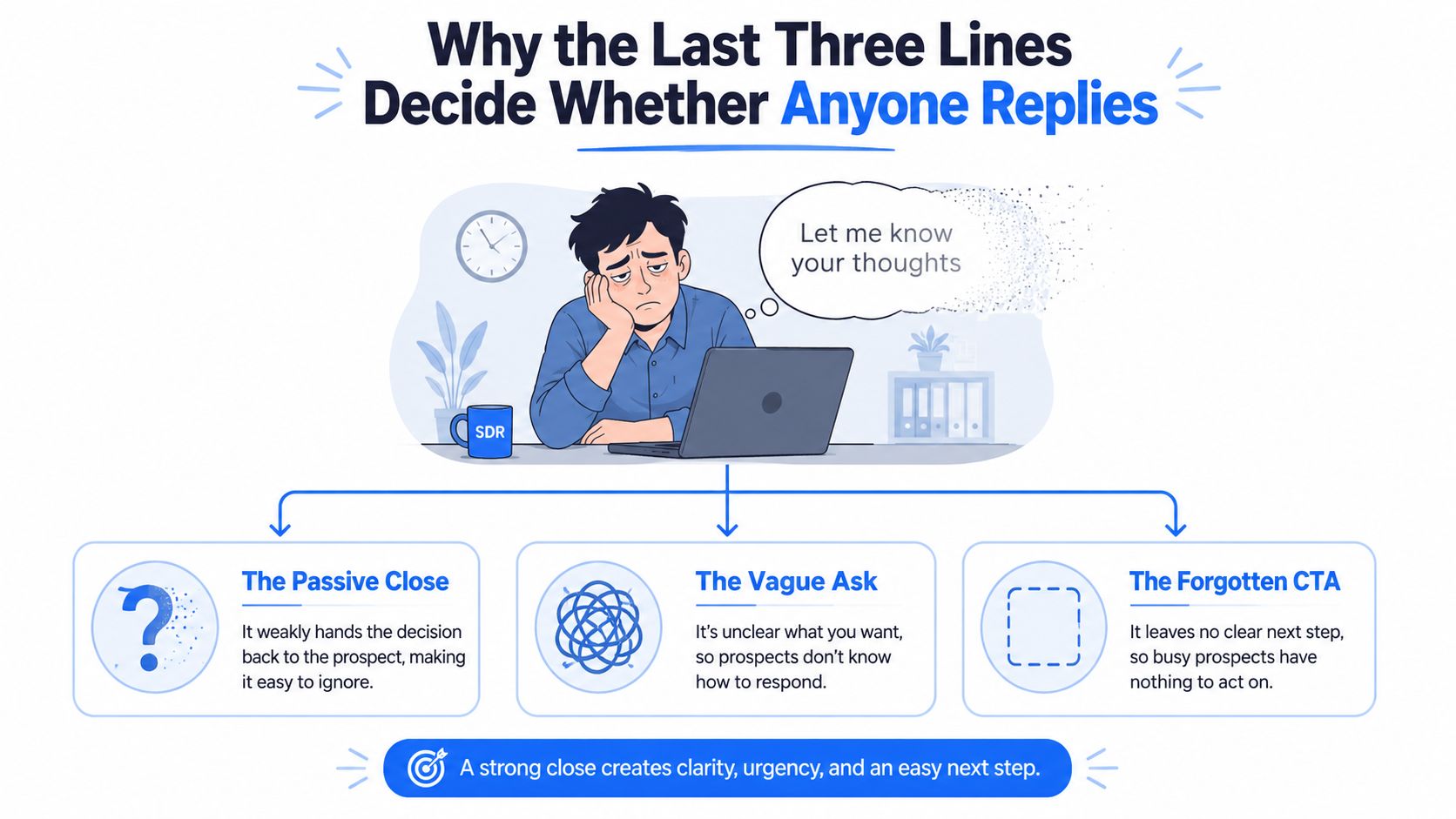
The final lines matter because they're the part that often gets processed as a decision prompt. On a phone, the closing is often the only section that survives a skim without effort. If the reader hits a vague line, they don't get clarity, they get work. That's why the close is the most valuable real estate in the email, not an afterthought.
What a weak close actually does
A weak close usually does one of three things. It hides the ask, it softens the ask until nothing is left, or it adds extra tasks that force the recipient to figure out what to do next. A line like “let me know your thoughts” sounds polite, but it's rarely actionable.
Practical rule: if the last line doesn't point to one clear action, it's not a close, it's a dead end.
That's why I send people to resources like effective email closing words when they're trying to expand their vocabulary, but I always tell them to treat phrasing as secondary. The job is to make the decision obvious.
A close also sits inside the broader flow of the message. If your CTA, sign-off, and signature don't work together, the reader feels the seam. The message may still be decent, but the bottom won't carry the weight it should. If you're building outbound systems at scale, that's the kind of detail worth folding into your process, and it fits naturally into a wider workflow like the one outlined on Lead Printer's blog.
The Three Parts of a High-Converting Email Close
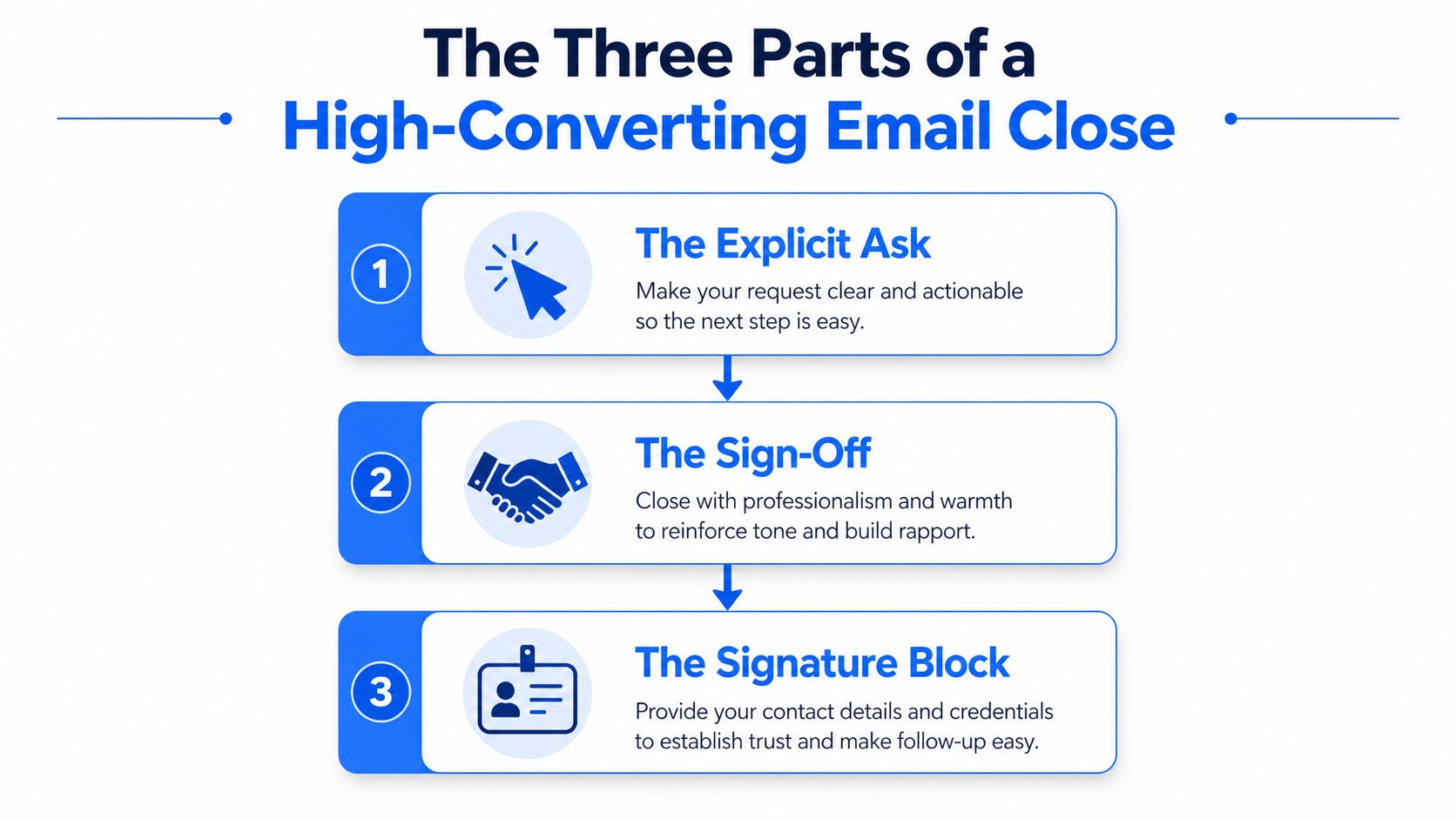
The strongest closes follow a simple structure. There's the explicit ask, the sign-off, and the signature block. They're different jobs, and they should stay different.
A lot of bad closings happen because writers mash all three together. They add a question, a polite phrase, a random “best,” and then a signature, but never decide what the recipient is meant to do. A cleaner close gives the reader a path.
The explicit ask
This is the sentence that tells the reader what happens next. For outbound email, the ask should stay low-friction. A yes or no, a quick reply, a short meeting, or a single next step works far better than a broad invitation to “chat sometime.”
A useful way to think about it is this, if the reader can answer in one move, the ask is doing its job. If the reader has to think through options, compare priorities, or invent the next step, the close has become work.
The sign-off
The sign-off is tone, not task. “Thanks,” “Best,” and “Cheers” all signal different levels of warmth and distance, but none of them should carry the actual CTA. That's a common mistake, especially in cold outreach where the sender hopes a friendly ending can substitute for a clear ask.
The signature block
The signature block isn't decoration. It's the credibility layer. It tells the recipient who you are, who you represent, and how to respond without hunting for context. A clean signature block makes the reply path easy.
The simplest model looks like this.
- Ask: “Would Tuesday or Wednesday work for a quick intro?”
- Sign-off: “Best,”
- Signature: Name, title, company, and reply-friendly contact details
Keep the ask in one sentence. Keep the sign-off brief. Keep the signature useful. That's the structure.
Sign-Off vs CTA and Why the Difference Matters
Many email guides blur these two together, which is part of the problem. The CTA is the action you want. The sign-off is the tone you leave behind. If those jobs get mixed, the email gets softer without getting clearer.
A renewal email usually needs a sign-off that protects the relationship, because the reader already knows you. Cold outreach needs the ask to do more of the work, because there is no existing context to rely on. The sign-off supports the message. The CTA drives the reply.
| Email type | Best sign-off tone | Best CTA shape |
|---|---|---|
| Cold outreach | Professional, light, low-pressure | One clear yes/no or one next step |
| Warm follow-up | Friendly, direct, accountable | Specific reply request tied to prior context |
| Renewal email | Reassuring, steady, relationship-aware | Confirmation, decision, or review request |
| Internal ask | Efficient, plain, collaborative | One action owner can complete quickly |
For broader etiquette, a useful companion is Humantext.pro's letter closings guide. It helps if you want to separate tone from task without making the message sound stiff.
What a weak close does
A weak close usually looks polite on the surface and unclear underneath. Writers pick a warm sign-off because they worry a stronger ask will feel pushy, then they hope the recipient will infer the next step. That usually leaves reply value on the table.
The better sequence is simple. Make the CTA concrete, then let the sign-off keep the relationship intact. “Best” can follow a firm ask. “Thanks” can follow a direct one. The sign-off should never be asked to do the CTA's job.
That distinction matters most when the email has a job beyond getting a reply. In a renewal, a vague ending can create confusion. In a cold outbound sequence, a polished sign-off will not rescue an unclear ask. Different email types need different closings, and the right tone depends on what the recipient already owes you, if anything.
Four Closing Templates You Can Copy and Adapt Today
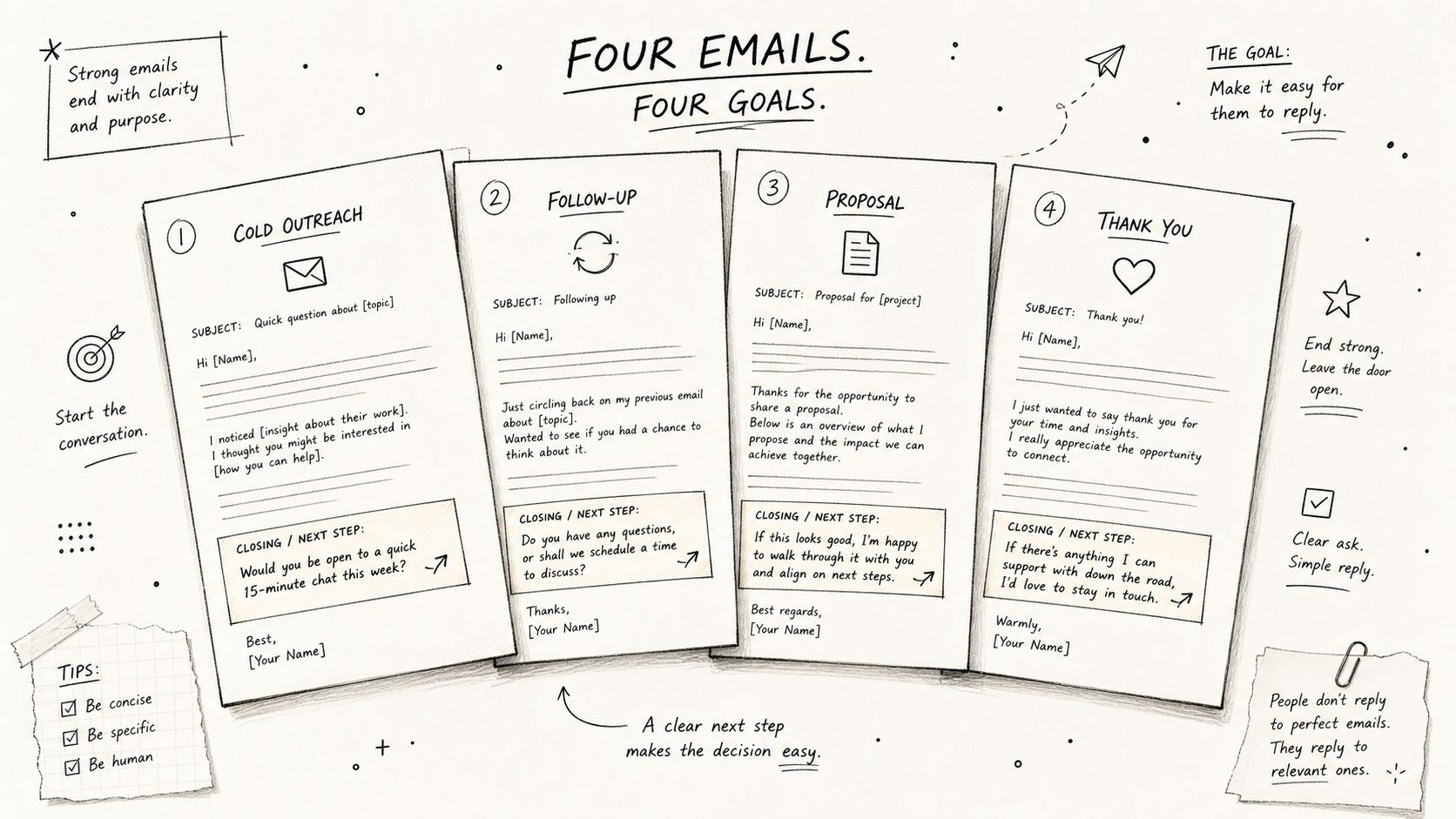
Theory is useful only if it changes the words you send. These four closing blocks cover the situations I see most often in outbound work, and each one keeps the ask separate from the sign-off.
If you're pressure-testing variants before a launch, pair this with A/B test outreach messages. The point isn't to copy a template forever, it's to use one as a controlled starting point.
Cold outreach
Template
Would you be open to a quick chat next week to see whether this is relevant?
Best,
Name
Why it works
It's one question, one outcome, and no extra branching. The reader can say yes, no, or suggest a different time without decoding the request.
Real example line
“Would you be open to a short call next week to see if this is worth exploring?”
Follow-up after no reply
Template
Should I close the loop, or is it worth sending over a couple of options?
Thanks,
Name
Why it works
It gives the recipient an easy binary choice. That lowers friction and avoids the tone-deaf “just bumping this” style that wastes the final touch.
Real example line
“Should I close this out, or would it help if I sent two possible ways to move forward?”
Internal ask to a teammate
Template
Can you confirm which version you want me to ship by 3 p.m.?
Thanks,
Name
Why it works
Internal email closings should reduce ambiguity fast. A teammate doesn't need persuasion, they need a decision frame and a deadline.
Real example line
“Can you confirm the final copy before EOD?”
Meeting request to a prospect
Template
If it makes sense, I can send over two times that fit your calendar.
Best,
Name
Why it works
The reader isn't forced into scheduling gymnastics. You're offering a path that preserves momentum without asking for too much effort.
Real example line
“If this is relevant, I can send over a couple of slots and keep it simple.”
The cleanest closings are short because they respect attention, not because they're minimal by default. If you're building repeatable outbound systems, that's exactly the kind of message testing logic a team should carry into every sequence.
Where Standard Closing Advice Falls Apart
The usual advice sounds harmless. Be concise. Be polite. Ask a question. Those rules work until they meet a real send, and then they break in predictable ways.
Renewal emails need context, not just brevity
“Keep it short” can backfire in renewal messages because the buyer often needs a reminder of what's being renewed, why it matters, and what they're deciding on. If the close strips out too much context, the recipient has to reconstruct the situation. That adds friction.
A renewal close can still be concise, but it should not feel detached from the value story. The ask has to stay close enough to the reason for renewal that the decision feels grounded, not abrupt.
Re-engagement emails can make question-based CTAs feel needy
Question-based closes often work in cold outreach because they are lightweight. In re-engagement, they can feel like a plea if the relationship has already gone quiet. The ask should match the state of the thread, not just the tactic.
That trade-off matters. A reply-maximizing close is not always the same as a relationship-preserving one. If you are trying to reopen a dormant conversation, a direct, calm ask can feel stronger than a question that sounds overly eager.
Mobile inboxes cut weak closes down
On smaller screens, a multi-line closing gets compressed fast. If the ask is buried under extra wording, the reader may never reach the core request. Short closings survive skimming better because the last lines stay visible and obvious.
The bottom of the email should survive a skim on a phone without losing the actual ask.
That is the test. The close has to make the next step clear without forcing the recipient to expand anything, scroll back, or reread the whole email.
A lot of standard advice also breaks because it treats the sign-off as the whole decision. In practice, the last lines do two jobs. One line frames the action, the other line lowers resistance. Teams that review outbound systems closely, like the process shown in the Lead Printer B2B SaaS framework, usually separate those jobs instead of stuffing everything into one tidy sentence.
Testing Your Closing Lines Like an Outbound Team
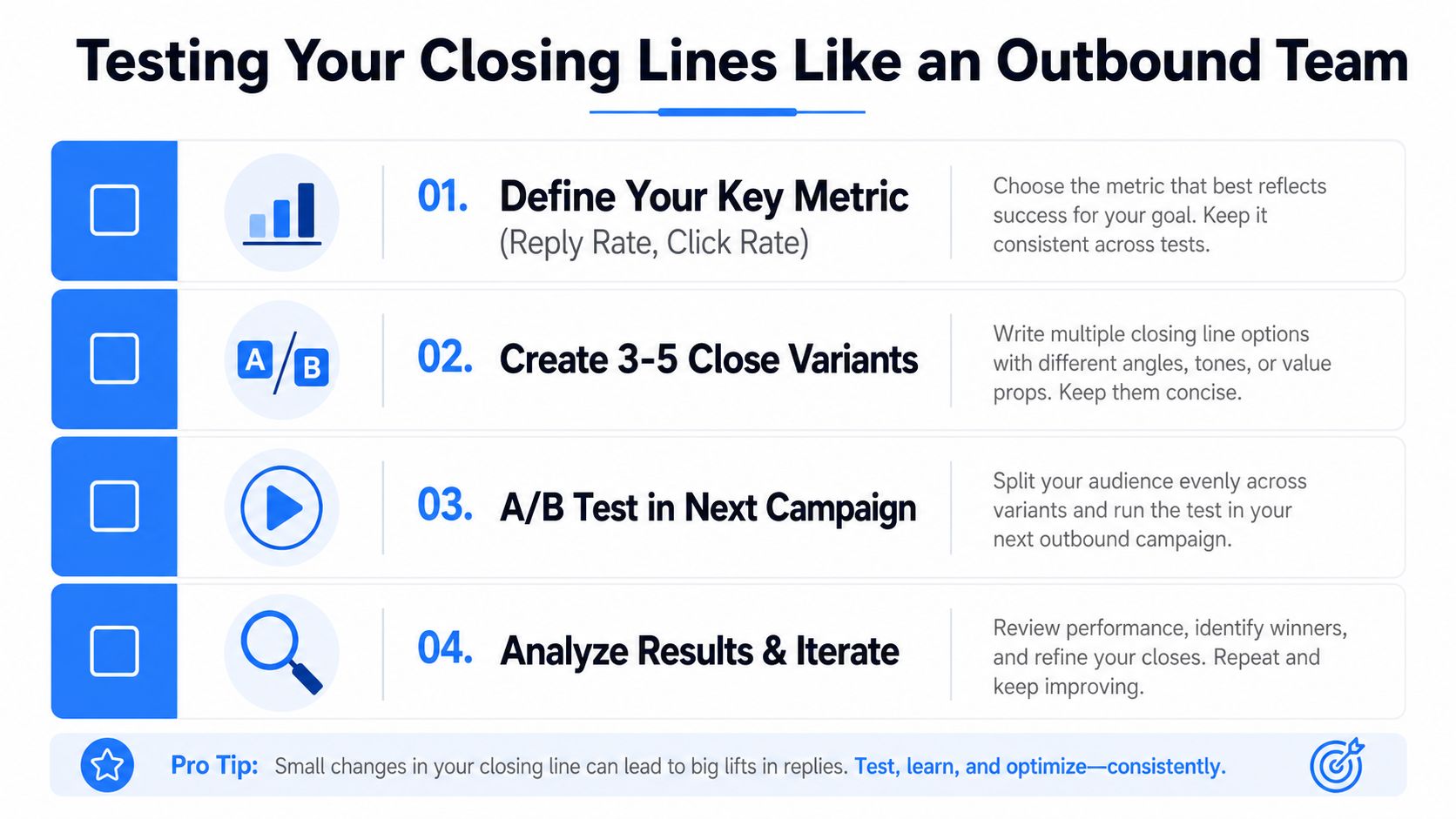
Many closing guides stop at examples, which is where the advice gets expensive. A list of sign-offs does not tell you which close fits your audience, your offer, or the state of the sequence. You get better answers by testing closing angles, not just swapping a few words at the end.
A LinkedIn marketing article on outbound testing recommends trying 3 to 4 clearly different angles, keeping the rest of the email constant, and giving each variant at least 200 contacts over 2 to 3 weeks before calling a winner. That approach makes sense because a sign-off tweak by itself rarely explains a lift in replies. The signal comes from the full closing system, the ask, the tone, and the sequence context around it.
What to test
Test different closing angles, not tiny phrasing changes. One version can use a direct yes/no ask, another can be a soft scheduling request, another can be a breakup-style close, and another can tie the final line directly to the offer. Keep the subject line, body, and audience as stable as possible so the close is the variable you are measuring.
For a broader view of how outbound programs are built around targeting, copy, and iteration, the Lead Printer B2B SaaS page shows the kind of structure that keeps these tests useful.
What not to confuse
A lift in opens is not a closing win. A larger sample of replies is not proof that the close improved the right outcome. If the sequence shifts while you are testing, the result belongs to the whole email, not the closing line.
The mistake I see most often is mixing reply volume with reply quality. A close can pull in more responses and still create worse conversations. Outbound teams need to separate those two signals, because they often point in different directions.
A simple operating rule
Use one metric for the test. Keep the variants distinctly different. Give the sample enough room to breathe before you decide what worked.
If the close is the lever, the test should isolate the lever. That is how you learn whether the audience prefers a softer ask, a firmer ask, or a different angle altogether.
A Self-Audit Checklist Before You Hit Send
Before sending your next batch, run the close through five checks. First, is there one explicit ask. Second, is the ask low-friction, meaning the reader can answer it quickly. Third, does the sign-off match the relationship and the email's purpose. Fourth, does the signature make replying easy. Fifth, does the close still make sense when you see it on a phone.
If any one of those fails, the bottom is doing too much or too little. That's where a quick review saves the campaign from sounding polite but unclear. A close that passes the check is usually short, direct, and easy to act on.
If you want a sanity check on the math behind pipeline effort, the Lead Printer ROI calculator is a practical way to map outreach volume to outcomes. It's most useful when you're comparing different outbound motions and want to see what the reply system needs to produce.
Fast audit: if a prospect can't tell what to do next in three seconds, the close needs another pass.
Treat the close as a decision system, not a formality. Once you do that, you stop asking whether the email “sounds good” and start asking whether it drives a reply. That shift changes the way you write the bottom of every message.
If you want a team that builds outbound sequences with sharper closes, cleaner targeting, and ongoing testing, visit Lead Printer. They design and run data-driven email and multichannel campaigns that create qualified sales opportunities across the US, UK, and EU.