The popular advice around manufacturing lead generation is still too broad. It tells companies to show up at trade shows, keep referrals flowing, and maybe run a few generic email blasts, then acts surprised when pipeline stays erratic. That approach misses how industrial buyers buy, because plant, engineering, procurement, finance, and leadership teams don't respond to noise, they respond to timing, relevance, and operational context.
Outbound works in manufacturing when it behaves like research, not mass marketing. A small, trigger-based account list, persona-specific messaging, and a multichannel sequence built for long sales cycles will beat a larger, blurrier list almost every time. If your campaigns keep stalling, troubleshoot lead generation results by checking whether the problem is targeting, timing, or follow-up discipline before you change the offer.
Table of Contents
- Why Most Manufacturing Lead Generation Fails
- Building a Trigger-Based Prospect List
- Designing Multichannel Sequences for Industrial Buyers
- Crafting Persona-Specific Messaging That Resonates
- Integrating Trade Channels and Localized Outreach
- Launching and Optimizing Your Manufacturing Campaign
- Measuring ROI and Scaling Your Outbound Engine
Why Most Manufacturing Lead Generation Fails
Manufacturing teams often blame outbound before they've fixed the basics. The problem is usually that the list is too broad, the timing is wrong, and the message has no operational reason to exist today. That's why trade shows, referrals, and inbound form fills still feel safer to many teams, even though those channels are inconsistent and don't always reflect who's in market.
Generic cold outreach fails because industrial buyers aren't shopping casually. They're evaluating application fit, supplier reliability, technical compatibility, and delivery risk, often across multiple stakeholders who each care about something different. If your first touch lands on the wrong role, or lands without a reason that connects to a real plant or procurement event, it gets ignored.
Precision beats volume
A manufacturing outbound program should start with a narrow Tier 1 account list of 20 to 30 accounts, then map 3 to 4 stakeholders per account across engineering, operations, procurement, finance, and leadership before any sequence goes live, as outlined in this manufacturing ABM methodology. The source is clear that the outreach should be persona-specific and staggered around day 1, day 3, and day 7 to fit long buying cycles and reduce single-threaded risk, which is exactly where broad spray-and-pray campaigns fall apart. See the account-based approach described in lead generation for manufacturing.
Practical rule: If you can't name the plant, the trigger, and the person who feels the pain, the email is too early or too generic.
That's the mental shift most teams miss. Outbound isn't a replacement for content, referrals, or trade shows, but it is a precision tool when the list is built around observable events and the message is written for a specific buyer role. Teams that keep treating it like a volume game usually burn domain reputation, annoy buyers, and conclude that manufacturing doesn't work for outbound when the real issue is structure.
Building a Trigger-Based Prospect List
The cleanest manufacturing prospect list starts with a reason to reach out now. A new facility permit, a capacity expansion, a reshoring move, a supplier disruption, a competitor recall, a new product line, or a hiring spike all create a real opening for a relevant conversation. Broad industry filters don't create that kind of context, they just give you more names to chase.
Start with observable events
Look for triggers in places buyers can't easily hide. Business registries, local planning and permitting notices, company press releases, LinkedIn hiring activity, job boards, and industry news all reveal movement before a buyer ever raises their hand. Capacity expansion and new facility permits often signal equipment, components, tooling, logistics, or contract manufacturing needs, while hiring spikes can point to new production lines or process changes.
A good list builder reads those signals like a buyer would. If a company is reshoring part of its supply chain, that isn't just news, it's a window into new supplier evaluation. If a competitor has had a recall, quality, compliance, and continuity concerns suddenly become easier to discuss in a way that's specific and useful.
Build the account map before the sequence
The most disciplined manufacturing teams keep the list small and dense. Start with the target account, then map each stakeholder by role and likely concern. Engineering cares about fit and integration risk. Procurement cares about sourcing stability and cost certainty. Operations cares about uptime. Finance wants predictability, while leadership wants fewer surprises.
The internal link that fits this process well is Lead Printer's manufacturer-focused outbound page, because it aligns prospect research, list building, and outreach execution around the same manufacturing buyer reality.
A simple way to operationalize this is to sort your accounts into three buckets.
- Immediate trigger accounts: companies with a recent operational event that clearly justifies outreach.
- Near-term trigger accounts: companies showing movement, but not yet at a point where the need is obvious.
- Watchlist accounts: accounts with the right profile, but no strong signal yet.
That structure keeps the team from over-emailing cold names while ignoring the accounts that are moving. It also makes segmentation cleaner, because the trigger itself becomes the opening sentence.
Designing Multichannel Sequences for Industrial Buyers
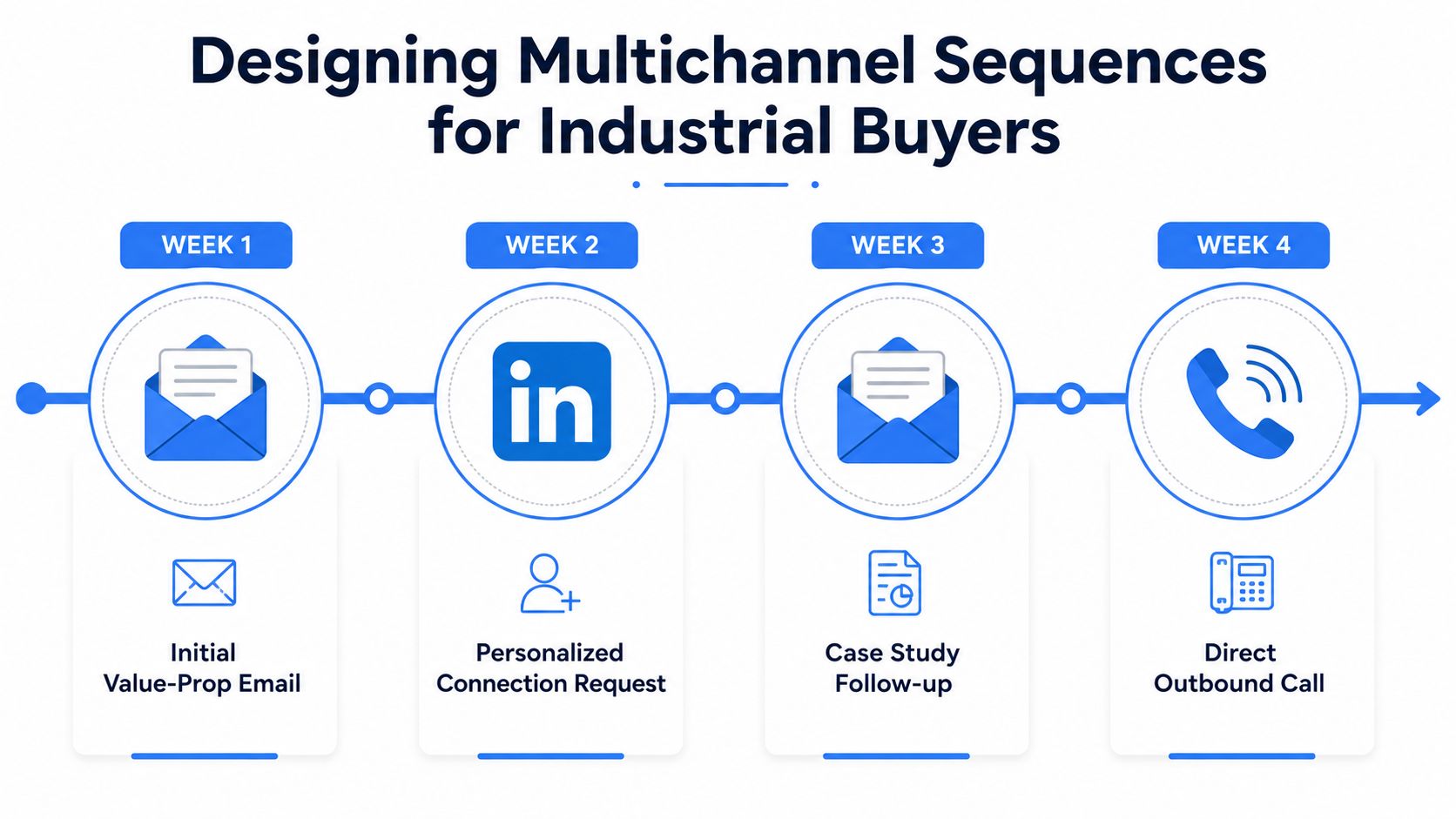
Manufacturing buyers rarely respond to one message, even when the message is good. Consensus-driven buying means the contact you reach first may not be the person who moves the deal, and the person who moves the deal may not read the first email. That's why the sequence has to do more than repeat the same pitch in different channels.
Use timing that respects industrial buying cycles
The most practical cadence is simple. Start with a Day 0 call plus email, follow with a Day 1 email, and send a Day 5 final check-in, which matches the structured follow-up model used in manufacturing lead-gen playbooks. The same guidance also recommends treating every inquiry as a same-day or within-24-hour follow-up event, because industrial buyers notice slowness quickly. Another operational detail that matters is bounce-safe first-batch sending, sampling records for fit validation, and removing duplicate contacts across accounts to protect deliverability and avoid over-contacting buyers, as noted in this manufacturing lead generation guide.
Don't open with a long product pitch. Open with the operational reason you reached out, then earn the next sentence.
The channel mix should reflect buying behavior, not marketing preference. Email handles the explanation. LinkedIn gives the recipient a second, lower-friction touchpoint. The phone matters when the account is real and the trigger is strong, because many industrial buyers still prefer direct contact once the outreach feels relevant.
Stagger touches across the account
A single-threaded sequence is fragile. If only one engineer sees the message, the deal stalls when that engineer is busy. If procurement sees it after engineering has already moved on, the sequence feels disconnected. Stagger touches so the right personas get different versions of the same trigger-based story, not a copy-paste blast.
The easiest way to prevent confusion is to assign roles before launch. One contact might get a technical angle, another gets a sourcing angle, and a third gets a risk or continuity angle. That isn't more work for its own sake, it's the difference between a campaign that feels coordinated and one that feels random.
For list sourcing and enrichment, a practical resource is SourceLoop's lead-finding toolkit, especially if you're trying to turn raw account names into a clean, reachable sequence list.
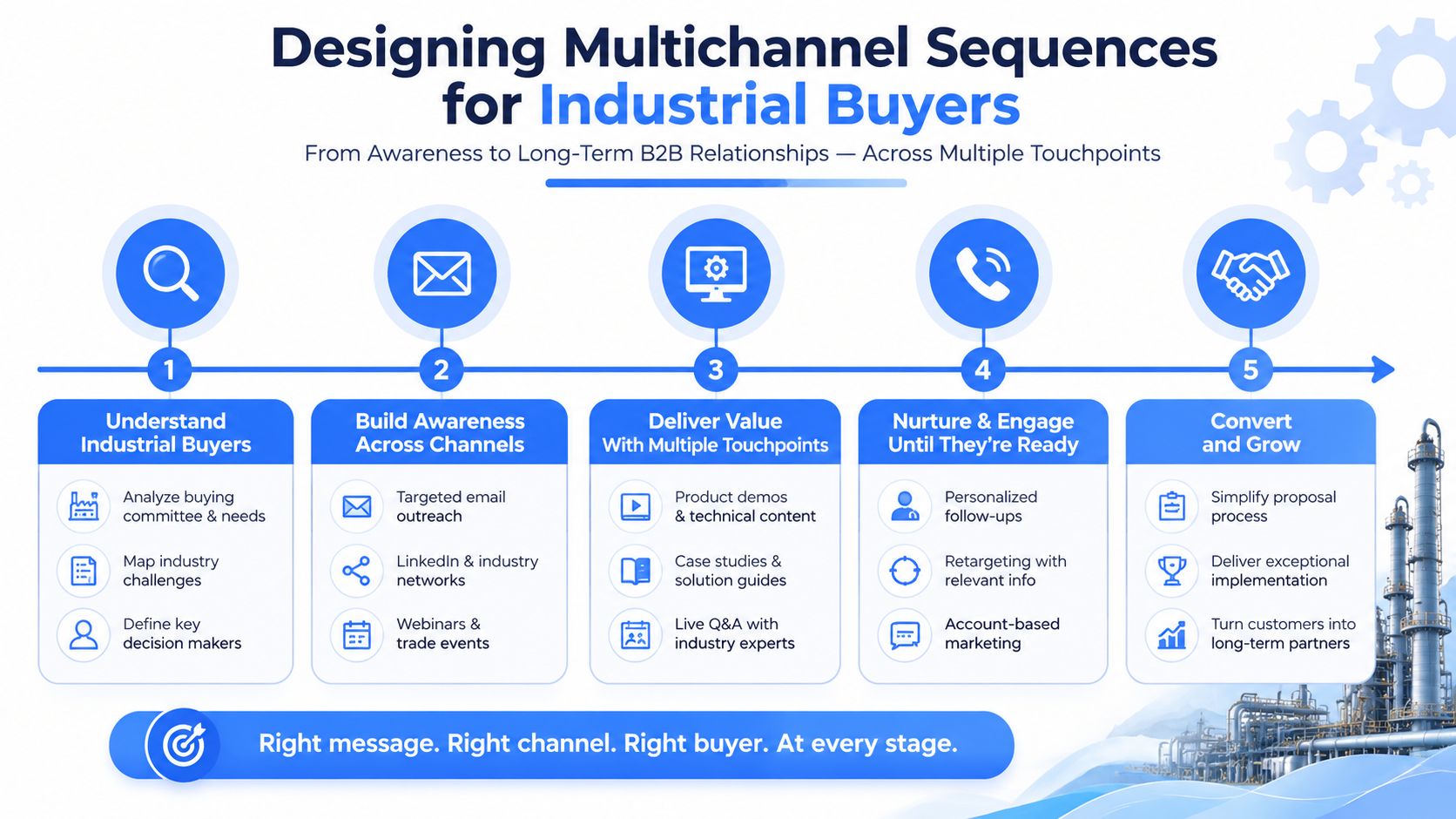
A sequence that respects industrial buying cycles doesn't feel aggressive. It feels coordinated, specific, and easy to forward internally.
Crafting Persona-Specific Messaging That Resonates
The same trigger can support very different messages depending on who receives it. A plant manager doesn't want a theory lesson. A procurement director doesn't care about your favorite feature unless it changes risk or sourcing certainty. An engineering lead wants to know whether your solution fits the stack, the spec, and the integration path.
Write for the person, not the account
A message to operations should sound operational. If a company is expanding a facility, the note should tie that event to uptime, throughput, scheduling, or line continuity. If the trigger is a supplier disruption, the language should stay close to delivery stability and disruption risk, because that's what keeps the buyer reading.
Procurement messaging needs different proof. Don't lead with jargon or product detail if the buyer's real concern is supplier reliability. Lead with why the current moment deserves a conversation, then show that you understand how sourcing teams think about consistency, handoff, and supplier accountability.
Engineering messaging should be the most technically grounded of the three. Reference the trigger, then move quickly into compatibility, integration, tolerance, or process implications. The best engineering outreach doesn't sound flashy. It sounds like someone took the time to understand the application.
A useful companion resource for this kind of targeting is Pipecorn's LinkedIn prospecting guide, because LinkedIn is often where the role mapping and signal verification happen before email.
Keep the CTA modest
The CTA shouldn't force a hard commitment too early. Ask for the right next step, not the biggest one. A plant manager may be willing to point you to the right person. A procurement lead may be willing to confirm whether the company is reviewing suppliers. An engineering contact may be willing to reply with a spec or constraint.
This is also where a good content library helps. A technical case study, comparison sheet, or application note gives the prospect something useful to forward internally. If your team is building that kind of outbound support material, Lead Printer's blog is a useful place to see how outreach content and sequence thinking are usually structured.
The strongest manufacturing emails sound like they were written after five minutes of account research, not five minutes of personalization tokens.
Integrating Trade Channels and Localized Outreach
Digital outbound doesn't replace trade shows, it makes them more productive. A booth conversation without follow-up is a warm lead that decays. A pre-event sequence can warm prospects before they arrive, and a post-event sequence can turn a rushed hallway conversation into a real meeting request.
Use events as signal, not as the whole plan
Trade shows are best treated as milestones inside a larger campaign. Before an event, outbound can identify likely attendees, reference the event in a relevant way, and create a reason to meet. After the event, the same contact list can receive a more informed follow-up built around what was discussed, what was promised, or which operational problem surfaced at the booth.
That matters because event memory fades fast. If a buyer met three vendors in one afternoon, the vendor who follows up with context, not a generic thank-you, tends to stand out. Outbound gives you the machinery to do that without relying on manual note-taking and hope.
Localize when you cross regions
Localized outreach becomes especially important when manufacturers expand into EU markets. Language choice, regional buying norms, and regulatory expectations all shape whether the message feels credible. A direct US-style pitch can work poorly if it ignores local business culture or sounds too transactional for the market.
Localization doesn't mean rewriting the entire offer. It means adjusting the opening, the proof points, the compliance references, and the call to action so the recipient doesn't have to translate your intent. The same logic applies to trade events. If your company is showing in one region and prospecting another, the message has to reflect where the buyer is, not just where your team is based.
A unified pipeline strategy uses each channel for what it does best. Events create in-person trust. Email and LinkedIn extend that trust. Localized outreach keeps the conversation credible across markets. When those pieces are aligned, budget stops being a fight between channels and starts becoming one system.
Launching and Optimizing Your Manufacturing Campaign
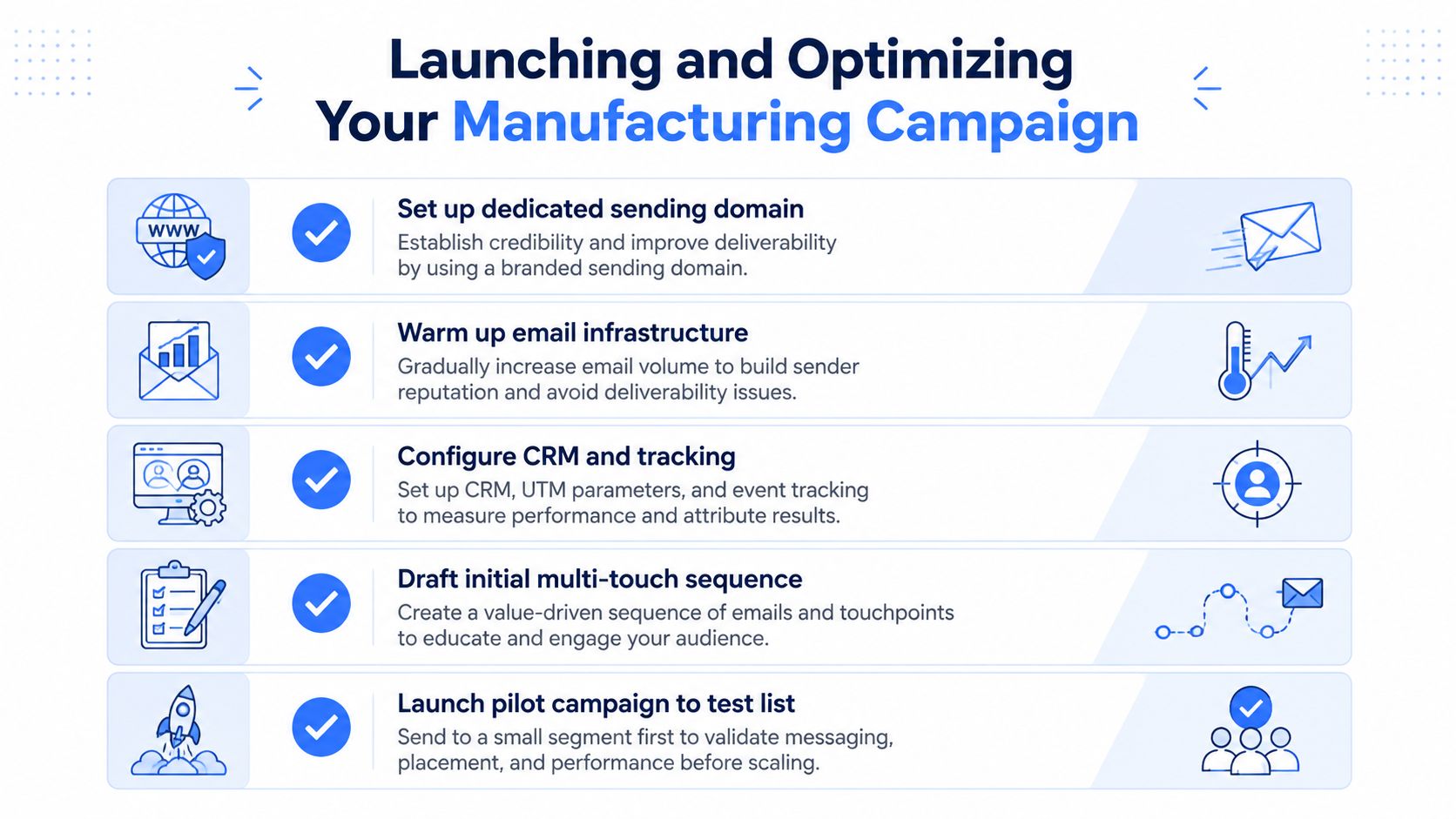
Before the first send, the infrastructure has to be clean. Manufacturing campaigns often fail for boring technical reasons, not creative ones. A good sequence can still land poorly if the sending setup is weak, the list is dirty, or the first batch is too aggressive for a cold domain.
Run the launch like an operations project
Start with deliverability safeguards, then move into list validation. A bounce-safe first batch tells you whether the list is real before you scale volume. Record sampling helps you confirm fit, and duplicate removal across accounts stops one buyer from being hit by overlapping sequences.
Email infrastructure matters, but so does campaign discipline. Separate inboxes should exist for testing and production. Tracking should be set before launch, not after the first reply. CRM fields should be ready so every response gets tagged by account, trigger, persona, and campaign.
Optimize what buyers actually react to
Once the campaign is live, don't optimize the words in isolation. Look at which triggers get replies, which personas respond fastest, and which CTA creates the least friction. In manufacturing, that usually means testing relevance first, then testing subject lines and format, because timing and fit do more work than clever copy.
Here's the launch checklist I trust most:
- Validate the list first: sample records, confirm the role, and verify the trigger before any send.
- Protect the inboxes: keep the first batch conservative so you can spot deliverability problems early.
- Track by account and persona: reply quality is more useful than raw response count.
- Refine the sequence after real replies: don't rewrite a campaign from a hunch when live feedback already exists.
If you want a fast way to estimate whether the campaign economics make sense, Lead Printer's ROI calculator is a useful internal planning tool for mapping outreach effort to expected pipeline.
Measuring ROI and Scaling Your Outbound Engine
Manufacturing leaders won't fund a campaign just because it feels smart. They want to know whether it creates pipeline, whether the list quality holds up as volume grows, and whether the team can keep response quality consistent. Outbound earns its place when it becomes a measurable growth lever, not a side project.
Track pipeline, not vanity activity
Reply volume by itself is not the point. The useful signals are account-level response quality, meeting acceptance, and the share of conversations that come from clearly relevant triggers. If one sequence gets more replies but fewer qualified conversations, it's not performing better, it's just louder.
Outbound also gets easier to defend when it's tied to a clear operational model. A tight account list, a disciplined sequence, and strong CRM reporting let the team see what types of accounts convert and what kinds of messages open doors. That creates a repeatable system instead of one-off wins.
Scale without losing targeting quality
Scaling manufacturing outbound should feel more like adding lanes to a controlled process than opening the floodgates. The point is to preserve trigger quality, stakeholder coverage, and personalization depth while expanding account coverage in a deliberate way. That's where teams often break down, because they scale list size before they've proven message-market fit.
Lead Printer's published proof points show how a structured outbound system can ramp volume without losing targeting quality, including a move from roughly 50 to 300 leads per month and delivery across 2,500+ campaigns with 32k leads generated, but those results only matter if the same discipline carries into your own process. Use those numbers as a reminder that scale is possible, not as a substitute for your own list strategy and follow-up rigor.
If you're comparing build-versus-buy options, a specialist agency makes sense when the team needs infrastructure, prospect research, multichannel sequencing, and reporting under one roof. An in-house team can work too, but only if someone owns list quality, sequence logic, deliverability, and campaign iteration with real accountability.
If you want manufacturing outbound built around trigger-based prospecting, multichannel follow-up, and account-level execution, Lead Printer can design and run that system with the research, sequencing, and reporting already wired in. If your pipeline is too dependent on referrals and random inbound, a structured outbound engine is the fastest way to create more controlled conversations with the right industrial buyers.