You're probably already feeling the mismatch. The team is dialing merchants, the inbox is sending, meetings are being booked, and yet the boardings don't follow at the pace the activity suggests. In merchant services, that usually doesn't mean the outbound motion is broken, it means the list is too broad, the timing is wrong, or the lead never had a real switching path to begin with.
The merchant service market is still large and expanding, with a projected USD 78.25 billion in 2026 market size and a projected USD 203.83 billion by 2033, based on a 17.3% CAGR (Coherent Market Insights merchant service market forecast). That scale creates opportunity, but it also hides a hard truth. Merchant service leads are not generic SMB leads. They're contract-friction leads, which means the difference between a booked meeting and a boarded account is usually buried in the statement, the processor relationship, and the renewal window.
What Makes Merchant Service Leads Different From Generic SMB Leads
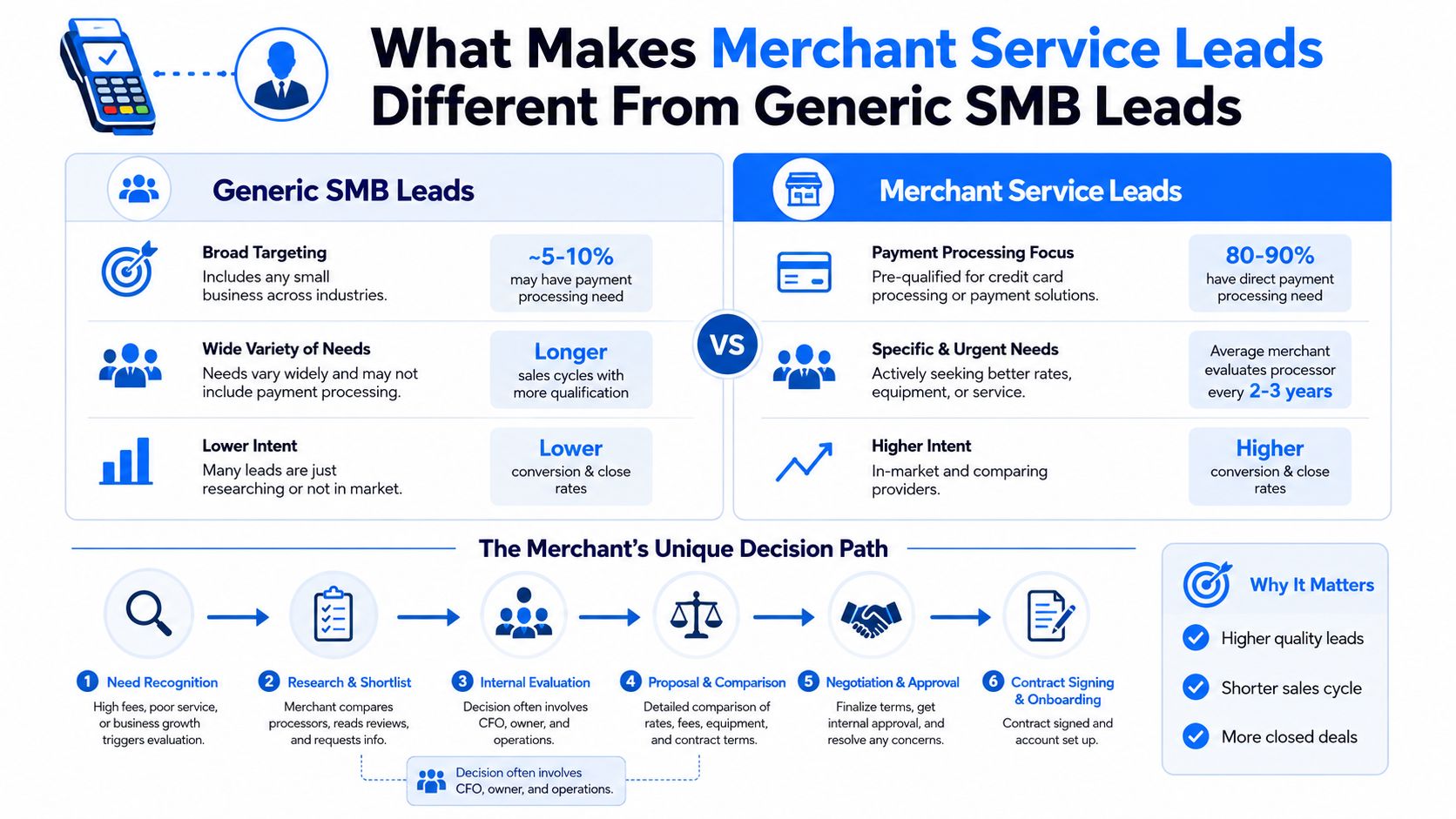
Generic SMB outbound assumes a business has a problem, knows it has a problem, and will respond when you describe a benefit. Merchant services usually don't work that way. The merchant already has a processor, often has equipment in place, and may be locked into a contract, a renewal clause, or a lease arrangement that makes switching annoying even when the economics make sense.
That's why the buying motion is so different. You're not just persuading a business to care about payments, you're trying to get it to interrupt an existing payment stack and move through a switching event. In practice, that means processors, statements, renewal windows, and contract posture matter more than broad pain language.
Practical rule: if you can't explain why a merchant can move now, you don't have a real merchant service lead yet.
The market context matters because the category is big enough to support specialization, but not so frictionless that spray-and-pray works. North America is expected to hold 29.4% of global share in 2026 in one major forecast, which reinforces how established and competitive the merchant services ecosystem remains in the US, UK, and EU-adjacent payments market (Coherent Market Insights merchant service market forecast). That maturity is exactly why vague “we help merchants save money” messaging underperforms. The decision is gated by existing infrastructure and switching cost, not abstract interest.
Think in terms of motion, not need
A merchant can need better pricing and still do nothing for six months. A merchant with a processor expiring soon, a bad statement, or an equipment lease about to roll over is much more movable. That's the operating difference.
The rest of the work is about narrowing your list to merchants with a realistic path to change, then qualifying them before you spend rep time. If you treat merchant service leads like generic SMB leads, you'll get plenty of conversations and too few boardings. If you treat them like timing-sensitive contract opportunities, the same dial volume starts to make more sense.
Qualifying a Merchant Lead Before You Book the Meeting
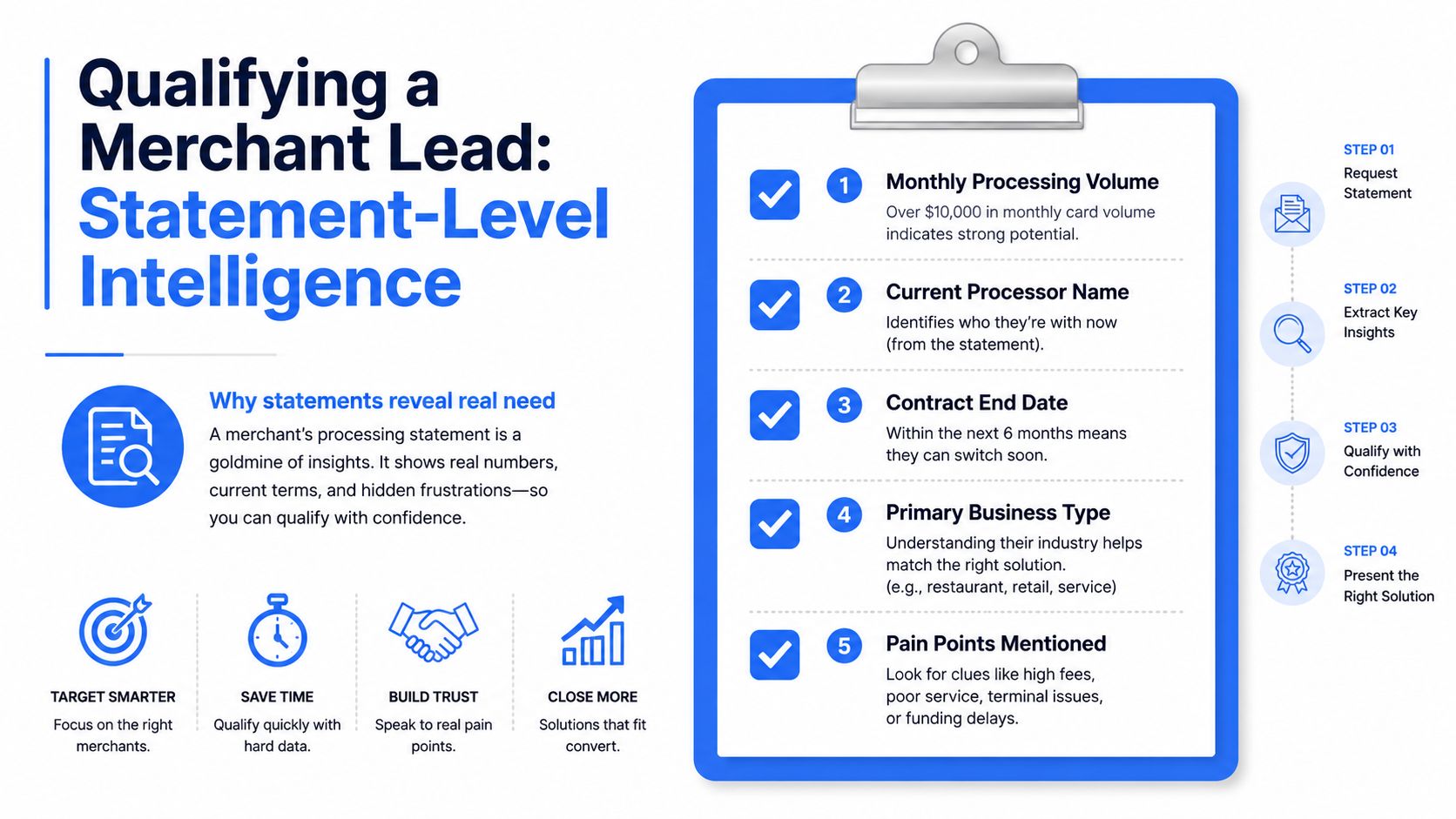
The strongest merchant-services pipelines don't start with “Who might care?” They start with “Who can switch?” That's why statement-level qualification beats generic contact capture. A lead with a name, phone number, and business category is not enough. You need enough detail to judge whether the merchant is in an active, switchable window, whether the statement is worth working, and whether the opportunity fits your economics.
Statement-level data comes first
A merchant statement tells you more than a cold form fill ever will. It shows the processor relationship, the fee structure, and clues about whether the account is worth deeper pursuit. Industry guidance on merchant-services lead generation keeps coming back to the same idea, verify whether the merchant is in an active, switchable window and inspect the statement before booking, because the pipeline is judged by pipeline-to-close rate, cost per qualified opportunity, and 90-day boarded-volume impact, not by raw meeting count (Launch Leads on choosing a merchant services lead generation provider).
That changes how you qualify. If a merchant can't share a statement, won't discuss their current processor, or clearly isn't near a renewal trigger, you're probably looking at an early-stage conversation, not a sales-ready lead. That doesn't mean the contact is worthless. It means they're not ready for a calendar slot that your closers have to carry.
What to verify before the meeting
Use a short, hard checklist before you hand anything to sales:
- Current processor and contract posture. If you don't know who they're with now, you can't position the switch cleanly.
- Statement access. A statement is the fastest way to see whether the account is worth the rep's time.
- Switchable timing. If the merchant isn't near a move, renewal, or review window, the urgency is weak.
- Business fit. The merchant's type and scale need to fit your offer, otherwise the conversation stalls later.
- Pain that's specific, not generic. “High fees” is common. A real reason to change is much more useful.
Dead leads often look busy at the top of the funnel. The statement usually tells the truth.
Red flags that should kill the handoff
If a prospect only wants a general chat, refuses to discuss current processing, or clearly isn't within a switching window, keep them in nurture. Don't let rep calendars become storage for unqualified curiosity. Volume without qualification is expensive because it inflates activity while starving actual boarded volume.
The main trade-off is simple. Qualifying harder reduces meeting count, but it usually improves the quality of the meetings you do keep. In merchant services, that's the better deal.
Building the Right ICP and List of Switchable Merchants
The cleanest merchant list is built from a narrow ICP, not from a pile of names. Start by defining the vertical mix you want, then layer in the payment volume band, target roles, and geography. Merchant services is not a one-size-fits-all offer, so your list should reflect the accounts your team can close and support without creating onboarding drag.
The buyer side matters too. For most merchants, the people who influence a switch are owners, CFOs, controllers, or operations leaders. On the provider side, especially when you're selling through ISOs or agent offices, the sales leader or partner manager often controls distribution and follow-through. That means your list design should reflect both the merchant decision-maker and the channel partner who can move the opportunity.
Sources that work in the real world
For discovery, LinkedIn Sales Navigator is still useful for role targeting. Business registries and Google Maps help build the company universe. Clay is practical for enrichment when you need to stitch together role, processor clues, and volume signals. Custom scraping is often what makes vertical-specific directories useful, because the data usually needs cleaning before it's prospect-ready.
A lot of teams lose time. They build one giant list, launch outreach, and hope the scoring happens later. That's backwards. A better pattern is to segment before outreach so the message, channel, and follow-up pressure match the account type. The one thing to avoid is treating every merchant like it's worth the same effort.
I keep a simple segmentation model: broad fit, likely fit, and switch-ready. Broad fit means the company matches your ICP but lacks clear timing. Likely fit means it matches the ICP and has some reason to review. Switch-ready means the account has enough signal to justify stronger sequencing and faster handoff.
A practical list build structure
For a 1,000-record build, the simplest working split is usually:
- Core ICP accounts. These fit your vertical and volume profile cleanly.
- Timing-sensitive accounts. These show a reason to evaluate sooner.
- Watchlist accounts. These fit strategically but need more signal before aggressive outreach.
That structure keeps your reps from over-investing in long shots. It also makes message testing cleaner, because you can compare how different account types respond without mixing all the signals together.
If you need a useful external reference on how operational context can shape prospect quality, the discussion of high chargeback rate problems is worth a look because it shows how pain signals can sharpen outreach when they're real, not invented. For teams building their own operating system, the same logic applies to list hygiene and role targeting, the kind of work often discussed in outbound resources like Lead Printer's agency overview.
Finding Merchants Who Are Actually Ready to Switch in 30 to 90 Days
Most merchant-services content stops at vertical and processor targeting. That's useful, but incomplete. The better question is whether the merchant is in a movable window right now. That's the unique advantage in this category, because a merchant with the right profile but the wrong timing will sit in your pipeline and do nothing.
Read the switch timing signals
The clearest signals are contract end-dates, auto-renewal clauses, and equipment lease buyout windows. If a merchant is approaching a renewal date, evaluating processors within the next 90 days, or facing a lease decision, the account becomes materially easier to work. The timing layer sits on top of your ICP and tells you who gets the first pass.
That's also why timing-specific research beats broad pain messaging. Industry guidance on merchant lead generation repeatedly points to contract end-dates, early-termination fees, and renewal-anniversary tracking as practical prospecting signals, even though that nuance is rarely turned into a full playbook (Launch Leads on merchant-services lead generation strategies). The insight is simple, merchant buying is often constrained by contractual friction, so your outreach has to land near a trigger.
If the merchant can't switch this quarter, you're not prospecting a lead. You're building a future conversation.
Operationalize the window
You won't always get perfect visibility into every contract. That's fine. The task is to enrich for timing proxies and rank them. Public filings, equipment financing data, renewal-anniversary patterns, and recent business events can all help you infer whether a merchant is closer to a move. Even when the data is imperfect, it's still better than treating all merchants as equally ready.
A good sequence uses the timing signal in the opening, not as an afterthought. For example, if a merchant just expanded, relocated, or is likely reviewing vendor contracts, the message should reflect that context. The point is to tie your outreach to a plausible trigger, not to generic curiosity about rates.
The practical payoff is segmentation. A “switch-ready this quarter” list should look different from your evergreen ICP. It deserves faster follow-up, more direct language, and a stronger push for a statement review. Merchants outside that window can stay in nurture, where the cost of patience is lower.
Messaging and Channel Sequencing That Reaches Merchants
Merchant service leads respond best when the sequence respects how little time the buyer has. Cold email should carry the main message, LinkedIn should reinforce credibility, and a selective call or SMS touch belongs only on the accounts worth the extra pressure. The sequence has to be tight enough to stay relevant and specific enough to sound like you know why the merchant might move.
The seller type changes the angle. A payment processor usually leads with operational simplicity, pricing clarity, or processing fit. An ISO or agent office often needs a message that signals channel support, lead flow, and partner economics. A fintech provider usually needs to translate product capability into merchant value without sounding like a feature dump.
Message by seller type
The best campaigns don't copy one template across all offers. They translate the same merchant pain into different seller language. For example, processors tend to do better when the message is direct about switching and cleanup, while fintech companies often need a more consultative opening because the product stack is broader.
| Seller Type | Primary Hook | Best Channel Mix | Key Proof Point |
|---|---|---|---|
| Payment Processor | Lower friction in switching and cleaner economics | Email first, then LinkedIn, then a selective call | Statement review and current processor fit |
| ISO or Agent Office | Faster merchant acquisition and partner support | Email plus LinkedIn, with call support for high-value accounts | Channel credibility and follow-through |
| Fintech Provider | Workflow improvement and integrated payment value | Email, LinkedIn, then tailored demos | Product fit and merchant use case |
The email still has to do the heavy lifting. LinkedIn is useful when the owner or finance contact has to see you twice before replying. Calls are best reserved for accounts where the statement, timing, and fit are already strong. That's the difference between sequence and noise.
Keep deliverability and inbox quality tight
A merchant-services program dies fast if the emails never land. Domain authentication, inbox warm-up, and controlled volume matter because the buyer won't see your pitch if the infrastructure is sloppy. That also means sending volume has to grow in line with deliverability health, not ambition.
One useful source for list validation is validate B2B contact lists, because clean records matter before any merchant campaign goes live. If the contact data is stale, the sequence doesn't get a fair shot.
The practical messaging rule is to lead with the switching reason, not your company history. Merchant buyers care less about your brand story than they do about whether the change is worth the interruption. Keep it short, specific, and tied to a trigger.
A Real 30 Day Sprint From List Build to Booked Meetings
A workable first month usually starts small enough to protect data quality. Week one is list build and ICP cleanup. Week two is copy, authentication, and launch. Week three is reply triage and test review. Week four is handoff and pipeline reporting.
Week one through week two
In the first week, the focus is on sourcing accounts, enriching them, and separating likely switchers from the broader list. LinkedIn and Clay are useful here because they let you stack role, company, and signal data before outreach starts. If you're validating the underlying contact quality, a resource like validate B2B contact lists is helpful for pressure-testing the records before launch.
Week two is where the infrastructure matters. You warm the inboxes, launch the first sequence, and keep the batch tight enough to watch deliverability and reply quality. The first send should tell you whether the message is resonating with the right kind of merchant, not whether the whole market is ready.
Week three through week four
By week three, you're sorting replies into real opportunities, partial fits, and bad timing. That triage is where merchant-services teams often learn the most, because the difference between a decent reply and a statement-qualified conversation becomes obvious very fast. A lower raw reply count can still produce better opportunities if the replies come from merchants with actual switching intent.
Week four is about reporting the right numbers to the sales team. Raw meetings are not the end state. The handoff should distinguish between general interest and accounts that have a statement, a fit, and a believable move window. That's the only way the sprint becomes a repeatable system instead of a one-off burst of activity.
Working rule: if a lead can't reach statement review inside the first motion, it's probably not ready for the closer.
Measuring Success by Boarded Volume Not Reply Rate
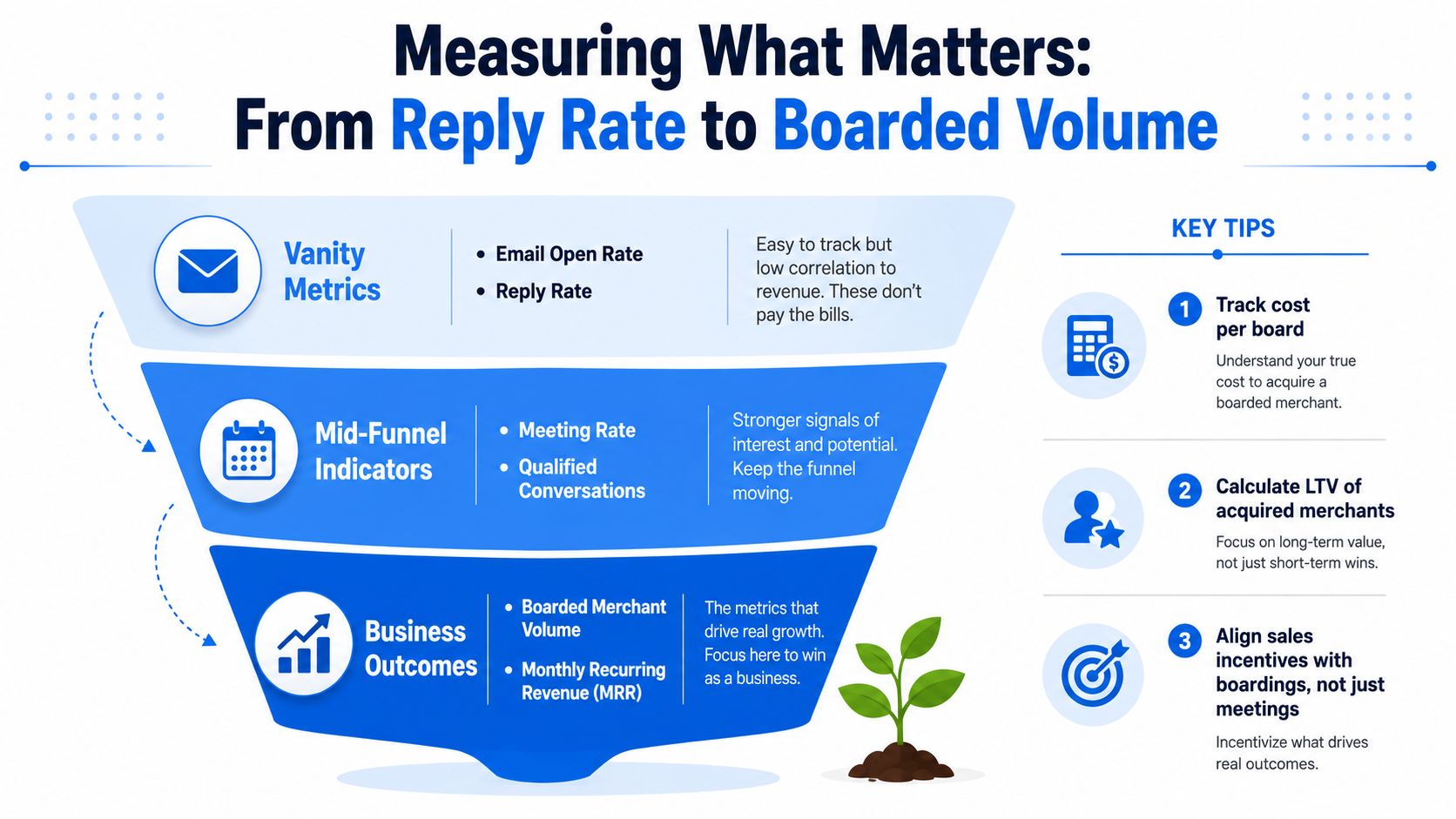
Merchant-services campaigns live or die on boarded volume, not vanity metrics. Reply rate and meeting rate are useful signals, but they don't pay commissions. The key question is whether your sequence produces statement-qualified opportunities that turn into boardings with acceptable economics.
That's why it helps to think in layers. A reply is just contact. A meeting is just motion. A statement-qualified opportunity is the first point where a merchant lead starts behaving like an asset. If your reporting stops before boarded volume, you're making decisions on incomplete evidence.
What to track instead
The most useful measurement habits are straightforward:
- Cost per qualified opportunity. This tells you whether the campaign is producing real sales work, not just inbox activity.
- Pipeline-to-close rate. This shows whether the opportunities are moving.
- 90-day boarded-volume impact. This keeps the campaign tied to near-term revenue, not abstract interest.
A useful comparison point from another vertical is e-commerce lead conversion rate, because it reinforces the same principle, top-of-funnel activity only matters when it makes it to business outcome. The metrics differ by category, but the measurement discipline is the same.
Lead Printer's ROI calculator is the kind of tool that helps teams pressure-test whether a merchant-services program is really paying back, especially when the pipeline looks active but boardings are lagging.
The reporting mistakes that cause false confidence
Three habits distort merchant-services reporting more than anything else. Teams count held meetings as revenue, they ignore cost per statement, and they celebrate reply volume even when the replies come from accounts that can't move. Those habits make the campaign look busier than it is.
Measure the campaign against boarded merchants and the speed at which switch-ready accounts move through the funnel. A merchant list built around timing signals should board faster than a long-tail list built on generic fit alone. If that isn't happening, the problem is usually list quality, qualification discipline, or onboarding friction, not copy creativity.
If you want a merchant-services outbound motion built around switch timing, statement-level qualification, and clean handoff into the sales process, Lead Printer can help you build it the right way. The team focuses on data-driven outreach that prioritizes real switching opportunities, not empty activity. If you're ready to turn merchant service leads into boarded accounts, visit Lead Printer and start with a campaign built around timing and qualification.