The worst mistake buyers make is shopping for a cold email marketing agency like it's a lead machine. It isn't. In 2026, the question is whether an agency can create pipeline without damaging your primary domain, weakening inbox placement, or dragging your sender reputation into a recovery cycle.
That's not a theoretical concern. Independent 2026 benchmark data show the average cold email reply rate is 3.43%, the average open rate is 27.7%, and 17% of cold emails never reach any inbox because they bounce or get filtered, which makes deliverability setup, list quality, and inbox placement foundational rather than optional [Martal benchmark data]. If an agency talks mostly about “more meetings” and barely about infrastructure, it's selling the outcome without proving it can protect the system that produces it.
| Agency model | What it optimizes | Main risk | Best fit |
|---|---|---|---|
| Broad outbound shop | Volume and breadth | Weak targeting and generic messaging | Teams testing a market |
| Deliverability-first agency | Inbox placement and domain safety | Slower ramp if the list is weak | Brands that can't afford reputation damage |
| Multichannel specialist | Sequencing across email and LinkedIn | Complexity if operations are sloppy | Teams selling into narrow segments |
| Lead-gen partner with qualification | Meetings and handoff quality | Overpromising on lead counts | Sales teams that need pipeline now |
A useful starting point is a deliverability checklist, not a pitch call. If you want a practical refresher on the basics of improve email deliverability, read it before you sign anything, because the agency that handles inbox placement well is already operating on a different level than the one that only writes copy.
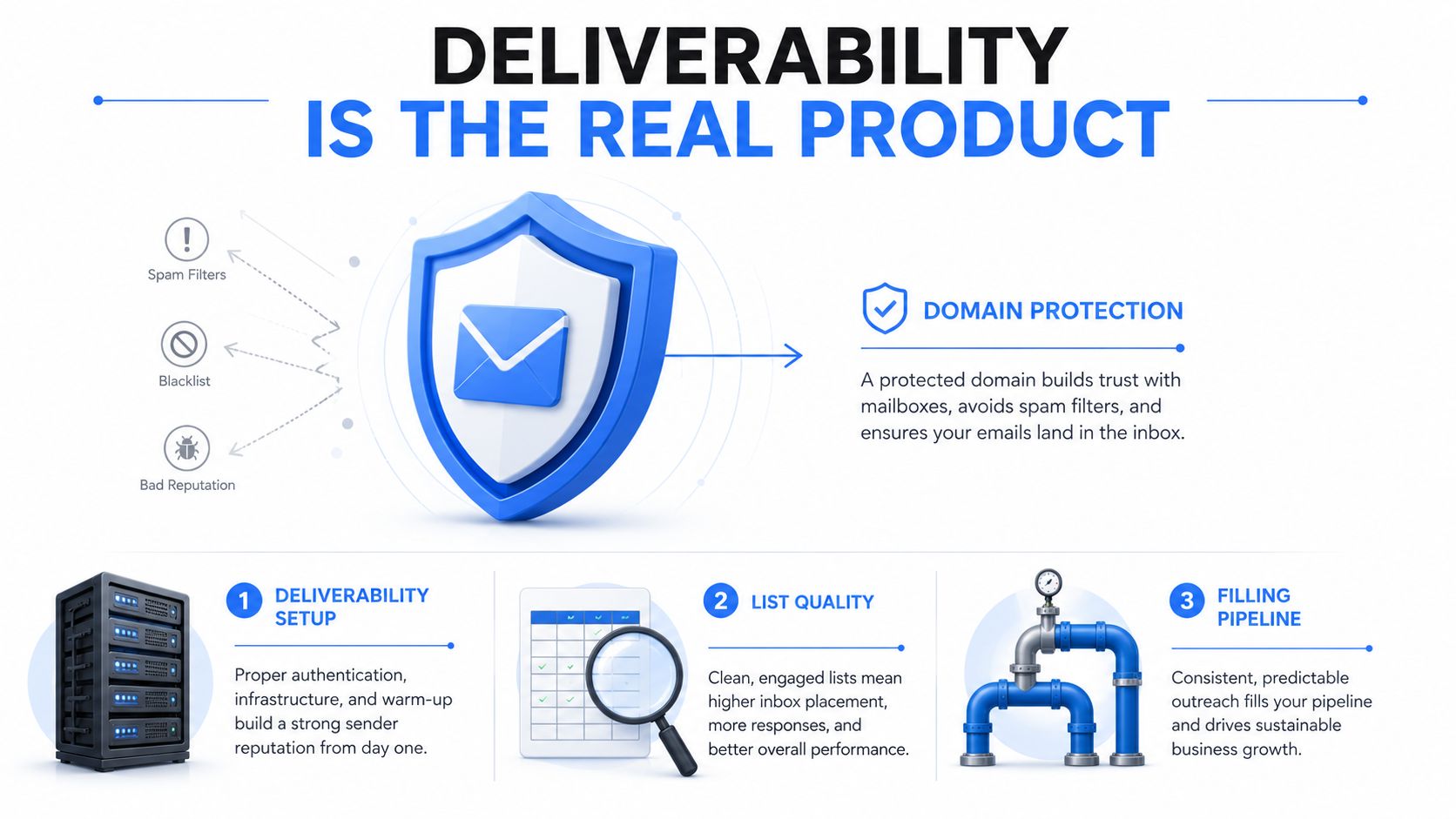
Practical rule: if an agency can't explain how it protects your primary domain, don't treat it as an execution partner. Treat it as a risk.
Deliverability Is the Core Product
A cold email marketing agency is often sold as a pipeline service, but the product underneath the product is deliverability. If messages do not reach the inbox, the rest of the stack, copy, targeting, sequence design, and reporting, has nothing to work on. That is why inbox placement, list hygiene, and sender reputation need to sit at the top of your evaluation, not near the end.
The trade-off shows up in day-to-day execution. Reply rates are modest, and a meaningful share of cold email never reaches an inbox because it bounces or gets filtered, so a decent sequence can still fail before a prospect sees it [Martal benchmark data]. In practice, that means the quality of the sending environment matters as much as the wording of the email.
What good agencies protect before they send
A serious operator talks about primary inbox placement, not just “delivered” volume. Guidance for 2026 sets a target of 90%+ primary inbox placement, recommends pausing a campaign if it falls below 85%, and says bounce rate should stay under 2% with spam complaint rate under 0.08% to protect domain reputation and preserve scale capacity [Litemail KPIs]. Those are guardrails, not vanity numbers.
If an agency treats warmup, authentication, and list verification as interchangeable buzzwords, it probably has not built enough outbound systems to know the difference.
The economics are unforgiving. One analysis reports an average cold email conversion rate of just 0.215%, or roughly 1 closed deal per 464 emails sent, while another benchmark says about 306 cold emails are needed to generate one qualified B2B lead [ReachOutly conversion analysis]. Small failures in inbox placement or targeting compound fast because there is not much conversion room to waste.
A deliverability-first agency also thinks in stages. Early campaigns need conservative sending, clean lists, and close monitoring. Scale comes later, after the domain has earned trust. That is the right order if you want the primary domain to stay healthy long enough to matter.
A basic refresher on improve email deliverability helps separate real infrastructure from pitch-deck language. The agencies worth hiring can explain exactly how they protect your primary domain before they ever ask for volume.
What a Cold Email Marketing Agency Does
A real cold email marketing agency doesn't just “send emails.” It wires together infrastructure, data, messaging, sequencing, and reporting so the campaign works as a system. If one layer is weak, the whole program degrades. Good agencies know that targeting without deliverability is wasted effort, and deliverability without targeting just sends the wrong message to more people.
The operational stack behind a working campaign
The first layer is infrastructure setup. That includes domain authentication, inbox creation, warm-up, and safeguards that keep the sending environment separate from the company's core brand risk. The second layer is prospect research and list building, usually from sources like LinkedIn Sales Navigator, Google Maps, target websites, or business registries, then cleaned and segmented so the list matches the intended buyer.
The third layer is data enrichment and personalization logic. A good agency decides whether the hook should be based on role, geography, tech stack, company size, or a trigger event. The fourth layer is sequence writing, and most weak vendors over-index on copy while under-investing in proof, relevance, and timing.
A useful internal reference is the way one agency framework describes the workflow end to end, from infrastructure through reporting, rather than as isolated line items. The functional map at Lead Printer's agency overview is a good example of how the pieces should fit together. The important part isn't the brand name, it's the structure: research feeds copy, copy feeds launch, launch feeds optimization.
What “full execution” should include
For SaaS, ecommerce, services, and manufacturing buyers, the right agency should be able to handle:
- List sourcing with intent, not just scraping names.
- Segmentation by buyer fit, so different offers don't get blended into one send.
- Sequence design that matches the segment, not a recycled template.
- Multichannel orchestration, when email alone isn't enough.
- Reporting on reply quality and meeting handoff, not only opens.
The best agencies sound boring when they describe operations. That usually means they've done the hard work already.
If a proposal skips any of those layers, you're not buying full execution. You're buying a slice of the workflow and hoping the missing parts won't matter.
RFP Criteria for Agency Evaluation
The fastest way to separate a real operator from a polished seller is to send a hard RFP before the sales call drifts into slides and promises. Ask for operational detail, not marketing language. If the answers are vague, you've already learned something.
Questions that expose the actual setup
Start with technical configuration. Ask, “How do you separate cold outreach infrastructure from the primary domain?” Then follow with, “Who owns SPF, DKIM, and DMARC setup, and how do you decide when to pause or rotate a campaign?” If they can't explain the workflow plainly, they probably rely on someone else's stack or a shallow playbook.
Then move into list quality. Ask, “What sources do you use, how do you verify addresses, and what gets excluded before send?” A good agency should be able to describe its enrichment logic, its cleaning process, and the signals it uses to reject bad records. Agencies that buy generic lists usually collapse under scrutiny at this point.
The questions that reveal whether strategy is real
Next, ask how they handle messaging. “What determines the first angle, the follow-up angle, and the proof point for each segment?” That question matters because weak agencies often use one sequence across too many audiences. Good operators adapt the message to the trigger, not the other way around.
You should also ask for reporting cadence. “What do you report weekly, and what action do you take when reply quality changes?” The best answer isn't a dashboard dump. It's a description of how they use data to change targeting, copy, or sending behavior.
Finally, ask about compliance and risk. “How do you handle opt-outs, regional outreach rules, and domain safety for US, UK, and EU sends?” If the response is generic, that's a problem. ZeroBounce's neutral guidance is useful here, because it pushes buyers to check whether the agency configures authentication, uses separate domains for warm versus cold outreach, respects sending limits, and manages spam-word risk. That is the level of detail you want before the shortlist, not after the contract is signed.
A clean RFP gives you a pass-fail view. The goal isn't to collect clever answers. It's to see whether the agency can explain how it operates.
Pricing Models and Cost Tradeoffs
Pricing tells you where an agency thinks accountability lives. A retainer says the agency is being paid for process and ongoing optimization. A per-lead model says the agency is willing to tie itself to output. A hybrid model tries to split the difference, usually because buyers want some predictability and agencies want protection from pure performance risk.
The danger is comparing price without comparing operating model. A cheap per-lead offer can still be expensive if the leads come from weak targeting or shaky inbox placement. A higher retainer can be fair if the team is managing infrastructure, research, copy testing, and list quality in a disciplined way.
What each model signals about accountability
Retainers work best when the buyer expects experimentation, list refinement, and broader campaign management. This is common for teams entering a new segment or testing a new message. The downside is obvious, if the agency isn't disciplined, the retainer can become a comfort blanket with no pressure on results.
Per-lead pricing appeals to buyers who want direct accountability, but it can distort behavior. Agencies under that model may optimize for any lead rather than the right lead, especially when qualification rules are fuzzy. That's why the definition of a qualified lead matters more than the fee structure itself.
Hybrid pricing usually fits mature buyers better because it spreads risk. You get a base fee for execution, plus outcome alignment on qualified opportunities. If you're trying to compare pricing models in practical terms, the Lead Printer ROI calculator is the kind of tool that helps you think through conversion value before you get distracted by monthly fees.
For general pricing structure ideas, Oviond's guidance on agency pricing Oviond advice is useful context because it shows how agencies think about packaging, scope, and margin, even outside outbound. That perspective matters when a cold email marketing agency tries to bundle deliverability, content, and lead qualification into one offer.
The rule is straightforward. Early-stage teams usually need a lower-complexity arrangement and a clear scope. More mature teams, especially those protecting brand and domain equity, should pay for operational rigor instead of chasing the lowest quoted number.
Red Flags in Agency Pitches
A weak pitch rarely sounds weak on the surface. It sounds polished, confident, and focused on outcomes. The warning signs appear when you ask how the agency protects the sending environment and how it measures the risk it creates.
Benchmarks that should trigger caution
Use the 2026 thresholds as a first filter. If an agency cannot explain how it aims for 90%+ primary inbox placement, that is a concern. If it is comfortable operating below 85%, it is accepting inbox loss that can make scale unstable [Litemail KPIs].
Bounce and complaint handling matter just as much. A program that cannot keep bounce rate under 2% or spam complaint rate under 0.08% is not just lagging, it is building domain debt [Litemail KPIs]. Each bad send makes recovery harder, especially if the agency keeps pushing volume while the signals worsen.
The pitch behaviors that usually hide risk
Be careful with vague promises like “we'll get you meetings fast” when the agency does not discuss list sourcing, sending limits, or domain separation. Be equally cautious with agencies that lead with reply volume but never define what counts as a useful reply. A response from the wrong buyer is noise, not pipeline.
Creative can matter, but it does not compensate for weak operations. Copy can improve response rates, yet it will not fix a poor domain setup or bad sending discipline. In practice, a weak infrastructure will drag down solid copy more reliably than good copy can rescue a broken setup.
Reject the pitch if the agency will not define its stop conditions. A serious operator knows when to pause a campaign, fix the underlying issue, and relaunch safely.
If you want a practical warning sign checklist, use this before the final call:
- No clear inbox placement target means the agency is probably optimizing the wrong metric.
- No explanation of list hygiene usually points to weak sourcing.
- No pause rule suggests the agency may keep sending through a problem.
- No regional compliance answer is a bad sign for US, UK, or EU outreach.
- No reporting on lead quality means the agency may be counting replies that do not convert.
The safest pitches usually sound least theatrical. They sound like operations, because that is what they are.
Broad Service vs Focused Angles
Broad outbound positioning used to be enough. An agency would claim it could reach anyone, write anything, and generate leads across industries. That approach still exists, but it's losing ground to narrower angle design, especially when the buyer's market needs a specific trigger, proof point, or channel mix.
The reason is simple. Recent practitioner evidence on LinkedIn suggests that only a few angle types keep working consistently in 2025 and 2026, including competitor followers, ultra-short two-line emails, and lead-magnet outreach with customized Looms or documents [LinkedIn practitioner note]. That doesn't mean broad positioning is dead. It means buyers should be asking for decision rules, not slogans.
When broad service still makes sense
Broad service models can still work when the buyer is early in market testing, has a flexible offer, or needs help finding signal before narrowing down. They're also useful when the agency is doing heavy research and the target market is still being defined. The downside is obvious, broad promises can hide thin specialization.
When focused angles win
Focused, trigger-based multichannel strategies make more sense when the market is already defined by role, company size, or event-based timing. Independent guidance for agencies also points toward narrower positioning and trigger-based outreach, such as new hires, technology adoption, or funding events, instead of static industry lists. That matters because the angle should match the buying moment, not just the segment label.
For SaaS buyers, a competitor-following angle can be more relevant than a generic product pitch. For ecommerce or fintech, a customized document or Loom can create enough context to earn the reply. For services and manufacturing, trigger-based relevance often comes from operational changes rather than broad category fit.
The lesson is to brief agencies with a segment-to-angle expectation. If they can't say when they'd use one angle versus another, they're selling capacity, not judgment. That's also why Lead Printer's B2B SaaS page matters as a reference point, because the messaging stack should change with the buyer type rather than stay frozen in one template.
Choosing the Right Agency by Scenario
The right agency choice changes with stage, geography, and buying motion. A startup entering outbound for the first time doesn't need the same operating depth as a company sending across the US, UK, and EU at once. A manufacturer selling to a narrow buyer set needs different logic from a SaaS team chasing a high-velocity pipeline.
For B2B SaaS, look for an agency that can segment by role, tech stack, and trigger, then test focused angles rather than broad blasts. Multichannel sequencing can help, especially if the sales team wants meetings that land close to the buying need. If your team also needs help with outbound execution capacity, a partner like Hire SDRs can sit alongside agency support when you need human follow-up instead of only campaign setup.
For ecommerce and fintech, timing and relevance matter more than generic category language. The message has to feel close to the business pain, not just the product feature set. If the agency can localize across regions and adjust the proof point by market, it's operating at a more useful level.
For professional services, the best fit is usually a tighter segment definition and a messaging system that doesn't overcomplicate the offer. Buyers in these categories care about credibility and fit, so overproduced outreach often works against you. In these cases, a smaller, cleaner sequence can outperform a broader brand-heavy pitch.
For manufacturing, the strongest agencies are usually the ones that can handle specialization without losing operational discipline. The buyer list is narrower, the relevance bar is higher, and regional localization can matter more than scale. That's where one-size-fits-all copy tends to fail quickly.
If you're deciding internally, use this filter. Early-stage, test a focused agency with strong deliverability and clean reporting. Multi-region or multi-segment, choose a partner that can localize and orchestrate across channels. If the agency can't tell you how it handles US, UK, and EU variation, it's not ready for a real rollout.
FAQ on Cold Email Agency Selection
How long does onboarding usually take
Onboarding should be long enough to verify infrastructure, list quality, and messaging fit before any serious send volume goes out. If an agency wants to launch immediately without checking the sending environment, that's a shortcut with a cost. The safer path is to treat onboarding as setup plus validation, not as a sales handoff.
Do lead guarantees mean the same thing across industries
No, they don't. A lead guarantee is only useful if the agency defines what counts as a qualified lead, how it handles disqualification, and what happens when the market is narrower than expected. A guarantee without a qualification definition is just a marketing line.
How is EU localization handled without duplicate content risk
The cleanest approach is not translation alone, it's localized messaging. That means changing the angle, proof point, and regional context rather than copying the same email into another language or market. Agencies that do this well treat region as part of the offer, not just the language layer.
What should I ask before I compare proposals
Ask three things, in order. First, how they protect domain safety. Second, how they define a qualified lead. Third, how they adapt the message by segment and region. If they answer those three clearly, you've got something worth comparing.
If you're choosing a cold email marketing agency and want the infrastructure, targeting, and multichannel structure handled by one team, Lead Printer can map the setup to your stage and market. Visit Lead Printer to review the service fit, compare the outbound approach, and decide whether your next campaign needs stronger domain protection before it needs more volume.