A CNC shop can have excellent equipment, reliable delivery, and a strong reputation with existing customers, yet still watch its new-business pipeline stall. The usual response is familiar: increase paid spend, refresh the brochure, attend another trade show, and ask sales to follow up harder. That activity can create noise without helping an engineer, plant manager, procurement lead, and executive agree that your company is the safest technical choice.
B2B marketing manufacturing requires a different operating model. Industrial buyers research independently, compare suppliers across multiple sources, and involve several stakeholders before a salesperson gets a serious conversation. Gartner's 2025 data places average manufacturer marketing spend at 9.5% of revenue, up from 6.7% in 2024, a shift that signals marketing is becoming a revenue function rather than a support activity (manufacturing marketing budget data from Gartner). The opportunity is substantial, but only for teams willing to build around technical proof, account-level visibility, deliverability, and long-cycle measurement.
Why Manufacturing B2B Marketing Is Different
A mid-market CNC company doubled its paid media budget after a strong quarter of referrals. Traffic rose, form submissions trickled in, and the sales pipeline barely moved. The problem wasn't necessarily the advertising. The campaign reached people who liked the company's capabilities, but it didn't help the right committee validate tolerances, production continuity, quality controls, integration requirements, or commercial risk.
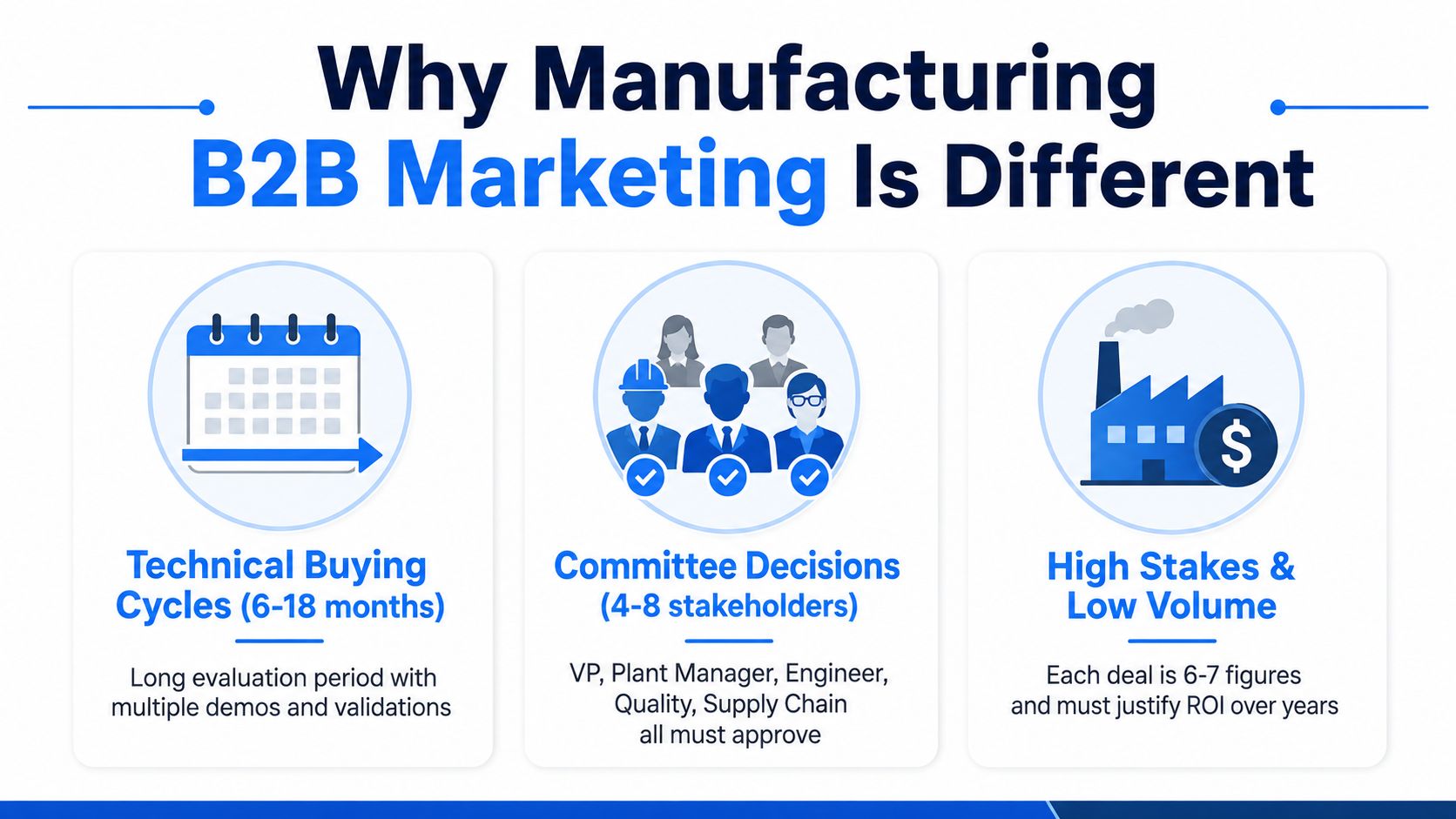
Manufacturing purchases take longer because the consequences of a poor decision reach the production floor. Engineers scrutinize technical claims, procurement tests commercial assumptions, plant leaders assess operational fit, and executives consider continuity, capacity, and strategic exposure. A supplier may need to remain credible through a long evaluation period before the account is ready to issue an RFQ.
Three conditions separate industrial marketing from shorter-cycle B2B programs:
- Technical scrutiny: A broad promise such as “improve efficiency” has little value without application detail, specifications, certifications, process evidence, and clear limitations.
- Committee approval: The person who downloads a datasheet may influence the decision without signing the purchase order. Messaging must work for technical users and economic buyers at the same time.
- Operational risk: Buyers aren't only purchasing a product. They're deciding whether your company can protect uptime, quality, supply continuity, and customer commitments.
Commodity pressure makes weak differentiation more expensive. Conversations about reshoring and nearshoring also push buyers to compare responsiveness, regional support, capacity, and resilience alongside unit price. That changes the role of marketing. Brand awareness helps, but technical proof over brand storytelling, committee coverage over a single-buyer funnel, and disciplined channel selection over scale-first spending are more reliable principles.
Practical rule: If a campaign can't help an engineer prove technical fit or help procurement defend supplier selection, it isn't ready to scale.
How Manufacturing Buyers Research and Buy
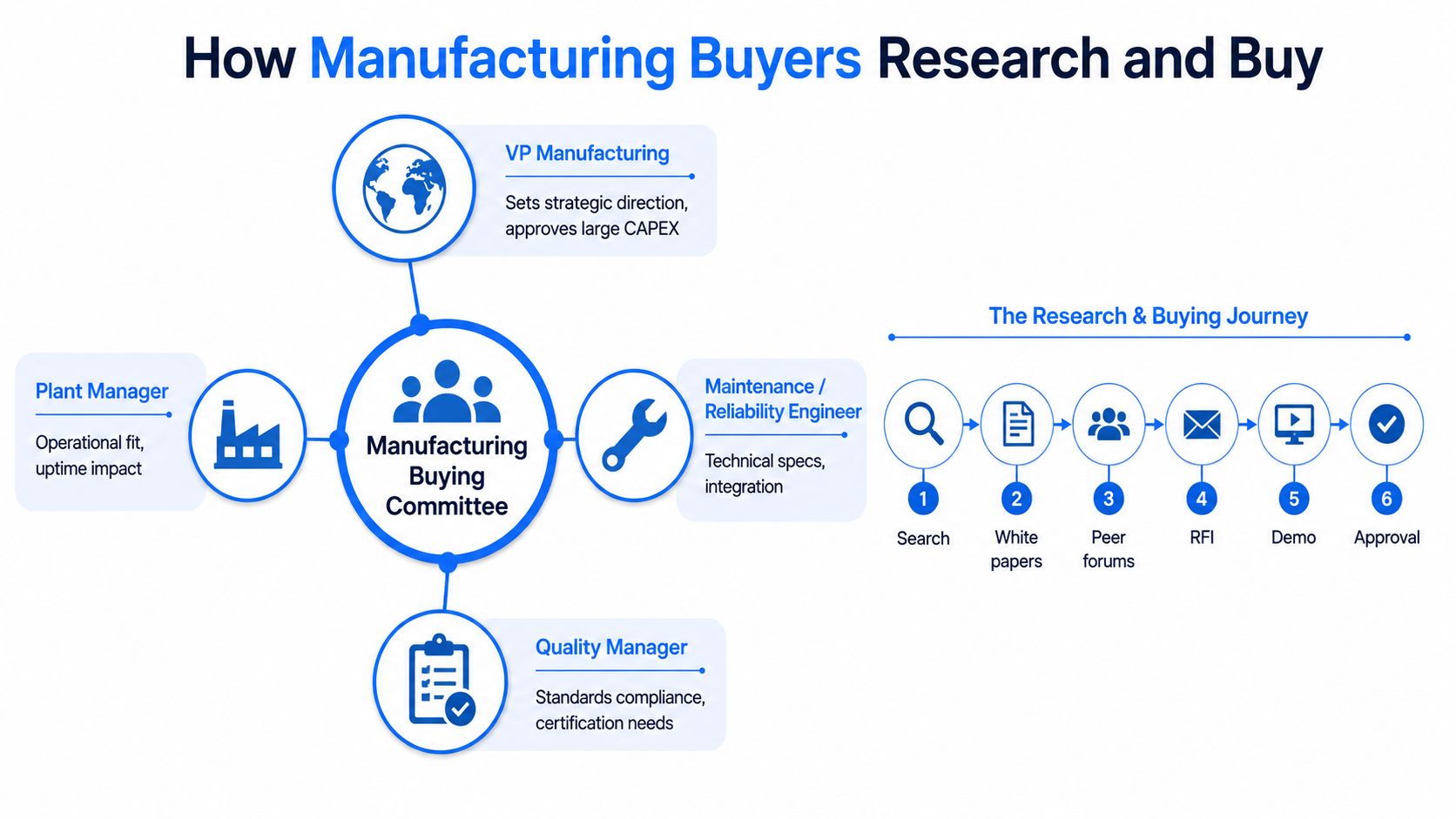
A manufacturing purchase can involve six voices before a supplier reaches the final approval stage. A VP of Manufacturing or Operations may define the strategic need. A Plant Manager tests operational fit, a Maintenance or Reliability Engineer evaluates integration, a Quality Manager checks standards, Procurement negotiates terms, and a C-suite sponsor approves the commercial risk. Treating that group as one persona creates gaps in messaging and follow-up.
Research starts before vendor contact. In a study of high-value manufacturing purchases, 85% of executives and managers said they research vendor or supplier websites before a major purchase, while 64% said they seek independent, objective information (high-value B2B manufacturing buying trends). The same study found that 33% believed vendors lacked sufficient technical depth and clear differentiation. A polished homepage cannot compensate for missing specifications, application detail, or evidence of performance.
Industrial buyers also compare information across channels. Gardner's Industrial Buying Influence work found that nearly 90% of industrial buyers use at least three media types during a purchase, and buyers are about three times more likely to rely on trade magazines, industry publications, and familiar company websites than on generic search and social sources (Gardner's industrial buying data). Your technical article, supplier page, peer discussion, and sales email should support one application-specific argument. Inconsistent claims create doubt, especially when engineers and procurement review the same supplier from different angles.
Build around triggers, not stable-state interest
Campaigns aimed at every plant in a broad industry attract accounts with no immediate reason to change. Prioritize signals that indicate a project, risk, or operational constraint:
- Downtime events: A failure, maintenance backlog, or reliability problem creates urgency.
- Capacity changes: New production lines, facility expansion, or reshoring initiatives can create supplier demand.
- System changes: ERP, MES, automation, or quality-system projects often expose gaps in existing processes.
- Compliance pressure: An audit, certification requirement, or customer mandate can move a project forward.
- Product launches: New programs require qualified suppliers before the public launch makes the need obvious.
Map each trigger to a useful asset and a specific outreach angle. Then use account-level signals to coordinate timing with sales. A practical resource on using data for B2B marketing reinforces the point: the task is not collecting more contacts. It is identifying which accounts, roles, and behaviors indicate a credible buying motion.
Building ICPs, Lists, and Segmentation for Manufacturers
A manufacturing ICP should describe the operating environment in which your solution is valuable, not just the industry label. Start with firmographics such as NAICS or SIC classification, plant count, employee bands by site, production type, revenue range, and installed equipment. A company may look attractive at headquarters level but lack the plant footprint, budget authority, or technical problem your offer addresses.
Add technographic and compliance signals. Identify ERP and MES platforms, automation vendors, PLC and robotics ecosystems, and certifications such as ISO 9001, AS9100, or IATF 16949 where they matter to the buying decision. Then layer in activity signals, including relevant hiring, capital expenditure announcements, facility changes, new programs, regulatory developments, and participation in technical events.
Use tiers to control effort
A useful model separates accounts by fit and the level of research they justify:
- Tier 1: Strategic accounts with strong operational fit and visible buying triggers. Use individual research, multi-threaded messaging, and sales coordination.
- Tier 2: Good-fit accounts with partial signals. Use segment-specific copy, role-based assets, and lighter personalization.
- Tier 3: Broad market coverage with strict qualification. Use educational content and limited outbound until engagement creates a reason to invest more.
For a 5,000-record target list, don't treat every row equally. First separate accounts by plant footprint and market segment, then identify the relevant functions at each site. A reliability engineer at a multi-site manufacturer needs a different opening from a procurement manager at a single specialized plant. Useful sources include ThomasNet, Kompass, trade show attendee data, regulatory filings, company hiring pages, and enrichment platforms that map plant-level roles.
Before launch, require a minimum record standard:
- Verified company and plant location.
- Relevant job title and functional responsibility.
- Seniority and likely influence in the committee.
- Verified business email.
- Account tier, trigger, and message segment.
| Tier | Account Profile | Primary Roles Targeted | Data Sources | Outbound Cadence |
|---|---|---|---|---|
| Tier 1 | High-fit plant group with active trigger | Operations, engineering, quality, procurement, executive sponsor | Registries, filings, LinkedIn, trade events, enrichment | High-relevance, multi-threaded sequence |
| Tier 2 | Strong fit with limited buying evidence | Plant, maintenance, engineering, procurement | Directories, websites, LinkedIn, hiring signals | Segment-based sequence with technical asset |
| Tier 3 | Broad category fit without a clear trigger | Role selected by use case | Industry directories and validated databases | Lower-intensity education and monitoring |
Channel Strategy for Manufacturing Audiences
No single channel reaches every member of a manufacturing committee. Email can open a conversation with a component buyer, LinkedIn can create familiarity with a plant leader, technical content can support anonymous research, and a trade show can accelerate an evaluation already underway.
| Channel | Best buyer stage | Typical cost per opp. | Scalability | When to invest |
|---|---|---|---|---|
| Outbound email | Net-new discovery and early evaluation | Varies by data quality, offer, and sales effort | High with disciplined segmentation | When the ICP is clear and speed matters |
| LinkedIn ABM | Account awareness and stakeholder engagement | Varies by audience size and personalization | Moderate | When named accounts and specific roles matter |
| Trade shows | Validation, demos, and late-stage acceleration | Capital-intensive and event-dependent | Low to moderate | When target accounts attend and meetings can be pre-booked |
| Technical content | Education and consensus building | Production effort varies by depth | High after creation | When buyers need proof before contact |
| Application-specific SEO | Ongoing discovery and research | Compounds over time | High for well-structured content | When specification searches reveal durable demand |
| Distributor or OEM partnerships | Market expansion and trust transfer | Depends on partner economics | Moderate | When partners already own local access or vertical credibility |
Outbound email often suits component and subcontract manufacturers because a precise account list can create conversations without waiting for broad search demand. LinkedIn ABM earns its place when you can name the plants, roles, and business context you want to reach. Trade shows work best as a coordinated sales motion, not as an annual ritual. Pre-event invitations, technical demonstrations, and rapid follow-up matter more than booth size.
Technical content should answer the questions that stop an engineer from progressing. That includes application notes, comparison guides, drawings, qualification requirements, test reports, and implementation constraints. SEO should focus on those real use cases rather than broad category language.
For a useful framework on how inbound and outbound motions differ, see this Wispra inbound outbound comparison. Manufacturers can also align event planning with industrial conference opportunities when a conference supports the target account strategy.
Channel principle: Start with email and LinkedIn for net-new accounts, reinforce those touches with proof-rich content and search, then use events when a buying window justifies the investment.
Outbound Infrastructure and Deliverability Essentials
A technically strong message can't create pipeline if it lands in spam or gets blocked by a plant's email gateway. Manufacturing senders face legacy corporate filters, attachment restrictions, strict security policies, and prospect expectations shaped by years of generic vendor outreach.
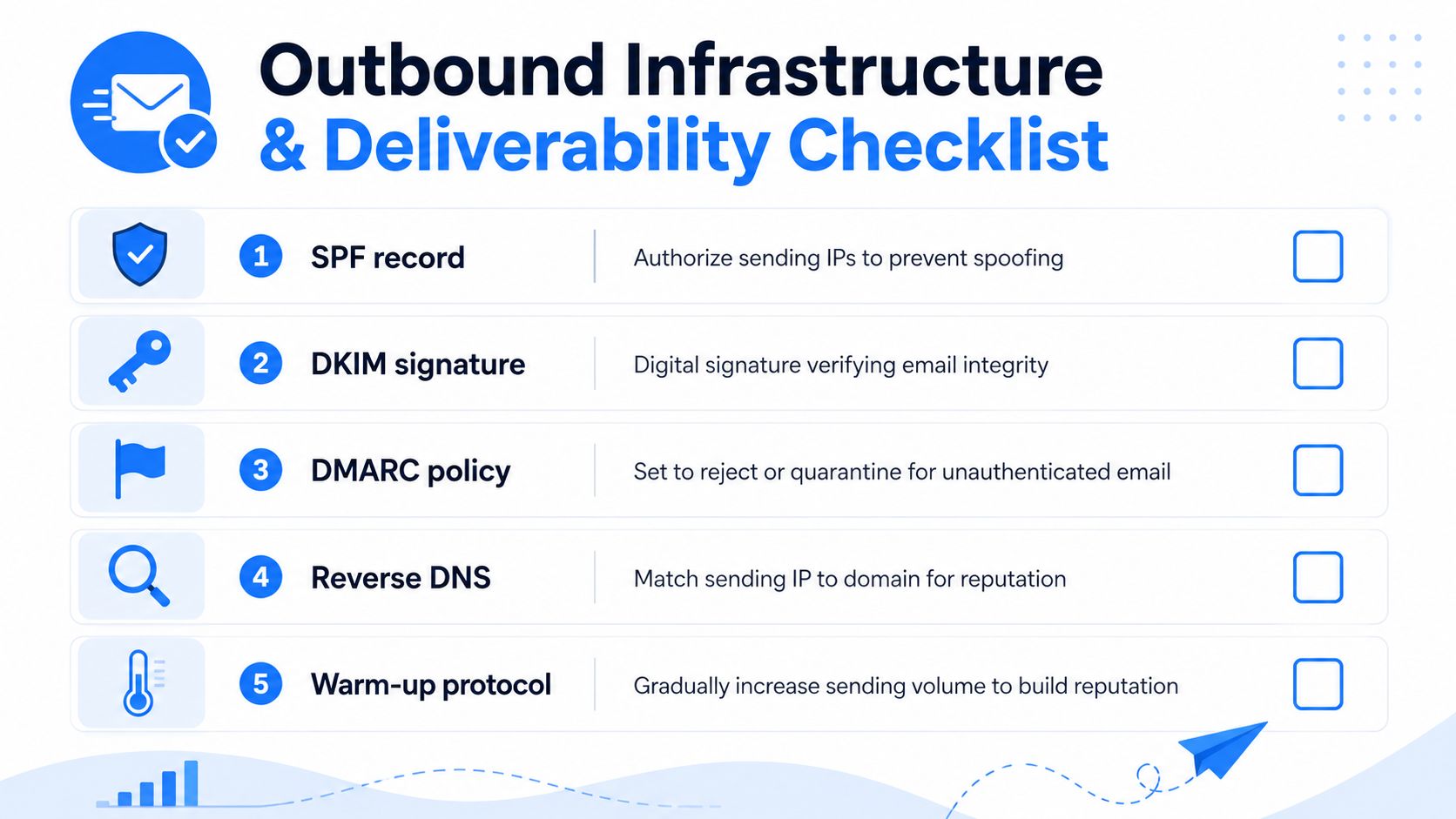
Set up authentication before writing the sequence. SPF authorizes legitimate senders, DKIM verifies message integrity, and DMARC provides policy enforcement for unauthenticated messages. Keep campaign infrastructure separate from the primary corporate domain where appropriate, and protect tracking links from looking deceptive or excessive.
Treat reputation as campaign capacity
Validity's 2026 benchmark reports a global inbox placement rate of 87.2% for 2025, while manufacturing recorded 89.9% (Validity Email Deliverability Benchmark Report). That difference matters in a narrow, high-value market. Better placement increases the reachable audience without requiring more prospect data or media spend.
Use a gradual warm-up over several weeks, test placement with tools such as MXToolbox, GlockApps, and Mailreach, and watch operational thresholds:
- Bounce rate: Keep it below 3%.
- Spam complaints: Keep them under 0.1%.
- Inbox placement: Monitor for performance above 85%.
Suppress role addresses such as info@ and sales@, existing customers, active opportunities, prior unsubscribes, and contacts with invalid consent status. Avoid sending large attachments in initial outreach. Link to a relevant technical page instead, and keep link volume modest.
Before launch, confirm lawful outreach by region, clear opt-out handling, suppression synchronization, accurate sender identity, and a process for responding to complaints. The Mailadept cold email guide offers additional practical context on writing and operating compliant campaigns.
Messaging, Localization, and Proof for US, UK, and EU Markets
Translation isn't localization. A manufacturing message must preserve technical meaning while adapting the commercial emphasis, proof format, language conventions, and regulatory context for the buyer's market.
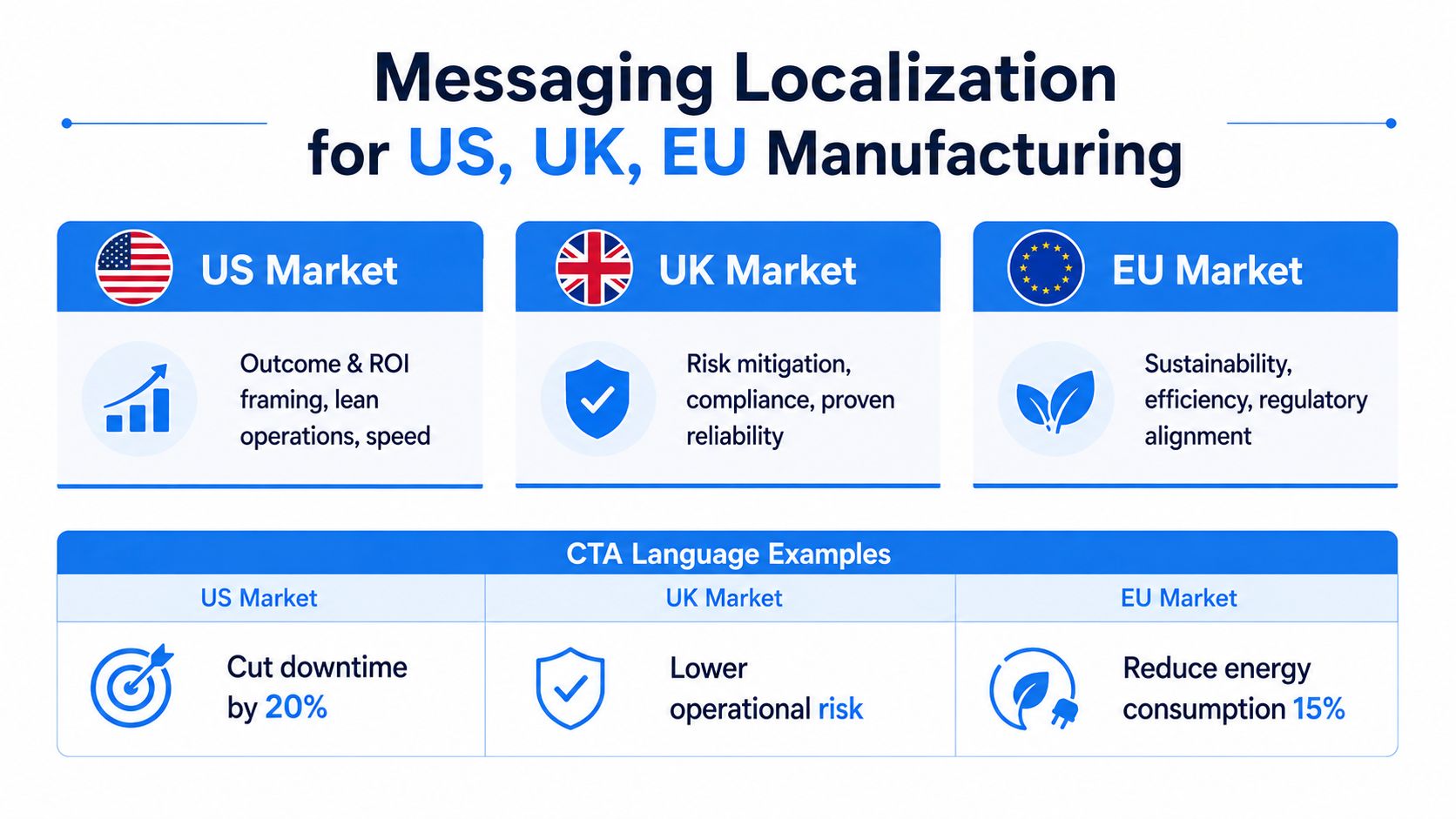
US outreach can be direct and outcome-oriented. Buyers may respond to language around throughput, lean operations, reshoring, nearshoring, responsiveness, and measurable operating impact. The opening should connect the capability to a plant problem, not lead with company history.
UK buyers often expect restrained claims, technical credibility, and evidence from comparable operations. Certifications, concise application notes, quality documentation, and practical risk reduction usually carry more weight than aggressive ROI language. EU buyers may place greater emphasis on regulatory alignment, total cost of ownership, environmental requirements, and references from the relevant region.
Localize the working details
| Element | US | UK | EU |
|---|---|---|---|
| Spelling | American English | British English | Local language where practical |
| Units | Imperial and metric as relevant | Metric, with industry exceptions | Metric |
| Dates | Month, day, year | Day, month, year | Local convention |
| Currency | US dollars | Pounds sterling | Local or euro pricing context |
| Tone | Direct and outcome-led | Concise and evidence-led | Formality varies by country and role |
| Proof | ROI framing, plant outcomes | Compliance and reliability | Regulation, lifecycle cost, regional references |
Proof assets should match committee needs: datasheets for engineers, application notes for evaluators, third-party test reports for quality, customer logos for executives, and plant audit summaries for procurement or operations. Keep the core value proposition stable, but adapt the subject line, opening sentence, examples, units, and CTA.
Use English for international accounts where the working language is clear. German, French, or Italian outreach can improve relevance when the account operates primarily in that language, particularly for technical or procurement contacts. In Benelux and Switzerland, check the individual's preferred language and use bilingual landing pages when the buying group spans regions.
Measurement, Attribution, and Optimization in Long Sales Cycles
Manufacturing marketers shouldn't judge a long-cycle program by open rates alone. Those metrics can diagnose delivery and initial attention, but they don't show whether an account is moving toward technical evaluation or an RFQ.
Track activity at the account and committee level. A second-thread reply from an engineer, repeated engagement with a datasheet, a request for specifications, or movement from discovery to technical evaluation can matter more than a large volume of low-intent clicks.
Connect signals to CRM stages
Use first-touch attribution to understand how an account entered the system, then use multi-touch attribution to see which assets and channels supported progression. Keep the CRM stages explicit:
- Opportunity created: The account has a defined commercial problem.
- Qualified RFQ: Requirements, timing, and fit have been confirmed.
- Technical evaluation: The supplier is being assessed against specifications or integration needs.
- Commercial close: Procurement and executive approval are progressing toward a decision.
| Metric | What It Tracks | Why It Matters in Manufacturing | Optimization Action |
|---|---|---|---|
| Committee engagement | Participation across relevant roles | Shows whether one contact is carrying the entire motion | Add role-specific content or stakeholder outreach |
| Repeat technical engagement | Return visits, downloads, or asset use | Indicates active self-education | Offer an application review or technical call |
| RFQ-stage velocity | Movement through requirements and quote stages | Separates interest from commercial momentum | Improve qualification and sales handoff |
| Stage aging | Time spent without progression | Reveals stalled evaluations | Trigger account-specific re-engagement |
| Pipeline source and influence | First touch and supporting interactions | Helps defend channel investment | Reallocate budget toward credible opportunities |
Set stage service-level expectations in the CRM and flag accounts that stall. A stalled technical evaluation needs a different intervention from a dormant early-stage contact. Change the offer, revise the sequence, provide a missing proof asset, or ask sales to bring in a technical specialist.
For commercial planning, a manufacturing ROI calculator can help teams connect campaign investment to qualified opportunities without pretending that every early interaction forecasts a closed deal.
Putting the Manufacturing Marketing Playbook into Action
A manufacturing program becomes manageable when the team limits the first motion. Don't target every vertical, every geography, and every product line at once. Choose a clear ICP, a named account set, one primary outbound channel, and one supporting content or event motion.
A practical 30, 60, and 90-day rollout
First 30 days, define and prepare
- Lock the ICP, account tiers, roles, triggers, and exclusion rules.
- Audit the website, technical proof, certifications, and application pages.
- Set up authentication, sending domains, suppression logic, CRM stages, and reporting.
- Build the first segmented list and validate contact data.
By day 60, launch and learn
- Start one email or LinkedIn motion with role-specific messaging.
- Pair outreach with one useful asset, such as an application note, datasheet, or technical assessment.
- Review replies by account, role, objection, and buying stage.
- Hold a weekly sales and marketing review focused on qualified engagement, not raw activity.
By day 90, decide and compound
- Keep the motion if the right accounts are engaging, multiple stakeholders are appearing, and opportunities are reaching defined stages.
- Reset the motion if data quality, deliverability, offer relevance, or account selection is blocking progress.
- Expand only after the message, infrastructure, and handoff process work within the initial segment.
Common failure patterns include skipping warm-up, leading with brand creative instead of technical proof, treating the EU as English-only, and reporting MQL volume without connecting it to RFQ reality. The Lead Printer manufacturing service is one option for teams that need external support across prospect research, infrastructure, personalized email and LinkedIn campaigns, qualification, and reporting.
Scale a winning motion when account fit and committee engagement are consistent. Reset a stalled one when the same audience repeatedly ignores technically relevant outreach, deliverability weakens, or sales rejects the meetings. That decision rule keeps the program from restarting from scratch each quarter.
Lead Printer builds and manages data-driven email and multichannel campaigns for manufacturers across the US, UK, and EU, including infrastructure, prospect research, localized messaging, qualification, and CRM handoff. If your team needs a more disciplined route from technical buyer research to qualified sales conversations, visit Lead Printer to discuss your target accounts and outbound motion.