A fintech company can spend $1,450 to acquire one customer on average, and digital banking platforms average $2,140. Embedded finance providers average $1,340, while crypto and digital asset platforms average $1,890, according to a 2026 fintech customer acquisition benchmark. That changes the meaning of a “lead.” A poorly targeted contact isn't just a wasted send. It can consume sales time, compliance review, technical evaluation, and a substantial downstream acquisition budget.
Lead generation for fintech therefore works best as a unit economics discipline, not a race to fill a spreadsheet. The strongest programs identify accounts with a credible reason to buy, reach the right buying group, make a relevant first approach, and qualify aggressively before handing opportunities to sales.
Why Fintech Lead Generation Demands a Different Approach
Fintech acquisition economics punish broad outreach. A buyer may require input from product, engineering, finance, risk, legal, and executive leadership before a deal can progress. The person replying to an email may shape the evaluation without controlling the budget. The budget owner may never consume marketing content. Treating both contacts as equivalent creates wasted sales effort and weakens qualification.
Referral-first programs paired with onboarding under four minutes brought average customer acquisition cost down to $1,034, 38% below the category average, according to the same industry benchmark. The practical implication is direct: reducing friction and improving fit can change the economics of every opportunity entering the funnel. Fintech teams should therefore run smaller, signal-based campaigns rather than optimize for contact volume alone.
Qualification carries financial weight
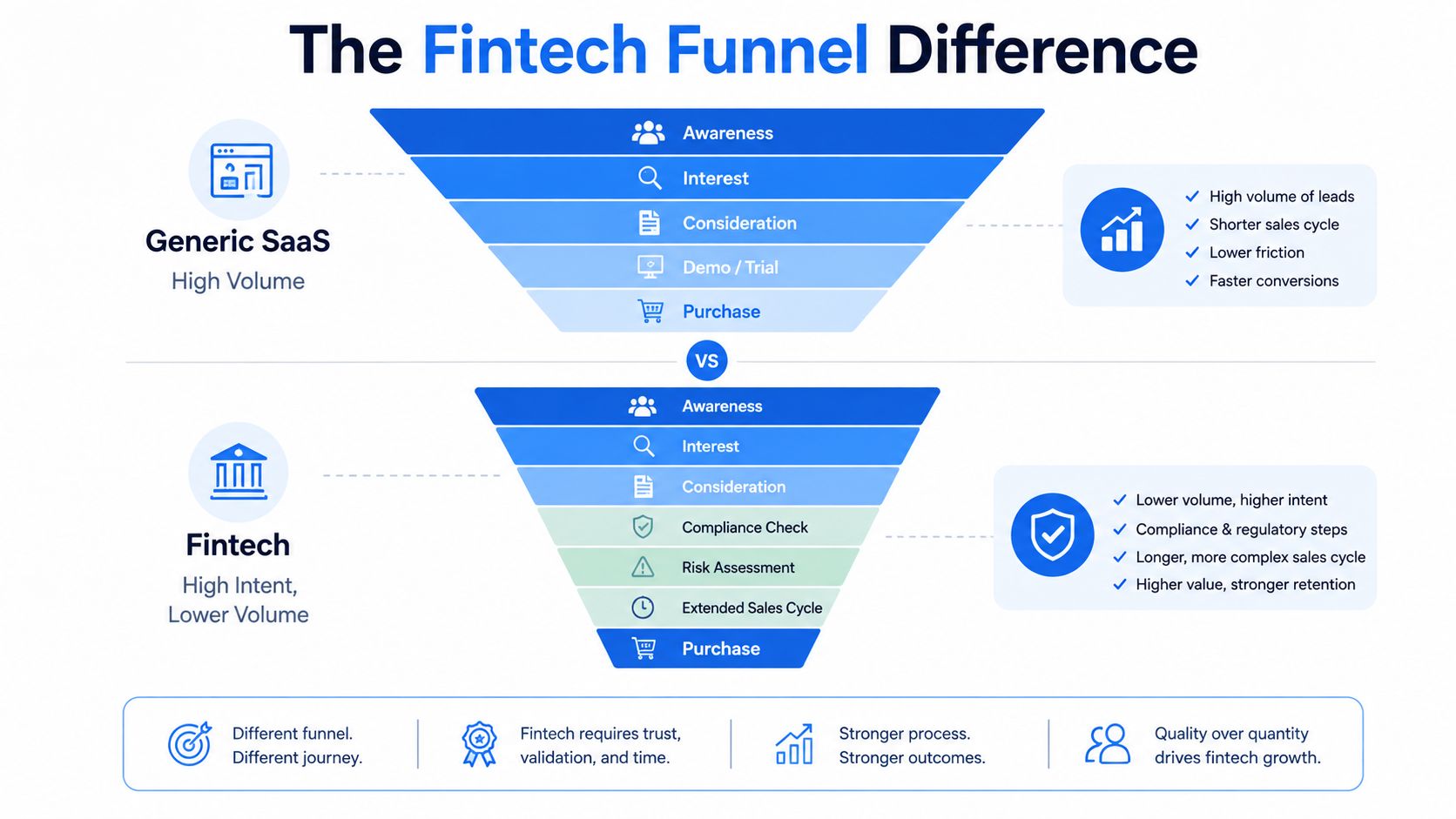
A generic SaaS campaign may tolerate broad awareness because prospects can trial the product quickly and adopt it with limited internal review. Fintech products often affect money movement, customer data, underwriting, identity verification, reporting, or regulated operations. Each promising lead can require technical validation, security work, compliance review, and executive attention before it produces revenue.
Qualification must therefore cover account selection, role mapping, qualification, and speed-to-meeting. A contact should not advance because someone downloaded a guide. Check the target jurisdiction, integration environment, risk profile, transaction model, and buying timeline before assigning sales capacity.
Teams selling other B2B software can review the B2B SaaS outbound funnel for a useful baseline, but fintech campaigns need additional gates. Put those checks into the campaign design. Otherwise, security or compliance objections appear late, after sales and technical teams have already invested time.
Practical rule: Define the conditions that make a lead commercially viable before setting a contact target.
Volume creates false confidence
Financial services search ads record an 8.3% click-through rate, compared with a 6.7% cross-industry average, while financial-services website visitors convert to leads at only 1.9%, according to fintech lead-generation benchmarks. The figures show why engagement alone is a poor pipeline measure. A click can signal curiosity without indicating authority, urgency, fit, or compliance readiness.
Use a narrow ideal customer profile, then build micro-campaigns around observable buying signals. Prioritize accounts with a credible reason to act, identify stakeholders who can confirm the problem, and tailor the message to operational and regulatory concerns. Fewer conversations are acceptable when each one has a stronger path to qualification and revenue.
Building Fintech Buyer Personas That Convert
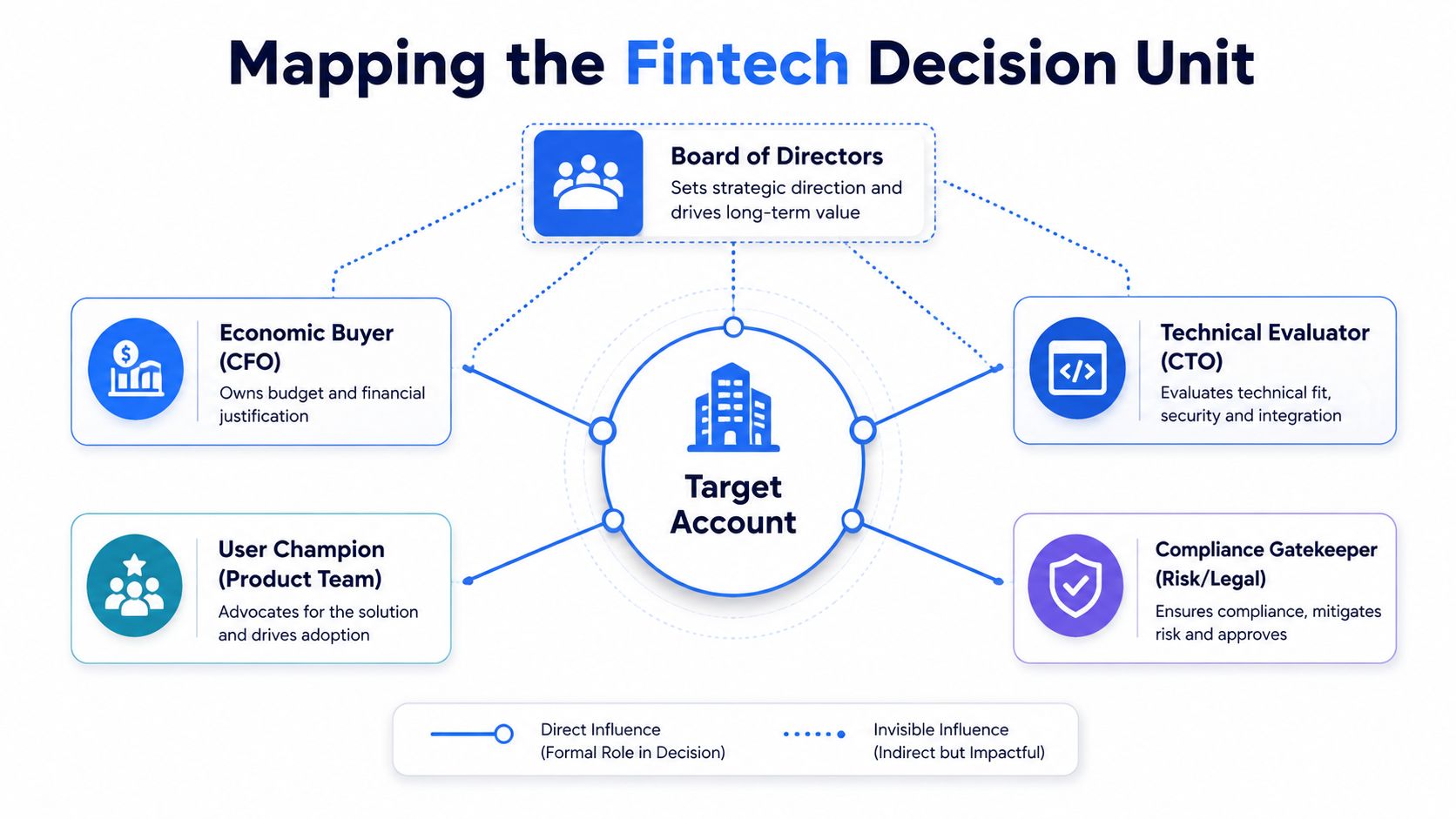
Job titles help locate contacts, but they do not define a fintech buyer persona. A Chief Technology Officer may approve the architecture while a Head of Payments owns the operational problem. A compliance leader may not sign the agreement, yet can stop implementation. The CFO may focus on commercial efficiency, while the product team prioritizes launch speed and customer experience.
Build personas around responsibility, influence, risk, and timing. Treat the account as the unit of analysis, then map how each stakeholder assesses the purchase. This approach supports smaller, signal-based campaigns because sales capacity goes to accounts with a plausible route through the buying committee.
Start with the account, not the title
For payments, examine the payment model, target merchants, geographic coverage, processor relationships, and integration requirements. For lending, assess the product, underwriting workflow, funding model, and regulatory exposure. For wealth management, review the client segment, advice model, custody arrangements, and technology maturity. Banking infrastructure demands a close look at core systems, API strategy, security expectations, and procurement complexity.
Useful segmentation fields include:
- Regulatory jurisdiction: Separate the US, UK, and EU before writing copy. The same product benefit may need different evidence or wording in each market.
- Operating model: Distinguish a direct-to-consumer fintech from a B2B infrastructure provider, marketplace, bank, lender, or embedded finance platform.
- Technology maturity: Record the current stack, integration style, API usage, and signs of legacy dependency.
- Commercial trigger: Look for expansion, a new product line, a partnership announcement, a technology migration, or a stated operational priority.
- Buying committee: Map the economic buyer, technical evaluator, user champion, and compliance gatekeeper instead of stopping at one contact.
Enrich behavior and context
LinkedIn Sales Navigator can identify relevant roles and organizational changes. Company registries and public filings provide jurisdiction and corporate context. Technology-stack sources can show which systems a prospect already uses, allowing the first message to address integration rather than repeat a generic product pitch. Clay can combine enrichment, scoring, and custom research into account records that sales can inspect.
A useful record should answer four questions: Why this company? Why this role? Why now? What evidence supports the fit? It should also show which stakeholder is likely to engage first and who could block progress later.
The most useful personalization isn't a flattering sentence about a prospect's company. It's evidence that you understand the account's operating environment.
Use separate messaging for each role. A CFO needs a commercial case, a CTO needs architecture and implementation clarity, a product leader needs workflow relevance, and risk or legal needs confidence that the vendor understands control requirements. One account signal can anchor the campaign, but the value proposition should change with the recipient's responsibility. That distinction improves qualification quality without requiring a larger contact list.
Choosing the Right Channels for Fintech Pipeline
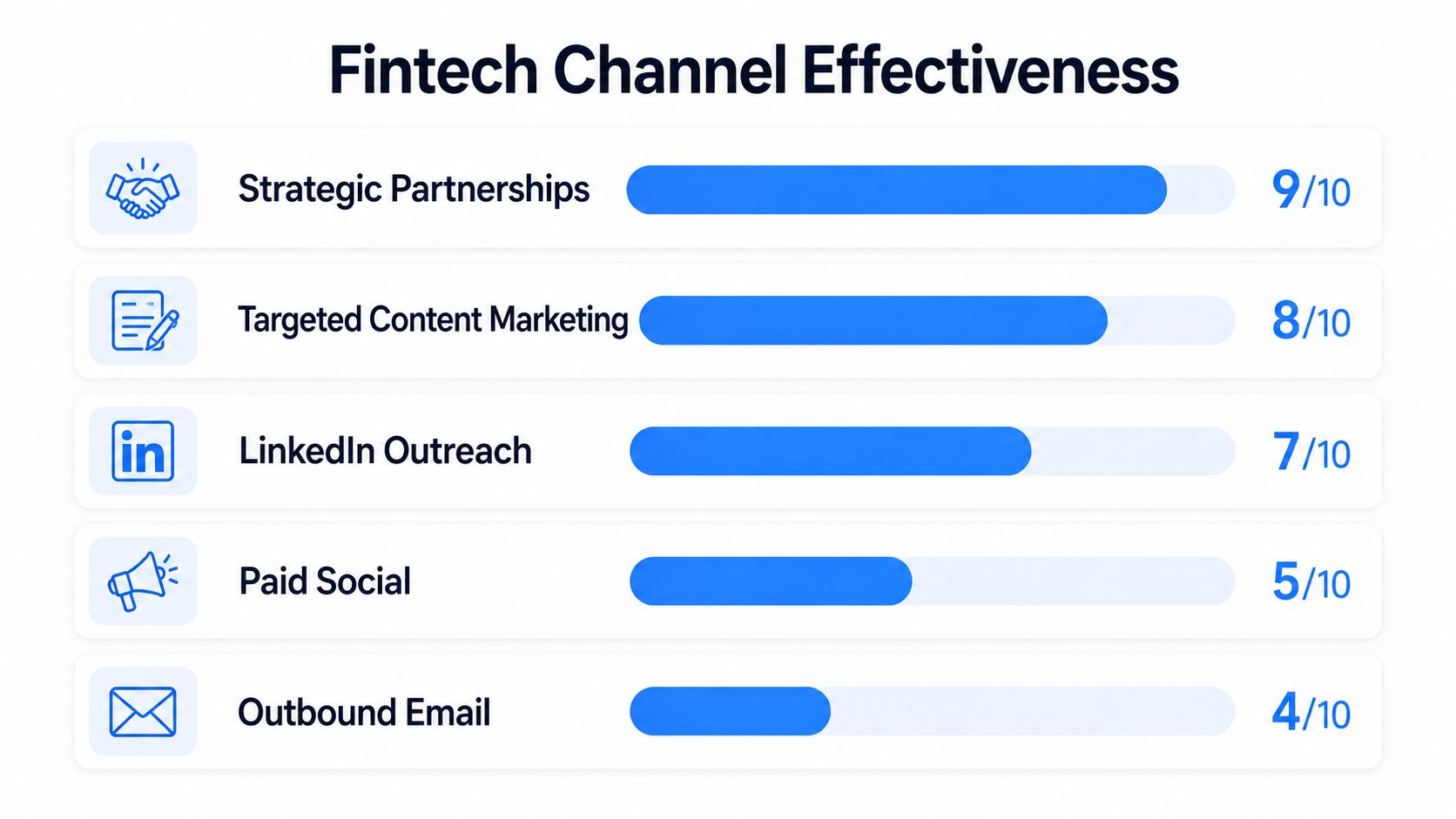
No single channel solves fintech pipeline creation. Each channel handles a different part of the trust and intent problem, and the right mix depends on product complexity, market, deal size, and sales cycle.
Paid search captures active demand, but it can become expensive quickly. Financial services Google Ads cost per lead increased from $66.69 in 2024 to $70.11 in 2025, a 5% year-over-year increase, while the cross-industry average cost per lead was $198.44, according to financial-services acquisition data. Search can work well for high-intent categories, but an inbound-only plan leaves the company waiting for prospects to describe the problem in the exact language the campaign targets.
Match the channel to the buying situation
Outbound email gives precise control over account selection and can introduce a relevant issue before the buyer searches for a vendor. It fails when the list is broad, the first message is generic, or the sender ignores consent and reputation requirements.
LinkedIn outreach works as a credibility and context layer. A thoughtful interaction with a product leader or risk executive can make a later email feel less interruptive. It still underperforms when every message asks for a demo without demonstrating knowledge of the prospect's role.
Strategic partnerships can shorten the trust gap. Integration partners, advisors, specialist consultancies, payment networks, and industry communities already have relationships with the audience. The trade-off is slower coordination and shared control over timing and attribution.
Content marketing earns attention around complex subjects, especially comparison, migration, integration, and regulatory-use-case topics. It compounds more slowly than an outbound launch, and content must be written for experienced financial buyers rather than beginners.
Paid advertising can support category education, retargeting, and high-intent capture. It becomes inefficient when the landing page is broad, the qualification path is weak, or the product requires a long education process before a meeting.
A useful allocation decision starts with three questions:
- Does the buyer already express intent through search or community activity?
- Can the product be explained and qualified in a short conversation?
- Does trust depend on an existing partner relationship or technical proof?
For infrastructure providers, pair account-based outbound with technical content and ecosystem partnerships. For B2B payments, combine trigger-led email, LinkedIn engagement, and integration-led messaging. For lending platforms, put more weight on compliance-aware education and role-specific qualification.
The following video offers another perspective on building a fintech channel strategy:
Email Infrastructure and Deliverability for Financial Services
A well-written fintech email that never reaches the inbox has no commercial value. Validity's 2025 benchmark reports finance inbox placement at 87.3%, while one widely cited all-industry summary places the overall figure at 83.1%. Finance-focused deliverability guidance also warns that the sector can remain below top-tier thresholds of 95% or more, making authentication, list hygiene, complaint control, and sender reputation central to financial-services email deliverability.
Build the sending foundation first
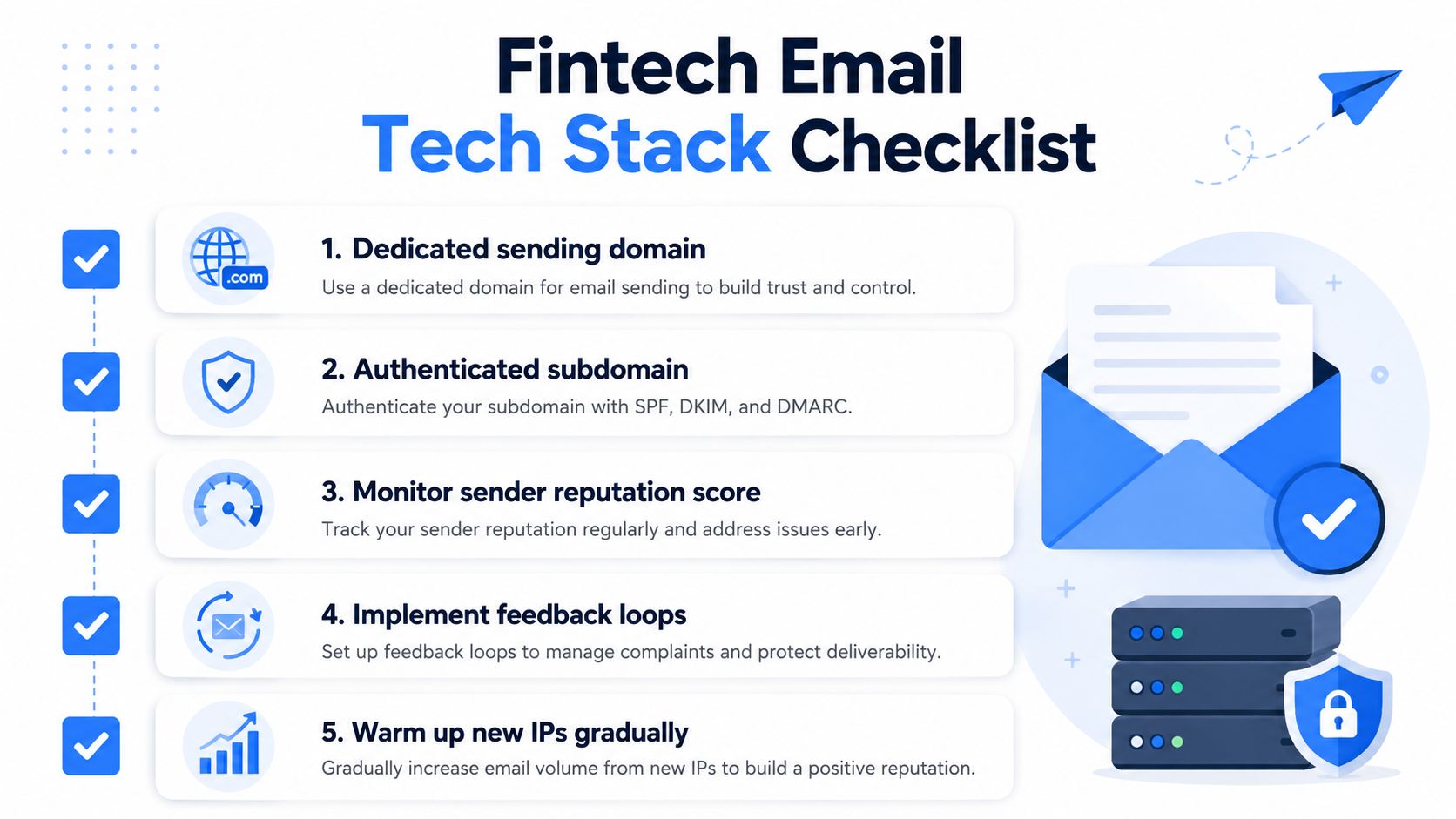
Use a dedicated sending domain or a clearly separated subdomain for prospecting. Authenticate it with SPF, DKIM, and DMARC, then verify that alignment works across the mail platform, tracking tools, and reply handling. Keep marketing and transactional traffic separated so a prospecting problem doesn't damage password resets, statements, alerts, or customer support messages.
New infrastructure needs a gradual warm-up. Start with engaged, relevant recipients, monitor bounces and complaints, and increase activity only when reputation remains stable. Inbox rotation can distribute sending activity, but it isn't a substitute for good data or appropriate volume.
Treat list hygiene as campaign governance
Remove invalid, role-based, duplicated, and previously unsubscribed addresses before launch. Suppress complaints immediately. Respect opt-outs across every campaign and maintain a central suppression list so one business unit can't accidentally re-contact a person who has already declined.
Your operations team should review authentication status, bounce behavior, complaint signals, inbox placement, domain reputation, and reply quality. The Lead Printer blog provides a useful reference point for teams evaluating outbound processes, but the internal owner still needs to understand the setup well enough to audit an agency or vendor.
A deliverability checklist should include:
- Authentication: Confirm SPF, DKIM, and DMARC are correctly implemented and aligned.
- Data validation: Verify addresses and remove risky records before they enter a sequence.
- Suppression: Apply unsubscribes, complaints, and do-not-contact requests immediately.
- Reputation monitoring: Watch sending domains and mailbox providers for deterioration.
- Message control: Avoid misleading claims, excessive links, and copy that resembles bulk spam.
- Reply handling: Route positive replies quickly and classify objections, requests, and opt-outs accurately.
The goal isn't to send more. It's to preserve the ability to reach relevant prospects consistently.
Signal-Based Targeting and Trigger Events That Drive Replies
Broad persona targeting assumes every fintech company with the right title has the same problem. It doesn't. A payments company hiring implementation specialists may be preparing for expansion, while another company with the same title and category may have no active project at all.
The better question is: what changed inside this account that makes the conversation timely?
Prioritize evidence over list size
Funding announcements, regulatory developments, new market entry, senior hiring, technology-stack changes, partnership launches, and product expansion can all create a reason to investigate. Not every signal deserves outreach. A signal becomes useful when it connects directly to your product's value and the recipient's responsibility.
For example, a new market launch may justify a conversation about local payment methods, compliance operations, or infrastructure capacity. A senior risk hire may indicate that controls are becoming a priority. A technology migration can open a conversation about integration, data movement, or implementation risk.
Signal sources can include company news, public filings, job postings, product documentation, technology intelligence, industry publications, and first-party website behavior. A LinkedIn lead signals platform can help organize account-level activity when a team needs a repeatable way to monitor relevant changes rather than manually scan every prospect.
Make the first touch carry the argument
Cold email reply rates average 3.43%, with the top 25% at 5.5% or higher and the top 10% at 10.7% or higher, according to B2B conversion benchmarks. The same practitioner coverage reports that 58% of replies come from the first touch, so the opening message deserves more attention than the later sequence steps.
That doesn't mean writing a long email. It means making the relevance obvious. Name the account signal, connect it to a plausible operational issue, state what your company helps with, and ask a low-friction question. Don't pretend to know the prospect's internal priorities. Offer a hypothesis they can confirm or reject.
A sequence can't rescue an irrelevant first message. Research the account before you optimize the follow-up cadence.
AI assistants are also becoming part of the research journey before buyers visit vendor websites, which raises the value of clear category language, authoritative content, and consistent proof. The practical response isn't to abandon outbound. It's to combine visible expertise with smaller campaigns aimed at accounts showing a credible reason to engage.
Navigating GDPR and Financial Compliance in Outreach
Compliance should shape campaign architecture from the beginning. It affects what data you collect, why you process it, how you document the processing, what claims you make, and how quickly you honor a person's objection.
For EU and UK outreach, establish the lawful basis for processing before list building. Document the purpose, source, retention period, access controls, and deletion process for prospect data. If an enrichment provider or agency processes personal data on your behalf, review the data processing agreement, subprocessors, transfer arrangements, security controls, and deletion obligations.
Build compliance into the workflow
Separate public business information from inferred or sensitive attributes. Use professional context that can be verified, such as a published role, company announcement, public technology reference, or stated business initiative. Don't infer financial vulnerability, health information, protected characteristics, or other sensitive details to make a message feel personalized.
Your copy also needs financial-services discipline. Avoid unsupported performance claims, guarantees, “risk-free” language, or wording that could imply regulatory approval where none exists. Product, legal, and compliance teams should approve claims libraries and escalation rules before campaigns run across multiple markets.
A practical audit asks:
- Purpose: Can the team explain why each data field is needed?
- Source: Can it identify where the contact and company information came from?
- Notice: Does the organization provide the required privacy information?
- Objection handling: Can recipients opt out easily, and does suppression work globally?
- Vendor control: Are enrichment, sequencing, CRM, and analytics providers covered by appropriate agreements?
- Localization: Does the message fit the language, business convention, and regulatory context of the recipient's market?
For a plain-language overview of the operational principles, consult Matil's GDPR compliance approach. Localization isn't limited to translation. UK and EU buyers may expect different wording, levels of formality, proof points, and references to local operating realities.
A compliant campaign can still be commercially direct. It makes relevance, transparency, and recipient control part of the experience instead of treating them as legal obstacles added after launch.
A Complete Fintech Outbound Campaign Playbook
High customer acquisition costs make volume-first outbound expensive. Start with one segment, one problem, and one buying hypothesis. A payments infrastructure provider might target fintechs entering a new jurisdiction, while a compliance platform could focus on firms showing hiring or product expansion signals. Define account conditions and disqualifiers before researchers collect contacts.
From research to launch
Build the account list from Sales Navigator, company registries, public sources, technology data, and trigger monitoring. Enrich each record with role, jurisdiction, operating model, stack, likely pain point, and evidence for outreach. Map the commercial, technical, user, and compliance perspectives when a deal needs several approvals.
Write the first message around the signal, not the product catalogue:
- Context: Refer to a public account event or operational change.
- Hypothesis: Connect that event to a specific problem your product addresses.
- Proof: Explain the relevant capability without unsupported outcomes.
- Question: Ask whether the issue sits with the recipient or another stakeholder.
Use email and LinkedIn as complementary touches, not duplicate broadcasts. Test one meaningful variable at a time, such as the trigger, role-specific angle, or call to action. Keep a control version so the team can separate genuine improvement from normal campaign variation. In regulated markets, smaller campaigns also make message approval and suppression management easier.
Measure commercial quality
Track delivered messages, replies, positive replies, qualified leads, meetings held, opportunities created, and pipeline contribution. Financial-services visitors convert to leads at 1.9%, while the cited benchmark places SEO lead close rates at 14.6% and outbound at 1.7%. These figures are useful only when the team defines “lead” consistently and applies the same qualification process across channels.
For tooling decisions, Extrovert's B2B tool guide helps teams compare research, enrichment, sequencing, and reporting options. Keep the commercial model visible with an outbound ROI calculator, then review results by segment, signal, role, geography, and qualification outcome.
Scale after the campaign produces relevant conversations and clean deliverability. If replies are weak, refine the account hypothesis and first message before increasing volume. If replies are strong but meetings are poor, tighten qualification, improve the offer, or remove friction from booking. The operating objective is a repeatable flow of qualified conversations that can pass compliance review and create pipeline.
Lead Printer designs and runs data-driven email and multichannel campaigns for fintech and other B2B teams, including infrastructure setup, prospect research, Clay-based enrichment, localized messaging, qualification, and pipeline reporting. Teams replacing volume-first outreach with signal-based campaigns across the US, UK, or EU can visit Lead Printer to discuss target accounts and growth requirements.