Setting Sales Appointments That Show Up and Convert
A healthy B2B appointment-setting program typically books meetings from 4% to 10% of contacts, with show rates of 65% to 80% and meeting-to-qualified-opportunity rates of 25% to 55%. That's the frame for this work, because setting sales appointments is rarely a one-touch win, and it's never just a copy problem. It's a system problem, and in 2026 the first place that system breaks is usually deliverability or the call to action, not the subject line.
The teams that book consistently treat meetings like a pipeline asset. They know that 6 to 12 touches are often needed before a meeting gets locked, that a full-time setter may book 18 to 25 meetings per week, and that no-show rates commonly sit around 20% to 30% in real outbound operations SalesFocus benchmark guidance. That's why the best operators focus on reachability, relevance, and confirmation before they obsess over clever wording.
What Modern Appointment Setting Looks Like in 2026
A one-channel, one-shot model breaks fast. In practice, setting sales appointments now depends on deliverability, reachability, and a clear CTA before copy gets any attention. If the message never lands, or the ask is muddy, the meeting never happens.
The buyer no longer experiences one touch in isolation
Prospects usually do not book after a single call or one email. They notice the name, the timing, the angle, and the channel pattern, then decide whether to keep engaging. Structured outreach replaced improvisation because repeated, low-friction recognition beats a lone, polished touch.
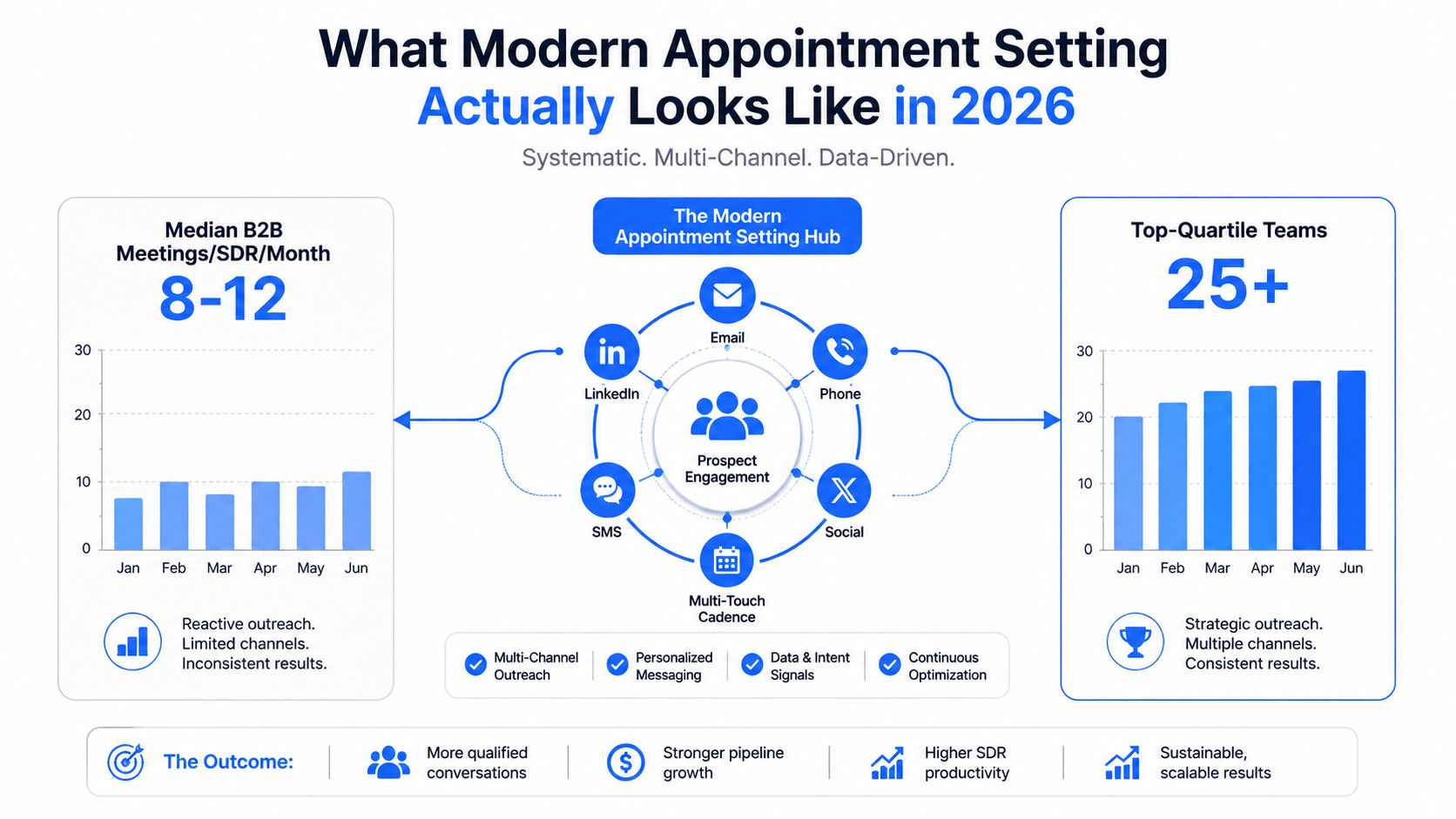
Modern outbound also runs on sequencing, not just sending. The stronger motions combine a verified list, warm infrastructure, a sequence that respects attention, and follow-up that assumes the first reply is rarely the last step. That is how meetings stop feeling accidental and start becoming repeatable output.
Practical rule: if the prospect cannot tell why you are reaching out and why now, they will not book, no matter how polished the copy sounds.
For a practical reference on qualified meeting booking tactics, compare your current motion with what disciplined appointment setters do day to day. The channel matters less than how the channels reinforce one another until the prospect has enough context to respond.
The workflow is now closer to pipeline engineering
Modern appointment setting starts with the target account, then moves through intent, sequencing, and confirmation. A setter working this way is not just filling a calendar, they are shaping downstream pipeline quality before a rep ever enters the room.
That is the operational difference that matters. Reps who chase volume without system discipline end up with crowded calendars and weak meetings, while teams that treat appointment setting like pipeline engineering get cleaner conversations and fewer wasted slots. The calendar is the output, not the strategy.
Why Cold Calling Alone Stopped Being Enough
Cold calling still matters for live objection handling and fast qualification, but it cannot sustain a full appointment-setting program. Buyers now expect context before commitment. The historical reason single-channel phone work gave way to coordinated outreach is simple, a widely cited SalesHive benchmark says it takes close to 10 call attempts on average just to reach a prospect, cold contacts convert into scheduled meetings at only about 1.5% to 3%, and there is roughly one meeting for every 40 dials on average.
The phone still matters, just not by itself
The phone works better after a prospect has already seen the name elsewhere. An email can create familiarity, a LinkedIn touch can create context, and a call can then feel like a continuation instead of an interruption. That sequence matters because the call is no longer starting from zero.
The old dialing-for-dollars era rewarded raw volume. Gatekeepers, caller-ID skepticism, and crowded inboxes make that same approach far less efficient now. A call without prior context often sounds like noise. A call that follows a relevant email or social touch has a real chance of landing as a useful follow-up.
| Era | Connect Rate | Answer-to-Meeting % | Dials per Meeting |
|---|---|---|---|
| Phone-first outbound | Lower, with heavy friction | About 2% to 3% cold call-to-meeting conversion | About 40 dials per meeting |
| Structured multichannel outreach | Better supported by prior touches | Higher when the call follows email and social context | Fewer wasted attempts because the name is warmer |
Orchestrated attention beats isolated effort
Buyers reward coordinated persistence. They respond when the message arrives in the right order, the reason for outreach is clear, and the ask does not feel abrupt. That is why channel mix matters more than channel loyalty.
Cold calling remains useful for live objection handling, speed, and direct qualification. The stronger motion pairs it with email and social touches so the prospect already has enough context to respond.
Building the Infrastructure and List That Make Meetings Possible
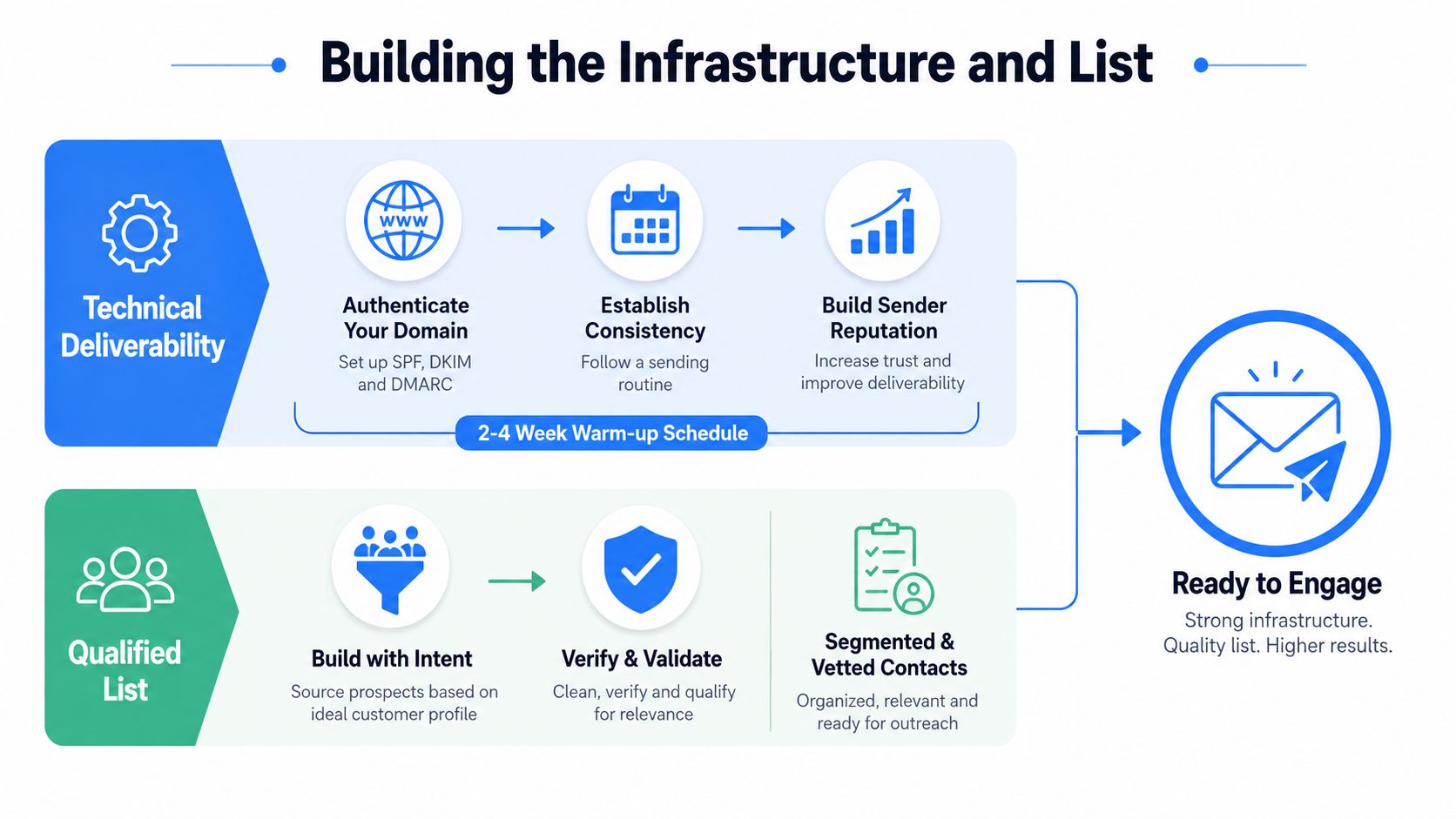
The biggest mistake in appointment setting is writing the sequence before the mailbox can even deliver it. Deliverability and list quality decide whether your outreach gets a chance to perform. A 2025 dataset covering 7.5 million cold emails found a 1.71% bounce rate and 98.29% implied deliverability rate, and benchmark reporting says full infrastructure, including dedicated domains, SPF/DKIM/DMARC, proper warmup, and volume limits, outperforms partial setups by a wide margin Belkins deliverability report.
Start with the sending environment
The mailbox is part of the sales system. If inbox placement is weak, even good messaging will underperform because prospects never see enough of it. That's why warmup, authentication, and volume control belong before launch, not after complaints start coming in.
A practical setup usually includes dedicated outbound domains, alignment across authentication records, and controlled ramp-up instead of sudden sending spikes. The point isn't technical showmanship, it's preserving inbox placement long enough for the market to respond.
Build a list that can actually convert
List quality is the other half of the equation. A good ICP isn't a slogan, it's a filter that tells you who belongs on the list and who doesn't. Layer firmographics, technographics, and intent signals so each contact has a reason to receive the message now.
A working example is easy to make concrete. A mid-market SaaS target list can be built from B2B SaaS, 50 to 500 employees, recently hired sales leadership, and research behavior around competitive keywords. That gives the outreach a business reason instead of a generic name drop.
- Tight ICP filter: define who the message is for before you source a single record.
- Verification pass: confirm role, company, and reachable contact data before sequencing.
- Intent overlay: use recent activity and trigger events to prioritize who gets touched first.
- Segmentation discipline: keep separate messaging lanes for different roles or buying situations.
Practical rule: list precision usually beats list volume on cost-per-meeting because bad-fit prospects rarely turn into real pipeline, no matter how busy the dashboard looks.
If you're still early in the technical setup, this email domain warm-up guide is a useful internal reference for the operational side of mailbox preparation. Once the infrastructure is stable, the list does the important work of deciding who deserves a seat on the calendar.
Writing Sequences That Earn the Meeting
Most sequences miss because they ask for too much too early. A prospect who barely knows you is unlikely to book time just because the wording is clean. Sequence design should earn a reply first, then move toward the meeting.
Lead with curiosity, not the calendar
A hard meeting ask on the first touch creates pressure before trust exists. Interest-based hooks and timeline-based hooks usually lower resistance because they invite a response without forcing a commitment.
The pattern that tends to work better is simple. Start with one relevant observation, add one clear hypothesis, then make one low-friction ask. If the prospect replies, the meeting ask can come later, after they understand why you are in their inbox.
| CTA Style | Example Line | Avg Reply Rate | Avg Meeting Book Rate | Best Use |
|---|---|---|---|---|
| Hard meeting ask | “Can we book 20 minutes next week?” | Lower when the name is cold | Lower when context is thin | Warm leads, referrals, known accounts |
| Interest-based hook | “Worth a conversation?” | 68% positive replies versus 41% for meeting-request CTAs CopyCrest benchmark | Better when moved into a later touch | Busy prospects, skeptical markets |
| Timeline-based hook | “Are you tackling this in Q2?” | Stronger when the timing issue is the core issue | About 3.4x more meetings than problem-based hooks, 2.34% vs. 0.69% | Prioritization, project timing, active initiatives |
Build a list that converts
A 7 to 10 step sequence gives enough room to work the conversation without sounding needy. The first few touches should focus on relevance and timing, not calendar pressure. By touch three or four, the ask can become more direct because the prospect has had enough exposure to place you.
A simple pattern works well. Open with context, follow with a short question, then use a direct meeting ask only after the first reply or after enough familiarity has been built. Keep personalization specific, not decorative, because prospects notice when the homework is shallow.
Subject lines should stay plain and believable. “Quick question on hiring” usually plays better than anything that looks engineered for opens. The email itself should read like a concise business note, not a campaign asset.
“Make the first reply easy, then make the meeting feel like the natural next step.”
For a stronger close on the final touch, this guide to closing an email is a useful companion. The point is the same. The meeting ask works best after the prospect has already shown some sign of life.
Qualifying and Booking on Live Conversations
A live call gives you a short window, and the rep who controls the pace usually controls the outcome. The first 90 seconds matter because that is when the prospect decides whether this is a real business conversation or just another interruption. The work is to lower friction, confirm relevance, and only then move toward a specific slot.
A practical call flow that doesn't waste motion
Start with a calm opener that acknowledges the interruption without groveling. Then ask one or two discovery questions that show whether the conversation deserves calendar time. A director of operations at a mid-market logistics company might say they have looked at this before, or that the CFO would want to see numbers, and both are useful buying signals.
BANT-lite qualification works here because it keeps the call grounded without turning it into an interview. The goal is to avoid booking meetings that were unlikely to become pipeline from the start, while still keeping the tone direct and respectful. A sentence like “If this is relevant, I'd rather book the right next step than make you repeat yourself later” does that cleanly.
- Ask for role clarity: “Are you the person who would own this internally, or does someone else weigh in?”
- Test urgency: “What changed recently that made this worth revisiting?”
- Look for buying language: phrases like “we looked at this last year” or “my CFO would want to see numbers” usually point to a real process, not casual curiosity.
If the conversation is moving, offer two specific slots instead of a vague “when works for you.” That keeps momentum and makes the decision smaller. It also avoids a dead-end follow-up thread.
When the stall comes, and it often does, handle “send me some info first” by asking what info would be useful. That turns a polite brush-off into a more honest conversation about timing and relevance.
For a tighter framework on how sellers assess fit before booking, this lead qualification reference is a useful internal companion. The point is simple, use the live conversation to confirm fit, then use the meeting request as a clean next step.
Confirmation Reminders and No-Show Recovery
A booked meeting still is not a held meeting. That gap is where outbound programs lose value, so confirmation needs its own stage in the process. Strong operators do not rely on the calendar invite alone, they reinforce the commitment before the slot arrives.
Layer the reminders on purpose
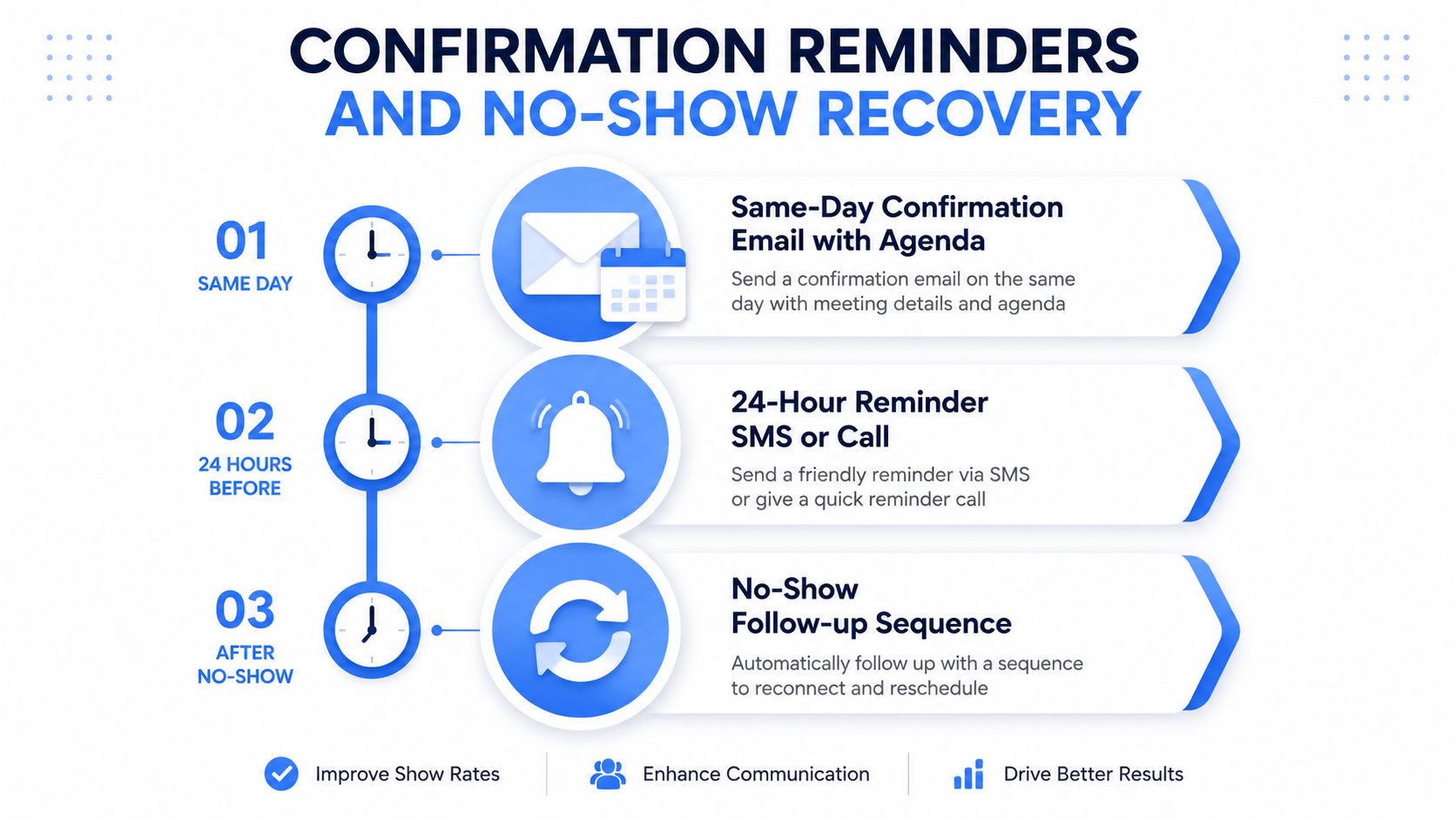
A same-day confirmation email should carry the agenda, the calendar attachment, and the reason the meeting matters. The 24-hour reminder should refer to the prospect's stated pain, not your product features. A final 1-hour text or Slack nudge works best only when the relationship is warm enough for that channel to feel natural.
Practical rule: reminders should reduce uncertainty, not repeat the pitch.
No-show recovery matters just as much. If the prospect does not show, a short grace period is fine, but do not let it drift. Send the rebook note quickly, acknowledge the missed time without guilt, and offer a clean next step if the issue is still relevant.
Use a short recovery sequence
The first message after a no-show should be simple and low-friction. Ask whether they still want to reschedule, then offer two new slots instead of making them do the work. If the lead goes quiet again, a “still a priority?” check-in can reopen the thread without sounding demanding.
A good recovery path has three moves.
- Immediate rebook ask: send it within an hour so the reason for the meeting is still fresh.
- Breakup note: keep it respectful, brief, and open-ended.
- 30-day nurture pivot: move the lead into lighter follow-up so the door stays open.
The key is not to overcorrect. If no-shows keep happening, the issue may be qualification, not scheduling. In that case, a better reminder system will not fix the deeper problem.
Measuring What Matters and Putting It All Together
The fastest way to spot a broken appointment-setting system is to inspect the funnel stage by stage. A strong program does more than book meetings, it gets them held, qualified, and turned into opportunities. For live conversations, benchmark data suggests strong teams convert about 15% to 20% of connected conversations into booked appointments, while weak programs often sit below 10%. Broader benchmark sources also place show rates around 60% to 80% and meeting-to-opportunity rates around 25% to 55% when qualification and reminders are disciplined Uplift Sales benchmark.
Track the funnel where it actually breaks
The five metrics that matter are connection rate, reply rate, qualified-to-meeting ratio, show rate, and meeting-to-opportunity conversion. If connection is weak, the list or channel timing is off. If replies are weak, the offer or CTA is wrong. If booked meetings do not convert, the qualification process is too loose.
Schedule quality matters just as much as outreach quality because calendar hygiene determines downstream pipeline health. If the calendar fills with the wrong people, the numbers get noisy fast. For a useful perspective on calendar planning and handoff discipline, better planning strategies for 2026 are worth studying alongside your outbound workflow.
Launch it in a sane order
A clean rollout does not need perfect conditions. It needs sequence.
- Deliverability setup: confirm sending hygiene before any real volume.
- List hygiene: verify contacts and segment by ICP before launch.
- Sequence build: write one core sequence with one clear CTA path.
- Call script: keep the opener and close consistent across reps.
- Confirmation system: add reminders before the first meeting is booked.
- No-show recovery: decide the follow-up path before the first no-show happens.
- Weekly review cadence: inspect the funnel every week, not every quarter.
If you are using tools to support this motion, Lead Printer builds and runs outbound systems that combine infrastructure, prospect data, personalization, and qualification before meetings hit the calendar. That matters because appointment setting works best when the process behind the invite is as disciplined as the message itself. The people who keep improving this stack usually end up with better planning strategies for 2026 and fewer calendar problems to clean up later.
If you want a team that builds the infrastructure, list, sequencing, and qualification process behind meeting-ready outbound, Lead Printer does that work end to end. It fits teams that need booked conversations that show up and move into pipeline, not just more names in a CRM.