Cold email reply rates for B2B technology campaigns average 3.43% in 2026, while top campaigns can reach 10% or more. That gap usually comes from better list quality, stronger deliverability, and more disciplined sequencing, not from cleverer copy alone.
Lead generation for technology companies is an operating system, not a contact-count exercise. A technology buyer may involve several stakeholders, research independently, and ignore messages that lack a clear connection to an active business problem. Your campaign must therefore protect inbox placement, identify accounts that fit, reach the right roles, and measure whether conversations become qualified pipeline.
The benchmark gap makes the operating problem visible. Average performance is accessible, but elite performance requires coordination between data, infrastructure, messaging, channel timing, qualification, and follow-up. The sections below focus on that system and the trade-offs behind it.
Why Most Tech Company Lead Generation Falls Short
The 3.43% average reply rate in the 2026 cold-email benchmark provides a baseline. Top campaigns exceed 10% in some SaaS and technology segments, according to cold email statistics from Sales.co. The gap reflects operating discipline across targeting, verification, sequencing, and sender reputation. Copy matters, but it cannot compensate for failures elsewhere in the system.
Many stalled programs begin with an oversized list. A technology vendor filters by industry and job title, then sends one sequence to companies with different architectures, budgets, buying triggers, and compliance requirements. SDRs spend time on contacts who were never plausible buyers. Relevant prospects receive messages that resemble every other vendor email in their inbox.
A useful account strategy also separates outbound from broader lead generation and demand generation work. Outbound creates direct opportunities, while demand programs build recognition and capture interest across a longer buying cycle. Treating both as the same motion makes attribution and qualification harder.
The failure points compound
A weak sender reputation reduces inbox placement. Poor firmographic filtering consumes sales capacity. Generic messaging makes the business problem harder for a prospect to recognize. Because the dashboard still shows sends, opens, and replies, teams often diagnose the wrong constraint.
Common breakdowns include:
- Bloated contact lists: More records do not create more opportunities when the accounts lack a credible use case.
- Unmaintained sequences: Reps follow a prescribed cadence briefly, then skip follow-ups or improvise without recording the reason.
- Unprotected sending domains: Scaling volume before authentication, warming, and bounce control stabilize can damage delivery.
- Generic AI copy: Automated wording may be grammatically clean while giving the recipient no reason to believe the message was written for their situation.
- Volume-led reporting: Reply counts look productive even when responses come from students, vendors, competitors, or accounts outside the ICP.
Operational rule: Treat every campaign as a chain. A strong message cannot rescue a poor list, and a clean list cannot compensate for damaged deliverability.
Acceptable activity metrics can still produce little pipeline. The reply rate may look normal while positive replies remain scarce. Positive replies may exist, but qualification can be inconsistent. Meetings may be booked with attendees who lack authority, urgency, or the relevant technical environment. The analysis of demand generation in the AI era is relevant because AI increases message volume and noise, making coordination between outbound activity and broader demand signals more important.
| Metric | Average Tech Campaign | Top-Quartile Tech Campaign |
|---|---|---|
| Reply rate | 3.43% baseline | Above 5.5% |
| Elite campaign reference point | Below elite level | Above 10.7% |
| Main differentiators | Broad targeting, inconsistent data, weak sequencing | Tight ICP, verified data, testing, stable deliverability |
The buying process makes raw lead volume a weak measure of progress. Gartner's B2B buying research is frequently summarized as involving 6 to 10 stakeholders on a typical buying committee. Salesforce's State of Sales 2024 has been cited for a 13% MQL-to-SQL conversion rate across B2B SaaS in this benchmark discussion. Reaching one junior contact does not establish account coverage. Technology-company lead generation must create relevant engagement across the buying group and connect that activity to qualified pipeline.
Defining an ICP That Tech Buyers Actually Fit
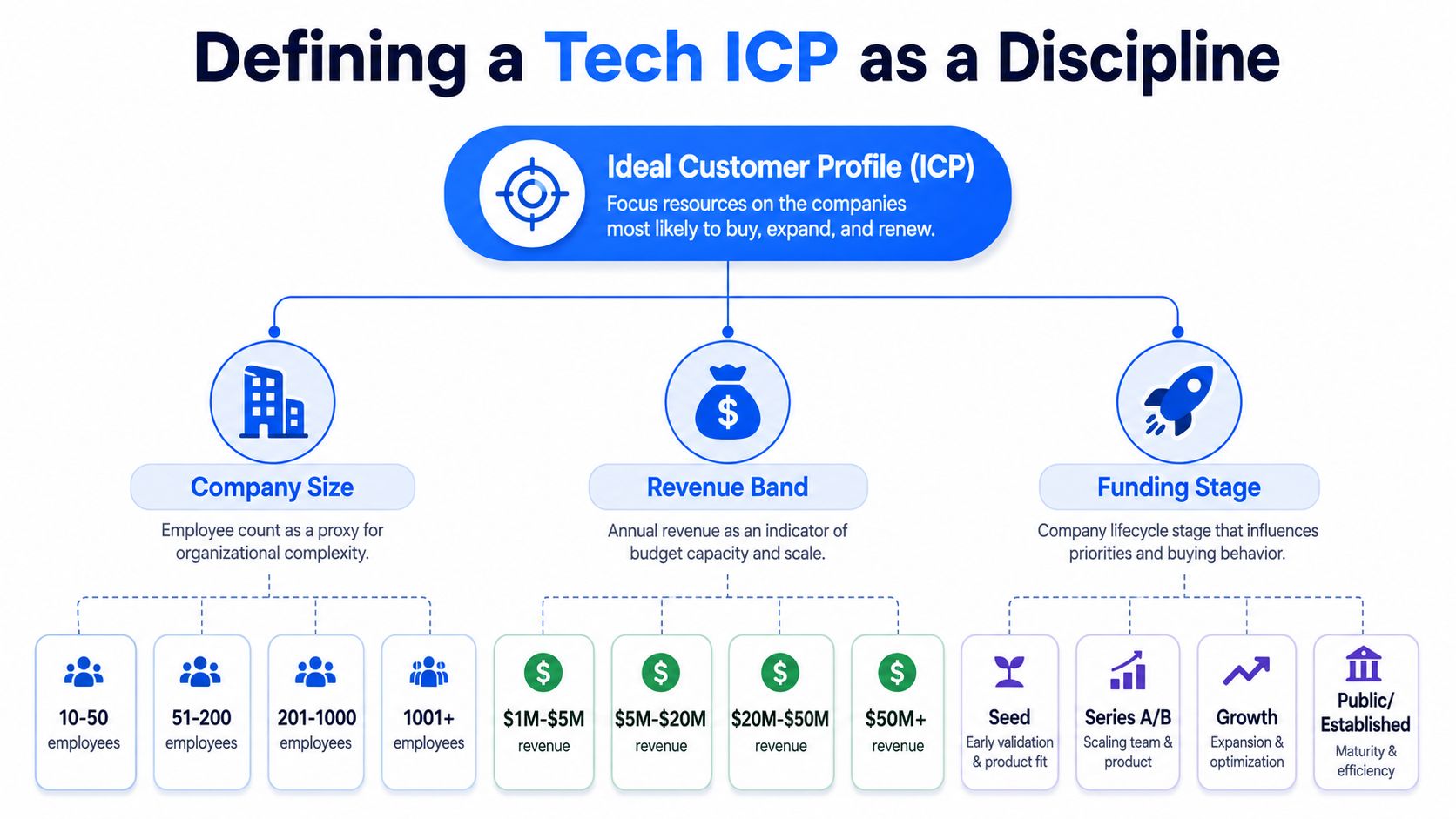
An ideal customer profile should tell a rep whom to pursue, whom to exclude, and why the account is likely to care now. It isn't a slogan from a positioning workshop. It's a set of working filters that the team revises as sales conversations reveal which assumptions hold up.
Start with firmographics. Define the employee range, revenue band, funding stage, geography, and industry vertical where the product has a credible wedge. Company size often acts as a proxy for operational complexity, but it shouldn't stand alone. A 100-person SaaS company with a distributed engineering team may have a stronger need for developer infrastructure than a larger business with a standardized internal platform.
Build the account filter
Use a short sequence of decisions:
- Choose the commercial environment. Separate startups, growth-stage vendors, public companies, agencies, and consultancies when their buying behavior differs.
- Identify the proven wedge. Specify the industry problem your product solves repeatedly, such as cloud cost control for SaaS or compliance automation for fintech.
- Add geography and language. Segment the US, UK, and EU rather than assuming one message works across all markets.
- Define exclusion rules. Remove companies without the relevant operating model, technical environment, or purchasing capacity.
- Record the evidence. Store the trigger, source, and reason for inclusion in the CRM.
Technographic signals sharpen the list. BuiltWith can help indicate a website's technology environment. Job postings on LinkedIn or Stack Overflow can reveal hiring around a relevant system or capability. Complementary tools may suggest that the account already has a workflow your product can improve, but treat inferred technology as a hypothesis until you validate it.
Map the pain chain
Role selection should follow the problem through the organization:
- End user: Feels the friction daily and can describe the workflow.
- Economic buyer: Owns the budget or business outcome.
- Technical evaluator: Tests architecture, security, integrations, or implementation risk.
- Internal champion: Connects the problem to a project and helps the vendor move through procurement.
For example, a cloud observability vendor might target a VP of Engineering and DevOps Lead at Series B SaaS companies in North America with 50 to 200 employees using AWS. It could exclude agencies and consultancies because their project-based environments distort conversion data and create a different sales motion.
The ICP should also connect to lead qualification. Define what makes a contact sales-ready before outreach begins. A reply from the right role at the right account is more valuable than several replies from companies that fail the basic fit criteria. Review accepted, rejected, and stalled opportunities regularly, then adjust the filters instead of blaming the copy for every weak result.
Building Verified Prospect Data Without the Noise
Prospect data becomes useful when each field supports a decision. A title helps select a persona. A company record supports firmographic fit. A technology signal informs the opening line. A verified email protects deliverability. Enrichment without a defined use is just database decoration.
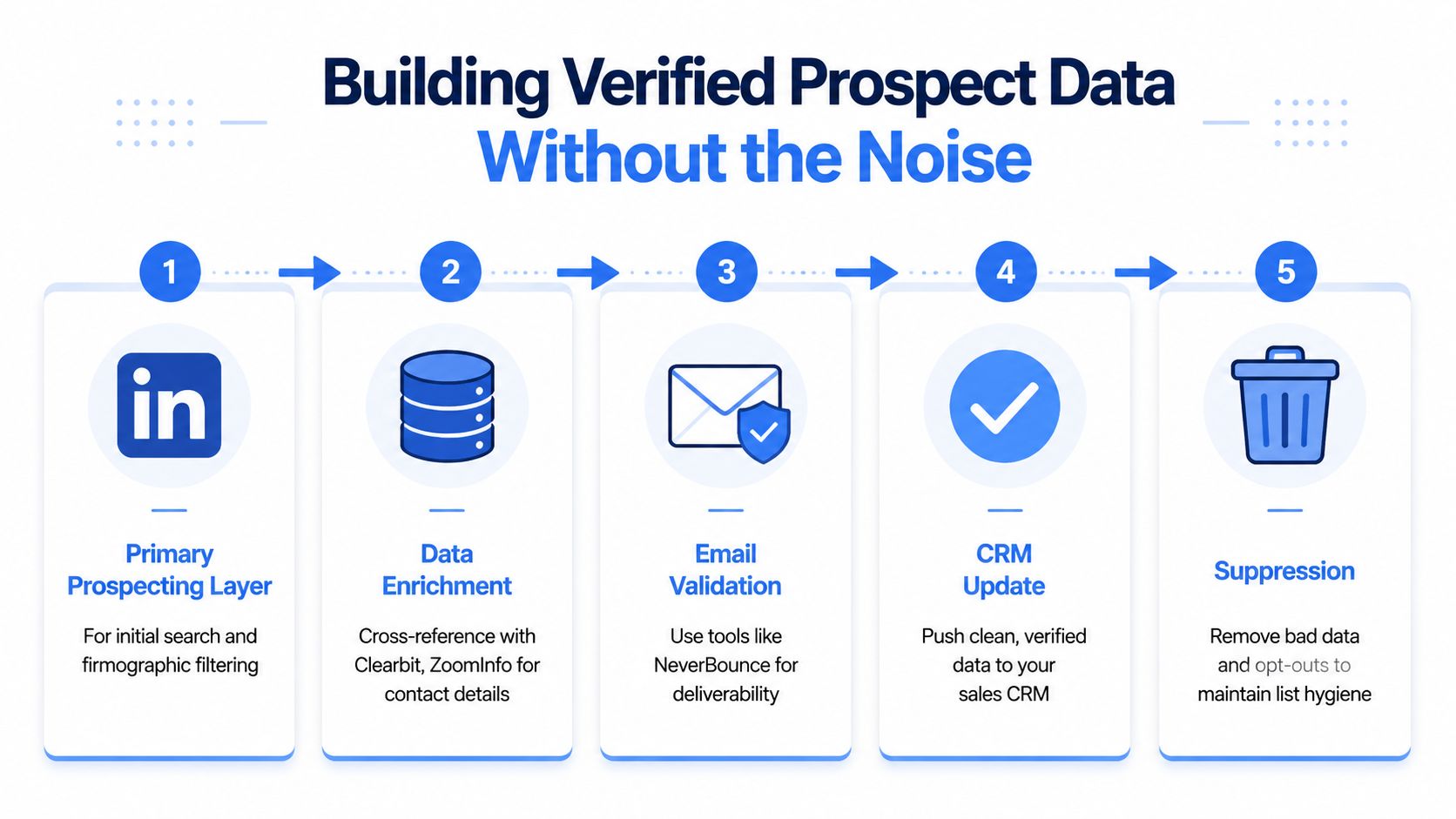
Begin with LinkedIn Sales Navigator as the primary prospecting layer. Use it to filter by role, seniority, company size, geography, industry, and account characteristics. Extract contacts through compliant workflows, preserve the profile URL, and record why the person belongs in the campaign. The source is valuable for discovery and role context, but it shouldn't be treated as proof that every email address is current.
Match each source to its job
Business registries and Companies House can help verify legal entities, company status, and director-level information, especially in EMEA. Google Maps and industry directories remain useful for vertical-specific lists where professional-network coverage is thin, such as regional service providers, manufacturers, and location-based operators.
Clay works well as an orchestration layer. Use waterfall enrichment across Apollo, ZoomInfo, Hunter, and Dropcontact, then apply rules for deduplication, field precedence, missing data, and confidence. Keep source fields separate from normalized fields so the team can identify which provider supplied a value and replace it when it becomes stale.
Custom scraping with Apify or PhantomBuster can add niche signals, including a relevant technology stack, a new office, or hiring activity. Scraping should support a clear research question, follow applicable platform rules, and avoid turning unverified inference into a claim in the email.
Validate before you send
Never launch from an unverified list. Run addresses through NeverBounce or ZeroBounce, suppress role accounts and known opt-outs, deduplicate by account and contact, and inspect risky domains manually. The brief recommends enforcing a 95%+ deliverability threshold before launch, although that operational threshold isn't the same as the measured bounce benchmark.
A 2025 dataset across 7.5 million emails found a 1.71% bounce rate, implying 98.29% deliverability, according to Belkins' email deliverability data. The practical safeguard stack is domain authentication, inbox warming, gradual volume ramping, and strict bounce control. The common mistake is scaling before reputation stabilizes.
For teams that need an external operating layer, B2B prospecting services can combine research, enrichment, validation, and suppression into one workflow. The important selection criterion isn't the size of a provider's database. It's whether the provider can explain how records were sourced, checked, segmented, and removed when they become unsafe or irrelevant.
Writing Messages That Reach Tech Decision-Makers
Technology buyers don't respond to personalization theater. A first name, company name, and a compliment about growth don't prove relevance. The message needs a specific observation, a plausible problem, and a low-friction next step that matches the recipient's responsibility.
A CISO cares about exposure, control, auditability, and incident risk. A VP Engineering may care about deployment friction, reliability, developer time, and architecture constraints. A CFO usually wants an economic case, while a CTO may first test whether the solution fits the existing environment. The same product can therefore require different evidence and different calls to action.
Use persona-specific angles
| Persona | Subject Line Pattern | Opening Hook | Primary CTA |
|---|---|---|---|
| CISO | Security gap at [company] | Reference a relevant control, audit, or security initiative | Ask whether the issue sits with their team |
| VP Engineering | AWS workflow question | Connect a hiring, infrastructure, or release signal to engineering friction | Offer a short technical comparison |
| CTO | Architecture trade-off | Point to an integration or scale constraint visible in the stack | Ask for the right technical owner |
| CFO | Cost of [process] | Tie the problem to spend visibility, leakage, or forecast confidence | Offer a brief ROI diagnostic |
| DevOps Lead | Deployment or alerting question | Mention a workflow change, platform, or operational signal | Ask for a yes or no on relevance |
A practical three-line opening is:
- Trigger: Mention a recent hiring move, stack signal, product launch, compliance change, or operational event.
- Problem: Explain the narrow problem that often follows that trigger.
- Relevance: State why your product may help without claiming knowledge you haven't verified.
Subject lines can follow several patterns:
- Observation-led: “Noticed your team is hiring for platform engineering”
- Pain-led: “Reducing alert noise in AWS environments”
- Curiosity-led: “Question about your deployment workflow”
- Role-specific: “For the person owning cloud cost controls”
- Change-led: “After the new compliance requirement”
- Benchmark-led without invented figures: “How are you handling service ownership?”
- Integration-led: “Terraform and [existing tool]”
- Soft permission: “Worth exploring for the platform team?”
Generic AI copy underperforms when it produces polished but empty language. Use AI for research organization, variant generation, and QA, then add the evidence and judgment that make the message credible. A CTA ladder can begin with “Is this on your roadmap?” and progress to “Would a short diagnostic be useful?” before asking for a 20-minute meeting. The harder ask belongs after the message has earned it.
Running Multichannel Sequences That Compound
A multichannel sequence should create recognition without creating pressure. Email carries the detailed point of view. LinkedIn supplies context and familiarity. Calls make sense when the account has a strong fit or a response indicates urgency. A webinar can work when several stakeholders need education before a meeting is realistic.
The sequence should be explicit enough that a new rep can execute it and flexible enough to stop when a prospect responds. Use recipient-local timing, prioritize Tuesday through Thursday from 8 to 10am, and leave at least 48 hours between touches on the same channel. Move any reply to a human within 30 minutes, especially when the prospect asks a question or describes an active project.
A practical sequence
The requested timeline contains nine named touchpoints, while the operating workflow can be expanded into 14 tracked actions:
- Day 1, send the personalized email.
- Day 2, review delivery and suppress invalid records.
- Day 3, send a LinkedIn connection request.
- Day 4, inspect the prospect's latest relevant activity.
- Day 5, send a follow-up email with a new angle.
- Day 6, update the account record with any new signal.
- Day 8, send a LinkedIn DM referencing the connection.
- Day 9, check for engagement and route replies.
- Day 12, send a concise breakup email.
- Day 15, place the account into a nurture state if there's no response.
- Day 18, re-engage with a relevant case study or technical resource.
- Day 25, attempt a call for high-fit accounts.
- Day 32, leave a voicemail only when the context justifies it.
- Day 40, invite the prospect to a relevant webinar.
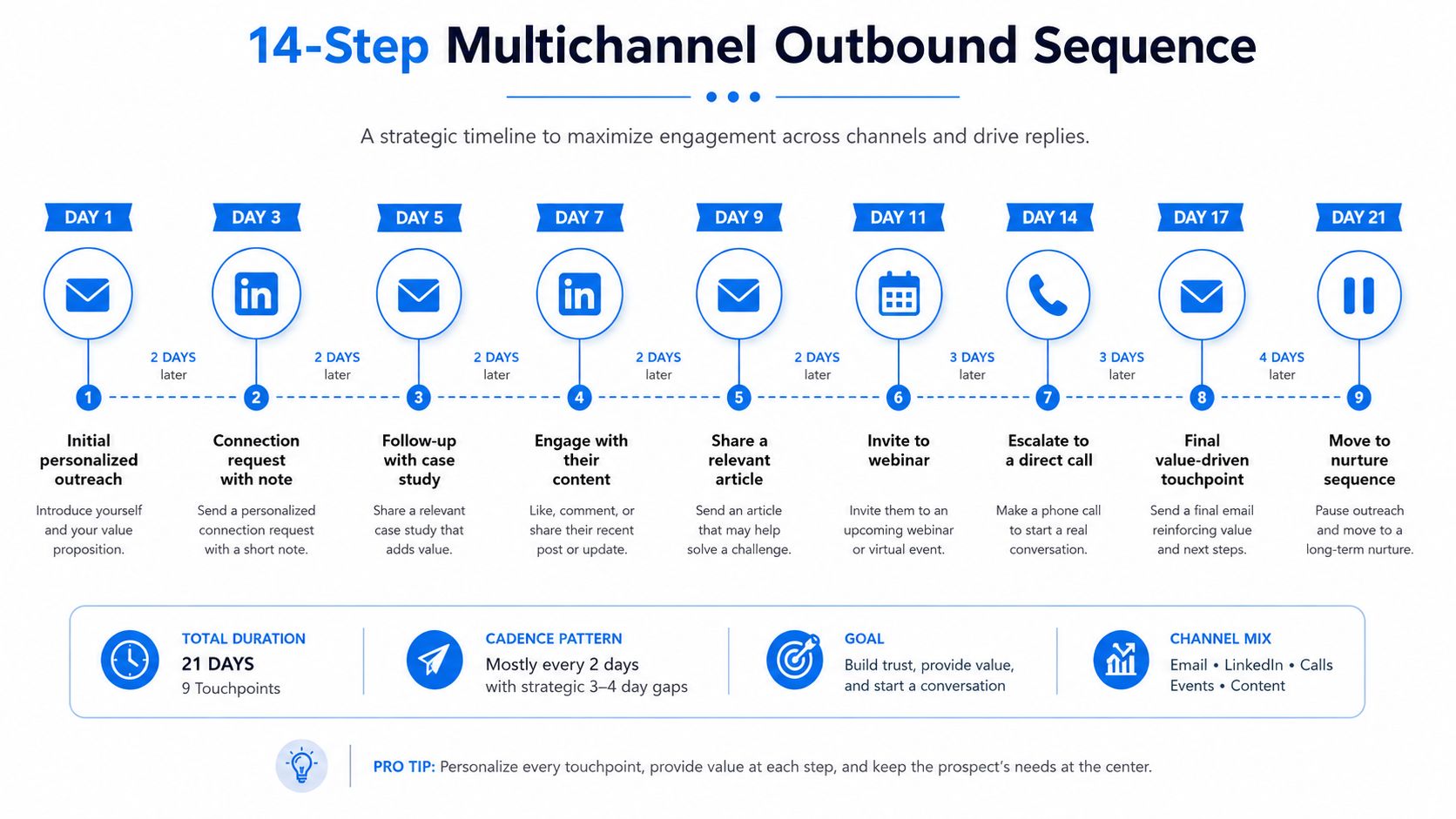
Keep channel roles distinct. Don't paste the email into LinkedIn, and don't send a case study without explaining why it fits the account. A useful resource on list building and nurture sequences can help teams design the transition between active outreach and longer-term follow-up.
This cadence should not become a machine that ignores intent. Stop immediately for a negative response, opt-out, or clear lack of fit. Escalate positive replies to a human, capture the question in the CRM, and let the rep answer the issue rather than forcing the prospect back into an automated branch.
The Metrics That Actually Predict Pipeline
Reply rate is an operating signal, not the commercial objective. A response can be positive, neutral, hostile, irrelevant, or accidental. Technology companies should optimize for qualified meetings, pipeline contribution, and lead-to-revenue conversion, particularly as buying committees grow and sales cycles lengthen.
One 2025 campaign dataset covering 7.53 million emails reported an average reply rate of 0.45%, according to MediaPost's coverage of declining B2B engagement. That figure is a warning against assuming that volume equals meeting generation. The same source summary reports that 33% of B2B brands are seeing declining engagement metrics and 74% say sales cycles have become longer. These figures make open rates and raw replies even less reliable as executive measures.
Use a metric hierarchy
Track metrics in the order the system depends on them:
- Deliverability: If inbox placement deteriorates, later metrics lose meaning. Use the 95%+ operational threshold from the launch standard, and investigate any material decline.
- Positive reply rate: Separate genuine interest from automatic responses, objections, referrals, and negative replies.
- Qualified meeting rate: Define qualification by account fit, persona relevance, problem, and timing. The brief proposes a 0.4% to 0.6% target, but treat it as a planning range rather than a universal law.
- Pipeline per 1,000 sends: Connect meetings to accepted opportunities and potential commercial value.
- Cost per qualified meeting: Include data, infrastructure, software, labor, and sales follow-up.
A green, yellow, and red framework should be customized to your sales motion rather than copied from a generic dashboard.
| Metric | Green | Yellow | Red |
|---|---|---|---|
| Deliverability | At or above 95% | Trending downward | Below the operating floor |
| Positive reply rate | Improving with relevant replies | Stable but weak relevance | Mostly negative or irrelevant |
| Qualified meeting rate | Within the defined target range | Below target with strong fit | No consistent qualified meetings |
| Pipeline contribution | Accepted opportunities are emerging | Meetings lack progression | No commercial movement |
| Cost per qualified meeting | Economically sustainable | Requires optimization | Higher than the value of generated pipeline |
SQL-to-meeting ratios expose qualification problems. If sales accepts leads but meetings don't happen, the handoff, timing, or contact selection needs attention. If meetings happen but opportunities don't progress, inspect persona authority, problem severity, competitive positioning, and technical fit. A CFO doesn't need another reply chart. They need to know whether outbound creates cycle-adjusted pipeline that justifies the spend.
Your 90-Day Outbound Launch Checklist
A defensible launch starts with control. During the first 90 days, the team should be able to explain why each contact was selected, which message they received, whether it reached the inbox, and what happened after the reply. Volume comes after that operating picture is reliable.
Weeks 1 through 4 establish control
Set up sending domains and inboxes, complete SPF, DKIM, and DMARC authentication, and warm inboxes before increasing activity. Create suppression rules for opt-outs, invalid addresses, existing customers, competitors, and contacts already in an active sales process.
Validate the ICP with a 200-record test batch. Review every record for company fit, persona, geography, technology evidence, and email status. The batch should expose weak filters before they affect a larger campaign. It also gives sales a chance to confirm that the records resemble accounts they can qualify.
Create two message variants per persona. Keep the audience and offer stable while changing one meaningful element, such as the subject line, opening trigger, or CTA. Hold off on conclusions until bounce behavior, positive reply quality, and persona fit have been reviewed together.
Weeks 5 through 8 prove the motion
Launch a three-touch email sequence supported by LinkedIn activity. Monitor bounce rates against the below 3% checkpoint in the launch plan. Compare reply performance with the 3.43% 2026 baseline cited earlier, and run inbox placement tests instead of treating open rates as a reliable signal.
Review results by domain, persona, account segment, sender, and message variant. A weak aggregate can conceal a viable niche, while a healthy average can conceal one sender domain with poor placement. Keep spam complaints under the 0.3% checkpoint in the operating plan. Pause segments that generate complaints, then inspect targeting and data before rewriting the copy.
Weeks 9 through 12 scale only what holds up
Increase volume only after infrastructure, list quality, and human response handling remain stable. Add a second persona when the first produces consistent qualified conversations and the team can explain the buying committee path. Add another channel when email and LinkedIn have defined jobs, rather than because the first channel feels slow.
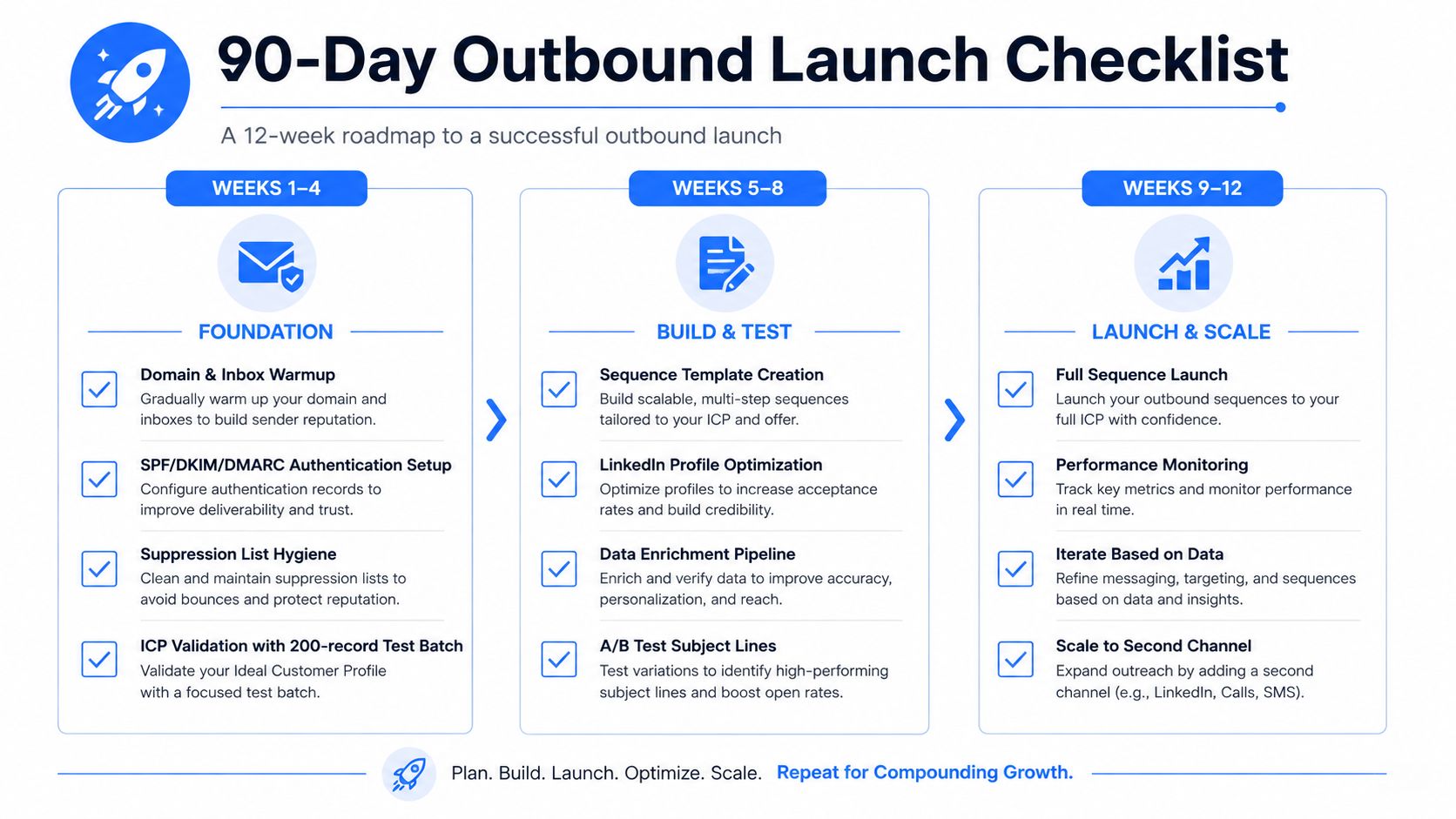
Use weekly checkpoints:
- Infrastructure: Authentication, warming, placement, bounces, complaints, and suppression.
- Data: Duplicate rate, verification status, missing fields, and account coverage.
- Messaging: Positive replies, objections, persona fit, and trigger relevance.
- Execution: Follow-up completion, reply routing, and response time.
- Pipeline: Qualified meetings, accepted opportunities, progression, and cost per qualified meeting.
AI can speed research and message variation, but stale data increases the chance of irrelevant targeting and unsupported claims. In 2025, 41% of B2B marketing teams were piloting agentic AI, while only 12% had governance specifically for autonomous agents. CRM contact data was reported to decay at 34% annually, and AI lead-scoring performance could fall by 28% against clean-data models, according to this analysis of AI lead-generation risks. Use automation for research and administration. Require human approval for claims, targeting, compliance, and escalation.
At day 90, the deliverable is a repeatable program that a new rep can execute, a manager can audit, and finance can evaluate against qualified pipeline. Use the 10%+ reply-rate benchmark as an exceptional reference point. It should inform goals, while data quality and sender reputation remain protected from dashboard-driven decisions.
Lead Printer builds and runs B2B email and LinkedIn outbound programs with prospect research, Clay-based enrichment, deliverability safeguards, persona-specific messaging, qualification, and calendar handoff. Visit Lead Printer to discuss a technology-company campaign built around verified data, qualified meetings, and pipeline contribution rather than raw lead volume.