A 28.5% average LinkedIn connection acceptance rate can look healthy until you compare it with what happens after acceptance. In a large-scale 2026 benchmark, connection request notes received replies only 3.0% of the time, while outbound messages sent after a connection was accepted averaged 10.4% replies. The implication is uncomfortable but useful: the connection request creates access, while targeting, timing, and the post-acceptance sequence create conversations. (Expandi's 2026 LinkedIn outreach benchmark)
A practical LinkedIn outreach strategy therefore starts before the message is written. Your prospect list, profile credibility, intent signals, sending window, and follow-up architecture usually matter more than another clever opening line. The copy still matters, but it works as the final layer of a system, not as a substitute for one.
Why Most LinkedIn Outreach Falls Flat in 2026
Optimizing the part of outreach that's easiest to edit is common. Teams debate hooks, rewrite templates, and add first-name personalization while leaving the audience, sender profile, and sequence untouched. That approach confuses visible activity with controllable performance.
The 2026 benchmarks show a sharper distinction. One benchmark covering more than 15 million LinkedIn contacts found an average connection rate of 26% and an overall reply rate of 7.2%. Reply rates varied by timing and market, reaching 7.9% in April, falling to 6.3% in September, and recording 6.0% in the United States, compared with 6.1% in the UK, 7.1% in Canada, and 6.4% in Australia. (Belkins' LinkedIn outreach study)
Those figures don't describe a copywriting problem alone. They show that audience fit and send conditions influence results before a prospect evaluates the wording.
The benchmark gap teams often miss
A separate 2026 benchmark found that accepted connection requests averaged 28.5%, but messages sent after acceptance averaged 10.4% replies. Connection notes themselves produced only 3.0% replies, which makes them a poor place to force a pitch. (Expandi's benchmark analysis)
| Metric | Average benchmark | Strategic implication |
|---|---|---|
| Connection acceptance | 28.5% | Earn access with relevance |
| Connection-note reply | 3.0% | Don't make the note your conversion step |
| Post-acceptance message reply | 10.4% | Put the value proposition after acceptance |
| Overall LinkedIn reply rate | 7.2% | Judge the full motion, not one message |
Teams also need to compare LinkedIn with the alternative channel. Independent benchmark summaries place targeted LinkedIn message replies around 10.3% to 10.4%, versus roughly 5.1% for cold email. The same benchmark set treats 15% or more as an attainable reply-rate goal for tightly filtered, personalized, multi-touch B2B campaigns, while 3% to 6% positive replies from total sends can represent a solid result in a well-targeted campaign. (Overloop's outbound benchmarks)
Practical rule: If a campaign is broad, a better template won't rescue it. Narrow the audience before polishing the sentence.
A useful LinkedIn sales outreach guide can help teams map the channel, but the operating principle remains simple. Stop treating connection volume as the main objective. Build a relevant audience, create a credible sender profile, send when the prospect is more likely to notice, and reserve the strongest message for the conversation that follows acceptance.
Profile Optimization That Lifts Acceptance Rates
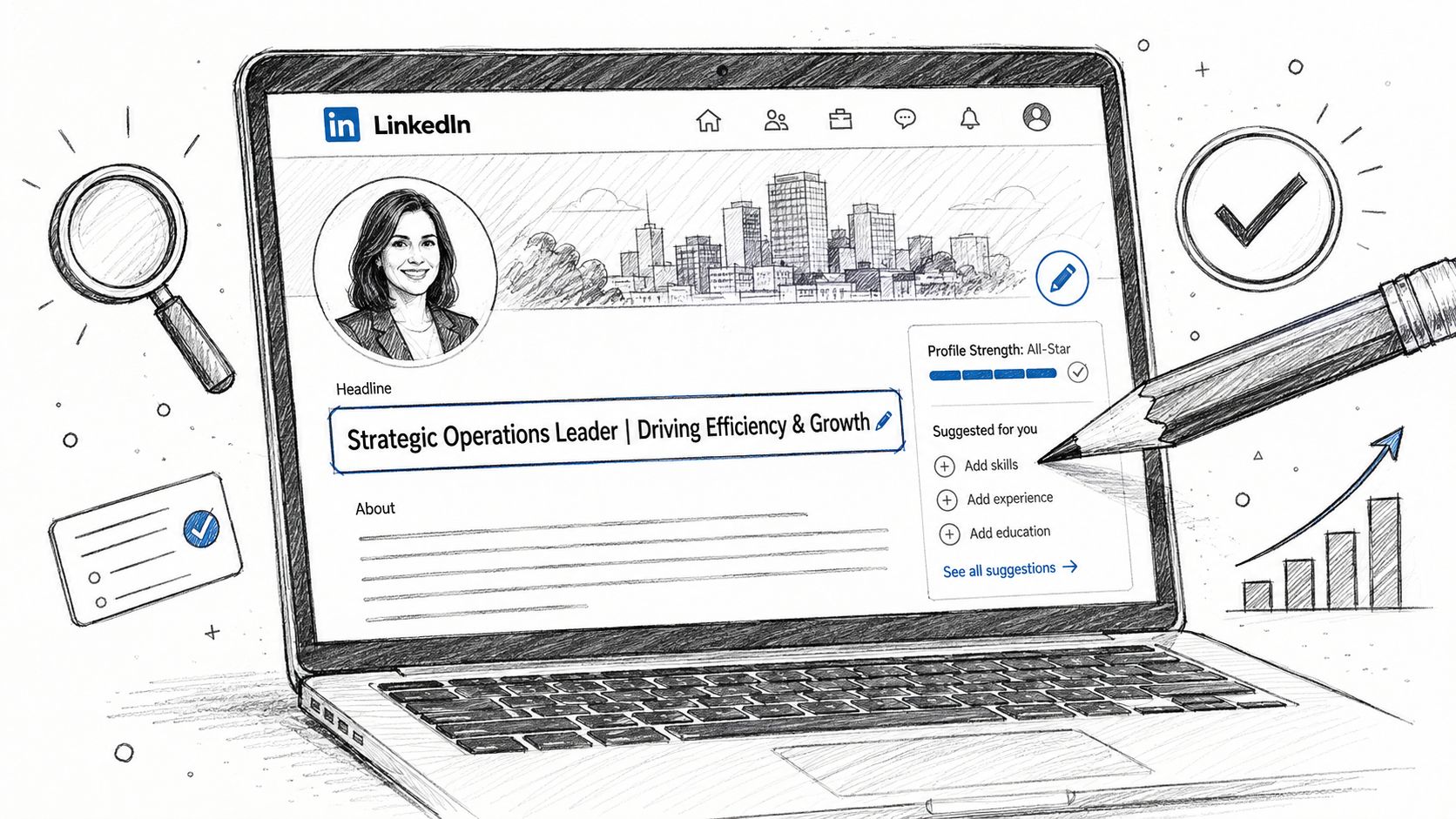
Your profile is part of every outreach message, even when you don't include a profile link. Prospects often inspect the sender before accepting, and a profile that reads like a generic résumé makes a relevant request look commercial.
Start with the headline. A job title tells prospects where you work, but it doesn't tell them why a connection could be useful. Replace a title-only line such as “Account Executive at Northstar” with a clearer positioning statement:
Before: Account Executive at Northstar
After: Helping mid-market SaaS operations teams reduce pipeline friction through cleaner outbound systems
The second version identifies the audience, problem space, and practical outcome. Don't add unsupported proof points just to make the line sound stronger. A precise promise is more credible than an impressive but unverifiable claim.
Make the profile confirm the request
Your banner should reinforce the headline, not compete with it. Use a clean visual treatment that communicates the market you serve, the operating problem you understand, or the category in which you work. Avoid dense product screenshots and slogans that say nothing specific to the buyer.
The About section has a similar job. The opening lines should explain who you work with and what you help them address before moving into your background. A prospect who clicks through should be able to answer three questions quickly:
- Who do you serve? Name the segment or role.
- What do you help with? Describe the operational problem in plain language.
- Why should they trust the conversation? Use relevant experience, clear examples, or a point of view you can support.
Activity signals provide the final layer. Recent comments on prospect-relevant posts can make your name familiar, while thoughtful posts demonstrate that your profile isn't maintained only for outbound. Skills and endorsements should support the buyer's world rather than list every capability you've ever used.
A useful regional perspective is available in this guide to APAC B2B LinkedIn lead generation, particularly for teams adapting positioning to different professional markets.
Use the following video as a practical profile review aid, then inspect your own page from a prospect's perspective:
Before sending requests, remove anything that creates uncertainty. An outdated role, vague headline, inactive profile, or banner filled with internal company language can undermine a message that would otherwise be relevant. Your profile doesn't need to become a personal media brand. It needs to make the connection request feel like a reasonable professional interaction.
Building a Target List That Actually Converts
A strong message to the wrong person is still a weak campaign. List building should begin with a written Ideal Customer Profile that defines both inclusion and exclusion criteria, then translate that document into repeatable search logic inside LinkedIn Sales Navigator.
Start with company attributes such as industry, operating model, geography, growth stage, and technology environment. Add human attributes, including function, seniority, time in role, and the responsibilities that indicate buying authority. A useful ICP isn't “B2B companies that need more leads.” It's a constrained description of a company and a person who can recognize the problem, influence the decision, and act on it.
Layer filters instead of relying on one search
Turn the ICP into multiple filter combinations rather than one oversized search. Vary the job title, seniority, function, company characteristics, and visible activity signals so you can see which segments accept and respond.
Intent signals deserve priority because they explain why a prospect might care now. Useful signals include:
- Recent activity: The prospect has posted or commented on a problem related to your offer.
- Hiring movement: The company is hiring into a team connected to the operational challenge.
- Funding or expansion: A company event suggests new priorities, capacity requirements, or vendor evaluation.
- Role changes: A recently promoted or newly hired leader may be reviewing processes and tools.
- Engagement: The prospect has interacted with content about the category or pain point.
The evidence supports this shift from broad ICP targeting to signal-led selection. A 2026 benchmark summary reports broad cold-list campaigns in the 10% to 20% acceptance and 3% to 8% reply range, while campaigns using signals such as hiring, funding, recent activity, or engagement have been reported in much stronger ranges, including 40% to 60% acceptance and 25% to 55% reply in some campaigns. Treat those figures as benchmark ranges, not guarantees, because signal quality and campaign execution vary. (LinkedNav's 2026 B2B outreach report)
Exclusion criteria protect the campaign
Negative filters are as important as positive ones. Exclude competitors, existing customers, students, irrelevant functions, and titles that can't authorize or influence the purchase. Remove duplicate contacts, people who have opted out, and records with weak evidence of role or company fit.
Refresh the list regularly. A new job change or post can make a previously static record timely, while an old trigger can lose relevance. Keep the source of each signal visible in your CRM so the sender can write from evidence rather than guesswork.
The Connection Request to First DM Sequence
Consider a VP of Operations at a mid-market software company. The company has begun hiring into its customer operations team, and the VP has recently commented on the difficulty of maintaining process consistency during growth. That combination gives you a reason to reach out. The job title alone doesn't.
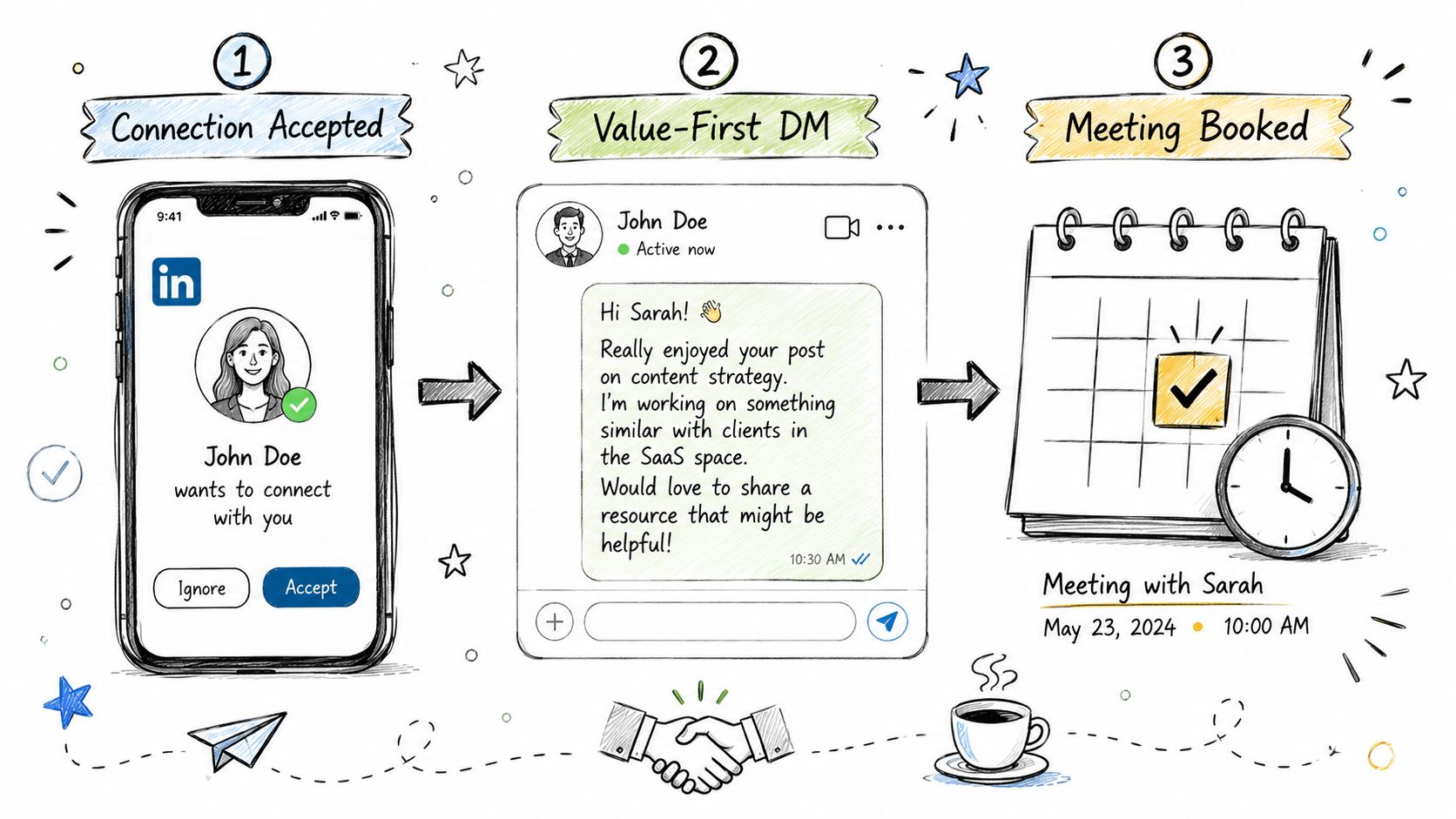
The connection request should create access without trying to close the meeting. A concise note might say:
“Your point about process consistency during team growth stood out. I work with operations leaders facing a similar transition, and I'd be glad to connect.”
A blank request can be appropriate when the profile and targeting already provide enough context, but a relevant note can clarify why the connection makes sense. Don't turn the note into a product description. The 2026 benchmark evidence is clear that the note is a low-yield conversion point, while the post-acceptance message carries more reply potential. (Expandi's connection and messaging data)
Put the useful idea in the first DM
Once the VP accepts, lead with the trigger and one relevant observation. Don't thank them for connecting and immediately attach a calendar link.
Generic opener:
“Thanks for connecting. I help companies improve their operations processes. Would you be open to a call?”
Trigger-led rewrite:
“Thanks for connecting. I noticed the operations hiring push at your company. Teams often find that new capacity exposes inconsistent handoffs between operations and customer teams. I can share a short checklist we use to spot those gaps. Would that be useful?”
The second message gives the prospect a reason to respond without demanding a meeting. If they engage, qualify the situation through the conversation. Ask what process is changing, where friction appears, and whether the issue has an active owner.
The follow-up should introduce a different angle, not repeat the opening:
- Message two: Reference a new post, company update, or a specific operational consequence of the trigger.
- Message three: Offer a concise resource or observation, then close the loop respectfully if there's still no response.
Keep every touch easy to answer. A prospect can reply with a short clarification, accept a resource, or say the timing isn't right. That lowers the cost of engagement without disguising the commercial purpose.
The sequence should feel like a thoughtful progression, not a stack of automated reminders. Timing and relevance matter more than elaborate personalization. The same 2026 benchmark found that morning connection requests reached roughly 32% acceptance, while AI-personalized messages didn't outperform human-written templates, which reinforces the value of timing and judgment over automation flair. (Expandi's State of LinkedIn Outreach H2 2026)
Multichannel Cadence With Email and LinkedIn DMs
LinkedIn-only outreach is useful when the prospect is active on the platform and the buying conversation depends on personal credibility. Email adds reach, persistence, and a more natural place for detail. The choice isn't ideological. It depends on the buyer, the account, and the evidence you have.
For a senior operations leader, LinkedIn can establish context before email arrives. For a contact who rarely posts but has a verified business inbox, email may carry the first substantive message. Enterprise targets may justify InMail when a connection path is slow or unavailable, but the copy still needs to be concise and specific.
Compare the cadence before adding touches
More touches don't automatically create more conversations. A 2026 benchmark summary found that top-performing campaigns used only three messages, while sequences with five or more messages reduced reply rates. The same source reports that morning sends outperformed evening sends, supporting a compact sequence built around relevance rather than brute-force persistence. (LinkedNav's sequence findings)
| Cadence type | Average touches | Reply rate | Meeting rate | Opportunity conversion |
|---|---|---|---|---|
| LinkedIn only, connection plus DMs | 3 messages | Around 10.4% for post-acceptance messages | Not specified in the benchmark | Not specified in the benchmark |
| Email plus LinkedIn | Varies by campaign | Around 10.3% to 10.4% for targeted LinkedIn messaging | Measure in your CRM | Measure in your CRM |
| Long LinkedIn sequence | 5 or more messages | Lower than compact sequences in the cited benchmark | Not specified | Not specified |
Don't send two touches through different channels in the same twenty-four-hour period. That pattern feels coordinated from the sender's side but crowded from the buyer's side. A better rhythm might be a LinkedIn connection, a post-acceptance DM, an email that references the same business issue, a LinkedIn follow-up, and a final email or call task for a high-priority account.
For teams designing the handoff between channels, this guide to cross-channel lead generation offers useful sequencing context. The operational requirement is straightforward: sync statuses, suppress duplicate touches, and let a reply on one channel stop the rest of the automated cadence.
A practical four-channel pattern for mid-market SaaS operations and revenue leaders can include LinkedIn, email, a phone task, and a useful content asset. Keep the message theme consistent, but adapt the format to the channel. LinkedIn should sound conversational, email should carry slightly more context, and a call task should reference the trigger rather than recite the email.
Metrics That Predict Pipeline, Not Vanity Counts
Connection volume and profile views tell you that activity happened. They don't tell you whether the activity can produce revenue. A useful dashboard follows the prospect from access to conversation, from conversation to meeting, and from meeting to qualified pipeline.
Track five metrics separately:
- Connection acceptance rate. This diagnoses list quality, profile credibility, and timing. If acceptance is weak, don't rewrite the DM first. Inspect the audience and sender profile.
- Positive reply rate. Separate replies that show interest from polite declines, wrong-person responses, and automated acknowledgments. This is closer to message-market fit than raw reply rate.
- Reply-to-meeting conversion. A campaign can generate conversation but fail to create a clear next step. Review the CTA, qualification questions, and handoff process when this falls.
- Cost per meeting booked. Include research, tooling, sender time, and campaign management. A higher reply rate isn't necessarily better if the team spends too much to handle unqualified responses.
- Pipeline value per 1,000 prospects. This connects list quality to commercial output. Calculate it from your own CRM data rather than borrowing an external ROI claim.
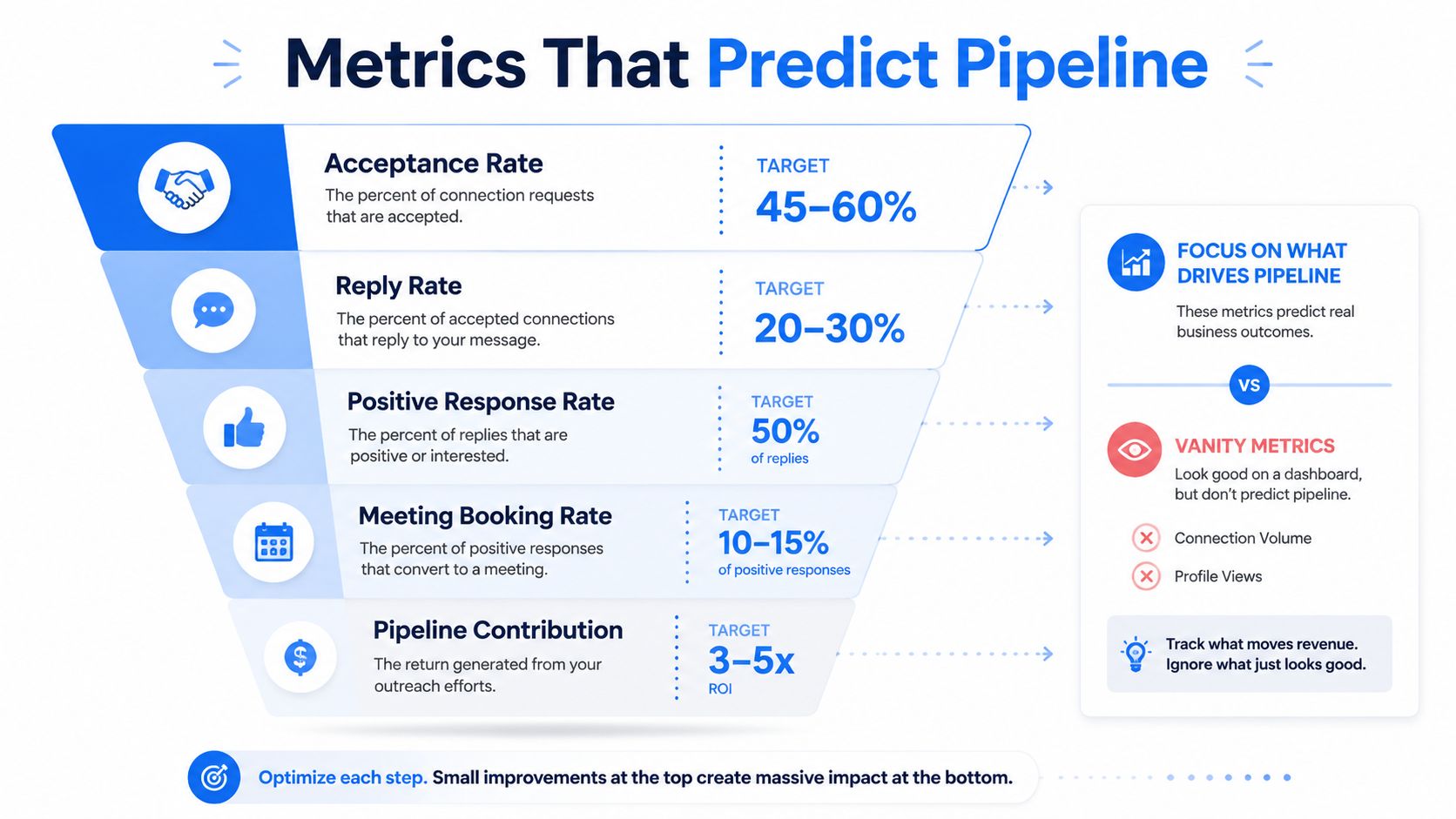
Diagnose the first broken stage
Use the funnel to choose one intervention at a time:
- Low acceptance: Review ICP filters, profile positioning, recent activity, and send timing.
- Healthy acceptance but weak replies: Relevance is probably lost after connection. Rewrite the first value-bearing DM around a real trigger.
- Strong replies but few meetings: Reduce CTA friction, ask better qualifying questions, and make the next step explicit.
- Meetings without qualified opportunities: Tighten negative criteria and define what counts as a sales-ready conversation.
- Pipeline without efficiency: Reassess channel mix, list sourcing, manual research time, and follow-up ownership.
The benchmark data gives you useful reference points without replacing your own funnel. A large 2026 study found 12.2% total replies for messenger campaigns when prospects were already connected, and another benchmark found only 2.0% of accepted connections booked a meeting. Together, those figures show why acceptance isn't pipeline and why your dashboard must continue past the connection stage. (Belkins' messenger campaign findings) (Expandi's H2 2026 benchmark)
For the qualification step, teams can use this practical resource on what lead qualification involves. The main discipline is to avoid optimizing the metric that's easiest to improve. More accepted connections won't solve a weak offer, and more replies won't solve poor qualification.
Your 30-Day LinkedIn Outreach Rollout
A workable rollout begins with infrastructure and ends with a documented optimization decision. Don't launch a large sequence while your profile, list definitions, and CRM stages are still changing.
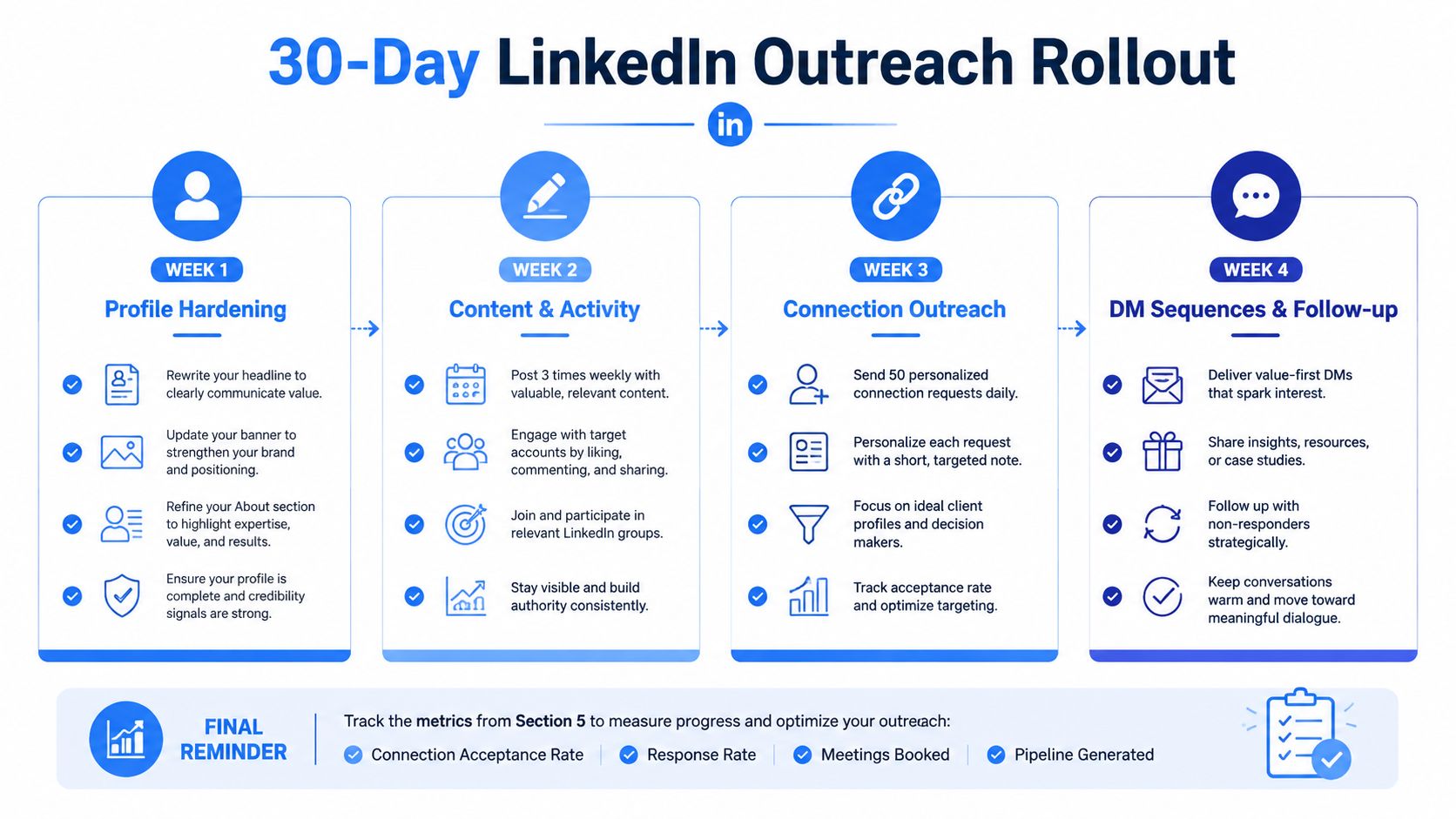
Week one focuses on profile and infrastructure
Rewrite the headline, update the banner, tighten the About opening, and seed the activity feed with useful comments and posts relevant to your target buyers. Confirm that Sales Navigator, InMail access where needed, CRM tagging, suppression rules, and reply ownership are ready.
Artifact: A reviewed profile and an outreach infrastructure checklist.
Week two builds the audience
Write the ICP one-pager with inclusion and exclusion criteria. Build the target list in distinct segments, then add the intent layer for hiring, role changes, funding, recent activity, and relevant engagement. Record the evidence behind each prospect so the message can refer to something real.
Artifact: An ICP one-pager and a clean, signal-tagged prospect list.
Week three launches the sequence
Start with a controlled sending window rather than an uncontrolled volume push. Pair connection requests with a compact post-acceptance sequence, then add email or another channel only when the prospect hasn't already received a touch that day. Keep human review in the message workflow, especially for senior contacts and high-value accounts.
Reserve daily blocks for profile tuning, prospect research, and reply handling. The exact allocation should match your team capacity, but each block needs an owner and a calendar slot. Unscheduled reply handling is how interested prospects become stale conversations.
Artifact: A sequenced message document and a live campaign dashboard.
Week four reviews evidence
Compare acceptance, positive replies, qualified meetings, and downstream opportunity quality by segment and message variant. Prune low-converting audiences before you add more copy tests. Keep an optimization log that records the change, the reason, the segment affected, and the outcome.
Before any new campaign goes live, verify these eight items:
- Profile clarity: The headline and About section explain the buyer relevance.
- ICP definition: Inclusion and exclusion rules are written.
- Signal evidence: Each priority prospect has a current reason for contact.
- Message fit: The first DM delivers value before requesting a meeting.
- Cadence control: Channel touches are coordinated and spaced.
- Suppression logic: Replies, opt-outs, customers, and competitors are removed.
- CRM ownership: Every response has a next action and responsible person.
- Measurement: Acceptance, positive reply, meeting, cost, and pipeline metrics are visible.
Teams that need appointment-setting support can review sales appointment setting services as one possible operating model. Whether you run the motion internally or use outside support, the standard stays the same: select the right people, contact them for a defensible reason, and measure what happens after they accept.
Lead Printer builds and runs data-driven outbound programs that combine prospect research, LinkedIn-assisted targeting, email, LinkedIn DMs, qualification, and calendar handoff for B2B teams. If you want a managed LinkedIn outreach strategy connected to measurable pipeline rather than vanity activity, visit Lead Printer to discuss your market, ICP, and campaign goals.