
Your email program looks busy on the surface. Campaigns go out, nurture flows keep running, and the dashboard still shows activity. But if sales keeps asking why owned channels aren't producing enough pipeline, the problem is usually invisible work nobody owns, deliverability hygiene, segmentation refreshes, copy testing, QA, and the discipline to keep all of it coordinated.
That's why email marketing outsourcing shouldn't be treated as a staffing shortcut. It's an operating system decision. The right partner takes ownership of the moving parts that determine whether email performs, while the wrong one just becomes an expensive task taker.
When Outsourcing Email Marketing Becomes the Smart Move
The clearest trigger is operational strain. Your email machine has outgrown the person running it, send volume keeps climbing, and nobody owns the cleanup work behind the scenes. Lists go stale, suppression files drift, QA slips, and campaigns still go out without the discipline that protects inbox placement.
A second trigger is performance decay. If reply rates are sliding while the list grows, the problem is usually segmentation, audience quality, or deliverability management. Hiring a junior marketer only adds more production capacity to a system that is already misfiring.
The signal is usually operational, not creative
Sales pressure makes the gap obvious. Leaders want more MQLs from owned channels, but the in-house marketer is buried in production and cannot reset the system. A real outsourcing partner handles copy, testing, data cleanup, and campaign execution as one workflow. A body shop just passes tasks back to you.
New market entry is another clean line. If you are moving into a geography, vertical, or product motion the team does not know well, internal instinct is not enough. You need people who already know how to set sender reputation, segment audiences, and build campaign logic in a new environment.
Practical rule: outsource when the bottleneck is operating discipline, not raw manpower.
If you are evaluating partners in a specific market, find an email marketing agency in Houston is a useful starting point for seeing how agencies position themselves around local execution and service scope.
A junior writer can draft emails. An outsourced operator can keep the program healthy under volume, pressure, and changing requirements. That difference shows up fast in a few concrete situations, such as a re-engagement program that needs list cleanup, deliverability fixes, and QA before launch, or a new product line that needs a sender setup the team can trust. That is the level of ownership that turns outsourcing into a serious operating decision.
Common Service Models and What Each One Actually Covers
Most buyers get trapped by vague service language. “Full service” can mean a genuine operating pod, or it can mean a freelancer with a dashboard and a templated workflow. The first thing you need is clarity on what shape of engagement you're buying.
Three models worth considering
| Model | Scope | Best For | Accountability | Typical Length |
|---|---|---|---|---|
| Full-service retainer | Strategy, copy, design, list hygiene, reporting, ESP configuration | Growth-stage teams with ongoing volume and no internal owner | High, one team owns outcomes | Ongoing |
| Project-based | Re-engagements, launches, audits, deliverability fixes | Teams testing a partner or solving one problem | Medium, tied to a defined deliverable | Short-term |
| Specialist add-ons | Copywriting, deliverability consulting, HTML builds | Mature in-house teams that need targeted expertise | Narrow, task-specific | Ad hoc |
Full-service retainers fit teams that need an external operating function, not a vendor. They're strongest when the company has enough email motion to justify a steady pod handling strategy, production, QA, and reporting. They fail when the client still wants to make every decision internally but expects the partner to “own” results.
Project-based work is the safest entry point if you're skeptical. A re-engagement sequence, new market launch, or deliverability audit gives you a concrete deliverable and a fast read on how the partner works. This is also where many teams learn that the agency they wanted was really only good at one slice of the stack.
Specialist add-ons make sense when your internal team already has strong operators and just needs a sharper edge. A deliverability consultant, an HTML builder, or a senior copywriter can plug gaps without replacing your team. This model breaks when leaders try to use it as a substitute for ownership.
If your program also feeds lead generation, the operating model should line up with the rest of the funnel, not sit in isolation. The way email marketing lead generation works at Lead Printer is a good reference point for how email, data, and follow-up can be run as one system instead of separate handoffs.
The right model is the one that matches your internal maturity. Don't buy a retainer if you still need a diagnostic. Don't piece together specialists if you need someone to run the machine every week.
Why Deliverability Engineering Drives Outsourced Results
Deliverability is the multiplier on everything else. Good copy won't save a program that never reaches the inbox. The first job of a serious outsourced partner is to protect the sender environment before they try to optimize response.
Infrastructure discipline comes first
The technical baseline matters. A fresh domain with no authentication reached roughly 25% inbox placement, while adding SPF, DKIM, and DMARC increased it to about 55%. When the domain was warmed and fully authenticated, inbox placement rose to about 90%, and modeled replies moved from 7.5 to 27 per 1,000 sends, a 3.6x lift versus baseline, according to a cold email deliverability benchmark (BiltAI deliverability benchmark).
That's why a good partner treats deliverability as infrastructure. They should maintain authenticated sending environments, separate domains or subdomains by stream where appropriate, and monitor bounce and complaint signals at the campaign level. If they only talk about subject lines and cadence, they're not running an operating system, they're decorating one.
Deliverability work should be continuous, not something someone checks once a quarter after the program already starts slipping.
Warm-up and monitoring are not optional extras
Warm-up matters whenever volume changes. If sends jump materially, the sending profile should ramp carefully instead of forcing the mailbox providers to decide whether you're trustworthy. If you're building this internally, how to warm up email domain is a useful internal reference for thinking about the sequencing.
The operational benchmark for healthy cold email is stricter than many expect. One source defines strong performance as delivery above 95%, inbox placement above 82%, bounce rate under 3%, and spam complaints below 0.1%, with SPF, DKIM, and DMARC passing (FirstSales cold email benchmarks). Another checklist flags bounce rates above 2% and complaints above 0.1% as sender-reputation risk signals (FirstSales cold email benchmarks).
That's the economics of outsourced email. The partner who understands reputation, authentication, and warm-up can protect reach before the first reply is ever written. The partner who doesn't will burn volume and blame the market.
How to Evaluate and Select the Right Outsourcing Partner
Treat vendor selection like hiring a senior operator. Cheap bids usually win on price and lose on structure. A serious partner brings judgment, process, and technical control.
Start with proof, not promises
Ask for seed-list test results across Gmail, Outlook, and Microsoft 365, then review the candidate's own domain reputation history. If they cannot show how they protect their own sending environment, they are asking you to trust a process they do not run cleanly themselves. That is a bad trade.
Ask for evidence tied to revenue, not vanity metrics. Opens and clicks do not tell you whether the program contributed to pipeline. You want anonymized campaign reporting that connects the work to actual business outcomes.
Test the operating model directly
Who writes the copy. How many clients does one strategist carry. Where does work move from strategy to production to QA. Those questions expose whether you are talking to a real pod or a thin layer of account management sitting over freelancers.
Technical depth matters just as much. Ask how they would warm a new sending domain, segment a suppression list, or recover from a blocklist hit. If the answers are generic, they do not own the system well enough to protect it under stress.
A vendor should also be able to speak clearly about legal and data handling. Review data processing agreement clauses before you sign anything that involves shared customer data.
| Criterion | What to Audit | Weight |
|---|---|---|
| Deliverability proof | Their own inbox placement, authentication, reputation controls | High |
| Revenue attribution | Evidence of pipeline impact, not just opens | High |
| Operating capacity | Pod structure, client load, QA process | Medium |
| Technical response | How they handle warm-up, suppression, and blocks | High |
If you want a practical comparator for this kind of selection, cold email marketing agency resources can help you benchmark what a serious operating partner is expected to cover. The key is simple, buy the team that can explain the system in plain language and show how they protect it when things go wrong.
Realistic Pricing and What You Get for the Budget
Pricing only matters if you know what the spend buys. A cheap retainer that skips list hygiene, QA, or deliverability work is expensive in disguise. A larger retainer that replaces several internal functions can beat a single hire on both cost and execution.
Match spend to operating depth
The benchmark numbers give a workable starting point. Outsourced email marketing has been cited at roughly $1,800 to $4,500 per month, while in-house labor runs around $5,000 to $12,000 per month, with savings of about 50% to 65%. The same benchmark reported faster setup times, typically 1 to 2 days instead of 3 to 5 days, when the provider already has the workflow in place (Process Smart benchmark).
Here's how I think about the bands.
| Engagement Model | Monthly Cost | Typical Volume | What You Get |
|---|---|---|---|
| Boutique specialist | Lower monthly retainer | Smaller, focused programs | Strategy, limited campaigns, basic monitoring |
| Mid-market agency | Mid-range retainer | Ongoing growth programs | Multi-campaign production, segmentation, testing, deliverability engineering |
| Enterprise retainer | Highest retainer | Complex, multi-team environments | Custom integrations, analysts, deeper attribution |
The mid-market band is often the cleanest fit for growth-stage B2B teams, because it covers real operating depth without forcing you to pay for enterprise overhead too early. It also gives you more breadth than one internal specialist usually can.
A separate benchmark in the same dataset puts outsourced open rates at 26% to 35% versus 18% to 22% in-house, click-through rates at 4% to 7% versus 2% to 3%, and ROI at about $42 to $56 returned for every $1 spent outsourced versus about $28 per $1 spent in-house. Treat those as benchmark ranges, not guarantees, but they explain why the cheaper-looking option is often the worse buy.
Budget for onboarding separately, and don't sign contracts priced only per send. You want ownership of outcomes, not a billing meter.
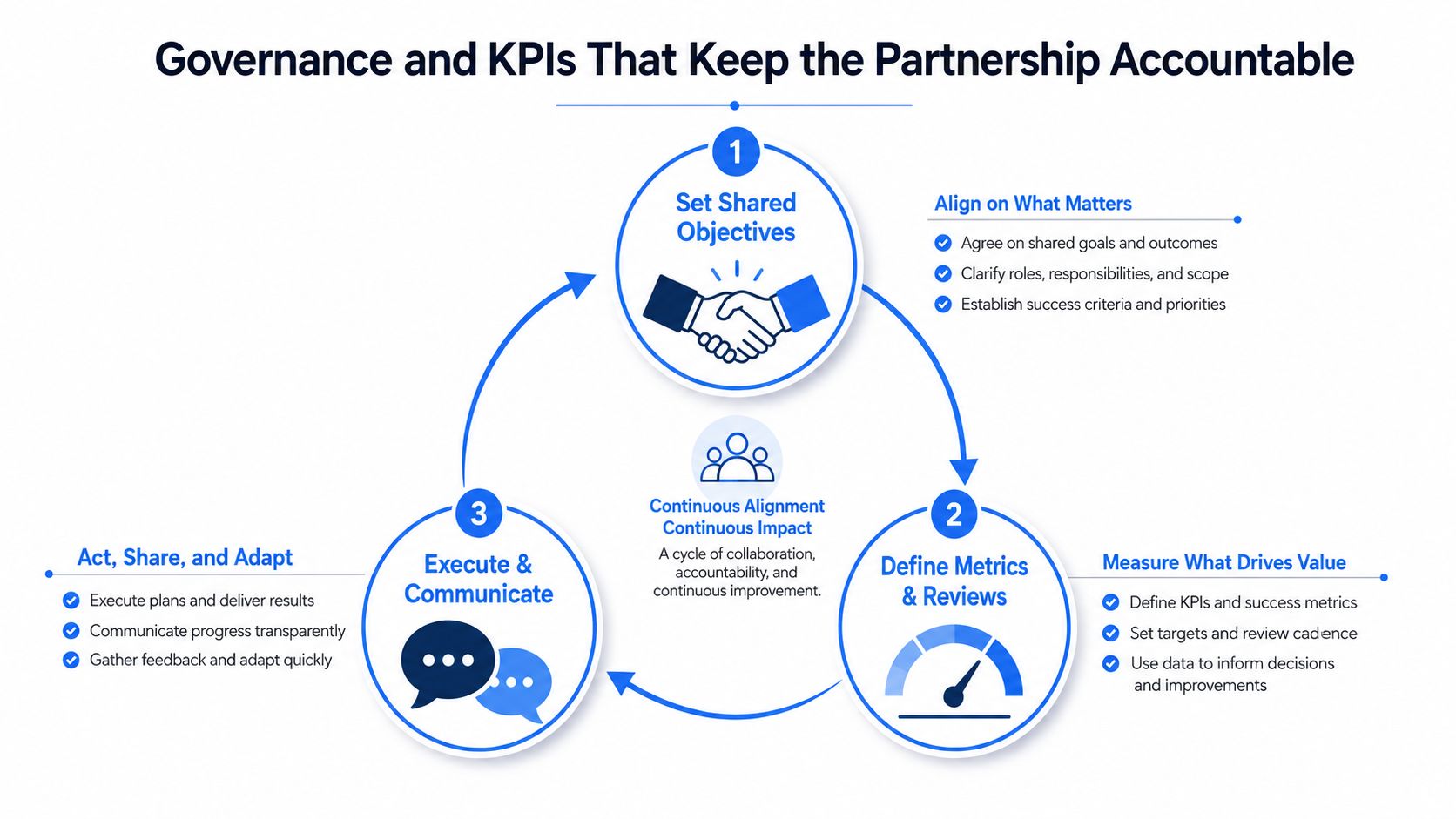
Governance and KPIs That Keep the Partnership Accountable
Most outsourced email programs fail because no one builds a governing layer around the relationship. The partner is asked to “own” email, but the client still runs approvals like a committee and data like a side project. That's not delegation, that's confusion with a retainer attached.
Build a lightweight operating rhythm
Start with a weekly 30-minute standup. Keep the agenda fixed, active campaigns, deliverability signals, blockers, and next-week priorities. That meeting prevents drift without recreating an internal department.
Then set a written approval workflow with a 24-hour SLA for copy, design, and segmentation changes. If reviews stall for days, the partner can't move with any speed, and the whole point of outsourcing disappears. The client still owns business judgment, but the provider needs a predictable path to execution.
Good governance is boring by design. If the process needs constant heroics, it isn't a process.
Define the handoff and the scorecard
Data handoff needs to be explicit. List hygiene, suppression files, and PII ownership should be documented before launch, not after a mistake forces the conversation. That's also where the accountability line between internal teams and the vendor gets drawn.
Reporting should stay tight. Track delivered rate, inbox placement, reply or engagement by segment, and pipeline influenced against a CRM source of truth. If a partner only shows opens and clicks, they're reporting activity, not outcomes.
This is also where performance measurement discipline from other functions is useful. If your team already uses a framework like how to measure CSAT NPS FCR, you already understand the value of picking a few meaningful KPIs and enforcing them consistently. Email needs the same mindset.
A sensible commercial structure is to tie 10% to 20% of the retainer to performance against two or three agreed KPIs. That creates skin in the game without turning the relationship into a punitive contract. If the provider won't accept that structure, they probably don't believe they can control the result.
A Practical Checklist Before You Outsource
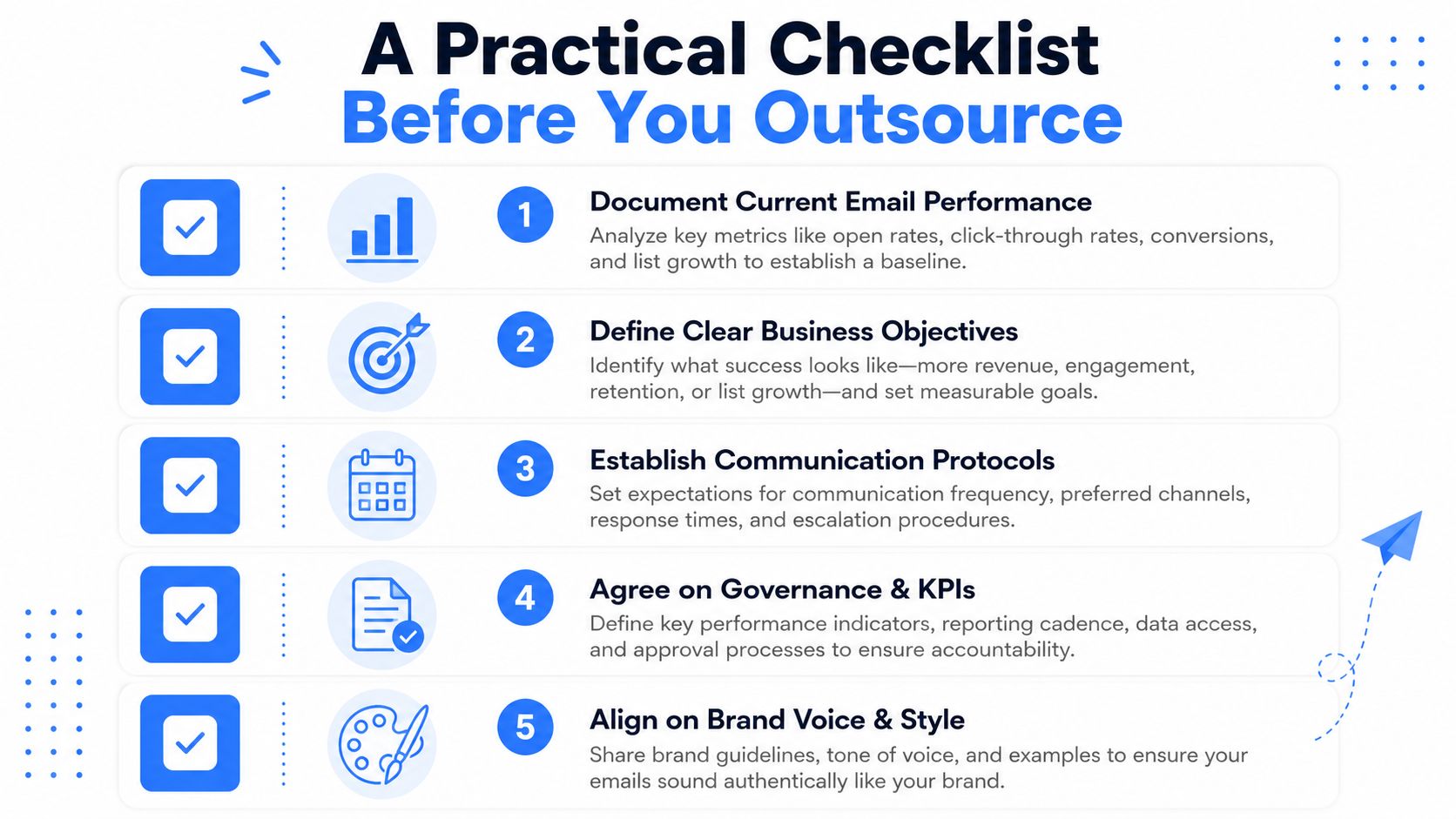
Treat this as a go, no-go filter before you sign. If a provider can't answer these questions cleanly, they are not ready to run your email program as an operating system.
Check the fundamentals before you sign
- Scope fit: Decide whether you need full-service execution, a project sprint, or specialist support. Do not force a retainer onto a one-off problem.
- Deliverability ownership: Ask who owns domain health, inbox monitoring, complaint handling, and warm-up during onboarding.
- Vendor evidence: Request their deliverability process, sample reporting, and proof that they can show business impact, not just engagement.
- Data handoff: Ask for the exact intake they need for segments, lists, exclusions, brand rules, and CRM access. If they cannot specify it, onboarding will stall.
- Trial scope: Start with a narrow pilot that tests setup quality, send discipline, and handoff speed before you commit to broader work.
Three items should stop the deal fast. You need a named deliverability owner on the vendor side, a documented handoff and access map, and a reporting model that ties email activity back to pipeline in your CRM. If those are vague, the relationship will get messy as soon as volume rises.
Two more items are usually ignored until they cause trouble. Put list ownership language in the contract, and define a transition plan that protects sender reputation during onboarding. Email is a live system. Treat it like one.
The right partner will answer these questions without spin. The wrong one will sell creativity and avoid the mechanics that keep the channel profitable.