Your sales team is busy, but the calendar still has gaps. Paid acquisition costs keep rising, internal prospecting takes time away from closing, and every agency pitch seems to promise a larger list rather than better conversations. The difficult question isn't whether you can send more outreach. It's whether an outside team can put the right message in front of the right account, get it into the inbox, qualify the response, and create pipeline your sales team can work.
A B2B lead generation agency should be judged as an outsourced revenue operation, not a contact database. The strongest partners protect sender reputation, build accurate account lists, personalize around genuine business context, and report on qualified meetings instead of hiding behind send volume. That distinction matters because cold outreach is structurally difficult, with average reply rates commonly sitting in the low single digits, according to recent B2B lead generation benchmarks.
What a B2B Lead Generation Agency Actually Does
A B2B lead generation agency takes responsibility for the prospecting workflow that many companies struggle to operate consistently. That usually includes identifying target accounts, finding relevant contacts, verifying data, launching outbound sequences, managing replies, qualifying interest, and handing suitable meetings to the client's sales team. The agency isn't paid to produce names. Its useful output is a sales-qualified conversation with a company that fits the agreed ideal customer profile.
That makes the agency different from several adjacent providers. A media buyer manages paid campaigns and advertising spend. A content marketing firm creates assets designed to attract and educate an audience. A CRM consultant improves systems, reporting, or automation. Those services can support pipeline, but an outbound lead generation agency operates the day-to-day prospecting engine.
Practical rule: Treat held, qualified meetings as the primary outcome. Contact counts are inputs, not proof of commercial value.
The workflow behind a qualified meeting
A reliable engagement starts before the first email:
- Account definition: The agency and client agree on industries, company characteristics, geography, buying roles, exclusions, and disqualifiers.
- Prospect research: Researchers source contacts from relevant databases, LinkedIn, business registries, company websites, and other appropriate sources.
- Technical preparation: Sending domains and mailboxes are configured, authenticated, warmed, and monitored before meaningful volume begins.
- Message development: Copy reflects the prospect's role, business context, likely problem, and reason to respond now.
- Reply management: Someone reviews positive, negative, ambiguous, and out-of-office responses instead of letting automation classify everything.
- Qualification and handoff: The agency checks agreed criteria, books or transfers the meeting, and records the context the seller needs.
A list-pushing vendor usually stops after sourcing contacts or launching a generic sequence. It may report sends, opens, or raw replies, but it doesn't own the quality of the conversation. A real operator stays accountable for the chain connecting data quality to inbox placement, relevance, response, qualification, and sales follow-up.
For companies comparing delivery models, B2B prospecting services can help clarify what a full outsourced workflow includes. The important buying question is simple: who owns the result when the campaign underperforms? If the answer is nobody beyond the person uploading a list, you're probably buying activity rather than pipeline.
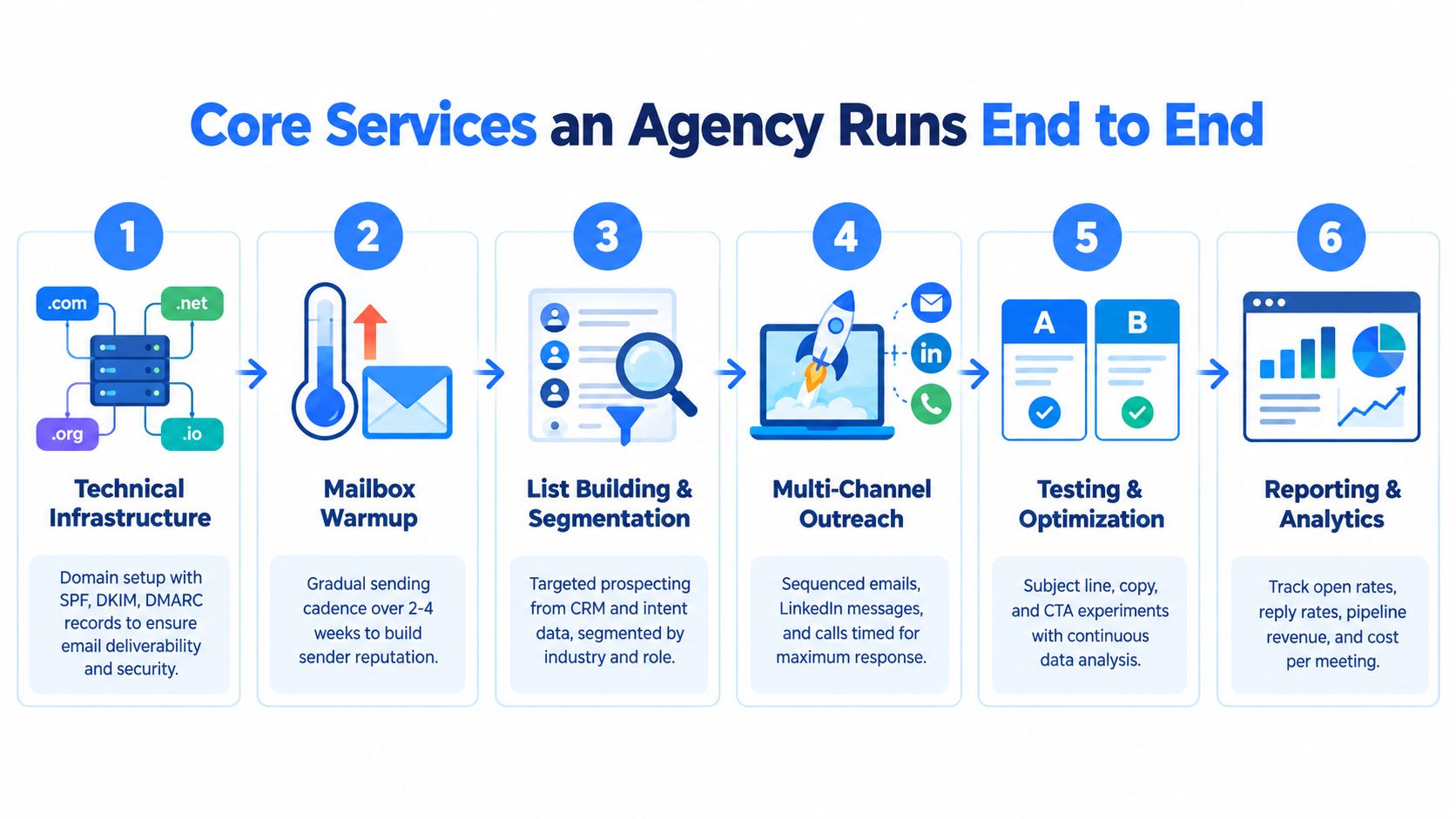
Core Services an Agency Runs End to End
A campaign should be built in operational order. Strong copy can't rescue an unauthenticated domain, and a technically sound setup can't compensate for inaccurate contacts or a weak account definition. Each service layer affects the next one.
Infrastructure comes before outreach
The first layer includes dedicated sending domains, mailbox creation, authentication, warm-up, sending limits, reputation monitoring, and suppression processes. Agencies should configure SPF, DKIM, and DMARC, then establish a cautious cadence instead of starting with a sudden blast. The platform choice should reflect deliverability controls and visibility, not the largest possible sending quota.
Poor execution is easy to spot. A vendor asks for one existing corporate domain, imports a scraped list, and starts sending within days. Another warning sign is an agency that can't explain how it separates campaign mailboxes from the client's primary employee accounts.
Data and segmentation determine relevance
List building means more than finding a job title. The operator needs to validate the account, confirm the person's role, enrich the record with useful firmographic or trigger information, and remove duplicates, former employees, generic inboxes, and unsuitable companies. Segmentation might reflect industry, geography, technology use, growth activity, hiring, role seniority, or a specific commercial event.
A monthly refresh is often more valuable than endlessly expanding the list. Stale data creates bounces, irrelevant messages, and unnecessary reputation risk. A good agency can explain where its records come from, how email addresses are verified, and when prospects are suppressed.
Copy and launch require judgment
Sequences should sound like a relevant business message, not a template filled with first-name tokens. Email, LinkedIn touches, calls, and follow-ups need a shared hypothesis about the recipient's problem. Teams can use an AI cold email generator to develop drafts and variations, but a human should check the factual basis, tone, personalization, and compliance before launch.
The launch phase should begin with controlled testing. Operators test subject lines, openings, calls to action, segments, and sequence timing while monitoring replies, bounces, complaints, and placement signals. Weak vendors optimize for activity. Strong agencies pause, revise, suppress, or narrow a segment when the evidence says the campaign is attracting the wrong audience.
Qualification completes the service
Reply triage is where many programs fail. A prospect asking for pricing isn't automatically qualified, and a polite response isn't necessarily buying intent. The agency should apply agreed criteria, conduct a useful discovery exchange, capture relevant context, and pass only suitable opportunities to the client's calendar.
That final handoff should include the account, contact role, reason for interest, relevant pain point, timing, and any stated requirements. Without that context, the client receives a meeting but still has to repeat the prospecting work.
Why Deliverability and Reply Rates Matter More Than Send Volume
A proposal can promise thousands of sends while leaving the buyer unable to answer a basic question: did the messages reach the right inboxes? Inbox placement and qualified reply rate expose that gap. Send volume measures activity. These metrics show whether targeting, infrastructure, and message relevance are producing conversations.
Industry benchmarks place average cold email reply rates around 3.43%, with many programs generating only 1% to 5% positive replies and top performers reaching roughly 8% to 10%, according to B2B lead generation benchmark data. Technical deliverability benchmarks commonly place average inbox placement around 75% to 85%, good programs around 85% to 92%, and excellent programs above 92%, according to cold email deliverability benchmarks.
The arithmetic changes the campaign economics. Ten thousand sends at a 3.43% reply rate produce roughly 343 replies before qualification. The same volume at a 10% reply rate produces about 1,000 replies. If only part of the campaign reaches visible inboxes, the usable audience contracts before copy or targeting can contribute.
| Metric | High-Volume Vendor | Disciplined Agency |
|---|---|---|
| Primary selling point | Number of sends | Qualified conversations |
| Infrastructure | Shared or poorly explained setup | Authenticated domains, controlled mailboxes, reputation monitoring |
| List approach | Broad, scraped, lightly checked | ICP-based, verified, segmented, suppressed |
| Personalization | First-name tokens and generic templates | Role, account, trigger, and regional context |
| Optimization | More volume after weak results | Pause, diagnose, narrow, and revise |
| Reporting | Sends, opens, raw replies | Placement signals, positive replies, meetings, qualification, pipeline |
The operational difference sits in the details. Domain history affects reputation, while authentication establishes sender legitimacy. Warm-up and throttling limit sudden sending pressure. Message structure, unsubscribe handling, and complaint monitoring influence filtering. Personalization helps only when it reflects account research, role context, or a relevant trigger. Adding a first name to a mass template does not create relevance.
Google's bulk sender requirements, introduced in February 2024, include SPF, DKIM, DMARC, one-click unsubscribe, and a spam complaint threshold below 0.3% for senders above 5,000 emails per day, as documented in the B2B cold email deliverability guide. Technical delivery and visible inbox placement are different outcomes, so an agency should report them separately.
Ask an agency to show how it measures placement, bounce behavior, complaints, positive replies, and meetings by segment. If it reports only sends, it is hiding the commercial constraint.
A campaign can weaken future performance. Poor targeting drives complaints, weak data creates bounces, and careless sending can damage domains needed for later campaigns. Review email deliverability best practices before comparing proposals. Smaller agencies often outperform high-volume shops because they can inspect these signals, suppress bad segments, and change sending behavior before a reputation problem spreads.
The buying question is “What placement and reply rates do you measure, how do you protect them, and what action follows when they decline?” A transparent process, clear thresholds, and documented corrective action matter more than an impressive send count.
Pricing Models and What Each One Really Buys You
Pricing should match the economics and uncertainty of your sales process. The cheapest model on paper can encourage the wrong behavior if it rewards contact volume rather than qualified demand.
| Model | What You Pay For | Best Fit | Watch For |
|---|---|---|---|
| Per lead | A defined contact or lead delivery | Buyers testing a narrow offer or simple qualification model | Broad definitions, weak intent, inflated contact counts |
| Retainer | Ongoing infrastructure, research, outreach, qualification, and iteration | Longer sales cycles, complex offers, and teams building a repeatable channel | Vague deliverables and activity reports without pipeline context |
| Performance or hybrid | A fixed operating fee plus a meeting or outcome component | Buyers wanting shared incentives and clear meeting criteria | Disputes over attribution, qualification, cancellations, and replacements |
Per-lead pricing sounds safe because you pay only for an output. The problem is that “lead” can mean a verified contact, a response, an interested prospect, or a meeting with a buying team. Those aren't interchangeable. Unless the contract defines role, account fit, intent, attendance, and replacement terms, the model pushes the agency toward breadth.
A retainer usually gives the operator room to invest in domains, mailboxes, research, copy testing, reply handling, and iteration. That matters when the product requires education or the buying committee includes several roles. Retainers aren't automatically good, though. Require a reporting cadence, named responsibilities, campaign scope, expected inputs from your sales team, and a clear process for changing the ICP.
Performance and hybrid arrangements can align incentives closely, but they need precise language. Define a qualified meeting before launch. Specify who owns rescheduling, what happens when a prospect doesn't attend, how duplicate accounts are handled, and how long the client has to reject an unfit meeting. A guarantee without operational definitions is mostly a sales phrase.
If you're budgeting internal automation alongside agency work, separate tool expenses from service fees. An AI assistant subscription cost may be useful for drafting or administrative support, but it doesn't replace account strategy, deliverability management, or human reply qualification. Choose the pricing model based on deal size, sales cycle, and risk tolerance, then make the contract enforce the quality standard you need.
How to Evaluate and Choose the Right Agency Partner
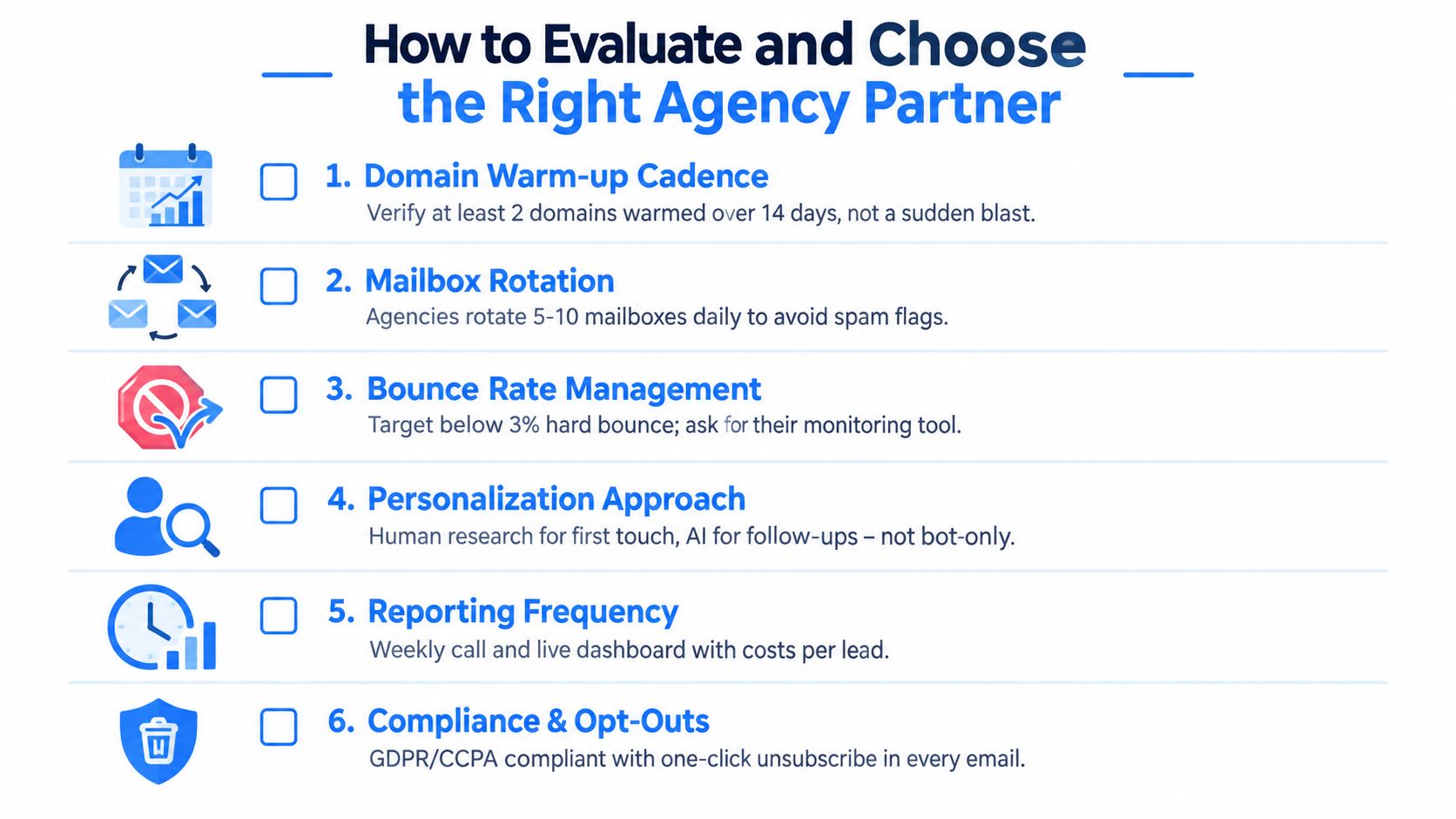
Use one working session to pressure-test every shortlisted agency. Don't start with its logo wall or a polished performance deck. Start with the systems that determine whether your messages reach legitimate prospects.
Ask operational questions first
Request plain-language answers to these questions:
- Domain protection: How are sending domains separated, authenticated, warmed, monitored, and retired?
- Mailbox management: How does the agency distribute sending, handle provider differences, and react to reputation changes?
- Bounce control: What happens to hard bounces, risky records, role-based addresses, and repeated failures?
- Suppression logic: How are current customers, competitors, unsubscribes, prior contacts, and unsuitable accounts excluded?
- Reply ownership: Who reads replies, during which hours, and how are ambiguous responses escalated?
- Compliance: How are opt-outs, regional requirements, lawful outreach, and data retention handled?
A credible answer should describe a repeatable process, not just name a platform. Tools such as HubSpot, Salesforce, Outreach, Instantly, Clay, and Lemlist can support execution, but software doesn't prove that the operator knows how to use it responsibly.
Inspect evidence, not promises
Ask for two unedited sequence samples and the reasoning behind the ICP. You should be able to see how the agency moves from account selection to message angle, follow-up, and qualification. If every sample uses the same structure, vague pain points, and interchangeable proof, the vendor is probably applying a template rather than developing a campaign.
Named case studies can help, but ask the agency to defend the figures on a call. Request reply-rate, meeting, attendance, and pipeline context, along with the campaign period and target market. Don't accept a screenshot with no definitions.
Data sourcing deserves the same scrutiny. If an agency uses phone research, address verification, or enrichment, you can compare skip tracing services to understand what the underlying data process may involve. That doesn't make every skip-tracing tool suitable for B2B outreach, but it helps you distinguish verified research from unsupported database claims.
Finally, review the contract. Look for replacement language, guarantees, cancellation terms, kill fees, ownership of domains and data, reporting access, and the process for ending campaigns. A practical cold email marketing agency should answer these questions before asking you to sign.
How Lead Printer Delivers and Backs the Results
Lead Printer's operating model centers on deliverability discipline and process visibility. The team sets up dedicated infrastructure, warms domains and mailboxes over time, defines the ICP with the client, and builds prospect data around roles, geography, industry, and account context. Sequences reflect relevant business triggers, then run across email and LinkedIn where appropriate. Performance reviews guide ongoing changes instead of allowing a sequence to run unchanged.
The qualification layer determines whether activity becomes a useful sales opportunity. A reply is not passed through because the prospect shows interest. Lead Printer checks the agreed account and contact criteria, manages inbox conversations, and sends suitable meetings to the client's calendar with context for a productive sales call.
Proof points across different campaign types
Published examples cover different commercial situations:
- Client A: An 18.6% reply rate and 21+ qualified meetings delivered, as reported in Lead Printer's client results.
- Client B: An enterprise deal sourced through the campaign, as described in the agency's client results.
- Client C: 50+ SaaS leads generated, according to the corresponding client example.
These outcomes are examples, not forecasts. Offer strength, market conditions, list quality, messaging, and qualification rules all affect results. A high reply rate can still produce weak commercial value if responses come from unsuitable accounts. A narrower campaign may generate fewer replies while creating better opportunities.
Lead Printer reports broader operating experience of 7.2 million emails and LinkedIn direct messages sent, 32,000 leads generated, and more than 2,500 campaigns delivered, as described in its publisher information. The same information lists Instantly.ai's Certified Lead Generation Expert recognition and Clay.com outbound automation certification.
What the guarantee should mean
The guarantee is tied to qualified leads rather than raw contacts. If a meeting fails to match the agreed ICP, Lead Printer states that it will replace it. That condition gives the buyer a defined remedy instead of treating every booked call as a successful outcome. Weekly reporting shows campaign activity, replies, meetings, qualification status, and pipeline progression, making the agency's contribution easier to review.
The definition of “qualified” must be written before launch. The client still needs accurate positioning, sales availability, timely feedback on meeting quality, and prompt follow-up on opportunities. A guarantee can create accountability for delivery standards. It cannot repair an unclear offer, weak sales handling, or poor inbox placement. Smaller agencies with tighter technical controls may produce fewer booked meetings, yet outperform larger vendors once reply quality and inbox placement are measured.
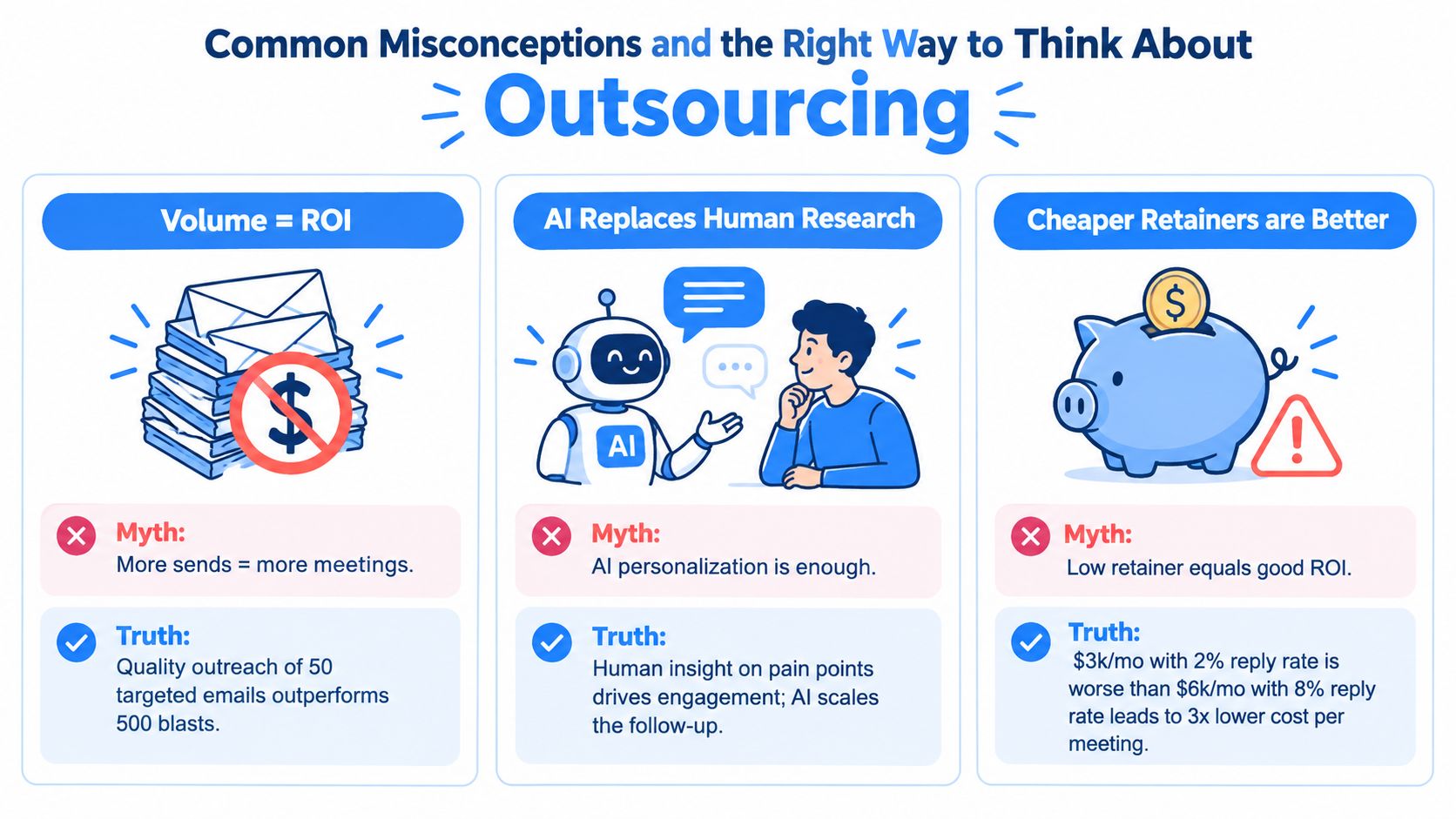
Common Misconceptions and the Right Way to Think About Outsourcing
The first mistake is treating send volume as the main performance indicator. A campaign sending 50,000 emails per month and producing 30 replies is operationally weaker than one sending 5,000 emails and producing 80 replies, even though the first program looks larger in a proposal. Those figures illustrate the principle rather than a benchmark. The meaningful comparison is qualified conversation yield after inbox placement, relevance, and account fit are considered.
The myths that distort buying decisions
Myth one, more emails create more revenue. More volume can multiply poor targeting, complaints, bounces, and wasted sales time. Sender reputation also matters beyond one campaign, so a low-discipline program can make future outreach harder.
Myth two, AI personalization replaces research. AI can help classify accounts, draft variations, summarize research, and manage follow-up. It can't reliably decide whether a company is a genuine ICP fit, whether a claim is accurate, or whether a reply contains a buying signal without human review and clear rules.
Myth three, a cheap retainer produces better ROI. A low fee paired with weak placement, generic copy, and poor qualification can cost more than a higher fee attached to a controlled process. Compare the cost per qualified meeting and the sales effort required, not the monthly invoice in isolation.
A five-point decision framework
Before signing, ask:
- Can the agency explain its deliverability controls in plain language?
- Can it show how account research changes the message?
- Does it define a qualified meeting and replacement process?
- Will reporting connect replies to held meetings and pipeline?
- Does the contract protect your domains, data, opt-outs, and exit rights?
Outsourcing works when you're hiring a managed process, not purchasing a bag of leads. The agency should own infrastructure, targeting, message iteration, reply handling, and transparent reporting. Your team should own positioning, sales feedback, meeting quality review, and follow-through.
The best buying decision usually favors the partner willing to narrow the audience, slow the sending cadence, explain failures, and change the campaign when evidence demands it. Careful execution beats impressive volume when inbox placement and qualification are measured.
Lead Printer builds and runs outbound email and multichannel campaigns with managed infrastructure, verified prospect research, localized messaging, reply handling, and qualified meeting handoff. Visit Lead Printer to discuss a campaign built around deliverability discipline, transparent reporting, and the accounts your sales team wants to reach.