Most advice about sales leads generating starts with better copy. That advice is incomplete. A polished email can't create pipeline if the message lands in spam, reaches the wrong role, or produces replies from companies sales can't serve.
Modern outbound works more like an operating system than a writing exercise. You need authenticated sending infrastructure, verified prospect data, relevant buying signals, coordinated channels, disciplined testing, and a handoff process that protects lead quality. Email remains a central channel, with 78% of businesses ranking it as their top lead-generation channel in 2026, ahead of referrals at 56% and paid social at 51% (Sopro's lead generation statistics). The opportunity is real, but the execution has become technical.
Building the Outbound Infrastructure
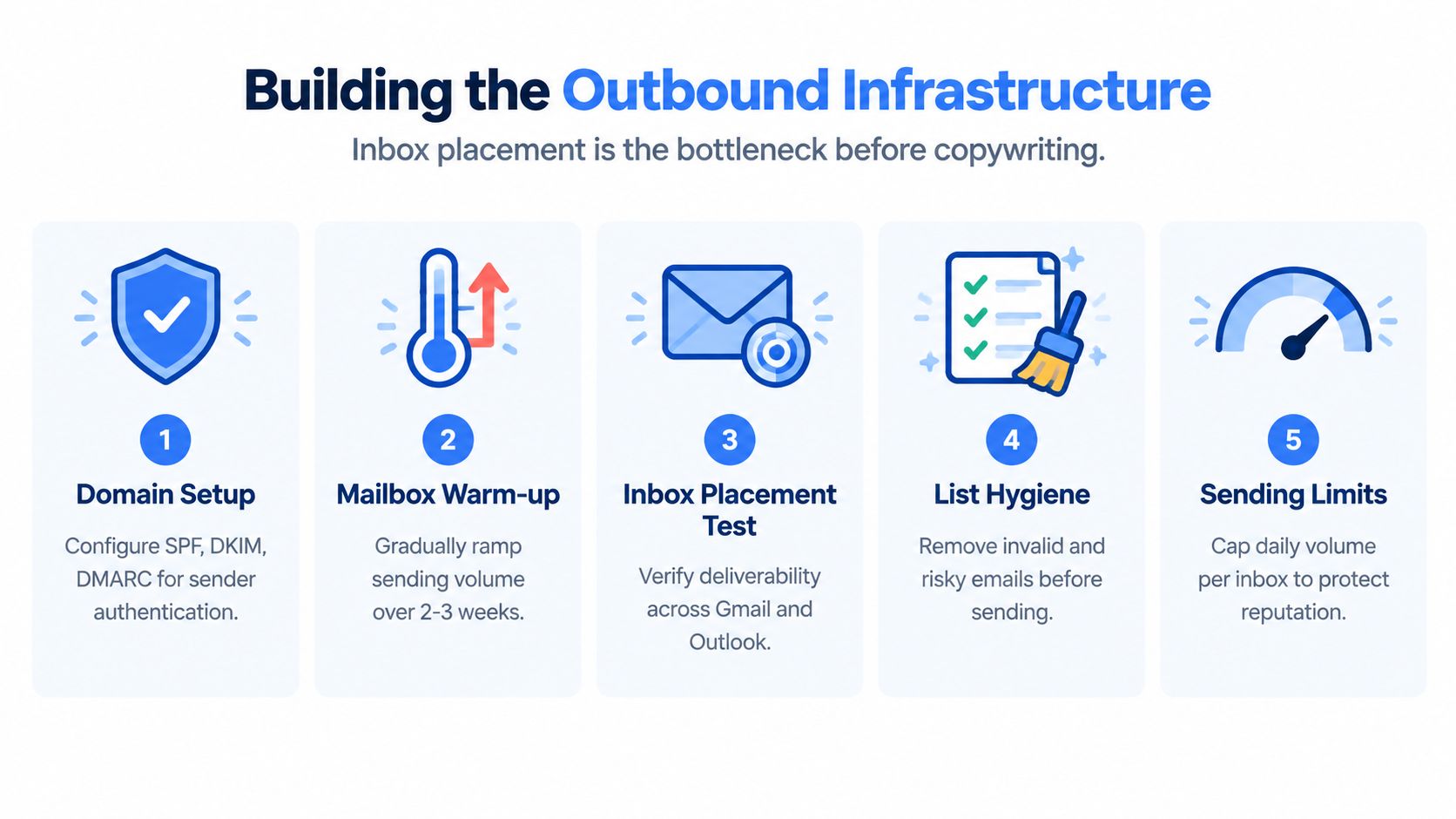
Copy isn't usually the first bottleneck. Inbox placement is. If providers distrust your sending domains or your lists contain risky addresses, a clever subject line won't reach the decision-maker.
Start by separating your corporate communication from outbound infrastructure. Your primary domain carries employee correspondence, customer conversations, invoices, and brand reputation. Outbound mailboxes should operate on secondary sending domains that are clearly related to the business without impersonating the main domain. This separation limits operational risk, but it doesn't excuse poor practices. A secondary domain still needs authentication, careful volume control, list hygiene, and monitoring.
Establish trust before sending
Configure sender authentication through SPF, DKIM, and DMARC. These controls help receiving providers verify that messages are authorized and protect against unauthorized use of your domain. Authentication won't guarantee inbox placement, but missing or misconfigured authentication creates avoidable friction.
Create individual mailboxes rather than relying on a single sender identity. Give each inbox a real profile, consistent signature, and sensible reply handling. Prospects should be able to answer a person, not a faceless campaign address.
Warm each mailbox gradually. A warm-up process should begin with restrained activity and increase only when delivery and engagement remain healthy. The exact pace depends on the provider, domain history, list quality, and campaign pattern, so rigid volume promises are less useful than monitoring. Teams can use a practical guide to warming up an email domain to structure the setup and avoid treating warm-up as a switch that can be turned on.
Monitor what delivery actually means
A delivered message isn't necessarily an inboxed message. A 2025 B2B dataset reported a 1.71% bounce rate and 98.29% delivery, while independent deliverability commentary placed average inbox placement at about 83.5%, meaning roughly one in six delivered emails may still miss the inbox (Belkins' deliverability analysis). Track bounce rate and inbox placement as separate controls.
Use a pre-send checklist:
- Authentication: Confirm SPF, DKIM, and DMARC are configured and passing.
- Mailbox health: Review sender activity, replies, bounces, complaints, and unusual provider warnings.
- List validation: Remove invalid, role-based, disposable, and risky addresses before launch.
- Volume discipline: Set conservative limits per inbox and increase activity only after stable results.
- Opt-out handling: Suppress unsubscribed contacts immediately across every campaign.
Infrastructure also supports broader competitive work. Teams assessing their position before launching outbound can use resources on how to dominate your market in 2026 to connect prospecting priorities with market research. The point isn't to send more. It's to make every sent message technically eligible to be seen.
Researching and Segmenting Your Ideal Customers
Once the sending environment is sound, campaign quality depends on the list. Generic databases produce generic outreach because they flatten meaningful differences between companies, roles, technologies, and buying situations.
A useful ICP has two layers. The first describes the account: industry, geography, business model, technology stack, and organizational shape. The second describes timing and relevance: a new executive, a technology change, expansion into a market, a visible operational problem, or a role that now owns the issue your product solves.
Build segments around buying context
LinkedIn Sales Navigator is useful for filtering roles, companies, industries, locations, and account changes. Custom research can add information that standard databases miss, such as a company's checkout provider, booking software, payment stack, hiring direction, or local footprint. For teams building prospecting workflows at scale, a LinkedIn scraping API can support structured data collection, provided the workflow respects applicable platform rules and privacy obligations.
Don't treat scraped data as verified data. Enrichment should confirm the contact's current role, company association, business email, geography, and fit before the record enters a sequence. A contact who changed jobs may still look valid syntactically while damaging campaign quality and confusing the recipient.
Use precision as the volume strategy
Cold outreach benchmarks show why targeting matters. One 2026 benchmark reported an average reply rate of 3.43%, while another analysis of 1.37 million cold emails cited 2.09% average replies, demonstrating how methodology, list quality, and audience selection affect results (Mailshake's 2026 cold email benchmarks).
Industry differences are equally important:
| Segment | Average reply rate | Positive reply rate |
|---|---|---|
| Consulting and advisory | 4.8% | 2.2% |
| IT and software | 3.9% | 1.7% |
| Financial services | 2.8% | 1.1% |
| Manufacturing and industrial | 2.4% | 1.0% |
These figures don't mean one industry is automatically attractive. They show why campaign reporting needs segment-level detail. A blended result can hide a weak vertical, a poor persona, or an unsuitable trigger.
Create separate campaign cells for each meaningful combination of market, role, pain, and signal. A finance director evaluating payment infrastructure shouldn't receive the same opening as a software founder hiring a sales team. Personalization at scale doesn't mean adding a first name. It means changing the reason for contact.
Practical rule: If you can't explain why this account is relevant now, it doesn't belong in the active sequence.
Crafting Multichannel Outreach Sequences
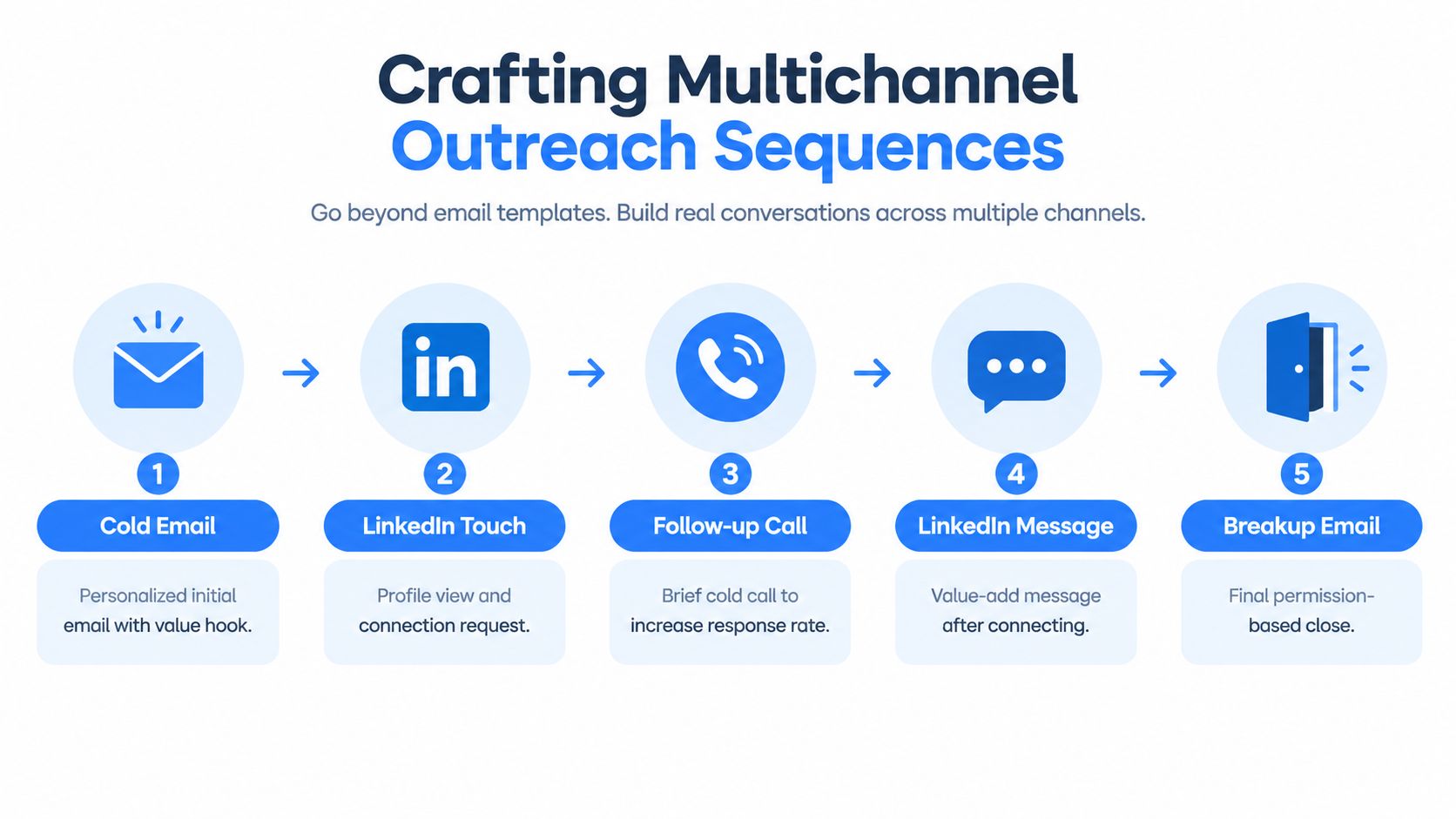
A sequence should feel like a coherent conversation, not five disconnected reminders. Email provides context, LinkedIn can create familiarity, and a phone call can clarify urgency when the account and role justify it. Each touch should add information or offer a useful next step.
Begin with a narrow offer. Avoid introducing every feature. State the problem you believe the prospect may recognize, explain why you contacted that role, and make a small request. The subject line should make the commercial relevance clear without resorting to exaggerated urgency. 77% of B2B buyers say they're more likely to open an email when the subject line is offer-led (Sopro's benchmark reporting).
Design the sequence by purpose
A practical sequence can follow this pattern:
- Initial email: Connect a specific business signal to a concrete problem and offer a focused conversation.
- LinkedIn touch: View the profile or send a relevant connection request without copying the entire pitch.
- Value follow-up: Share a useful observation, short resource, or alternative interpretation of the problem.
- Call attempt: Use the research from the account record to make the call relevant, not random.
- Permission-based close: Give the prospect an easy way to decline, redirect you, or suggest a better contact.
Coordinate channels rather than increasing pressure. If someone replies, stop the automated sequence. If they engage with a LinkedIn post, use that signal to make the next message more contextual. If they don't engage, reduce frequency and avoid repeating the same request.
Keep every channel credible
Phone outreach creates a separate reputation surface. Use a stable business identity, identify yourself clearly, and respect requests not to be contacted. Teams adding SMS or voice workflows should also understand how number history affects trust, including the operational issues covered in this SMS Activate number reputation guide.
Email-only automation often fails because it treats every prospect as equally available and every touch as interchangeable. A coordinated workflow can use cross-channel lead generation to align email, LinkedIn, calls, and relevant nurture rather than forcing one channel to carry the entire campaign.
The sequence should also have a stop condition. A clear opt-out, a negative response, a role mismatch, or a request to contact someone else should update the CRM and suppress future outreach. Persistence is useful only while the contact still has a reasonable opportunity to benefit.
Testing and Localizing Campaigns for Global Markets
Testing and localization solve different problems, but they must work together. Testing identifies which message performs better within a defined audience. Localization makes sure the message means what you intend in that audience's market, language, and commercial context.
Start with one variable. Test the opening hook, offer, call to action, or subject line separately instead of changing everything at once. If the audience, list quality, send window, and sequence also change, you won't know whether the result came from the copy or the operating conditions.
Build a clean testing loop
Use a repeatable process:
- Form a hypothesis: State what you expect to change and why.
- Keep the audience stable: Compare equivalent segments rather than mixing markets or roles.
- Choose a primary outcome: Positive replies or qualified meetings are more useful than opens.
- Record operational factors: Note mailbox, domain, send window, list source, and suppression behavior.
- Make one decision: Keep, revise, pause, or retarget the campaign based on the evidence.
Open rates deserve caution because Apple Mail Privacy Protection can inflate them. Reply behavior, positive intent, accepted meetings, and pipeline contribution provide stronger signals. A campaign with more opens but no meaningful conversations isn't a successful test.
Localize the operating details
US, UK, and EU prospects may share a business language while responding to different levels of directness, formality, proof, and risk. A message written for a US sales leader may sound too aggressive to a UK operations director. An EU campaign may also require closer review of lawful basis, transparency, data source, retention, and opt-out handling.
Localization should change more than spelling. Review:
- Role vocabulary: Use the title and responsibility terms familiar in that market.
- Commercial framing: Adjust the problem statement to local purchasing norms and business priorities.
- Proof format: Present relevant references and product language without implying unsupported results.
- Timing: Account for local working patterns and holidays.
- Compliance copy: Make identity, purpose, and opt-out instructions clear.
Keep the data model consistent across regions, but maintain separate message variants and suppression lists. This lets a team compare performance without allowing a poorly localized campaign in one market to contaminate the reputation or learnings of another.
Qualifying Leads and Managing the Handoff
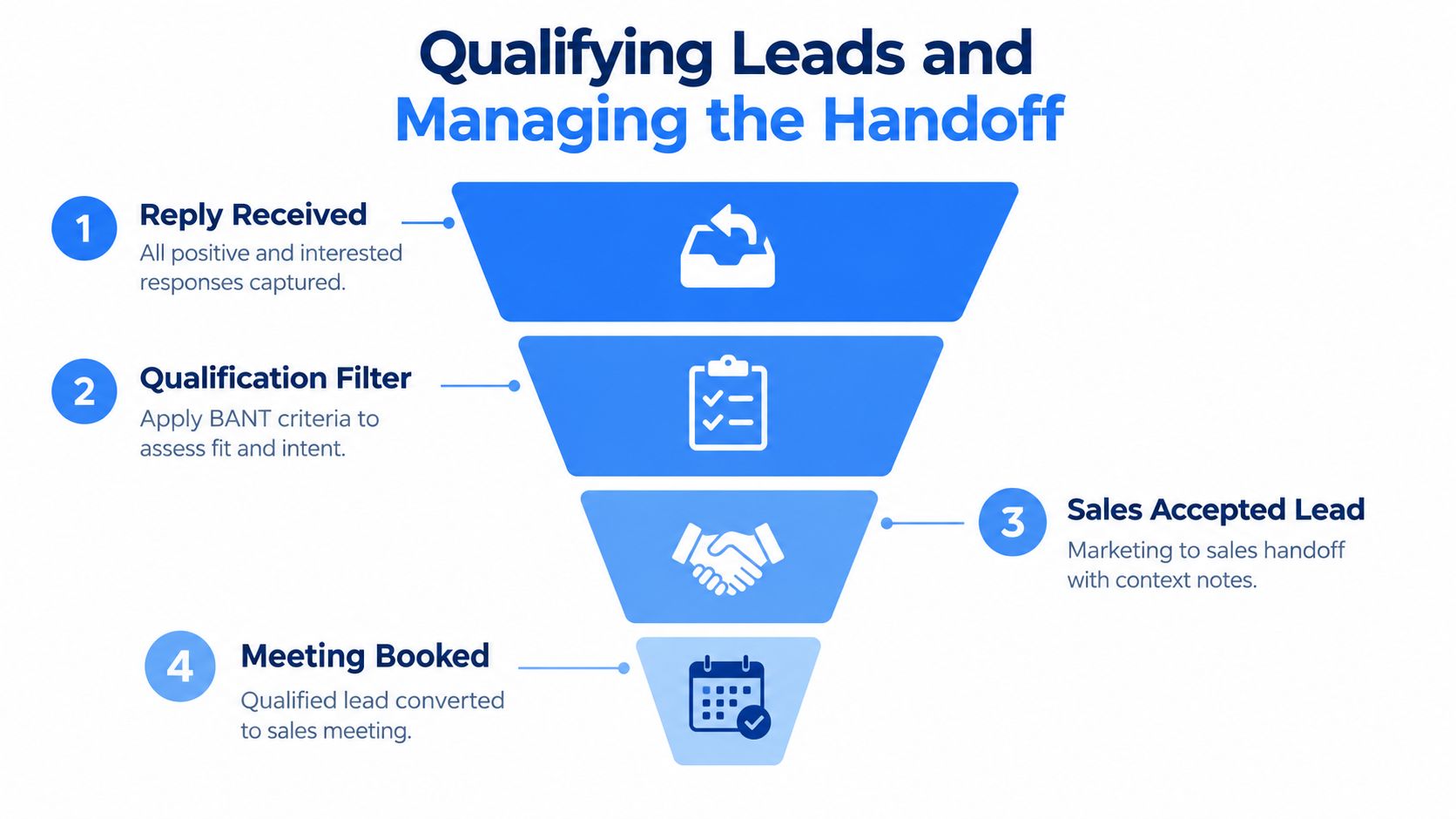
A reply isn't automatically a sales lead. It may be a polite decline, a request for information, a student inquiry, a competitor, an unqualified company, or a referral to someone else. Counting every response as pipeline encourages marketing to optimize for inbox activity while sales absorbs the waste.
The readiness problem is visible in the funnel. Independent 2026 data reported a median B2B cost per lead of $213, an average lead-to-customer conversion rate of 0.94%, and an MQL-to-SQL rate of 9.8% (Digital Applied's 2026 lead generation data). Those figures point to leakage after capture. More names won't solve a process that sales doesn't trust.
Apply a consistent qualification filter
Use a simple framework such as BANT, but don't turn it into an interrogation. A useful first response should establish enough context to decide whether a conversation is worthwhile:
- Budget: Is there a realistic commercial path to purchase?
- Authority: Does the contact own the decision, influence it, or know who does?
- Need: Does the stated problem match the solution?
- Timing: Is there an active project, trigger, or evaluation window?
Add fit and intent to the record. Fit describes whether the account belongs in the ICP. Intent describes whether the contact has shown a reason to act now. A prospect can be a strong account fit without being meeting-ready.
Teams that need a clearer operating definition can use this guide to understand lead qualification, then adapt the criteria to their sales cycle and average deal complexity.
Protect the handoff
The sales representative should receive the original reply, account research, trigger, campaign variant, qualification notes, objections, and the agreed next step. Never send a bare calendar link and expect the account executive to reconstruct the conversation.
If a prospect asks a question, answer it before pushing for a meeting. If they request another stakeholder, update ownership immediately. If they aren't ready, place them into a relevant nurture path rather than forcing a sales call. Lead readiness is a shared operating standard, not a label marketing applies at the end of a campaign.
Measuring Success with Outbound Benchmarks
Open rates no longer deserve to sit at the center of outbound reporting. Apple Mail Privacy Protection makes that metric difficult to interpret, while low reply rates mean a campaign can appear active without producing commercial intent. The reporting model should follow the business outcome, from message delivery through qualified pipeline.
A useful hierarchy separates diagnostic metrics from decision metrics:
- Infrastructure metrics: Bounce rate, inbox placement, authentication health, complaints, and unsubscribe behavior.
- Engagement metrics: Replies, positive replies, negative replies, referrals, and requests for information.
- Sales metrics: Sales-accepted leads, meetings booked, meetings held, opportunities created, and pipeline contribution.
- Efficiency metrics: Time spent per qualified opportunity, cost by segment, and revenue influence.
The operational benchmarks support a precision-first approach. Across 2025 and 2026 datasets, average cold email reply rates cluster around 3.43% to 5.1%, while tightly segmented campaigns can reach 10% to 15% or more when the ICP, hook, and follow-up discipline are strong (SalesHive's B2B outreach practices). These are benchmarks, not promises. They become useful only when you compare equivalent segments and preserve the definitions behind each metric.
2026 Outbound Performance Benchmarks
| Industry | Average Reply Rate | Positive Reply Rate |
|---|---|---|
| Consulting and advisory | 4.8% | 2.2% |
| IT and software | 3.9% | 1.7% |
| Financial services | 2.8% | 1.1% |
| Manufacturing and industrial | 2.4% | 1.0% |
Use the table as a diagnostic starting point, not a target detached from context. A campaign below 2% response is generally a signal to investigate targeting or deliverability before rewriting every sentence, while reallocating volume should wait until positive reply rate clears about 5% (SalesHive's outbound benchmark methodology). The right intervention depends on where the failure occurs.
Measurement rule: Fix the earliest broken stage first. A copy rewrite can't compensate for inbox failure, and more sending can't compensate for a poor ICP.
If bounces rise, pause and validate the list. If delivery looks healthy but replies remain weak, examine role fit, trigger quality, offer relevance, and sequence design. If replies are strong but meetings are poor, qualification or calendar handling is leaking value. If meetings happen but opportunities don't progress, sales acceptance, positioning, or account selection needs review.
Reporting should also preserve regional and segment detail. Combine US, UK, and EU results only after reviewing each market's deliverability, language, role distribution, and response behavior. A single blended dashboard may look efficient while hiding the exact segment that is creating or destroying pipeline.
Lead Printer builds and runs data-driven email and multichannel campaigns, covering infrastructure, prospect research, personalization, qualification, and CRM handoff for B2B teams across the US, UK, and EU. If your team needs a more disciplined sales leads generating system, visit Lead Printer to discuss a campaign built around inbox placement, buying signals, and meeting-ready opportunities.