Your pipeline is light, the board wants answers, and hiring another SDR won't fix next quarter. That's the moment most founders start looking at an outsourced sales team. Some do it because they need speed. Others do it because they're tired of spending months recruiting, onboarding, and managing reps before a single real meeting shows up.
My advice is simple. Don't treat outsourced sales as a hiring shortcut. Treat it as an operating-model decision.
That distinction matters. If you buy “appointments” like a commodity, you'll probably get a calendar full of weak meetings, noisy reporting, and a vendor that blames your market. If you build the right operating model with the provider, you can get a disciplined outbound function running faster than an internal build. By 2025, about 68% of B2B companies were reported to use some form of sales outsourcing, up from 55% two years earlier, and outsourced programs are often described as launching outbound in about 30 days or less, compared with roughly 12 to 20 weeks to hire and ramp internal SDRs according to SalesHive's outsourced sales team overview.
That speed is real. The catch is that speed only helps if the program is built on clear ownership, sharp messaging, and weekly decisions from your side.
What an Outsourced Sales Team Actually Does
A founder who is two quarters behind on pipeline usually wants one thing. More meetings, fast.
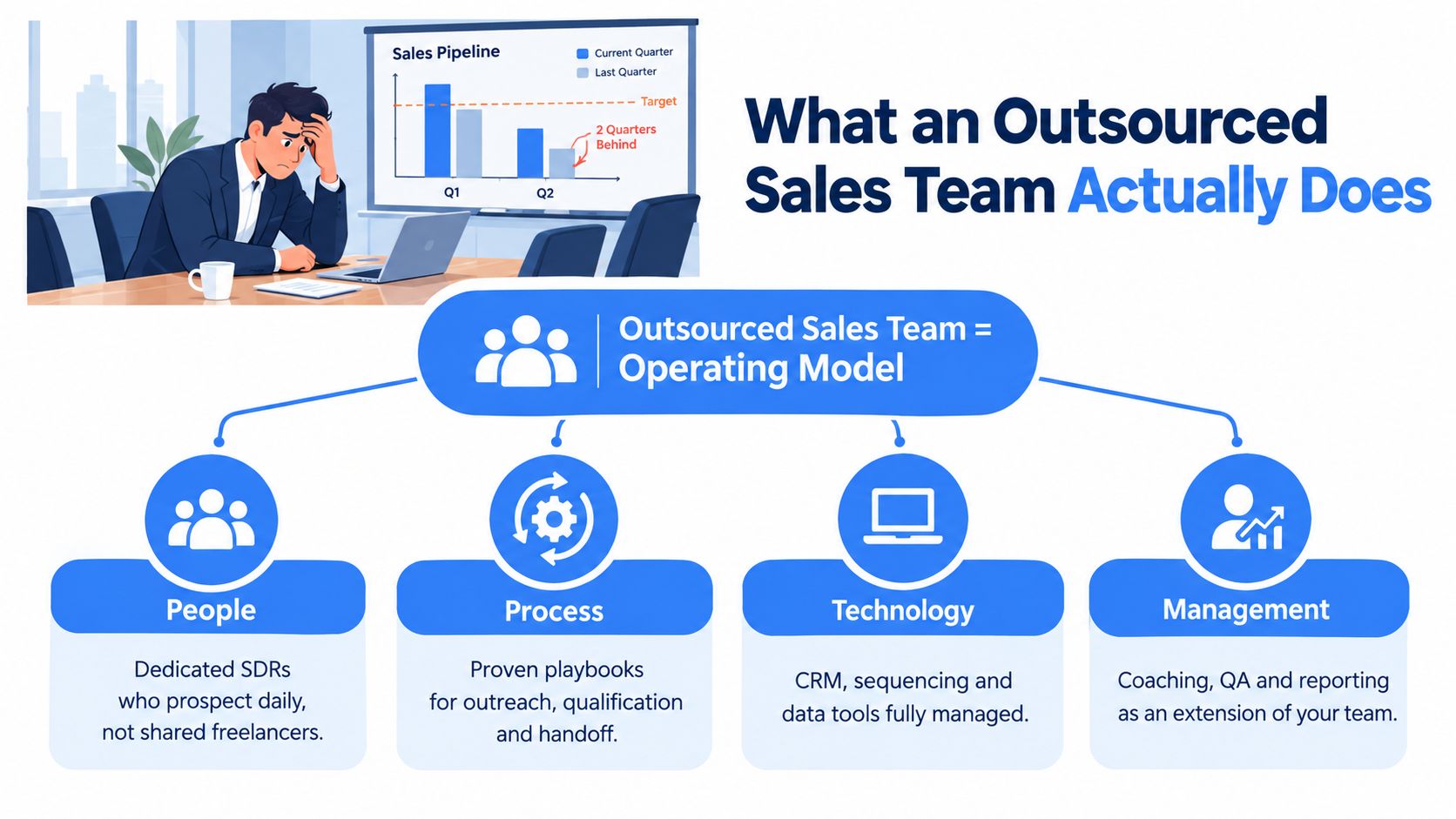
That urgency is fair, but it leads to bad buying decisions. An outsourced sales team isn't just “someone else doing prospecting.” It's a working system made up of people, process, tech, and management that runs outbound on your behalf under your brand.
The provider's real job
A credible outsourced team usually handles four core functions:
- List building and account selection. They source target accounts, find relevant contacts, and structure lists by role, segment, geography, or buying trigger.
- Outbound sequencing. They write and run the email, LinkedIn, and sometimes calling sequences that start conversations. If you need a refresher on what strong outbound messaging looks like, this cold email guide is a useful baseline.
- Live calling and qualification. They don't just send emails and hope. Good teams call, qualify interest, handle first-line objections, and sort curiosity from buying intent.
- Meeting handoff with notes. They book the meeting and pass context into your CRM or calendar. That handoff should include pain points, current setup, role seniority, and why the prospect agreed to talk.
If a provider can't explain those four jobs clearly, you're not buying a team. You're buying activity.
What you still own
Founders get lazy, then blame the agency.
You still own three non-delegable inputs:
- ICP definition. Not a giant list. A real ideal customer profile with exclusions.
- Offer positioning. Why now, why you, why this matters to the buyer.
- Discovery support for the closer. Your AE or founder still has to run a serious discovery call and convert interest into pipeline.
Practical rule: If you can't explain your ideal buyer, core pain, and strongest proof points in one page, an outsourced team won't rescue you.
Team versus freelancer
A true outsourced sales team is not the same as a solo freelance SDR. It's also not a marketplace broker that tosses leads over a wall.
A real team gives you dedicated reps, a managed workflow, QA, reporting, and accountability. That's much closer to a structured appointment-setting model like B2B appointment setting services, where outreach, qualification, and meeting handoff are coordinated as one system.
The output you should expect is not “leads.” It's qualified sales meetings that your closer can take seriously. If the result is just a contact list or vague interest, the model is broken.
Outsourced Sales Team vs In-House SDRs
Your founder wants pipeline this quarter. Your sales lead wants tighter message control. Finance wants to avoid another full-time hire that takes months to ramp. That is the decision.
This is an operating-model choice. Pick the wrong model and you create drag in management, reporting, and handoff quality long before you see a meeting problem.
The four common options
An in-house SDR setup gives you the most direct oversight, but it also asks for the most internal support. Hiring, onboarding, coaching, list building, tooling, and daily supervision stay on your side.
An outsourced setup shifts execution outside your company, not ownership of the result. You still need someone internally to own ICP, approve messaging, review call quality, and decide what counts as a qualified meeting. Without that owner, outsourced sales turns into outsourced activity.
Here is how the common models differ:
| Model | Time to Launch | Internal Management Load | Control Over Messaging | Best For |
|---|---|---|---|---|
| Agency-led outbound | Fast | Medium | Medium | Companies that need coverage quickly and want the provider to run day-to-day execution |
| Fractional SDR pod | Fast | Low to medium | Low to medium | Teams testing a segment, offer, or geography before building a larger motion |
| Embedded SDRs | Moderate | Medium to high | High | Firms that want dedicated outbound capacity with tighter process and brand control |
| In-house SDR | Slow | High | Very high | Companies with a stable playbook, active coaching, and patience to build internally |
What each model is actually buying you
Agency-led outbound buys speed. It works best when your offer is already clear and your team can judge quality fast. If messaging is still changing every week, agency output will swing with it.
Fractional SDR pods buy cheap experimentation. They are useful for market tests, but shared attention usually means weaker account depth, slower feedback loops, and less message precision.
Embedded SDRs are usually the best middle ground. You get dedicated capacity without adding payroll, but this only works if your team treats the provider like part of the sales floor, not a vendor that gets ignored after kickoff.
In-house SDRs buy control and institutional learning. They make sense once you already know the motion works and have a manager who can coach consistently.
Compare providers against an SDR agency operating model and ask a harder question than price: who on your team will own message quality, qualification standards, and weekly performance decisions?
The real trade-off
Founders often frame this as cost versus quality. That is too shallow.
The trade-off is control versus management load. In-house gives you tighter control, but you pay for it in hiring time, coaching effort, and slower ramp. Outsourced gets you to market faster, but only if you keep strong internal ownership over the parts that determine conversion.
If you want a clear recommendation, use this rule:
- Choose in-house SDRs when outbound is already proven and you have management capacity.
- Choose an outsourced sales team when you need speed, want to test or expand, and can assign one internal owner with authority to steer the program.
If nobody inside your company owns the system, do not outsource yet. Fix that first.
How Much an Outsourced Sales Team Costs
A founder signs a $9,000 monthly outsourced SDR contract, books a healthy number of meetings in month one, and still sees almost no pipeline. The mistake was not the provider alone. The company bought activity without defining the operating model behind it.
That is how you should price outsourced sales. Start with the revenue motion you need, then judge whether the provider's cost matches the level of execution and internal involvement required.
The pricing models you'll see
You will usually get one of four commercial models:
- Flat retainer for a fixed scope or dedicated capacity
- Retainer plus per-meeting fee
- Pay-per-meeting
- Hybrid pricing based on region, channels, targeting complexity, or qualification depth
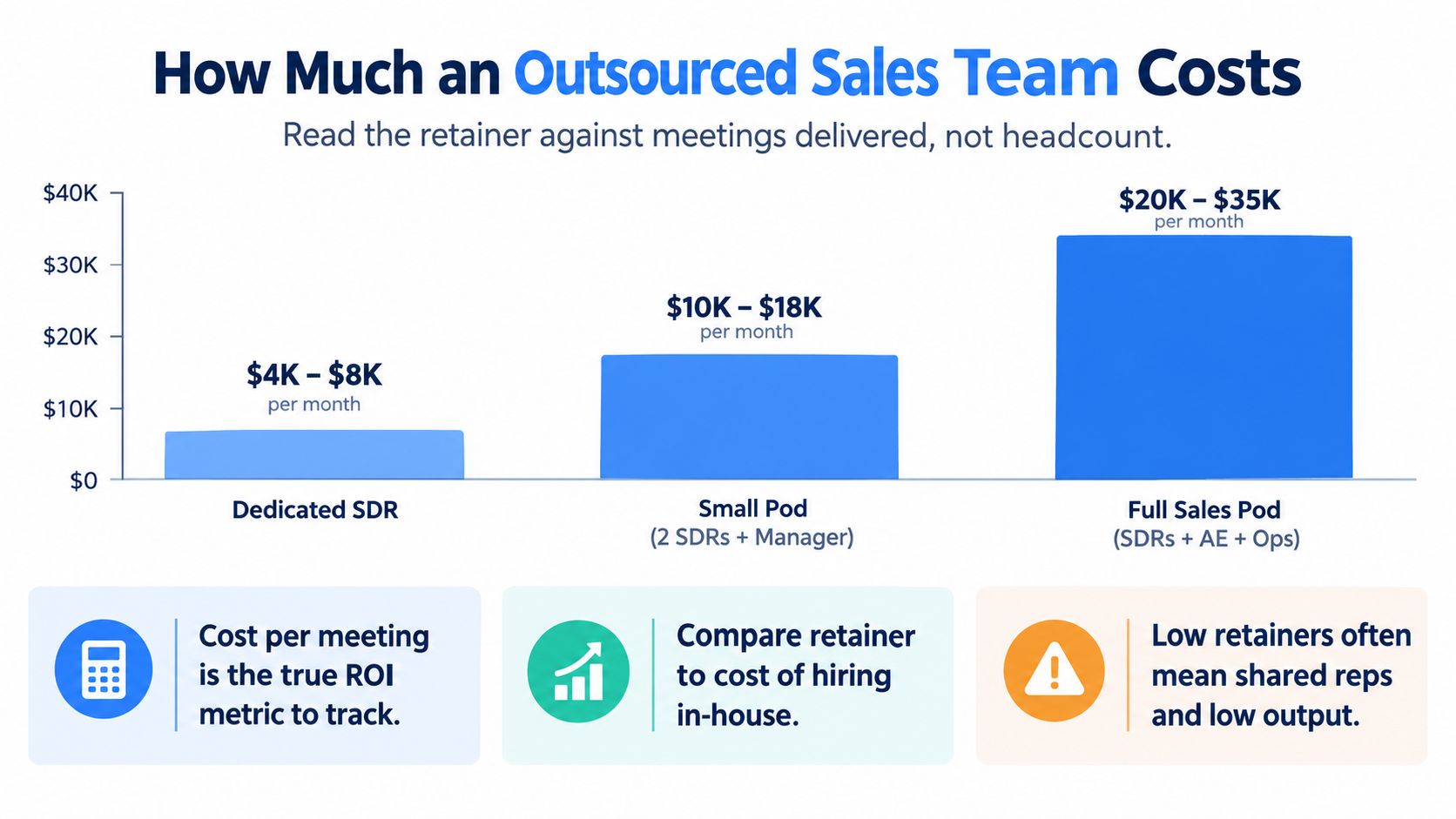
In practical terms, lighter prospecting support sits at the low end, while a dedicated SDR or multi-person pod sits higher. Full outsourced sales coverage often lands somewhere in the mid four figures to low five figures per month, depending on list building, copy, tooling, management, and reporting.
That range matters less than founders think.
The cost driver is not title count. It is how much work the provider is taking on, and how much your team still needs to own. A cheap retainer with weak targeting, shared rep capacity, and thin reporting usually costs more than a higher retainer tied to strict qualification and weekly optimization.
How to read the retainer correctly
Use one formula first: monthly fee divided by qualified meetings delivered.
Then pressure test it with a second question. How many of those meetings turn into real pipeline?
That second step is where buyers get lazy. Calendar volume is easy to celebrate. Pipeline creation is what pays for the program.
This is the same mistake companies make in other outsourced functions. Scope, internal ownership, and reporting discipline shape the bill more than job titles do. If you want a useful comparison point, this breakdown of outsource data analytics costs shows the same pattern clearly.
Here's the rule I give founders. Price outsourced sales like an operating system, not a staffing line.
If the provider is sourcing data, writing copy, running outreach, qualifying replies, booking meetings, and feeding insight back into your GTM team, the fee should be higher. If they are only supplying outbound labor against your lists and messaging, the fee should be lower. Confusing those two models leads to bad vendor selection.
Cheap meetings are expensive when AEs spend time on accounts that were never a fit, never had intent, or never matched your qualification standard.
Pay-per-meeting pricing deserves extra skepticism. It sounds aligned, but it often rewards the wrong behavior. If the provider gets paid when something hits the calendar, they have an incentive to lower the bar unless your contract closes that loophole.
What to ask before you sign
Get these answers in writing before procurement starts:
- What exactly counts as a qualified meeting?
- Who owns list quality, suppression rules, and territory exclusions?
- What notes, context, and qualification fields are attached to each handoff?
- How do you treat no-shows, reschedules, and bad-fit meetings?
- What reporting connects meetings to opportunities and pipeline value?
- Who on our side is expected to review messaging, call notes, and weekly performance decisions?
That last question gets missed all the time. It should not. Outsourced sales underperforms when the client expects the vendor to own strategy, qualification policy, and message correction without active internal leadership.
For buyers who want a quick visual explanation before negotiating scope, this short video is worth watching.
Use a blunt standard. Judge the program on cost per qualified meeting, meeting-to-pipeline conversion, and the amount of management work your team must still supply to keep quality high. That is the actual price.
Why Outsourced Sales Programs Fail
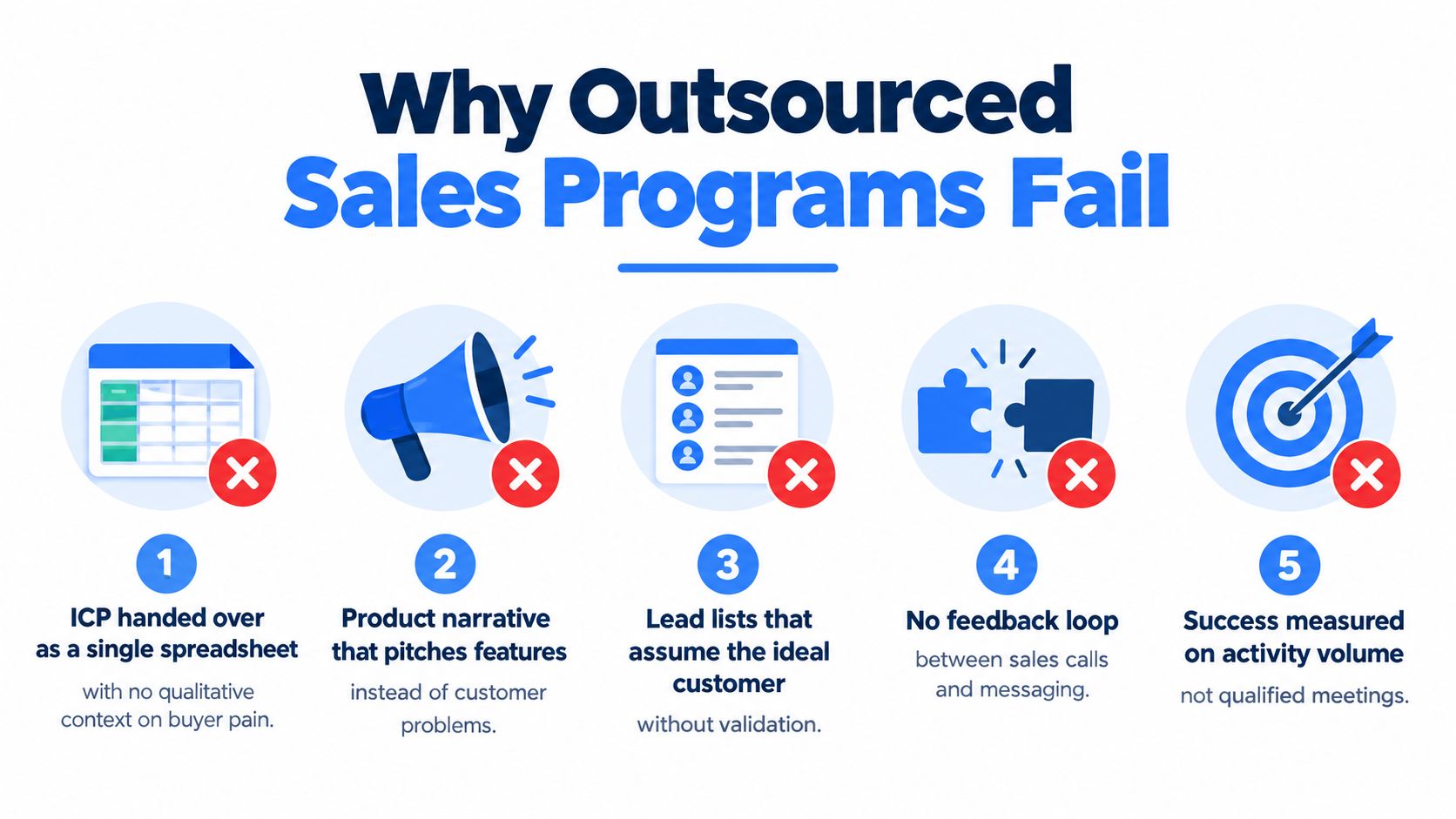
Most failed outsourced sales programs don't collapse because reps can't sell. They collapse because the operating model is weak.
That's the pattern that gets ignored. Industry coverage repeatedly points to misaligned goals, communication gaps, integration problems, weak brand knowledge, and turnover as core failure points. The same coverage also notes growing AI adoption, with one market report saying 83% of outsourcing leaders are integrating AI into service delivery and another noting more than 71% of leading outsourced sales providers expanded AI-driven prospecting in 2025, according to Outsource Accelerator's analysis of outsourcing sales challenges.
The client-side mistakes that kill performance
The ugly truth is that clients usually underfeed the program.
Common examples:
- A thin ICP handoff. You hand over a spreadsheet of accounts with no context on who buys, why they buy, or who should be excluded.
- Feature-heavy messaging. The script pitches product capabilities instead of buyer problems.
- Bad assumptions about data. You expect the provider to magically know your installed base, partner conflicts, blocked accounts, or dead segments.
- No internal owner. Nobody on your side can approve messaging, review calls, or decide what changes this week.
A SaaS founder will blame the SDR for low connect rates, while the gatekeeper script is still untested. A manufacturer will expect fast meetings from a list that hasn't been filtered against existing customers or distributors. That isn't a vendor failure first. It's an input failure.
What must exist before launch
You need operational basics in place:
- One accountable owner on your side
- A living messaging document with objections and proof points
- CRM hygiene so reps aren't working junk records
- Weekly feedback loops tied to real conversations
Outsourced programs fail less from bad effort and more from bad governance.
If you want the provider to sound like part of your team, you have to give them the material and decision access to do that. Otherwise they become disconnected appointment setters who generate noise and call it output.
A 30-Day Onboarding Playbook
You sign the outsourced sales contract on Monday. By Friday, the provider is asking for target accounts, call scripts, CRM access, product proof, and meeting rules. If your team cannot supply those fast, the issue is not onboarding speed. It is that you treated outsourcing like a hiring shortcut instead of an operating model with shared ownership.
A good first month has one job: get the provider productive without letting them invent your market strategy for you. Fast launch matters. Control matters more.
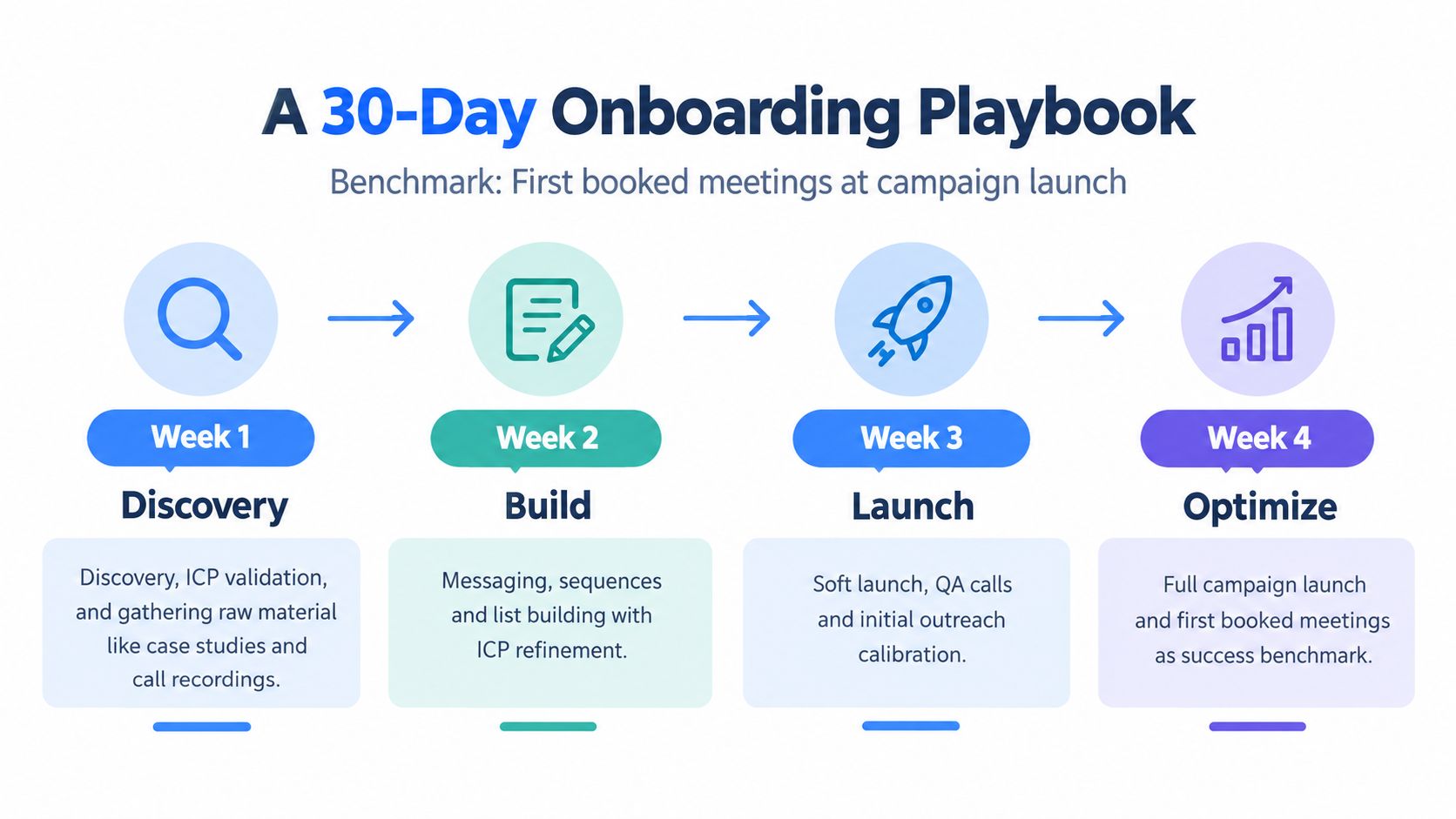
Week 1 discovery and ICP validation
Week 1 is for market transfer. Your provider needs enough context to speak like a trained rep, not a rented caller.
Give them the raw inputs: customer examples, objection handling, competitor differences, lost-deal reasons, disqualification rules, and the buying triggers that create urgency. If those materials are weak, fix them now. Bad inputs in week 1 turn into bad meetings in week 4.
The founder or sales leader should approve the ICP in this first week. That means named segments, account exclusions, buyer roles, and territory rules. Do not delegate this to a junior marketer or let the provider guess.
Week 2 messaging and list build
Week 2 turns strategy into execution. The provider drafts sequences, builds lists, and maps contacts across the buying committee.
Run two review passes. The first checks factual accuracy. The second checks whether the message creates enough commercial tension to earn a reply. If the copy sounds polished but soft, rewrite it.
Keep approval tight. One owner on your side should clear messaging, reject weak lists, and decide what changes now versus later.
If your team wants a simple reference for documenting repeatable onboarding steps, this guide on how to find the onboarding playbook is a helpful operational example.
Week 3 pilot sends and call QA
Week 3 is a controlled test, not a full rollout.
Launch in small batches and inspect what comes back. Look at reply quality, role fit, early call recordings, and meeting acceptance. You are checking whether the provider understood the assignment and whether your internal assumptions were right in the first place.
Three review questions matter here:
- Are the right accounts and titles in the sequence?
- Do replies show buyer interest, confusion, or indifference?
- Can an AE use the call notes without asking for missing context?
If the answers are weak, fix targeting or messaging before adding volume. More activity will not rescue a flawed setup.
Week 4 launch and early optimization
By week 4, you should be ready for a wider launch because the operating model is in place. The provider knows who to contact, what to say, how to qualify interest, and how to hand meetings over. Your team knows who approves changes and how fast decisions get made.
Judge the launch by meeting quality and handoff quality. A calendar full of low-fit meetings is not traction. It is cleanup work for your closers.
Use this checklist:
- Approve the ICP with clear inclusion and exclusion rules
- Approve outreach copy before higher-volume sends
- Spot-check early account lists
- Review first meetings for qualification and note quality
- Hold one weekly decision meeting with the internal owner and provider lead
Skip those steps and the vendor will still start outreach. You will just spend the next month correcting preventable errors while paying for the privilege.
KPIs and Reporting That Matter
Most outsourced sales reports are padded with activity. Emails sent. Calls dialed. Tasks completed. None of that tells you whether the program is working.
A useful dashboard separates leading indicators from lagging business outcomes.
Track signals, not noise
In the first stretch of a campaign, the leading indicators matter most:
- Connect rate
- Conversation rate
- Reply sentiment
- Meetings held relative to outreach effort
Later, the lagging metrics decide whether the program deserves to stay:
- Qualified pipeline generated
- Cost per qualified meeting
- Sales-cycle conversion from meeting to opportunity
The provider may try to lead with volume because volume is easy to inflate. Don't let them.
Board-level question: Did the program create qualified meetings that moved into pipeline, and what corrective action are we taking this week?
A reporting cadence that forces accountability
Use a simple cadence:
| Metric | Type | Target Benchmark | Review Cadence |
|---|---|---|---|
| Connect rate | Leading | Set by your baseline after first campaign batches | Daily in the first two weeks, then weekly |
| Conversation rate | Leading | Set by your early calling data | Daily in the first two weeks, then weekly |
| Reply sentiment | Leading | More positive and relevant over time | Weekly |
| Meetings held | Leading to lagging | Trend should improve as targeting sharpens | Weekly |
| Qualified meetings | Lagging | Must align with sales acceptance criteria | Weekly and monthly |
| Pipeline value created | Lagging | Must be visible by source and owner | Monthly |
| Cost per qualified meeting | Lagging | Must improve or justify current spend | Monthly |
One dashboard view only
Your dashboard should show four things on one screen:
- Meetings held
- Qualified meetings
- Pipeline created
- Cost per meeting
If those metrics live in different systems and nobody reconciles them, reporting will drift into storytelling. Keep qualification criteria tight and documented. If you need a clean framework for that definition, this breakdown of what lead qualification means is the standard to align around.
Every KPI conversation should end with a decision. Change the list, tighten the script, revise the opener, or rework qualification. If no action follows the metric review, the meeting was just theater.
When an Outsourced Sales Team Is the Right Move
An outsourced sales team is the right move when you need pipeline before you can reasonably build headcount, and when your internal team can support the operating model without pretending the vendor will figure everything out.
I use a four-question filter.
Question one is time pressure
If you need pipeline movement quickly, outsourcing becomes attractive. Internal hiring is slower by nature. Recruiting, onboarding, tool setup, and coaching all take time. If you're under pressure this quarter, speed matters.
If time pressure is low, internal build becomes more defensible. You can afford to recruit carefully and train for your exact sales motion.
Question two is process maturity
This is the biggest one.
If your CRM is messy, your ICP is fuzzy, and your messaging changes every week, outsourced execution will amplify that confusion. The provider can't manufacture clarity. They can only execute against what you give them.
If your process is reasonably stable, outsourcing works far better. You don't need perfection. You need enough consistency to support targeting, qualification, and feedback.
Question three is deal complexity
Outsourced teams fit some sales motions better than others.
A B2B SaaS company trying to generate steady discovery calls for a defined buyer can often outsource effectively. An ecommerce brand entering a new region can also use outsourced outbound to test demand and local messaging. A mid-market manufacturer targeting distributors can make it work too, but only if product fit, territory rules, and account exclusions are documented tightly.
What doesn't fit well is a sale that depends on deep technical diagnosis in the first touch. In those cases, a hybrid model usually wins. Let the outsourced team open doors and qualify basics. Let your internal experts run the technical conversation.
Question four is commitment
A serious outbound program needs enough time to stabilize. If you're not willing to support the program for a meaningful stretch, don't start. You'll confuse setup time with failure and pull the plug before the system settles.
Don't outsource sales because you want less responsibility. Outsource because you want faster execution inside a model you're still prepared to manage.
Three decision scenarios
- B2B SaaS scale-up: Strong fit for outsourcing if the buyer persona is defined and the founder can approve messaging quickly. Best choice is often embedded reps or an agency-led outbound team.
- Ecommerce brand entering a new region: Good use case for a fractional pod or agency-led model to test segments and messaging without building local headcount first.
- Mid-market manufacturer: Works if product lines, territories, channel conflicts, and exclusions are documented. If not, hire internally or use a tightly managed hybrid.
Red flags that should end the sales call
Walk away if the vendor:
- Won't share activity data
- Talks only about rep count instead of meeting quality
- Pushes full payment upfront
- Can't name reference customers in your ACV band
- Avoids discussing your internal responsibilities
- Promises results without asking hard questions about ICP, CRM, and offer
That last one matters most. A good provider should make you slightly uncomfortable in the sales process. They should ask for ownership, access, exclusions, call reviews, and message approval. If they don't, they're probably selling volume, not outcomes.
Lead Printer offers a practical version of this model for B2B teams that need outbound execution without building the whole function in-house. It handles prospect research, multichannel outreach, qualification, and handoff so your closers can focus on real sales conversations. If that's the gap you're trying to solve, visit Lead Printer.