
Some weeks your pipeline looks healthy on paper, but the calendar tells a different story. Inbound slowed down, account executives are spending prime selling hours chasing cold prospects, and every forecast call turns into the same debate about coverage. You know outbound should help. What's less clear is whether hiring internally, finding a freelancer, or bringing in an SDR agency will fix the problem.
That's where teams often get stuck. They search for an SDR agency expecting a simple answer, then run into vague promises about meetings booked, emails sent, and “full-funnel growth.” The problem is that modern outbound isn't just a people question anymore. It's also an infrastructure question, a data question, and a handoff question.
A bad outbound setup is like putting a strong sales rep in a car with no fuel gauge and a clogged fuel line. The rep may work hard, but the system keeps failing underneath them. That's why evaluating an SDR agency only by activity volume misses the issue. If messages don't land in the inbox, if targeting is sloppy, or if booked meetings arrive without context, the visible activity hides weak pipeline economics.
This matters more now because outbound has become more operationally demanding. Authentication, sending ramp, complaint control, list quality, and AI-assisted research all shape whether outreach creates real opportunities or just burns domains and budgets.
The useful question isn't “What is an SDR agency?” by itself.
It's “What does an SDR agency run, what should I expect it to own, and when is that model worth paying for?”
Introduction Why Pipeline Stalls Without Consistent Outbound
A familiar B2B scenario goes like this. Marketing produces a burst of demo requests after a launch, webinar, or partner push. Sales gets optimistic. Then the burst fades, open opportunities age, and the team starts depending on a few large deals to save the quarter.
At that point, leaders usually try one of three things. They ask AEs to prospect more, they hire a junior SDR, or they start talking to outsourced providers. The first option steals time from closing. The second takes time to recruit, onboard, and manage. The third sounds faster, but it often raises a different worry: will an external team create qualified meetings, or just inflate activity?
A lot of confusion comes from how broad the term has become. Some providers are basically appointment setters. Others are lead list vendors wearing an agency label. The stronger firms operate more like an outbound production system. They handle the technical setup, prospect research, copy, sequencing, inbox management, and the handoff into your CRM and calendars.
That difference matters because pipeline doesn't stall only from lack of effort. It stalls when outreach is inconsistent, when no one owns the top of funnel every day, and when the process between first touch and first meeting is full of leaks.
One clue sits in market data. Recent benchmark coverage notes that cold B2B reply rates slipped from 6.8% in 2023 to 5.8% in 2024, while Google's large-sender rules require SPF, DKIM, DMARC, one-click unsubscribe, and spam complaint rates below 0.3% (SalesHive on email outreach rules and reply-rate pressure). That means a team can “do outbound” and still lose a large share of the effort before a buyer ever sees the message.
Here's a quick explainer before we go deeper.
Practical rule: If your outbound review starts with “How many emails did they send?” instead of “How many messages reached the inbox and became real sales conversations?” you're measuring the wrong layer first.
That's why the best use of an SDR agency isn't brute-force activity. It's consistent top-of-funnel execution with enough operational discipline that the work reaches the market, gets replies, and hands over meetings your sales team can convert.
What an SDR Agency Is and How It Fits Your Revenue Engine
An SDR agency is an outsourced team that runs sales development for you. In plain language, that means it helps identify likely buyers, starts outbound conversations, qualifies interest, and books meetings for your sales team.
Think of your revenue engine as three linked motions. Marketing creates awareness and captures demand. Closing teams convert active opportunities into revenue. Sales development sits in the middle, turning target accounts into conversations.
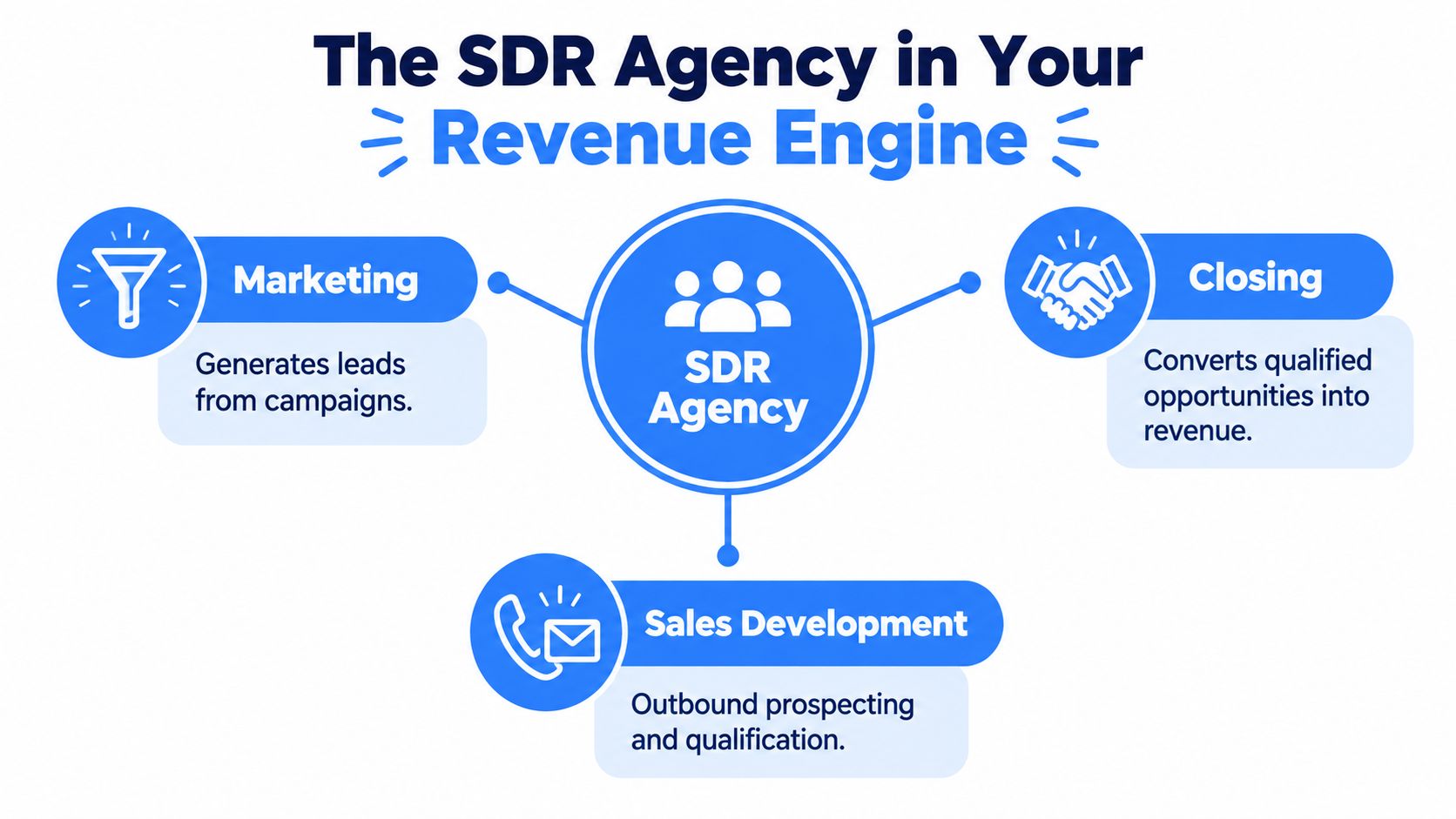
Where the agency sits
A good SDR agency doesn't replace marketing or your closers. It acts as the prospecting layer between them.
- From marketing: It uses campaign insights, ICP definitions, positioning, and market signals.
- Into sales: It passes over meeting context, qualification notes, objections, account history, and next-step expectations.
- Across operations: It should sync with CRM fields, routing rules, calendar ownership, and reporting.
If you want a clean mental model, treat the agency like a dedicated prospecting engine that feeds your account executives with warmer starts.
For teams that need a grounding in the broader outbound motion, this guide on how to build a sales pipeline with outbound is useful because it shows how prospecting fits into pipeline creation rather than treating it as isolated cold outreach.
What you are buying and what you are not
Buyers often get confused. An SDR agency is not automatically the same as every adjacent service.
| Service type | What it mainly provides | What it usually does not provide |
|---|---|---|
| SDR agency | Outreach execution, qualification, meeting booking, process management | Full-cycle closing |
| Lead list vendor | Contact data | Messaging, sequencing, reply handling |
| Appointment setter | Meeting booking | Deep ICP work, deliverability ownership, reporting discipline |
| Demand generation agency | Campaign strategy and channel mix | Day-to-day outbound prospecting handoffs |
That distinction matters because your pain determines the fit. If your problem is only missing contact data, you don't need a full agency. If your problem is that no one owns outbound execution from infrastructure to handoff, you probably do.
Why the model is changing
The old picture was simple. Hire humans, make calls, send emails, book meetings.
The new picture is hybrid. Research, list-building, segmentation, and early personalization are increasingly assisted by AI tools and workflow platforms. Market projections also show the outsourced SDR services market growing from USD 2.09 billion in 2025 to USD 3.84 billion by 2032 (360iResearch market projection for outsourced SDR services).
That doesn't mean humans disappear. It means the value shifts. Buyers now care more about whether the provider can combine automation with judgment, protect data, connect to CRM workflows, and hand over opportunities cleanly.
The useful test is simple. Ask whether the agency helps your reps spend more time in qualified sales conversations, or just creates more top-of-funnel noise.
Inside the SDR Agency Operating System From Inbox to Meeting
The easiest way to judge an SDR agency is to inspect its operating system. Not the pitch deck. The actual workflow.
A professional setup moves in sequence. Infrastructure first. Then targeting. Then messaging. Then orchestration. Then qualification and handoff. If an agency starts with “we'll send a lot of emails next week,” it's skipping the machinery that keeps outbound healthy.
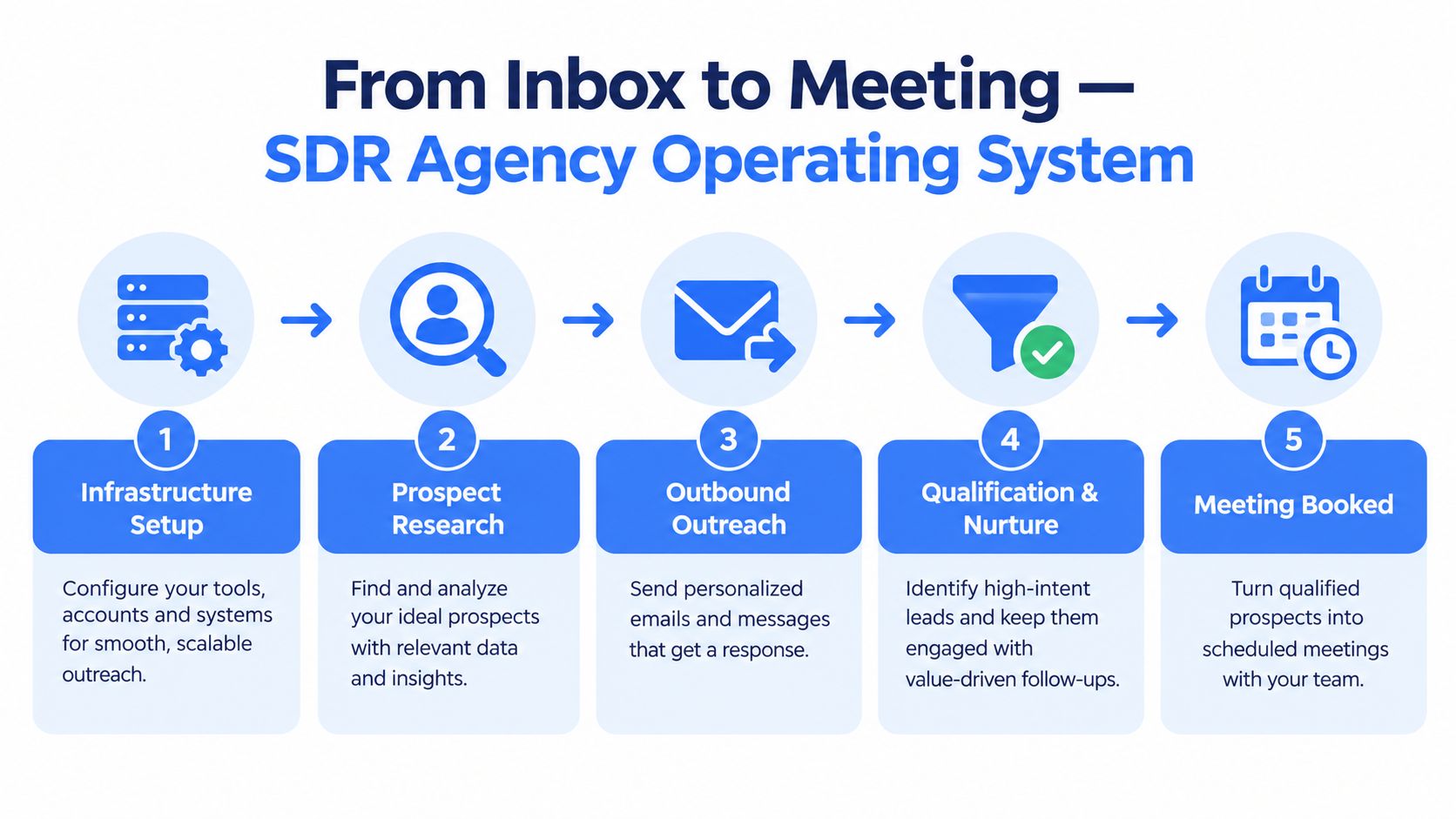
Step one starts before a single message
Outbound email works a lot like shipping. Before you worry about the message inside the box, you need the label, route, and sender identity to be trusted.
Independent deliverability benchmarks report inbox placement around 23% to 45% when SPF, DKIM, and DMARC are absent, versus roughly 82% to 95% when domains are fully authenticated and aligned (Inboxkit deliverability benchmarks on authentication and inbox placement). That's why technical setup isn't admin overhead. It directly affects how much of your outbound can even be seen.
A competent SDR agency should own or clearly coordinate:
- Authentication and alignment: SPF, DKIM, and DMARC need to be set correctly before scale.
- Mailbox planning: Separate sending identities, role design, and rotation logic matter.
- Complaint control: The team needs rules for list hygiene, relevance, unsubscribe handling, and message pacing.
Warm-up is reputation building
New domains don't behave like established ones. Mailbox providers watch early behavior closely, so rushing volume is one of the fastest ways to damage reputation.
Benchmark summaries show that new domains typically need about 4 to 6 weeks of gradual sending, starting at roughly 5 to 10 emails per day, to avoid early reputation damage. Those same summaries report that domains sent without warm-up often show only 40% to 70% inbox placement, while warmed domains can reach about 90% to 95% (SalesTarget on email warm-up benchmarks and volume ramps). If you want a practical walkthrough of the process itself, this guide on how to warm up an email domain lays out the logic in plain terms.
That's why serious operators don't treat fast launch as a badge of honor. They treat it as a risk variable.
Precision in targeting changes everything downstream
Once infrastructure is stable, the next job is audience selection. Agencies increasingly use tools like Clay, LinkedIn Sales Navigator, enrichment workflows, and custom scraping to build more precise lists.
The goal isn't just “find companies in SaaS” or “reach heads of marketing.” The goal is to narrow to buyers with a plausible reason to care now. That might mean filtering by region, hiring patterns, product motion, merchant type, installed tools, or segment-specific pain.
Good targeting improves four things at once:
- Relevance of the first message
- Lower complaint risk
- Cleaner qualification
- Better AE follow-up context
Messaging and sequencing need structure
Many teams think copy is the main event. It isn't. It's one layer in a chain.
Strong outbound messaging usually combines a short hypothesis about the prospect's situation, a clear value angle, and a low-friction next step. Then the agency wraps that into a sequence across email and often LinkedIn, with timing designed to create multiple chances for a response without turning into spam.
Some agencies test variations in:
- Subject framing
- Opening context
- Pain point selection
- Call-to-action style
- Persona-specific proof language
The point of testing isn't creativity for its own sake. It's learning which message-account combinations create replies worth handing to sales.
If an SDR agency can't explain how it edits lists, pauses weak sequences, and protects sender reputation while testing messaging, you're not looking at a system. You're looking at a sending habit.
Qualification and handoff are where pipeline becomes real
A booked meeting only matters if the receiving rep can work it. That means the handoff needs enough context that the conversation starts in second gear instead of first.
A clean handoff usually includes:
- Why the prospect replied
- What pain or trigger showed up
- Who else may be involved
- What the prospect agreed to discuss
- Any fit concerns
This is the part many outsourced motions get wrong. They optimize for calendar count and underinvest in transition quality. In practice, the SDR agency that protects inbox placement and runs disciplined handoffs often creates more pipeline than the one bragging about pure activity.
Who Benefits Most From an SDR Agency
Not every company needs an SDR agency. Some just need better follow-up on inbound. Others need a founder-led outbound test before building process. But there are a few business types where the model tends to fit especially well because the pain is operational, not just tactical.

B2B SaaS firms with uneven pipeline
SaaS teams often know their ICP well enough to sell once a meeting starts. The weak spot is consistency. Product launches, content spikes, and partner referrals can create bursts of demand, but they rarely produce steady calendar coverage by themselves.
An SDR agency helps when the company needs:
- Always-on outbound: So AEs aren't prospecting between demos.
- Segment testing: Mid-market versus enterprise, one vertical versus another.
- Operational ownership: Inboxes, lists, sequences, and qualification under one roof.
For companies in that position, a focused resource on lead generation for SaaS can help compare outbound motions by sales model and target account type.
Ecommerce, payments, and fintech teams selling to merchants
These businesses often sell into crowded markets where attention is fragmented and buyers are busy running operations. The challenge isn't only finding merchants. It's reaching the right owner, operator, or growth lead with relevant language that doesn't sound generic.
An agency can help by combining list-building, merchant segmentation, and multichannel outreach. That's particularly useful when your internal team is strong at demos and solution selling but not built to run prospecting systems at scale.
Professional services and manufacturers
Consulting firms, training companies, accountants, industrial suppliers, and manufacturers often face a different issue. They may have strong delivery reputations but weak outbound process. Their best leads come from referrals, trade relationships, or repeat business, which leaves pipeline exposed when those channels slow down.
A capable SDR agency adds structure by:
- Building targeted account lists
- Reaching decision-makers consistently
- Qualifying for fit before calendar handoff
- Supporting market expansion into new regions
Agencies selling on behalf of enterprise clients
Some marketing and growth agencies need outbound infrastructure not just for themselves, but as an extension of client delivery. In that situation, the SDR agency model can act like a specialized top-of-funnel layer that the internal team doesn't want to build from scratch.
This is especially useful when the work requires localized outreach across markets such as the US, UK, and parts of Europe. Messaging nuance and process discipline matter more there than raw activity.
The best fit isn't “companies that want more leads.” It's companies that need a repeatable way to create qualified conversations without turning their account executives into part-time prospectors.
SDR Agency Versus In House Team Versus Freelancer
Choosing an outbound model is less about ideology and more about trade-offs. Each option can work. The question is which risks you want to own directly.
An in-house team gives you the most control, but it also means you own hiring, onboarding, management, tooling, process design, and deliverability discipline. A freelancer can be a light way to test outreach, but coverage is narrower and continuity risk is higher. An SDR agency usually brings the broadest system fastest, but you give up some direct day-to-day control.
Choosing Your Outbound Model
| Criteria | SDR Agency | In-House Team | Freelancer |
|---|---|---|---|
| Ramp time | Usually faster because process, tooling, and operating routines already exist | Slower because recruiting and onboarding come first | Can start quickly, but often with limited setup depth |
| Skill coverage | Broader coverage across research, copy, sequencing, deliverability, and reporting | Depends on who you hire and who manages them | Usually strongest in one or two areas, not the full system |
| Control | Shared control, especially if the agency runs the day-to-day motion | Highest control | Moderate control, but limited by one person's bandwidth |
| Deliverability management | Often stronger if the agency has repeatable infrastructure discipline | Can be excellent, but only if your team already knows the craft | Often uneven unless the freelancer specializes in outbound ops |
| Scalability | Easier to expand into more segments or channels | Scales with more hiring and management load | Harder to scale without quality drift |
| Knowledge retention | Varies by contract and documentation quality | Highest if process is documented internally | Depends heavily on the individual |
| Single-point risk | Lower than a solo operator if the agency has bench depth | Lower if the team is fully staffed | Higher because one departure can halt momentum |
When each model makes sense
Use an SDR agency when you need a functioning outbound motion, not just a person. This is common when pipeline pressure is immediate or when your team lacks internal operators who can manage sequencing, targeting, and sender health.
Build in house when outbound is a long-term core capability and you already have strong sales leadership and revenue operations support. This route makes more sense once your messaging, ICP, and process are already proven.
Start with a freelancer when you want a narrow experiment. For example, testing one segment, one geography, or one channel before committing to a larger build.
One decision filter most teams miss
A lot of buyers compare these models on labor alone. That's too narrow.
The deeper question is whether you're buying capacity or capability.
- If you already have infrastructure and process, capacity may be enough.
- If your infrastructure, targeting, and handoff are weak, you need capability.
For teams still evaluating talent options on the hiring side, a resource like Hire SDR can be useful for understanding the market for individual SDR talent. It complements the agency decision because it helps you see when a headcount solution might be enough and when it probably won't.
Pricing Lead Benchmarks and How to Evaluate an SDR Agency
Pricing conversations around SDR agencies often go sideways because buyers ask for a cost per lead before they inspect what's included. That's backwards. In outbound, price follows operating complexity.
Some providers charge a monthly retainer. Some charge per meeting. Others use a hybrid model with a base fee plus performance incentives. None of those models is automatically good or bad. What matters is whether the commercial model encourages careful targeting, clean qualification, and honest reporting.
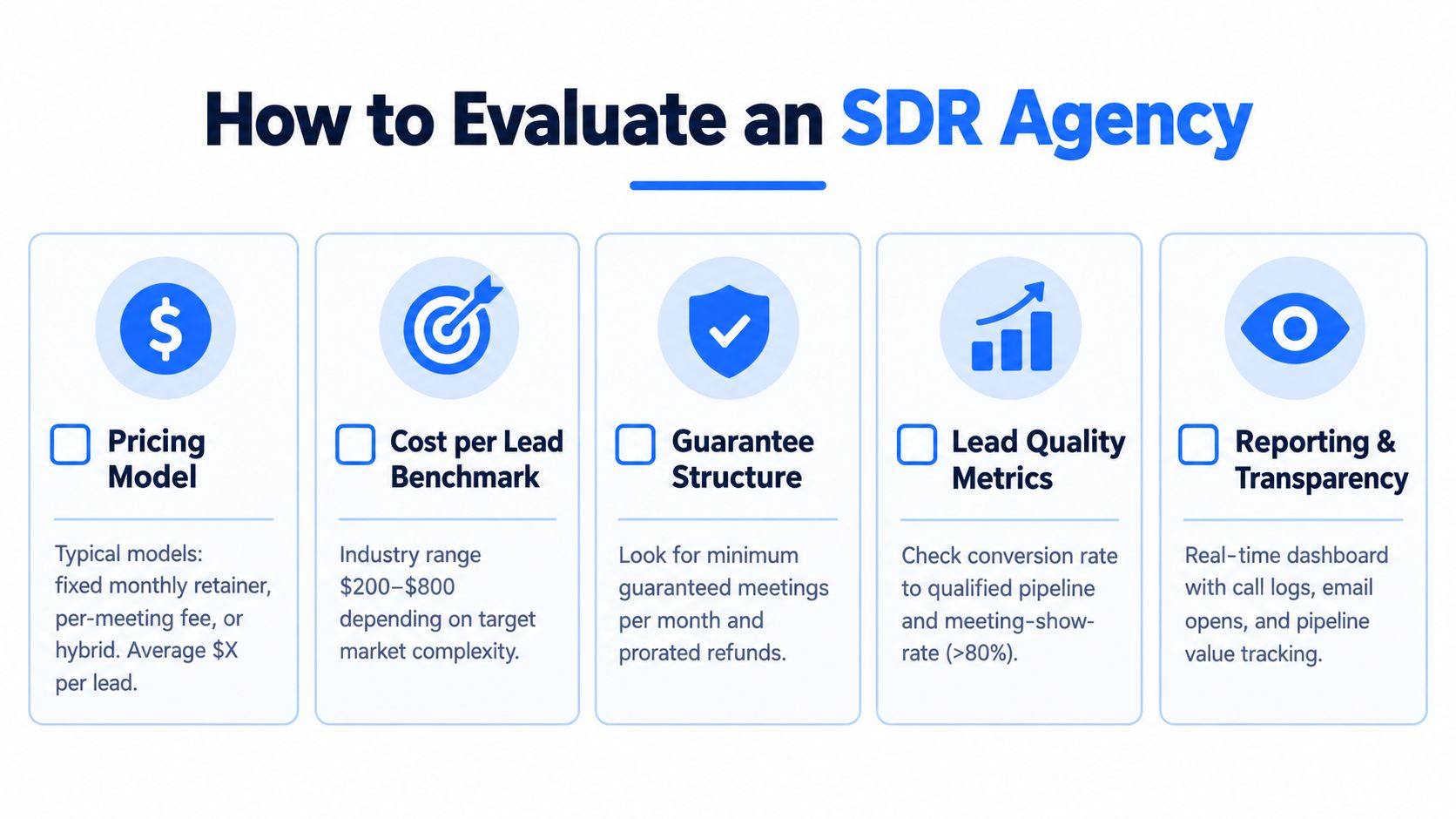
Start with the package, not the promise
When you evaluate an agency, ask what operational layers are included.
- Infrastructure work: Authentication, inbox setup, warm-up oversight, and sender safeguards
- Data work: Research, enrichment, segmentation, and ongoing list maintenance
- Execution work: Copywriting, sequencing, reply handling, qualification, and booking
- Measurement work: Reporting, pipeline tracking, and feedback loops with AEs
A low-fee offer can look attractive until you realize your team still has to own half the system.
For a grounded view of what outsourced sales development can include in practice, this page on sales development outsourcing is helpful because it breaks the service into operational parts rather than treating it like a black box.
What to inspect before you sign
A strong vetting process usually sounds less like “how many meetings do you guarantee?” and more like this:
- How do you protect deliverability? Ask who owns authentication, ramping, complaint control, and inbox monitoring.
- How do you build target lists? Ask which sources, filters, and enrichment steps they use.
- How do you personalize without faking relevance? You want a repeatable process, not shallow token inserts.
- What does a qualified handoff include? Ask for examples of notes, CRM fields, and meeting context.
- How do you report quality? Activity should be visible, but so should conversion and feedback from sales.
Use proof carefully
Proof points are useful, but only if you read them in context.
For example, Lead Printer states a minimum guarantee of 20 qualified leads per month, says most clients get an average of 50 leads per month, and notes that some programs reach 200 to 300 leads per month. The company also cites 7.2M emails and LinkedIn DMs sent, 32k leads generated, and 2,500+ campaigns delivered in its published company materials. Those figures tell you the team has process exposure at scale. They do not, by themselves, tell you whether your segment, offer, and handoff will work.
That's the right mindset for every agency case study. Look for signs of operational maturity, then ask whether the same conditions apply to your market.
Evaluation shortcut: The best agency answers hard operational questions comfortably. The weaker one keeps pulling the conversation back to volume, generic personalization, and booked-meeting totals.
Making Your SDR Agency Partnership Pay Off
Once you choose an SDR agency, the work starts. Most programs fail in the handoff between a decent outbound engine and an unprepared internal team.
The partnership works best when both sides agree on three things early. First, the ideal customer profile needs to be tighter than “mid-market companies” or “SaaS founders.” Second, qualification has to be explicit. Your definition of a useful meeting should be written down, not assumed. Third, account executives need a response process for booked meetings and live replies, or momentum disappears fast.
A short checklist that saves a lot of pain
- Set the ICP precisely: Industry, role, geography, account size, and disqualifiers should be concrete.
- Define handoff rules: Decide what notes, fields, and pre-meeting context must be attached.
- Review quality weekly: Don't only review volume. Review fit, show rate, and sales feedback.
- Protect the infrastructure: Treat sender reputation and inbox health as revenue assets.
- Adjust quickly: Pause weak segments, rewrite poor-performing angles, and feed objections back into copy.
Some teams make the mistake of outsourcing outbound and mentally outsourcing judgment too. That doesn't work. The best results come when the agency supplies execution discipline and the client supplies market truth.
A good SDR agency should reduce the load on your sales team, not increase the cleanup work. When targeting is sharp, deliverability is healthy, and handoffs are clean, outsourced sales development becomes less like rented labor and more like a reliable extension of revenue operations.
Lead Printer builds and runs outbound systems for B2B teams that need more than list sourcing or appointment setting alone. That includes email infrastructure, warm-up discipline, prospect research, personalized multichannel outreach, qualification, and calendar handoff across markets such as the US, UK, and EU. If you're evaluating whether an SDR agency model fits your pipeline goals, visit Lead Printer to see how the company structures outbound as an end-to-end operating system.