Most advice on lead generation for SaaS still starts with copy, subject lines, and “better personalization.” That's the wrong starting point in 2026. If your messages never reach the inbox, or they reach the inbox but go to the wrong accounts at the wrong time, the wording barely matters.
The bottleneck has moved upstream. Benchmarks compiled from more than 2 million emails put average cold email response rate at 2.66%, while a separate 2026 study of 16.5 million emails found 5.8% reply rates in professionally managed campaigns, which tells you the campaign setup matters more than cosmetic tweaks to the opener (Sales.co cold email statistics). That spread is the story. SaaS teams don't need more clever lines, they need reachability, signal quality, and tight ICP discipline.
Why SaaS Outbound Stopped Working the Old Way
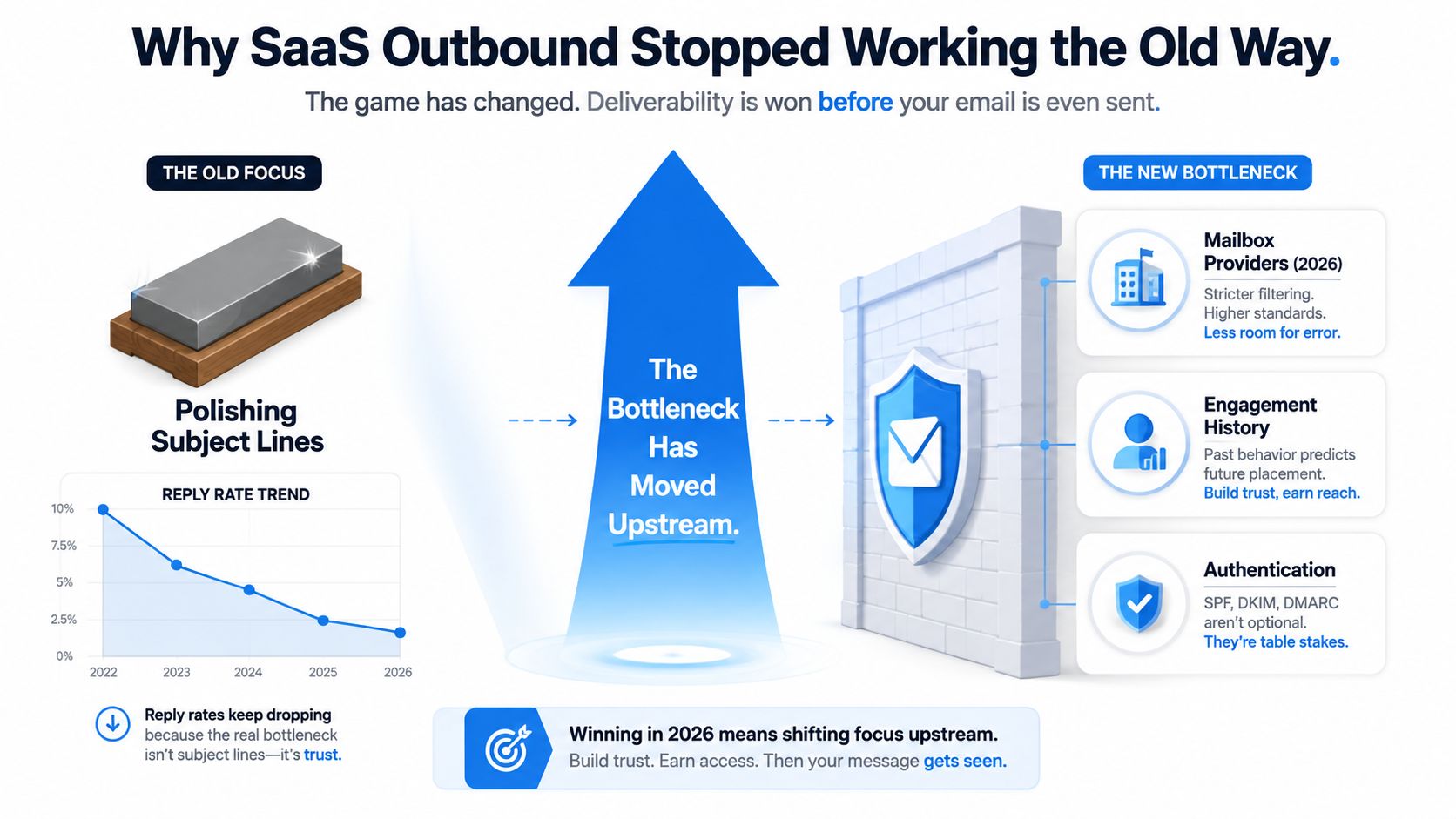
The old playbook assumed a decent list and a sharp email would do most of the work. In practice, broad cold outreach now runs into inbox filters, crowded buyer inboxes, and prospects who've seen the same template a dozen times before lunch. Benchmarks for broad B2B cold outreach sit around 3.4% to 5.1% reply rate, while top SaaS campaigns reach roughly 10% to 12% response rates, which makes the gap between “acceptable” and “working” very real (Cleverly cold email benchmarks by industry).
The buying problem changed before the writing problem did
Mailbox providers now reward sending reputation, authentication, and engagement history far more than a polished line at the top of the email. A campaign can have strong copy and still never get judged by the buyer because it lands in Junk or Promotions. That's why one campaign can outperform another by more than double the baseline even when both “sound good” on paper.
Practical rule: if reply rates are weak, assume the first failure is reachability or list quality, not creativity.
For SaaS teams, that means the first question isn't “What subject line will get the open?” It's “Did the account get a fair chance to see the message at all?” Recent benchmark-style coverage says deliverability for cold email in B2B SaaS has fallen to about 18% in 2026 from roughly 45% in 2022, while average reply rates slid to around 2 to 3.4%, and open rates are now heavily distorted by privacy features (FounderVentures cold email deliverability collapse). That changes the operating model.
The teams that still win don't write dramatically better outreach. They send to better-fit accounts, with cleaner infrastructure, and with timing that matches a buying signal. Copy is still important, but now it's a multiplier on top of a system, not the system itself.
Defining a SaaS ICP That Survives First Contact
A SaaS ICP that survives real prospecting isn't a static persona sheet. It's a decision map. You need to know who feels the pain, who signs off, who blocks the deal, and what event makes the problem urgent enough to answer.
Build the one-page filter first
Start with the role map, not the company description. For a mid-market data platform, that usually means the economic buyer, the technical evaluator, and the user champion all sit in the same account but care about different outcomes. Then write the trigger that puts them into market, such as a funding event, a migration, or a churn spike, and spell out the disqualifiers just as clearly, like company size, stack mismatch, geography, or budget band.
A simple one-pager keeps the rest of the workflow honest. If a prospect doesn't fit the filter, they don't go into the list. If they fit the filter but have no trigger, they don't get the same message. That one distinction saves a lot of wasted sequencing.
| SaaS ICP One-Pager Template | ||
|---|---|---|
| Field | Definition | Example (Mid-Market Data Platform) |
| Economic Buyer | Person who owns budget | VP Revenue Operations |
| Technical Evaluator | Person who checks fit | RevOps systems lead |
| User Champion | Person who feels the day-to-day pain | Sales operations manager |
| Trigger | Event that creates urgency | Series B raise or CRM migration |
| Disqualifier | Clear reason to exclude | Outside target geography |
| Stack Fit | Core tools already in place | HubSpot and adjacent SaaS stack |
The best ICPs are small enough to exclude a lot of people. That feels uncomfortable at first, but it improves list quality, sequencing, and qualification all at once. If you want a tighter handoff between marketing and sales, the framework in this lead qualification guide is a useful companion to the ICP work.
Good outbound is mostly disciplined rejection. The more clearly you say no, the better your yeses become.
Deliverability: The Gatekeeper
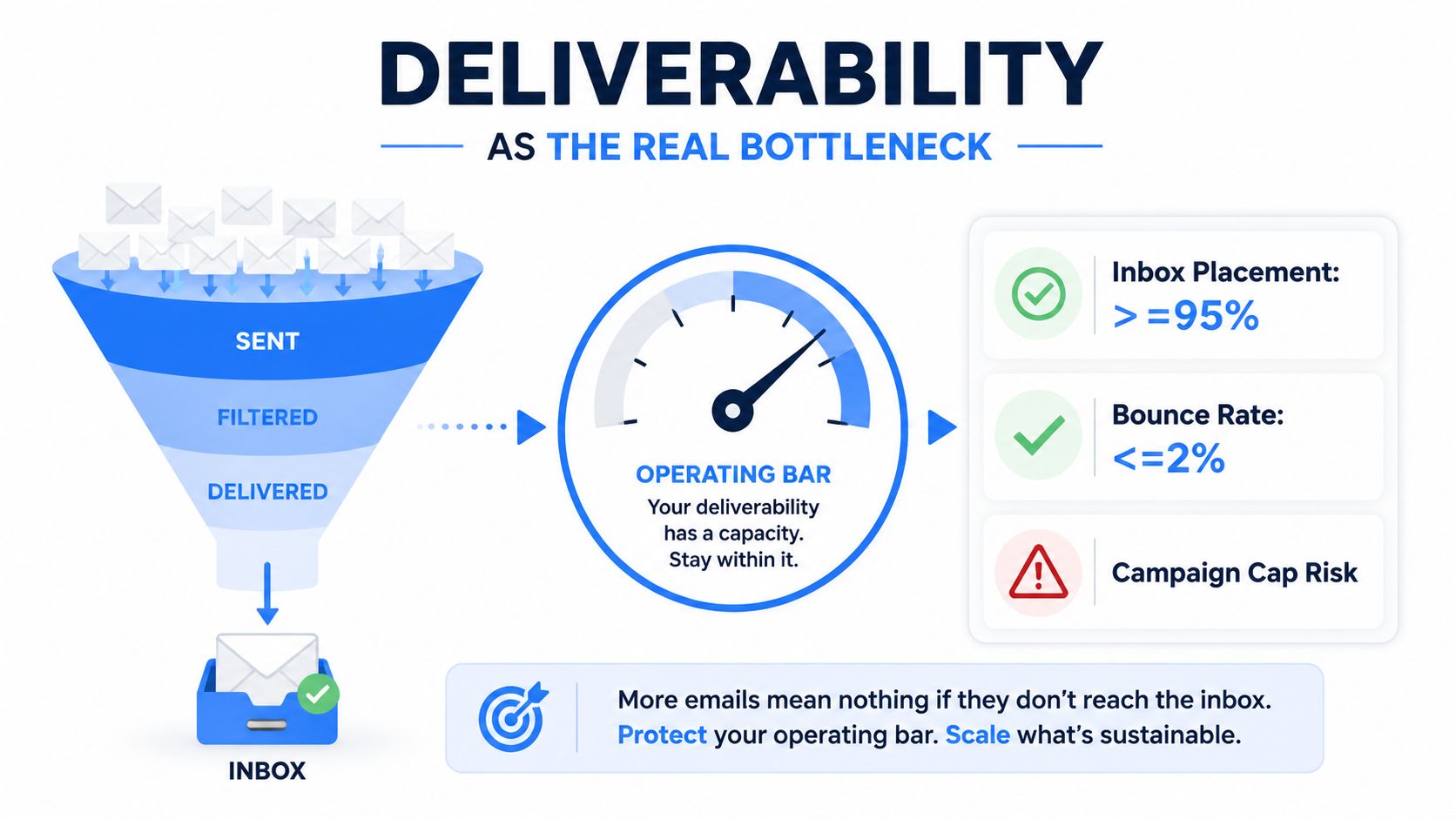
Deliverability decides whether the rest of the campaign gets a fair test. Benchmark summaries consistently treat 95%+ inbox delivery as a healthy target and under 2% bounce rate as the sign of clean list hygiene and sound sending infrastructure (Martal cold email statistics). That is the floor, not the finish line.
What Moves the Inbox Rate
Mailbox providers judge trust before they judge copy. SPF, DKIM, and DMARC alignment on a dedicated sending domain are the baseline, then list validation, role-account suppression, and careful handling of catch-all addresses do the rest. If the infrastructure looks sloppy, the buyer may never see the message.
A quick sanity check before launch helps. A blacklist checker can show whether your domain already carries baggage that will drag down a campaign.
I've seen teams spend days on the first sentence while the sending setup is still weak. That approach wastes time. Warm-up, throttle control, and basic hygiene usually do more for meetings booked than another round of subject-line tests.
For the setup side, this warm-up guide covers domain onboarding and warm-up steps in a practical way. Warm-up is not ceremonial. It is how a new sender earns the first real conversations.
Signs your setup is hurting you
Rising bounce rates, slower replies without a list change, or a large share of messages that seem invisible all point to a system problem. Each bounce weakens sender reputation and makes inbox placement harder to recover. Teams that keep sending through a flagged domain usually spend more time repairing reputation than generating pipeline.
A second signal is inconsistent performance across similar segments. If one list behaves normally and another stalls, the difference is often infrastructure or list quality, not copy. That is why the sending layer has to be monitored alongside reply rate and meeting rate.
A 2026 guide from FounderVentures cold email deliverability collapse says campaigns with lower bounce rates consistently outperformed campaigns with higher bounce rates, and it recommends pausing outbound when bounce rate rises above 2%. That is a practical stop rule, not a theory.
The lesson is straightforward. Week-one infrastructure choices usually matter more than month-six copy edits.
Email and Multichannel Sequences Built as One System
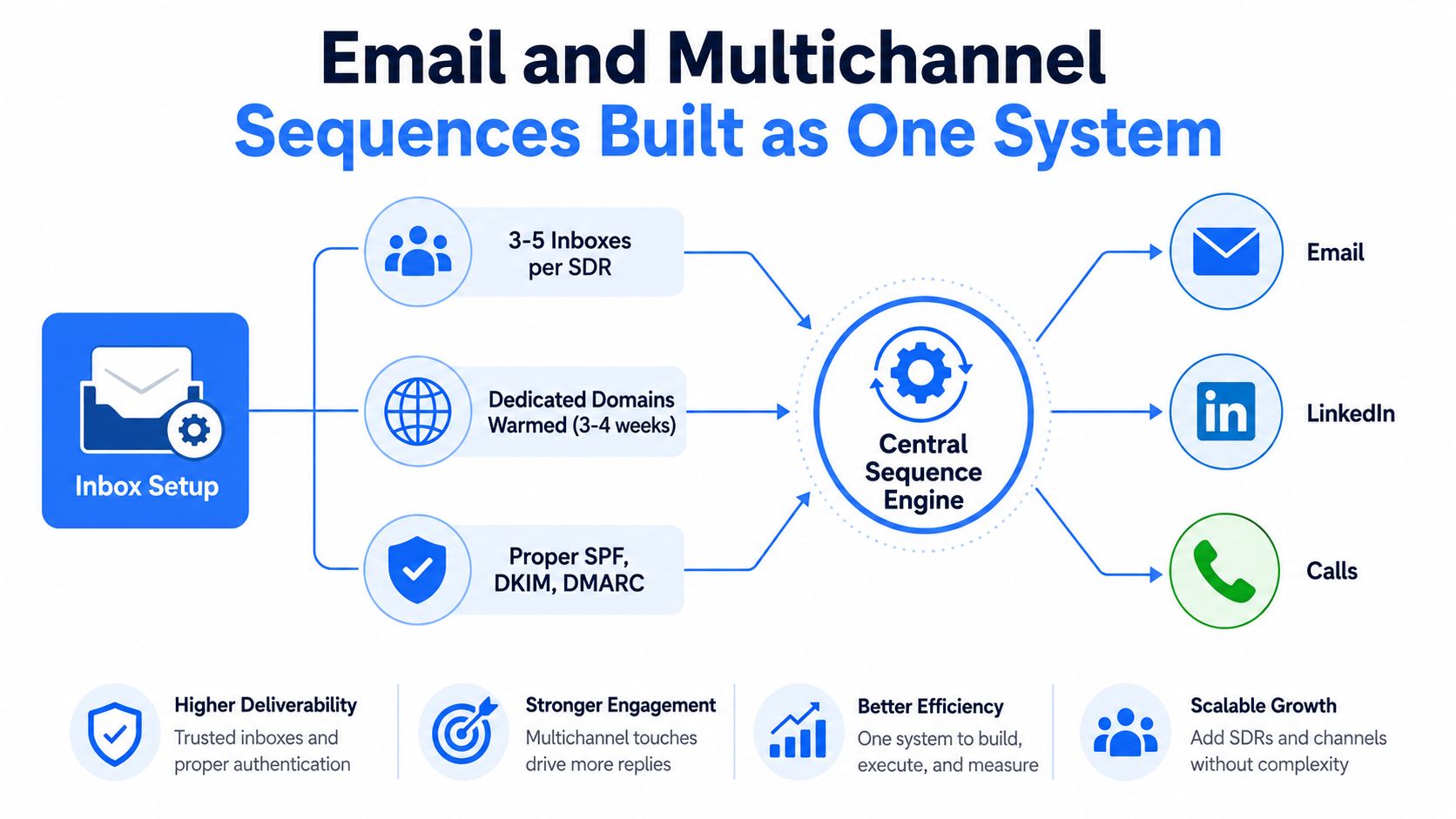
Outbound works better when email, LinkedIn, and calls behave like one coordinated machine instead of separate motions run by different people. That starts with the inbox layer. Dedicated sending domains, proper authentication, and human-sounding sending patterns matter because they establish the reputation that every later touch depends on.
A week-one workflow a team can actually run
Set up the sending layer first. Then build the sequence around a real buying motion, not around channel enthusiasm. A simple structure looks like this.
- Prepare the inboxes. Use dedicated domains, authenticate them properly, and warm them before anything high-volume goes out.
- Load the list by tier. Keep top-fit accounts separate from broader experimental segments.
- Write one core email, then adapt by tier. Industry and role in version one, trigger reference in version two, and deeper research only where the account justifies the time.
- Blend the touchpoints. Email starts the contact, LinkedIn adds recognition, and calls or a light nudge follow when the account shows signs of engagement.
- Route replies fast. A human response loop matters because it reinforces engagement signals and keeps the pipeline from stalling.
A 7 to 9 touch sequence is usually enough to create rhythm without looking desperate. The exact order matters less than the consistency between signal, message, and timing. If the prospect just changed roles, the LinkedIn note should sound like a continuation of the email, not a separate campaign pretending not to know what happened.
The practical trade-off is simple. More channels create more chances to be noticed, but only if the same account gets a coherent experience across each touch. If the LinkedIn handoff feels random, it dilutes trust instead of building it.
Personalization that's worth the time
Tier 1 personalization uses the buyer's industry and role. Tier 2 brings in the trigger. Tier 3 is deep research, like a specific initiative, hiring pattern, or public project. Only a minority of accounts deserve tier 3, because the extra work only pays off when the account is already close to the fit line.
Video can help explain that handoff logic visually, especially for operators trying to build a repeatable process rather than a one-off campaign.
That kind of sequence works because it treats channels as parts of the same timing engine. The prospect doesn't care which internal team owns which touch. They care whether the outreach is relevant enough to answer.
Signal-Based Prospecting in Practice
The best outbound lists in SaaS don't start with “everyone who fits the ICP.” They start with accounts that have moved. A trigger changes the odds that a message will matter, which is why signal-led outreach usually beats static list blasting.
The four signal buckets that deserve attention
Firmographic signals include funding, headcount changes, and tech stack shifts. Intent signals include topic surges and comparison research. Trigger events include executive hires, expansions, and compliance deadlines. Engagement signals include pricing page visits and repeat content downloads.
| Signal Types and Likely Impact on SaaS Outbound | ||
|---|---|---|
| Signal Type | Example Data Source | Expected Reply Lift |
| Firmographic | Funding, headcount, technographic change | Higher relevance than static lists |
| Intent | Topic surge, comparison search activity | Stronger timing alignment |
| Trigger Event | Executive hire, expansion, compliance deadline | Strongest urgency signal |
| Engagement | Pricing page visits, repeat downloads | Useful for follow-up prioritization |
The point of the table isn't to over-model the data. It's to stop treating every prospect the same. Some signals justify a first touch, some justify a faster follow-up, and some mean the account should move into a higher-priority queue.
A practical example helps. A RevOps tool targeting mid-market SaaS firms sees a company announce a new VP of Sales after a Series B. The first message references the hiring change and the pressure that usually follows a new sales leader's arrival. If the hiring post is confirmed, the sequence continues. If it isn't, the account stays in a lower-touch stream until another signal appears.
That approach trims the list size, but it raises the quality of the conversation. The Starr Conspiracy's 2025 trend coverage argues that signal-based outbound should be rebuilt around events such as job changes, funding, technographic shifts, and product-usage changes, and says those combinations can outperform persona-based blasting by 5 to 10 times in reply rate (The Starr Conspiracy B2B lead generation trends 2025). The broader lesson is that timing is not a nice-to-have, it's the filter.
Channel Mix Beyond Cold Email
Cold email is still the fastest way to create meetings, but it's not the only channel that matters. The right mix depends on speed, control, and how much reachability risk you can tolerate. Outbound gives you precision and immediate motion, while other channels add trust, compounding, or credibility in different ways.
How the channels behave differently
Cold outreach is fastest and most controllable, but it's capped by inbox reachability. Inbound SEO compounds over time and can improve the quality of the demand pool, but it doesn't help if you need pipeline this quarter. Paid social can target tightly, though it usually costs more to keep the same level of attention. Partnerships and integrations bring in high-trust leads with low volume. Events create concentrated attention, which is why they still matter for enterprise motion.
| Channel Comparison for SaaS Lead Generation | |||
|---|---|---|---|
| Channel | Cost per Meeting | Time to First Meeting | Best-Fit Stage |
| Cold Email | Lowest in the short run, but reachability-limited | Fast | Early stage and targeted plays |
| Inbound SEO | Delayed payback, then compounding | Slow | Growth stage and durable demand |
| Paid Social | Higher and more volatile | Moderate | Growth stage with clear targeting |
| Partnerships | Low volume, high trust | Moderate | Expansion and ecosystem plays |
| Events | Resource-heavy but concentrated | Fast during campaign windows | Enterprise and late-stage motion |
The channel mix should match the company stage. Early-stage SaaS usually needs heavy outbound plus content that supports trust. Growth-stage teams tend to balance outbound, paid, and partnerships. Late-stage teams can layer events and ABM on top of a content base that already proves the company knows the market.
If you're deciding whether to add or drop a channel, use unit economics and speed to pipeline. If a channel is slow but compounds well, keep it alive. If it creates meetings but can't hold quality, tighten the targeting. For a broader operating model that links channels instead of treating them separately, this cross-channel lead generation guide is a useful reference.
A channel mix is only defensible when each piece has a job. If everything is meant to do everything, nothing gets measured cleanly.
KPIs and Attribution That Match How SaaS Buys
Open rate and click rate can make a dashboard look busy while telling you very little about pipeline. In SaaS outbound, the metrics that matter are the ones that connect contact activity to actual sales movement. That means positive reply rate, meetings booked per 1,000 contacted accounts, MQL-to-SQL conversion, and fully loaded cost per SQL.
A dashboard the SDR manager can use on Monday
If you need a clean attribution framework, the definitions in Crowbert's marketing attribution glossary are a helpful baseline for aligning sales and marketing on what gets credit and when.
| SaaS Outbound KPI Reference Table | |||
|---|---|---|---|
| KPI | Definition | Red Band | Green Band |
| Positive Reply Rate | Replies that are not auto-responses or out-of-office | Under 1% | 3%+ |
| Meetings Booked per 1,000 Accounts | Meetings created from contacted accounts | Low enough to review list quality | Strong enough to scale |
| MQL-to-SQL Conversion | Share of MQLs that become sales-qualified | Weak handoff | Healthy sales follow-through |
| Fully Loaded Cost per SQL | Tooling plus labor divided by SQLs | Rising without pipeline gain | Controlled and predictable |
A simple two-touch attribution model works well enough. Use source on first touch, campaign on last touch, and count the meeting as the conversion event. That keeps credit from getting lost without forcing a huge CRM rebuild.
The practical thresholding is straightforward. Positive reply under 1% is red, 1 to 3% is amber, and 3%+ is green. If a sequence sits below threshold for two consecutive weeks, pause it and inspect the list, the timing, and the sending setup before changing the copy.
Each KPI should trigger a specific action. Low positive reply means the SDR manager reviews targeting and deliverability. Weak meetings per 1,000 accounts means the list is too broad or the offer is weak. A falling MQL-to-SQL rate means qualification is letting the wrong leads through. Rising cost per SQL means the campaign is getting more expensive without earning its keep.
The point of the dashboard is not to admire trends. It's to tell the team what to do next.
Scaling, Localizing, and Staying Compliant
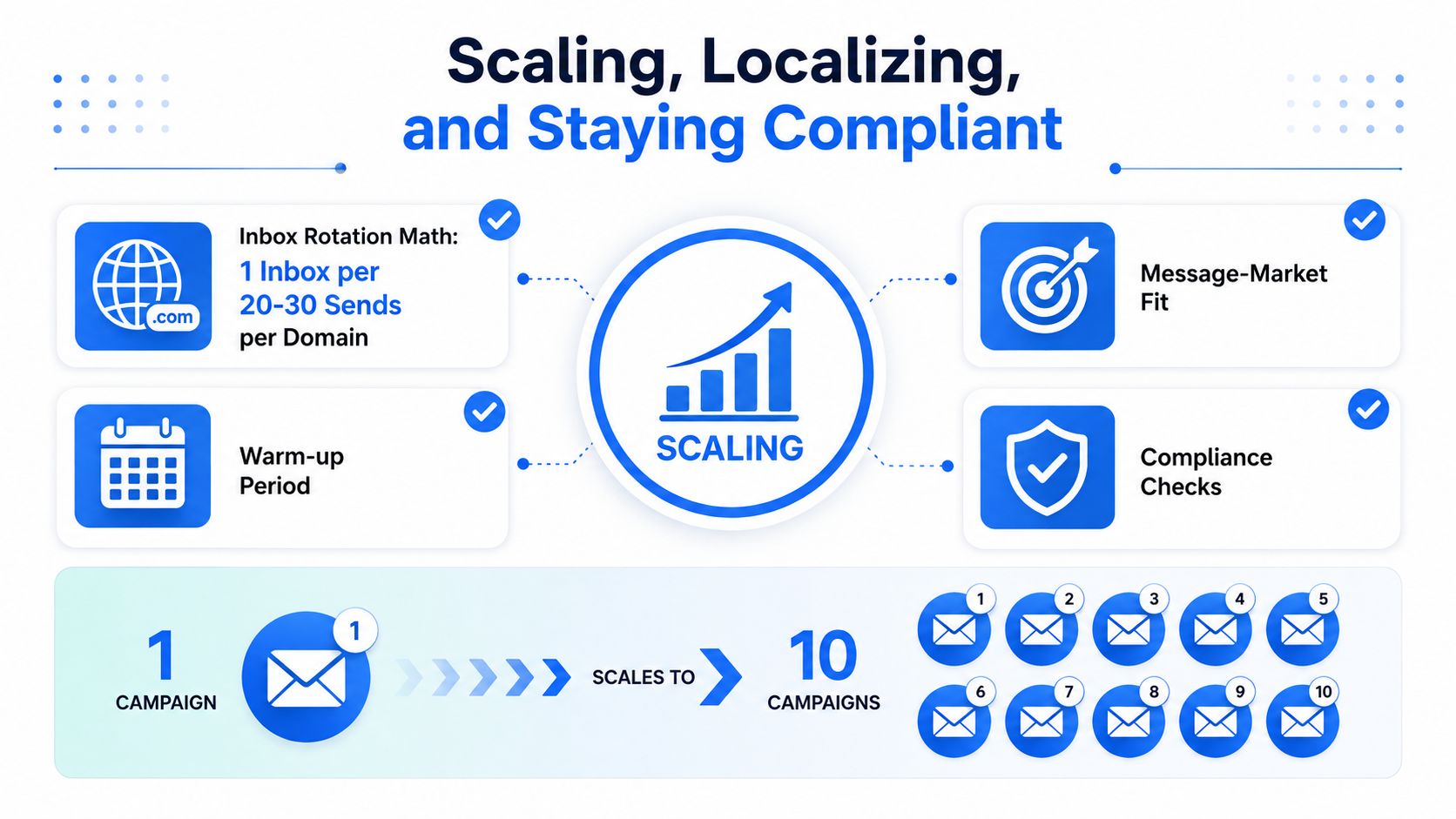
Scaling outbound is less about sending more and more about protecting the system while volume grows. The first trap is inbox overload. A rough operating rule is 1 inbox per 20 to 30 daily sends per domain, with warm-up in place for at least 21 days before pushing harder. That keeps the sending pattern believable while you add capacity.
What changes when the team grows
Two SDRs can usually run lean if the list is tight and the sequence is stable. A third SDR usually justifies a RevOps owner because list hygiene, routing, reporting, and suppression sync start to break when nobody owns the system end to end. That's the moment to standardize.
Localization matters more than many companies realize. US, UK, and EU prospects notice send windows, date formats, currency references, and spelling. A message scheduled in the prospect's local morning reads as thoughtful. A subject line with the right spelling tells the buyer the rep did the homework.
Compliance isn't a box to check after launch. It's part of whether the launch survives review, mailbox scrutiny, and internal approval.
On the legal side, SaaS teams need to handle GDPR lawful basis with documented legitimate interest, CAN-SPAM with a physical address and unsubscribe, UK PECR for B2B email, and CCPA disclosures where relevant. For EU campaigns, a one-page DPIA and a synced suppression list help prevent quarter-end delays. If you want a practical read on the tooling side of security and compliance operations, the Vanta features and pricing analysis is a useful reference point for understanding how teams think about trust controls.
The pre-launch checklist is boring, and that's exactly why it works. Check SPF, DKIM, and DMARC. Sync suppression lists. Confirm warm-up is complete. Make sure localization is accurate. Verify the compliance story before the campaign goes live.
Scaling the wrong system just creates a bigger problem faster. Scaling the right one turns one reliable campaign into ten without breaking the inbox.
If you want a team that builds lead generation for SaaS around deliverability, signal quality, and multichannel execution instead of guesswork, visit Lead Printer. We build the infrastructure, prospect data, and outbound sequences that turn better targeting into qualified meetings across the US, UK, and EU.