When outbound looks busy but the calendar stays thin, the problem is rarely send volume alone. It is usually weak orchestration, loose qualification, or both. I have seen sales reps spend 3 to 5 hours chasing prospects that never should have reached a call in the first place, and that is where the wrong appointment setting agency adds more motion without more revenue.
An effective vendor works like a pipeline operator, not a contact list factory. It keeps targeting, messaging, follow-up timing, and meeting handoff aligned so the sales team spends time on conversations that match the ICP and sales motion. If those pieces are not written into the process and the SLA, the result is predictable, activity goes up, meetings do not.
What an Appointment Setting Agency Actually Does
When the calendar is empty and the quarter is already moving, an appointment setting agency acts like an outsourced pipeline engine. It combines prospecting, outreach orchestration, reply handling, and qualification so your sales team gets conversations worth taking, not just names in a spreadsheet.
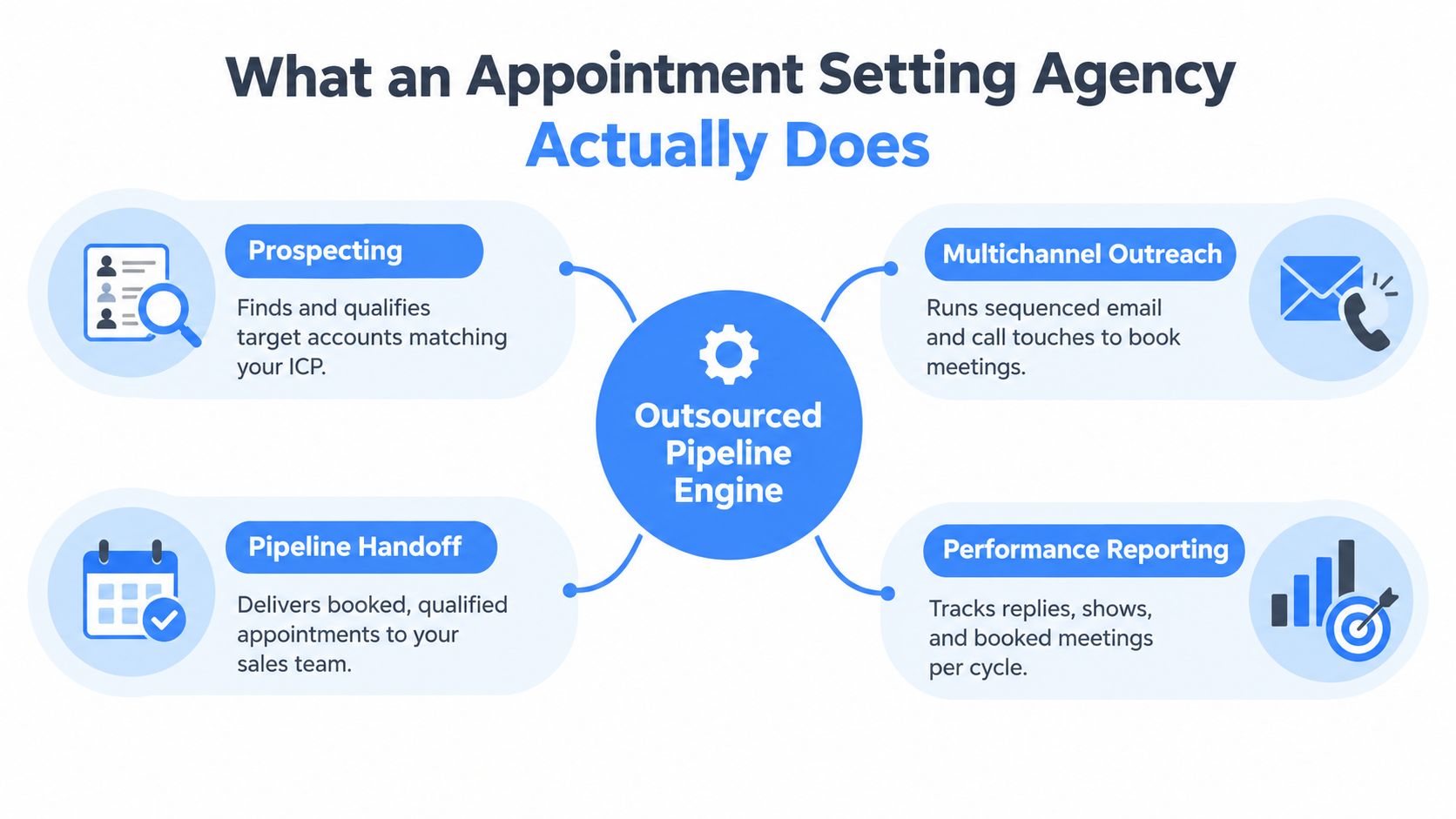
At a practical level, that means finding the right accounts, building the right sequences, and handing off meetings that fit your ICP and sales motion. It's less about “doing outreach” and more about coordinating the parts that make outreach convert, from targeting and messaging to follow-up timing and meeting confirmation. A useful way to think about it is as a system with four moving parts, prospecting, multichannel outreach, pipeline handoff, and performance reporting.
The real job is orchestration, not just outreach
The benchmark that matters here is the low conversion rate. Only about 1% to 2% of total outbound touches become booked meetings, according to the appointment setting benchmark from SalesHive. That's why good agencies don't rely on one channel or one message, they keep sequencing, refining, and qualifying until the right buyer responds.
Practical rule: if a vendor talks mostly about send volume, you're hearing a production pitch, not an appointment-setting strategy.
The best agencies also treat data quality and sequence timing as core assets, not support work. That's because the difference between a decent campaign and a useful one usually shows up in the handoff, whether the prospect was relevant, reachable, and ready for a sales conversation. For a deeper look at qualification standards, see Lead Printer's lead qualification framework.
Appointment Setting Agencies vs In-House Teams
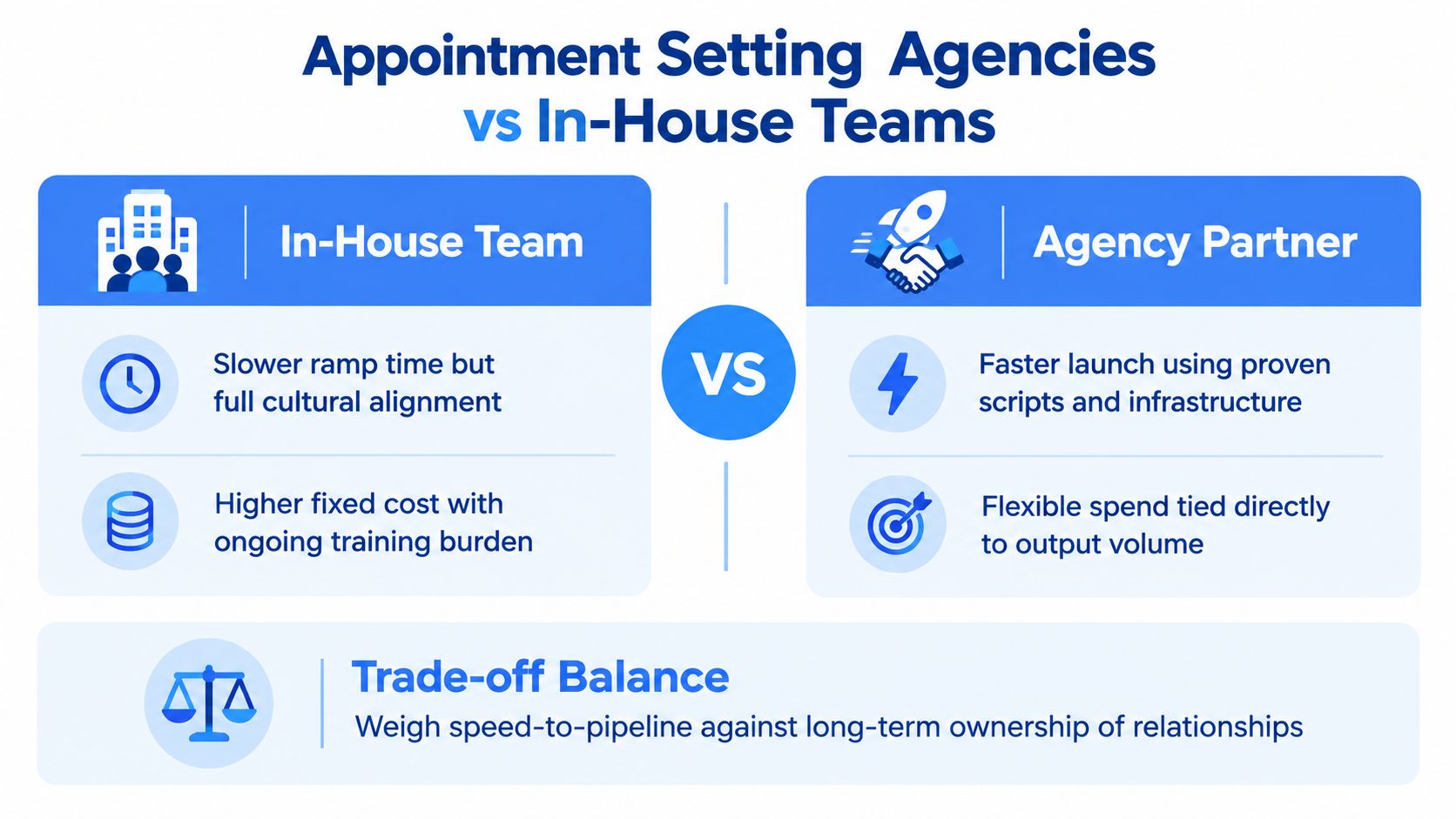
Choosing between an agency and an internal team usually comes down to one question, do you need speed now, or control over every moving part? An in-house team gives you tighter ownership of messaging, process, and institutional knowledge. An agency gives you faster launch, proven infrastructure, and less operational drag while your team stays focused on closing.
Where agencies usually win
Agencies absorb the setup burden that slows internal teams down. They handle the campaign scaffolding, sequence design, list building, inbox management, and day-to-day operational churn that many companies underestimate. That makes them useful when sales leaders need meetings faster than they can hire, train, and stabilize a full internal function.
They also bring a repeatable operating model, which matters when your team hasn't built outbound at scale before. The trade-off is real, though. You're renting execution, and that means you need stronger contract terms if you want clean qualification and clear ownership of what gets booked.
Where in-house usually wins
Internal teams usually have stronger context and better long-term control. They sit closer to the product, the customer feedback loop, and the evolving offer, so their outreach can stay aligned with what the market is hearing from sales and marketing.
If your buying cycle is complex, the real comparison isn't cost alone, it's whether you want fewer operational variables or more direct control over how each conversation is shaped.
For teams that want to keep strategy close to home while outsourcing execution, the sales development outsourcing model can be a useful middle ground. Just make sure the handoff rules are explicit, especially around meeting quality and follow-up ownership.
How Appointment Setting Agencies Work Step by Step
The strongest programs don't start with copywriting. They start with infrastructure, because deliverability, list quality, and handoff discipline determine whether the campaign can even earn a reply. In practice, the workflow looks a lot more like an operations chain than a creative exercise.
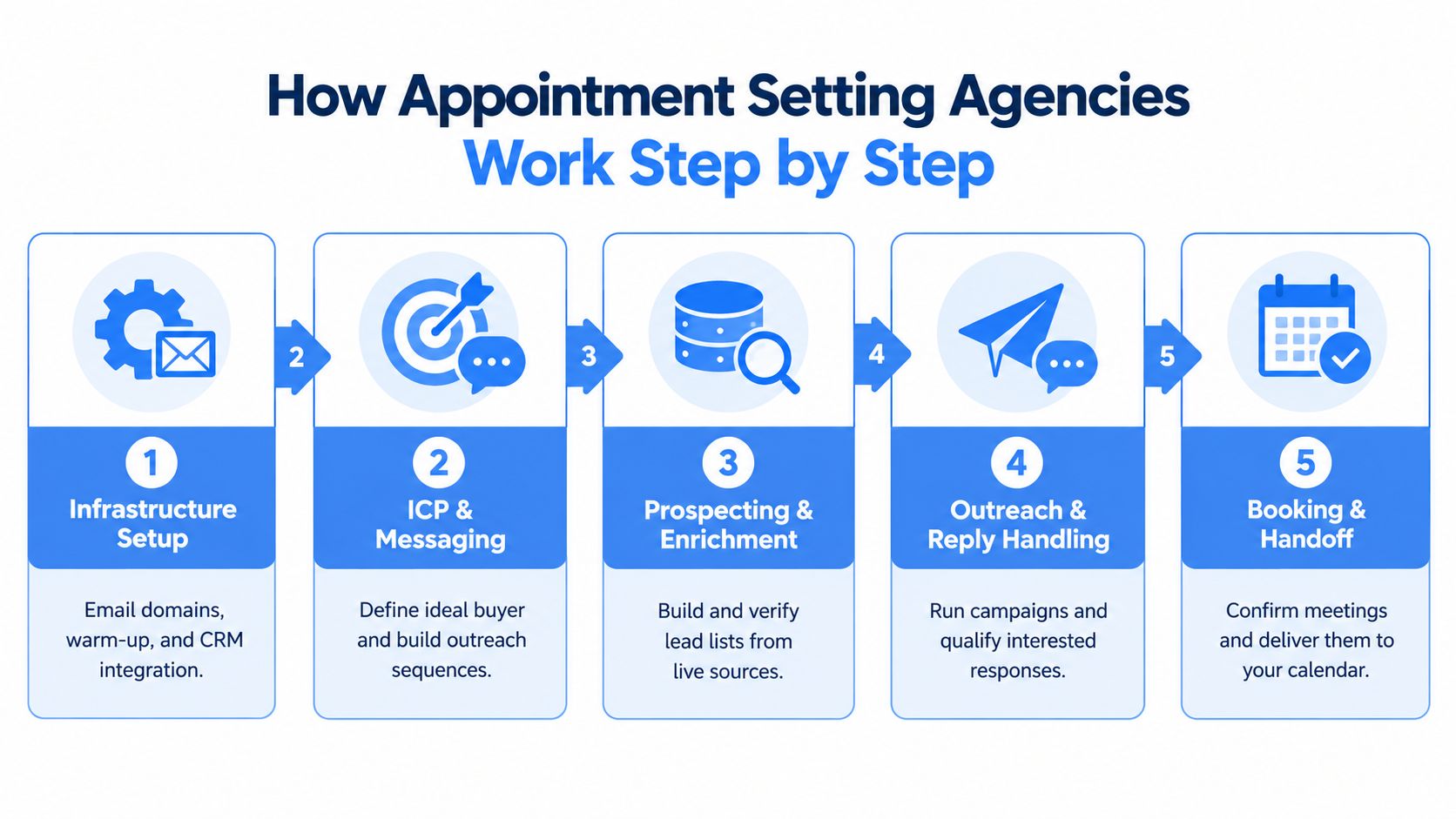
Step 1 to Step 3 build the campaign foundation
First comes infrastructure setup. That includes the email environment, inbox readiness, and CRM integration so responses can be tracked correctly. Then the agency defines the ICP and writes the messaging around that profile, instead of blasting the same pitch to every contact in the market.
After that, the team moves into prospecting and enrichment. Strong vendors use live sources, verify contacts, and segment by relevance so the list reflects the market you want, not just a large database export. Mediocre providers usually slip here, because weak data produces weak replies no matter how polished the sequence looks.
Step 4 and Step 5 turn replies into meetings
The outreach phase is where multichannel orchestration starts to matter. Cold email alone typically produces about 1% to 3% reply rates in B2B, while coordinated multichannel sequences combining email with LinkedIn and/or calls often outperform email-only by roughly 2x to 4x, according to Smartlead's multichannel outreach guidance. That's a strong argument for coordinated touches rather than single-channel persistence.
Once someone replies, speed matters. Faster human follow-up, clean qualification, and a tight booking process reduce the drop-off between interest and calendar commitment. Benchmark data for outreach-led meetings commonly sits around 0.5% to 1.2% on average, with stronger execution reaching 1.5% to 3%+, and meeting attendance often landing at 70% to 80% unless confirmation and qualification are tightened, according to KnowledgeNet's outbound email benchmarks.
If you want a useful hiring lens for the team that will handle replies, the question list in Virtustant Jobs' sales interview frameworks is a helpful reference point for judging process discipline.
For a practical service overview, Lead Printer's appointment setting workflow follows the same logic, prospect, sequence, qualify, and hand off.
Key Metrics and ROI Expectations
A vendor report can look strong until you trace activity to pipeline. Replies matter, but they are only an early signal. Booked meetings, attendance, qualification quality, and opportunity conversion show whether the agency is creating useful sales conversations.
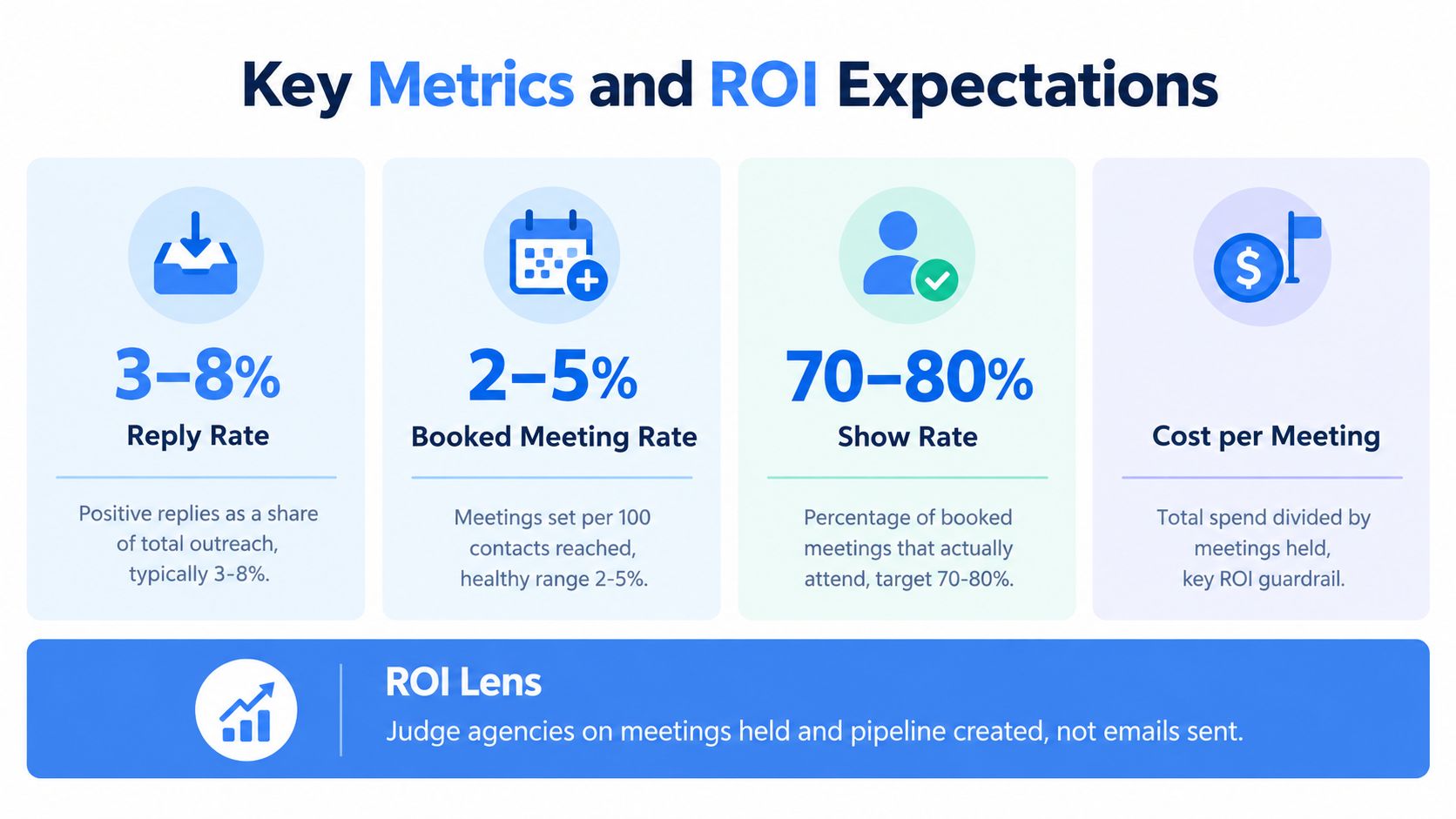
What to ask for in reporting
Start with the booked-meeting rate. Independent benchmark data places outreach meeting rates around 0.5% to 1.2% on average, with stronger execution reaching 1.5% to 3%+, according to KnowledgeNet. Treat this as an early read on whether targeting, messaging, sequencing, and reply handling are working together.
Then inspect the show rate. A calendar full of unattended meetings creates work for sales without producing useful conversations. KnowledgeNet's benchmark places attendance around 70% to 80% unless qualification and confirmation are tightened. Low attendance therefore points to a handoff or process problem, not merely a need for more volume.
How to read the numbers correctly
Replies can hide weak orchestration. A vendor may generate interest from contacts who lack the right role, problem, timing, or buying authority, leaving your team to filter the output. Request the complete chain: reply rate, booked-meeting rate, show rate, qualification outcomes, and meeting-to-opportunity conversion where available.
Practical rule: judge the agency on meetings held and pipeline created, not on emails sent.
As noted above, KnowledgeNet's benchmarks provide context for why conversion remains limited even in a functioning program. Volume cannot compensate for poor targeting or unclear qualification standards. Ask the agency to document those standards, define how replacements work, and report each stage consistently in the written SLA.
The SalesHive appointment-setting benchmark also illustrates why activity totals alone are a weak evaluation measure. Compare vendors on orchestration quality, qualification discipline, and the percentage of booked meetings that your sales team accepts and attends.
Pricing Models and Contract Structures
Pricing is where many deals go sideways, because the cheapest structure is often the easiest one to game. A clean agreement should line up incentives so the agency gets paid for useful meetings, not soft bookings that your team rejects later.
| Pricing Model | How It Works | Best For | Main Risk |
|---|---|---|---|
| Flat Retainer | Fixed monthly fee for outreach and meeting generation | Teams that want predictable spend and steady execution | Risk of paying for activity if qualification is vague |
| Performance-Based | Payment tied to booked or qualified meetings | Buyers who want strong output accountability | Incentive to overbook or relax standards |
| Retainer Plus Performance | Base fee plus variable upside for results | Teams that want balance between stability and outcome focus | Requires clear measurement and reporting rules |
| Pay Per Appointment | Fee only when a meeting is booked | Buyers testing a new motion or vendor | Can reward low-quality meetings if the definition is loose |
What the contract has to define
The core protection is a written definition of a qualified appointment. If that definition is vague, everything else becomes debatable later, from whether the meeting counted to whether the replacement policy applies. The contract should also spell out reporting cadence, handoff expectations, and what happens when the prospect doesn't meet the agreed criteria.
A good structure doesn't just measure volume, it protects against misaligned incentives. If the agency wins by booking anything with a calendar slot, you'll pay for meetings your closers don't want. If they win by holding to qualification standards, your pipeline is more likely to stay clean.
How to Choose the Right Appointment Setting Agency
A useful vendor review starts with a live campaign scenario. Ask the agency to explain how it would handle your ICP, account list, contact data, outreach sequence, positive replies, and sales handoff. The answers should reveal its orchestration quality, qualification standards, and escalation path. Review the written SLA terms with the same care.
Questions that separate strategy from theater
Ask how they define an accepted meeting, verify buying authority, and record the prospect's stated need before booking time. Ask how they handle bounced domains during an active campaign, what deliverability threshold triggers a pause, and what evidence causes a sequence pivot. “We optimize continuously” is not enough without named triggers, owners, and response times.
Clarify what happens after a prospect replies positively. Who qualifies the opportunity, how quickly does the handoff occur, and what happens when the account falls outside the ICP? Request sample reports showing booked meetings, attendance, qualification acceptance, rejection reasons, and follow-up ownership. Send volume and reply rates alone cannot show whether the meetings help sales.
Red flags that usually matter
- Vague meeting definitions: the agency should specify role, company fit, business need, timing, and the evidence required for acceptance.
- Pressure to skip a pilot: a short test can expose list quality, messaging fit, handoff gaps, and deliverability issues before a longer commitment.
- No escalation process: bounced domains, hostile replies, calendar failures, and repeated no-shows need clear owners and response rules.
- Weak data story: ask how contacts are sourced, validated, refreshed, and removed after a bounce or opt-out.
For a broader vendor-evaluation lens, the buyers guide from Big Moves Marketing offers a useful companion. The strongest vendors walk you through the process behind their results and explain which parts can be repeated for your market.
Real Results and Case Benchmarks
A vendor can report strong activity and still leave sales with weak opportunities. Lead Printer's published results offer a useful benchmark for examining how targeting, execution, and output fit together. The agency reports a minimum guarantee of 20 qualified leads per month, with clients averaging around 50 qualified leads per month and some reaching 200 to 300 qualified leads per month. It also reports 7.2 million emails and LinkedIn DMs, 32,000 leads, and more than 2,500 campaigns. These figures are presented in its published case results.
What those outcomes suggest
The reported ramp from about 50 to around 300 leads per month for one client suggests that higher volume can work when list quality, messaging, and localization remain aligned. Scaling sends is straightforward. Preserving qualification standards and useful responses requires tighter coordination across targeting, campaign execution, and handoff.
That orchestration is the part buyers should examine closely. Ask how the agency defines a qualified lead, whether its reported figures refer to accepted opportunities or initial responses, and which written SLA terms govern delivery quality. A large lead total has limited value if sales rejects a high share of the accounts or receives incomplete context.
The results also describe localized outreach for EU markets, showing how language and market context can affect relevance. Published examples involving ÖÖD House, B2B Growth, and ESTO associate campaign value with different outcomes, including warm leads, revenue, and sales opportunities. The right benchmark therefore depends on the buyer's commercial objective and the acceptance criteria agreed before launch.
What matters most is whether a vendor can walk you through the process behind any number it cites and demonstrate that the process can be repeated across campaigns.
Next Steps and How to Get Started
Before you talk to any agency, write down three things, your ICP, your target monthly meeting requirement, and your qualification criteria. If those aren't defined, every vendor will fill in the blanks differently, and you'll end up comparing sales decks instead of operating models.
Then ask each agency the same questions. How do they source data, how do they sequence channels, how do they define a qualified meeting, and what happens when a booked call isn't a fit? If the answers stay vague, move on.
A simple shortlist rule helps. Choose the vendor that can show clear targeting, written SLA terms, transparent reporting, and a realistic explanation of how meetings turn into pipeline. Avoid anyone selling raw volume without showing how quality is protected.
If you want a team that handles outbound infrastructure, multichannel sequencing, qualification, and handoff in one place, Lead Printer builds and runs that workflow for B2B teams. They focus on meeting-ready leads, not vanity activity, and their published process is built for buyers who need pipeline with clear qualification standards.