Appointment setting pricing ranges from $150 to $1,000 or more per meeting by buyer seniority, while the reported 2025 average cost per qualified B2B appointment was $550 to $1,700. The useful comparison isn't the cheapest calendar booking, but the total cost of a held meeting with a prospect your sales team can pursue.
A proposal can look inexpensive because the vendor bills before attendance or qualification is established. Another can look costly because it includes research, infrastructure, and responsibility for replacing unsuitable meetings. To compare them fairly, separate what triggers payment, what qualifies as delivery, and what you spend before the campaign reaches steady operation.
Appointment Setting Pricing Models Compared
What does one meeting cost, and what are you paying for? The answer starts with the commercial model, not the meeting count. A retainer buys delivery capacity, a per-appointment contract buys a defined event, and a hybrid combines a fixed charge with performance-based billing.
SalesOne's appointment-setting services guide publishes monthly retainers of $2,000–$5,000, scheduled-meeting fees of approximately $75–$500, and hybrid arrangements of roughly $2,000–$4,000 upfront plus $150–$400 per meeting. These are published market ranges, not quotes for your target audience or campaign.
Appointment setting pricing models and typical costs
| Model | Typical price | You pay for | Main risk |
|---|---|---|---|
| Monthly retainer | $2,000–$5,000 per month | Campaign capacity and activity across the month | Paying for weak meetings if targeting is loose |
| Pay-per-appointment | $75–$500 per scheduled meeting | Each meeting the vendor books | No-shows raise the real cost per held meeting |
| Hybrid | $2,000–$4,000 upfront plus $150–$400 per meeting | Setup work plus a performance charge | Higher total spend; higher-touch programs can exceed these levels |
A monthly retainer makes budgeting straightforward, but the contract still needs an acceptance standard. A vendor can satisfy a calendar-volume target without delivering prospects who match your product, geography, or purchasing role.
Pay-per-appointment makes the bill move with delivery. However, the vendor's responsibility might end when someone accepts an invitation, not when that person attends or passes your fit checks.
With a hybrid, establish whether the base charge pays for initial infrastructure, continuing campaign management, or both. Otherwise, you can't tell whether you're paying separately for work already included in the meeting fee.
Choose the unit before choosing the model
The important commercial shift is from paying for activity toward paying for verified outcomes. Calls made and invitations accepted are easier to count than buying relevance, but they aren't interchangeable deliverables.
Practical rule: Write the billable event into the agreement before negotiating its price.
Keep adjacent services separate, too. MedicalVirtual's Medical Virtual Assistants resource is relevant when evaluating healthcare administrative support, but administrative scheduling shouldn't be treated as equivalent to outbound prospect acquisition.
Use a sales outsourcing pricing comparison to identify what operational work belongs inside the fee. Choose a retainer for a fixed spending commitment, per-appointment billing when spend should rise with accepted delivery, or a hybrid when both parties share campaign risk. In every case, define whether qualified describes a booked appointment, an attended meeting, or a prospect who satisfies written fit criteria.
What Drives the Price Up or Down
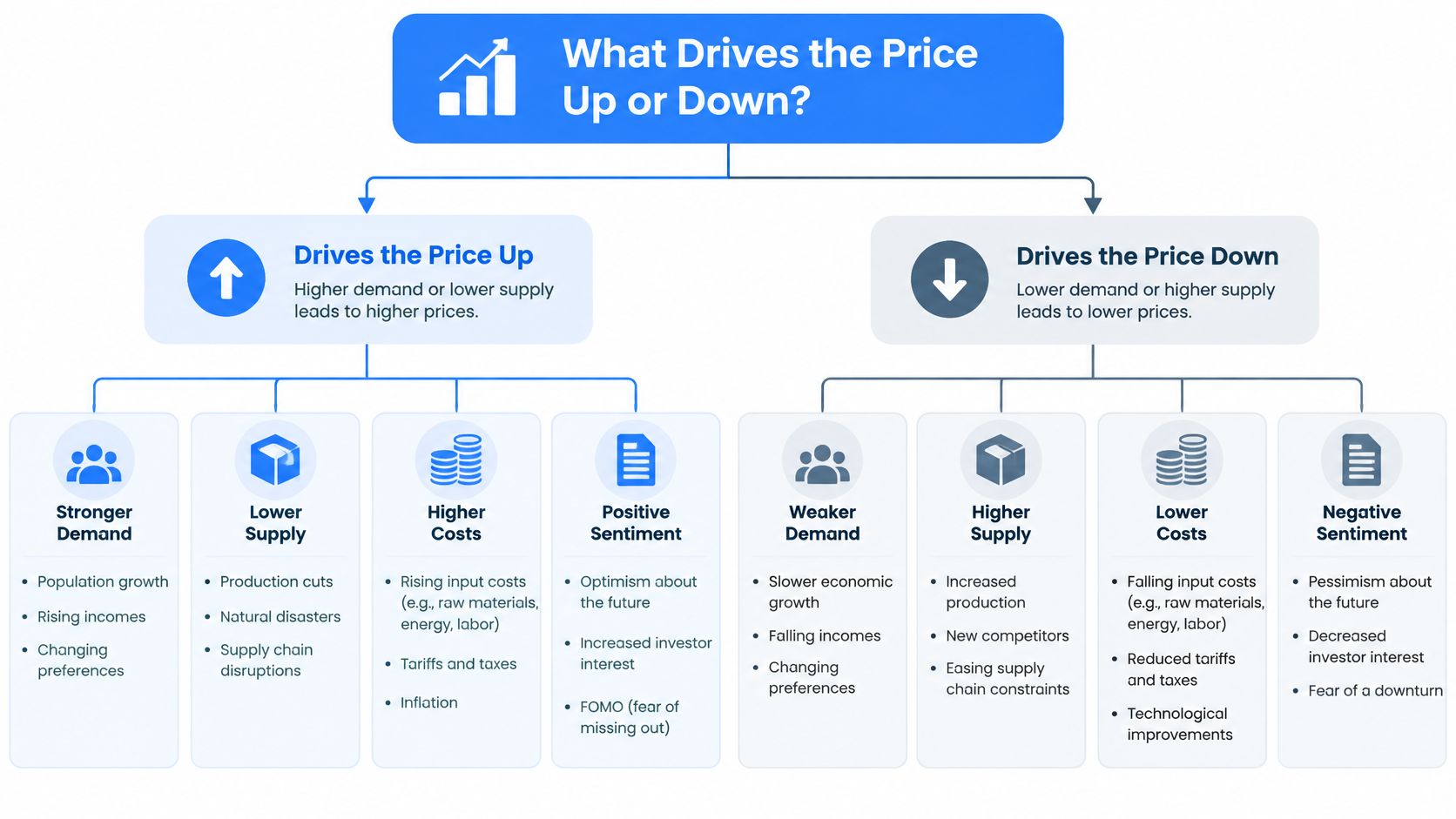
Price follows the work and risk required to produce an acceptable meeting, not the number of invitations sent. A useful proposal makes that work visible instead of hiding everything inside a single unit price.
The following diagram organizes the factors to examine when comparing campaign scope.
Research and qualification effort
- Targeting difficulty. A narrowly defined fintech buyer list requires different research from a broad list of business owners. Ask: How many relevant contacts must you research to produce an accepted meeting, and which exclusions do you apply?
- Qualification depth. Confirming title and company size isn't the same task as establishing a relevant problem and willingness to discuss it. Ask who has authority to accept or reject delivery when the vendor and your salesperson disagree.
These questions expose whether a low quote reflects efficient execution or a lighter service. For example, using LinkedIn Sales Navigator to identify a role doesn't establish that the company has the operating conditions your product requires. That may need website research, enrichment, and manual review.
Channels, markets, and commitments
Multichannel outreach adds coordination. Email and LinkedIn messages need consistent positioning, suppression rules, reply handling, and ownership of the next action. Ask which channels, tools, and response-management tasks the quoted fee includes.
Localization needs its own scope. Translating English copy isn't equivalent to reviewing terminology, buyer roles, and the commercial proposition for a local market. For EU campaigns, ask whether native review, market-specific prospect research, and localized testing appear as separate deliverables.
A volume guarantee creates a different allocation of risk. The contract should identify whether a missed commitment results in additional delivery, a credit, a refund, or no financial remedy.
| Driver | What to inspect in the proposal |
|---|---|
| Narrow audience | Research sources and exclusion rules |
| Strict qualification | Acceptance owner and evidence required |
| Additional channels | Included execution and reply handling |
| Localization | Translation, native review, and market segmentation |
| Delivery commitment | Written remedy for missed delivery |
Don't assume an unusually low quote is wrong. Ask which task the vendor has removed, automated, or transferred to your team. If nobody can explain the difference, you don't yet have comparable offers.
Price Benchmarks by Buyer Seniority
SMB and mid-market decision makers, vice-presidents, and enterprise executives shouldn't be placed in the same pricing bucket. The relevant question is whether the fee reflects the access and qualification work required for your actual buyer, rather than an agency's blended meeting volume.
The seniority bands below are directional published ranges. They aren't consistently defined as booked-only prices, so don't assume that every offer within a band includes attendance or verified qualification.
Per-meeting price bands by buyer seniority
| Buyer level | Typical fee per meeting | What raises it |
|---|---|---|
| SMB and mid-market decision makers | $150–$400 | Tighter qualification and list research |
| Vice-president level | $400–$700 | Harder access and stricter fit criteria |
| Enterprise and C-suite | $700–$1,000 or more | Longer research and executive-level messaging |
| Blended cost per qualified B2B appointment, 2025 | $550–$1,700 | Reported average range, citing Clutch data |
For the blended comparison, Smartlead reports that SalesAR, citing Clutch data, placed the 2025 average cost per qualified B2B appointment at $550–$1,700. That is a reported range, not a universal average price or an enterprise-only benchmark.
Seniority changes the task the appointment setter must perform. An executive-focused campaign needs a reason for that specific person to engage, not merely a personalized greeting. Research into responsibilities, organizational priorities, and purchasing influence becomes part of the delivery scope.
Use the benchmark without misreading it
Find the tier that matches the person your sales team needs to reach. Then check whether the vendor is targeting that person directly or booking someone who might introduce you later. Both conversations can be useful, but they aren't the same purchased outcome.
A meeting with a senior title isn't automatically a qualified opportunity. The prospect must also have a relevant role in the purchase.
A cheaper booking can consume more sales time if your representative must discover basic fit during the call. A better-qualified conversation can justify a higher acquisition fee, but only if the qualification evidence is available for inspection.
Before accepting a blended quote, request a breakdown by buyer role, delivery definition, and target market. The published bands don't establish a regional price schedule. Localized copy, native review, and separate data sourcing should therefore be explicit line items, not unexplained additions to a global meeting fee.
How to Calculate Your Cost per Qualified Opportunity
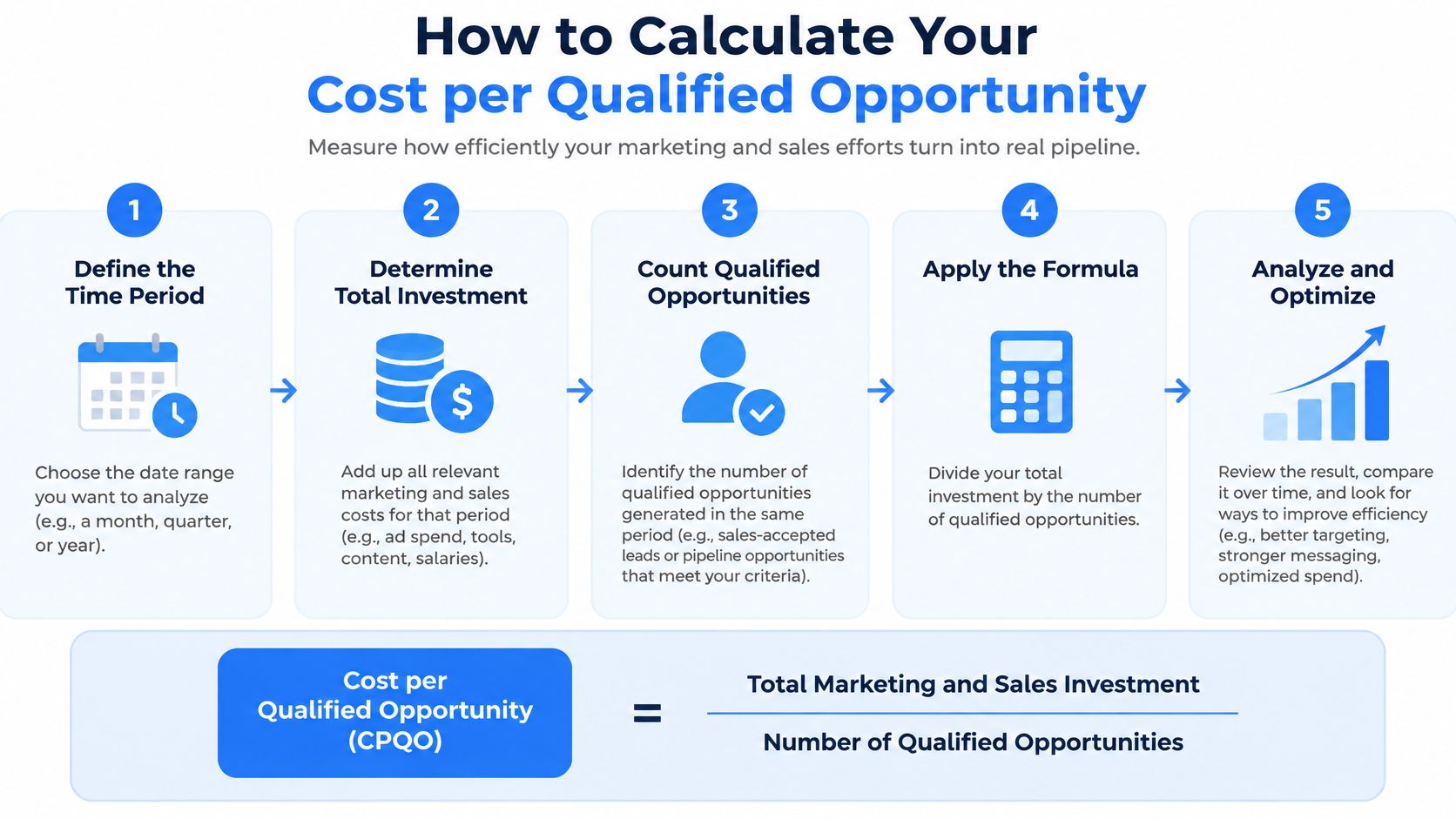
Start with the denominator your finance and sales teams really need. Booked meetings, held meetings, qualified conversations, and accepted opportunities are different funnel stages. A cost calculation becomes misleading when the invoice counts one stage and the performance report counts another.
The calculation should follow delivery through to acceptance.
Work through attendance first
Tomba's B2B lead-generation guide illustrates a $300 meeting fee, 200 scheduled meetings, and a 20% no-show rate, leaving 160 delivered meetings at an effective cost of $375 each, a 25% increase over the headline price.
The arithmetic behind that example is:
- Count scheduled delivery. Use the calendar bookings that triggered charges.
- Remove nonattendance. Apply the observed attendance rate, not the vendor's booking count.
- Calculate acquisition spend. Multiply the scheduled-meeting fee by billed bookings, then include applicable campaign charges.
- Divide by meetings received. Acquisition spend divided by held meetings gives the attendance-adjusted unit cost.
- Apply qualification and opportunity acceptance. Divide by the held meetings that pass your written criteria, then separately calculate cost per sales-accepted opportunity.
Don't insert an assumed qualification rate into the forecast and treat it as observed performance. Pull the accepted count from your CRM and record rejection reasons, such as wrong geography, insufficient company fit, or no relevant purchasing role.
Distinguish a qualified lead from an opportunity
Our clients book a meeting for every 3–4 leads, and they need 10–20 leads to close a sale. Those are distinct conversion relationships, not permission to label every lead an appointment or every appointment an opportunity.
Use a shared lead qualification definition before setting CRM stages. Then track salesperson time spent on rejected meetings as an additional cost, using recorded time and your internal loaded labor rate.
For a complementary explanation of appointment-setting economics, use the video below alongside your own funnel report.
Your final comparison should show acquisition-only cost and fully loaded cost separately. That lets you see whether a vendor saves money on the invoice by transferring qualification work to your sales team.
Sample Pricing Scenarios for SaaS, Ecommerce and Services
The following are hypothetical budget scenarios, not published industry averages or offers from Lead Printer. Each assumes the stated scheduled volume is delivered; none assumes that every booking attends, qualifies, or becomes pipeline.
The useful distinction is between a recurring operating fee and a one-time launch expense.
Sample monthly pricing by industry
| Scenario | Pricing model | Monthly volume | Monthly cost | Cost per meeting |
|---|---|---|---|---|
| B2B SaaS, VP-level buyers | Assumed $550 per scheduled meeting | Assumed 12 meetings | $6,600 | $550 scheduled |
| Ecommerce brand selling to merchants | Assumed $3,000 setup, then $250 per meeting | Assumed 16 meetings | $7,000 initially; $4,000 thereafter | $437.50 initially; $250 thereafter |
| Professional services, SMB owners | Assumed $3,000 monthly retainer | Assumed 20 meetings | $3,000 | $150 scheduled |
For B2B SaaS, the illustrative calculation is $550 × 12 = $6,600. The unresolved issue is the delivery obligation: a proposal for scheduled conversations isn't equivalent to one that requires attendance before billing.
The monthly total also doesn't establish who handles interested replies, rescheduling, or technical questions before the call. If your account executives must perform that work, assign it an internal owner and budget rather than treating it as free.
For ecommerce selling to merchants, the hypothetical first-month calculation is $3,000 + ($250 × 16) = $7,000. Without another setup charge, the same scheduled volume costs $4,000 in a subsequent month.
Separate launch economics from recurring delivery
In that ecommerce scenario, a hypothetical 90-day budget with unchanged monthly volume totals $15,000, including setup, across 48 scheduled meetings, or $312.50 per scheduled meeting. That blended figure is more informative for launch approval than the recurring meeting fee alone, but it still isn't a qualified-opportunity cost.
For professional services, the hypothetical retainer calculation is $3,000 ÷ 20 = $150 per scheduled meeting. The apparent efficiency depends on delivering the assumed volume; unused capacity remains a buyer risk unless the agreement specifies a remedy.
Budgeting check: Show launch-period cash spend and recurring unit economics separately. Neither number substitutes for the other.
Don't turn these examples into sector benchmarks. For manufacturers, the cited comparisons don't establish a sufficiently specific industry price band. Request a proposal built around distributor, procurement, engineering, or owner-level targets, with the same separation between research scope, scheduled delivery, and accepted opportunities.
Contract Terms and Guarantees That Change the Price
A monthly rate isn't the full cost of starting an outbound program. During the launch period, the vendor may be building infrastructure and validating the market while your team is waiting for usable pipeline.
Sales Focus's appointment-setting comparison describes published programs ranging from roughly $2,500 monthly plus setup to about $10,000 per four-week cycle. These aren't equivalent scopes or billing periods, which is precisely why a headline-rate comparison can mislead.
Separate setup from campaign billing
Setup can include inbox creation, warm-up, data validation, list building, copywriting, localization, and deliverability safeguards. Ask for a 30-, 60-, and 90-day plan that distinguishes completed launch work from campaign outcomes.
At Lead Printer, setup takes 3–4 weeks and includes infrastructure setup and warm-up, onboarding, copywriting, and list building. We charge for the campaign period, when emails are going out and leads are coming in, rather than charging separately for the setup period.
Clients can choose a one-month campaign commitment instead of the three-month commitment, but that shorter option includes an additional setup fee. Distinguish that fee from charging for elapsed setup time when comparing commitment options.
Mark each term present, absent, or unclear
| Contract term | Evidence to request | Your status |
|---|---|---|
| Setup scope | Named deliverables and any additional charge | Present, absent, or unclear |
| Ramp milestones | Infrastructure, testing, and launch checkpoints | Present, absent, or unclear |
| Optimization | Included work and when it begins | Present, absent, or unclear |
| Pause rights | Notice requirements and billing treatment | Present, absent, or unclear |
| Cancellation | Exit date, notice, and remaining liability | Present, absent, or unclear |
| Refund remedy | Trigger, exclusions, and claim procedure | Present, absent, or unclear |
| Unused capacity | Carryover, replacement, credit, or forfeiture | Present, absent, or unclear |
A guarantee should cover an outcome the provider can control and define. We don't operate on a pay-per-close model and don't guarantee closed revenue or a number of clients.
Keep that distinction when evaluating promises from any vendor. A lead-delivery commitment doesn't eliminate your responsibility for discovery, commercial fit, proposal quality, or closing.
Finally, compare launch campaigns with launch campaigns. A mature program has already accumulated targeting and response information; a new market requires validation. Require the proposal to identify which costs end after launch and which continue for as long as delivery continues.
Vet Your Vendor Before You Sign
A credible proposal should survive a written acceptance test. Send the same requests to every shortlisted provider so that a persuasive sales conversation doesn't replace a comparable contract.
Use the checklist as a procurement record, with an owner assigned to each unresolved item.
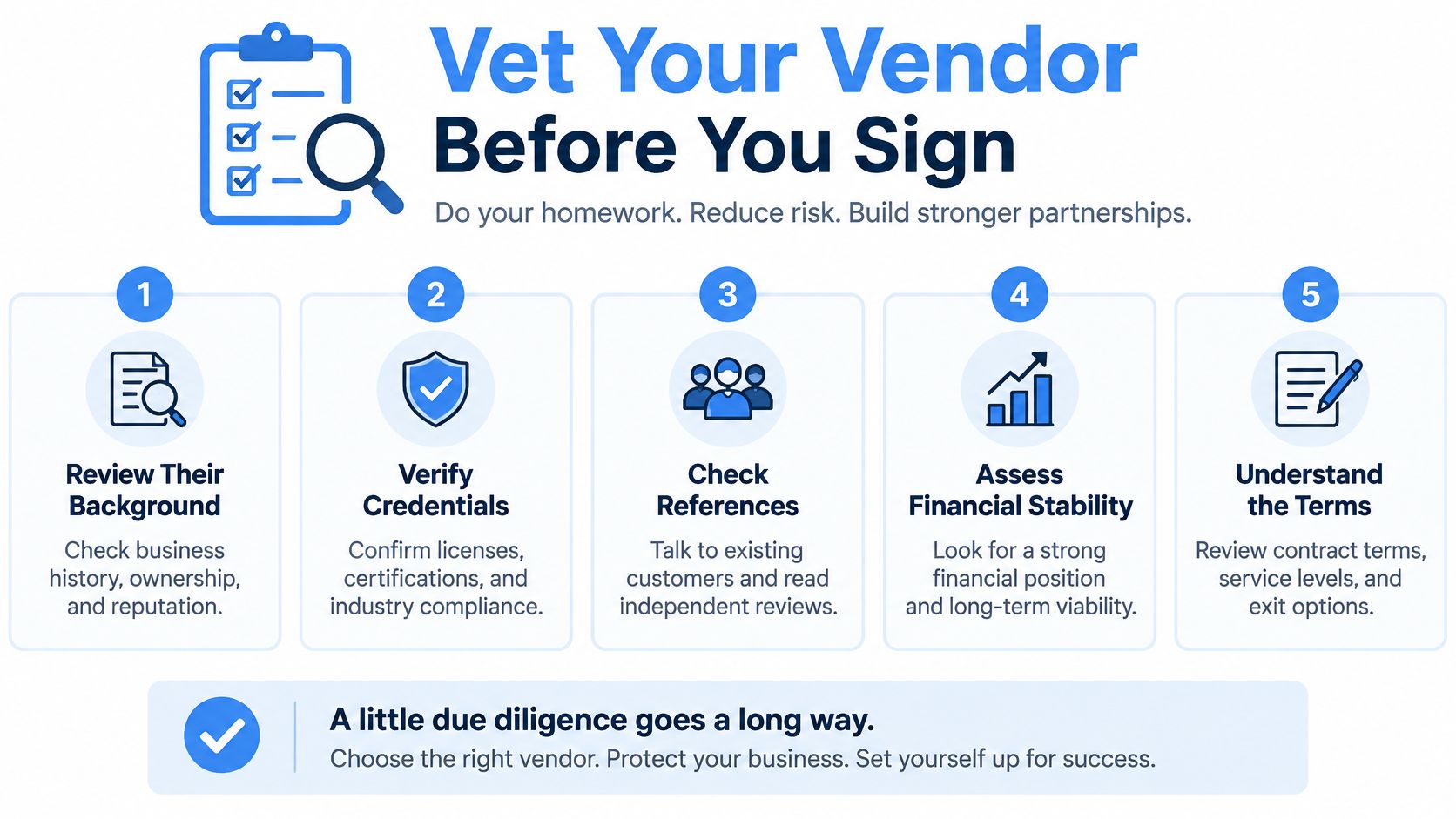
Request answers you can enforce
Qualified lead definition. Request a written definition of an accepted lead and the named person responsible for resolving disputed fit. Follow up by asking what evidence accompanies delivery and whether your sales operations team can reject it against the agreed criteria.
Price basis. Request that the agreement state whether billing applies to scheduled, held, or qualified meetings. Ask the vendor to explain how a rescheduled conversation appears on both the invoice and the performance report.
Replacement policy. Request free replacements for no-shows and meetings outside the agreed profile, including the claim deadline. Confirm that the remedy appears in the agreement rather than only in an email or sales presentation.
Reporting. Request separate counts for booked, held, qualified, and opportunity-stage outcomes. Ask who reconciles CRM records with the invoice when a prospect changes status after reporting closes.
Review rights. We let clients review messaging, lead targeting, and personalization strategy before campaigns go live. For competing proposals, establish whether approval is a contractual right and who authorizes subsequent changes.
Proof. Request case results with clearly defined outcomes and a reference you can contact. Ask whether the result describes leads, appointments, accepted opportunities, or closed business before comparing it with your target.
Match the vendor category to the job
If your requirement includes administrative intake rather than outbound acquisition, Attorney Assistant's resource can help you compare intake and scheduling vendors. Keep that shortlist separate from providers responsible for researching and engaging new B2B prospects.
For outbound, compare the scope of B2B appointment-setting services against your acceptance checklist. We guarantee a minimum of 20 qualified leads per month, while most clients receive about 50; our promise is 20+ qualified leads within 30 days, or a refund.
Those are lead commitments, not held-meeting or revenue guarantees. Bring that same distinction to every proposal before you approve spend.
Lead Printer offers a free 45-minute pipeline audit that maps your ideal customer profile and estimates how many qualified leads outbound can generate each month. Bring your vendor quotes and acceptance checklist, then visit Lead Printer to request the audit and establish a target cost per qualified opportunity before committing to a campaign.