Your sales team has a CRM full of names, a collection of outreach tools, and too little time for actual conversations. Reps build lists between calls, follow-ups slip, and nobody can explain whether a quiet campaign has a targeting problem or an inbox-placement problem.
A sales automation agency should take responsibility for that operational work, not just send more messages. The buying decision comes down to what the agency runs, where people validate its output, and whether its reporting lets you distinguish genuine pipeline from activity.
What a Sales Automation Agency Delivers
Your reps should spend their hours in discovery calls and follow-ups. An agency earns its fee by running the machinery behind those conversations: data sourcing, sending infrastructure, message sequencing, reply handling, and handoff reporting.
That machinery only works when each part connects cleanly to the next. A verified list means little if domains are not authenticated. Strong copy fails if replies sit unanswered for two days. I recommend buyers judge an agency on how it connects those steps, not on how many messages it promises to send.
Lead Printer provides outbound lead generation with sales automation. The work includes combining databases from Google Maps and LinkedIn scraping with AI sales research to build prospect databases for clients.
Core services and what you receive
| Service | What the agency does | What you receive |
|---|---|---|
| Email deliverability setup | Authenticates domains, creates inboxes, and runs warm-up | Inbox-ready sending infrastructure |
| Prospect research | Builds lists from role, map, website, and registry sources | Verified prospect database |
| Data enrichment | Adds firmographic and role context to raw records | Ideal customer profile segments |
| Multichannel sequencing | Coordinates email and LinkedIn DMs with branching rules | Automated sequences that pause on reply |
| Personalized copywriting | Writes messages tied to segment, role, and offer fit | Unique sequence copy per segment |
| Qualification and handoff | Manages replies and books calendars | Meeting-ready opportunities for your team |
Email deliverability setup supplies the technical foundation. Authentication, mailbox creation, and controlled warm-up belong in scope. Check what the agency monitors after launch: bounce rate, spam complaints, and reply distribution by domain. Inbox readiness at setup does not guarantee placement three weeks later.
Prospect research determines who enters the campaign. Role filters help, while map listings, company sites, and business registries can surface companies that large contact databases miss. Ask how exclusions are handled. Existing customers and open opportunities should never enter a cold sequence.
Data enrichment and segmentation turn records into usable audiences. Added attributes are useful only when they create a clear reason to contact that segment now. A usable output groups accounts by a shared problem and a matching offer, not by extra columns in a spreadsheet.
Multichannel sequencing coordinates email and LinkedIn activity around one set of rules. Personalized copywriting should reflect the segment's role, geography, and likely constraints. A rewritten first line helps little when the problem statement misses.
Qualification and handoff convert responses into work your team can continue. Insist on the full thread, evidence of fit, open questions, and the agreed next step on the calendar. That record is where human judgment stays in the process, since automation cannot decide whether a vague reply deserves a meeting.
Identify the missing work
Coverage applies across B2B SaaS, ecommerce and payments, professional services, and manufacturing. The targeting logic changes with the buyer, so a sequence that works for operations managers rarely fits finance owners without revision.
Before comparing providers, mark each service above as working internally, missing, or needing repair. If list building is solid but inbox management slips, pay for help at that bottleneck instead of a full rebuild. A short audit of where follow-ups stall often shows which row of the table matters most.
How an Automated Outreach Campaign Runs
A missed handoff stalls a campaign faster than bad copy. The agency waits for approval, the client assumes sending started, and an interested reply sits with no owner.
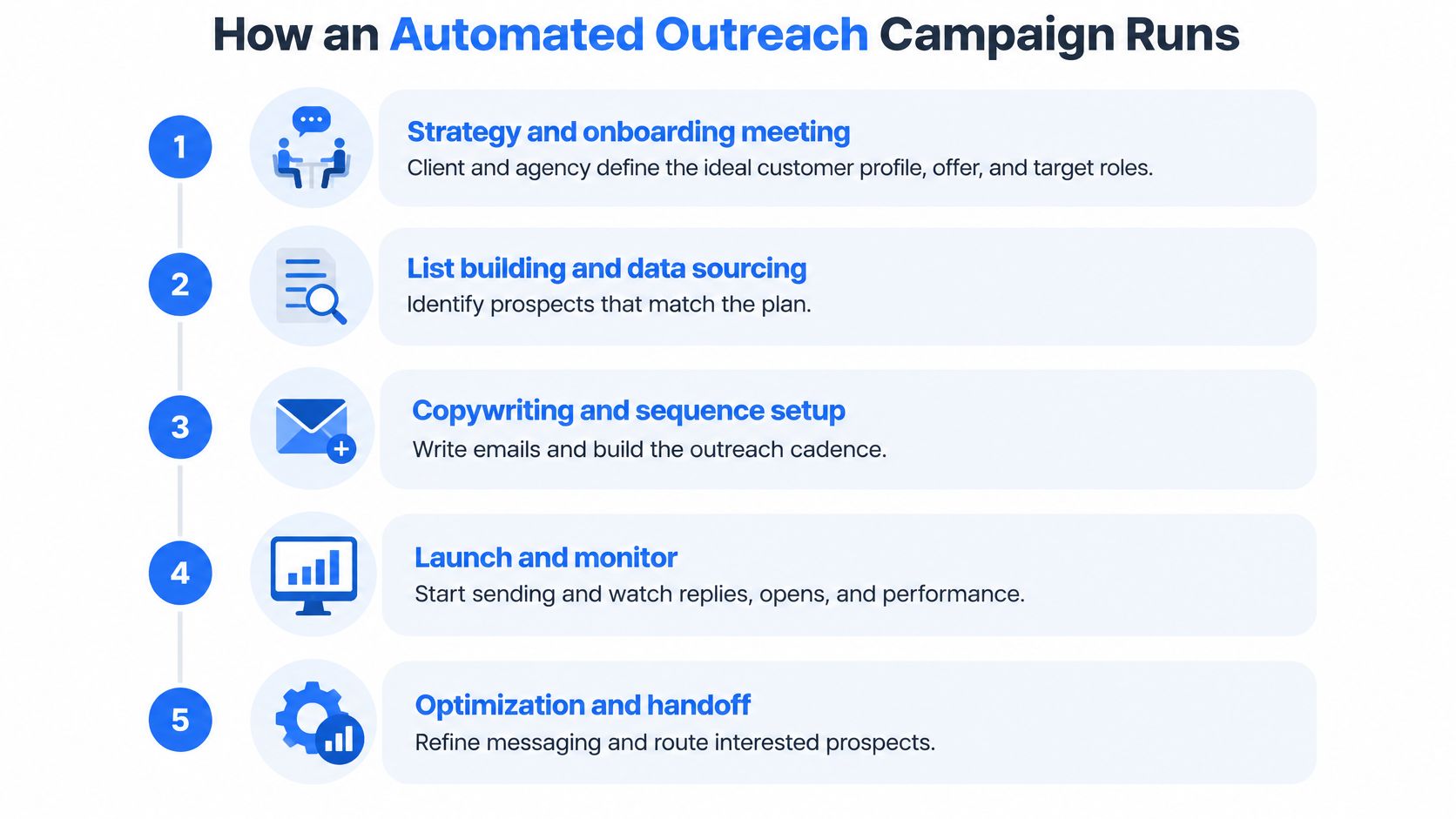
The sequence below shows who does what, and in which order. Clear ownership at each step prevents that stall.
From onboarding to a live campaign
Strategy and onboarding, client and agency. Define the ideal customer profile, offer, target roles, and exclusions together. Bring examples of strong customers and poor-fit accounts. Exclude existing customers, open opportunities, and companies your team should not approach.
Email infrastructure setup, agency. Configure authentication, create mailboxes, and warm them up before volume rises. At the same time, agree who owns the accounts and what access the client keeps.
Research, agency. Build the prospect database from Google Maps, LinkedIn Sales Navigator, targeted websites, and relevant registries. Enrich with firmographic and buying context using Clay and scraping, then verify the accounts match the agreed audience.
Copywriting, agency with client sign-off. Draft sequences based on deep research, including technology stack analysis, mutual connections and competitive intelligence. The client approves positioning and commercial claims, not only tone and spelling. The setup period includes this work alongside infrastructure, warmup, onboarding, web scraping and AI sales research automation.
Launch and orchestration, agency. Coordinate email and LinkedIn touches with rules tied to prospect status. A reply stops scheduled prospecting messages and moves the thread to review. Live buying signals time outreach around relevant changes instead of treating every account as equally ready.
Qualification and handoff, client's sales team with agency support. The agency handles initial replies and scheduling within the agreed scope. The client checks commercial fit, takes ownership of the conversation, and gets the context needed for the call.
Coordination matters more than extra touches
In McKinsey's 2021 B2B Pulse research on omnichannel in B2B sales, 83% of B2B decision-makers considered omnichannel selling more successful for prospecting and securing new business than traditional face-to-face-only approaches. The finding supports coordinated coverage across channels, not higher send volume.
Take a prospect who asks a technical question by email. A disconnected system fires an unrelated LinkedIn pitch the next day. A controlled system preserves conversation state across channels, pauses the sequence, and routes the question to a person for an answer.
Operational rule: Automate the next appropriate action, not merely the next scheduled action.
Our B2B outbound lead generation approach runs these stages as one managed campaign. Before launch, map each stage to an owner, a completion window, and an approval requirement. Unassigned work creates launch risk.
Email Deliverability as the Control Layer
Weak authentication can cause rejection or filtering. Poor list hygiene can create bounces and complaints, weakening mailbox-provider trust and reducing inbox placement. Your effective audience shrinks before you can meaningfully test the message.
This diagram shows why infrastructure belongs in campaign management, not just onboarding.
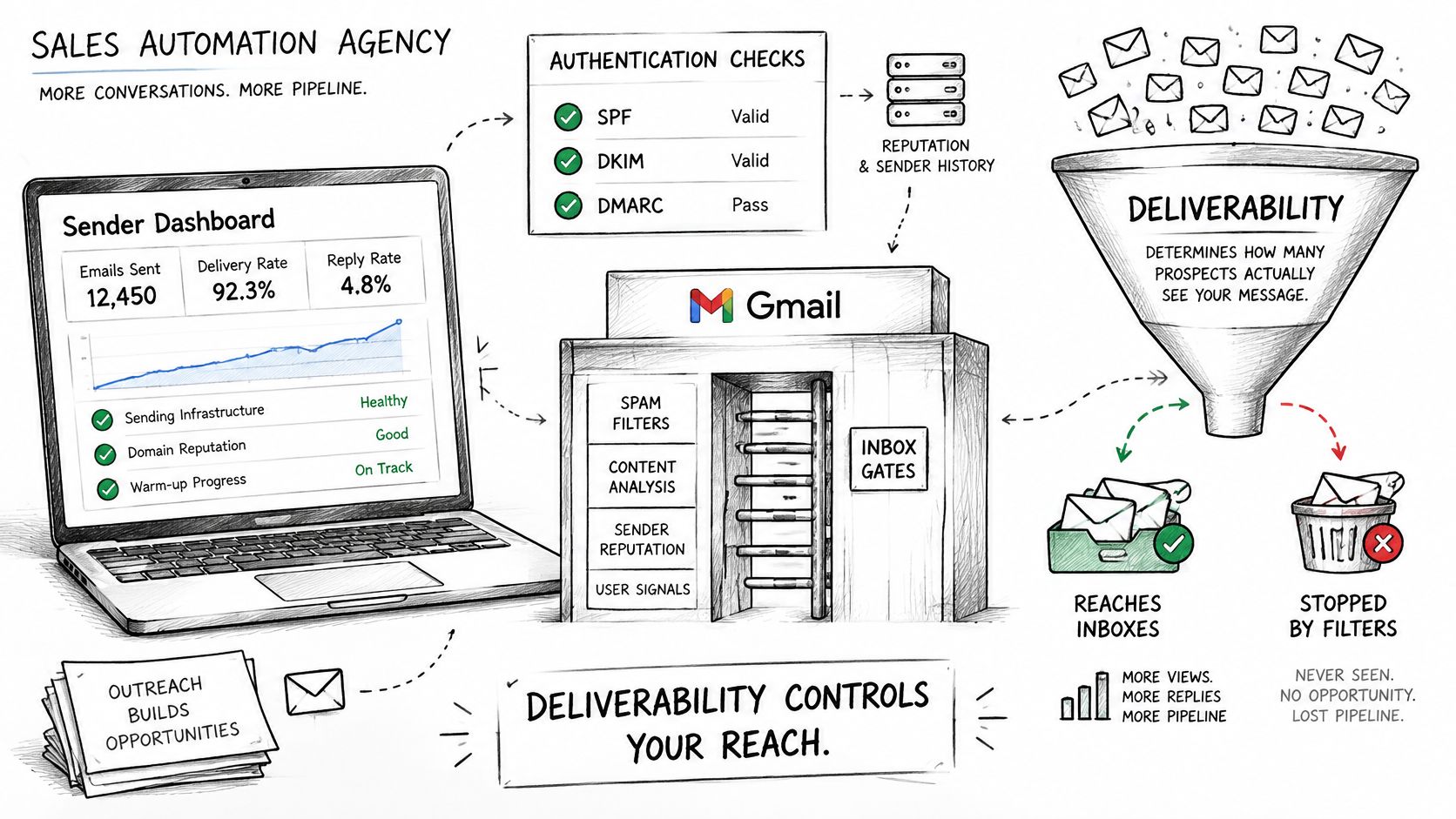
According to Google's email sender guidelines, senders to Gmail accounts must implement at least SPF or DKIM, while bulk senders must use SPF, DKIM, and DMARC; sending domains or IPs also need valid forward and reverse DNS records. Google recommends keeping user-reported spam rates below 0.1% and preventing them from reaching 0.3%, where inbox-delivery support and mitigation eligibility can be affected.
Controls that belong in daily operations
- Separate sending infrastructure. Use clearly attributable outreach domains separate from the primary corporate domain. Separation helps manage risk, but it isn't permission to send irrelevant messages.
- Check identity alignment. Ensure the From domain aligns with the appropriate authenticated identity. A record existing isn't enough if the message doesn't use it correctly.
- Limit sending volume. Our maximum is 20 emails per mailbox per day, with a maximum of 60 emails per domain per day. These are our operating limits, not a universal guarantee of safe delivery.
- Suppress unsuitable contacts. Remove invalid addresses and uninterested recipients immediately. Keep suppression records available across campaigns.
- Monitor and intervene. Review complaint and bounce trends daily. Reduce or pause sending when reputation indicators deteriorate instead of compensating with more volume.
Our email-domain warm-up guidance explains the preparation involved. Warm-up doesn't replace relevant targeting or continued monitoring once real outreach begins.
We send plain-text, no-HTML emails with no images, links, or open-rate tracking. That choice keeps the message format simple, but it doesn't make authentication or recipient relevance optional.
Use this video alongside a review of the agency's operating controls.
Demand separate reporting layers
Reports should distinguish sent volume, authenticated delivery, inbox placement, positive replies, meetings, and complaints. Ask how each is measured, especially inbox placement, which isn't established merely because a receiving server accepted a message.
A strong meeting total doesn't prove infrastructure is healthy. If the agency achieves it while complaints rise, your next campaign may start with damaged domains and an interrupted pipeline.
Where Automation Ends and Human Judgment Begins
The claim that automation replaces salespeople confuses task execution with commercial judgment. Software can assemble evidence and draft a response. Someone still needs to decide whether the evidence is true and the response is useful.
In a Gartner survey of 645 B2B buyers, 67% preferred a rep-free buying experience, yet 69% wanted to validate AI-generated insights with a sales representative. Self-directed discovery and human validation aren't opposites. Buyers can want both.
Automate versus human review by task
| Task | Automate | Human review |
|---|---|---|
| Prospect list building | Scraping, enrichment, and scoring | Spot-check ICP fit for edge accounts |
| Trigger detection | Flag accounts with live buying signals | Confirm the trigger is real and still current |
| Personalization | Draft lines from tech stack and role data | Verify every factual claim before launch |
| Reply handling | Pause the sequence on any response | Classify curiosity versus buying intent |
| Qualification | Score fit and engagement | Decide whether the opportunity is meeting-ready |
| Handoff | Book the calendar and send context | Brief the rep on questions and objections |
Consider an automated opening that congratulates a company on a product launch that never happened. The sentence may sound polished, but the recipient now has a reason to distrust everything that follows.
The reviewer should check the original announcement, its date, and whether it refers to the correct company. If the evidence isn't available, remove the claim rather than asking the model to make it sound more believable.
Inbox access also needs boundaries. If you're evaluating how to give agent access to inbox, Sickle offers a relevant resource to examine alongside your permissions policy. Decide what an agent may read, draft, or send, and require human approval for sensitive replies or unsupported commercial statements.
Keep conversion responsibility explicit
We generate leads; the client's team closes them. Agree who answers product questions, handles objections, and follows up after a meeting before the campaign starts.
A prospect who requests information hasn't necessarily agreed to a sales meeting.
Human validation should leave evidence in the reporting. Track personalization accuracy, qualification reliability, show rate, and opportunity acceptance. Also review whether prospects who challenged an automated claim received a useful answer rather than another canned response.
For a practical audit, select a small sample of recent automated messages. Check every factual claim against its original source, then inspect the replies and handoff notes. You'll learn more about operational quality from that trail than from a polished personalization demo.
Agency Versus an In-House Outbound Team
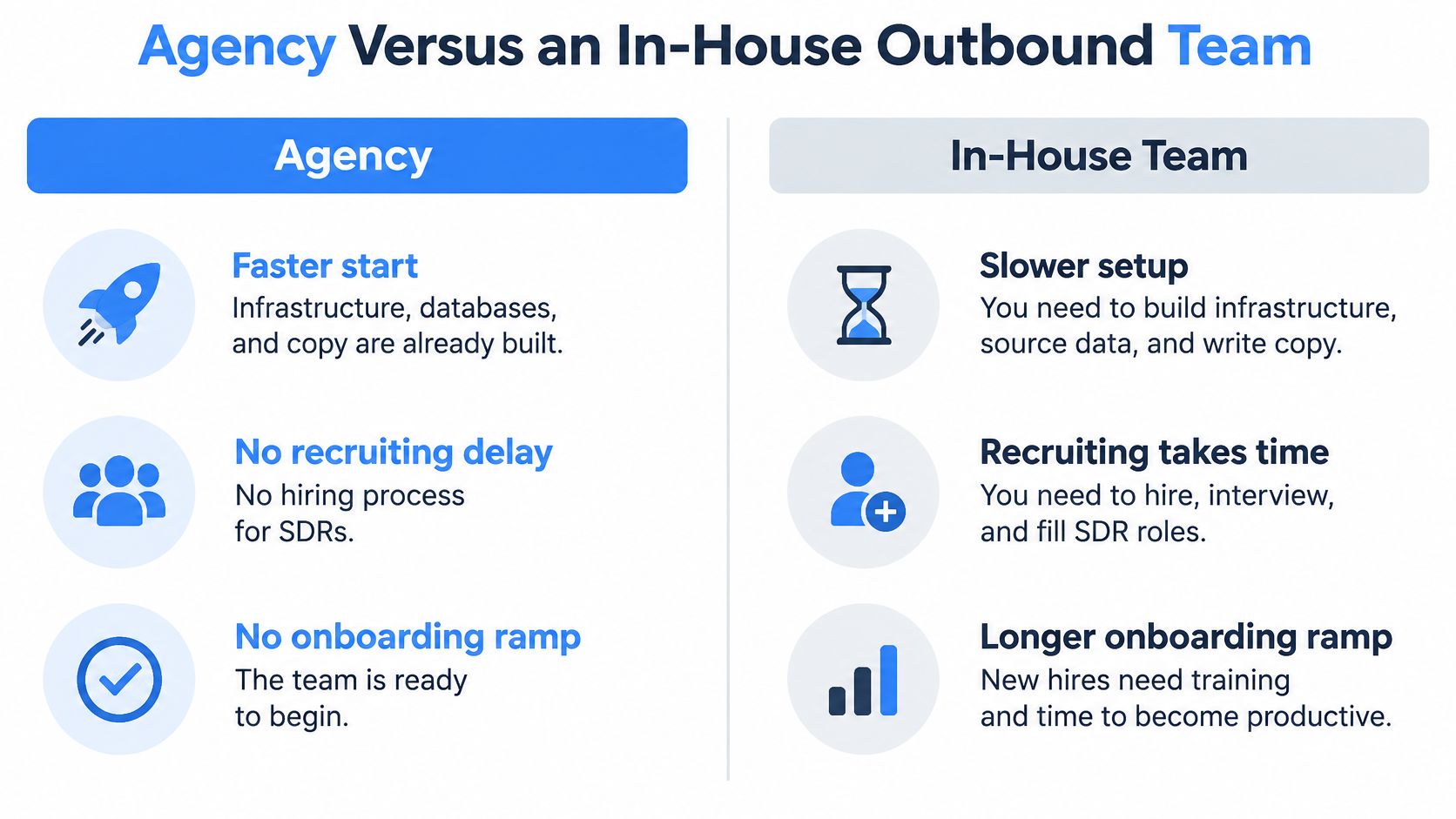
An agency buys execution capacity. An in-house team builds a capability you directly manage. Neither choice removes the need for a good offer, clear targeting, or competent sales follow-up.
This comparison illustrates the staffing and setup trade-offs.
Agency versus in-house outbound at a glance
| Factor | Agency | In-house |
|---|---|---|
| Time to first campaign | Established infrastructure, database workflows, and copy processes | Hiring, onboarding, and SDR ramp time |
| Tooling and skills | Access to Clay and LinkedIn Sales Navigator, with deliverability expertise | Tooling and deliverability skills must be built or hired |
| Control | Less direct control over message nuance, prospect data, and sender reputation | Direct control over messaging, data, and sender reputation |
| Knowledge | Can stay with the vendor unless documented | Product knowledge, brand voice, and institutional memory build over time |
| Feedback loop | Reported through the provider's process | Direct feedback from live calls |
| Cost model | Campaign-period pricing; our standard setup isn't charged separately | Headcount and tooling costs continue regardless of output |
An established agency can start faster because it doesn't need to recruit an outbound team or invent its delivery process. It still needs to research your market and prepare campaign-specific assets. Treat claims of instant launch cautiously when your product requires detailed explanation.
Our standard engagement charges only for the campaign period, when emails are going out and leads are coming in. A one-month commitment is an alternative that includes an additional setup fee, so the written proposal should identify the applicable arrangement.
Buy expertise, not access to AI
In HubSpot's 2025 State of Sales survey, 84% of sales representatives said AI saves time and optimizes processes. Separately, Seamless.AI's 2025 AI in Sales Insights Pulse Report found that 74% of respondents use AI to craft personalized messages or outreach.
Software access alone isn't a convincing reason to outsource. Compare the agency's judgment, process ownership, and available capacity with what your team can realistically maintain.
For staffing-budget planning, Filta's staffing cost breakdown for Florida agencies offers a contextual resource. Build your own comparison around management time, recruiting, training, and tools, not salary alone.
Choose an agency to test a market, segment, or channel quickly. Build internally when outbound is a permanent core capability and you have staff to operate it. Either way, document targeting decisions and campaign learnings so knowledge remains usable.
Evaluate Agencies on Proof, Pricing and Compliance
Provider evaluation criteria and red flags
| Criterion | What good looks like | Red flag |
|---|---|---|
| Outcome KPIs | Replies, meetings held, opportunities, and pipeline value | Only sent volume or open rates |
| Case studies | Named client, sector, timeframe, and lead counts | Anonymous logos without numbers |
| Pricing | Clear retainer or campaign fee and scope | Hidden setup fees or vague deliverables |
| Guarantee | Minimum qualified leads with written refund terms | No definition of qualified |
| Deliverability controls | Domain separation, warm-up, and complaint monitoring | Volume promises without infrastructure details |
| Compliance | Clear sourcing, opt-out handling, and regional rules | No explanation of contact origins |
Define the outcomes before comparing proposals. A qualified reply meets your agreed fit and intent criteria. A held meeting happened. An accepted opportunity is one your sales team agrees to pursue, and pipeline value should follow your CRM's opportunity rules.
Use consistent denominators for conversion rates. Deduplicate activity at account level so email and LinkedIn responses from the same buying group don't inflate performance.
Put guarantees into commercial context
Our stated minimum is 20 qualified leads per month, with an average of about 50 per client and refund terms. Verify the qualification definition, exclusions, reporting period, and refund conditions in the contract rather than relying on headline wording.
Our clients book meetings with every 3–4 leads and need 10–20 leads to close a sale. Applying that stated range to the monthly floor suggests roughly one to two sales, not a promised closing result. Sales-cycle length and your team's execution still affect when revenue arrives.
The sales outsourcing pricing guide provides context for comparing fee structures. Request a written breakdown covering setup, campaign management, tools, deliverables, and termination conditions.
Before signing: Ask for reference clients whose sector and sales motion resemble yours, not just the largest result in the pitch deck.
For EU outreach, request the documented lawful-basis assessment, contact-list origins, opt-out and suppression process, and procedure for data-subject requests. Have qualified counsel review regional requirements where needed. Localizing an email's language isn't the same as establishing a compliant outreach process.
Sample Results and How to Test Fit Before Committing
Sample campaign outcomes reported by Lead Printer
| Client or campaign | Activity | Reported outcome |
|---|---|---|
| Seisuk | 194 leads generated | Client closed over 150,000 euros in sales |
| Esto | 106 sales opportunities | 7 new clients closed |
| B2B Growth | 237 interested leads | 40,000 euros in revenue |
| Marketing Parrot conference | 336 sales opportunities in 4 months | Tickets sold to 102 people |
| Venture Villas Bali | 345 people booked to a web seminar | Booked through cold email |
These are vendor-reported outcomes, not forecasts for your business. Market, offer, sales process, and follow-up affect what happens after someone responds. Webinar registrations, interested leads, and sales opportunities also represent different levels of commitment, so don't compare them as interchangeable units.
Match the campaign to the buying situation
B2B SaaS campaigns can segment around trial activity you legitimately hold, recent funding, and relevant tool-stack signals. For ecommerce and payment providers, merchant platform, sector, and verifiable transaction-volume bands can help distinguish suitable accounts.
Professional services firms need a different lens. Consulting, training, and accounting offers should match firm size, service line, and decision-maker responsibility. A generic message to every senior title usually ignores who owns the actual problem.
Manufacturers should organize distributors and business buyers by region and product category. Say a manufacturer targets EU distributors: segment by country and product line, localize language and subject lines, and measure distributor meetings rather than total sends.
Run a fit test before committing
- Count the reachable market. Identify addressable accounts and relevant people without counting duplicate records as additional demand. Our model suits high-ticket B2B services that solve a real problem with at least 5,000 people in the target market.
- Work backward from your close rate. Estimate the qualified leads needed for your revenue target using your own sales history. Include the time between first conversation and purchase.
- Request a business review. We offer a quick demo through the website form and review the business to give an honest answer about whether outbound fits.
- Model the economics. Use our free guide or website ROI Calculator to estimate cost per meeting, then test how the result changes when meeting attendance or closing performance weakens.
I would book a fit check only when someone on your team can respond to positive replies within the next business day. That's an operating recommendation, not a conversion benchmark. An agency can create an opening, but your team needs the capacity to continue the conversation.
Lead Printer builds and runs outbound campaigns covering infrastructure, prospect research, personalized messaging, and lead qualification so your team can focus on sales conversations. Visit Lead Printer to request a business fit review, and bring your target customer profile, offer, and follow-up capacity so the discussion produces a practical campaign decision.