A 98.29% deliverability rate can still produce a pipeline problem. One 2025 dataset covering 7.5 million emails recorded that delivery level, yet its average reply rate was only 0.45%, which is a useful warning for anyone treating inbox placement as the finish line rather than the starting point. The benchmark data points to the 2026 bottleneck: ICP precision, local relevance, and sequence design.
That distinction matters because modern B2B marketing email is no longer a volume game. Permission, sender identity, unsubscribe handling, and data governance became operational requirements through milestones including the U.S. Commercial Email Act of 2000, CAN-SPAM in 2003, and GDPR in 2018, helping turn email into a measurable system built on consent, reputation, list hygiene, and targeted messaging. This historical overview explains why serious outbound programs now need both technical controls and commercial judgment.
Why Most B2B Marketing Email Campaigns Quietly Fail
A SaaS team can send a polished sequence to a carefully assembled prospect list, see a healthy-looking open rate, and still generate almost no sales conversations. The subject line may be fine. The design may be clean. The failure usually sits deeper, in poor inbox placement, weak account selection, or an offer that doesn't match the recipient's priorities.
Open rates are especially dangerous when treated as proof of intent. Apple Mail Privacy Protection can automatically open messages, so recent coverage argues that opens are better used as a deliverability proxy than as a reliable engagement metric. Cirrus Insight's benchmark analysis also reports that 67% of B2B teams identify deliverability as a major prospecting barrier, which makes inbox monitoring more useful than celebrating inflated opens.
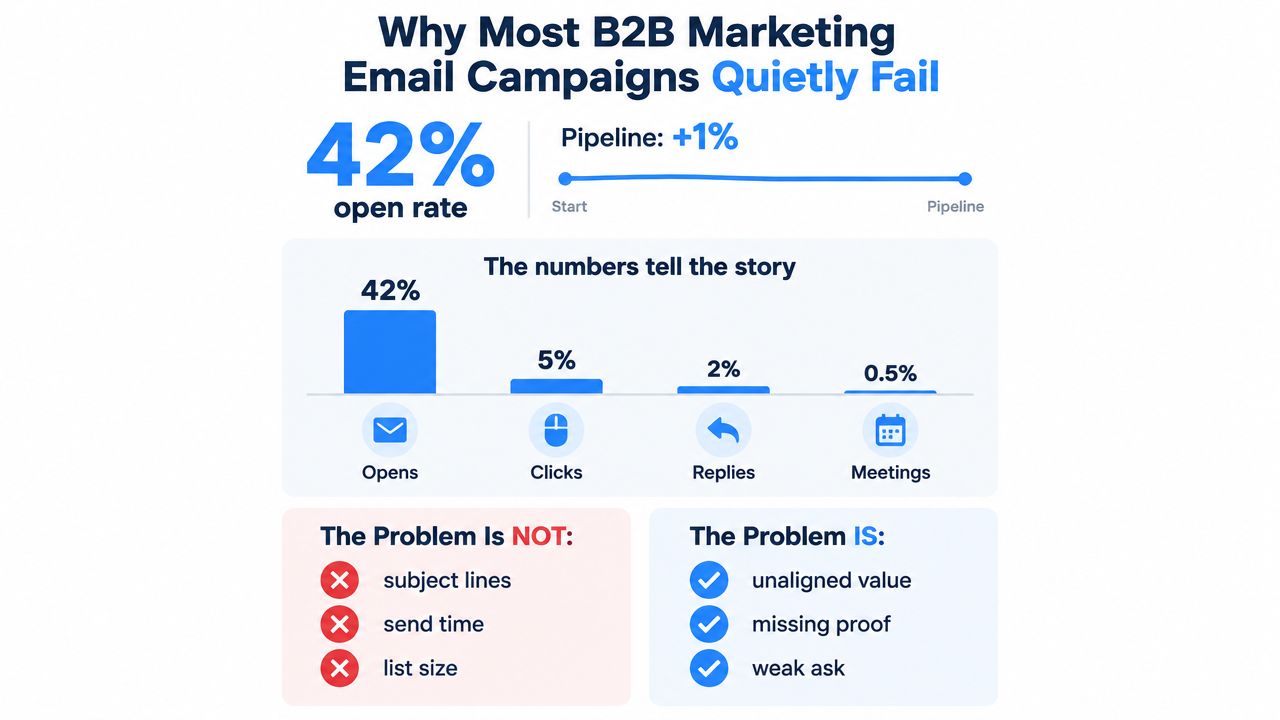
Three recurring patterns explain why campaigns underperform:
- Unverified sending infrastructure: Authentication gaps damage trust before the buyer sees the message.
- Mixed audience targeting: One generic offer rarely fits different industries, roles, regions, and buying situations.
- Standalone execution: Email sent without LinkedIn, retargeting, content, or sales follow-up creates a disconnected buyer experience.
Inbox placement fixes the first problem, but it won't fix an irrelevant offer. A tightly targeted sequence with modest design and clear context will usually outperform a beautifully branded blast sent to a broad list. Teams should treat email deliverability best practices as the floor, then compete through sharper market selection and more useful conversations.
Building Sending Infrastructure That Actually Lands in the Inbox
Infrastructure comes before copy. A sender can't compensate for weak authentication with a clever subject line, and a sales team can't recover all the opportunities lost when mailbox providers throttle or filter messages.
Set the authentication baseline
SPF tells mailbox providers which systems can send for your domain. DKIM adds a cryptographic signature that helps verify the message wasn't altered. DMARC gives receiving providers a policy for handling messages that fail authentication and helps align the visible sender with the authenticated domain.
Healthy B2B senders should aim for SPF and DKIM pass rates at or near 99%, with anything below about 95% treated as a warning. DMARC below 90% is a red flag in the benchmark synthesis from Sender Reputation. The same source reports roughly 85% to 95% inbox placement for fully enforced authentication paired with aged domains. Use those figures as operating thresholds, not promises.
Warm the domain deliberately
Start with a small daily volume per inbox, increase gradually, and watch complaint, bounce, and placement signals before adding more traffic. Domain age, engagement quality, provider throttling, and consistency matter more than forcing a calendar-based ramp.
A practical infrastructure review should cover:
- Sending domains: Decide whether a dedicated subdomain protects the root brand domain without weakening trust through excessive separation.
- IP strategy: Shared IPs can simplify operations, while dedicated IPs create more control and more responsibility for reputation.
- Provider limits: Confirm how the ESP throttles messages and handles temporary failures.
- Monitoring: Review Google Postmaster Tools, Microsoft SNDS, blacklist status, bounces, complaints, and authentication alignment.
- Suppression: Remove invalid, opted-out, role-based, and repeatedly unresponsive contacts from active sequences.
| Metric | Healthy | Red Flag | Remedy |
|---|---|---|---|
| SPF pass rate | Near 99% | Below about 95% | Audit authorized senders and alignment |
| DKIM pass rate | Near 99% | Below about 95% | Repair signing and domain alignment |
| DMARC pass rate | Strong enforcement, ideally near 99% | Below 90% | Investigate failures before scaling |
| Inbox placement | Roughly 85% to 95% for mature, authenticated senders | Materially below that range | Reduce risk, inspect reputation, and pause expansion |
| Bounce rate | Around 2% or lower | Above 2% | Reverify data and suppress invalid contacts |
Teams building from zero can use a specialist guide to build cold email infrastructure to map domains, inboxes, authentication, and monitoring. The operational sequence should be simple: authenticate, verify mailboxes, warm gradually, inspect reputation, test placement, and scale only after the signals remain stable. A dedicated email domain warm-up process helps keep that ramp controlled rather than improvised.
Defining the ICP and Segmenting the List
The most expensive list is the one that looks large but contains few realistic buyers. A useful Ideal Customer Profile combines firmographics, technology signals, buyer context, and geography. Each input should answer a commercial question, not merely add another field to a spreadsheet.
Start with four filters:
- Firmographics: Identify the industries, company sizes, operating models, and revenue bands that can support the problem you solve.
- Technology signals: Look for platforms, integrations, hiring patterns, or operational tools that indicate a relevant need.
- Role and seniority: Separate the economic buyer, technical evaluator, day-to-day user, and internal champion.
- Geography and regulation: Account for time zones, language, procurement norms, and rules affecting data use or outreach.
Score accounts on a 0 to 100 fit model using those inputs, then remove the long tail below your chosen threshold. A narrow list gives the team enough room to make the message specific. A broad list forces vague language, and vague language makes the prospect do the work of figuring out whether the email applies.
List building is only half the job. Run SMTP checks, flag catch-all domains, suppress role addresses, validate seniority, and record the evidence behind each account. Keep campaign lists separate from nurture lists. A campaign list contains contacts with a defined fit and a current reason to engage. A nurture list can hold promising contacts who need education or a future trigger, but those contacts shouldn't inflate outbound performance reports.
Operator's rule: If the team can't explain why an account belongs in a sequence, it doesn't belong in that sequence.
Build the campaign around a segmentation matrix rather than a single template.
| Segment | Persona | Core Pain | Sequence Angle |
|---|---|---|---|
| Growth-stage SaaS | VP Sales | Inconsistent qualified pipeline | Capacity and meeting quality |
| Mid-market ecommerce | Payments leader | Checkout friction and approval loss | Merchant conversion context |
| Professional services | Managing partner | Reliance on referrals | Predictable business development |
| Manufacturer | Commercial director | Limited access to decision-makers | Account targeting and regional relevance |
Each cell deserves its own proof, language, and call to action. Adding a first name to a generic message isn't segmentation. Role-specific relevance is.
Writing Cold Email Sequences That Earn the Reply
A cold email has four jobs, and they need to appear in a logical order:
- Hook: Establish a relevant observation quickly.
- Value frame: Connect that observation to a business outcome or useful insight.
- Proof: Give the reader a reason to believe the sender understands the problem.
- Ask: Offer a low-friction next step that doesn't demand a major commitment.
The body has to justify the promise made by the subject line. This is why open rate alone tells an operator very little. One 2025 benchmark set reports a B2B open rate of 20.8%, click-through rate of 3.2%, conversion rate of 2.5%, and unsubscribe rate of 0.08%, but the benchmark source also makes clear that sender quality and targeting shape those outcomes.
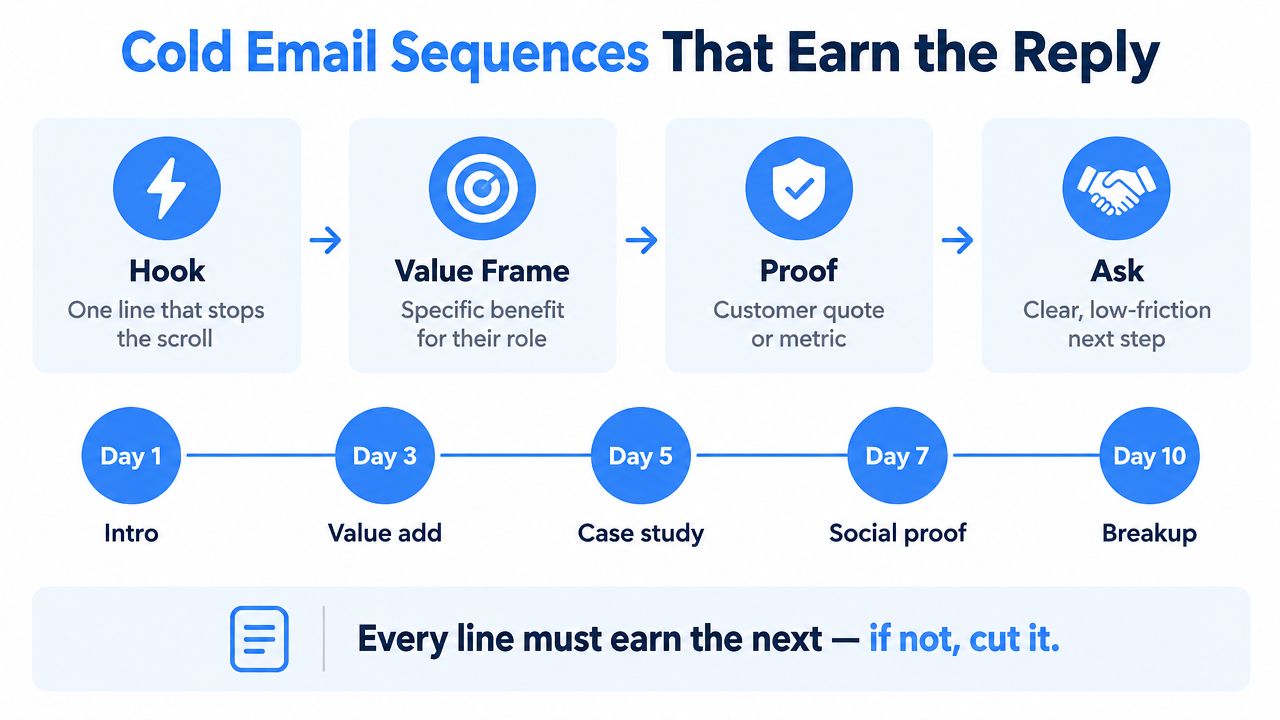
A practical sequence can use five touches:
- Day 1: Introduce one relevant problem and make the smallest credible ask.
- Day 3: Reframe the problem with a sharper role-specific implication.
- Day 7: Add proof, such as a customer result, relevant observation, or useful asset.
- Day 12: Use a soft trigger, such as a market change, hiring signal, event, or new initiative.
- Day 19: Close the loop without manufactured urgency.
Keep each message concise, often within 50 to 90 words when the situation supports it. Those word-count boundaries come from the operating approach in the brief, not a universal benchmark, so clarity matters more than hitting an arbitrary number.
Personalization should reference something beyond a first name. Use the prospect's role, market, technology environment, region, hiring activity, public initiative, or likely operational constraint. Avoid long introductions, feature lists, conditional branches, and paragraphs that explain your company before explaining why the recipient should care.
The writing order matters. Write the ask first, then the proof that makes the ask credible, then the value frame, and finally the opener. For additional practical examples, use this guide to cold email outreach, then refine the final message with a focused email closing approach.
Reading the Benchmarks Without Fooling Yourself
Averages hide the decision that matters most: who received the message and why should they respond now? Benchmark reporting places general B2B cold email reply rates around 3% to 5.1%, while top-quartile campaigns can reach 15% to 25%, creating a spread that aggregate averages flatten. Stylograph's analysis argues that the useful question isn't whether a rate is “good”, but which combination of ICP tightness, hook, local relevance, and follow-up design produced it.
The brief's realistic planning bands are useful as operating hypotheses, but they should not be presented as universal promises:
| Campaign Archetype | ICP Definition | Personalisation Depth | Reply Rate | Meetings per 1,000 Sent |
|---|---|---|---|---|
| Broad outbound | Loose or mixed ICP | Template-led | 0.5% to 2% | Track actual qualified meetings |
| Focused outbound | Tight role and account fit | Role-specific | 3% to 8% | Track actual qualified meetings |
| Trigger-led outbound | Narrow ICP with local relevance | Deep contextual personalization | 12% to 25% | Track actual qualified meetings |
The table shows why a campaign can land in the inbox and still fail commercially. Technical delivery removes one obstacle. It doesn't create urgency, establish trust, or prove that the offer fits the account.
Track qualified-reply rate, qualified meetings, and meetings booked per 1,000 sent instead of treating opens and clicks as pipeline. The 7.5-million-email dataset cited earlier recorded a 1.71% bounce rate while reply rate remained 0.45%, which is strong evidence that list quality and technical delivery don't solve a weak commercial proposition by themselves.
If reply rates stay flat after several copy changes, compare segments before rewriting again. Flat performance across a tightly defined segment suggests an offer or market problem. Flat performance only among one role, region, or industry usually points to poor fit, weak local relevance, or the wrong proof.
Orchestrating Email With LinkedIn and Other Channels
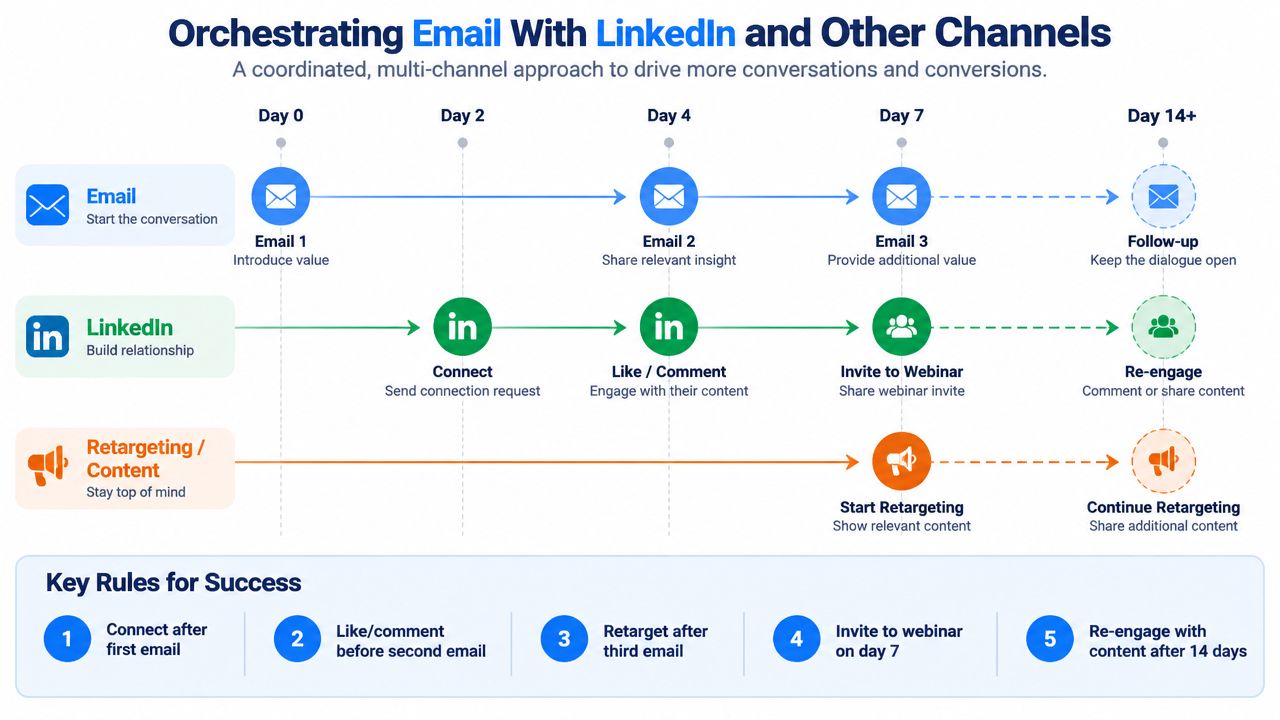
Email works better when each channel performs a distinct job. LinkedIn can establish familiarity, retargeting can preserve visibility after a site visit, and a webinar or useful asset can give the prospect a safer reason to engage than a direct sales request.
A sequence might begin with a LinkedIn connection request on Day 0, followed by a profile view and email on Day 1. A relevant comment or post engagement can come on Day 3, the second email on Day 5, an InMail or voice note on Day 9, and a final email on Day 19. Those timings are a workflow example, not a guaranteed formula. The message should remain coordinated, so the prospect doesn't receive three versions of the same pitch.
Assign a role to every channel
LinkedIn is useful for identity and context. A thoughtful profile visit or relevant engagement can make the later email feel less anonymous, but automated likes and empty connection requests create noise.
Retargeting belongs after a prospect visits a relevant page or interacts with a content asset. It keeps the brand visible to an otherwise anonymous audience, while email carries the one-to-one conversation. Use paid social when the audience is narrow enough and the landing experience supports the same proposition as the sequence.
Webinars and content funnels work when they answer a real buying question. Invite a segment based on role, region, or problem, then route attendees into follow-up that reflects what they consumed instead of sending the same sales email to everyone.
Localization requires more than translating a sentence. Use the recipient's language where appropriate, account for US and EU time zones, adapt examples to local market conditions, and capture content engagement in a GDPR-compliant way. Don't assume consent for one channel automatically authorizes every other channel.
Teams managing several LinkedIn touchpoints can review the PostPulse LinkedIn platform as one possible workflow resource. Regardless of tooling, define suppression rules before launch:
- Remove active conversations: Stop automation when a person replies, books, or asks not to be contacted.
- Suppress disqualified contacts: Exclude wrong roles, competitors, and regions from future sends.
- Pause engaged prospects: Move meaningful content engagement into a human-reviewed path.
- Close stale sequences: Don't keep adding touches after clear disinterest or repeated negative signals.
Qualifying Replies and Handing Off to Sales
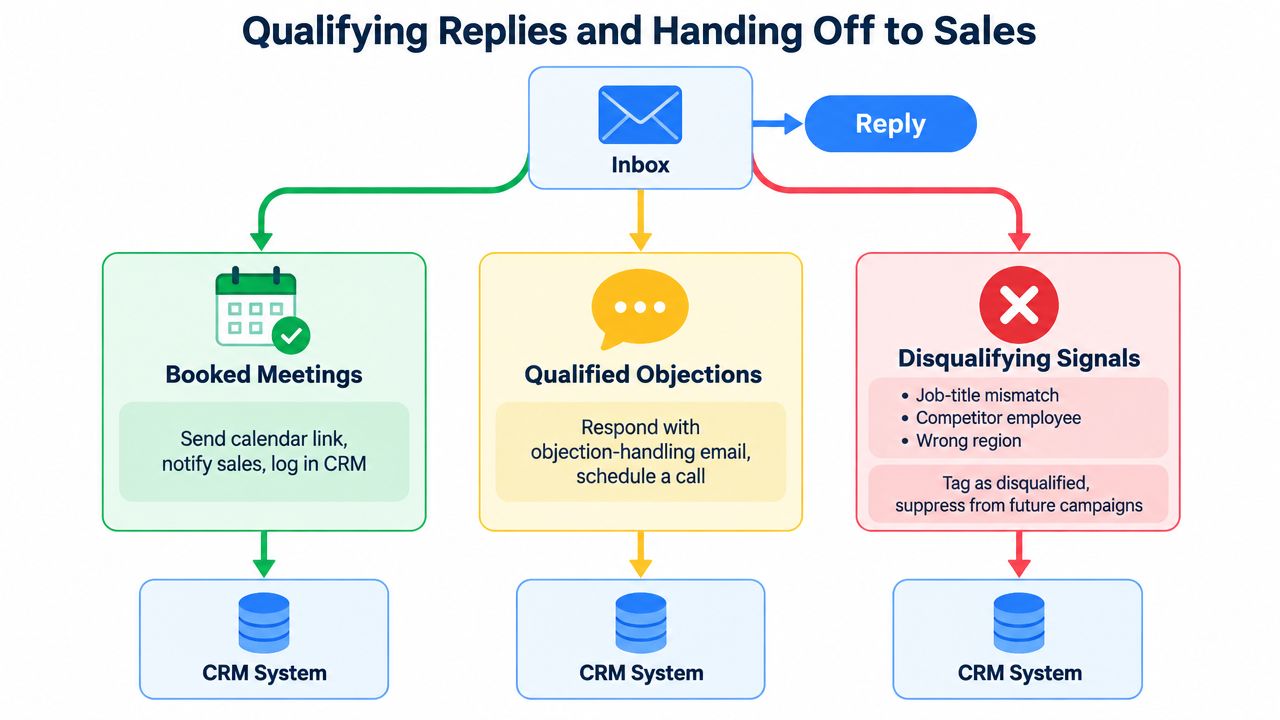
A reply isn't automatically a lead. The inbox needs a classification system that separates commercial opportunity from polite acknowledgement, curiosity without fit, and clear disqualification.
Three reply types deserve distinct handling:
- Booked meetings: Confirm the appointment, notify the owner, and preserve the original context.
- Qualified objections: Treat objections as buying information. Address the concern and offer a conversation when the underlying fit is real.
- Disqualifying signals: Suppress job-title mismatches, competitor employees, wrong-region prospects, and explicit opt-outs.
Use a fast scoring rubric
An SDR can score a reply across five fields:
- Fit: Does the company match the ICP?
- Intent: Does the response indicate an active problem or curiosity tied to that problem?
- Authority: Can the person influence or approve the decision?
- Timing: Is there a credible window for evaluation?
- Context: Does the reply connect to the trigger, pain, or proof used in the email?
The score matters less than consistent application. A senior executive at the wrong type of company shouldn't outrank a relevant operator with a clear problem. Sales teams should also distinguish a qualified objection from a soft no. “Not a priority” can be useful timing information, while “remove me” is a suppression instruction.
Before the first call, the salesperson should receive the original email, the full reply chain, LinkedIn touchpoints, enrichment notes, the account's fit rationale, and a suggested agenda. Sending only a calendar notification throws away the context that earned the reply.
Operational discipline keeps momentum intact. Confirm booked meetings the same day, route them to the correct CRM owner, and define what happens when a prospect shows interest but then goes quiet. A short human follow-up can preserve the conversation, but the contact shouldn't return automatically to a generic sequence without review.
A fast handoff isn't just administrative efficiency. It protects the relevance that made the prospect respond.
Measuring Pipeline Contribution and Improving the System
The useful north star is pipeline per email sent, not the open rate. Opens and clicks help diagnose delivery and message interaction, but once a qualified opportunity enters the CRM, the team needs to connect the campaign to meetings, sales stages, and revenue feedback.
Review the system weekly:
- Inbox placement: Check whether messages reach the inbox consistently across major providers.
- Reply quality mix: Separate qualified replies, objections, neutral responses, and disqualifications.
- Meeting-show rate: Identify whether the booking and reminder process creates real attendance.
- Sales feedback: Record whether the account fit, pain, authority, and timing matched the campaign assumptions.
- Pipeline movement: Track opportunities by source and preserve the original campaign context.
Use one controlled test priority at a time. A monthly test can focus on one ICP slice, one subject-line direction, one CTA, or one multichannel sequence. Changing the audience, offer, copy, cadence, and channel together creates an attractive dashboard but weak evidence.
| Metric | Healthy Range | Warning Threshold |
|---|---|---|
| Delivery rate | Around 98% in the cited B2B benchmark sets | Sustained decline from baseline |
| Open rate | 20.8% in one 2025 B2B benchmark set | Treat as diagnostic, not intent |
| Click-through rate | 3.2% in one 2025 B2B benchmark set | Low interaction after delivery |
| Bounce rate | 1.71% in one 7.5-million-email dataset, and 2.0% in another benchmark set | Above the relevant baseline |
| Conversion rate | 2.5% in one 2025 B2B benchmark set | Weak movement after qualified engagement |
| Unsubscribe rate | 0.08% in one 2025 B2B benchmark set | Rising complaints or opt-outs |
| Reply rate | 0.45% in the cited 7.5-million-email dataset | Flat replies despite delivery |
Use diagnosis rather than reflexive rewriting. Low delivery points to infrastructure or list hygiene. Good delivery with weak replies points to ICP fit, offer, hook, or local relevance. Replies without meetings may indicate a vague CTA, poor qualification, weak calendar access, or a mismatch between the promise and the sales conversation. Qualified meetings without pipeline progression usually require sales feedback on proof, pricing context, authority, or timing.
The technical foundation is now table stakes. The competitive advantage comes from choosing fewer, better accounts, writing for the actual buyer's situation, coordinating channels without creating noise, and measuring the path from sent message to qualified pipeline.
Lead Printer builds authenticated email infrastructure, verified prospect lists, personalized sequences, multichannel outreach, reply qualification, and calendar handoff for B2B teams across the US, UK, and EU. If your campaigns reach inboxes but fail to create enough qualified conversations, visit Lead Printer to discuss a tighter outbound system.