Most buyers approach Instantly vs Apollo as if they're choosing between two versions of the same cold-email tool. That advice is too shallow to be useful. The platforms overlap at the sequence level, but they're built around different operating problems: Instantly is centered on sending scale, while Apollo is centered on prospect data, targeting, and controlled engagement.
That distinction matters more than a feature checklist. A founder sending carefully selected outreach from a small mailbox pool has different constraints from an agency coordinating campaigns across US, UK, and EU domains. The wrong platform won't just waste subscription spend. It can force your team into the wrong sending model, create unnecessary compliance work, or stall testing when you need to expand.
By 2026, third-party coverage described Apollo as serving nearly 5 million users across more than 600,000 companies, while Instantly remained positioned as a specialized cold-email platform for high-volume outbound operators (Apollo's comparison of Instantly and Apollo). The practical question is simple: do you need more control over who you contact, or more infrastructure for how you send?
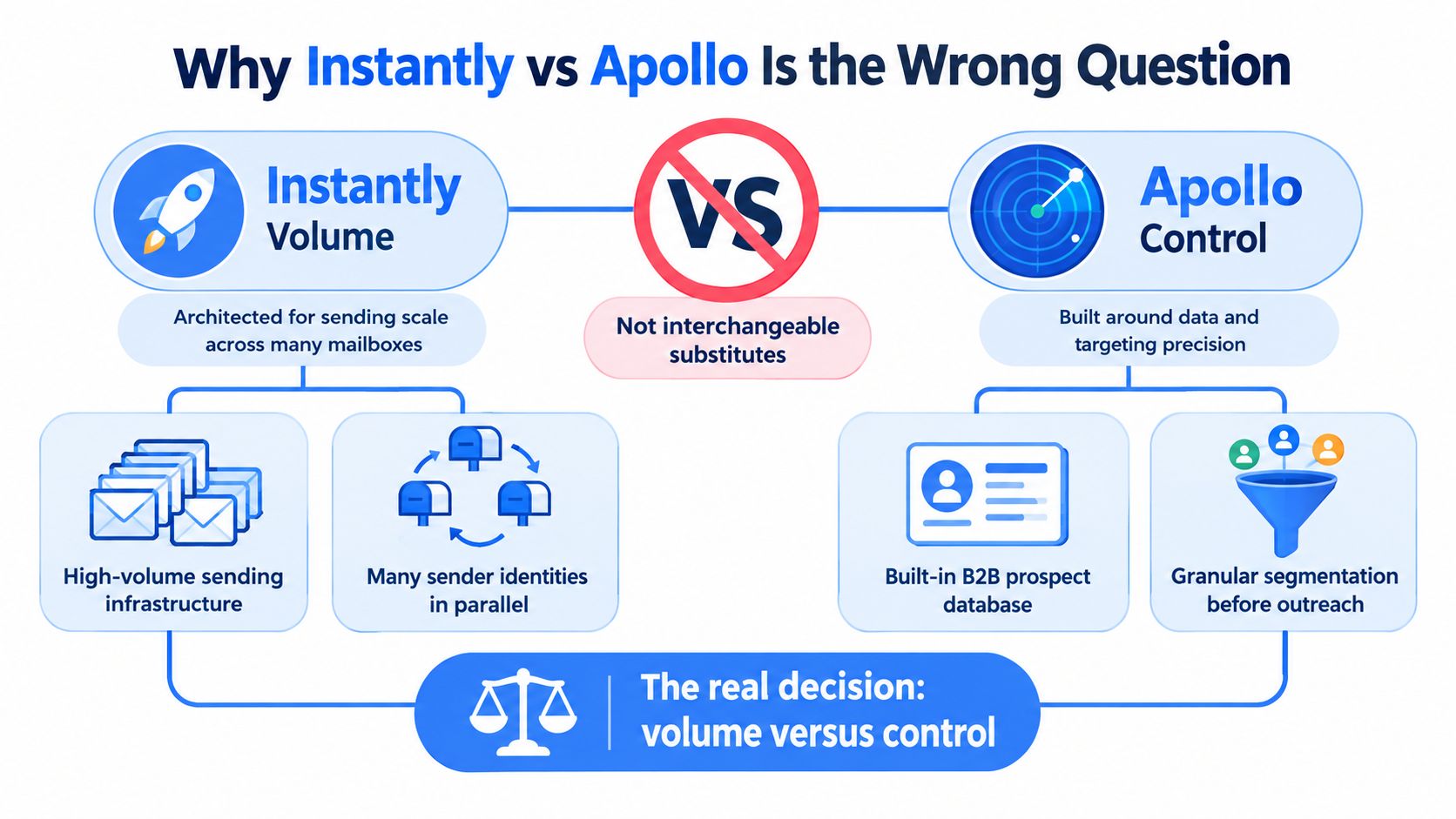
Why Instantly vs Apollo Is the Wrong Question
Instantly and Apollo aren't interchangeable substitutes. Apollo was founded in 2015 and grew around sales intelligence, prospect discovery, and engagement workflows. Instantly was founded in 2021 as a bootstrapped company focused on cold-email sending rather than a broad sales-data suite (Sparkle's Instantly and Apollo comparison).
That difference drives the buying decision: volume versus control. Instantly is designed for operators who need to coordinate many sending identities, automate warm-up, and distribute campaigns across a larger mailbox infrastructure. Apollo is designed for teams that want to identify prospects, filter accounts, and launch controlled sequences from the same sales workspace.
Two different operating philosophies
Instantly optimizes the sender. Its value increases when your team already has, or can build, a clean prospect list and needs the sending layer to handle mailbox rotation, warm-up, and campaign distribution.
Apollo optimizes the prospector. Its value increases when targeting quality, database access, segmentation, and a unified sales workflow matter more than maximum outbound throughput.
That's why feature-count comparisons mislead buyers. Apollo can send email, and Instantly can support lead workflows, but those capabilities don't carry equal strategic weight inside each product. One platform treats sending as the center of the operation. The other treats sending as one part of a broader revenue workflow.
Practical rule: Choose the platform that matches your bottleneck. If your problem is finding qualified contacts, start with Apollo. If your problem is operating more sending infrastructure safely, start with Instantly.
The rest of the decision should follow your operational profile, not whichever product has the longer feature page.
What Each Platform Actually Does in 2026
Apollo's core identity is a sales intelligence and engagement platform. It combines prospect research, data workflows, and outbound execution in a single environment. Its long history, beginning in 2015, has shaped a product aimed at sales teams that need targeting and engagement connected rather than separated (Apollo's product comparison).
Instantly started in 2021 as a bootstrapped business and is positioned as a specialized cold-email sending platform. Third-party comparison coverage describes it as a flat-fee outbound tool used heavily by small businesses, while Apollo is presented as a broader, database-led product aimed at a larger and more mature market segment (Sparkle's platform analysis).
Instantly vs Apollo at a glance
| Attribute | Instantly | Apollo |
|---|---|---|
| Founded | 2021 | 2015 |
| Core identity | Cold-email sending and campaign execution | Sales intelligence and engagement |
| Primary optimization | Sending scale and mailbox operations | Prospect discovery, targeting, and control |
| Best starting point | Teams with lists and outbound infrastructure needs | Teams that need data and outreach in one workflow |
| Pricing orientation | Flat-fee outbound model | Per-seat sales platform model |
| Operational bias | Volume | Control |
| Main limitation | Less suitable when data intelligence is the main need | Conservative sending model can constrain scale |
The overlap is real, but it shouldn't obscure the architecture. Instantly is the better fit when email execution is the job. Apollo is the better fit when prospecting and engagement are part of a larger sales process.
For founders comparing the wider AI email market, Samuel Woods' competitive email AI guide for founders offers useful context on how sending, personalization, and automation tools fit together beyond this specific matchup.
Deliverability, Warm-Up, and Sending Architecture
Deliverability is where the difference becomes operational rather than theoretical.
Apollo's own guidance recommends a conservative profile of 50 emails per day per mailbox, 6 emails per hour, and a 600-second delay between emails. Apollo also warns that provider thresholds override the platform's own limits, so teams can't treat the software setting as permission to send more aggressively (Apollo's email sending limits).
Apollo's product documentation states a 94% deliverability figure on a cold list and suggests beginning around 20 emails per day per mailbox before gradually increasing volume as reputation improves (Apollo's email deliverability guidance). That approach protects reputation through restraint. It works for controlled campaigns, carefully segmented audiences, and teams that value predictable mailbox behavior over rapid scaling.
Instantly takes a different route. Its warm-up guidance says the Premium Blue Flame inbox network uses aged Google and Microsoft accounts and delivers approximately 9% more replies than Standard. Instantly's comparison materials also describe a private 4.2M+ account network and deliverability automation designed for large-scale sending (Instantly's agency comparison).
Deliverability architecture compared
| Capability | Instantly | Apollo |
|---|---|---|
| Core approach | Warm-up, mailbox rotation, and sending scale | Conservative per-mailbox sending |
| Ramp philosophy | Infrastructure-led expansion | Gradual reputation-led growth |
| Best fit | Many mailboxes and domains | Controlled outreach from individual mailboxes |
| Main protection mechanism | Redundancy and distribution | Lower throughput and stricter caps |
| Operational risk | Poor list quality can spread across more infrastructure | Sending caps can slow testing and expansion |
Neither approach makes poor outbound safe. Instantly's architecture can distribute volume, but it can't rescue an unverified list or weak messaging. Apollo's restraint can protect a mailbox, but it can't solve a campaign that needs rapid segmentation and parallel testing across multiple regions.
This is especially important for programs operating across 10–50+ mailboxes, US, UK, and EU domains. Localized campaigns often need separate sender identities, different schedules, and tighter control over which audience enters each campaign. Instantly is the stronger sending layer for that operational model. Apollo is the better choice when the campaign is deliberately narrow and the database workflow matters more than mailbox expansion.
Teams should also validate inbox placement independently rather than relying on a warm-up score or a platform claim. The email deliverability best-practices guide is useful for checking the technical and operational controls around either platform.
Pricing Models and Real ROI for Outbound Teams
The pricing question isn't “which plan is cheaper?” It's what happens when your operation grows in mailbox count, users, clients, and data consumption.
Instantly's model is built around a flat-fee outbound structure. That favors teams adding sending accounts without wanting the software bill to rise with every mailbox. Apollo's model is more closely tied to seats and usage, which makes sense for a sales organization where each user needs prospecting, engagement, and workflow access.
The economic fit changes sharply by buyer type. A small team that only needs a handful of mailboxes may pay for Instantly's scale before using it. An agency with many client environments may find Apollo's per-seat structure harder to justify because it charges for a broader sales platform than each client campaign requires.
Monthly cost comparison across team sizes
The brief doesn't provide verified plan prices or enough data to calculate credible monthly totals for 5, 25, or 100 active inboxes. A precise table would therefore create false certainty.
| Plan Tier | Instantly, Est. Monthly | Apollo, Est. Monthly |
|---|---|---|
| 5 active inboxes | Depends on workspace and usage configuration | Depends on seats, credits, and plan |
| 25 active inboxes | Depends on workspace and usage configuration | Depends on seats, credits, and plan |
| 100 active inboxes | Depends on workspace and usage configuration | Depends on seats, credits, and plan |
Where each model breaks
Instantly rewards operational density. If one team manages many inboxes inside a deliberate sending system, a flat-fee model can keep marginal mailbox cost predictable. The trade-off is that you still carry the cost of domains, mailbox provisioning, list verification, copy, monitoring, and campaign management.
Apollo rewards workflow consolidation. A sales team may accept per-seat economics because Apollo combines prospecting and engagement. The model becomes less attractive when the team needs many isolated client operations, or when most users don't need the full sales-intelligence layer.
The cheaper platform is the one your team can operate without paying for unused architecture.
Use a cold outreach ROI calculator to model labor, infrastructure, list preparation, qualification, and meetings rather than comparing subscription prices alone.
Compliance, EU Localization, and Agency Scaling
Most comparisons underweight compliance because it doesn't appear in a product demo. Agencies discover the problem later, when they need to explain data provenance, lawful basis, client separation, and regional processing choices.
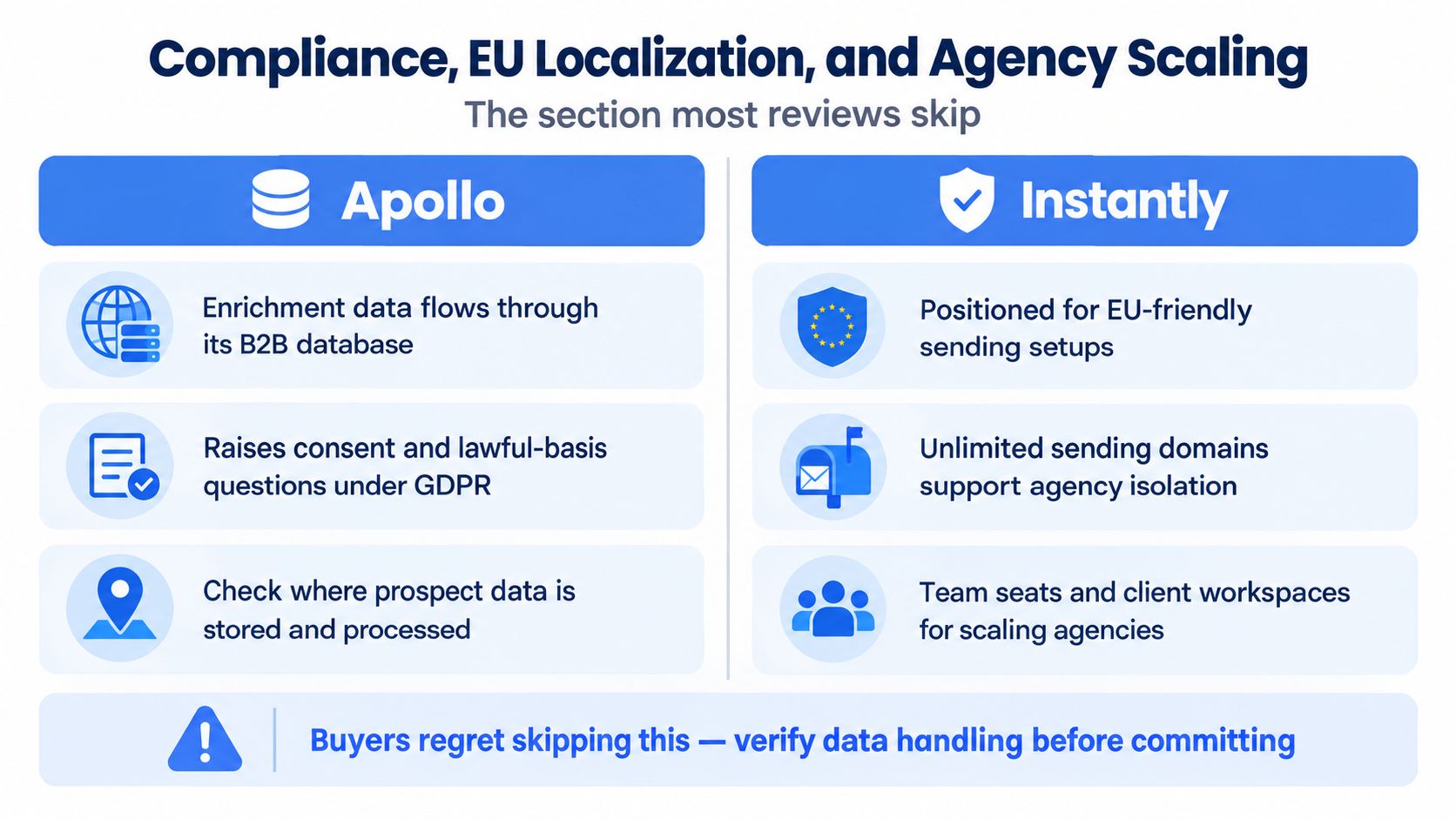
Apollo's database-led model creates a clear responsibility: teams must understand how enrichment data is sourced, processed, and used for EU prospecting. That doesn't automatically make Apollo unsuitable for European outreach, but it does mean the buyer must review data handling and the legal basis for contacting each audience.
Instantly shifts more responsibility to the operator because teams generally bring or build their own lists. That can reduce dependence on a platform-owned prospect database, but it doesn't remove GDPR obligations. The agency still needs a defensible process for collection, verification, suppression, personalization, and handling objections.
Multi-region operations expose the difference
An agency working across US, UK, and EU markets needs more than translated copy. It needs isolated campaign logic, sender-domain discipline, local timing, region-specific suppression rules, and reporting that keeps each client and geography distinct.
Instantly's multi-domain and workspace-oriented sending model fits that structure more naturally. Apollo's seat-based organization can work for an internal revenue team, but it becomes less comfortable when an agency needs clean client separation and white-label reporting.
Neither platform should be treated as a complete localization system. Teams still need to review language quality, names with diacritics, time zones, local business norms, and regional compliance requirements before launch.
The decision is straightforward. Choose Instantly for agency-scale domain separation and sending operations. Choose Apollo when enriched targeting is worth the additional data-governance work. Don't let a generic “GDPR-friendly” label replace a real review of data handling.
Best Fit by Buyer Profile and Use Case
Stop asking which platform is universally better. Ask which operating profile you're funding.
B2B SaaS founders
Choose Instantly when founder-led outbound depends on email volume, multiple sending domains, and a low marginal cost for adding mailboxes. A SaaS founder who already knows the ideal customer profile can source or enrich a list separately and use Instantly as the execution layer.
Choose Apollo instead when the founder is still refining market segments, needs firmographic filtering, or wants prospect research and sequencing in one workspace. Apollo reduces tool switching when the main challenge is identifying the right accounts.
Ecommerce and merchant-focused brands
For transactional or promotional email, use a dedicated email service provider rather than either platform. Instantly and Apollo are outbound tools, not substitutes for a customer lifecycle system built around consent, purchase behavior, deliverability programs, and campaign permissions.
For cold partnership outreach, Apollo has the stronger starting position because enriched targeting matters more than mailbox rotation. You need to identify relevant retailers, platforms, agencies, or payment partners before you worry about scaling sends.
Services agencies
A services agency running separate campaigns for many clients should choose Instantly. Workspace and sending-account separation fit the agency's operational need to isolate domains, audiences, copy, and reporting.
A boutique agency running narrow account lists may prefer Apollo. If consultants are targeting a small number of high-value accounts and need richer prospect context, Apollo's data workflow can justify its broader platform design.
Manufacturers
Manufacturers selling into long procurement cycles rarely need maximum email throughput. Apollo is the better fit when firmographic segmentation, seniority targeting, and account research determine success.
Instantly becomes relevant only when the manufacturer has a validated list, repeatable messaging, and a legitimate reason to coordinate larger sending infrastructure. Volume alone won't shorten procurement cycles, so don't buy a sending platform to compensate for weak account selection.
Migration and Parallel-Testing Checklist
Switching platforms without isolating variables creates bad conclusions. A deliverability problem can look like a copy problem, while a list-quality issue can look like a platform failure.
Five checks before cutover
Audit every sending domain. Record mailbox health, existing campaign activity, suppression lists, and any reputation warnings before moving a sequence.
Plan the warm-up ramp. Allow a 15 to 30 day warm-up period for new or materially changed mailbox infrastructure. Don't import a mature campaign and immediately push its full schedule.
Authenticate and verify. Check SPF, DKIM, and DMARC for every sending domain. Confirm that each tool's sending configuration matches the domain you intend to use.
Isolate the platforms. Don't send the same campaign through Apollo and Instantly from the same mailbox pool. Use separate domains or clearly separated infrastructure to prevent reputation bleed.
Mirror the test. Keep the audience, offer, core copy, personalization depth, and follow-up logic comparable. Use a seed list to observe placement, then compare replies over a consistent two-week test window.
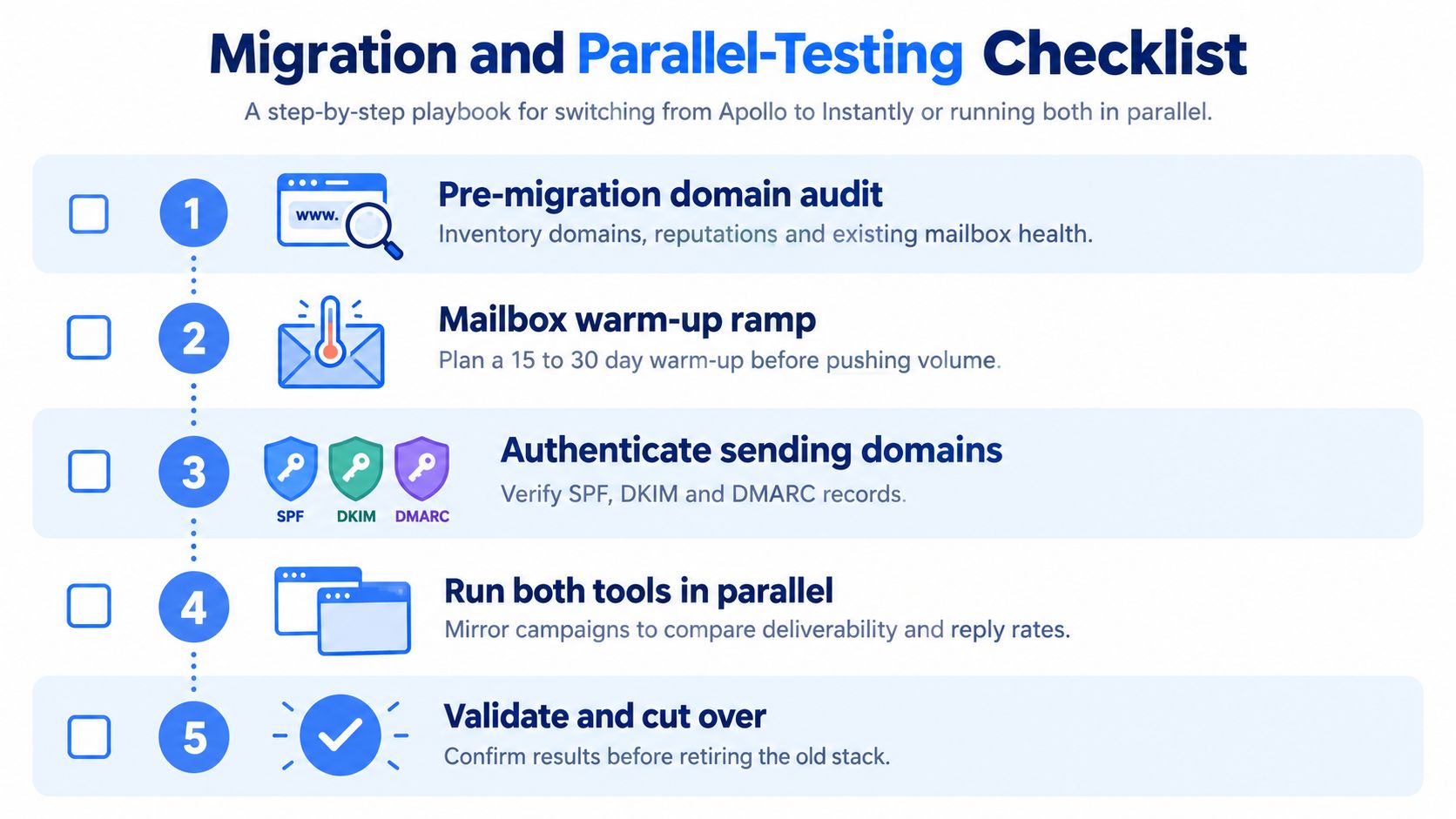
Don't cancel the old platform because the first week looks promising. Keep the legacy workflow until the new setup passes your bounce, placement, reply-quality, and operational checks. Teams assessing alternatives can also use this guide to compare Apollo alternatives before committing to a replacement.
The Final Decision Framework
Pick Instantly when your operation depends on high-volume email execution, many sending domains, agency client separation, and flat-fee scaling. It's the right tool when you already understand your audience and need to operate the sending layer with more flexibility.
Pick Apollo when prospect intelligence is the bottleneck. It fits single-rep workflows, controlled sending, enriched targeting, and teams that want data, engagement, and sales management in one place.
Pick neither when your real constraint is strategy or execution. A platform won't fix an undefined ideal customer profile, weak offers, poor list hygiene, untranslated messaging, or an inbox nobody manages.
| Buyer Profile | Pick Instantly If | Pick Apollo If | Pick Neither If |
|---|---|---|---|
| Founder-led SaaS | You have validated lists and need sending scale | You need prospect discovery and segmentation | You haven't defined the buyer or offer |
| Internal sales team | Email is the primary channel | Email sits inside a broader sales workflow | Your team can't operate campaigns consistently |
| Multi-client agency | You need domain and workspace separation | You run narrow, research-heavy account programs | Compliance and localization need specialist support |
| EU expansion team | You can manage your own data governance | Enrichment materially improves targeting | You can't verify data handling and lawful basis |
| Mature outbound operation | Sending limits slow testing or expansion | Consolidation reduces operational complexity | Your infrastructure and messaging are still unstable |
Use stop conditions. Move away from Apollo when its sending model stalls campaign testing or its cost no longer matches the workflow you use. Move away from Instantly when your team spends more time sourcing, enriching, qualifying, and reporting than executing email.
When neither platform covers multi-region, multilingual, compliance-heavy outreach internally, Lead Printer offers infrastructure setup, prospect research, localized messaging, email and LinkedIn campaign management, qualification, and reporting as a managed outbound process. Visit Lead Printer to discuss whether your team needs a tool decision or an operating partner that can run the system across the US, UK, and EU.