Your sales team is busy, but the pipeline still looks thin. Account executives spend mornings researching prospects, founders review SDR candidates, and every promising hire seems to need weeks of training before producing useful conversations. By the time someone is ready, the market or messaging may have already changed.
Outsourced sales reps offer a different operating model. You buy execution, process, and capacity from an external team instead of building every prospecting function internally. That can accelerate pipeline creation, but it can also create brand, data, and management problems if you treat the provider as a black box.
Introduction to Outsourced Sales Teams
A typical failure pattern starts innocently. A B2B company hires an SDR to create meetings, hands over a broad target list, and expects activity to turn into revenue. The SDR spends hours researching accounts, writing emails, updating the CRM, and chasing replies. Meanwhile, the account executives still prospect because they don't trust the handoffs. The company has added headcount without adding much selling time.
Outsourced sales reps can solve the capacity problem when the engagement is designed around a clear commercial outcome. A specialized partner can handle account research, list building, messaging, outreach, qualification, appointment setting, and CRM updates. The internal team then focuses on discovery, solution design, negotiation, and closing.

The model has moved well beyond a niche tactic. The broader sales and marketing business process outsourcing market was estimated at USD 28.65 billion in 2022 and is projected to reach USD 57.46 billion by 2030, with a 9.4% CAGR from 2023 to 2030, according to Intel Market Research's outsourcing market estimate. Cloud tools, distributed teams, and remote selling made external execution easier to coordinate across markets.
Pipeline velocity matters more than headcount
The right question isn't, “Should we outsource sales?” It's, “Which part of the revenue process is slowing growth, and can an external team own that bottleneck?”
If account executives lack qualified conversations, outsource prospecting and meeting creation. If your team has meetings but weak qualification, outsource research and pre-meeting screening. If you're entering a new region, use a partner with local language and market coverage instead of hiring before demand is proven.
A useful guide to outsource B2B sales effectively should help you think in terms of scope, ownership, and handoffs rather than counting booked calls. Outsourcing works when the external team becomes an accountable extension of your sales process, not a disconnected activity vendor.
Defining Outsourced Sales Representatives
An outsourced sales representative is an external sales professional working on behalf of your company under a defined commercial process. The representative may generate demand, qualify accounts, book meetings, manage opportunities, or support the full sales cycle. The important distinction is operational ownership. You aren't merely buying contact data. You're assigning part of the revenue workflow to a team with its own management, tools, and reporting.
The engagement can sit anywhere on a spectrum.
Four practical engagement models
Lead generation focuses on identifying potential buyers and creating initial interest. The provider may research accounts, enrich contact data, and deliver prospects, but your team handles outreach or qualification.
Appointment setting adds direct communication. Reps contact prospects, validate basic fit, handle early objections, and schedule conversations with internal sellers. The quality of the qualification criteria determines whether those meetings are useful.
Sales development outsourcing covers a repeatable outbound function. The external team owns targeting, messaging, multichannel activity, follow-up, CRM hygiene, and agreed reporting. A dedicated SDR agency can be suitable when your company needs consistent top-of-funnel execution but doesn't want to recruit and manage every SDR internally.
Full-cycle representation extends responsibility through discovery, proposals, negotiation, and sometimes closing. This model requires deeper product training, explicit pricing authority, legal boundaries, and close coordination with your internal leadership.
The model should match your constraint. A company with strong account executives and weak prospecting doesn't need a full outsourced sales department. It needs a tightly governed sales development function. A company entering an unfamiliar market may need broader support, including local research, messaging adaptation, and early-stage opportunity management.
Define the handoff before signing
Write down what happens after a prospect replies. Specify who qualifies the account, who owns the CRM record, who schedules the meeting, and what information the account executive receives. Include disqualification rules for poor fit, duplicate accounts, existing opportunities, and prospects outside the serviceable market.
Don't let the phrase “outsourced sales reps” hide the scope. Ask whether you're buying labor, managed execution, or commercial ownership. Those are different products, and they require different controls, fees, and success measures.
Outsourced Sales Versus In-House and Lead Generation
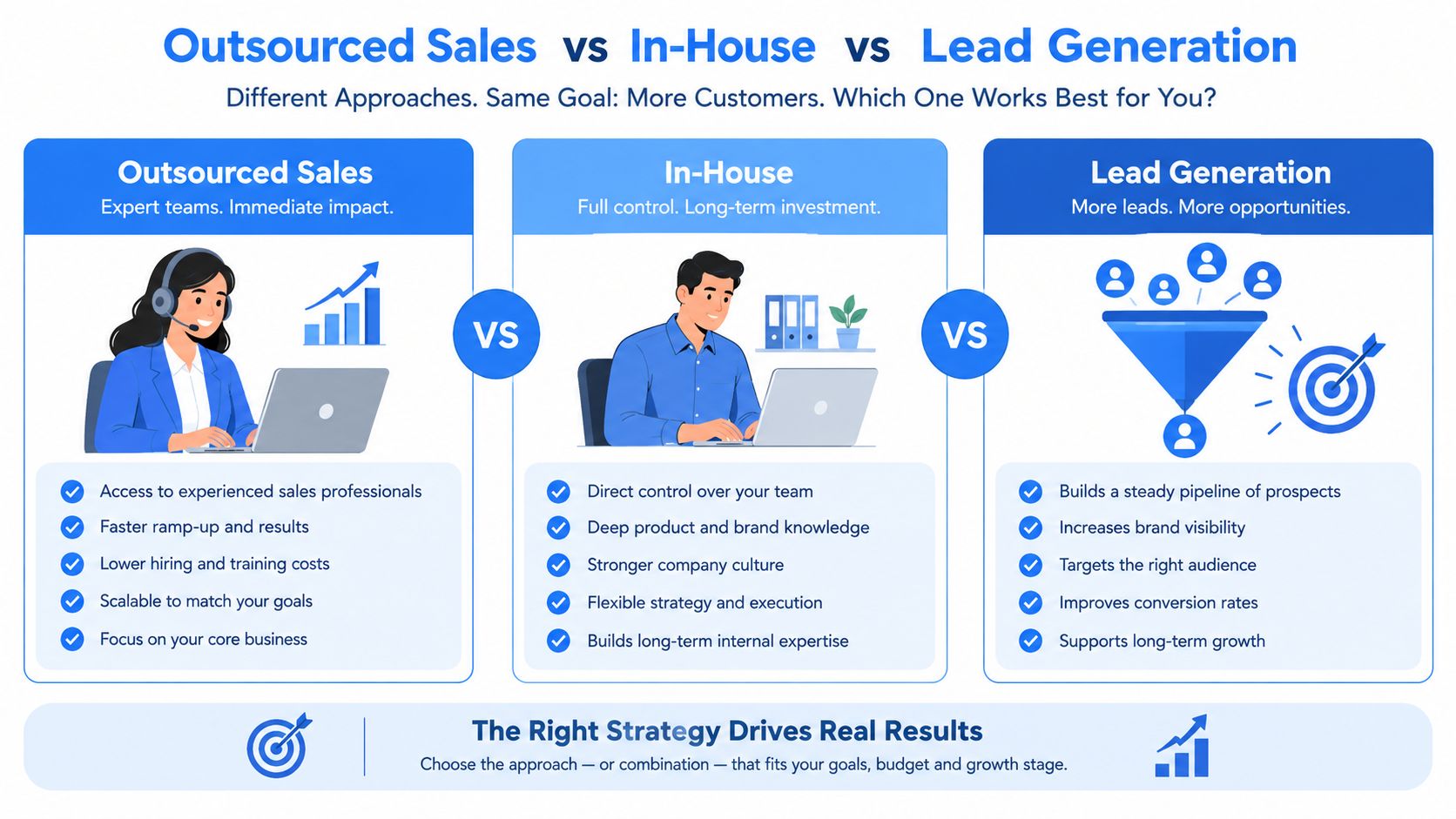
These three options solve different problems. Confusing them creates expensive expectations.
| Model | Best fit | Main strength | Main trade-off |
|---|---|---|---|
| In-house SDR team | A stable market with internal management capacity | Maximum control over training and daily execution | Recruiting, ramping, tooling, and management stay with you |
| Outsourced sales reps | A company that needs managed capacity or market access | Faster deployment with external process and specialization | You must govern messaging, data, and quality |
| Lead generation service | A team that needs prospect research or initial demand creation | Narrower scope and simpler handoff | Your internal team may still own outreach and qualification |
An in-house team gives you direct control. You can change messaging immediately, embed SDRs in product training, and build institutional knowledge over time. The cost is management attention. Hiring, coaching, data quality, deliverability, performance reviews, and coverage all remain internal responsibilities.
Outsourced sales reps reduce that administrative load, but they don't remove the need for direction. You gain a managed operating layer, often with established tooling and specialist workflows. You give up some tactical control, so the agreement must specify audience, positioning, approval rights, reporting, and escalation paths.
A lead generation service sits further upstream. It may build lists, identify decision-makers, and generate responses, while your team handles qualification and meetings. That can work well when your internal sellers already have a proven process and only need more opportunities. It won't fix weak discovery, poor follow-up, or unclear positioning.
Choose based on the bottleneck
Use this decision rule:
- Choose in-house if your market is understood, your managers can coach consistently, and long-term internal capability matters more than immediate flexibility.
- Choose outsourced sales if you need specialized execution, regional access, or additional capacity without committing to a permanent headcount build.
- Choose lead generation if your sales team can qualify and close but lacks enough researched accounts and initial conversations.
The same logic applies when comparing AI employees vs building in-house. Don't compare tools or vendors in isolation. Compare the complete operating system, including supervision, data ownership, quality control, and the work your internal team must still perform.
For companies that only need targeted prospect creation, outsourced lead generation may be more appropriate than a broader sales engagement. Start with the narrowest model that fixes the actual constraint. Expand only after the handoff works.
Benefits, Costs, and Performance Benchmarks
Outsourcing creates value through speed, specialization, and shared infrastructure. A provider can bring researchers, campaign managers, sales development managers, data tools, and established workflows into one program. You avoid assembling every component before testing whether a market responds.
The economic case is strongest when the provider delivers comparable meeting quality at a lower fully loaded cost. One industry benchmark places in-house SDR costs at approximately $821 to $1,150 per meeting, compared with $357 to $500 per meeting for outsourced programs, as reported by Martal's sales-as-a-service benchmark. The comparison implies roughly 2x cost efficiency when output volume is comparable. Treat that as a benchmark, not a promise. Cheap meetings are worthless if they don't match your ICP or progress into real opportunities.
What AI-augmented execution changes
AI and automation can improve throughput, but only when humans control the inputs and review the outputs. Reported operational benchmarks for AI-augmented outsourced teams include 80 to 100 accounts researched per day, 150 to 200 personalized emails per day, 8% to 12% reply rates, and 6 to 8 meetings per week. The same benchmark reports manual execution at 20 to 30 accounts, 40 to 60 emails, 3% to 5% reply rates, and 2 to 4 meetings per week. These figures come from Apollo's outsourced sales team benchmarks.
The reported time to first meeting also differs sharply, from 4 to 6 months in-house to 2 to 3 weeks in outsourced models, according to the same source. That gap reflects ready-made workflows and faster campaign deployment, not a guarantee that your sales cycle will shrink.
Set economics before activity goals
Build the commercial model around qualified opportunities, not raw volume.
- Define a qualified meeting. Require a target role, relevant business problem, acceptable company profile, and a clear reason for attending.
- Measure conversion after handoff. Track attendance, acceptance by the account executive, progression, and disqualification reasons.
- Separate fixed and variable costs. Know what covers research, tooling, management, copy, and reporting. Tie any performance component to quality.
- Review the unit economics monthly. Cost per reply isn't enough. Compare cost per accepted meeting and cost per sales-qualified opportunity.
Practical rule: If a provider can't show how activity connects to accepted opportunities, you're buying motion rather than pipeline.
Risks, Governance, and Common Pitfalls
Most outsourced sales failures aren't caused by the existence of an external team. They happen because the buyer delegates judgment without delegating clear standards.
Poor targeting creates the first failure. If the provider receives a vague ICP, outdated account data, or a message built around generic benefits, reps can produce activity that looks productive while damaging your reputation. The risk becomes greater when compensation rewards meetings without measuring fit, progression, or revenue relevance.
Recent coverage of lead generation trends highlights the same governance problem. Buyers increasingly want hybrid human and AI execution and outcome-based pricing, while poor targeting and weak data remain recurring failure modes. The lead generation trends analysis from Martal also notes that meeting quality can decline after the first few months when scorecards prioritize volume over opportunity quality.
Install a quality system
Give the provider a living operating brief, not a static onboarding document. It should include:
- ICP boundaries: industries, roles, company characteristics, regions, and explicit exclusions.
- Message controls: approved claims, prohibited language, proof points, competitors, and escalation rules.
- Qualification standards: business pain, timing, authority, existing tools, and next-step requirements.
- Feedback cadence: a regular review of accepted, rejected, attended, and progressed meetings.
- Data ownership: CRM access, enrichment records, campaign history, suppression lists, and export rights.
Review actual conversations, not just dashboards. Listen to calls, inspect replies, and read the messages that generated meetings. If internal sellers repeatedly reject opportunities for the same reason, change the targeting or qualification rule instead of asking reps to “try harder.”
Time zone and market misalignment add another hidden risk. A recent guide on inside sales outsourcing companies warns that poor alignment can slow follow-up and reduce response quality, while buyers increasingly expect providers to work directly inside CRM and revenue technology stacks. Choose coverage that matches your buyers' working hours and language needs.
The right governance principle is simple: outsource execution, not accountability. Your provider can own daily activity, but your leadership must own positioning, customer fit, and the definition of a valuable conversation.
How to Pilot and Scale Your Outsourced Program
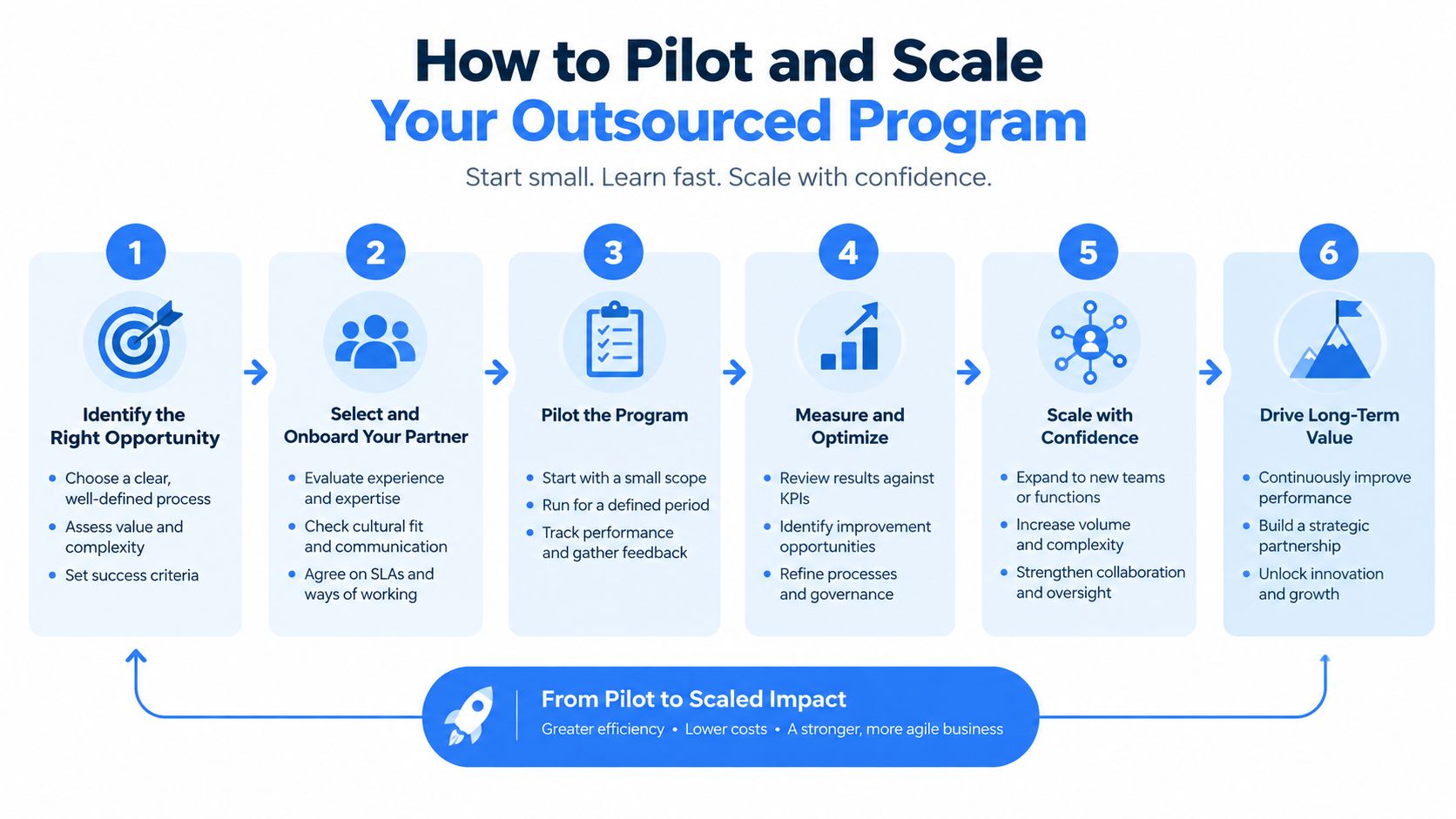
A pilot fails when it tries to prove everything at once. Choose one market, buyer profile, offer, and measurable handoff. That narrow scope makes weak performance traceable to targeting, messaging, timing, data quality, or sales follow-up.
Build the pilot in six steps
- Write acceptance criteria. Define a qualified meeting, rejection reasons, and the evidence required for internal sales to accept the handoff.
- Connect the systems. Provide controlled CRM, calendar, suppression-list, and sales-material access. Set permissions before any outreach begins.
- Approve targeting. Review account lists and personas before launch. Fix an ICP problem at the source rather than blaming reps for poor meetings.
- Launch a controlled sequence. Test messages and channels while recording each change, audience, and outcome.
- Inspect handoffs weekly. Review replies, notes, attendance, disqualifications, and next steps with internal sellers. Compare accepted meetings with later pipeline progression.
- Scale after quality stabilizes. Add markets, segments, or volume only when accepted opportunities remain consistent across review periods.
Outsourced teams can increase activity quickly, but volume is not proof of fit. One example describes increasing leads from approximately 50 to 300 per month while maintaining targeted outreach quality in new markets, as reported by Lead Printer. Treat that result as a planning reference, not a forecast.
Regional expansion requires the same controls. Confirm language, time-zone coverage, local proof points, compliance requirements, and internal follow-up capacity before entering another market. If you are comparing providers with local hiring, guidance on interviewing LATAM sales talent clarifies the difference between recruiting individual sellers and managing external execution.
Track campaign performance by source, segment, meeting status, and pipeline outcome. A rising meeting count paired with falling acceptance or attendance signals a governance problem, not a successful scale-up.
Here is a practical explainer on the operating model:
Evaluation Checklist and Contract Considerations
Select the provider that can explain its process in operational detail. A polished sales deck isn't evidence of execution quality. Ask to see how the team researches accounts, approves messaging, records objections, and handles a meeting that fails your qualification standard.
Questions for the provider
- Who does the work? Identify researchers, reps, managers, copywriters, and escalation owners. Confirm whether the people in the proposal will run the campaign.
- Which systems are included? Ask about CRM access, enrichment, sequencing, call recording, reporting, and data export.
- How is quality measured? Require definitions for qualified leads, accepted meetings, attendance, opportunities, and disqualification.
- How does feedback change campaigns? Look for a documented review loop, not a promise of “optimization.”
- How are markets localized? Confirm language capability, time-zone coverage, regional research, and approval of local messaging.
- What happens when performance slips? Establish remediation steps, ownership, and exit rights before launch.
The provider should also show how it protects your brand. Ask whether messages receive human review, how unsubscribes and suppression requests are handled, and how the team avoids contacting existing customers, active opportunities, or strategic accounts without approval.
Contract terms that protect the program
Put the scope in writing. Define target markets, channels, deliverables, reporting frequency, access rights, ownership of prospect data, confidentiality, and the process for changing the ICP. Include a clear service-level definition for accepted leads rather than relying on a vague meeting quota.
Pricing deserves equal precision. Separate setup fees, recurring management, tooling, and performance payments. If compensation rewards appointments, add quality controls so the provider can't maximize calendar volume by weakening qualification. If the partner offers a guarantee, define the remedy, evidence required, and exclusions.
Data ownership is essential. Your company should retain access to campaign history, prospect records, replies, suppression lists, and CRM activity. The contract should explain what happens to that data when the engagement ends.
Before choosing a partner, review sales development outsourcing as a distinct operating model rather than treating it as interchangeable with list buying or freelance recruitment. The right agreement makes responsibilities visible, quality measurable, and termination manageable.
Contract test: If you can't explain what the provider owns, what your team owns, and how a bad meeting gets corrected, the agreement isn't ready.
Lead Printer builds and manages outsourced B2B outbound programs across prospect research, data enrichment, personalized email and LinkedIn outreach, qualification, CRM handoff, and reporting. If you need a governed way to create qualified pipeline across the US, UK, or EU, visit Lead Printer to discuss a focused campaign.