The board deck is due tomorrow, pipeline coverage is thin, two SDRs have resigned, and the people still on the team are spending their days sorting replies instead of creating new conversations. Meanwhile, a new market opportunity has appeared, but building the lists, domains, messaging, and follow-up process internally would take longer than the revenue plan allows.
That's the situation in which many B2B teams decide to outsource lead generation. The decision isn't automatically about reducing headcount or buying more meetings. Done properly, it's about adding a controlled operating layer for research, deliverability, outreach, and qualification when internal capacity can't keep pace.
The distinction matters. Cold outreach is a low-response environment. One 2026 benchmark places the average B2B cold email reply rate at 3.43%, while 5% to 10% is considered good and 10% or more is considered elite, according to LeadRivet's 2026 outbound benchmark. A vendor that increases send volume may increase activity without improving pipeline.
Why B2B Teams Consider Outsourcing
A growth leader rarely searches for an agency because prospecting is theoretically difficult. The search usually starts after the internal system stops absorbing pressure. Hiring an SDR requires recruiting, onboarding, management, tooling, list development, messaging, and quality control. A new rep also needs product, market, objection, and customer-profile context before activity becomes useful.
If two experienced SDRs leave together, the company loses capacity and institutional knowledge at the same time. Waiting for replacements can delay coverage while remaining staff spend more time on operational work and less on creating qualified conversations.
Practical rule: Outsource when the cost of waiting for internal capacity is higher than the cost of building a governed external motion.
The same logic applies when entering a new geography or testing a new segment. An internal team may understand its established market but lack localized research, relevant buying signals, or tested messages for a different audience. An external team can provide campaign operators, research workflows, and sending infrastructure already used in other programs. The buyer still needs to set the strategic boundaries and inspect how the work is performed.
Outsourcing is a capacity decision
Market adoption reflects this shift. One industry summary estimates that about 60% of B2B companies outsource at least part of their lead generation activities. It also estimates the outsourced B2B lead generation market at roughly $2.66 billion in 2024, with a projection of about $7.33 billion by 2033 at an implied 11.9% CAGR, as reported in Stealth Agents' lead generation outsourcing summary.
These figures do not prove that outsourcing fits every business. They show why specialist support has become a normal operating choice. Companies may use external teams for prospect research, deliverability operations, outreach execution, and early qualification instead of building every function internally.
The performance question is operational. Industry benchmarks consistently show low reply rates, making volume an unreliable quality proxy. More sends cannot compensate for weak domain setup, poor targeting, or engagement that ignores account signals. Buyers should verify the vendor's sending controls, suppression process, research standards, and reporting before judging the promised meeting volume.
The trade-off is management, not abandonment
Outsourcing removes execution work, not accountability. Your team still defines the ideal customer profile, approves positioning, handles objections, accepts or rejects meetings, and closes the feedback loop with sales.
The strongest arrangements treat the vendor as an extension of the revenue team. Weak arrangements hand over a vague audience, a product brochure, and a meeting target, then blame the provider when irrelevant prospects reach the calendar. Clear scope, review points, and feedback rules protect pipeline quality.
What Outsource Lead Generation Actually Covers
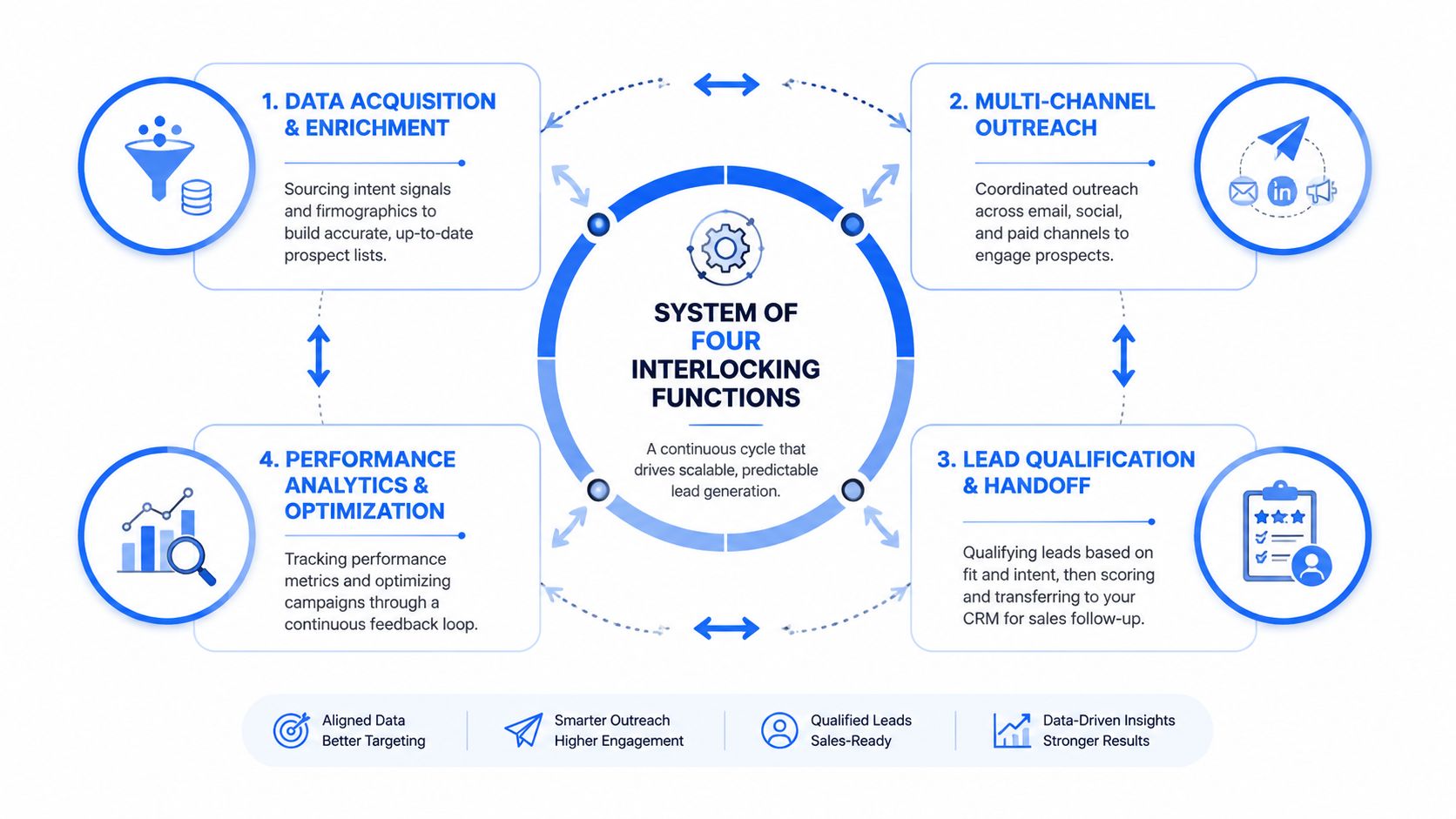
Outsourced lead generation is a connected operating system, not a send-and-pray service. Four functions need to work together: data acquisition and enrichment, outreach infrastructure, messaging and sequencing, and qualification with handoff.
Data comes before copy
The first layer identifies accounts and contacts that fit the commercial strategy. It can include firmographics, technology use, geography, role seniority, hiring activity, funding events, or other buying signals. Enrichment verifies whether the person still holds the role and whether the company meets the account criteria.
A vendor that skips this work often compensates with volume. That creates familiar symptoms: generic titles, outdated contacts, broad lists, and replies from companies that could never buy.
Infrastructure protects future campaigns
The infrastructure layer covers sending domains, mailboxes, warm-up practices, authentication, reputation monitoring, suppression handling, and campaign separation. These details determine whether messages reach inboxes and whether the sender can continue operating after an unsuccessful test.
The concern is practical. A 2025 benchmark across 7.5 million cold emails reported an overall bounce rate of 1.71%, with 1.93% in the first half of the year and 1.45% in the second half, according to the LinkedIn deliverability benchmark. The same source reports material geographic variation, including 3.26% in India, 2.86% in Spain, 0.71% in Finland, and 1.05% in Sweden. A vendor should therefore explain how infrastructure and targeting change by market.
Engagement and handoff complete the system
Copywriters turn the research into relevant propositions, sequence steps, follow-up logic, and objection handling. Qualification specialists then decide whether a response meets the agreed standard, record the context, and route it into the CRM or calendar.
For buyers who want a broader explanation of the downstream process, what lead management involves is a useful reference because lead generation only creates value when ownership, status, routing, and follow-up are clear. Teams comparing implementation approaches can also review outbound lead generation services as an example of how research, infrastructure, messaging, and campaign execution may be combined.
In-House, Outsourced, and Hybrid Operating Models
There isn't one correct structure. The right choice depends on how stable your ICP is, how quickly you need pipeline, how much control your team can provide, and whether sales leaders can manage another operating function.
An in-house SDR team gives you the closest connection to product marketing, account executives, and customer feedback. Reps learn the company's language through daily interaction, and managers can change priorities quickly. The trade-off is fixed overhead, hiring risk, management time, and the need to build every technical and data process yourself.
A fully outsourced program offers speed and flexible capacity. It can make sense when you're launching a segment, entering a geography, or dealing with a temporary gap in prospecting coverage. The cost is governance. Without direct access to campaign decisions and clean reporting, you may receive activity without learning which messages, accounts, or signals are producing commercial value.
The hybrid model is often the most practical for scale-stage teams. The partner manages list building, infrastructure, research, and initial sequences. Your internal team owns positioning, qualification standards, sales acceptance, discovery, and closing. That arrangement preserves customer and product context while allowing specialists to run repetitive operations.
| Dimension | In-House SDR Team | Fully Outsourced | Hybrid Model |
|---|---|---|---|
| Cost predictability | Fixed payroll, tools, and management overhead | Flexible scope, but contract terms require scrutiny | Shared cost across internal and external functions |
| Control | Highest direct control | Requires formal governance and access | Strategic control stays internal |
| Ramp speed | Slower because hiring and training are internal | Faster when infrastructure already exists | Fast launch with internal oversight |
| Pipeline quality | Strong when managers and feedback loops are mature | Depends heavily on qualification discipline | Often balances scale with product context |
| Best use | Stable ICP and repeatable motion | New markets or urgent capacity gaps | Growing teams that need scale without losing control |
A simple decision rule
Early-stage companies and teams under $2 million ARR often benefit from a lean outsourced or hybrid model because they may not yet have enough repeatability to justify a full internal function. That threshold is a planning rule, not a universal law.
After product-market fit, with a stable ICP and consistent sales process, an internal team can become more attractive. Most scale-stage companies still benefit from hybrid execution, particularly when deliverability, data operations, or regional expansion would otherwise distract sales leadership.
How to Choose the Right Lead Generation Partner
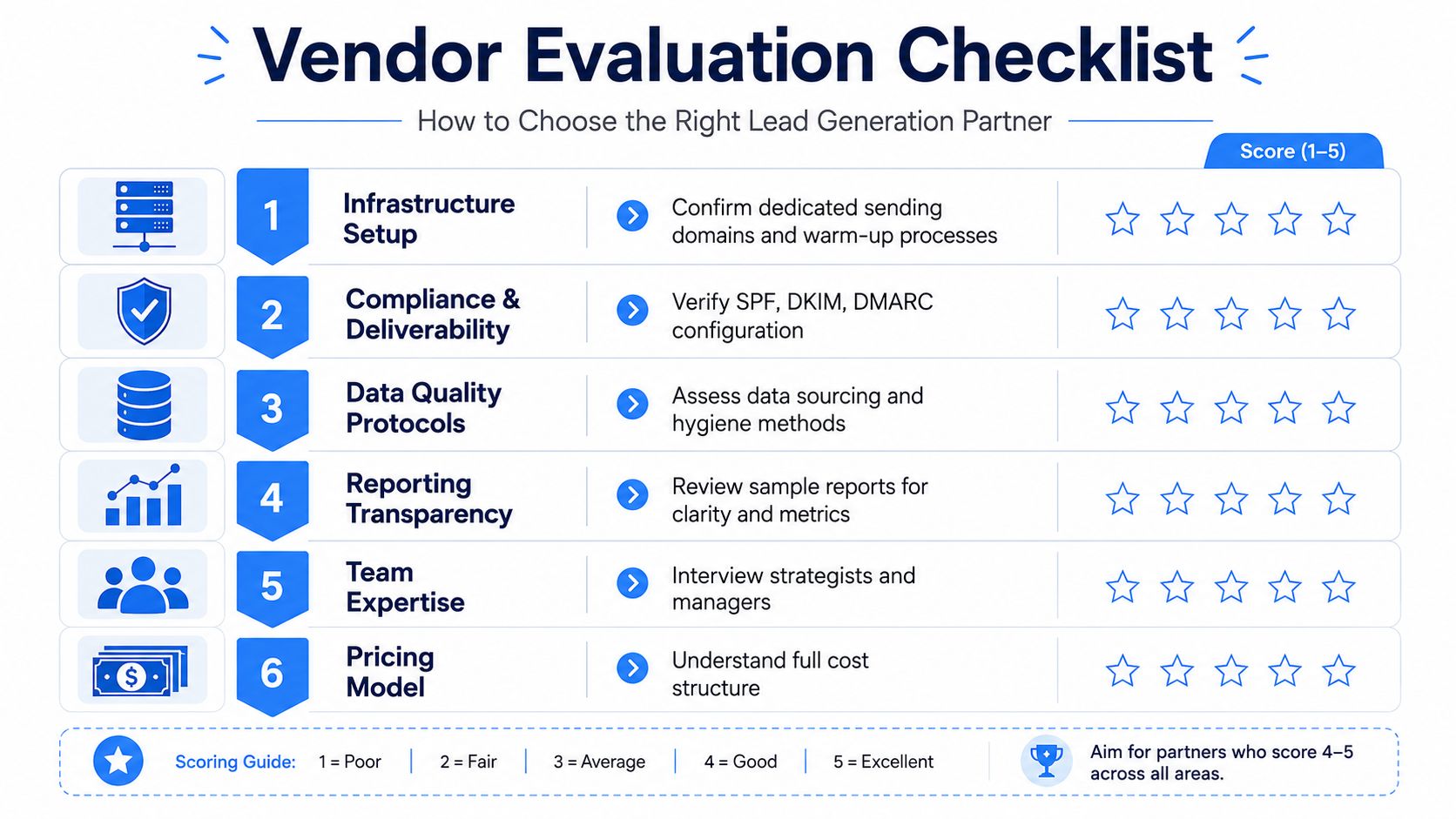
Evaluate the operating system, not the sales presentation. Put each vendor on a 1 to 5 scorecard across six areas, and disqualify any provider that can't document at least two critical capabilities in writing.
1. Infrastructure setup
Ask who owns the sending domains and mailboxes, how warm-up works, and how the provider separates your reputation from other clients. Confirm that SPF, DKIM, and DMARC are configured correctly and that campaign data remains accessible.
A vendor that sends every client's outreach through one shared domain is a serious red flag. So is a provider that refuses to explain what happens when a campaign generates bounces, complaints, or unsubscribe requests.
2. Data sources and hygiene
Ask whether the list is licensed, scraped, enriched, or based on intent signals. Request a sample with source disclosure before signing. You should be able to understand why each account is included, not just see a spreadsheet of names.
3. ICP definition
A capable partner will pressure-test your ICP using firmographic, technographic, role, geography, and trigger-event criteria. A weak one will copy the audience from your brief without asking which customers have converted or which segments sales rejects.
4. Qualification rigor
Review the discovery script and lead-status definitions. The outsourced rep should screen for fit, problem relevance, authority, timing, and next-step willingness, then provide usable context to the account executive.
5. Reporting cadence
Require weekly campaign reviews with deliverability, bounce, reply, positive reply, meeting, and rejection data separated by campaign. A single activity total hides quality decay.
6. Contract terms
Check auto-renewal language, data portability, ownership of copy and campaign history, minimum commitments, replacement rules, and pilot provisions. Questions about external team governance can be sharpened with seven key questions for remote staffing, particularly around accountability and role clarity.
Use the same criteria when reviewing sales development outsourcing providers. A polished deck is not evidence of sound infrastructure, clean data, or disciplined qualification.
This video can provide additional context for assessing outsourced sales operations:
Pricing Models and What They Really Cost
Pricing changes vendor behavior. The cheapest quoted unit price can become expensive when your sales team spends time rejecting poor-fit leads, cleaning records, or repairing damaged sending infrastructure.
| Model | Typical Cost | Primary Risk | Best Fit |
|---|---|---|---|
| Per lead | Often priced by delivered contact | Quality drift and list expansion | Buyers with strict acceptance criteria |
| Per meeting | Often priced by booked conversation | Low-fit meetings and weak attendance | Teams with a precise meeting definition |
| Retainer | Fixed monthly scope | Buyer carries more delivery risk | Managed programs requiring iteration |
| Hybrid | Base fee plus performance component | Conflicting incentives if poorly defined | Mature teams with shared accountability |
Per-lead pricing looks easy to budget, but it pays for names rather than commercial progress. Require acceptance criteria for every lead, define exclusion rules, and cap the total volume. Otherwise, a provider can broaden the audience or recycle older records when the original segment becomes difficult.
Per-meeting pricing appears more outcome-oriented. The problem is that “booked” can mean a calendar invitation was accepted, not that the prospect fits your ICP or will attend. Define a qualified meeting in writing, include show-up requirements, and establish a replacement process for no-shows or rejected accounts.
Retainers transfer more execution risk to the buyer, but they can support better work when the partner needs time to research, test, learn, and refine. Hybrid pricing can align incentives when bonuses depend on meetings held or opportunities accepted, rather than raw replies.
Model the full cost. Include internal review time, CRM enrichment, handoff meetings, required software, compliance oversight, and the opportunity cost of account executives handling unsuitable appointments. Don't accept a long commitment without a meaningful pilot and a clear exit process.
KPIs That Separate Vendors From Meeting-Factories
Reply rate provides context, but it is easy to inflate. A vendor can widen the list, ask a low-friction question, or count any response as success. The commercial test is what follows: meetings held, opportunities accepted, and pipeline created.
Use benchmarks to set expectations, not to replace a scorecard. Belkins' cold email response rate analysis reports a 5.8% average reply rate across 16.5 million emails sent in 2024 and describes a decline from about 8.5% in 2019 to roughly 5% in 2025. These figures show why a vendor should explain audience quality, message relevance, and conversion after the initial reply.
| KPI | Activity vs Pipeline | Target Range | What It Signals |
|---|---|---|---|
| Reply rate | Activity | Use benchmark context, not a standalone target | Message and audience engagement |
| Positive reply rate | Bridge metric | Set by segment and signal quality | Relevance and buying interest |
| Meetings held | Pipeline leading indicator | Defined by your qualification standard | Calendar quality and attendance |
| Opportunity creation | Pipeline | Reviewed by cohort | Sales acceptance and commercial fit |
| Pipeline contribution | Pipeline outcome | Tracked through the agreed sales window | Revenue relevance |
| Bounce and complaint trends | Infrastructure | Must remain within agreed safeguards | Sender reputation sustainability |
The table should drive vendor reviews. Ask for cohorts by segment, trigger, sender domain, and sequence, rather than accepting a blended account average. A high reply rate paired with weak meeting attendance usually points to loose targeting or weak qualification. Rising bounces and complaints indicate an infrastructure problem that can reduce future inbox placement.
Signals beat static filters
Signal-based outbound uses events such as job changes or funding rounds to identify better timing. For campaigns built around a fresh signal and a directly relevant message, reported reply rates of 15% to 25% are achievable, according to GenFlow's 2026 outbound benchmark.
That range is a reason to inspect the operating process, not promise a result. Ask what triggered each message, when the vendor captured the signal, how long it remains valid, and who removes stale records. The vendor should also show how signal quality affects audience selection, copy, follow-up timing, and handoff.
Use B2B prospecting services as a reference when comparing how providers define research, targeting, technical setup, and sales handoff. Tie compensation to meetings held and opportunities created, with written acceptance criteria, rather than replies or booked calendar slots alone.
B2B Scenarios Where Outsourcing Delivers
Outsourcing performs best when the company knows what it wants the external team to execute. The following scenarios illustrate where specialist capacity can help, and where an unclear brief can undo the advantage.
| Scenario | Why Outsourcing Works | Common Mistake |
|---|---|---|
| Early-stage SaaS with a defined ICP | A specialist can combine list research, sending infrastructure, and focused sequences | Chasing volume instead of qualified pipeline |
| Mid-market ecommerce selling procurement tools | External researchers can map buying committees and activate account signals | Treating account-based outreach like mass marketing |
| Services firm entering a new vertical | A partner can provide research workflows and vertical messaging experience | Accepting meetings without strict fit criteria |
| Industrial manufacturer with long sales cycles | External teams can manage nurture and re-engagement across named accounts | Leaving field-sales handoff undefined |
An early-stage SaaS company may need outbound coverage before it has the time or management bandwidth to build a full SDR function. The useful outsourced scope might include account selection, technical setup, and first-touch sequencing, while the founder or sales leader handles discovery. The mistake is letting the provider optimize for list size rather than learning which accounts have the problem.
For an ecommerce or payments company selling to businesses, the buying committee often includes operations, finance, procurement, and technology stakeholders. A campaign that contacts only one title may produce polite interest without internal movement. The partner should map the account and coordinate messages around a relevant business event.
A services firm entering a new vertical needs domain credibility. Outsourcing can accelerate research and testing, but the client must still review terminology, objections, and qualification logic before launch.
Manufacturers face a different challenge. A prospect may need multiple touches before a field salesperson engages. Outsourcing helps maintain account-level nurture, but it fails when no one defines who owns the next action, what counts as an active opportunity, and how dormant contacts return to sequence.
The unified rule is simple: scope, ICP, and handoff must be specified before delegation. If all three are handed to the vendor, the buyer has outsourced strategy as well as execution.
A 90-Day Implementation Checklist for Buyers
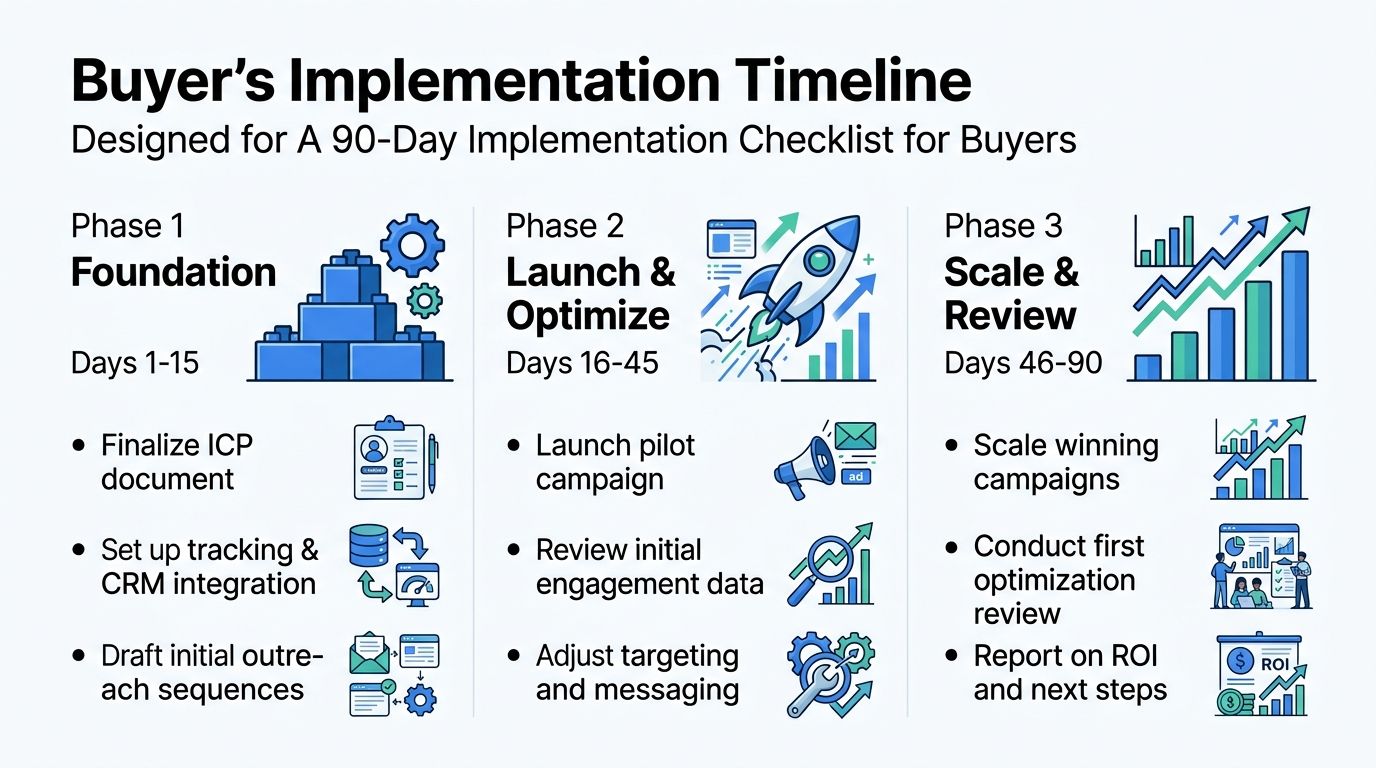
A good first quarter has distinct gates. The vendor shouldn't scale sending because the calendar says launch day has arrived. Each phase should answer a different question: is the foundation sound, is the campaign relevant, and is the resulting pipeline worth expanding?
Days 1 to 15, build the foundation
Start with a written ICP. Include company size, industry, geography, technology environment, relevant roles, exclusions, and trigger events. Share product positioning, approved claims, customer language, objections, and examples of accounts sales considers poor fit.
Connect the CRM and agree on status definitions before any leads arrive. Decide what qualifies as an MQL, SQL, accepted meeting, rejected meeting, opportunity, and recycled contact. Provision dedicated sending infrastructure and confirm SPF, DKIM, and DMARC configuration before launch.
Days 16 to 45, validate the launch
Approve the target account list and exclusion segments. Review subject lines, opening messages, calls to action, follow-up logic, and personalization rules. Ask the vendor to explain how it will handle opt-outs, bounced contacts, duplicate accounts, and replies that don't fit the campaign.
Run a soft launch with a small cohort. Monitor bounce, open, reply, and positive reply rates by sequence, but don't interpret early engagement without reviewing the actual conversations. A high reply count can still represent weak relevance.
Days 46 to 75, ramp with feedback
Hold weekly pipeline reviews with the vendor and the internal sales owner. Bring real reply examples, objections, account notes, and rejected meetings into the discussion. Document which trigger events create useful conversations and which segments consume time without progressing.
Scale only the sequences that pass both quality and deliverability checks. Retire messages that attract curiosity but not buying relevance.
Days 76 to 90, decide from pipeline evidence
Compare performance with the agreed KPIs. Isolate the top two sequences, review opportunity creation, and assess whether account executives accept and advance the meetings. Formalize the monthly reporting cadence, including campaign-level data and ownership of historical records.
At the end of the period, choose among renewal, expansion, or restructuring. The decision should follow pipeline contribution and sales acceptance, not send volume, open counts, or a polished activity report.
A buyer can hand this checklist to the vendor at kickoff:
- Foundation: Finalize the ICP, positioning, CRM workflow, qualification rules, and sending infrastructure.
- Launch: Approve accounts, exclusions, messaging, and a controlled pilot cohort.
- Ramp: Review deliverability, replies, objections, meetings held, and sales feedback each week.
- Optimization: Scale proven sequences, retire weak ones, and document signal and segment performance.
- Decision: Renew or change scope based on accepted opportunities and pipeline contribution.
Lead Printer offers outsourced B2B outbound execution across prospect research, data enrichment, email and LinkedIn campaigns, qualification, CRM handoff, and reporting. If you're evaluating partners around deliverability infrastructure and signal-based targeting, visit Lead Printer to review whether its scope fits your 90-day implementation plan.