Outbound lead generation doesn't fail because people hate cold outreach. It fails because teams try to send before the machine underneath the sending is ready. Bad lists, weak deliverability, fuzzy ICPs, and sloppy sequencing burn through domains and budgets long before a prospect decides whether to reply.
That's why the old advice, send more emails, test more subject lines, and keep pushing volume, is usually the wrong place to start. Modern outbound is a precision system, not a blasting exercise. The teams that win treat it like infrastructure, data operations, and message design working together, then they optimize for pipeline, not vanity activity.
Why Outbound Lead Generation Still Wins in 2026
The popular story says outbound is either dead or dirty. Both versions miss the point. Outbound lead generation still works because it lets sales teams choose who to target and when to engage, which is something inbound can't reliably do for decision-makers who aren't actively searching.
That matters most in account-based sales, new market entry, and any situation where pipeline can't wait for search demand to mature. In those cases, outbound is less about cheap volume and more about control, precision, and relevance. When a buyer isn't raising their hand, someone still has to create the first useful conversation.
The modern outbound mindset
The channel has changed a lot from the old cold-calling playbook. It now leans on email, LinkedIn, enrichment, automation, and role-based personalization, because buyers expect context and relevance on every touch. The companies that get results don't think in terms of “send more.” They think in terms of better data, tighter lists, and coordinated touches.
Practical rule: If your outbound looks like mass broadcast, you're competing on annoyance. If it looks like account research turned into a tailored conversation, you're competing on fit.
That shift is also why the reputation of outbound and the usefulness of outbound are not the same thing. Spammy execution earns the channel its bad name. Structured execution is what sales leaders use when they need predictability and direct access to accounts that won't come in through organic channels.
The core lesson is simple. Outbound still wins when the market is hard to reach, the accounts are well defined, and the team is disciplined enough to build systems that compound instead of burning lists for one-off results.
The Economics and Market Reality of Outbound
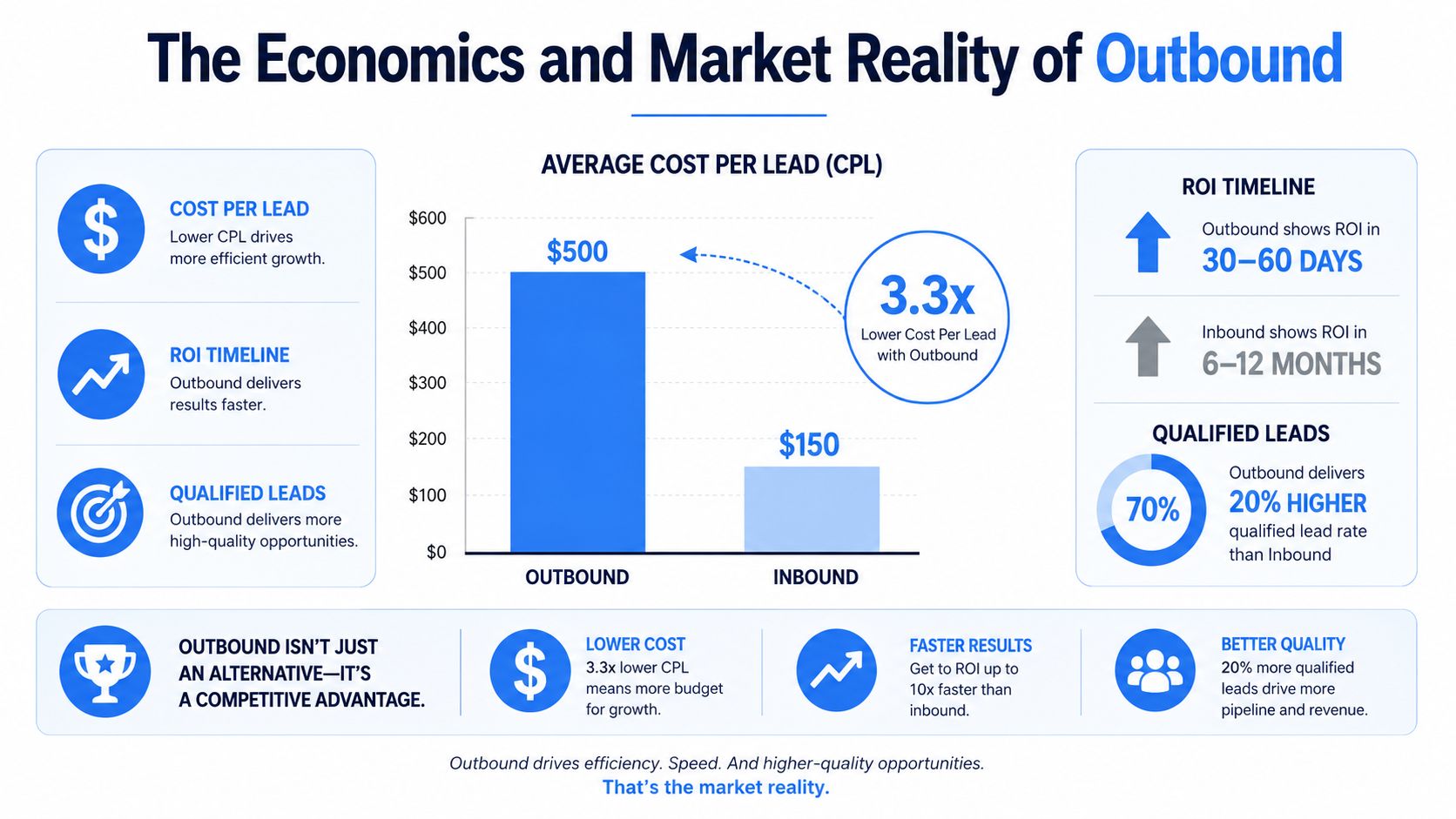
Outbound gets judged by the wrong yardstick when teams compare it with inbound on raw cost per lead. The trade-off is control. One 2024 benchmark cited by EditorNinja says outbound leads cost 39% more than inbound leads, so a $100 inbound lead would average about $139 through outbound methods such as cold email or cold calling (EditorNinja lead generation statistics). That premium is the cost of reaching accounts that matter before demand shows up on its own.
Why the higher cost can still make sense
Outbound usually carries more labor, more tooling, and more operational overhead. It also serves a different job. Teams use it to create pipeline, target strategic accounts, and reach buyers before they enter a search journey, so the economics should be measured against revenue quality and speed, not only lead price.
The performance benchmarks show where execution breaks down. In the same benchmark data, cold email reply rates were 5.8% across 16.5M emails, while cold-calling success rates were 2.3% across 204k+ calls (EditorNinja lead generation statistics). Those numbers are a reminder that outbound rewards tight targeting, clean list hygiene, and solid infrastructure more than raw send volume.
What the market says about durability
This is not a fading channel. A 2025 industry source says the global lead generation services market was valued at $4.1 billion in 2022 and is projected to reach $9.9 billion by 2028, a 17.5% CAGR (Stealth Agents research). Another 2026 market summary says the broader outbound marketing services market was valued at $47.64 billion in 2024 and is projected to reach $83.96 billion by 2033 at 6.5% CAGR (Stealth Agents research). Those projections show that outbound still has structural demand, especially where sales teams need pipeline control.
The same source also notes average B2B email open rates around 35.6%, MQL-to-SQL conversion around 13%, and an average B2B buying committee of 6 to 10 stakeholders (Stealth Agents research). That combination explains why one-message blasting fails. A modern sequence has to reach multiple stakeholders with different angles, or it stalls before the committee reaches agreement.
If you want a useful framing beyond channel hype, outbound sales in the AI era is a practical way to look at how automation, relevance, and timing changed the economics.
Building the Infrastructure That Determines Deliverability
Most campaigns do not fail in the copy. They fail in the wiring. If your sending setup, authentication, inbox health, and reputation handling are out of order, the prospect never sees the message. Outbound infrastructure should be built like production plumbing, not a side project assembled the day before launch.
Start with separation and reputation
Dedicated sending domains are standard practice for a reason. They shield the primary business domain from avoidable reputation damage and give outbound teams a clean place to monitor performance. In practice, that means the outreach system can absorb testing, list churn, and volume changes without putting the core company domain at risk.
Warm-up matters for the same reason. A new inbox has no trust yet, so volume needs to ramp gradually while sender behavior proves consistent. Teams that skip that step often misread a reputation problem as a messaging problem, then rewrite copy that was not the issue.
Clean infrastructure does not make a bad offer work. It keeps a good offer from disappearing into spam before anyone has a chance to judge it.
Track the operational thresholds that actually matter
For scalable outbound infrastructure, a useful benchmark is email deliverability above 95%, hard bounce rate under 2%, sequence completion above 70%, and opt-out rate under 0.5% (UnifyGTM automated outbound metrics). Those thresholds matter because they affect inbox placement, sender reputation, and audience fatigue. If opt-outs rise, the segmentation or cadence is usually off. If bounces rise, the list hygiene is weak.
Inbox-provider changes also matter. Google and Yahoo's bulk-sender requirements have made authentication and unsubscribe handling mandatory for large-scale email programs, while Apple Mail Privacy Protection can distort open-rate reporting (Chili Piper outbound lead generation). Teams should optimize for deliverability and downstream reply or meeting metrics, not opens alone.
Keep the stack operational, not ceremonial
Infrastructure is not a one-time setup. It needs monitoring, list cleaning, deduplication, and periodic re-verification of older records. That becomes even more important when you are pulling from multiple sources and sending across several inboxes. If you rely on a scrape markdown api to assemble records, the quality of the source data needs the same attention as the sending layer.
A simple rule helps here. Verify before launch, monitor during send, and clean after every campaign cycle. If the technical layer drifts, even the strongest sequence will not reach the right people consistently.
Data Quality and Targeting Precision
The most critical variable in outbound isn't copywriting. It's data quality. A good message to the wrong account still fails, and a weak message to a sharp list often performs better than people expect because relevance does the heavy lifting.
Build from ICP, not from contact volume
Start with a clear ideal customer profile, then work outward. That means defining the firmographic and role criteria that matter, then building lists around those filters instead of collecting contacts first and hoping the campaign logic fixes them later. Poor targeting compounds across every stage, from delivery to reply to booked meeting.
One benchmark framework sets ICP match rate above 80%, hygiene score above 90%, reply rate at 5%–10%, and meeting conversion from replies at 15%–25% (Dievio outbound KPIs). Those numbers are useful because they make the relationship between targeting and downstream conversion obvious. If the list fit is weak, the reply rate usually tells you before the copy does.
Enrichment beats guesswork
The best teams don't stop at job title and company size. They enrich by role, tech stack, geography, and competitive context, then segment messaging around what each subgroup cares about. That's how one list turns into multiple relevant sequences instead of one generic blast.
Practical rule: If reply rates are low, look at ICP fit first. Low engagement is often a targeting problem wearing a copywriting costume.
Prospect research can come from LinkedIn Sales Navigator, company websites, business registries, and other public sources, but the process has to be structured. Context.dev's scrape markdown API can be useful for teams that need cleaner extraction from target sites before enrichment and segmentation. The tool is only part of the system, though. A key win comes from using that data to sharpen role-based relevance.
Use precision as the default, not the exception
The more specific the segment, the easier it is to make the message feel earned. That doesn't mean every account needs a fully bespoke sequence. It means every segment should have a reason to exist, and every field in the list should support a targeting decision.
Lead Printer's workflow reflects that logic in practice. It uses LinkedIn Sales Navigator, Google Maps, targeted websites, and business registries for list building, then layers enrichment and segmentation on top of that data so the outreach matches the account instead of the other way around. One tool in that process can be Clay, but the bigger point is the system behind it.
Multichannel Sequencing and Campaign Orchestration
A single cold email rarely builds trust on its own. The campaigns that hold attention create recognition through coordinated touches, so the prospect sees one consistent motion across email, LinkedIn, and, where it fits, phone. Channel count matters less than orchestration.
The best sequences start with a low-friction LinkedIn action, then a relevant email, then a follow-up that changes the angle without changing the account. The buyer should not feel three separate pitches. They should feel one account-aware conversation that keeps showing up in useful places.
How the channels reinforce each other
Email gives structure and scale. LinkedIn gives visibility and a lower-pressure way to stay in front of the buyer. When both are timed around the same account context, each touch makes the next one feel more familiar.
A practical pattern looks like this. A rep views the prospect's profile, sends a targeted email the next day, then follows up on LinkedIn with a short note tied to the same problem. If the prospect opens but does not reply, the next touch can reference a different pain point or stakeholder angle instead of repeating the first ask.
Rotation matters because fatigue shows up fast. Many teams repeat the same sentence with different send dates. That is persistence without strategy.
Personalization has to match the market
Localization matters, especially in EU markets and niche verticals where language, references, and buying context change how messages land. A broad sequence can still work for initial testing, but segmented language usually performs better when the buyer expects local nuance or role-specific relevance.
The strongest multichannel programs also map stakeholders. With 6 to 10 stakeholders in the average B2B buying committee, one contact rarely carries the full deal. The sequence has to account for one person opening the message, another forwarding it, and a third acting as the approver. That is why the surrounding data layer matters so much, because weak account records make even a good sequence feel generic before it starts. If you want to pressure-test that setup, the Lead Printer ROI calculator is a practical way to sanity-check whether the effort matches the economics.
Example of coordinated orchestration
A services firm selling into mid-market manufacturers may start with one message to the operations lead, then a parallel LinkedIn touch to the commercial lead, and a later follow-up that reframes the same offer around risk reduction rather than speed. None of the touches should feel random. Each one should move the account one step closer to a meeting by making the offer easier to understand from a different seat in the committee.
Good orchestration turns isolated outreach into a sequence the buyer can process. It also keeps the team honest about infrastructure. If the list is stale, the titles are wrong, or enrichment is thin, multichannel sequencing just distributes failure across more touchpoints.
Measuring the Right Outbound Metrics
Most outbound dashboards are crowded with numbers that hide the failure point. Open rate can look healthy in a privacy-heavy inbox, while activity volume can make a weak campaign seem productive. A better measurement system separates infrastructure health from targeting precision and message quality.
| Metric | Target Benchmark | What It Indicates | Common Fix |
|---|---|---|---|
| Email deliverability | Above 95% | Inbox placement and sender reputation | Clean lists, re-verify old records, monitor sending health |
| Hard bounce rate | Under 2% | List quality and record freshness | Deduplicate, validate titles, remove stale contacts |
| Sequence completion | Above 70% | Whether prospects are reaching the full cadence | Shorten friction, fix broken routing, simplify steps |
| Opt-out rate | Under 0.5% | Fatigue, relevance, or list mismatch | Tighten segmentation, adjust messaging, slow cadence |
| ICP match rate | Above 80% | Targeting accuracy | Refine filters, improve enrichment, cut weak segments |
| Hygiene score | Above 90% | Data cleanliness and reliability | Rebuild lists, verify contacts, remove duplicates |
| Reply rate | 5%–10% | Combination of fit and message relevance | Diagnose ICP before rewriting copy |
| Meeting conversion from replies | 15%–25% | Sales qualification and offer strength | Improve CTA, calendar flow, and qualification logic |
The first mistake is treating a low reply rate as a copy problem when the issue is fit. The second is overvaluing opens when inbox providers have already made that signal less reliable. Apple Mail Privacy Protection and bulk-sender filtering have changed what the numbers mean, so downstream metrics matter more than vanity ones.
Diagnose the layer that's failing
High bounces point to a data problem. Low replies with healthy deliverability usually point to ICP fit or message relevance. Good replies with weak meeting conversion usually point to the qualification flow, the offer, or the handoff.
That kind of discipline saves a lot of wasted testing. Too many teams rewrite subject lines when the list is stale or the sequence is reaching the wrong persona. Measurement should show what to fix before another week goes into “optimizing.”
For teams that want to pressure-test ROI before scaling, the Lead Printer ROI calculator is a practical reference point for thinking about pipeline economics rather than just send volume.
When Outbound Is Worth the Investment
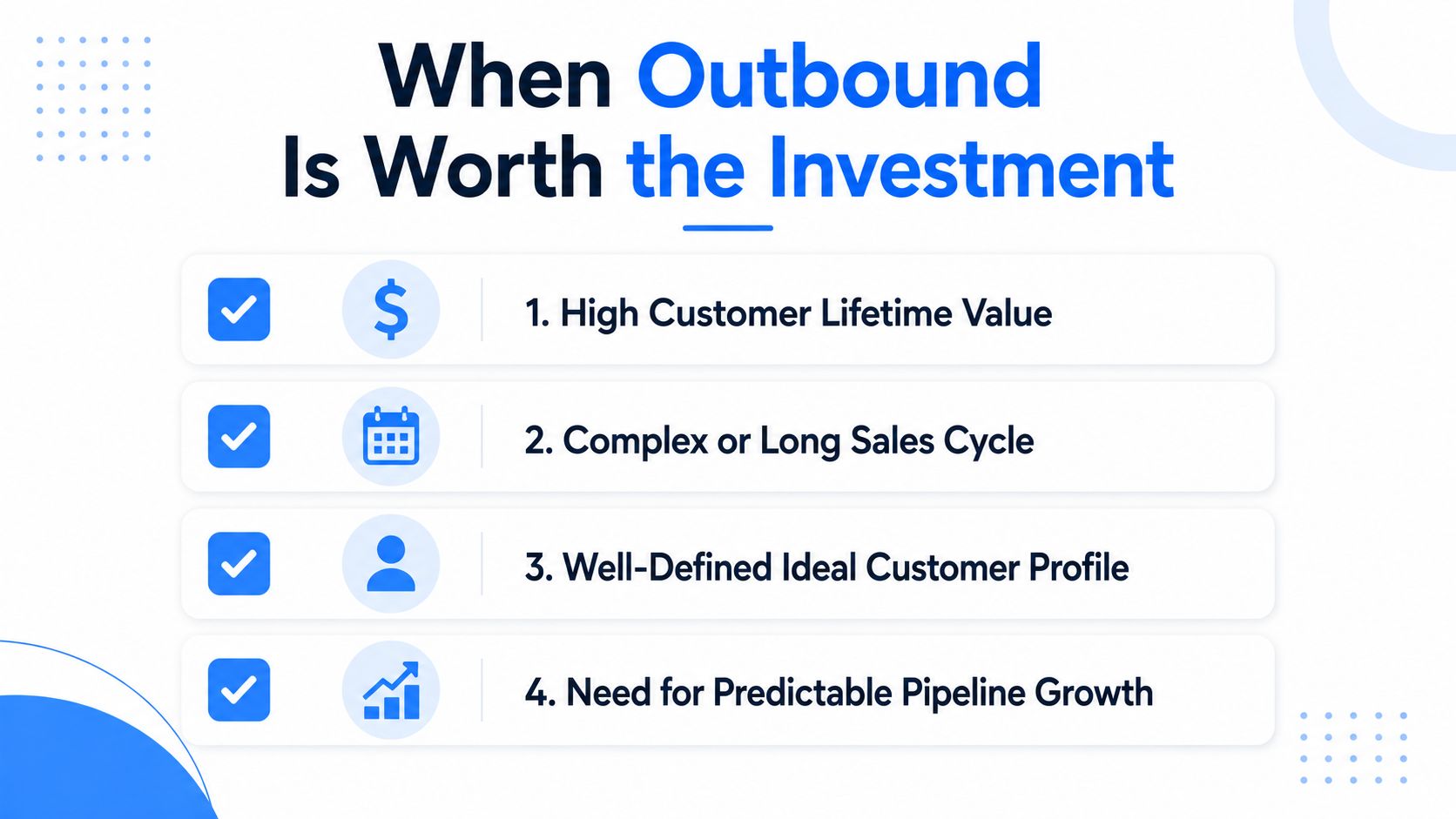
Outbound isn't for every business. It's worth the effort when the economics support the labor and when the market is specific enough to target with discipline. If the customer base is broad, the deal size is small, or the offer needs very little education, outbound can become a noisy distraction.
The conditions that justify the work
Rework's guidance says outbound is appropriate when the ideal customer is clearly defined, the deal size justifies the effort, and the team can afford the labor, with a typical minimum ACV of about $5K (Rework outbound lead generation). That framing is useful because it turns outbound into an economics question, not a personality test. If the deal doesn't justify the work, the channel won't magically fix that.
The strongest use cases usually share a few traits. The accounts are identifiable, the buyers are reachable, and the sales motion has enough complexity that a direct conversation materially improves the odds of closing. In those scenarios, outbound is often the fastest way to create a pipeline you can forecast.
When to skip or delay outbound
If the ICP is still fuzzy, outbound will just teach you the wrong lessons faster. The same is true when the team can't handle booked meetings well, because generating interest without a reliable follow-up process creates waste on both sides. And if the offering doesn't justify a real human sales motion, the channel will feel expensive no matter how well it's run.
Here's the cleanest test. If you can name the accounts, explain why they care, and support the labor with real deal value, outbound deserves a seat at the table. If not, you'll get more results from inbound, partnerships, product-led motion, or a slower qualification-led approach.
The Lead Printer B2B SaaS page is a useful reference point if you're comparing what a structured outbound motion looks like in a software context, especially when the buying process is longer and the stakeholder map is wider.
Launching Your Outbound Program in 2026
The cleanest launch order is infrastructure first, data second, messaging third, and measurement last. Teams that reverse that order usually spend their time fixing the wrong layer. A sequence cannot save a broken domain, and a list cannot make up for vague targeting.
A practical launch sequence
Start with sending infrastructure and inbox health. Set up authentication, confirm inbox placement, and make sure your sending domains and mailboxes can handle the volume you plan to run. Then define the ICP, source the list, enrich the records, and remove anything that does not fit the target profile. Only after that should you write the sequence, because the copy has to match the people you have assembled.
Once the campaign is live, review the signals in the same order. Deliverability shows whether the infrastructure holds. Bounce rate shows whether the data is clean. Reply rate shows whether the message and targeting line up. Meeting conversion shows whether the offer and qualification flow are working. If one of those layers breaks, do not guess. Fix the layer that is failing before you add more volume.
The hardest part of 2026 outbound is the amount of hidden friction before a rep ever gets a reply. Inbox conditions keep tightening, unsubscribe handling needs to be clean, and reputation management is part of the job from day one. Privacy changes also make old reporting habits less reliable, so the team needs a tighter operating cadence and a more disciplined view of what counts as a real signal. The Mail Tracker outreach guide is a useful reference if you are pressure-testing how outreach should be planned and measured at the execution level.
If you are deciding whether to build in-house or work with a partner, the Lead Printer agencies page is a practical place to compare how an outsourced outbound motion can be structured around research, sequencing, and qualification instead of send volume alone. That distinction matters more than many teams admit. Agency help is only useful if the operator can control data quality, inbox setup, and follow-up discipline, not just produce a longer list of sends.
A useful final test is simple. If the system cannot handle clean data, real deliverability, and a credible follow-up motion, do not scale it yet. Fix the layer that is failing, then expand the part that is already working.