60% of SDRs were at quota, according to the 2025 Bridge Group research cited below. Companies consider SDR as a Service because recruiting, ramping, and managing an internal team can take time and produce less predictable results than hiring plans suggest. Meeting counts alone, however, do not show whether the program creates qualified pipeline. Buyers should assess qualification criteria and demand reporting that tracks opportunities beyond the calendar.
Why SDR as a Service Exists and What It Actually Means
In the State of Sales Development research, Bridge Group and InsideSales report benchmark figures that make the operating burden clear: prospecting requires sustained daily activity, and SDR teams need time to ramp. These figures are from the research identified by that source, not a later edition of a Bridge Group study. For buyers, the implication is practical: an outsourced program should be judged by qualified pipeline and accepted handoffs, not activity or meeting totals alone.
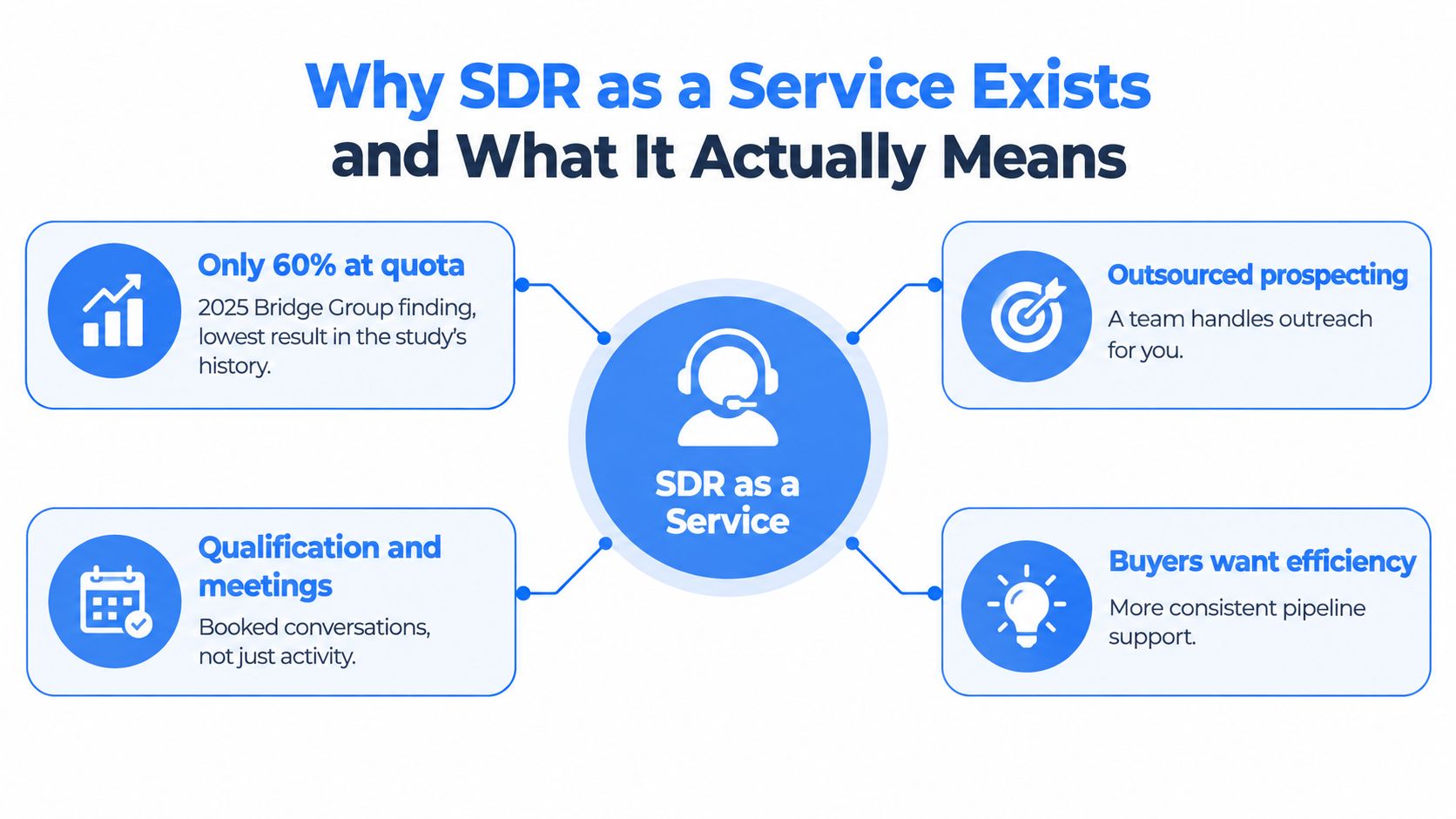
SDR as a Service means an external provider runs the prospecting and qualification function, from building lists and managing outreach infrastructure to handling replies and handing qualified meetings to account executives. The buyer avoids recruiting, training, equipping, and managing the team day to day. The purchase is a defined operating function, not a bundle of contacts or booked calls. Its value depends on the quality of segmentation, outreach, qualification, and handoff, plus whether those steps are visible in reporting.
Where the Model Fits Best
The model fits when a company has a specific capacity or learning gap to address:
- A closing team with no pipeline: Account executives can run discovery, but prospecting is not happening consistently.
- Entry into a new region: Localized outreach can test demand before the company commits to local headcount.
- An unproven segment: Leadership can assess response from a vertical or persona before making permanent hires.
A provider should name the problem it owns and define how results will be measured. Contracts should specify qualification criteria, what counts as an accepted meeting, how rejected handoffs are handled, and which activity and outcome data the buyer can audit. Without those terms, vendors and buyers may count different things as success.
A calendar can fill while the sales team rejects the meetings. Judge the program by whether it produces qualified opportunities that sales accepts, and require reporting that connects outreach to those outcomes.
How the SDR Role Became a Separate Function
Prospecting wasn't always a distinct job. Generalist salespeople once found their own accounts, worked them, and closed them, which meant prospecting happened only when closing work allowed. Early versions of a dedicated role appeared at Oracle's Direct Marketing Division in the 1980s, with similar structures at Computer Associates in the late 1990s, and the SDR title spread during the early 2000s before Aaron Ross's 2011 book Predictable Revenue popularized the formal split between sales development representatives, account executives, and customer success, as traced in this history of the sales development representative role.
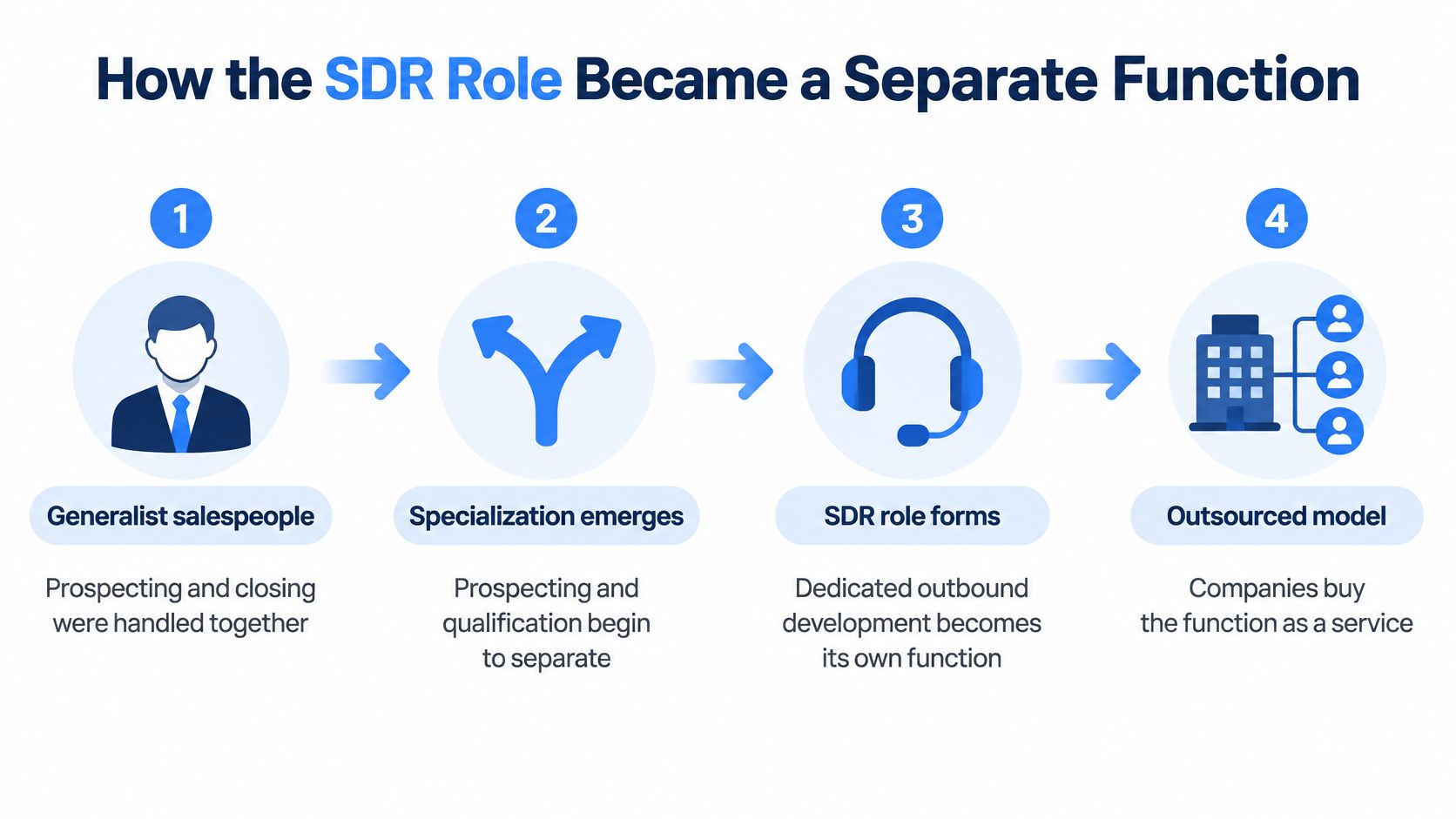
That separation is what made the outsourced version possible. Once identifying accounts, researching contacts, starting conversations, and qualifying interest became defined workflows with their own activity mix, a company could buy that function instead of building it. The same historical account reports that in 2018 SDRs managed an average of 103.8 accounts and 5.6 contacts per account, performed 107.8 activities per day including 40.7 phone and 38.4 email activities, spent 19.0 minutes researching each account, and averaged 3.2 years of tenure, up from 2.8 years previously. Tenure rising tells you the role had become an operational discipline, not a temporary entry level assignment.
The pattern shows up in regulated industries too, and teams building a bank inside sales function face the same choice between generalists and dedicated prospecting roles. B2B software and other complex sales markets remain the natural home for outsourcing this work, because the research and qualification effort per account is high and the closing motion is different work.
The video below walks through how that separation plays out in a modern sales development team.
How an Outsourced SDR Program Runs End to End
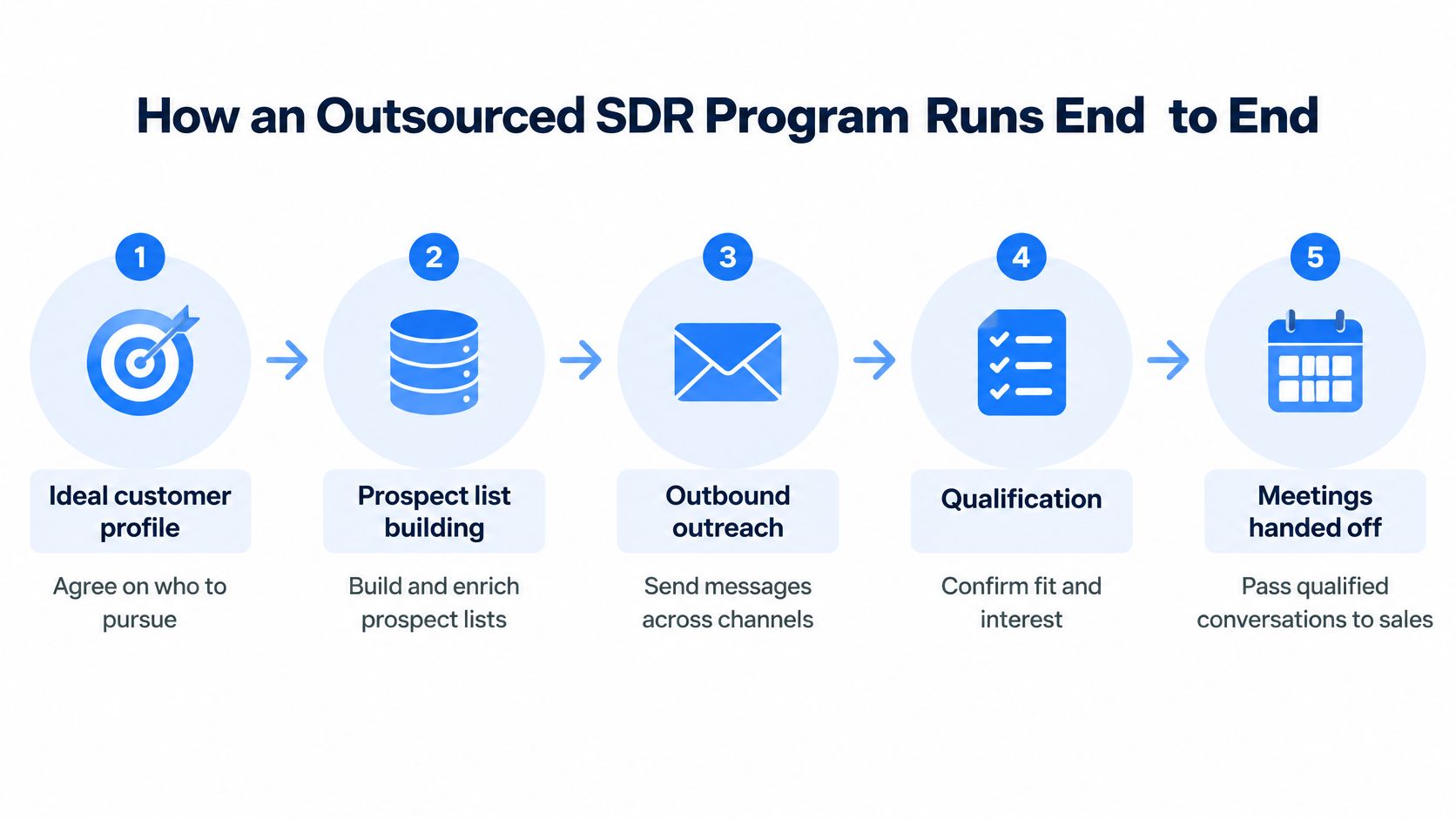
An outsourced SDR program is a pipeline system, not just a way to fill calendars. Its results depend on how well the vendor connects account selection, outreach, qualification, and handoff. Gartner Peer Community findings show that 92% of surveyed organizations rated their pipeline generation efforts as very or somewhat effective. The same survey found 68% identified understanding prospect pain points and 61% identified prospect-confirmed interest as criteria for passing a lead to sales. LinkedIn messages represented 17% of net-new leads, according to Gartner Peer Community findings on SDR pipeline generation. Buyers should turn these criteria into written program rules and reporting requirements.
The Operating Sequence
- Agree the ideal customer profile: Specify industries, company size, geography, target roles, and exclusions before list building begins.
- Build and enrich lists: Identify accounts and contacts, verify their details, and record the reason each account fits the profile.
- Set up infrastructure: Configure sending domains and inboxes, authenticate them, and warm up gradually.
- Write sequences by persona: Connect each message to a specific operational problem for its intended role.
- Run multichannel outreach: Coordinate email, phone, and LinkedIn around the same account hypothesis, and track activity by channel.
- Qualify replies: Apply an agreed threshold using a shared definition of what lead qualification actually requires before launch.
- Hand off with context: Include the prospect's stated pain, role, and conversation history with the meeting.
Where Each Stage Breaks
Weak execution often looks like activity without usable pipeline. A list without role filters can produce replies from people who cannot buy. Sending too much before domain warm-up is complete can get messages throttled or blocked. A sequence may earn opens without confirming interest, so opens alone do not establish the prospect-confirmed interest that 61% of surveyed organizations cite as a handoff criterion. If the handoff omits the prospect's own words, the account executive has to restart discovery.
Audit point: Ask the vendor for a sample handoff note. If it contains a name and meeting time but no pain point or relevant conversation detail, the reporting may count meetings without showing whether they are qualified.
Channel design also needs a rationale. The Gartner findings report LinkedIn's share of net-new leads, but do not establish that one channel mix produces better conversations across segments. Ask the vendor how it allocates activity across email, phone, and LinkedIn for your audience, what results it reports by channel, and what evidence would prompt a change. The contract should define the qualification threshold, required handoff fields, and how rejected leads are reviewed. That makes performance auditable beyond meeting volume.
Comparing In-House SDRs, SDR as a Service, and Appointment Setting
These models differ in who runs prospecting and what the provider is paid to deliver. In-house SDRs give you direct control over messaging, data, and team culture, while your company handles recruiting, the multi-month ramp described earlier, management, and tools. With SDR as a Service, a provider takes responsibility for hiring, training, infrastructure, and supervision. Its fee replaces fixed headcount cost with either a retainer or per-lead payment. Appointment setting is narrower: agencies commonly focus on booked meetings, which may include prospects outside your ICP or without a relevant need. Buyers assessing dedicated B2B appointment setting services should distinguish calendar output from qualified pipeline.
| Model | Cost Structure | Control | Typical Ramp | Primary Metric | Best Fit |
|---|---|---|---|---|---|
| In-House SDRs | Salary, tools, management time | Full | Slowest, includes hiring | Quota attainment | Proven segment, stable messaging |
| SDR as a Service | Retainer or per-lead fee | Shared, contract defined | Fast, provider infrastructure exists | Qualified leads and pipeline | New segment, new region, urgent gap |
| Appointment Setting | Per-meeting fee common | Lowest | Fast | Meetings booked | Teams with strong in-house qualification |
How to Choose Between Them
Build in-house when the segment is proven, messaging is stable, and a manager can coach daily activity. To widen the candidate pool beyond the local market, compare options at the Best place to hire SDRs. Outsourcing may fit a new segment or region, or an urgent pipeline gap that cannot wait for hiring and ramp. Appointment setting is more suitable when your team already qualifies prospects rigorously, since the provider's incentive is meeting volume. In my assessment, treating appointment setting and full SDR coverage as interchangeable is a poor buying decision: the contract should specify whether the vendor owns qualification or only books meetings.
Lead Printer is one example of the middle model. It describes a service covering infrastructure setup, prospect research, data enrichment, personalized sequencing, multichannel outreach across email and LinkedIn, qualification, and calendar handoff for clients in SaaS, ecommerce, services, and manufacturing. It states a guarantee of 20 or more qualified leads per month. Treat that promise as a contract question, not proof of pipeline performance. Define qualification against your criteria, document how rejected leads are handled, and put any refund terms in writing before outreach begins. Then assess reporting against accepted leads and resulting pipeline, not meetings booked alone.
Pricing Models and the ROI Math That Matters
Pricing structure determines vendor behavior more reliably than any sales pitch. Four models dominate the market, and each one rewards something different.
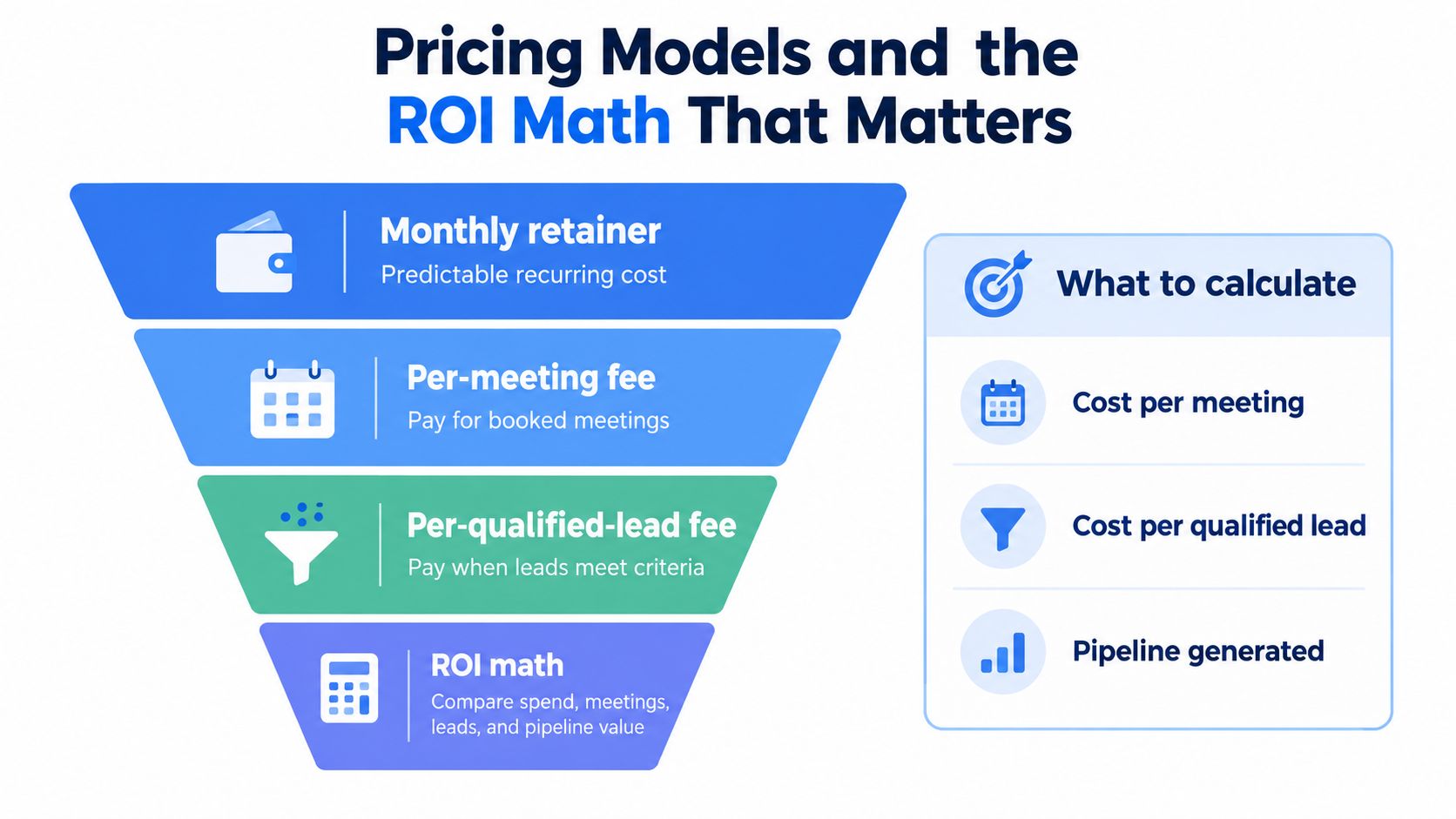
- Monthly retainer: Predictable cost, and the provider gets paid regardless of output, so reporting obligations carry the accountability.
- Per-meeting fee: Simple to understand, and it directly rewards booking meetings whether or not those prospects fit.
- Per-qualified-lead fee: Payment follows your qualification criteria, which makes the definition of qualified the most contested line in the contract.
- Hybrid or pilot pricing: A base fee plus performance component, often used to test fit before a longer commitment.
Running the Comparison Honestly
Build the in-house side first. Add salary, tools, data, management time, and the productivity lost during ramp, then divide by the qualified leads that ramped output realistically produces. Most internal business cases assume every hire hits quota, which the opening benchmark contradicts. Then place the provider's fee beside that figure and compute cost per qualified lead for both. Finally, extend the math one stage further, from qualified lead to opportunity to closed revenue, because a cheap lead that never converts is the most expensive line in the model.
Cost per lead is a purchasing metric. Cost per accepted opportunity is a revenue metric. Contracts written around the first routinely disappoint on the second.
The benchmark activity data explains why. A program can generate a healthy number of daily quality conversations at an attractive fee and still be expensive if few of those conversations clear your qualification threshold. Volume discounts your unit cost on paper while your account executives absorb the cost in rejected meetings and wasted discovery calls.
Before signing, insist on seeing three numbers from any provider's existing work, stated in ranges if confidentiality requires it. You need cost per qualified lead, lead acceptance rate by the client's sales team, and opportunity conversion by segment. A vendor that reports only sends, opens, and meetings is asking you to fund activity and audit nothing.
Implementation Checklist and Compliance Requirements
Launch quality is decided before the first email sends. The UK Information Commissioner's Office states that UK GDPR applies to B2B marketing when personal data such as an individual's name or work contact is processed, and that relying on legitimate interests requires identifying a legitimate interest, demonstrating necessity, and balancing the activity against the individual's rights and freedoms, as set out in the ICO guidance on business to business marketing. Legitimate interests doesn't automatically authorize every marketing use, and separate electronic marketing rules still apply.
The Qualification Contract Comes First
Sign off a jointly approved checklist covering revenue, firmographic, role, pain, timing, and buying authority criteria. Add explicit disqualification rules, because what a provider must reject matters as much as what it must find. Then run a sample lead review before launch, where the provider presents example accounts and contacts and your sales team accepts or rejects each one with reasons recorded. That single meeting prevents most month-two arguments about lead quality.
Operational and Compliance Setup
- Authentication verified: Confirm sending domains pass checks before warm-up, using an independent SPF and DKIM checker rather than taking a vendor's word for it.
- Suppression applied globally: Opt-outs and objections must filter across clients, domains, sequences, and channels before every send, a practice that sits at the core of sound email deliverability best practices as well as privacy compliance.
- Provenance recorded per contact: Hold the source, intended business purpose, targeting rationale, lawful basis assessment, privacy information workflow, suppression status, and objection timestamp for every record.
- Objection workflow documented: Deletion and objection requests need an owner, a response standard, and an audit trail.
Narrower, role-relevant targeting reduces privacy impact and unnecessary volume at the same time. That's the practical link buyers miss. Compliance discipline and deliverability discipline are largely the same discipline, because suppressing objections and invalid contacts immediately protects sender reputation while satisfying legal obligations.
Close the loop with audits at 30, 60, and 90 days. The first review checks infrastructure health, list accuracy, and reply quality. The second examines acceptance and rejection reasons from account executives. The third judges opportunity conversion by segment and decides whether to scale, retarget, or exit.
KPIs, Vendor Evaluation Questions, and Real-World Results
A dashboard that treats activity as qualification can make a busy SDR program look like a productive one. An opened email or LinkedIn profile view records activity. A reply that confirms a relevant business need is a qualification signal. Track contactability, positive-reply rate, qualified-reply rate, meeting rate, show rate, lead acceptance rate, and opportunity conversion separately, with results broken down by segment, channel, persona, and message variant.
Quota attainment is another warning signal, but it should be reported consistently. One industry analysis discusses weak SDR performance and the limited value of meetings with prospects outside the ICP or without a relevant need, as described in this analysis of SDR team best practices and quota performance. Avoid combining a quota benchmark from one source with a different estimate of missed quotas as if they were directly comparable. In every report, distinguish lead acceptance from pipeline contribution: acceptance means a lead meets agreed targeting criteria, while pipeline contribution requires evidence that the lead progressed into an opportunity.
Questions Most Buyers Forget to Ask
Ask vendors to show how they govern outreach, not just how many meetings they book. An industry evaluation found that only 7 of 406 indexed outreach vendors documented all seven assessed compliance dimensions, while the average documented 2.31. The same evaluation reports that 84% of enterprise procurement decision-makers in North America and Europe wanted explicit disclosure for AI-assisted sales outreach, according to the GTM Tech Index evaluation of outreach vendor compliance.
Require clear answers on contact provenance and the lawful basis for outreach. Ask how objections and deletion requests are logged, when AI assistance is disclosed, who controls inboxes and domains after termination, and what audit logs the client can inspect. Put ownership, reporting fields, and access to records in the contract. If a provider cannot explain these controls, meeting volume alone is not evidence of a reliable pipeline system.
Named client outcomes can illustrate a provider's claimed operating range, but figures need traceable sourcing before they support a buying decision. Results such as ÖÖD House's 687 warm leads, B2B Growth's €40k in revenue and 237 qualified leads, ESTO's 7 new clients and 106 sales opportunities, and Noda's growth from roughly 50 to roughly 300 leads per month are presented without citations here, so treat them as unverified examples, not benchmark evidence. Ask the vendor for the original case study and the underlying definitions: what counted as a lead, which leads were accepted, and how many became opportunities.
Your Next Step Toward Outsourced Pipeline
Start with a scoped pilot, not an annual contract. Pick one segment and one region, sign the qualification checklist at kickoff, and schedule the 90-day review with acceptance and rejection rates on the table before outreach begins. A good first month is specific. Infrastructure is live and authenticated, lists are built against the agreed ICP, sequences run across at least two channels, and the first qualified meetings arrive with context attached.
Set your exit triggers in advance. A high meeting count paired with a low lead acceptance rate means you're funding calendar utilization, and that's grounds to renegotiate or walk away. The quality standard belongs to you, not the vendor, and the checklist you signed at kickoff is the document that makes the entire engagement auditable.
If you're ready to test outsourced prospecting against your own qualification criteria, Lead Printer builds the infrastructure, prospect data, and personalized multichannel sequences and hands qualified meetings to your sales team. Start with one segment, judge the pilot on acceptance rate and opportunity conversion at 90 days, and expand only when the pipeline evidence supports it.