Stop trying to force a meeting in the first message. That's the most popular advice in outbound, and it's why your reply rates keep sliding. Buyers don't need you to introduce the problem. In most cases, they've already researched the category, built a shortlist, and formed a view before you write. Learning how to sales prospect in 2026 means aligning outreach to where the buyer already is, proving relevance fast, and qualifying harder before you scale.
Why Most Sales Prospecting Stops Working in 2026
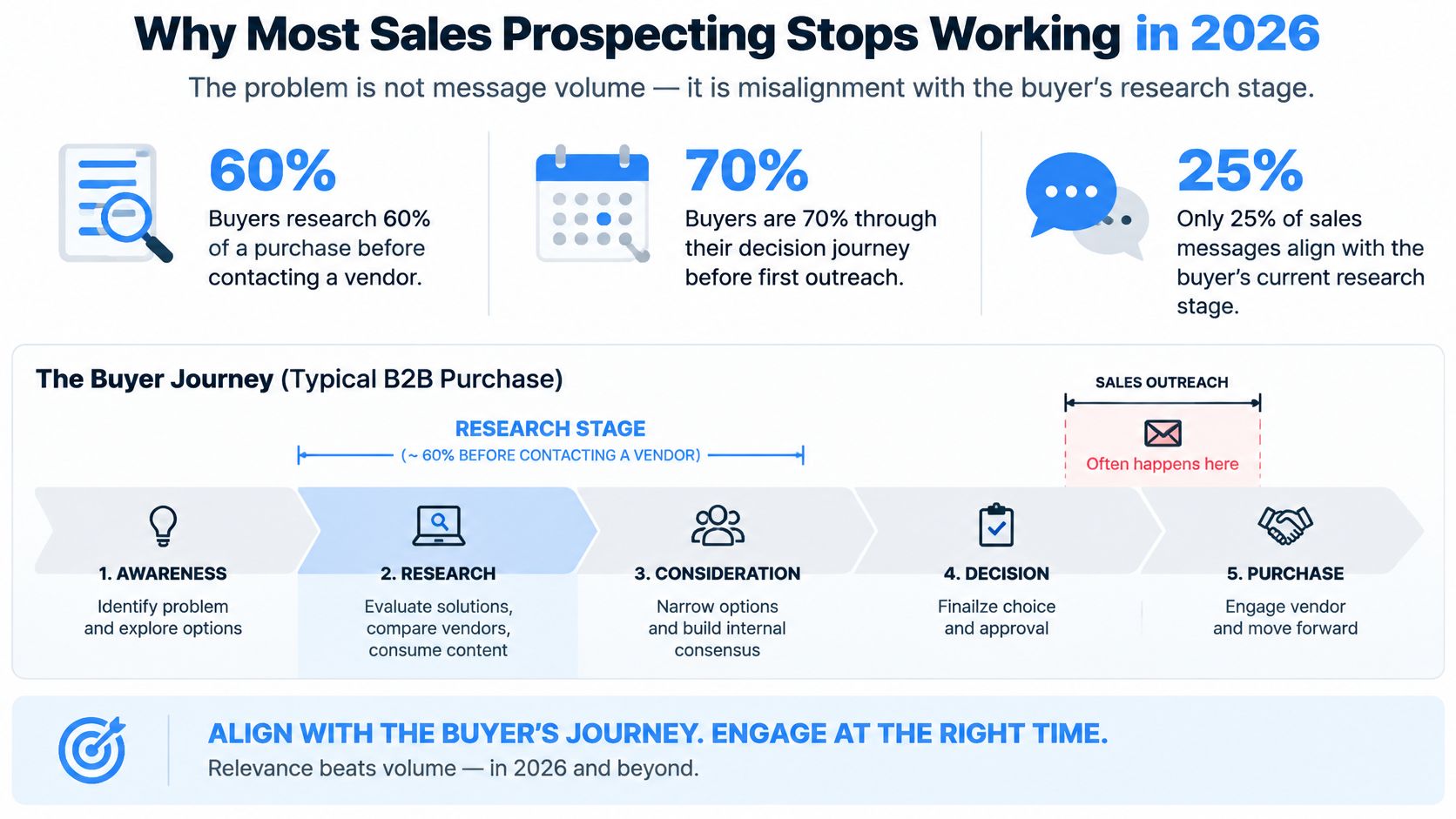
Most prospecting fails because sellers act as if the buyer starts at zero. They pitch basic education, ask for a discovery call, and repeat that request across channels. The buyer, meanwhile, is checking documentation, comparing vendors, and asking peers. Your sequence isn't early. It's misaligned.
The data undercuts the demand for rep-led discovery. A buyer survey of 646 buyers conducted in August and September 2025 found 67% of B2B buyers prefer a rep-free buying experience, up from 61% a year earlier. That doesn't mean sellers are irrelevant. It means buyers want control over when a seller enters and what value that seller adds.
The visual below maps that gap between seller timing and buyer research.
AI has widened the gap. Buyers now arrive with machine-generated summaries, vendor comparisons, and opinions formed before first contact. They still want a human to validate risk, fit, and implementation details. They don't want a scripted tour of facts they already found.
Prospect as confirmation, not interruption
Treat your first touch as a diagnostic check. State the trigger you observed, offer one specific hypothesis, and make it easy to confirm or correct it. Link to evidence the buyer can assess alone, then offer a conversation only if that evidence creates a useful next question.
Reducing pressure isn't soft selling. It's respecting a buyer who can verify your claims without you.
Channel sprawl makes the problem worse when every touch repeats the same pitch. Buyers encounter brands across websites, email, professional networks, communities, and sales calls. If those surfaces tell different stories, trust drops. Teams selling into structured growth motions, including operators who study proven franchise sales lead approaches, face the same constraint. Consistency beats volume.
Your job isn't to manufacture curiosity from nothing. It's to find a live business change, connect it to an unresolved decision, and give the buyer a credible reason to test your thinking. Do that and the meeting becomes the buyer's choice, not your demand.
Building a Trigger-Based ICP Instead of a Generic Persona
An ICP defined by industry and headcount is a mailing list, not a prospecting strategy. It tells you who could buy someday. It doesn't tell you who has a reason to evaluate now. Replace static firmographics with observable change.
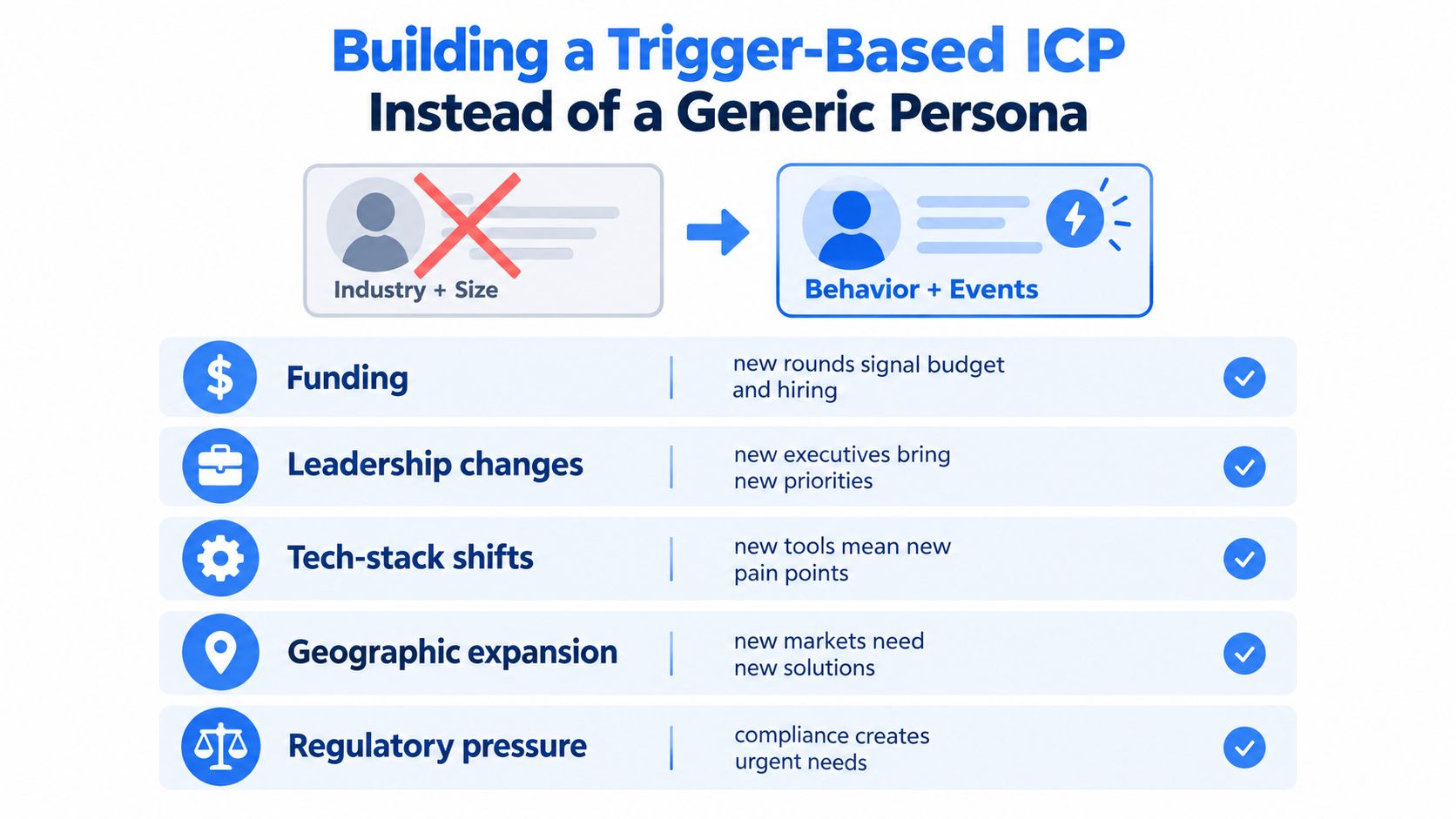
Gartner reports that 99% of B2B purchases are driven by organizational changes, which is why trigger selection should come before copywriting. Funding, leadership changes, expansion, technology adoption, regulatory pressure, and strategic initiatives create budget movement and internal urgency. A static persona creates neither.
The checklist below shows the shift from generic attributes to buying triggers.
Build the ICP in this order
Start with customers who bought quickly and succeeded, then work backward to the event that opened the conversation. Was a new executive hired? Did the company enter a market, adopt a platform, acquire a business, or face a compliance deadline? Those events become your inclusion criteria, while industry and size become secondary filters.
Then map the buying committee instead of hunting one perfect contact:
- Economic buyer: Owns the commercial outcome and budget decision.
- Functional owner: Lives with the workflow problem every day.
- Technical evaluator: Tests integration, security, and implementation fit.
- Procurement or compliance contact: Controls process, risk, and approval.
Each role gets a different hypothesis because each role fears a different failure. A finance leader cares about payback and contract exposure. An operations manager cares about disruption. Sending both people the same outcome claim signals you haven't thought about either job.
The account record audit
Before any account enters a sequence, require four fields. You need trigger evidence, role fit, company fit, and a verifiable reason to contact. If one field is missing, park the record in nurture or research it further. Don't let a sequence invent relevance that the data doesn't support.
Practical rule: If you can't explain why this account, why this person, and why now in plain language, you're not ready to send.
The common ICP mistakes are predictable. Teams target companies that resemble customers superficially, chase job titles without authority, and treat a technology install as intent by itself. Tighten the filter. A smaller list built around live change will outperform a broad persona list because every message starts with a commercial reason to exist.
Sourcing and Enriching Prospect Data That Actually Reaches Buyers
Good targeting dies when the underlying data is stale, guessed, or scraped without verification. Source deliberately, enrich only what changes the message, and disqualify weak records before they damage deliverability or waste research time.
Use different sources for different markets. LinkedIn Sales Navigator works well for role and seniority discovery inside named accounts. Google Maps and targeted websites help with location-led businesses. National business registries help confirm legal entities, operating status, and geography. Skilled teams that build lists through structured B2B list building services combine these sources instead of trusting one database to cover every segment.
Common B2B Data Sources Compared
| Source | Coverage | Verification Depth | Best Use Case |
|---|---|---|---|
| LinkedIn Sales Navigator | Strong for identifiable professional roles | Role and company visible, email still needs verification | Buying committee mapping |
| Google Maps | Strong for local and multi-site businesses | Location and website visible, contact depth varies | Geographic and premises-led prospecting |
| Targeted company websites | Narrow but current | Leadership, locations, initiatives, and technology clues | Trigger research and account context |
| National business registries | Broad legal coverage by country | Entity status and registration details | Market sizing and company validation |
| Commercial databases | Broad contact coverage | Quality varies by segment and refresh cycle | Initial discovery before manual checks |
Enrichment should answer a prospecting question, not fill columns for their own sake. Add role scope, geography, relevant technology, hiring context, and the trigger source. Tools such as Clay and custom scraping can assemble those fields, but automation doesn't rescue a bad inclusion rule.
Buyers in competitive procurement settings provide a useful parallel. Platforms explaining how helps buyers win contracts emphasize structured evaluation rather than raw opportunity volume. Apply the same discipline to prospect records. Score evidence quality before anyone writes copy.
Records to reject outright
Remove contacts with unverifiable email patterns, departed employees, generic inboxes where a named buyer is required, duplicate people under multiple titles, and accounts outside your serviceable geography. Reject records whose only personalization source is a first name. Also reject companies showing a trigger you can't connect to your offer.
Run a final hygiene pass for formatting, domain validity, role duplication, suppression status, and account ownership. This is boring work. It's also where reply rates are protected. Clean data lets a good hypothesis reach the right person. Dirty data turns even strong copy into bounces, complaints, and false conclusions about the market.
Setting Up Sending Infrastructure That Protects Deliverability
Deliverability isn't a technical detail you hand off after copy is approved. It's the gate that decides whether anyone sees the message. Teams burn domains when they rush setup, send from the main corporate domain, or scale volume before mailbox reputation exists.
The setup sequence below gives you the minimum infrastructure order.
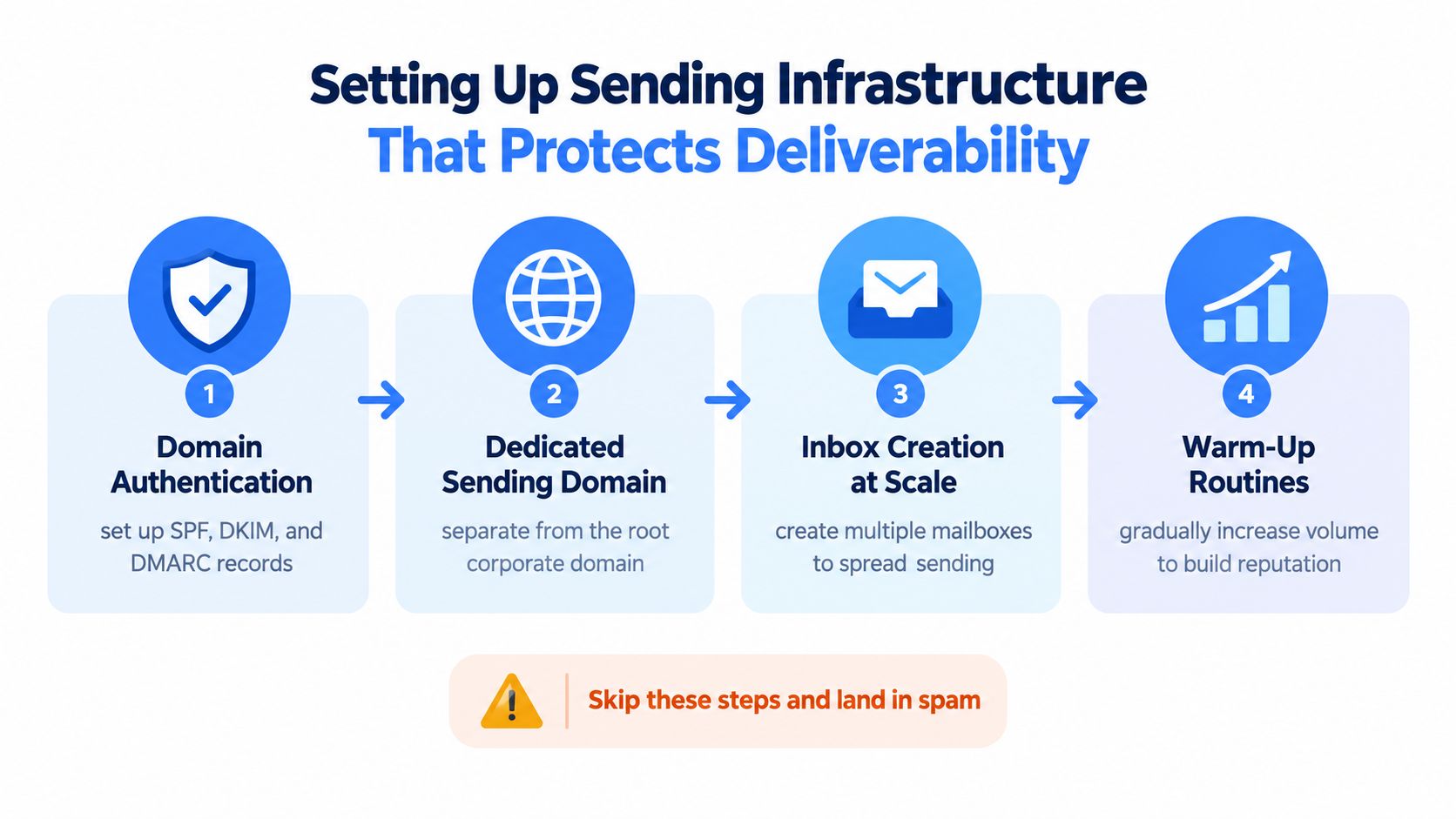
Start with dedicated sending domains that resemble your brand without putting the root corporate domain at risk. Authenticate every domain with SPF, DKIM, and DMARC, then create a sensible mailbox structure. Don't overload one inbox to save setup time. Spread sending so one mailbox problem doesn't take the whole campaign down.
Warm-up isn't magic protection. It builds a sending history gradually, but it can't offset bad lists, misleading copy, or sudden volume spikes. Follow a disciplined ramp based on the process for warming up an email domain, and keep warm-up activity separate from your judgment of real campaign engagement.
Failure modes that show up early
The first warning is usually a lift in bounces from weak data. Next comes placement decay when recipients ignore or complain about irrelevant messages. Then replies fall and teams wrongly rewrite copy while the actual problem sits in domain reputation, mailbox concentration, or list quality.
Watch deliverability weekly at domain and mailbox level. Monitor bounce patterns, spam complaints, unsubscribe behavior, reply quality, and inbox placement signals from your sending platform. Don't treat open tracking as a reliable health score. Privacy features and automated scanning distort it.
This walkthrough shows the infrastructure checks to complete before launch.
Build safeguards before scale. Cap daily volume per mailbox, pause weak domains, suppress complainers immediately, and keep prospect segments separated so a bad source doesn't contaminate the full program. Infrastructure discipline gives testing a clean signal. Without it, you're diagnosing messaging while your emails never reach the inbox.
Designing Email and LinkedIn Sequences Around One Account Narrative
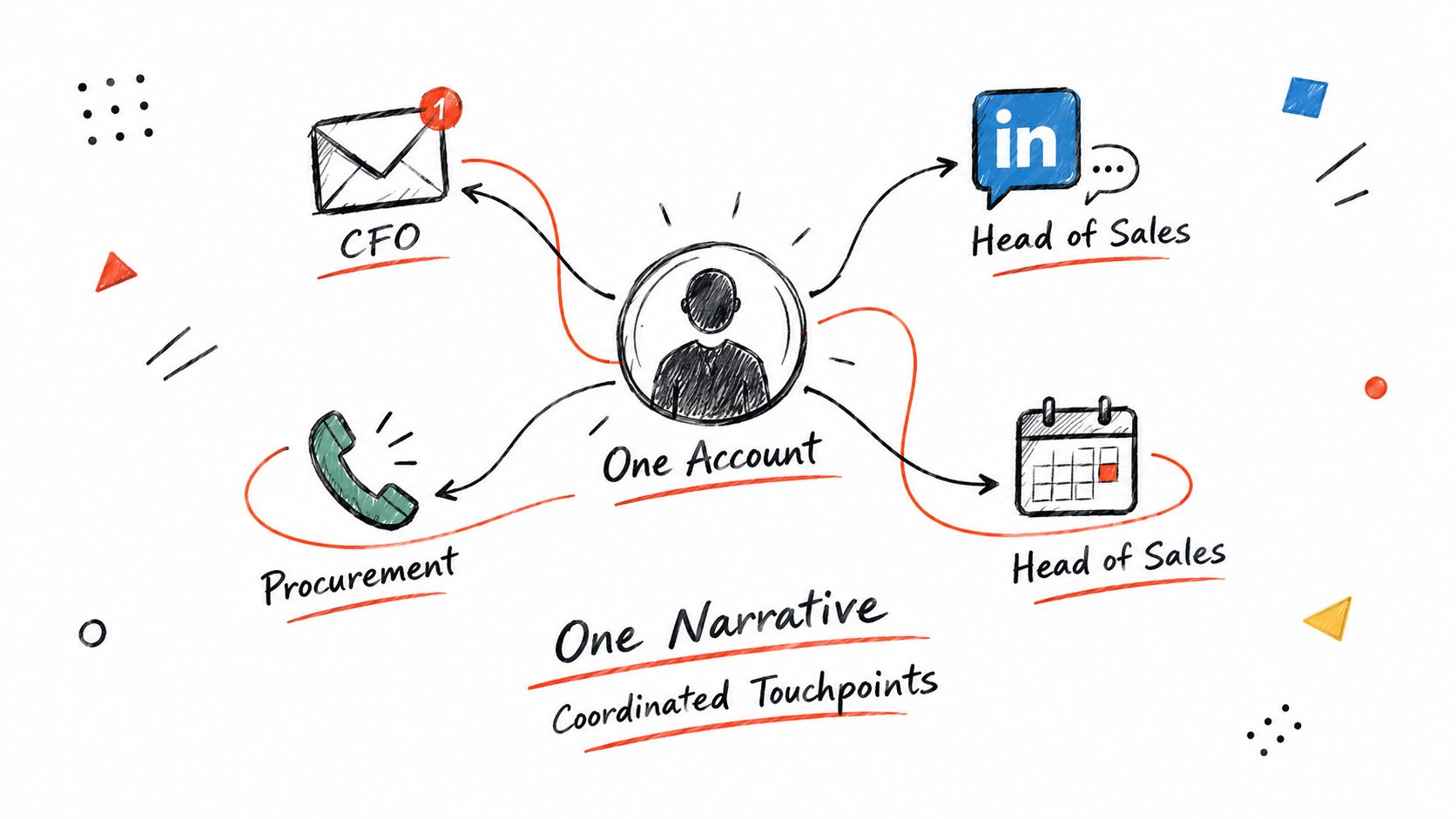
A sequence shouldn't be five versions of the same request. It should advance one account-level story, with each channel and stakeholder receiving the part relevant to their decision. Email carries the business hypothesis. LinkedIn adds context and credibility. A call or webinar handles complexity when the buyer signals interest.
Coordination matters because buyers rarely experience your outreach in the order you planned. One stakeholder opens the email, another sees a LinkedIn profile, and a third lands on your website. If the claims conflict, the account hears noise. Gartner reports 69% of buyers encounter inconsistencies between website information and sales-provided information, so govern every touch from one approved evidence base.
The diagram below shows coordinated outreach into one account rather than isolated contact sequences.
Assign each touch a distinct job
Open with the trigger and a concise insight. Follow with a self-service asset the buyer can inspect privately, such as a diagnostic, implementation note, customer example, or benchmark framework. Then use LinkedIn to reinforce relevance through a useful observation, not a copied email in a smaller box.
Later touches must add information. Address implementation risk, stakeholder alignment, timing, or a common misconception. Don't send a bare bump. If you have nothing new to contribute, stop and place the account into a considered reactivation path.
Role splits keep the narrative coherent:
- Economic buyer: Focus on cost of delay, commercial risk, and decision criteria.
- Functional owner: Focus on workflow change, team adoption, and measurable operating pain.
- Technical evaluator: Focus on integration, data, security, and implementation effort.
- Procurement contact: Focus on process clarity, vendor risk, and evaluation requirements.
Suppression rules protect the account
Stop all related touches after a meaningful reply. Don't let an automated LinkedIn message ask a question the prospect answered by email. Suppress colleagues from receiving contradictory claims, and brief the account owner when multiple stakeholders engage. Account-level deduplication matters more than squeezing out another touch.
Adjust tone and channel expectations by market. US buyers may tolerate direct sequencing that feels abrupt in parts of the UK or EU. Language, privacy norms, seniority, and professional network habits should shape timing and formality. Test by segment instead of copying one playbook everywhere.
Specialist motions make this coordination clearer. A team researching a niche investor or partner audience through a guide to sales automation fundraising contacts still needs one narrative per account, even though the audience differs from SaaS operations buyers. Whether you sell software, services, ecommerce infrastructure, or manufactured products, the principle holds. One hypothesis, role-specific proof, no channel freelancing.
Personalization Tactics That Move Reply Rates Without Burning Hours
Personalization fails when it's decoration. Swapping a first name, company name, or industry into a generic pitch doesn't make the message relevant. Buyers can tell the difference between observed context and mail merge in seconds.
That distinction matters commercially. 73% of B2B buyers actively avoid suppliers that send irrelevant outreach, so personalization should prove fit, not flatter the recipient. Spend research time where it changes the buyer's reason to respond.
Use three levels deliberately
Token personalization changes names and company fields. Use it only for low-priority nurture, never as your main outbound claim to relevance. It creates scale without insight and teaches buyers to ignore you.
Role and company context connects a known responsibility to a credible problem. For example, a weak opener says you help companies improve efficiency. A stronger version tells a new operations leader that expansion into another region often exposes handoff gaps between sales, onboarding, and support, then asks whether that issue is appearing in their rollout.
Trigger-based personalization ties the message to a specific event and its likely consequence. Research earns its keep here. The message should show the observed change, state a testable hypothesis, and offer proof or a low-friction way to validate the idea.
A useful personalization block answers one question for the buyer. Why is this message true for us, right now?
Don't research every account at maximum depth. Prioritize by trigger strength, deal potential, stakeholder access, and evidence quality. Give top-tier accounts human research. Give mid-tier accounts enriched role context and a reviewed hypothesis. Keep weak-fit records out entirely instead of disguising them with clever opening lines.
Clay-style enrichment can gather technology, hiring, location, leadership, and website signals at scale. Humans still need to review whether those signals support a plausible business claim. Automated sentences built from disconnected facts sound impressive and say nothing. Good email copywriting turns verified context into a clear point of view, not a scrapbook of data points.
Measure personalization by positive replies and qualified meetings, not by output volume or compliments about clever copy. If deeper research doesn't improve conversation quality, your trigger logic is wrong. Fix account selection before asking writers for more creativity.
Launching, Testing, and Optimizing the Campaign
Launch small enough to learn and structured enough to trust the result. Begin with pre-launch QA on every record, domain, mailbox, link, merge field, and suppression rule. Then soft launch to a clean segment that represents the wider market. Don't scale because the calendar says it's time.
Read early results by segment, trigger, role, and channel. HubSpot's 2025 survey of more than 350 sales professionals found 42% reported social media as producing the highest cold-outreach response rate, compared with 26% for email and 23% for phone. Treat that as a reason to test sequence order by persona and market, not as proof one channel wins everywhere.
Test variables that change decisions
Test the trigger hypothesis before polishing subject lines. Then test opener, proof format, call to action, and channel order. Change one meaningful variable at a time within a comparable segment. If a variant attracts curiosity but produces unqualified calls, it isn't winning.
Track the funnel with metrics that expose quality:
- Valid-contact rate: Shows whether sourcing and verification worked.
- Positive-reply rate: Separates relevant interest from raw responses.
- Qualified-meeting rate: Shows whether replies become real sales conversations.
- Show rate: Reveals whether meeting intent was genuine.
- Opportunity creation: Connects prospecting to pipeline, not activity.
- Revenue per account: Keeps optimization tied to commercial value.
Ignore vanity signals when they conflict with pipeline. Raw reply volume can rise because a message is provocative, confusing, or attracting the wrong roles. Open rate is a weak deliverability proxy. Lead count means little when account executives reject the meetings.
Debug in the right order
If delivery is clean but positive replies are weak, inspect trigger fit and role selection first. If positive replies arrive but meetings don't book, inspect the next step. It may demand too much, arrive too slowly, or fail to explain why a call helps. If meetings book but don't become opportunities, your qualification standard is too loose.
Qualify replies quickly while context is fresh. Confirm the trigger, problem ownership, stakeholder involvement, timing, and reason for responding. Hand off with the original hypothesis, relevant evidence, all channel history, and open questions. The account executive shouldn't restart discovery as if prospecting never happened.
The reusable playbook is simple. Define triggers, source and verify data, protect infrastructure, sequence one account narrative, personalize at the right depth, launch and optimize, then qualify and hand off cleanly. Avoid over-contacting, inconsistent claims, and optimizing for replies instead of pipeline. When those controls hold, each campaign teaches you something the next one can use.
If your team needs this system built and run end to end, Lead Printer creates trigger-based prospect lists, sets up protected sending infrastructure, and runs personalized email and LinkedIn campaigns across the US, UK, and EU. Visit us to discuss your ICP, markets, and pipeline target, and we'll map the outbound process around the buyers you need to reach.