Most advice about what is email copywriting starts in the wrong place. It treats every email like the same job, when a marketer writing to a warm list and a salesperson writing a cold prospect list are trying to win different actions in the inbox. One wants opens and clicks, the other needs replies and meetings, and the copy rules split from there.
That split matters because email isn't a side channel anymore. Industry sources cite returns of $36 to $44 for every $1 spent, and one guide says email is 40x more effective at acquiring customers than Facebook or Twitter (email marketing returns and benchmark context). The money is why copywriters obsess over words, structure, and testing, not just design.
Table of Contents
- Why Email Copywriting Is Not One Craft
- What Email Copywriting Actually Means
- The Four Principles Every Email Copy Needs
- Subject Lines and Openings That Earn the Read
- Two B2B Outreach Templates Worth Stealing
- Cold Outbound Copy Versus Inbound Newsletter Copy
- Common Misconceptions That Quietly Kill Replies
- Putting It All Together and Your Next Move
Why Email Copywriting Is Not One Craft
A lot of beginner advice assumes there's one “good email” formula. That breaks the moment you compare a newsletter to a cold outbound message. A newsletter already has attention, so the copy has to reward that attention with a useful click or a purchase. A cold email starts with no trust and no permission, so the copy has to feel relevant fast enough to earn a reply.
Different inbox jobs need different writing choices
In inbound work, the reader knows the brand, recognizes the list, and usually expects a campaign. The copy can lean into curiosity, offers, and a clear next step because the relationship already exists. In outbound B2B, the same style can backfire. If the message sounds too polished or too promotional, it can read like automation instead of a person reaching out.
That's why better copy isn't always “more persuasive” in the classic marketing sense. In cold outreach, the stronger move is often lower friction. A plain subject line, a short opener, and a specific request can feel more trustworthy than a clever pitch because the reader can understand it immediately.
Practical rule: the more unfamiliar the reader is, the less copy should try to impress them.
The outcome defines the draft. A marketer wants the email to support opens, clicks, and revenue. A salesperson wants the email to create a conversation that can move into pipeline. If you blur those two goals, you end up borrowing tactics from the wrong playbook and wondering why the numbers don't move.
Email's scale explains why this discipline became its own craft. There are about 4.48 billion email accounts globally, and a 2026 projection places global users at 4.73 billion (global email audience and mobile reading context). In a channel that large, even small wording choices matter because the inbox is crowded, skimming is normal, and the reader has options.
What Email Copywriting Actually Means
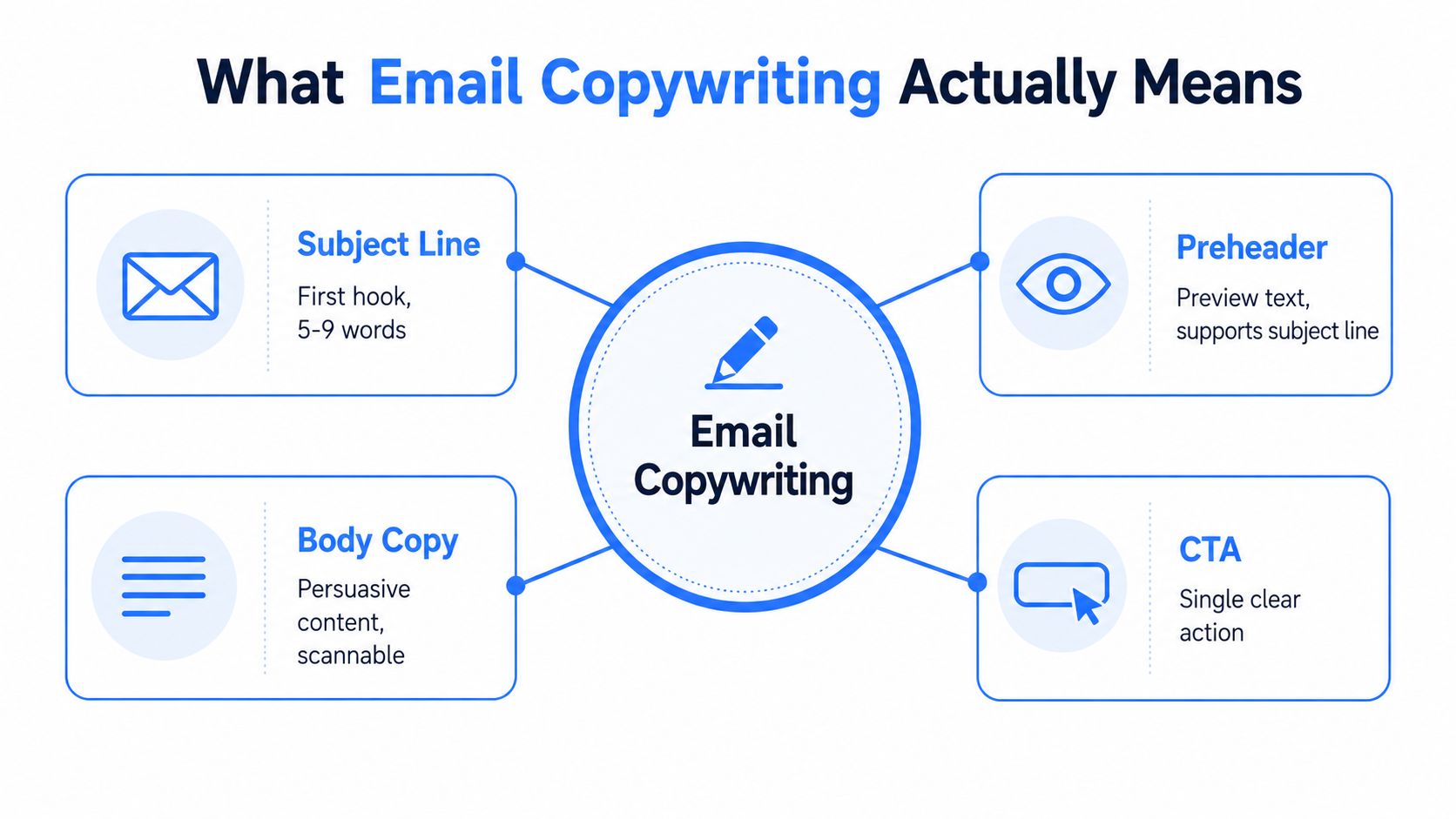
At the simplest level, email copywriting is the writing inside an email that gets a specific action. That action might be a click, a reply, a purchase, or a booked call. The craft includes the subject line, preview text, body copy, and CTA, and each part has its own job.
The four parts work as a chain
The subject line earns the open. The preview text supports that promise. The body copy keeps the reader moving, and the CTA turns attention into action. If any one part is unclear, the rest of the email carries more weight than it should.
That's why short, scannable writing keeps showing up in the strongest guidance. Inbox readers skim. Mobile clients cut longer text down fast, and roughly 60% of emails are read on mobile devices (mobile reading behavior and segmentation benchmarks). In practice, that means dense paragraphs and buried asks are working against how people read.
The operational layer matters in outbound
Outbound copy adds one more requirement. The message has to feel human, earn inbox placement, and ask for a response without sounding like a form letter. That's not just “write better.” It's a system that combines copy, inbox behavior, and response design.
A useful way to define the term is this. Email copywriting is the craft of writing each inbox element so a reader understands the point quickly and takes one measurable action. Inbound uses that craft to drive campaign performance. Outbound uses it to create trust fast enough to start a sales conversation.
The structure also has to respect different performance benchmarks across list types. Mailchimp reports average open rates of 31.35% for Business + Finance emails and 40.04% for Non-Profits, with click rates of 2.78% and 3.27% respectively (industry email benchmarks). Those gaps are a reminder that the same copy style won't perform the same way in every category.
The Four Principles Every Email Copy Needs
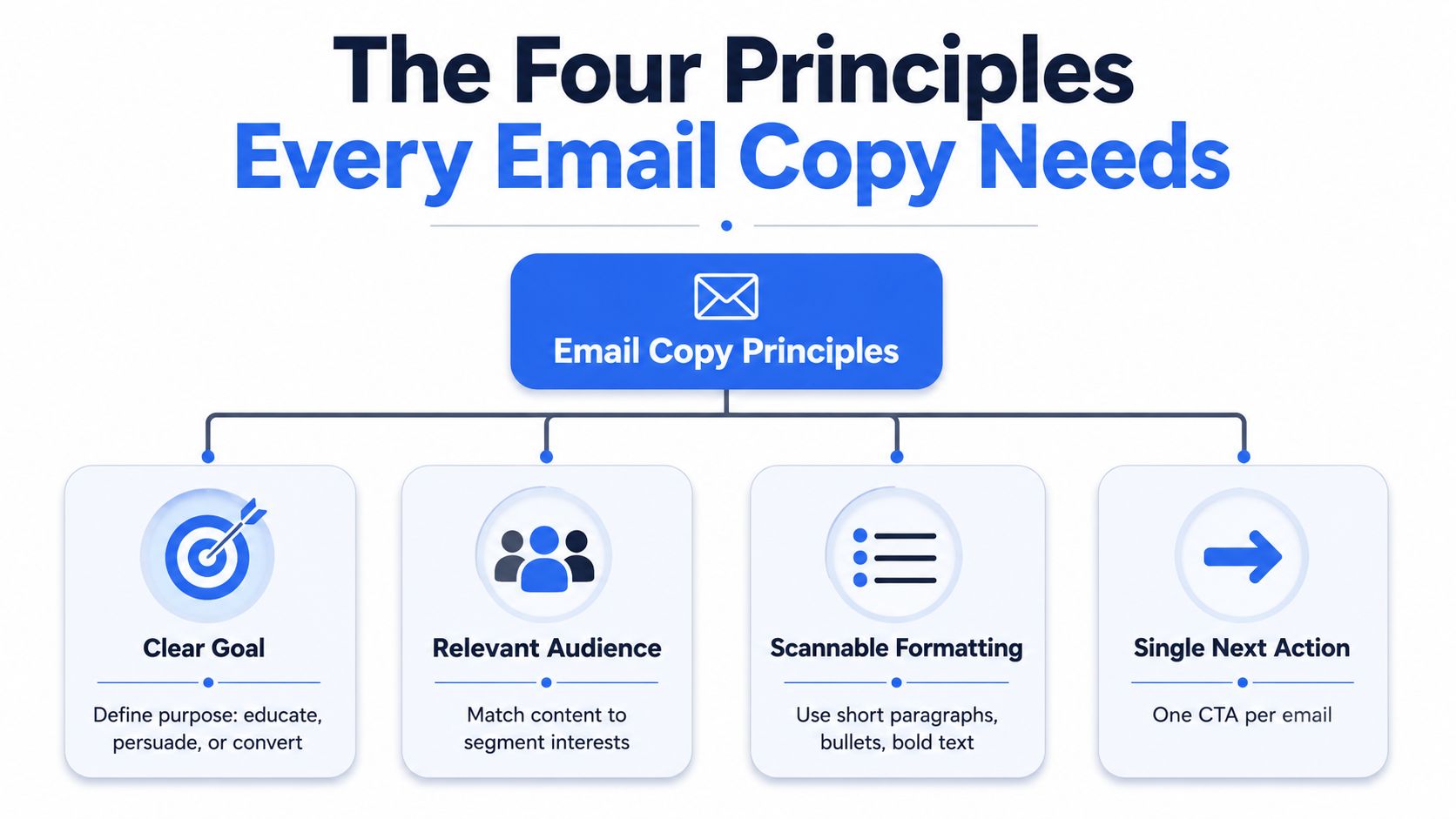
Strong email copy usually rests on four principles, even when the wording changes. It needs a clear goal, a relevant audience match, scannable formatting, and one next action. If one of those pillars is missing, the message starts to wobble.
Clear goal
Every email needs a job before it needs a flourish. If the goal is to educate, the copy should point to clarity. If the goal is to persuade, the body needs proof and a reason to care. If the goal is to convert, the ask has to be obvious.
When the goal is fuzzy, the email usually looks busy and performs like it. You can still see opens, but clicks or replies often fall apart because the reader never understood what the message wanted from them. That is not a design problem. It is a goal problem.
Relevant audience
Segmented campaigns keep outperforming generic blasts because relevance changes the way people read. Historical B2B data cited by AWAI says 93% of B2B marketers use email to distribute content, 83% use newsletters in content marketing, and segmented campaigns have been associated with revenue increases as high as 760% (global email segmentation and B2B usage context). The exact lift will not be the same in every business, but the direction is clear. Relevance pays.
If the reader can tell the email was written for “everyone,” they will usually treat it like it was written for no one.
That is the point where generic advice breaks for outbound. A newsletter can speak to a broader list because the reader already chose to hear from the brand. A cold email has to earn attention from the first line, which means the audience fit has to be tighter and the promise has to be specific. The planning work matters too, and the examples on Lead Printer's blog are useful if you want to see how that logic changes across campaign types.
Scannable formatting and one next action
A practical structure benchmark from Pipedrive recommends 20 to 25 words per paragraph, and Mailjet and Brafton both stress one clear message and frequent use of bullets or headers (email copy structure guidance). That advice is less about style and more about reducing cognitive load. Readers should be able to scan, find the point, and move to the next step without effort.
The CTA needs the same discipline. One email, one obvious action. If you ask for two or three things, the reader has to decide what matters before they can respond, and many will not bother. If you are writing a brand campaign, that action might be a click. If you are writing outbound, it is usually a reply or a meeting request.
For a practical follow-up on click behavior, find effective click rate methods is worth reading alongside your own tests, especially if you are comparing CTA placement across different list types. I would treat it as a technique library, not a template dump.
Subject Lines and Openings That Earn the Read
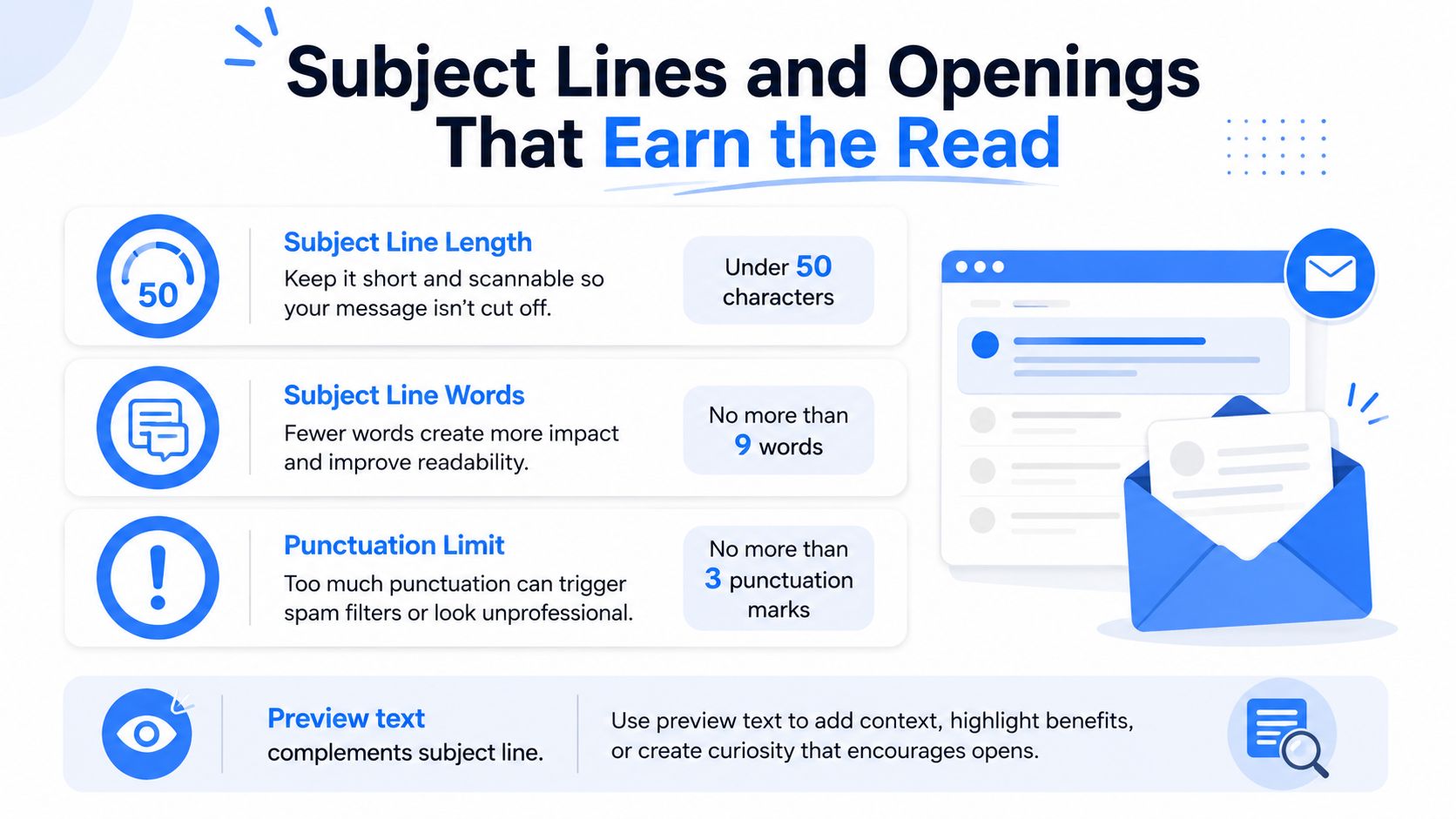
Subject lines do most of the heavy lifting before the email is even opened. Benchmarks compiled by Embryo report that subject lines under 50 characters produced the highest conversions, and simple subject lines can increase responses by 541% versus creative ones (subject line and sales email benchmark data). Another benchmark says subject lines perform best at no more than 9 words and 60 characters, with no more than 3 punctuation marks (HubSpot community guidance on subject line length and punctuation).
Make the subject line do one job
The subject line is not the place to show range. It's there to earn a click into the message. If the line tries to be clever, urgent, promotional, and brand-aware all at once, it usually loses clarity.
That's why simple often wins in outbound. The reader should understand the point without decoding the sentence. In a cold list, “Quick question about your onboarding flow” can feel more usable than something polished and indirect because the reader knows why you're there.
Let preview text support the promise
Preview text should extend the subject line, not repeat it. If the subject line names the topic, the preview text can supply context, a benefit, or the reason to care. Repeating the same idea twice wastes the limited space inboxes give you.
The opening sentence has the same pressure. It needs to name relevance quickly, hint at value, and avoid sounding like a template. That's hard, but it's also why the first line matters so much in cold email. The reader is deciding whether to keep going before they've committed to the whole message.
Use personalization with restraint
Embryo's compiled research also notes that name personalization can lift open rates by 10% to 14% (personalization and response benchmarks). That doesn't mean inserting a first name saves weak copy. It means simple, visible relevance can help the message feel addressed to a real person.
Sales emails of 200 to 250 words achieved the highest response rate at 19% in the same source (sales email length benchmark). That number matters less as a formula and more as a reminder that brevity and specificity work together. A short email can still be weak, but a long one rarely becomes stronger by adding more explanation.
For teams trying to tune click behavior after the open, that's where the structure and the ask start to matter more than polish. The subject line gets the door open. The first sentence convinces the reader you're worth the next ten seconds.
Two B2B Outreach Templates Worth Stealing
A cold email template should be a scaffold, not a script you send untouched. The point is to keep the structure tight enough that the reader can understand it quickly and the sender can adapt it to a real persona. If you want more variants, find sales templates that convert is a useful place to compare structures without copying them blindly.
First touch prospecting template
Hi [First Name],
I'm reaching out because your team's [specific process or role area] stood out to me.
We help [persona] with [specific outcome], especially when they want a cleaner path from [problem] to [result].
Would it make sense to talk for 15 minutes next week?
Best,
[Your Name]
The opener is short because cold readers don't reward setup. The second line names a specific audience and problem, which gives the message a reason to exist. The last line is binary on purpose. It makes the next step easy to answer.
A template like this works best when the sender knows the persona well. If the prospect list is loose, the line about outcome starts to sound generic. That's where research matters more than flair.
Follow-up template with context
Hi [First Name],
I sent a note earlier about [topic], and I wanted to add one detail in case it helps.
Teams usually look at this when they're trying to [business goal]. That's the part we can support without adding more pressure to your current process.
If it's relevant, I'd be happy to share a few examples. Would a short call be useful?
Best,
[Your Name]
This version assumes prior touch, so it doesn't waste space reintroducing the sender. It adds a small amount of context and uses a softer ask. That makes it better for follow-up, where forcing a yes too early can create friction.
Useful habit: write the CTA as the easiest honest question you can ask, not the most aggressive one you can imagine.
For teams building outbound at scale, Lead Printer is one option that combines prospecting, infrastructure, personalized copy, and campaign execution. Its service pages describe that workflow in B2B terms, including the Lead Printer B2B SaaS service and the broader agency setup at Lead Printer's main site. Use that kind of offer as a reference point if you're deciding whether to write copy in-house or hand it to a team that runs the full outbound process.
Cold Outbound Copy Versus Inbound Newsletter Copy
Cold outbound and inbound newsletter copy share tools, but they do not share the same job. Cold outbound is trying to earn a reply from someone who didn't ask for the message. Inbound newsletter copy is talking to a list that already opted in and usually expects some kind of value exchange.
| Dimension | Cold Outbound | Inbound Newsletter |
|---|---|---|
| Goal | Reply, meeting, conversation | Click, read, purchase, nurture |
| Audience temperature | Cold | Warm |
| Subject line style | Specific, human, low-friction | Brand-aware, curiosity, offer-led |
| Body length | Usually under 250 words in practice, especially for first-touch outreach | Variable, but still scannable |
| CTA | A question or reply prompt | A button or link |
| Risk | Sounds automated or pushy | Sounds generic or overly promotional |
A marketer moving into outbound usually brings too much brand language. The result can feel polished but vague. A salesperson moving into newsletters often brings too little context for the warmer audience. The email ends up direct, but not interesting enough to click.
The rule of thumb is simple. If the reader already knows you, you can afford more room to persuade. If they don't know you, you need more restraint, more specificity, and fewer words. That's why the same “good email” advice falls apart when people use it across both contexts without adjusting the goal.
Common Misconceptions That Quietly Kill Replies
A few myths keep showing up in email advice, and they're costly because they sound reasonable. The biggest one is that longer emails perform better. In practice, the data and the inbox behavior point the other way. The stronger move is usually concise copy that respects how quickly readers scan.
More punctuation and flair do not equal more opens
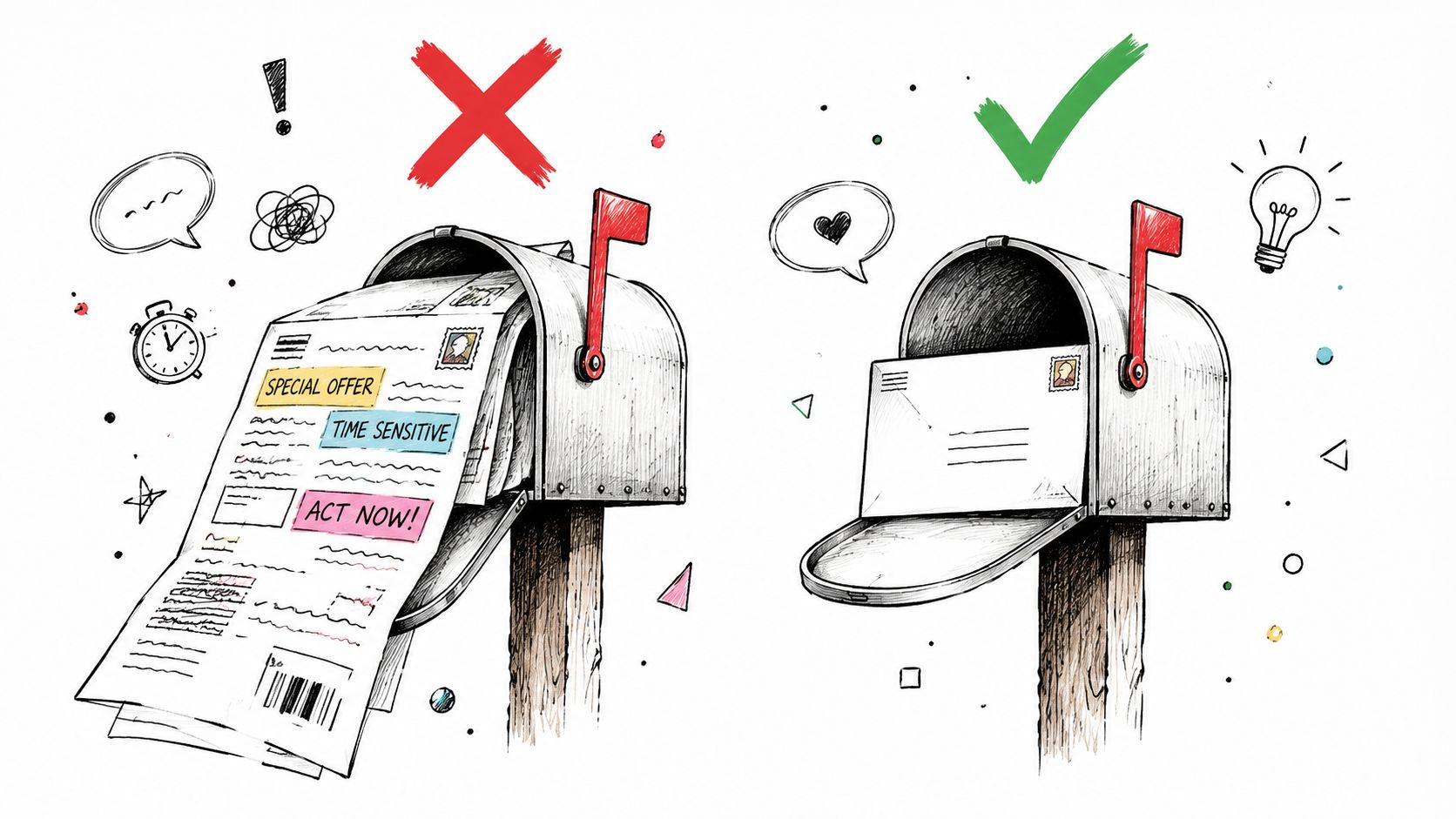
HubSpot's community guidance says subject lines perform best with no more than 3 punctuation marks (subject line punctuation guidance). That doesn't mean punctuation is banned. It means clutter makes the line harder to read and can drag attention in the wrong direction. In a cold inbox, that's usually a bad trade.
Another myth is that AI-generated copy is ready to send as soon as it's written. It isn't. It still needs human editing for specificity, tone, and a real point of view. Without that pass, the message often sounds like it was built for a dashboard instead of a person.
The last myth is that clever always beats clear. Embryo's compiled research points the opposite way, since simple subject lines can dramatically outperform creative ones in response behavior (subject line simplicity and response benchmark). The one-line takeaway is blunt. If the reader has to decode your message, you've already lost too much attention.
Putting It All Together and Your Next Move
Email copywriting is the work of shaping the subject line, preview text, body, and CTA so one specific audience takes one specific action. A useful way to keep the draft grounded is to check four things at once, the goal, the audience fit, the formatting, and the single next step you want the reader to take.
Inbound and outbound follow different rules. In inbound email, the copy needs to keep the brand easy to read and make the click feel obvious. In outbound email, the copy has to earn trust fast and invite a reply without sounding machine-made. That split matters because the reader's job is different, a marketer is usually scanning for opens and clicks, while a salesperson needs responses and meetings.
Outbound teams also need a realistic view of the numbers. A subject line can help, but only if the message is built to reach the inbox and stay relevant once it lands there. If you are planning a campaign, a tool like the Lead Printer ROI calculator can help you think through outbound value in a more structured way. Use that alongside proper infrastructure, domain authentication, and deliverability safeguards, because copy only earns results after the email is delivered.
The next move is simple. Choose the lane first, inbound or outbound, then write to that job instead of blending the two. If you are building a pipeline channel for B2B outreach, keep the copy honest, the targeting tight, and the delivery setup in place before you judge whether the message is working.