The largest or most visible agency isn't automatically the right B2B lead generation agency in the UK. Your real constraint matters more. You may need qualified pipeline, stronger deliverability, phone capacity, international coverage, cleaner prospect data, or a faster alternative to recruiting and managing an internal SDR team.
That changes how you should compare providers. The useful questions concern ICP precision, data ownership, channel mix, qualification standards, proof points, geographic coverage, pricing basis, reporting, commitment, and operational responsibility. A provider that excels at data-led email may be a poor choice for phone-first selling. A multilingual SDR partner may be excessive for a tightly defined UK market.
The seven options below represent different outbound operating models. Lead Printer is the featured full-stack benchmark, not an undisputed winner. Use the list alongside practical tactical lead generation case studies and judge each agency against the bottleneck your sales team faces.
1. Lead Printer
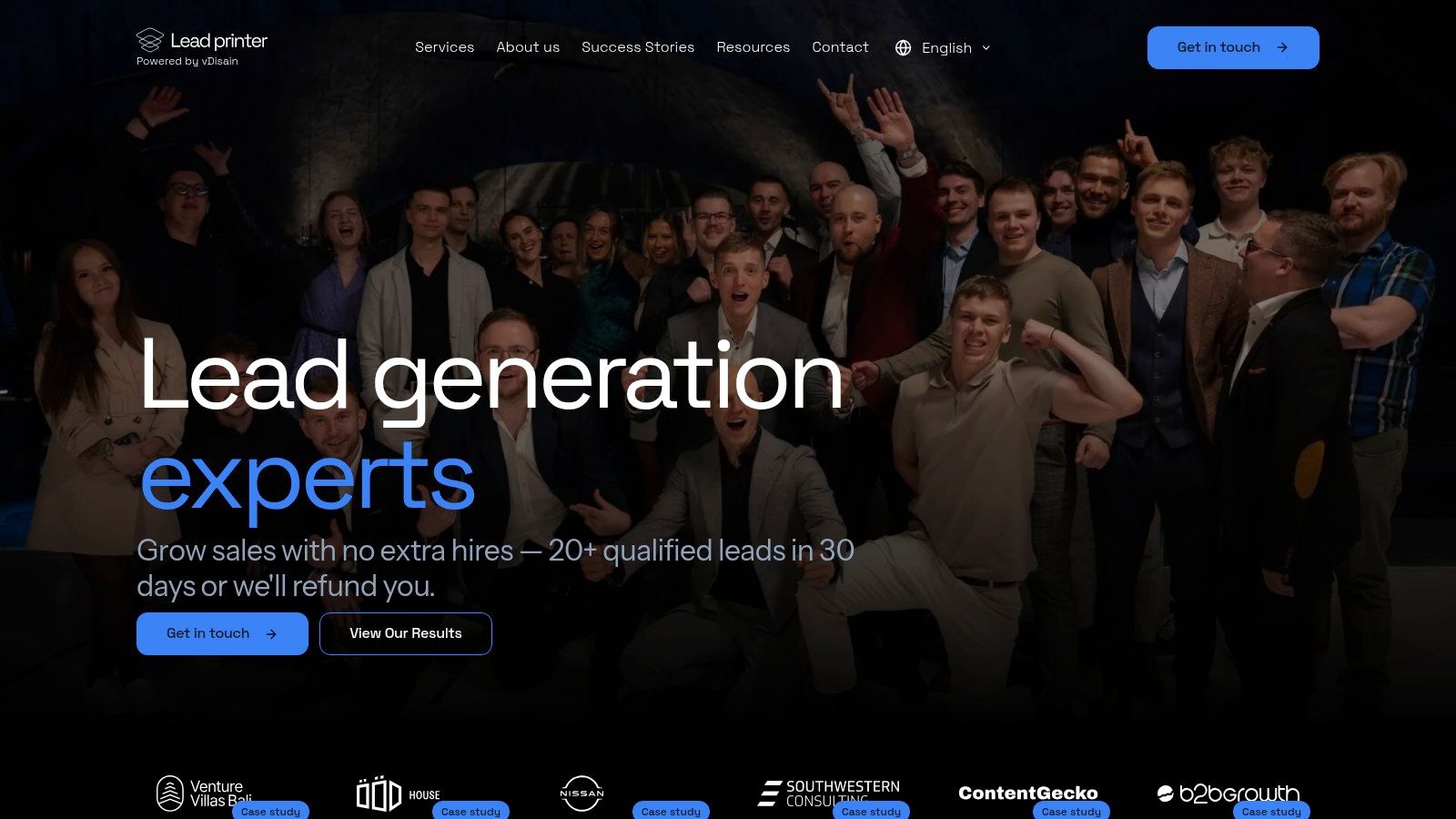
Lead Printer represents the full-stack outbound model. It combines prospect research, data enrichment, email infrastructure, personalized messaging, LinkedIn outreach, qualification, and reporting for B2B companies selling across the UK, EU, and US. That makes it a relevant benchmark when the problem isn't just finding contacts, but coordinating the technical and commercial parts of outbound execution.
The agency states that it guarantees a minimum of 20 qualified leads per month, while most clients receive an average of 50 leads per month, with some campaigns reaching 200 to 300 leads per month. Its published proof points include 7.2 million emails and LinkedIn direct messages sent, 32,000 leads generated, and more than 2,500 campaigns delivered. Those figures are supplied by Lead Printer, so buyers should ask how “qualified lead” is defined, how opportunities are attributed, and which examples resemble their own market.
Why the operating model stands out
Lead Printer manages sending infrastructure without using a client's primary domain, including domain authentication, inbox creation, warm-up, mailbox limits, and deliverability safeguards. It builds prospect lists through LinkedIn Sales Navigator, Google Maps, business registries, and targeted websites, then uses Clay and custom scraping for enrichment and segmentation.
The service also supports AI-assisted sales research, personalized cold email sequences, LinkedIn DMs, and webinar funnels where appropriate. Campaigns launch with testing and continue through optimization, inbox management, lead qualification, calendar handoff, live reporting, and weekly updates. For EU expansion, localized messaging can be added rather than treating every market as an English-language copy exercise.
Practical rule: Treat the guarantee as a quality and delivery term, not as a guarantee of closed revenue. Your sales team still owns follow-up, discovery, proposals, and conversion.
Commercial fit and limitations
Lead Printer says setup usually takes three to four weeks, covering infrastructure, warm-up, copy, and list building. Its standard engagement requires a three-month minimum commitment, followed by month-to-month terms. Public pricing isn't listed, so the proposal should specify campaign scope, qualification criteria, handoff responsibilities, assurance terms, and what happens if the minimum isn't met.
This model fits mid-market and growth B2B companies that want scalable outbound without hiring SDRs. It makes less sense for an extremely narrow market, an offer with no repeatable buyer profile, or a business that can't support a sufficiently large total addressable market. The central trade-off is clear: you buy an integrated outbound system and specialist execution, but you still need internal sales capacity to convert the opportunities.
2. Sopro
Sopro represents the data-led, managed prospecting model. Its service is built around bespoke prospect research, verified contact data, email-led outreach, optional multichannel activity, and a client portal that tracks campaign progress and replies. For a buyer comparing a B2B lead generation agency in the UK, that combination is useful when data quality and visibility matter more than phone volume.
The agency emphasizes hand-built prospect audiences, data verification, deliverability, campaign management, and data ownership. It also presents a proprietary technology ecosystem supporting campaign execution and reporting. The practical advantage is operational transparency. Rather than receiving a static list and a vague activity report, a buyer can ask to see how records were selected, how replies are classified, and how campaign learning feeds into the next audience.
Best use case
Sopro is strongest for teams with a defined ICP that want a partner to manage prospecting without hiding the underlying data. Email is the core channel, with LinkedIn and other channels available depending on the campaign. That makes it a better fit for structured digital outreach than for a sales programme built primarily around live calling.
A useful comparison is Lead Printer's cold email marketing service. The distinction isn't “email versus email”. Buyers should compare infrastructure ownership, list-building methods, personalization depth, reply handling, reporting access, and the exact point at which an interested prospect becomes a qualified lead.
Questions to verify
Sopro's pricing is quote-based, so ask how the commercial model changes with audience complexity, geography, channels, and qualification requirements. Confirm whether your team retains usable prospect data after the engagement, how opt-outs are managed, and whether the portal exposes the fields needed for CRM reconciliation.
Sopro is a sensible shortlist choice when you want managed outbound with visible data operations. It may be less suitable if your primary bottleneck is phone capacity, or if your sales team needs an outsourced SDR to conduct extended qualification conversations before booking meetings.
3. Operatix
Operatix represents the phone-capable, outsourced SDR model for technology companies. It focuses on B2B software and technology vendors, including areas such as cybersecurity, cloud, data, and martech. Its service scope includes outbound SDR work, appointment setting, inbound lead qualification, and market-entry support.
The agency's strongest differentiator is market specialization. A technology vendor selling into complex accounts may need more than a contact list and a sequence. SDRs need to understand technical categories, identify relevant stakeholders, handle objections, and recognize whether a conversation is commercially meaningful. Operatix organizes its delivery around technology-focused pods and supports multilingual engagement across EMEA, North America, LATAM, and APAC.
Where it fits
The model is particularly relevant to a software company entering a new region or testing an international sales motion. Multilingual coverage can reduce the burden of hiring, training, and supervising separate SDR teams for every market. It can also help a UK-headquartered vendor maintain a consistent qualification process while adapting conversations to local languages and buying contexts.
For broader context on the difference between outsourced execution models, compare this with outbound lead generation services. A generalist email-led provider and a specialist SDR agency may both promise meetings, but they create those meetings through different staffing, qualification, and accountability structures.
Risks to examine
Operatix is designed primarily for technology vendors. A manufacturer, accounting firm, or general professional services company may not receive the same value from a technology-specialist team. Pricing isn't public and is determined during scoping, so ask whether the proposal covers research, calling, email, meeting qualification, CRM updates, enablement, and regional management.
Before selecting Operatix, request evidence from a market with similar sales complexity. Confirm how the agency defines a sales-accepted meeting, how it handles no-shows and rescheduling, and whether your internal account executives can provide prompt feedback. This model works best when the client has a substantial offer, a clear market-entry objective, and enough sales capacity to process qualified conversations.
4. Air Marketing
Air Marketing is the clearest phone-first SDR option in this roundup. Its outsourced sales and lead generation service centers on telephone outreach and appointment setting, supported by email, social activity, and CRM integration experience such as HubSpot.
That channel emphasis matters. Email can create efficient reach, but a phone-led programme gives SDRs the opportunity to ask follow-up questions, test urgency, clarify responsibility, and decide whether a prospect meets the agreed qualification standard. For complex B2B services or offers where trust and context influence the sale, that human conversation can be more valuable than another automated touch.
The operating trade-off
Air Marketing's approach suits organizations that want a turnkey outsourced SDR function without building a calling team internally. It may also work well when an existing sales department can close meetings but lacks the time, consistency, or discipline to prospect by phone.
The cost is operational sensitivity. Phone performance depends heavily on list quality, ICP clarity, call preparation, caller experience, and the relevance of the opening conversation. A weak brief can turn a phone-first model into expensive activity. Ask to review call frameworks, coaching processes, disposition categories, recording access, and the feedback loop between SDRs and account executives.
What to include in the brief
Air Marketing publishes guidance about SDR outsourcing costs and scoping, but pricing isn't listed as a fixed public rate. Your proposal should therefore separate staffing, management, data, technology, calling, email support, appointment setting, and reporting rather than presenting one unexplained package price.
Choose Air Marketing when live conversation is the bottleneck. Choose an email-led partner when the primary constraint is scalable research and inbox-based outreach. A hybrid can be sensible, but only if each channel has a distinct role. Otherwise, the client may pay for multiple activities without learning which one creates sales-accepted opportunities.
5. Inside Global
Inside Global represents the international SDR hub model. With roots in the UK, it focuses on B2B technology, SaaS, and software companies that need pipeline generation, appointment setting, and inside sales support across multiple regions.
Its value is less about a single outreach tactic and more about extending a revenue team into new geographies. A company expanding from the UK into the US or wider EMEA may need prospect research, regional messaging, SDR coverage, meeting generation, and operational oversight. An outsourced partner can provide that structure without forcing the business to recruit and manage a separate local team before demand has been validated.
Best fit for expansion
Inside Global is positioned for enterprise-grade engagements and international sales development. That makes it more relevant to technology businesses with a defined product, a clear target market, and enough commercial capacity to follow up on meetings across regions. It isn't the obvious choice for a non-tech business seeking a small, single-market prospecting test.
The agency's strategic scope covers research, outreach, and meeting generation. During selection, ask how it allocates responsibility between its SDR team and your internal sales team. Confirm who owns account selection, who approves messaging, how regional performance is reported, and whether CRM updates happen in your system or the agency's.
Commercial questions
Pricing is custom and isn't posted publicly. Ask for a proposal that identifies the staffing model, management layer, market coverage, onboarding process, minimum commitment, and expected handoff standard. Also ask how the agency handles a market where the initial hypothesis proves wrong. A good international partner should be able to revise segments and messaging rather than only increase activity.
Inside Global is a strong candidate when the business needs international sales development capacity without immediately building local infrastructure. Its relevance falls when the buyer wants a lightweight email service, a pay-per-lead arrangement, or support outside B2B technology.
6. Growthonics
Growthonics represents the data-enrichment-before-outreach model. The service combines targeted research, verification, CRM cleansing, enrichment, email sequences, LinkedIn outreach, and appointment setting. Its positioning is particularly relevant to UK and EU teams that know their outbound performance is being limited by inaccurate, incomplete, or poorly segmented prospect records.
That sequence is important. Many teams try to fix weak outreach by rewriting copy, when the deeper problem is that the campaign targets the wrong company, role, technology stack, or geographic segment. A data-first partner can improve the foundation before adding more sends or more channels.
Why data changes the decision
Growthonics is suited to a business that already has a market hypothesis but lacks reliable execution data. Ask how it verifies contacts, identifies decision-makers, enriches firmographic and technographic fields, cleans duplicate CRM records, and handles records that can't be confirmed. These details determine whether the service improves targeting or merely produces another large spreadsheet.
For teams prioritizing professional-network outreach, compare its approach with LinkedIn lead generation. The meaningful comparison is not the presence of LinkedIn in both offers. Examine whether LinkedIn activity follows a verified ICP, how account research informs messaging, and how replies move into qualification and CRM handoff.
Selection caution
The supplied information identifies Growthonics as a London-based outbound partner, but its listed website is Air Marketing. The brand footprint includes similarly named properties, so verify that you're engaging the intended London team and the correct service line before sharing CRM access or signing a statement of work.
Public pricing isn't maintained. Request a current scope that separates data work from outreach, states data ownership, describes compliance controls, and explains how enrichment quality will be audited. Growthonics is most compelling when bad prospect data is the central bottleneck, not when the business wants more activity from the same unvalidated audience.
7. Pearl Lemon Leads
Pearl Lemon Leads represents the flexible multichannel and pay-per-lead model. It combines cold email, LinkedIn, phone outreach, prospect research, telemarketing, appointment setting, and qualification for UK and US campaigns.
The commercial distinction is its published starting prices and optional pay-per-lead structures. That can make initial budgeting easier than a fully custom proposal, particularly for a company testing a market or comparing channel costs. It doesn't remove the need for due diligence, though. A lower-friction commercial model only works when the buyer and provider define the deliverable precisely.
What to clarify in writing
Ask whether a payable lead must match a specific industry, company profile, geography, role, need, and engagement behavior. A positive reply isn't necessarily a sales opportunity, and a booked meeting isn't necessarily sales-accepted. The contract should explain how duplicates, poor-fit contacts, cancellations, no-shows, and disputed qualification are handled.
Pearl Lemon Leads offers broad channel coverage from one vendor. That can be useful when you want to test email, LinkedIn, and phone without coordinating multiple suppliers. It can also create attribution problems if the agency doesn't report channel-level activity and downstream status in a shared CRM.
Practical fit
This model suits buyers who value commercial flexibility and visible entry points. It may be less suitable for a complex enterprise motion that needs a dedicated SDR pod, deep technical enablement, or long-term regional account development.
Phone quality deserves particular scrutiny. Ask for sample recordings, caller training details, call frameworks, escalation procedures, and evidence from a similar ICP. Also confirm the data source, opt-out process, reporting fields, and whether the agency transfers usable prospect records at the end of the engagement.
Top 7 UK B2B Lead Generation Agencies, Comparison
| Service | 🔄 Implementation complexity | ⚡ Resource requirements | ⭐📊 Expected outcomes | Ideal use cases | 💡 Key advantages |
|---|---|---|---|---|---|
| Lead Printer | High, end-to-end deliverability, domain/auth, warm‑up (3–4 wk) | Medium–High, campaign fees, 3‑mo min, sizable TAM recommended | ⭐⭐⭐⭐⭐ Guaranteed ≥20 qualified leads/month (typical ~50; can scale to 200–300) | Mid‑market/growth B2B (SaaS, ecommerce, services, manufacturing, fintech) in US/UK/EU needing scalable outbound | Deliverability engineering; multichannel personalization; strong case studies; guarantee |
| Sopro | Medium, bespoke ICP, double‑verified data, compliant processes | Medium, quote-based pricing; client input for ICP/data; live portal | ⭐⭐⭐⭐ Predictable email‑led pipeline with fast iteration and high data quality | B2B firms seeking compliant, verified outbound with real‑time visibility | Strong compliance & data verification; transparent reporting; rapid launch |
| Operatix | Medium, pod‑based SDR ops, vertical playbooks, multilingual setup | High, ongoing SDR engagements, enterprise scope, custom pricing | ⭐⭐⭐⭐ Enterprise‑level appointment setting and market‑entry acceleration | Tech/software vendors needing outsourced SDRs and regional expansion | Deep vertical expertise; multilingual teams; proven enterprise experience |
| Air Marketing | Low–Medium, phone‑first SDR setup with CRM integration | Medium, phone resources, CRM work, discovery to tune messaging | ⭐⭐⭐⭐ Higher‑intent meetings via live calls; turnkey SDR function | Organizations prioritizing phone outreach and live conversations (CRM users) | Strong telephone outreach DNA; CRM integration; transparent scoping content |
| Inside Global | Medium, on‑demand SDR teams, international deployment logistics | High, enterprise engagements, region‑specific resourcing and management | ⭐⭐⭐⭐ Qualified appointments and pipeline support for international expansion | Tech/SaaS companies expanding across EMEA/US needing an SDR hub partner | Enterprise‑grade SDR support; international coverage; strategic SDR scope |
| Growthonics | Low–Medium, data collection/cleansing then multichannel sequences | Medium, data enrichment, CRM cleansing, compliance checks | ⭐⭐⭐⭐ Improved data quality, deliverability and scaled outreach across UK/EU | UK/EU firms needing data‑first preparation before scaling outbound | Data‑first approach; UK/EU compliance familiarity; CRM enrichment services |
| Pearl Lemon Leads | Low, packaged multichannel plans with published starting prices | Low–Medium, clear entry pricing; optional pay‑per‑lead model available | ⭐⭐⭐ Outcomes vary by ICP; pay‑per‑lead gives cost predictability | Small–mid B2B teams wanting clear pricing and optional pay‑per‑lead engagements | Published starting prices; flexible PPL option; combined email/LinkedIn/phone coverage |
Choose the Operating Model, Not Just the Agency Name
The right choice starts with the bottleneck. Outsourcing is practical when your business needs specialist deliverability, prospect research, multilingual coverage, faster market testing, or flexible pipeline creation without hiring and managing an SDR function. It can also reduce the operational load of maintaining sending infrastructure, enriching records, writing sequences, managing replies, and coordinating handoff.
UK outbound teams should take deliverability seriously. The DMA's 2025 Email Benchmarking Report says delivery rates rose to 98% in 2024, while Great Britain marketing emails recorded a 39.98% open rate in 2023, as reported in this UK B2B lead generation benchmark summary. Those figures don't prove that any agency will produce meetings, but they do show why technical infrastructure and message relevance belong in the buying decision.
The economics also favor careful qualification. UK B2B benchmarks report an average 13% MQL-to-SQL conversion rate, with top performers reaching 39% to 40% through behavioral lead scoring, while another benchmark places the average B2B sales cycle at 11.3 months and says 70% of that time is spent in anonymous research. These figures are compiled in UK email marketing ROI research. An agency that reports only meetings booked may be measuring the easiest stage, not the stage that determines revenue.
When internal SDR hiring makes more sense
In-house can be preferable when your messaging is already repeatable, your market is tightly defined, managers have time to coach SDRs, and the company needs deep institutional knowledge from every conversation. Internal teams also make sense when account executives need constant proximity to prospecting feedback or when compliance and brand risk require direct control over every interaction.
Outsourcing is usually stronger for a flexible test, a new region, a data repair project, or a campaign that needs specialist infrastructure immediately. The decision isn't permanent. A company can outsource execution while keeping strategy, qualification rules, CRM ownership, and closing expertise internal.
Vendor comparison checklist
Before signing, ask each provider to document:
- Target segment and TAM: Which industries, company profiles, roles, regions, and account counts will the campaign cover?
- Qualified lead definition: Does qualification require a positive reply, a matched decision-maker, a confirmed need, or a booked and accepted meeting?
- Channel responsibilities: Who owns email, LinkedIn, phone, webinars, follow-up, and nurture?
- Data ownership: Can your team export enriched records, suppression lists, notes, and campaign history?
- Compliance and deliverability: How are authentication, warm-up, list hygiene, opt-outs, sender reputation, and regional requirements managed?
- CRM handoff and reporting: Which fields, statuses, source details, and pipeline stages will be updated?
- Relevant proof: Can the agency show evidence from a similar market, sales cycle, offer, and buyer group?
- Setup and commitment: What happens during onboarding, how long does launch take, and what minimum term applies?
- Pricing basis and assurance: Are you paying for time, leads, meetings, or a managed programme, and what remedy applies when agreed criteria aren't met?
Reporting should connect activity to pipeline, not stop at send volume or meeting counts. These agency client reporting tips are useful when evaluating whether a provider can make its work visible to commercial stakeholders.
Shortlist two or three operating models, request scoped proposals, and compare expected pipeline contribution rather than headline lead volume. The best B2B lead generation agency UK option is the one that owns the parts of outbound your team can't execute reliably, while giving you enough data and reporting to judge whether the work is creating real sales progress.
Lead Printer builds and runs data-driven email and multichannel campaigns for B2B companies across the UK, EU, and US, including infrastructure, prospect research, enrichment, personalization, qualification, and reporting. If you need scalable outbound without hiring an SDR team, visit Lead Printer to discuss a scoped campaign and its qualified-lead assurance.