Most advice about manufacturing sales outsourcing gets this wrong. Agencies sell manufacturers on a clean handoff from cold outreach to signed purchase order, then discover they can't handle the technical objections, plant-level politics, or procurement pressure that decide the deal. The smarter model is narrower and more effective, outsource the top of the funnel, keep technical closing in-house.
That isn't a compromise, it's the operating model that fits how industrial buying works. External teams are useful when the job is research, outreach, qualification, and meeting setup, while your own people handle demos, plant visits, RFQ response, pricing authority, and contract negotiation. Industrial sales research and guidance point in the same direction, full-cycle outsourcing is rarely the right answer, but a hybrid approach is a practical benchmark for manufacturers that need more pipeline without giving away technical control peer-reviewed study, industrial sales outsourcing guidance.
If you buy a full-funnel promise, you usually get weak product knowledge, shallow qualification, and a vendor pushing for control it hasn't earned. If you scope the engagement surgically, you get what outsourcing does well, speed, volume, and disciplined outreach, without sacrificing the expertise that closes industrial business. By the end, you should know exactly what to hand off, what to keep, and how to spot a vendor that's overselling the wrong model.
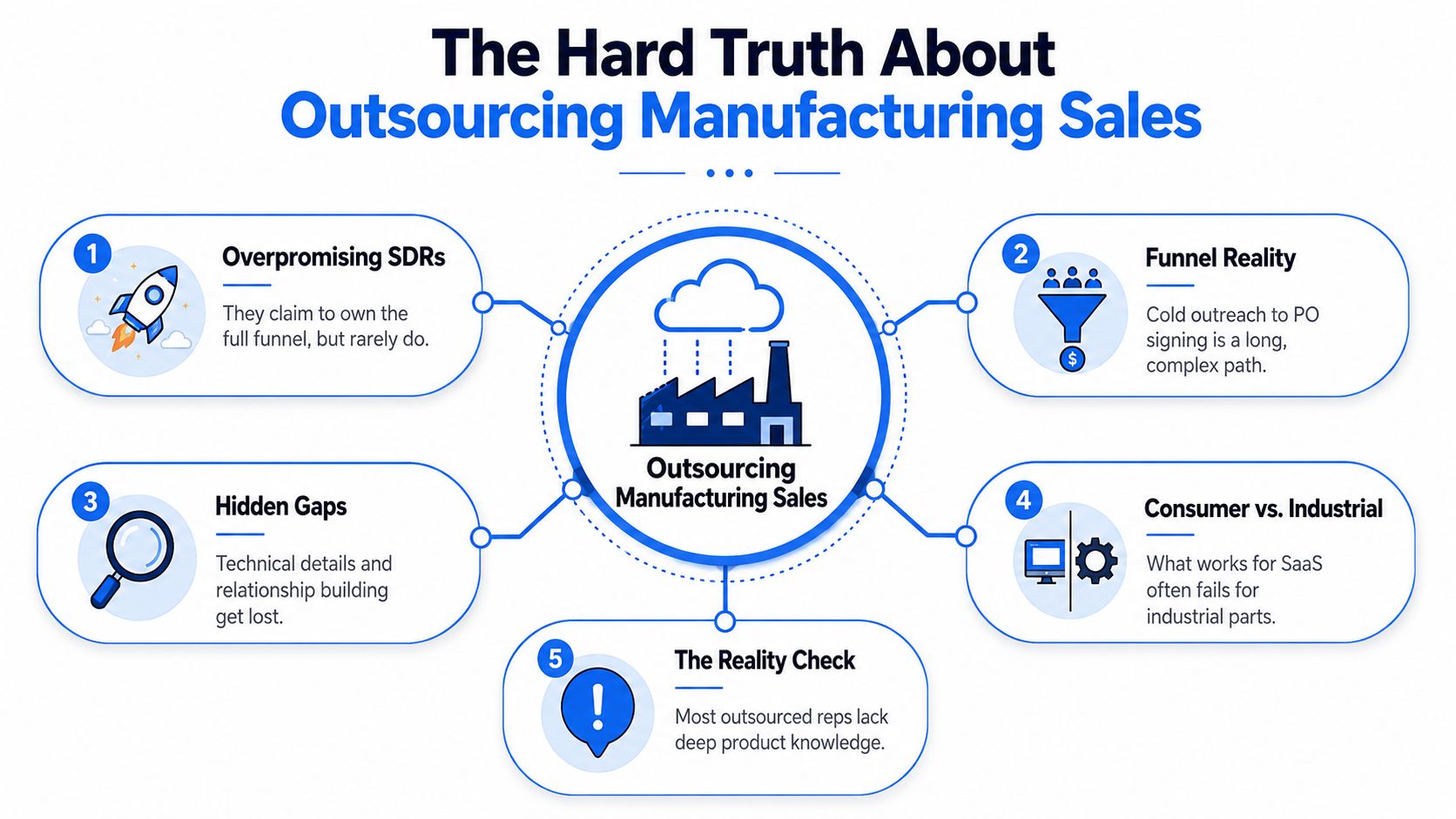
The Hard Truth About Outsourcing Manufacturing Sales
The most common sales pitch from outsourced SDR firms is simple, and it's misleading. They say they can own the whole funnel, from first touch to signed PO, as if industrial selling were just a longer version of SaaS prospecting. It isn't. Manufacturing deals usually depend on technical context, plant realities, and a level of buyer-specific knowledge that a generic outbound team doesn't have.
The model that actually works
The better default is a hybrid operating model. Let the external team own research, outbound, qualification, and meeting setting, then hand the opportunity to your internal closers once the conversation gets technical or commercial. That matches the evidence on industrial sales outsourcing, which says top-of-funnel work is the strongest fit and full-cycle outsourcing is often a bad fit for complex B2B manufacturing industrial sales outsourcing guidance.
Practical rule: if a vendor can't explain how they handle engineering questions, procurement pushback, and plant-specific objections, they're not ready to own the close.
There are exceptions. Commodity SKUs, long-tail distributor channels, and lower-ASP product lines can support broader outsourcing because the technical burden is lighter and the transaction path is simpler. But even there, you should be careful about handing over messaging and pricing discipline to people who don't live inside your category.
The larger market signal supports outsourcing as a mainstream operating model, not a desperation move. A manufacturing outsourcing market estimate put the category at USD 248.30 billion in 2024 and projected USD 497.65 billion by 2034, with APAC at more than 43.8% of the market in 2024, about USD 108.5 billion manufacturing outsourcing market report. That doesn't prove every sales function should be outsourced. It does show manufacturers already rely on external capability when scale, specialization, or speed matter.
What to expect from the rest of the decision
The question isn't whether outsourcing works. It's where it stops. Use it to build pipeline, qualify buyers, and shorten the time to meaningful conversations, then keep the technical and relationship-heavy work inside the business where it belongs.
Defining Manufacturing Sales Outsourcing
Manufacturing sales outsourcing means hiring a third party to run a defined slice of your revenue pipeline. It is not contract manufacturing, private label, or production outsourcing. The vendor sells on your behalf using your positioning, your target market, and your commercial rules.
Keep the scope tight. The strongest model is an outsourced top-of-funnel engine, not a full replacement for your sales team. That means research, outreach, and qualification belong outside, while technical closing stays inside with people who know the product, the plant, and the buyer's objections.
A useful way to frame the setup is as an outsourced revenue layer, not an outsourced company. Some manufacturers use fee-for-service SDR pods. Others use performance-based appointment setting. Fractional sales teams and full-cycle programs exist too, but those broader models break down fast when technical product knowledge matters. For industrial buyers, the practical scope usually stops before the close.
If you want a broader operational context before you define sales workflow, a resource like DocsBot for production workflows can help teams map how documentation, handoffs, and process discipline fit inside manufacturing operations. That process mindset matters here, because outsourced selling fails when the internal handoff is sloppy.
For teams building this model, sales development outsourcing guidance is useful as a starting point, because the primary job is usually demand creation, not handing away the entire sales motion.
The work that should move outside
The vendor should handle ICP research, account targeting, cold email, calling, LinkedIn outreach, qualification calls, and meeting hand-off. They should build lists, write first-touch messaging, and remove bad-fit prospects before they hit your calendar. That is where outside teams add clear value.
If a rep can't qualify fit, timing, and authority in plain language, the handoff is too early.
The work that should stay inside
Your team should keep technical demos, plant audits, RFQ response, pricing authority, and post-sale account management. Those tasks require product depth, commercial judgment, and credibility with plant managers, operations leaders, engineering, and procurement. That is a competence issue, not a trust issue.
| Sales Activity | Outsourced Vendor | Manufacturer (In-House) |
|---|---|---|
| ICP research | Yes | Oversees strategy |
| Target account building | Yes | Approves priorities |
| Cold email and calling | Yes | Reviews messaging |
| LinkedIn outreach | Yes | Sets guardrails |
| Qualification calls | Yes | Defines criteria |
| Meeting hand-off | Yes | Owns next-step ownership |
| Technical demo | No | Yes |
| Plant audit | No | Yes |
| RFQ response | No | Yes |
| Pricing authority | No | Yes |
| Account management | No | Yes |
B2B manufacturing sales outsourcing is also not telemarketing, and it is not marketing agency work. Telemarketing chases volume. Marketing agencies create awareness. A good outsourced sales partner does less broad spray-and-pray activity and more disciplined pipeline creation tied to real commercial criteria.
If you are comparing service models, the point is simple. Do not buy “sales” when you really need a meeting-generation engine that feeds an internal technical sales team. Keep that line clear, and the engagement gets much easier to manage.
Why Manufacturers Outsource Sales and What the ROI Looks Like
Manufacturers outsource because internal hiring is slow, expensive, and too rigid for the demand problem they are trying to solve. If you need meetings now, waiting months for a new rep to learn specs, territories, and buyer language is the wrong move. Outsourcing gets research, outreach, and qualification moving faster, and it avoids adding permanent headcount before demand is proven.
The market context supports that choice. Sales outsourcing is no longer a niche experiment. A broader sales-and-marketing BPO market was estimated at USD 28.65 billion in 2022 and projected to reach USD 57.46 billion by 2030, with a 9.4% CAGR from 2023 to 2030 sales and marketing BPO market report. That is a formal category with durable demand, not a cleanup service for broken sales teams.
The ROI equation manufacturers should use
Do not judge a vendor on meetings alone. Judge them on cost per qualified meeting and cost per opportunity, then compare that with the fully loaded cost of an in-house rep. Salary, benefits, tools, manager oversight, and the ramp period all belong in the math.
The hidden cost is time. An internal rep may need months to book meaningful meetings, especially if the product is technical or the buyer group is complex. An outsourced team that already knows how to prospect, qualify, and hand off can shorten that early-stage delay and turn fixed payroll into variable pipeline spend.
Financial logic: fixed payroll punishes uncertainty, variable spend gives you room to scale with demand.
That matters even more in a new geography or channel. A vendor can test the market without you hiring a full local team first. If the channel does not respond, you stop the spend. If it does, you already have a qualified pipeline to justify more investment.
For manufacturers comparing models, a resource like find CNC shop guides can help when you are matching specialized buyer research to outreach. The point is discipline. Shape the message around the target market before sales activity starts.
The cost advantage is about flexibility, not cheapness
Outsourcing is not automatically cheaper every month. It is better because it makes sales cost adjustable. You are paying for output, not just capacity, which fits demand shifts, territory changes, and launches that need a fast pipeline push.
When to Outsource and When to Keep Sales In-House
The wrong question is, “Should we outsource sales?” The right question is, “Which part of the sales motion benefits from outside execution?” If you answer that directly, the decision becomes straightforward.
| Factor | In-House Sales Team | Outsourced Sales Partner |
|---|---|---|
| Cost structure | Fixed salary, benefits, tools, management | Variable program or rep cost |
| Speed to first meetings | Slower, due to hiring and ramp | Faster, because the team is already in place |
| Expertise depth | Stronger on product, plant, and account nuance | Stronger on outbound process and volume |
| Control over messaging | Direct control | Shared control with written standards |
Outsource when the bottleneck is pipeline
Use outsourcing when you already have internal product expertise, but not enough conversations. It's also a fit when you need to enter a new region without hiring locally, or when the sales cycle is long enough that prospecting volume matters more than immediate closing depth. The evidence on industrial sales supports that split, external teams do best at the early stages, while internal experts handle the heavier technical work industrial sales outsourcing guidance.
Keep it in-house when the deal depends on on-site plant tours, regulated certifications, or high-value, relationship-heavy negotiations. In those cases, the buyer wants access to senior people who can answer hard questions, not a generic appointment setter reading from a script. If the average contract is large enough to justify a seasoned seller, do that instead of pretending a vendor can shortcut the process.
My recommendation is blunt
Use a hybrid model by default. Let the outsourced team build lists, run outreach, qualify interest, and book meetings. Let your technical sellers, application engineers, and account leaders close the business and protect margin. That combination gives you speed without surrendering control.
Decision rule: if the prospect's next question is technical, internal owns it. If the prospect's next step is a meeting, the vendor can own it.
The same guidance applies across most industrial categories. The closer a sale gets to engineering depth, procurement complexity, or relationship dependence, the less sense it makes to outsource the close. That's the line you should protect.
How to Choose the Right Outsourcing Partner
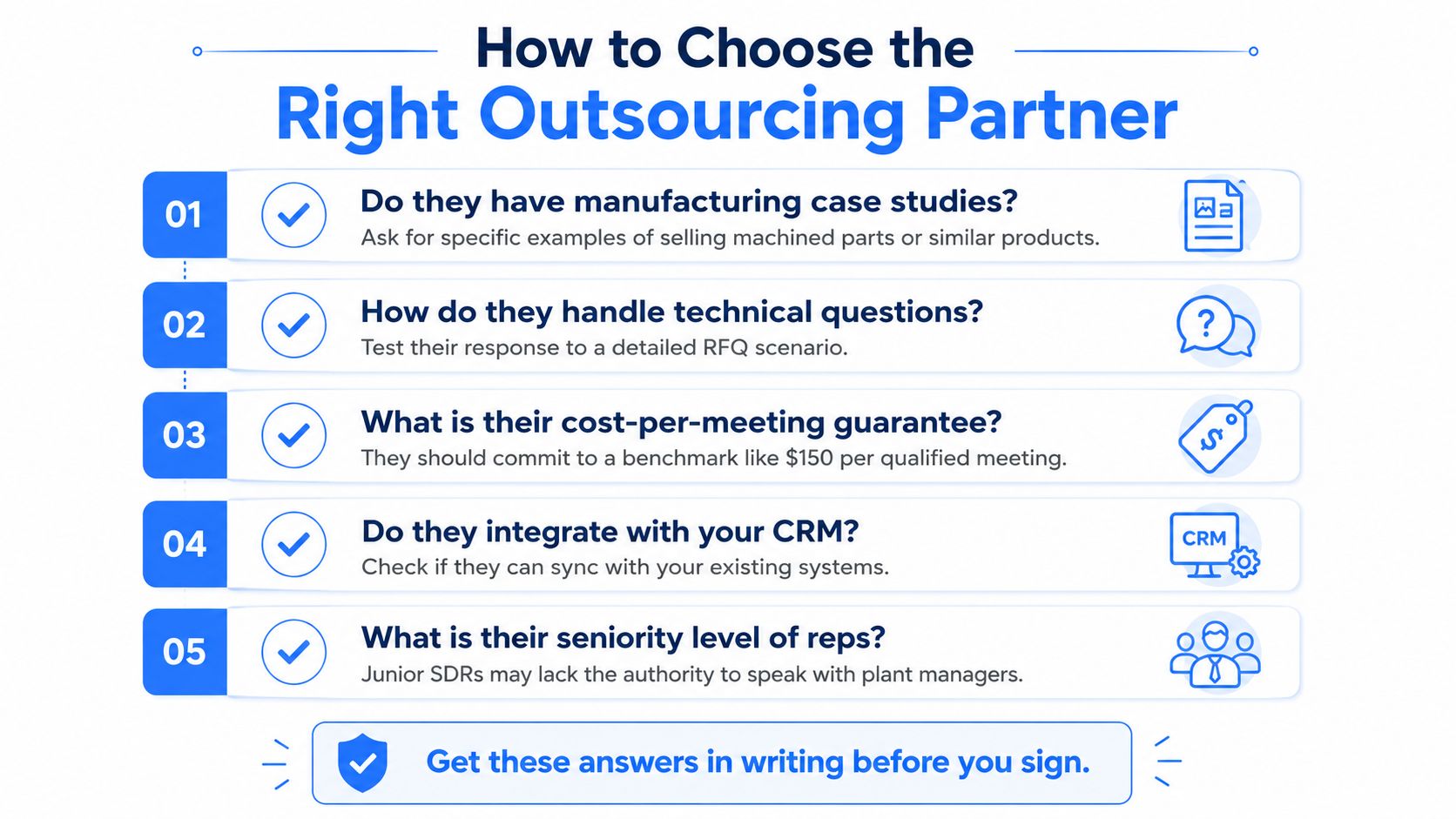
Choose a partner for manufacturing sales outsourcing by scoping the work tightly. Hand off research, outreach, and qualification. Keep technical closing, plant-specific pricing, and senior negotiations in-house. Agencies often sell full-funnel replacement. That pitch is wrong for manufacturers, because the moment a deal turns technical, you need people who can speak credibly to operations, engineering, and procurement.
Ask better questions before you sign
Start with proof, not a polished pitch. Ask for manufacturing case studies with named clients and verifiable pipeline outcomes. Ask whether the reps are dedicated to your account or split across multiple clients, because shared teams usually dilute attention and slow feedback.
Practical rule: if they won't show call recordings or SDR resumes, you are being asked to trust a black box.
Press them on qualification. A serious vendor should explain how they judge fit, timing, authority, and whether the lead belongs with your internal seller. If they cannot describe that process clearly, they do not understand industrial qualification well enough to protect your calendar. For teams comparing service models, Lead Printer's sales development outsourcing is a useful reference point for how an outsourced top-of-funnel program should be structured.
Commercial terms need the same discipline. Push for clear pricing, whether it is per-rep, per-program, or a hybrid. Confirm exit terms before you sign, and make sure you own the data, contact lists, and reporting history if the relationship ends.
Red flags you should not ignore
- Guaranteed meeting counts without source disclosure, because guarantees without process visibility are sales theater.
- Vague ICP definitions, because if the target is fuzzy, the outreach will be too.
- Reluctance to share call recordings, because real teams do not hide how they work.
- Junior reps handling complex buyer conversations, because plant buyers notice immediately.
- No answer on CRM integration, because your pipeline data should not live in a silo.
Treat the vendor like a specialist extension of your revenue team. If they act like an agency selling activity, walk away. If they can show how they will qualify industrial demand and hand it back cleanly to your internal closers, keep moving.
Implementation Steps and the KPIs That Matter
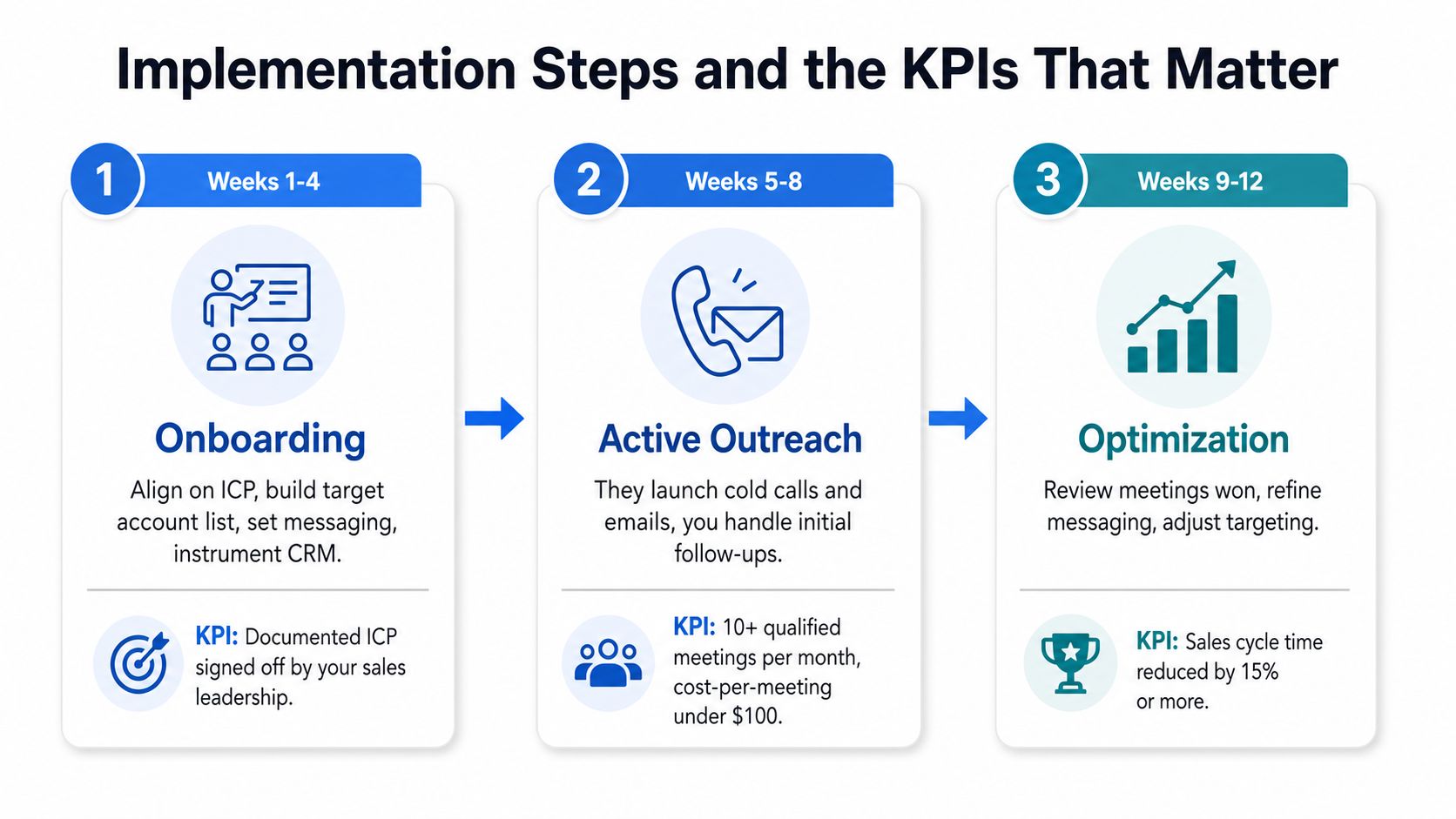
The first month should feel structured, not busy. If a vendor starts firing emails before the ICP is signed off and the CRM is ready, you're already behind. Good implementation starts with alignment, then moves to volume, then to improvement.
Stage 1, onboarding
During weeks 1 to 4, lock the ICP, build the target account list, agree on messaging, and instrument the CRM. The KPI that matters here is simple, the documented ICP has to be signed off by both sides, and the tracking dashboard has to be live. If either one is missing, the campaign is not ready.
This is also when you define handoff rules. The vendor should know exactly what counts as a sales-accepted lead, what a qualified meeting looks like, and who follows up after the booking. If your internal owner and the vendor interpret those rules differently, the numbers will be useless later.
Stage 2, ramp
During weeks 5 to 12, the team launches outbound sequences, qualifies responses, and hands off opportunities. The key KPI here is cost per sales-accepted lead and the meeting-to-qualified-lead conversion rate. If those numbers aren't working, the problem is usually message-market fit or weak qualification, not raw activity.
If Stage 2 misses target for two consecutive months, stop and review the strategy before you extend the contract. Don't let a vendor explain away a weak ramp with more activity and no better output. That's how bad programs linger too long.
Stage 3, optimization
From month 4 onward, the work shifts to improving scripts, adding channels, and expanding pipeline sources. At this stage, watch pipeline coverage ratio, average time to first meeting, and SQL-to-opportunity conversion. Those are the numbers that tell you whether the program is feeding real revenue, not just meetings.
If you want a simple operational benchmark, use a pipeline coverage target of 3x quota as a planning anchor, then review monthly. That figure should be treated as an internal goal, not a magic promise from the vendor. The point is discipline, not theater.
For a broader view of demand generation workflows, Lead Printer's lead generation for manufacturing fits the same model, research, outbound, qualification, and handoff. The implementation lesson is the same no matter who runs the program, the pipeline has to be measurable from day one.
Putting It All Together Without Repeating Old Mistakes
The strongest manufacturing sales outsourcing program is not the one that does everything. It's the one that does the first part of the job extremely well and stops before technical closing gets muddy. Outsource top-of-funnel, keep closing in-house, and enforce a clean handoff.
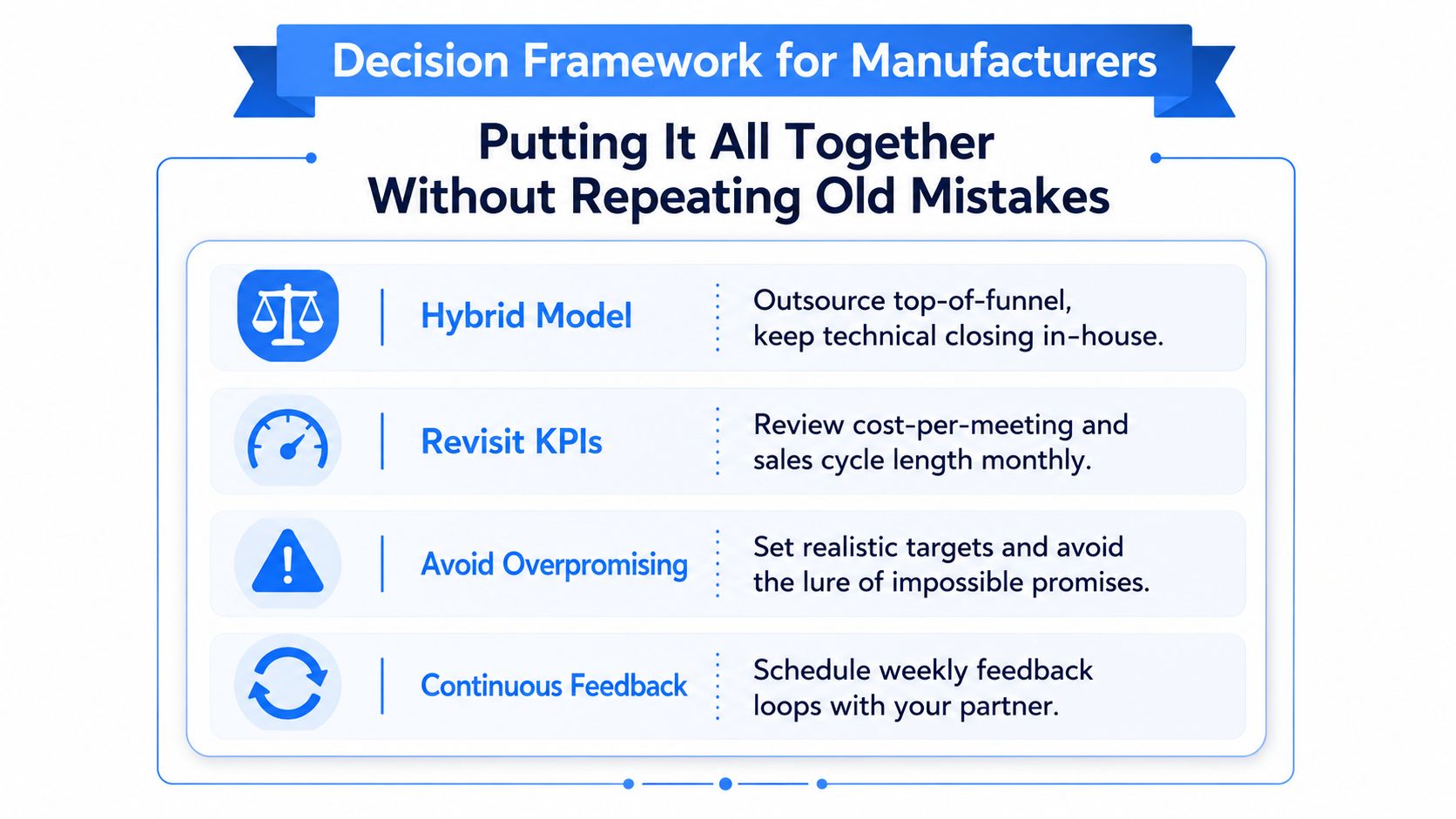
Use a simple decision filter
- Hybrid Model, outsource research, outreach, and qualification, keep technical closing inside.
- Revisit KPIs, watch cost-per-meeting, cost-per-opportunity, and sales cycle length every month.
- Avoid Overpromising, reject vendors that promise ownership of the whole funnel without proving industrial depth.
- Continuous Feedback, schedule regular review calls and force the program to adapt fast.
Five warning signs usually mean the engagement is drifting off course. The first is rising cost per qualified meeting. The second is declining show rates. The third is vague reporting. The fourth is heavy SDR turnover. The fifth is the vendor pushing to own the close before earning that right.
Warning sign: when a vendor starts talking more about volume than fit, pipeline quality is already slipping.
Your next 30 days should be straightforward. Align internal stakeholders on who owns what. Clean up the CRM so handoffs are traceable. Scope a pilot with clear target accounts and qualification rules. Review the contract carefully, and insist on a defined exit clause if the program underperforms.
Manufacturers do not need more hype around outsourcing. They need a tighter model, sharper expectations, and a partner who understands that the job is to create qualified opportunities, not pretend to replace your technical sales team.
Lead Printer builds outsourced outbound programs for manufacturers that need qualified meetings, not empty activity. If you want a team that can run research, outreach, and qualification while your closers handle the technical sale, visit Lead Printer and see whether that model fits your pipeline goals.