Your pipeline just slipped again. The AE requisitions are still open, CAC keeps creeping up, and the board wants to know why growth feels harder even though the product's fine and the team's working weekends. That's usually the moment leaders start looking at whether to outsource B2B sales, not because they want a shortcut, but because the internal motion is too slow, too expensive, or too inconsistent to carry the quarter.
The mistake is treating outsourced sales like extra hands. It's not. It's a system that includes people, list quality, inbox infrastructure, messaging, qualification, reporting, and handoff discipline. If any one of those pieces is sloppy, you don't get more pipeline. You get burned domains, bad meetings, and a vendor who looks busy while your closers sit idle.
What It Really Means to Outsource B2B Sales
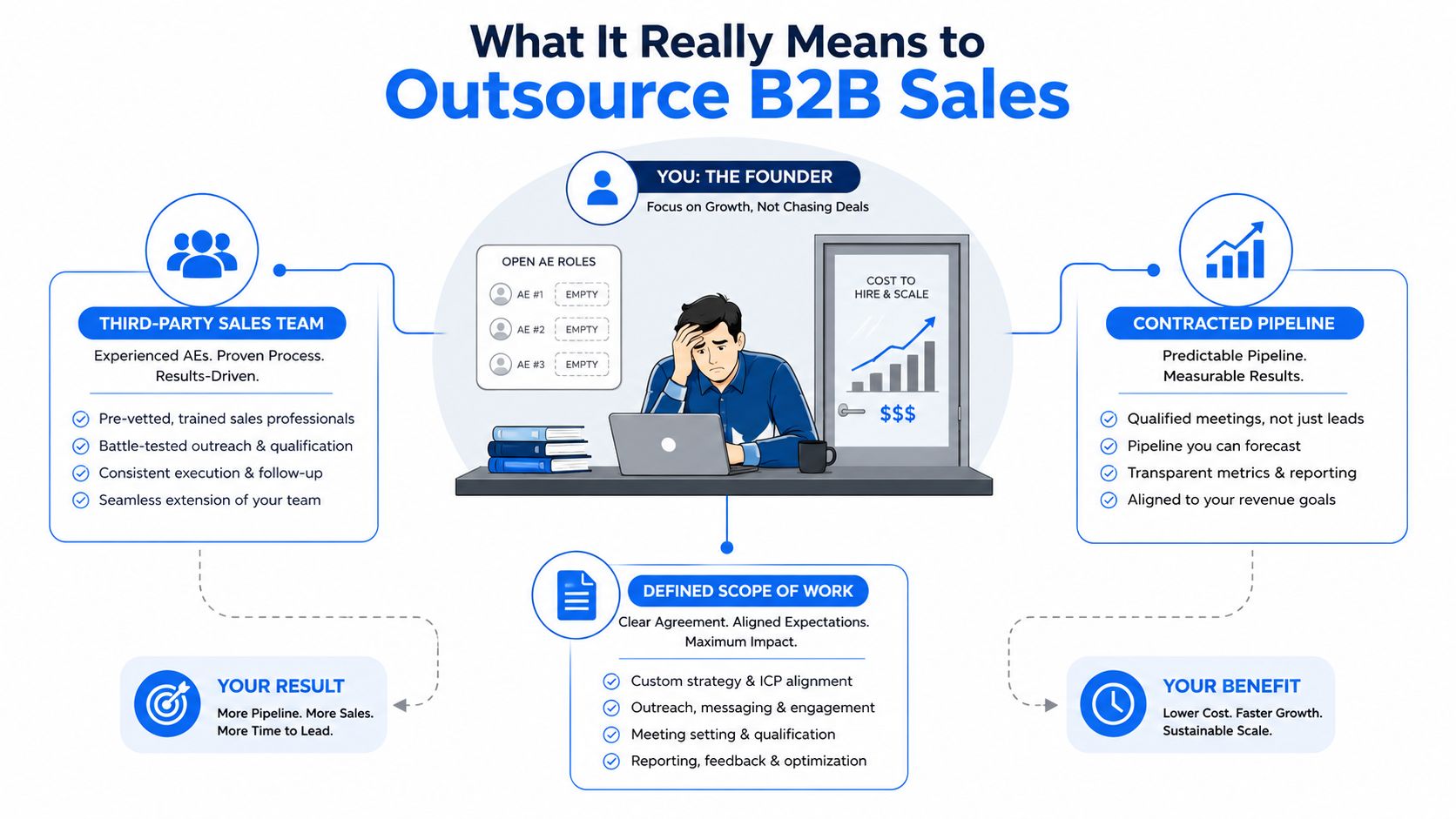
I've seen founders reach this decision after a brutal stretch. Pipeline dries up, the AE team is stretched thin, and the board starts asking why growth stalled even though spend went up. At that point, outsourced B2B sales means contracting a third-party team to own outbound prospecting, qualification, and sometimes full-cycle selling against a defined ICP and quota, not just “sending more emails.” That distinction matters because a real partner is working from a sales motion, not a contact list.
The three shapes this model usually takes
The lightest version is SDR-as-a-service, where the vendor handles top-of-funnel work and hands meetings to your closers. The next step is outsourced account development, where the team leans harder into qualification, sequencing, and multi-threaded outreach across buying committees. The deepest version is full-cycle outsourced sales, where the partner owns more of the journey from first touch to close.
What it is not is just as important. It isn't a list-buying shop. It isn't a mail-merge factory. It definitely isn't a substitute for product-market fit.
Practical rule: if a vendor talks about “booked meetings” before they talk about ICP, deliverability, and handoff quality, you're looking at a volume shop, not a pipeline partner.
Treating the model this way keeps the conversation honest. Outsourced sales is a blend of people, process, and technical infrastructure, and the vendor either understands all three or they don't. If they don't, the relationship will look active while the pipeline stays weak.
Why the Outsourced Sales Model Has Gone Mainstream
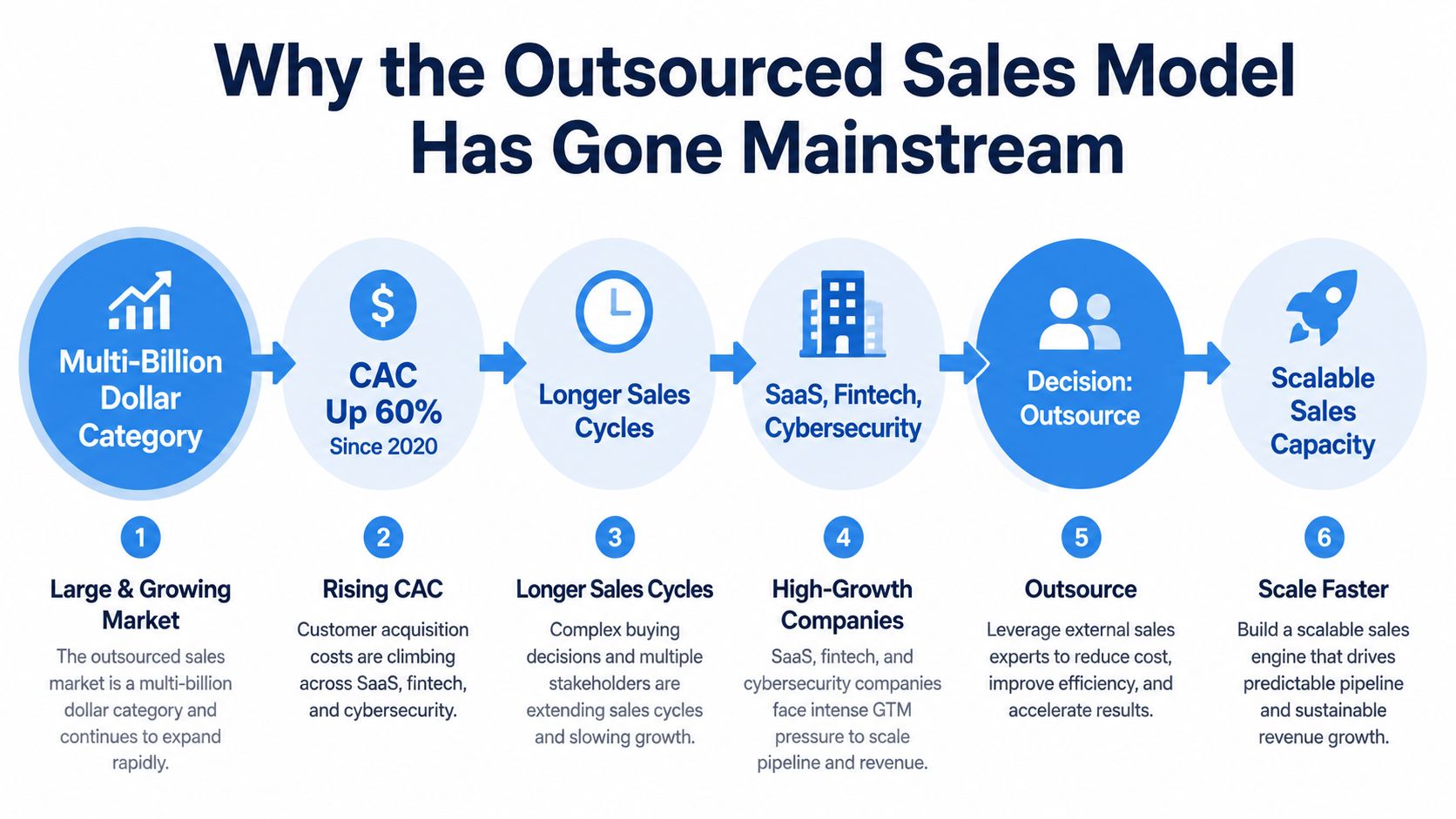
The category didn't grow because outsourcing got fashionable. It grew because outbound got harder, buyers got more self-directed, and internal hiring got slower and more expensive. One independent industry estimate pegs the global sales and marketing business process outsourcing market at USD 28.65 billion in 2022, with growth to USD 57.46 billion by 2030 at a 9.4% CAGR (saleshive.com). That's not a niche sidecar business anymore. It's a mainstream operating model.
The mechanics behind the shift
The old spray-and-pray motion is weak because buyers ignore it. They research across channels, they involve more stakeholders, and they don't reward lazy outreach. Recent B2B research says 61% of buyers prefer a rep-free experience and spend only 17% of the journey with any supplier rep, while the buying process now spans an average of 10 channels (division50.com). That creates a hard problem for internal teams. It's not enough to “call harder.” You need better timing, better sequencing, and better multi-threading.
Outsourced providers can help because they're set up as a pod. That usually means a researcher, an SDR, and a manager working from an enrichment stack, a qualification framework, and a handoff process. Good operators don't blast cold messages and hope. They run authenticated sending infrastructure, warm inboxes carefully, and use sequences that combine email, LinkedIn, and call follow-up where appropriate.
If you want a practical automation reference to pair with that kind of motion, boost revenue with automation is a useful read because it focuses on process design rather than hype.
The other reason this model has gone mainstream is specialization. Agencies that run multiple programs at once learn faster than isolated in-house teams. They see which subject lines die, which sequences get filtered, and which handoff patterns close. That doesn't mean they're automatically better. It means the good ones have process memory your team may not have.
The Real Benefits and Trade-offs You Should Weigh
The upside is obvious if you've been living the hiring pain. Outsourcing gives you speed to pipeline, variable cost instead of fixed headcount, and access to people who already know how to run data, sequencing, and outbound operations. You also get a perspective from outside your building, which can be useful when your internal team has been staring at the same ICP for too long.
What you gain, and what you give up
You gain speed because a vendor can usually get moving faster than a full hire cycle. You gain specialization because their team may already know the tooling, deliverability problems, and reporting cadence required to make outbound work. You gain scalability because you can ramp a push without rebuilding your org chart.
You give up control. You also give up some tribal knowledge about customer objections, edge cases, and why a prospect said no. That's a real cost. If the vendor is weak, the risks show up fast in brand damage, domain reputation, and wasted meetings that your AEs never want to touch.
If your product needs deep technical discovery before a meeting is even worth taking, outsource cautiously. Good vendors can qualify, but they can't invent product understanding.
Here's the trade-off in plain language. Outsourcing buys speed, scale, and specialization at the price of context, control, and concentration risk. That's a good deal for the right motion and a bad deal for an immature one.
| Dimension | Benefit | Trade-off to Accept |
|---|---|---|
| Speed | Faster pipeline generation than hiring from scratch | Less internal control over day-to-day execution |
| Cost structure | More flexible than permanent headcount | Vendor fees can become sticky if results are weak |
| Expertise | Access to trained SDR processes and tooling | Less tribal product knowledge than your own team |
| Capacity | Easier to scale for a launch or seasonal push | Higher dependence on the vendor's systems |
| Perspective | Outside eyes can challenge stale assumptions | Their recommendations may not fit your culture |
The honest answer is simple. Use outsourced sales when you need a working pipeline motion fast, but don't pretend it removes your responsibility for quality control.
When Outsourcing Makes Sense and When It Backfires
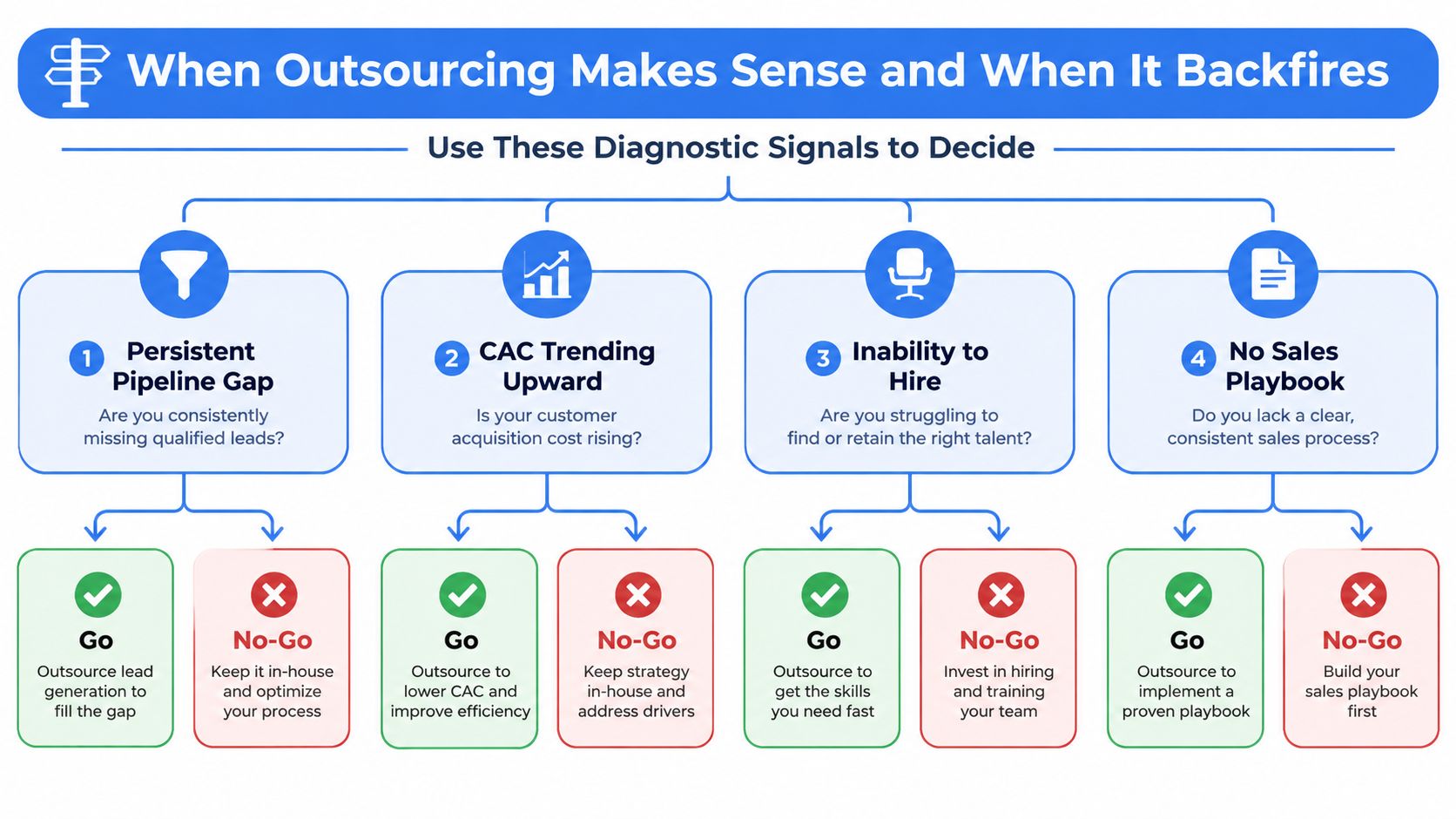
Start with four signals. If you've got a persistent pipeline gap even though the AE team is active, that's a green light to look at outsourcing. If CAC is trending upward for two straight quarters, that's another. If you can't hire or retain SDRs in the geography you care about, or if your TAM is deep enough to support parallel outbound motions, the model starts to make sense.
A practical go or no-go test
Use clear thresholds instead of vibes. If pipeline coverage is below 3x quota, your team is underfed. If CAC has crossed your payback ceiling, the current motion isn't healthy. If you've had three failed SDR hires in six months, stop pretending the hiring market is going to fix itself. If your ICP list has more than 5,000 accounts, that usually gives a vendor enough room to work multiple segments without immediately exhausting the pool.
That said, outsourcing backfires in a few very specific cases. Early-stage products without product-market fit usually just outsource confusion. Deep technical sales cycles can fail when the vendor can't handle nuanced discovery. Regulated industries can block vendor staff at compliance review. Internal AEs can also sabotage the model if they refuse to accept handoffs or treat the vendor like a nuisance.
The right conclusion isn't “never outsource.” It's “don't outsource a broken motion.” Outsourcing is a force multiplier, not a substitute for a sales system that already has a pulse.
How to Evaluate and Select the Right Vendor
Start with deliverability, because bad infrastructure will bury good messaging. If a vendor is sending cold outreach without a warm-up process, authenticated sending domains, and aligned sender setup, walk. A B2B cold email setup should use SPF, DKIM, and DMARC, warm the domain for about 14 to 21 days, and increase volume gradually instead of scaling fast. Good inbox placement sits at 80%+, strong performance reaches 90%+, bounce rates should stay below 4%, and spam complaints should stay near zero (danishleadco.io).
Score vendors on infrastructure, data, compliance, and reporting
After deliverability, check the list source. I want licensed or properly sourced data, not scraped junk dressed up as intent. Then check compliance for the markets they touch. That means GDPR, CAN-SPAM, CCPA, and CASL discipline, not a compliance line buried in a deck.
Evaluation gets sharper when you compare the vendor's operating model to your own motion. Our guide to sales development outsourcing is a useful reference point here, because it forces the same questions I ask in vendor reviews, data quality, sender setup, and how the team handles handoff. For heavier systems like ERP or operations, a partner screen such as find a vetted Odoo partner is a good reminder to judge operational fit, not outbound theater.
Keep this scorecard in front of every call.
| Criterion | Weight | Pass Threshold |
|---|---|---|
| Deliverability infrastructure | High | Inbox placement above 90% |
| Data sourcing | High | Licensed or verified sources, no scraped lists |
| Compliance posture | High | Written support for applicable privacy rules |
| Reporting cadence | Medium | Weekly pipeline reporting, not monthly summaries |
| Rep replacement policy | Medium | Clear replacement terms for underperformers |
I also want sample sequences, redacted reply logs, and references from your vertical. If a vendor only sells meetings booked and avoids discussing reply rate or opportunity count, that is a warning sign. Those numbers show whether the meetings are real or just calendar noise.
I would also look at a provider like Lead Printer the same way I would review any other option, by checking its deliverability discipline, list-building process, multichannel execution, and reporting structure against your exact ICP. Brand name does not matter. The operating model does.
Onboarding and Implementation Playbook
A clean ramp protects your domains and your brand. Start with a real kickoff, not a kickoff theater deck. Lock the ICP early, define your disqualifiers, and bring win-loss notes into the messaging so the vendor is not guessing at what matters to buyers.
A 30/60/90 rollout that does not wreck your inbox
Weeks one and two should be the workshop, ICP lock, persona mapping, and message pillars. Weeks three and four should focus on sequence build, dedicated sending setup, and warm-up discipline. If you need a practical reference for sender setup and list hygiene, use our cold email lead generation guide before you let volume climb. Weeks five and six are your soft launch window, where volume stays low enough to watch reply quality and inbox health. Weeks seven through twelve are for scaling, weekly reviews, and checking whether the meetings are turning into opportunities.
The technical piece matters just as much as the messaging. If the vendor cannot explain warm-up, reply detection, and handoff logging, they are not ready. If they cannot define MQL versus SQL with you, they will create internal confusion fast.
Operating rule: do not scale a sequence just because it is sending. Scale it when the replies are clean, the complaints are low, and your AEs say the meetings are worth taking.
For analytics-heavy teams, enterprise analytics solutions 2026 is a useful adjacent read because it reinforces a hard rule. Reporting only matters when the data is usable for decisions. I would hold outsourced sales to the same standard. If you cannot see what happened by segment, sequence, and rep, you are flying blind.
KPIs, ROI Benchmarks, and Scorecards That Work
Vendor scorecards fail when they reward activity instead of economics. Meetings booked is not enough. Leads delivered is not enough. MQLs are not enough if the buyer has barely spoken to anyone and the outreach never reached the right account. Scorecards should show whether the vendor is creating useful conversations, not just filling calendars.
The metrics that tell the truth
Track the basics, but tie them together. Reply rate shows whether the message has life. Positive reply rate shows whether the offer is landing. Cost per meeting helps with budgeting, but only if those meetings become opportunity. Pipeline generated is the number that settles the argument. Pipeline-to-close ratio shows whether the motion is creating real demand or just noise. If you need a practical way to pressure-test those numbers before you commit budget, use our ROI calculator. SQL handoff rate shows whether the vendor and your closers agree on what good looks like.
A strong scorecard also needs leading indicators. Data accuracy, deliverability health, and multi-thread depth tell you whether the machine is healthy before revenue shows up. Data-quality-focused B2B teams often treat high list accuracy as a target and measure completeness, consistency, timeliness, and uniqueness (saleshive.com). That is the right mindset. List hygiene is not a side issue. It decides whether your outbound motion reaches inboxes or burns them.
| KPI | Weak Vendor Benchmark | Strong Vendor Benchmark |
|---|---|---|
| Reply quality | Lots of generic responses | Clear positive replies from target accounts |
| Meetings booked | High volume with vague fit | Fewer meetings, stronger qualification |
| Cost per meeting | Cheap on paper | Sustainable relative to pipeline created |
| SQL handoff rate | Unclear or inconsistent | Consistent acceptance by your closers |
| Pipeline contribution | Hard to trace in CRM | Visible, attributable opportunities |
| Deliverability health | Hidden problems | Stable inboxing, low complaints, clean bounce behavior |
The failure modes that waste budget
List-pumping looks productive until sender reputation starts slipping. Spray-and-pray sequences burn domains and train prospects to ignore you. Single-threaded outreach dies as soon as procurement or legal gets involved. Misaligned ICPs between vendor and AE team create friction because the vendor celebrates meetings your closers will not take. Black-box reporting hides all of it.
Use a scorecard that exposes the failure points early.
- Deliverability audits: Review inbox placement, bounce behavior, and complaint trends before scaling.
- ICP documentation: Make the vendor work from explicit fit and disqualifier rules.
- Sequence review checkpoints: Approve copy, timing, and handoff logic before launch.
- Multi-thread minimums: Require outreach to reach more than one stakeholder where deals are committee-driven.
- CRM integration standards: Every touch should be attributable in your system, not trapped in spreadsheets.
- Pilot with kill clauses: Cut fast if the quality drops.
- Shared dashboards: Weekly visibility beats monthly surprises.
If you cannot prove ROI in your CRM, the program is not measurable enough to scale. Use the scorecard to connect reply quality, meetings, and pipeline back to revenue. If that chain breaks, the vendor is selling motion, not outcomes.
Templates, SLA Checklist, and Next Steps
A good SLA keeps everyone honest. It should spell out who owns deliverability, who owns data sourcing and consent, how ICP alignment gets approved, what sequence changes require sign-off, what counts as a qualified meeting, how often reporting lands, and how security is handled. If the vendor resists that level of detail, they're asking you to trust them without giving you any control.
SLA and scorecard template
Use this structure and make the vendor fill in the blanks:
- Deliverability responsibility: Vendor owns sending infrastructure, warm-up, and inbox monitoring.
- Data sourcing and consent: Vendor states where data comes from and what legal basis applies.
- ICP alignment: Buyer approves target account rules and disqualifiers.
- Sequence approval: Buyer signs off on messaging, offers, and channel mix.
- Meeting quality standard: Define what qualifies as a handoff to sales.
- Reporting cadence: Weekly dashboard, including replies, meetings, and pipeline.
- Security and access: Document CRM access, data handling, and retention.
For your own vendor scorecard, weight infrastructure, talent, process, and reporting. Then write an exit clause that covers notice periods, data return, IP ownership, and transition support. That clause is what keeps you from getting trapped in a bad relationship just because the sequences live in their stack.
Ten-step action checklist
- Run an internal pipeline diagnostic.
- Shortlist three vendors with similar ICP experience.
- Demand a paid pilot with hard kill criteria.
- Negotiate SLA terms before launch.
- Instrument CRM attribution from day one.
- Review deliverability before any volume increase.
- Lock ICP and messaging in writing.
- Launch in waves, not all at once.
- Review results at 30, 60, and 90 days.
- Scale only if the scorecard proves the motion works.
If you do this right, outsourced sales stops being a gamble and becomes an operating decision. If you want help building that kind of system, visit Lead Printer and see how a structured outbound program fits your ICP, your reporting needs, and your pipeline goals.