Your Q2 pipeline looks thin. Two agencies have pitched six-figure retainers, but hiring an internal strategist feels risky because you're not sure what the role should own or how quickly it should produce evidence. Meanwhile, sales is asking for better accounts, marketing is reporting activity, and nobody can explain which parts of the outbound motion are creating qualified opportunities.
A sales and marketing strategist should solve that operating problem. This person isn't a coordinator who keeps campaigns moving. They connect targeting, positioning, sequencing, deliverability, qualification, sales handoff, and revenue reporting into one accountable pipeline system. This guide gives you a practical framework for defining the role, setting KPIs, evaluating deliverables, and deciding whether to hire a person or engage an agency.
Why B2B Teams Need a Sales and Marketing Strategist Right Now
Misalignment is expensive because sales and marketing make decisions that directly affect the same revenue process. Industry reporting estimates that misalignment costs businesses about $1 trillion annually, while only 8% of companies report strong alignment between sales and marketing teams, according to Revenue Memo's sales and marketing alignment research. The same research reports that 65% of sales and marketing professionals see a lack of alignment in their organizations, even though 82% of C-level executives believe the functions are already in sync.
That gap usually appears in practical ways. Marketing targets a broad category while sales works a narrow account list. Copywriters describe product features while buyers need risk reduction. SDRs receive leads without context, and revenue leaders review meetings without knowing whether the underlying accounts fit the intended customer profile.
Practical rule: If nobody owns the connection between audience, message, channel, and conversion, your team is funding disconnected activity rather than a pipeline motion.
The strategist creates that connection. They define who should be contacted, why those accounts should care now, what proof the message needs, how prospects move between channels, and which responses qualify for sales attention. They also establish the feedback loop that lets sales objections improve marketing content instead of disappearing into private conversations.
Strategy is an operating system, not a campaign brief
A campaign has a start date and an end date. An outbound operating system has rules. It determines how the team selects accounts, enriches contact data, assigns leads, handles replies, records outcomes, and changes the message when the market responds.
Modern revenue teams increasingly depend on CRM and analytics infrastructure. Salesforce marketing research reports that 88% of marketers use analytics or measurement tools, 86% use CRM systems, and 84% use first-party data. It also reports that 98% of sales leaders say trustworthy data matters more during change, as summarized in Mailshake's sales statistics resource.
The strategist should therefore be judged by operating clarity, not presentation quality. If your team needs a broader foundation for search-led demand alongside outbound, SemDash's SEO guide for B2B companies is a useful companion resource. But don't confuse content visibility with pipeline ownership. Someone still needs to connect attention to qualified conversations and revenue outcomes.
Defining the Sales and Marketing Strategist Role
The role starts with ownership, not a list of tools. A strong sales and marketing strategist owns the commercial logic across the revenue cycle, from ideal customer profile definition through opportunity creation and sales feedback. They may not personally write every email or configure every workflow, but they set the standard and make the decisions that shape execution.
Their core responsibilities typically include:
- ICP definition: Specify firmographic, technographic, behavioral, and trigger-based criteria that distinguish attractive accounts from merely available contacts.
- Offer positioning: Turn the company's capability into a reason for a specific buyer to act, with clear pain, urgency, proof, and next step.
- Sequence architecture: Decide how email, LinkedIn, phone, content, and referrals work together rather than letting every channel operate independently.
- Lead routing: Define what qualifies as a sales-ready response, who receives it, how quickly it's handled, and what happens when the lead isn't ready.
- Conversion analytics: Trace movement from contacted accounts to replies, meetings, opportunities, and revenue influence.
The strategist sits above execution but close enough to execution to detect failure. A growth marketer may run top-of-funnel experiments. A demand-generation lead may manage programs that capture existing interest. A chief revenue officer usually carries broader commercial accountability, including sales, marketing, and customer growth. The strategist builds the connective tissue between those functions.
Where the role overlaps
Overlap is healthy when decision rights are explicit. The strategist should set the outbound brief for SDRs, copywriters, data researchers, and revenue operations. The growth marketer can test acquisition angles, the demand-generation lead can operate channel programs, and the CRO can resolve executive-level trade-offs.
In a company with fewer than 50 people, one strategist may also execute much of the work. That isn't a flaw, provided the person still thinks in systems and documents repeatable processes instead of becoming the only person who knows how the motion works.
| Role | Owns | Primary KPI | Typical Stage |
|---|---|---|---|
| Sales and marketing strategist | ICP, positioning, sequencing, routing, conversion system | Qualified pipeline contribution | Cross-functional |
| Growth marketer | Acquisition experiments and channel growth | Efficient qualified demand | Early and mid-funnel |
| Demand-generation lead | Program execution and demand capture | Program-sourced opportunities | Mid-funnel |
| CRO | Revenue organisation and commercial performance | Revenue and retention outcomes | Full revenue cycle |
A strategist who only reports campaign activity is operating below the role's value. The right hire can explain which assumptions drive the motion, which evidence supports those assumptions, and what the team will change when results disagree.
Core Skills and Responsibilities That Drive Pipeline
Judge the strategist in two horizons. Day-one skills determine whether they can diagnose and improve an existing motion without hiding behind a lengthy discovery phase. Ninety-day capabilities show whether they can turn scattered activity into an operating cadence the team can repeat.
What must be available immediately
The person should be able to write an ICP that a researcher can use without interpretation. They should frame an offer around a buyer problem, build a sequence with purposeful touchpoints, inspect a poor reply rate, and explain why a list is or isn't commercially useful.
Look for tangible outputs:
- ICP one-pager: Account tiers, exclusion criteria, buyer roles, trigger events, and examples of acceptable accounts.
- Messaging matrix: Pain points, desired outcomes, objections, proof points, and language by persona.
- Sequence blueprint: Channel order, timing logic, personalization fields, reply branches, and escalation rules.
- List-building logic: Required fields, verification standards, enrichment sources, and rules for removing weak records.
- Deliverability diagnosis: Authentication review, bounce analysis, sender reputation checks, and inbox placement testing.
Deliverability knowledge is essential for outbound. A strategist doesn't need to be a specialist infrastructure engineer, but they must understand how authentication, list hygiene, sending behavior, and reputation affect the number of prospects who ever see a message.
What should exist after the first operating cycle
Over the first 90 days, the strategist should build the management layer around execution. That includes a weekly sales and marketing review, lead scoring and routing rules, attribution definitions, objection libraries, and documented playbooks.
They should also know when not to automate. Buyers increasingly use AI and digital channels to self-educate, but automation can't replace credible judgment. LinkedIn's trust research reports that only 45% of buyers trust sellers, while 69% want sales representatives to validate AI-generated insights at important decision points and 51% say they're more likely to encounter misleading information from generative AI than from a sales representative in LinkedIn's Trust Advantage research.
Domain understanding matters more than tool certificates. A strategist who understands the buyer's economics, internal politics, switching risk, and approval process will usually outperform someone who knows every feature in a sequencing platform but can't explain why the offer deserves attention. For a practical qualification framework, use this guide to lead qualification when assessing whether the candidate can translate interest into sales-ready opportunities.
If you're evaluating candidates without treating degrees as a proxy for commercial ability, Talent Pronto's case for skills-based hiring provides useful context. Ask for work samples, teardown exercises, and references tied to pipeline ownership.
KPIs and Outcomes That Actually Matter
A strategist needs a scorecard that follows the path from account selection to revenue. Don't let the reporting stop at opens, clicks, or raw lead volume. Those numbers can look healthy while the sales team receives poor-fit conversations.
Use four KPI families.
Pipeline contribution measures whether the motion creates commercially relevant value. Track sourced pipeline, influenced pipeline, qualified opportunities, and pipeline coverage against the sales target. Define sourced pipeline as opportunities that originated from the strategist's motion, and influenced pipeline as opportunities where the motion materially assisted progression.
Outbound engagement measures whether the market responds. For cold email, current 2026 benchmarks place average reply rates around 2–5%, with 7–12% for top-quartile teams. LinkedIn direct messages typically produce 10.3–16.9% reply rates, depending on audience and personalization, according to SalesTarget's 2026 multichannel outreach benchmarks. Treat those figures as directional benchmarks, not promises.
Opportunity creation tracks positive replies, qualified meetings, show rates, accepted opportunities, and progression between stages. A reply only matters when its sentiment and account fit justify a sales action.
Revenue influence connects the system to closed-won outcomes, retention quality, contract value, and sales-cycle movement. The strategist may not control pricing or closing, but they should be accountable for the quality of opportunities handed to sales.
Build the dashboard around decisions
Inbox placement belongs near the top of the dashboard because it controls exposure. Benchmarks for well-configured B2B inbox placement in mixed-provider audiences sit around 70–85%, with 85% or higher considered strong and 93% or higher top-tier. For B2B services, one benchmark places inbox placement at 83–86%, according to Mailforge's email deliverability benchmarks.
| KPI Category | Metric | B2B Benchmark | Cadence |
|---|---|---|---|
| Pipeline | Sourced and influenced pipeline | Set against sales capacity and target | Weekly and quarterly |
| Engagement | Cold email reply rate | 2–5% average, 7–12% top quartile | Weekly |
| Engagement | LinkedIn DM reply rate | 10.3–16.9%, audience dependent | Weekly |
| Deliverability | Inbox placement | 70–85% typical, 85%+ strong | Weekly |
| Opportunity | Positive replies and qualified meetings | Establish baseline by segment | Weekly |
| Revenue | Sourced closed-won business | Track by campaign and account tier | Quarterly |
The weekly view should show accounts contacted, deliverability, reply sentiment, qualified meetings, show rate, opportunities created, and pipeline value. The quarterly view should show which segments, offers, and channels produced revenue, plus the next test roadmap. Open rates, MQL counts, and unqualified lead volume should stay out of executive reporting unless they explain a downstream movement.
Hiring a Strategist Versus Engaging an Agency
The choice isn't “talent versus outsourcing.” It's control versus speed, with expertise and risk determining whether the trade-off is worth it. A full-time strategist can develop deep institutional knowledge and retain proprietary playbooks, but the company carries the ramp, management burden, and cost of a wrong hire. An agency can bring pattern recognition and execution capacity quickly, but your team must retain ownership of data, positioning decisions, and learning.
Use this comparison before approving a proposal.
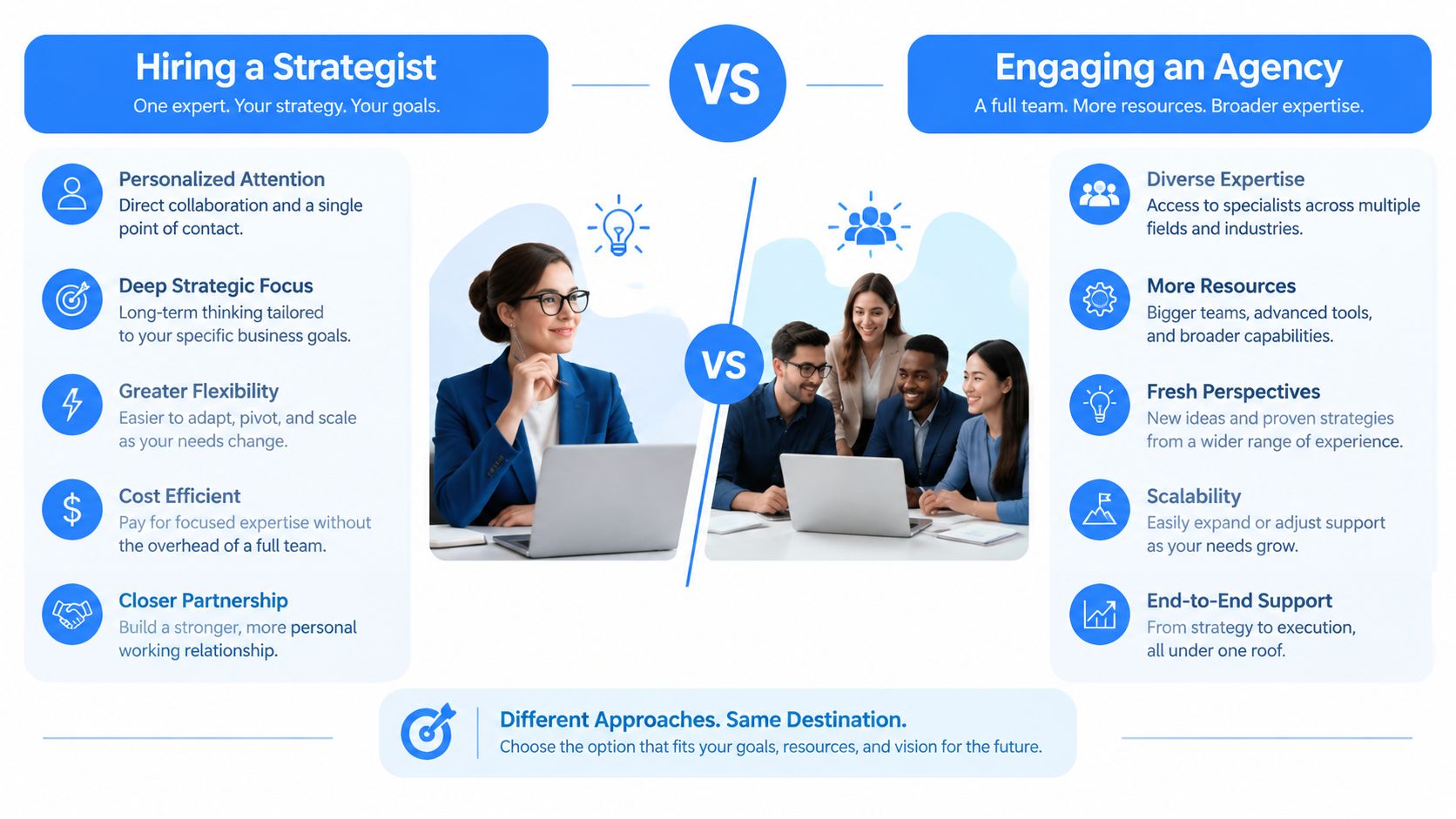
Choose based on the operating condition
| Decision factor | In-house strategist | Specialist agency |
|---|---|---|
| Control | High, with direct access to internal decisions | Shared, requiring clear client-side ownership |
| Speed | Slower while the person learns the business | Faster because systems and specialists already exist |
| Expertise | Deepens around your market over time | Broader pattern recognition across accounts |
| Management | Requires coaching, tools, and cross-functional support | Requires briefing, review, and governance |
| Risk | A poor hire can stall the motion | A poor partner can produce generic activity or weak-fit leads |
My recommendation is straightforward:
- Pre-seed companies with fewer than 10 customers: Use a fractional strategist. You're still validating the ICP, so a full-time specialist may lock in assumptions too early.
- Teams between $1 million and $5 million in annual recurring revenue with a stable ICP: Hire in-house. You need institutional knowledge, fast feedback from sales, and ownership that compounds.
- Companies without outbound DNA: Start with an agency for 90 days, with a written transfer plan. Learn what works before deciding whether the capability belongs inside.
- Enterprise teams: Use a hybrid model. Keep strategy, data governance, and decision rights internal while using specialist capacity for research, infrastructure, or campaign execution.
If you're considering outsourced execution, compare the operating model in a lead generation agency against the role you expect an internal strategist to perform. Don't buy a retainer without defining who owns the ICP, data, approval process, replies, CRM hygiene, and weekly decisions.
A bad hire costs more than salary. It consumes leadership time, creates false confidence in weak channels, and leaves the company with undocumented assumptions. An agency becomes the smarter move when you need speed, lack technical outbound experience, or want to test a market before committing to headcount. It becomes the wrong move when the partner refuses to expose methodology, hides performance behind activity reports, or keeps the customer relationship outside your CRM.
The decision tree is simple. If you have a stable market and enough internal sales feedback, hire. If you have uncertainty, limited capacity, or no outbound operating experience, buy a defined engagement first. If the channel proves strategically important, bring the core decision-making capability inside.
Sample Deliverables From an Outbound Strategist
Don't evaluate a strategist by the polish of a pitch deck. Evaluate the artifacts they leave behind. A good deliverable lets another competent person understand the decision, execute the next step, and measure whether the assumption survived contact with the market.
The ICP document
The ICP should be concise enough to use during account selection. It should define firmographic criteria, relevant technologies, buyer roles, trigger events, disqualifiers, and account tiers. It should also include a validation list of 50 target accounts, with a short reason each account belongs in its tier.
The quality test is practical. Ask a salesperson to select accounts from the document without asking the strategist for clarification. If the salesperson produces a different interpretation, the document is descriptive rather than operational.
The sequence playbook
A sequence playbook should show the logic behind four to seven touches across email, LinkedIn, and phone. It needs branching paths for positive replies, objections, referrals to another stakeholder, no response, and disqualification.
Look for specific hypotheses. For example, the strategist might test whether a role-specific pain message outperforms a category-level claim, or whether a proof point works better before the call to action. Weak playbooks contain generic templates, artificial personalization, and no explanation of what the team will learn.
The deliverability report
The report should document SPF, DKIM, and DMARC checks, sender reputation, bounce rate, and inbox placement across Gmail, Outlook, and corporate domains. The brief calls for a bounce rate under 3% as a quality threshold, but that figure is an internal acceptance criterion here, not a universal market benchmark.
The strategist should explain what changed, why it changed, and what the team should monitor next. A report that displays green status indicators without connecting technical health to campaign exposure isn't useful.
The quarterly pipeline review
The quarterly review should connect account engagement to business outcomes. Include sourced pipeline, conversion rates, account engagement scoring, sales feedback, objections, segment performance, and a prioritized roadmap for the next 90 days.
The review should answer four questions:
- What worked: Which account tiers, offers, roles, and channels created useful conversations?
- What failed: Where did fit, message, deliverability, qualification, or sales follow-up break?
- What changed: Which assumptions should the team keep, revise, or remove?
- What happens next: Which tests receive priority, who owns them, and what evidence will determine the next decision?
A strategist who delivers documents but can't defend the choices behind them isn't providing strategy. They're producing collateral.
Hiring and Briefing Checklist for B2B Leaders
Write the brief before you interview candidates. Otherwise, the most articulate applicant will define the role for you, usually around the work they already know how to sell.
Must-haves
- Pipeline ownership: The candidate can name the pipeline outcomes they owned and explain the levers behind them.
- Sequence fluency: They can walk through channel order, personalization depth, reply branches, objection handling, and testing logic.
- Deliverability competence: They understand authentication, list hygiene, sender reputation, bounce control, and inbox placement.
- ICP judgment: They can defend an ICP in 15 minutes, including exclusions and the evidence behind account prioritization.
- Revenue systems comfort: They can work inside a CRM, interpret intent data, define routing rules, and document sales handoffs.
Useful additions
Category design experience helps when the market doesn't yet understand the problem. Sales-adjacent technical fluency helps the strategist translate product complexity into buyer language. Content positioning skills are valuable when buyers self-educate, while light revenue operations ability makes reporting and process documentation more durable.
The candidate doesn't need to be the best copywriter, data engineer, and salesperson in the company. They do need enough fluency to brief each specialist, inspect the work, and connect the outputs.
Red flags
- No named numbers: They discuss “strong performance” without explaining what they measured or how pipeline was attributed.
- Vague mechanics: They can't explain how a sequence branches after a reply or how they diagnose deliverability.
- Brand-only language: They focus on visibility, awareness, and assets while avoiding account quality and sales conversion.
- Tool worship: They list platforms but can't explain the commercial decision each platform supports.
- Blame shifting: They criticise sales, data, or internal teams without showing how they established shared operating rules.
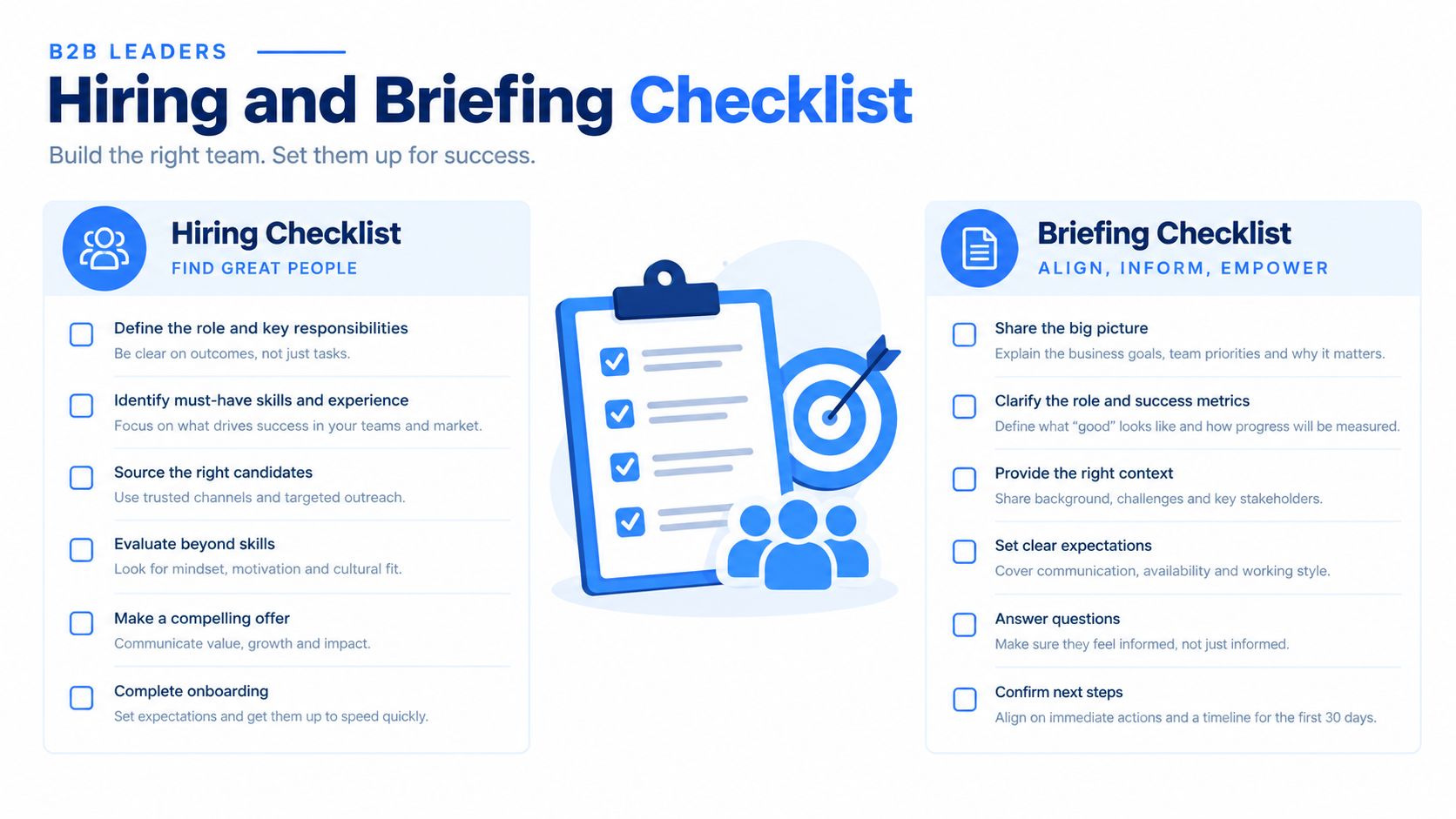
The briefing template
Copy these questions into your hiring document:
- What pipeline and revenue outcome must this role influence?
- Which customer segments, industries, geographies, and account types are excluded?
- Which KPIs will determine success, and which metrics will not count?
- What tools are already in place for CRM, data enrichment, sequencing, analytics, and reporting?
- What specific pain does the target buyer acknowledge today?
- Which competitors, alternatives, internal workarounds, or status quo options will the message address?
- What happens when a prospect replies, and who owns qualification and follow-up?
- What will the strategist report weekly, monthly, and quarterly?
- Which decisions can the strategist make independently, and which require executive approval?
- What evidence must exist at the 90-day review checkpoint to continue, change, or end the engagement?
Use the answers to compare a person with an outsourced lead generation partner on equal terms. Require access to campaign data, clear ownership of prospect records, documented messaging decisions, and a defined handoff into your CRM. The right choice is the one that gives your company a functioning pipeline system, not merely more activity.
Lead Printer provides outsourced B2B outbound execution across prospect research, data enrichment, email and LinkedIn campaigns, qualification, CRM handoff, and reporting. If you need an execution partner while you validate your strategist hire or build internal capability, visit Lead Printer to discuss a defined outbound engagement.