Your pipeline has stalled, but nobody agrees why. Sales development reps are exhausted from chasing weak accounts, marketing keeps delivering MQLs that never become opportunities, and qualified meetings have stayed flat for two quarters. Leadership responds by asking for more activity, when the problem is usually operational: the team lacks a dependable system for finding the right buyers, reaching their inboxes, and deciding which conversations deserve sales time.
That's the role a lead generation agency is supposed to fill. The right partner doesn't sell a magic list or promise that volume automatically becomes revenue. It builds and operates a prospecting system around your ideal customer profile, outreach infrastructure, messaging, qualification rules, and CRM handoff.
The decision is a build-versus-buy decision. You can build the data, tooling, deliverability expertise, copy, and management capability internally, or you can buy access to an operating team that already does that work. Either choice can work. The expensive mistake is buying an agency before your sales motion is ready, or hiring internally before you know what process you need.
What a Lead Generation Agency Actually Does
A lead generation agency is a third-party operator that identifies potential customers, contacts them across relevant channels, qualifies their interest, and passes suitable conversations to your sales team. The work usually includes audience research, prospect data, campaign messaging, email or LinkedIn outreach, appointment setting, lead scoring, and reporting.
The core mandate is straightforward: create a steady flow of vetted prospects into the top and middle of the funnel. That means the agency should help your closers spend more time with plausible buyers and less time searching for them. It may also manage follow-up, respond to prospects, and coordinate the handoff inside your CRM.
That definition matters because agencies often oversell their role. A vendor can create access to buyers and improve the front half of the sales process. It can't close deals for a sales team that lacks discovery discipline, and it can't repair an offer that buyers don't understand.
What the agency owns
A credible partner typically owns several connected activities:
- Audience definition: It documents the companies, roles, locations, triggers, and business conditions that make an account worth pursuing.
- Prospect research: It finds and enriches contacts instead of handing over an unverified spreadsheet.
- Campaign execution: It runs email, LinkedIn, phone, paid, or other selected channels according to the sales motion.
- Qualification: It checks whether a response matches your ICP and whether there's enough interest or context for a sales conversation.
- Handoff and feedback: It routes the opportunity to the right rep and uses sales feedback to refine targeting and messaging.
The engagement should be treated as an operating system, not a one-off campaign. Campaigns need enough time to establish a baseline, identify weak segments, test positioning, and feed sales outcomes back into the next iteration. A three-to-six-month minimum is common in the market, but a longer contract doesn't make a weak process good. It only gives a weak process more time to consume budget.
Practical rule: Judge the agency by the quality of conversations your sales team can progress, not by the number of contacts uploaded into a dashboard.
A lead generation agency isn't a closing team, a substitute for product-market fit, or a guaranteed-revenue vendor. It can improve the mechanics around demand creation, but your company still owns the offer, pricing, sales follow-up, and customer experience. The rest of this guide focuses on the operating layers that determine whether outsourced prospecting pays back.
The Three Building Blocks of Outsourced Lead Generation
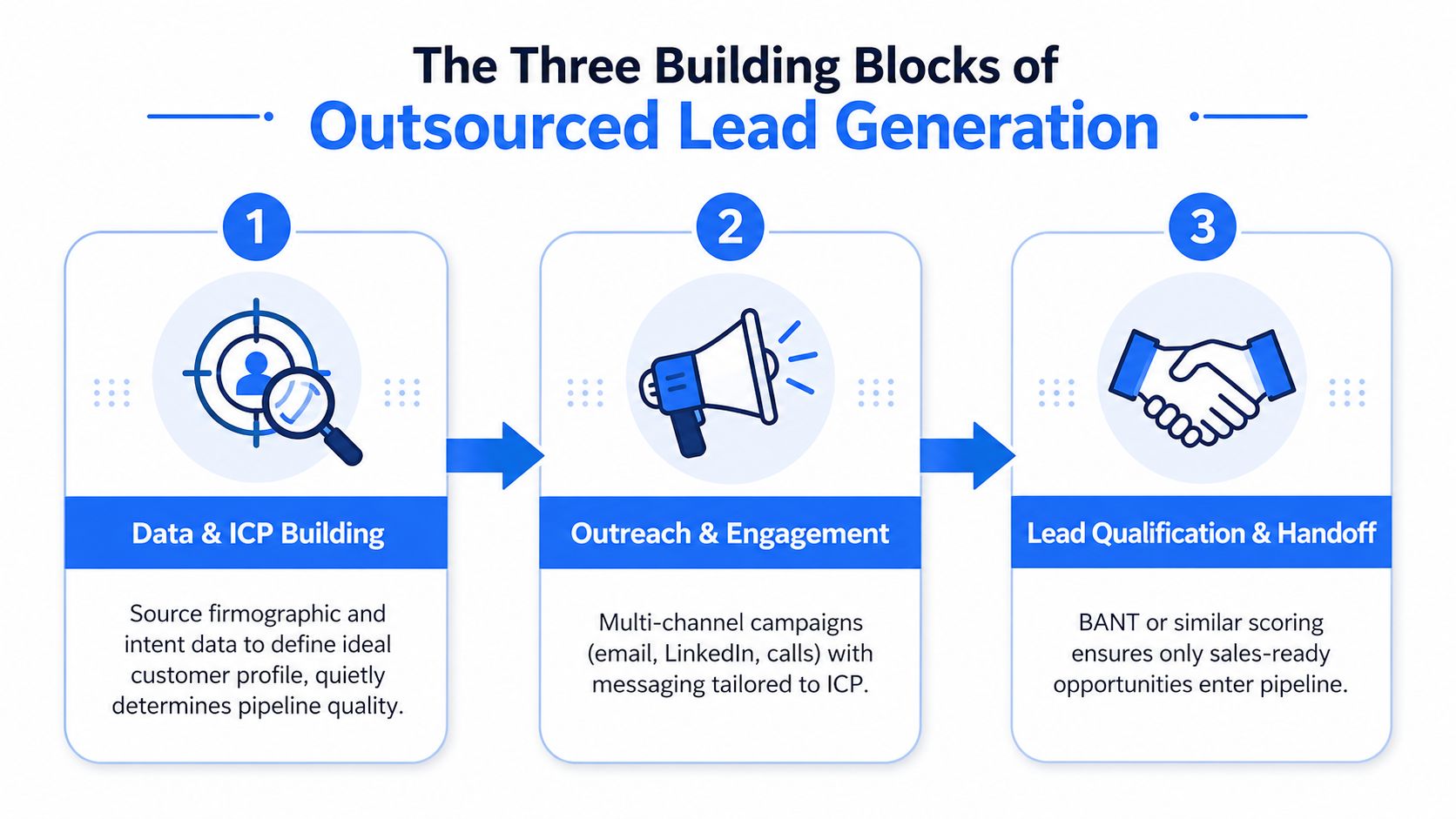
Outsourced lead generation has three essential layers: data and ICP building, outreach execution, and qualification with handoff. Strong agencies connect them tightly. Weak agencies sell one layer, usually outreach volume, while leaving the client to absorb failures in the other two.
Data and ICP building
The agency should pressure-test your ideal customer profile against actual sales evidence, not copy a sentence from your website. That means reviewing closed-won and lost accounts, mapping the buyer committee, identifying firmographic boundaries, and separating useful intent signals from assumptions.
Data quality sets the ceiling for everything that follows. An outdated role, irrelevant company, or badly matched geography creates wasted touches before copy has a chance to work. A good partner should explain where prospect data comes from, how it's verified, how records are enriched, and which contacts are deliberately excluded.
Outreach and engagement
Execution may include cold email, LinkedIn steps, calling, retargeting, or a coordinated sequence across several channels. The channel mix should follow buyer behavior and compliance requirements, not the agency's favorite tool.
Technical execution is just as important as copy. Cold-email programs should generally keep inbox placement above 90% to 95%, bounce rate below 2%, and spam complaints below 0.1%, according to cold-email deliverability benchmarks. If the agency can't show how it monitors domain reputation, authentication, list hygiene, and sending volume, it's asking you to trust the most fragile part of the system blindly.
Qualification and handoff
The final layer determines whether sales trusts the channel. The agency might use BANT, MEDDIC-style scoring, or a custom framework built around your buying process. It should capture the prospect's role, business context, stated need, timing, and next step, then route that information through your CRM.
Bad data poisons outreach. Weak outreach wastes good data. Sloppy qualification poisons both by filling your calendar with conversations that never belonged there. That's why an agency is only as strong as its weakest layer.
Realistic ROI Numbers and Cost Per Lead
Start with the economics your agency may avoid discussing. The 2026 benchmark cited a median B2B cost per lead of $213, up from $198 in 2025, with a wide performance gap between the top and bottom quartiles. The same benchmark placed the top quartile at $84, the bottom quartile at $397, and average lead-to-customer conversion at 0.94%, or roughly one closed-won customer for every 106 captured leads. See the 2026 B2B lead-generation benchmark for the underlying figures.
Those numbers aren't a quote for your campaign. They're a warning against evaluating a vendor on CPL alone. A cheap lead from a low-intent segment can cost less and produce less revenue than a narrowly targeted lead that sales can progress.
| Pricing Model | Typical Cost Per Lead | Lead-to-Meeting Rate | Assumed ROI Risk |
|---|---|---|---|
| Pay per lead | Varies by source and qualification depth | Often unclear unless defined contractually | High, because volume can replace buying intent |
| Pay per meeting | Higher effective cost when meetings are genuinely qualified | Depends on attendance and ICP fit | Medium to high, especially with weak no-show rules |
| Monthly retainer | Depends on scope, market, and channel mix | Should be reported from lead through opportunity | Medium, with better control when data and assets remain transparent |
Run the math from revenue backward. If your average contract value is $25,000 and your qualified opportunity close rate is 20%, each qualified opportunity has an expected revenue contribution of $5,000 before delivery costs, retention, and sales expense. If an agency produces meetings but few become qualified opportunities, the meeting count is irrelevant. If it produces qualified opportunities that your team can't follow up quickly, the agency still won't create payback.
Separate a guaranteed lead floor from revenue contribution. A guarantee may specify a number of leads, but it doesn't guarantee fit, attendance, opportunity creation, or closed-won revenue. Before signing, ask for the conversion assumptions between captured lead, meeting, sales-qualified opportunity, and customer. If the agency won't show those assumptions, build your own conservative model and price the risk into the decision.
When Outsourcing Lead Generation Makes Sense
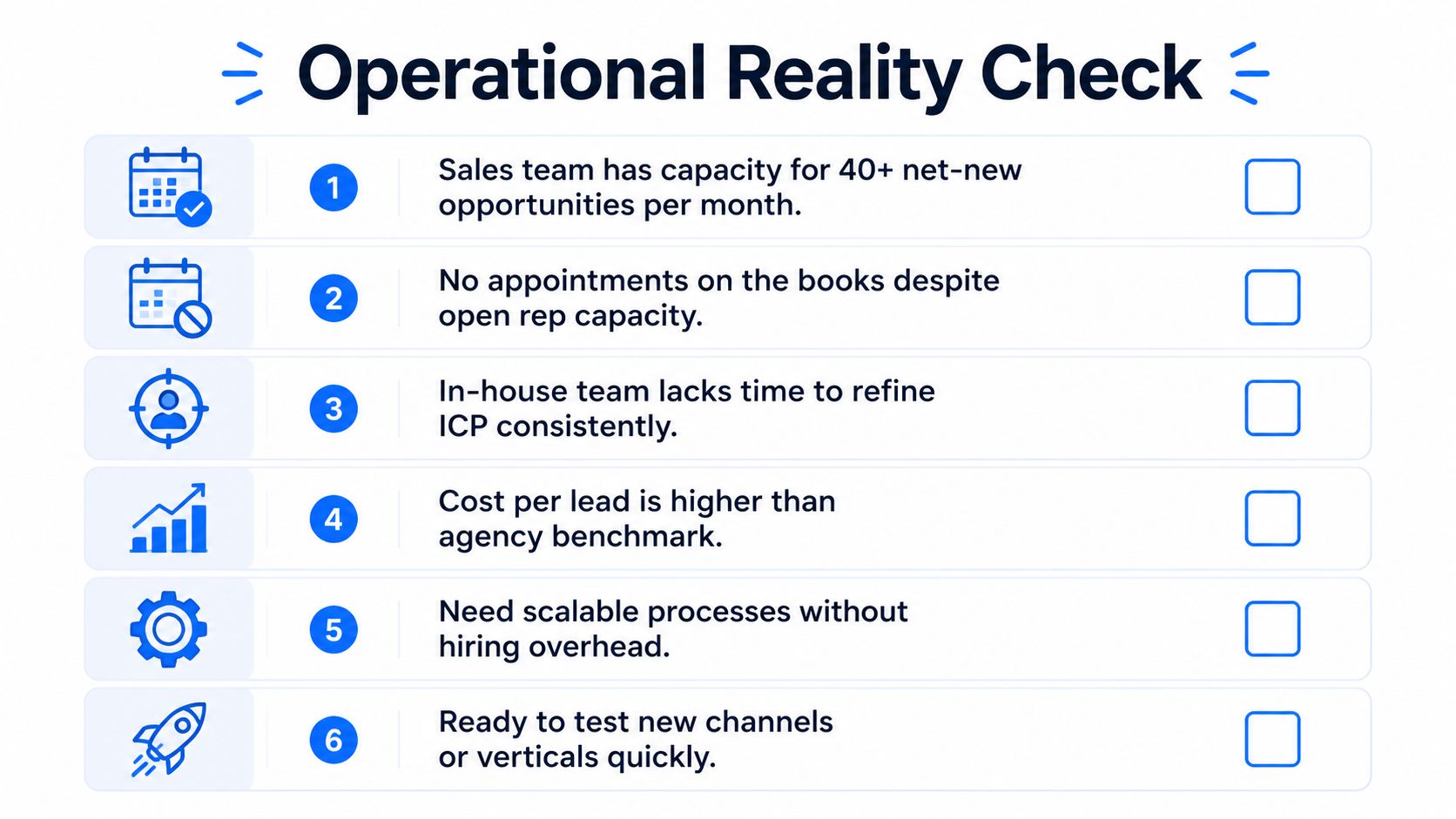
Outsourcing makes sense when your sales team has a working motion but lacks the capacity or infrastructure to keep prospecting consistent. It doesn't make sense because leadership wants growth faster.
Use three tests.
First, check sales capacity. If your team can absorb 40 or more net-new opportunities per month but has no appointments scheduled for the next 60 days, an outsourced partner may solve a real bottleneck. Those thresholds are operating criteria, not universal benchmarks. The point is to confirm that sales can work the output before you buy it.
Second, check conversion economics. Adding 10 qualified meetings per month only matters if your team can turn some into opportunities and customers. A strong close rate and clear follow-up process make outsourced volume valuable. A weak discovery process turns additional meetings into additional calendar noise.
Third, check budget and commitment. Plan for at least $8,000 to $15,000 per month and a six-month commitment if you're buying a managed program, as outlined in the operational brief for this decision. Don't allocate that budget before deciding who owns qualification, CRM hygiene, sales follow-up, and campaign learning.
Outsourcing breaks down in predictable situations:
- Founder-led discovery: The founder is still responsible for every discovery call and can't absorb additional meetings.
- Missing CRM process: There's nowhere reliable to route leads, record outcomes, or return feedback.
- Unclear positioning: The agency is expected to discover the company's value proposition through random outreach.
- Unworkable offer: Prospects may be interested, but pricing, packaging, or implementation creates immediate friction.
- No ownership after handoff: Sales treats the agency's meetings as someone else's problem.
A useful outsourced lead generation operating model should extend a functioning sales motion. It shouldn't be the first step in inventing one.
This video can help your team think through the outsourcing decision from an execution perspective.
Case Studies That Show What Good Looks Like
A useful case study lets a salesperson verify the result. It names the starting condition, the intervention, the audience, the period, and the outcome that matters after handoff.
Consider the difference between a SaaS company that moved from three outbound demos per month to 28 in 90 days after rebuilding its ICP and replacing purchased lists with intent signals, and an agency promising 500 leads without showing connection data or opportunity creation. The first example explains what changed. The second only describes inventory.
Another strong proof point comes from a manufacturing supplier that doubled SQL-to-opportunity conversion after introducing lead scoring and routing rules before increasing volume. That result points to a less glamorous truth: qualification architecture can create more value than additional contacts.
| Dimension | Verified Campaign | Agency Promise |
|---|---|---|
| Starting point | States the existing meeting or conversion problem | May omit the baseline |
| Intervention | Names ICP changes, intent data, scoring, or routing | Often says “multichannel outreach” |
| Measurement | Tracks demos, SQLs, opportunities, or revenue movement | Focuses on contacts or leads delivered |
| Sales verification | Lets the client inspect CRM outcomes | May rely on a vendor dashboard |
| Transferable lesson | Shows which operating decision improved quality | Provides little guidance beyond buying volume |
Ask case-study references questions the marketing page can't answer. Which accounts were excluded? How did the sales team define a qualified opportunity? What happened to no-shows, duplicate accounts, and positive replies that weren't ready to meet? Did the agency report sourced pipeline separately from influenced pipeline?
The strongest evidence usually looks boring. It contains a before state, a defined intervention, and an outcome your revenue team can inspect. A large lead total without qualification criteria is not proof of pipeline performance.
The Deliverability and Qualification Problem
A large agency isn't automatically a safer agency. Scale can mean more experience, but it can also mean more sending domains, more clients sharing operational patterns, and more pressure to increase volume. Deliverability depends on the specific infrastructure protecting your campaigns, not the size of the logo on the proposal.
A 2025 study reported a 69% year-over-year decline in results for respondents, while another benchmark found overall delivery near 98% but inbox placement at only 83.1%, demonstrating that delivered messages aren't necessarily visible in the inbox. These figures appear in the state of cold email research, and they expose the difference between transport success and buyer reach.
What to demand technically
Ask the agency to show how it monitors:
- Inbox placement: Not merely sent or delivered status.
- Domain reputation: Including safeguards for sending identities and client separation.
- Authentication alignment: SPF, DKIM, and DMARC implementation.
- Bounce control: Verification, suppression, and handling of invalid records.
- Complaint signals: Processes for stopping campaigns before reputation deteriorates.
- Sequence pressure: Limits on volume, follow-up frequency, and audience saturation.
Teams that need a practical implementation reference can review this guide on how to warm up an email domain. The agency should also explain what happens when placement falls below its operating threshold.
Qualification creates the second failure point. A prospect may reply positively but lack authority, urgency, budget alignment, or a problem your product solves. The sales team needs explicit rules for deciding whether that person enters the pipeline, and resources such as Pipecorn's guide to qualify leads more effectively can help formalize those rules.
Bigger outreach volume can't compensate for poor inbox reach or weak qualification. It only multiplies the waste.
The practical standard is simple: low enough volume to protect reputation, precise targeting, relevant replies, and a handoff that gives the closer a reason to continue the conversation.
How to Evaluate and Compare Lead Generation Vendors
Replace “proven results” with a scorecard. Compare three or four finalists using the same questions, the same qualification definition, and the same reporting requirements. A vendor that refuses to answer technical questions before the contract won't become transparent after signing.
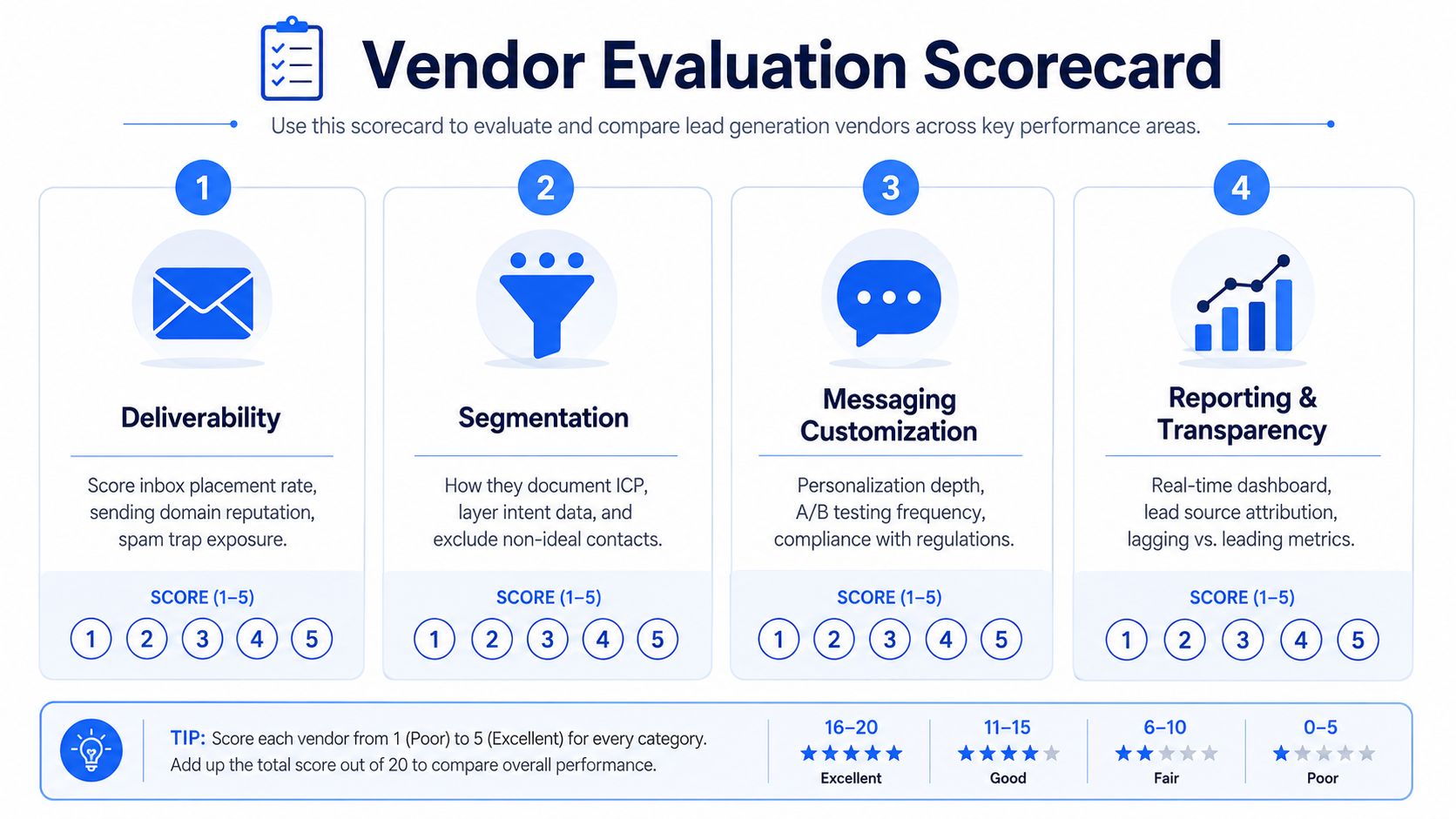
Deliverability
Request inbox placement reporting, sending-domain reputation controls, authentication ownership, bounce trends, spam complaint handling, and evidence of suppression processes. Ask whether the reported figure reflects inbox placement or only delivery. The distinction should be explicit.
Segmentation
The agency should document your ICP in operational terms. Ask how it layers firmographic data with intent, how it handles buying committees, which roles are excluded, and how often the list is refreshed. A redacted sample lead list will reveal more than a polished presentation.
Qualification
Ask whether SDRs, automation, or AI handles discovery and scoring. Demand the exact conditions for a qualified lead, booked meeting, sales-qualified opportunity, replacement meeting, and no-show. If your sales team uses a different definition, fix that before launch. A detailed lead qualification framework can help your team establish shared language.
Reporting and transparency
The weekly report should connect activity to pipeline. It should show lead source, positive replies, meetings, attendance, sales acceptance, opportunity creation, and sourced pipeline where available. Don't accept a dashboard that celebrates lead count while hiding what happened after handoff.
For SaaS buyers comparing broader demand-generation models, this SaaS demand generation agency guide provides useful context on how different providers position their services. Use it as market orientation, not as a substitute for vendor-specific diligence.
Exit terms
Protect your operating assets. The contract should address:
- Data portability: Your prospect data and enrichment should be exportable.
- Suppression ownership: Your exclusions and opt-outs must remain available to your team.
- Campaign assets: You should receive approved copy, segmentation logic, and performance history.
- CRM records: Handoff data belongs in your system, not only the agency's platform.
- Account ownership: Define who controls relationships and future outreach.
- Termination: Clarify notice periods, refunds, replacement rules, and any account restrictions.
Before negotiation, request two named references from current clients, a redacted delivered-lead sample, and a real weekly report. Those materials expose whether the vendor measures pipeline or merely activity.
Making the Hire With Confidence
Choose the agency that can make your sales team more productive, not the one that promises the largest contact count. A thousand contacts that never reach the inbox or don't match your ICP have no commercial value. The relevant outcome is a qualified conversation that progresses under your sales process.
The build-versus-buy decision becomes clearer when you ask three questions:
- Can sales absorb a consistent flow of sales-ready conversations?
- Do you lack the data, copy, infrastructure, or campaign management to create them internally?
- Will your CRM capture the learning if the agency leaves?
If the answer is yes across the board, a focused outsourced engagement can be more practical than hiring two SDRs and a RevOps contractor before your process is proven. If the answer is no, fix the internal constraint first. An agency can't make an unavailable sales team responsive.
Run a controlled pilot
Start with a 60-to-90-day pilot, one defined market, one fixed ICP, a bounded account set, and one primary success metric. Choose qualified meetings booked or sales-qualified opportunities created, then define those terms in writing. Don't let the vendor change the measurement halfway through the test.
Your pilot checklist should include:
- Deliverability monitoring: Confirm that inbox placement, bounce rate, complaint signals, and domain reputation are reviewed.
- Qualification rules: Match the agency's criteria to your sales team's acceptance criteria.
- CRM ownership: Store contacts, conversations, outcomes, and source data in your system.
- Sales response time: Assign an owner for every accepted meeting and positive reply.
- Feedback cadence: Review disqualified accounts and objections with the agency regularly.
- Asset handoff: Require campaign copy, segments, learnings, and suppression records at exit.
Lead Printer is one option for teams that want an outsourced B2B outbound process covering email infrastructure, prospect research, data enrichment, personalized messaging, multichannel outreach, qualification, and CRM handoff across the US, UK, and EU. Evaluate it by the same standards as every other vendor: inbox reach, ICP fit, qualification quality, reporting, and pipeline contribution.
Make the decision this week by documenting your ICP, defining a qualified opportunity, auditing your CRM handoff, and asking finalists for deliverability evidence and a sample report. Then invite the vendor that passes those tests into a controlled pilot, with your data and campaign assets staying inside your systems.
Lead Printer builds and runs data-driven email and multichannel campaigns designed to create qualified sales opportunities, including infrastructure setup, prospect research, personalized outreach, qualification, and reporting. Visit Lead Printer to discuss a focused outbound pilot for your target market and sales capacity.