Your report says the campaign worked. Sales says it didn't. Marketing counted replies, sales counted real conversations, and both teams are looking at the same list and seeing different things.
That gap is where qualified lead generation either works or breaks down. It's not about finding more names. It's about agreeing, in advance and in writing, what evidence a lead must show before sales will accept it.
What Makes a Lead Qualified, Not Just Interested
Take a hypothetical SaaS team. Its campaign produces 300 replies in a month, sales books only six calls, and none of those calls moves forward. Nothing failed in the sending. The problem is simpler. Every reply was counted as a lead, so curiosity and buying intent were treated as the same thing.
The difference shows up clearly at a trade show. One person stops, takes a brochure, and walks on. Another asks for a quote, names the problem they're trying to solve, and mentions a budget line. The first person is interested. The second is closer to qualified.
Why a Job Title Is Not Enough
Buying doesn't move in a straight line. Gartner's work on the four recurring B2B buying jobs identifies problem identification, solution exploration, requirements building, and supplier selection, and buyers often revisit one or more of those jobs before choosing a provider.
Buyers also gather information across digital channels and conversations with people as they work through those jobs, so a person can match your target role perfectly and still be at the very first job, just naming a problem they haven't decided to fix.
Labels make this harder. Marketing might call that person a qualified lead while sales sees someone who hasn't started a project. If you're sorting out how marketing and sales stages relate, it helps to start with understanding MQL and SQL frameworks, then map those labels to evidence your own sales team will trust.
The Four Stages a Lead Passes Through
The process needs four plain stages. They're a ladder, and a lead has to earn each step.
| Stage | What it means | Evidence required | Owner |
|---|---|---|---|
| Interested contact | Replied or booked a call out of curiosity | Positive reply with no named problem | Lead generation team |
| Discovery-ready lead | Has a named business problem, a relevant solution category and reachable access | Problem stated, timing known, contact can reach a decision | Lead generation team with SDR |
| Sales-accepted opportunity | Client sales team accepts it under agreed rules | Acceptance checklist passed and next step agreed | Sales team |
| Forecastable opportunity | Budget owner, stakeholders and timeline are confirmed | Budget owner identified, stakeholders mapped, dated next step | Sales and revenue operations |
Read the ladder from bottom to top and you'll see why reply counts mislead. An interested contact gives you a conversation starter. A forecastable opportunity gives revenue operations something it can plan around, because someone has confirmed money, people, and dates.
Rule to write down: A lead is qualified only when it reaches a stage the client's sales team has agreed to accept, and that agreement exists before the campaign launches.
Without that written agreement, you'll argue about quality after the leads arrive. With it, every lead gets checked against the same standard, and the argument about what counts happens once, in writing, instead of after every campaign.
Qualification Criteria to Score Each Lead
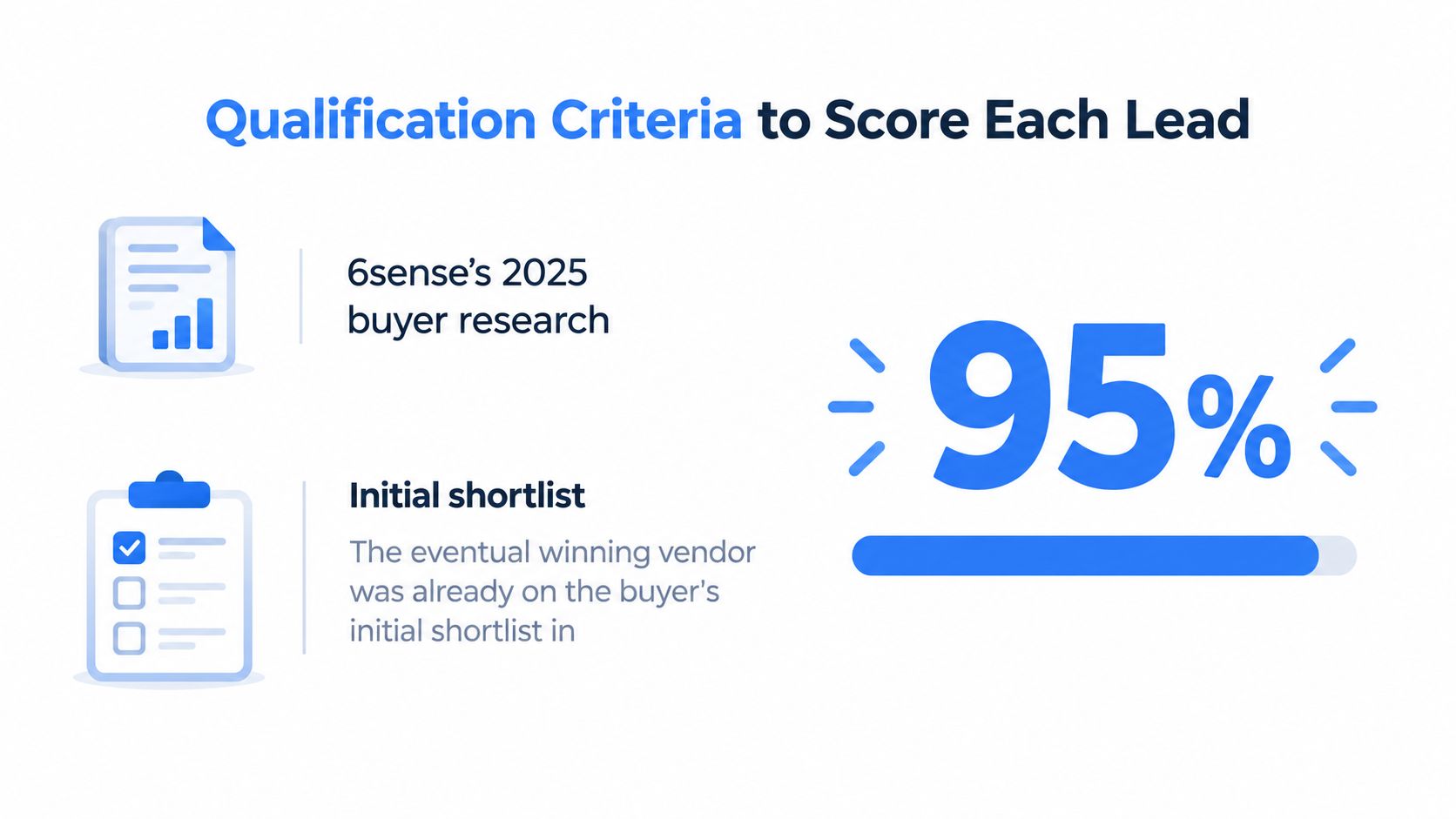
Here's a surprising finding. In 6sense's 2025 buyer research, the eventual winning vendor was already on the buyer's initial shortlist in 95% of purchases, and buyers contacted vendors only after roughly 61% of the journey had passed, as summarized in coverage of 6sense's 2025 buyer research.
That changes what a positive reply means. A buyer may answer you politely while their shortlist is already set. So a reply isn't proof of qualification. It's an invitation to check for evidence.
The graphic below puts that shortlist finding in one place, because it's the number worth remembering when you score a lead.
Six Checks, Each With a Passing Signal and a Red Flag
| Criterion | Passing evidence | Red flag | Rule |
|---|---|---|---|
| Business problem | Prospect names a pain the solution addresses | 'Just exploring' with no problem named | Must-have |
| Timing | Active project, budget cycle or review date within the next two quarters | No project and no review date | Must-have |
| Permission | Lawful basis, source and opt-out status recorded | No recorded source or basis | Must-have |
| Access to the decision | Contact owns or influences the decision | Gatekeeper with no route to a decision-maker | Strong signal |
| Hidden buyers | Finance, procurement, legal, operations or security identified | One contact drives every step with no stakeholder map | Strong signal |
| Active comparison | Evaluating vendors or building a shortlist | Competitor research with no buying process | Strong signal |
The row teams skip most often is hidden buyers. Finance, procurement, legal, operations, and security can stop a deal without ever answering an email. Your contact may love the product, but if security has to approve it and no one has named that person, the lead record is incomplete.
Log the Negative Signals Too
A good record captures what's missing, not just what's present. Log no active project, no budget owner, generic curiosity, and inability to involve stakeholders as reasons a lead stays at the interested stage.
Some teams score people from social profiles in the same structured way, and Instagram API profile qualification is a useful reference for how a profile check can be documented as explicit fields rather than a gut feeling. The principle transfers. Each criterion should be a field someone can fill, check, and audit.
A lead goes to sales only when it passes every must-have and at least two strong signals. Every rejection carries a reason code.
That pass rule sounds strict. It's meant to be. It keeps volume from being mistaken for pipeline quality, and it gives you a clean way to learn. When rejections cluster around timing, your targeting is finding the right companies too early. When they cluster around access, you're reaching people who can't move a decision.
Permission Rules That Change What Counts as Qualified
A lead can pass the problem, timing, and access checks and still be unusable. If you reached the person without a lawful basis, sales shouldn't work that lead, and it shouldn't appear in your qualified count. Permission isn't paperwork after the fact. It's one of the criteria.
The rules differ by market, so the check has to happen per contact, not per campaign.
The Rules in Three Markets
- United States: CAN-SPAM covers commercial email. You need an accurate sender identity, a valid postal address, and a working opt-out that you honor promptly.
- United Kingdom: PECR governs electronic marketing. B2B email to corporate addresses is generally allowed with an opt-out, while UK GDPR applies whenever you process a named individual's personal data, so you record the source and purpose.
- European Union: GDPR legitimate interest isn't blanket permission. You need a documented assessment covering purpose, necessity, and balance against the recipient's reasonable expectations, plus a suppression list that holds across every tool you use.
A Simple Test Case
Take a contact in Germany pulled from a scraped list. The role is right, the company fits, and they reply with a real problem and a review date. But there's no legitimate interest assessment on file and no record of where the data came from.
That lead fails the permission check. Exclude it from qualified counts and client reporting, even though everything else looks perfect. Counting it would overstate pipeline and put both sender reputation and the client's brand at risk.
Two habits protect you here. Localize messaging for EU markets so relevance is clear and defensible, and keep suppression handling clean so an opt-out in one tool is honored everywhere. This is general information, not legal advice, so have counsel confirm your approach for each market before you scale.
Methods That Produce Qualified Opportunities
No channel qualifies a lead on its own. Each method gives you a different signal at the start, and each one has a blind spot you'll need to check some other way.
Methods Ordered by the Evidence They Carry
Targeted outbound email and LinkedIn come first in most programs, built from ideal customer profile filters like role, tech stack, headcount, geography, and industry. Lists often come from Sales Navigator, Google Maps, targeted websites, and national business registries. The signal is a role match. The blind spot is timing, because a perfect fit says nothing about whether they're buying now. If you're building lists around licensed roles, reviewing licensing data for workforce research helps you judge whether a source is documented well enough to support the permission check. Teams that run this as a structured program usually treat it as outbound lead generation built around a defined ICP rather than one broad send.
Trigger-based outreach ties your message to something that just changed, such as hiring for a role your product supports, a funding round, or a switch in the tools a company uses. The signal is timing. The risk is staleness, since a trigger from last quarter may already have produced a decision.
Webinars and events give you attendance and, more usefully, the questions people ask. A specific question often names the business problem for you. The blind spot is that many attendees came for the content, not to buy anything.
Inbound demo and content forms let prospects declare their own problem in their own words, which is strong evidence. They also attract students, job seekers, and competitors, so you still need the access and timing checks before sales sees them.
Referrals and partner introductions can hand you direct access to a decision-maker, which is hard to get any other way. Warmth isn't qualification, though. A referred lead can arrive friendly and still have no project.
Reactivating past opportunities starts with earlier stage evidence and old objections already on record. You know more on day one, but you must recheck timing and stakeholders, since both may have changed.
**How to choose:**Pick one primary method per segment and match it to the stage it can realistically reach. Don't ask a role-match method to produce forecastable opportunities.
How to Hand Off Leads Without Losing Intent
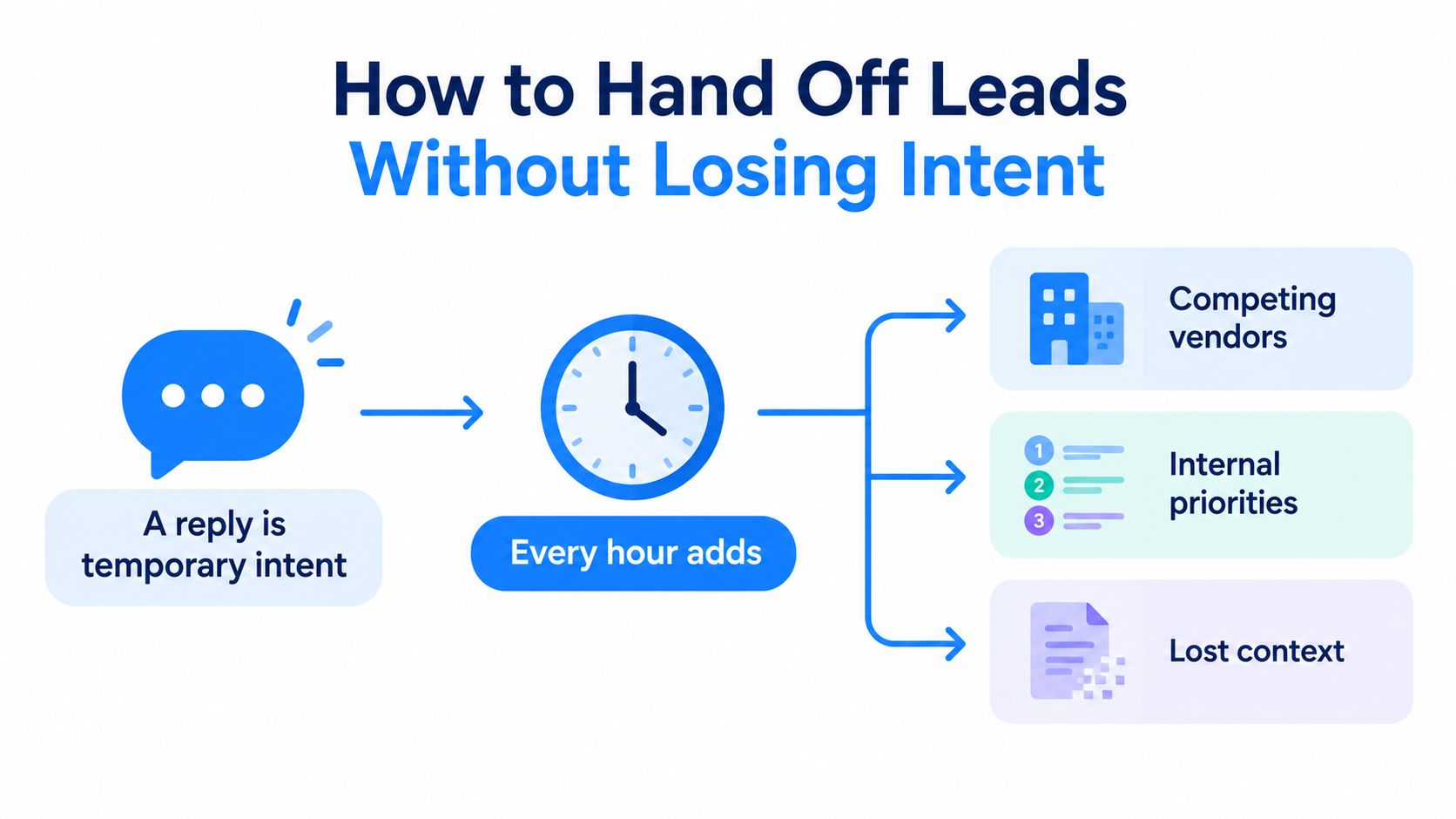
A prospect replies at 9:40 a.m. to say the timing finally looks right. By Friday her priorities have shifted, a competitor has called, and she half-remembers why she wrote back. A reply carries real intent, and intent works like a perishable good: it loses value the longer it sits unclaimed.
The diagram below shows that decay in plain terms, and it explains why handoff speed belongs inside your written qualification definition.
Seven Steps for a Clean Handoff
- Route the reply: Send each positive reply from the campaign inbox to a named owner within the same hour, so no lead sits unowned.
- Set a target by tier: Aim for a human reply under one hour for leads that passed every must-have criterion.
- Attach the evidence: Put the campaign, persona, original message, criteria passed, and signals logged on the CRM record, so sales can judge the lead against the agreed definition rather than a hunch.
- Reply to the pain: Write the first response around the specific problem the prospect named in the thread.
- Offer one next step: Give one concrete option with two or three time slots. At this stage, a disciplined process for setting sales appointments turns a reply into a calendar hold.
- Escalate misses: If the target is missed, escalate to the sales lead and log the delay.
- Require reason codes: When sales rejects a lead, capture why. Those codes are how you sharpen the written criteria instead of guessing.
What Each Response Window Costs
The figures below come from a 2011 Harvard Business Review audit of 2,241 U.S. companies, summarized in research on speed to lead and qualification odds.
| Response window | What the audit showed | Required action |
|---|---|---|
| Under 5 minutes | Response decay begins almost immediately; every slower band shows weaker qualification odds | Route automatically to a named owner |
| Under 1 hour | 37% of audited companies responded within an hour, and those firms were nearly 7x more likely to qualify the lead than companies that waited longer than an hour | Set as the default human response target |
| 1 to 24 hours | Qualification odds dropped steeply across this window; among audited companies that replied within 30 days, the average response time was 42 hours | Have the owner review the lead and send a second, specific touch |
| Over 24 hours | 23% of audited companies never responded; firms waiting 24 hours or longer were more than 60x less likely to qualify the lead than firms responding within one hour | Escalate to the sales lead and log the loss as caused by delay |
One caveat deserves attention. The audit tracked inbound web and form leads, so treat the figures as directional guidance when you set targets for outbound replies.
Even with that caveat, the lesson holds. Fit earns the reply, speed and one specific next step earn the conversation, and the handoff only counts when sales accepts the lead under the rules you agreed before launch.
Measuring Lead Quality and Pipeline Impact
Open rates, reply rates, and meetings can all look healthy while pipeline stays flat. If that sounds familiar, you're probably measuring activity and calling it quality.
Part of the problem is visibility. Buyers form shortlists privately, and AI tools, peer networks, review platforms, and private communities shape choices without leaving attribution signals, a pattern described in analysis of the invisible B2B buying journey. A buyer can research you for weeks, then appear in your CRM as if from nowhere.
Metrics From Activity to Pipeline
| Metric | What it counts | Blind spot |
|---|---|---|
| Replies | Positive and negative responses to outreach | Says nothing about fit, timing or budget |
| Meetings booked | Calendar holds made by the campaign | Does not show whether a real problem or budget exists |
| Sales-accepted opportunities | Leads the client's sales team accepts under agreed rules | Only meaningful if acceptance rules are written down |
| Campaign-sourced pipeline | Opportunities whose first contact came from the campaign | Misses buyers who researched privately first |
| Campaign-influenced pipeline | Accounts with campaign touches before an opportunity opened | Over-credits the campaign when other channels did the work |
| Recycled opportunities | Past deals reactivated by the campaign | Can double count pipeline already in the CRM |
| Holdout cohort comparison | Pipeline in qualified accounts versus matched accounts without outreach | Needs careful account matching and a long enough window |
Read the table as a ladder. Replies sit at the top and tell you the least. The holdout comparison sits at the bottom and tells you the most, because it asks whether outreach added pipeline compared with similar accounts you didn't touch.
A Three Layer Measurement Model
- Campaign-sourced pipeline: The first contact came from outreach, so the campaign can claim the opportunity's origin.
- Campaign-influenced pipeline: The account was touched before an opportunity opened, so the campaign contributed without being the sole cause.
- Recycled opportunities: Reported on their own line, so reactivated deals aren't counted as new pipeline.
Add one quality ratio across all three layers, sales-accepted opportunities divided by qualified leads. If that ratio falls, your criteria are drifting, no matter how good reply rates look. This is why reporting inside lead generation campaigns should separate sourced, influenced, and recycled pipeline rather than roll them into one number.
Finally, ask prospects how they first heard of the provider and record the answer on the opportunity. Self-reported attribution often catches the peer recommendation or community thread that tracking missed. It won't be perfect, but it's better than claiming one email caused every meeting.
Agree the Qualification Definition Before You Scale
You can put this in place in one month without changing your whole stack. The work is mostly agreement, not technology.
The Sequence to Run This Month
- Write the four stages: Sit with the sales lead, define each stage, and get written sign-off on what sales-accepted means.
- Choose the criteria: Settle on the six checks, the pass rule of every must-have plus at least two strong signals, and your rejection reason codes.
- Set response targets: Agree a human reply under one hour for leads that passed every must-have, and name who escalates when it's missed.
- Pick primary measures: Make sales-acceptance rate and campaign-sourced pipeline the main numbers, with replies kept as a secondary activity metric.
- Run a 30-day pilot: Use one segment and one channel, and keep a holdout account group where you can.
- Review every rejection: Check each rejected lead against its reason code and adjust the criteria before you expand.
The photo below captures what step one looks like in practice. Two people, one document, and a definition both sides sign.

Questions to Ask Any Provider Before Signing
Bring the same discipline to outside help. Before you sign with any provider, ask which of the four stages a guarantee counts toward, who decides acceptance, and how rejected leads are handled and reported.
Ask what permission evidence is recorded for each contact, and how pipeline contribution is measured against your holdout group. Get the answers in writing. A headline lead count means little until you know the acceptance rule behind it, and a provider who can answer these questions clearly is telling you something useful about how they work.
If you'd rather not build the infrastructure, targeting, and inbox management yourself, Lead Printer runs data driven email and multichannel outbound campaigns that deliver meeting-ready leads across the US, UK, and EU, with qualification and calendar handoff handled for your sales team. Visit Lead Printer to see how a pilot campaign could fill your pipeline with leads your sales team has agreed to accept.