Send more, personalize more, add another channel. That's the most popular advice for fixing outbound, and it often creates the problem it claims to solve. More touches to the wrong person, with a sharper first line, still leave finance, security, and operations unconvinced.
A good lead gen specialist doesn't optimize for a lonely meeting with the obvious job title. They build buying-group progress among people who'd often rather research alone first. If you judge the role by reply rate and booked calls, you'll get a busy calendar and thin pipeline. Judge it by qualified opportunities that sales can advance, and the job, the skills, and the hiring decision all change.
What a Lead Gen Specialist Actually Owns
A lead gen specialist owns the system that finds the right accounts, reaches the people who influence a purchase, and hands sales a conversation worth taking. They aren't the closer. They also aren't a generalist who runs the blog, events, and paid ads between cold emails.
That distinction matters because job posts blur four different jobs. Use the table before you write a job description or brief anyone.
Lead Gen Specialist Versus Nearby Roles
| Role | Primary job | Monthly output | Fits when |
|---|---|---|---|
| Lead gen specialist | Builds the acquisition system from ICP and data through qualified handoff | Targeted lists, live sequences, qualified opportunities | Outbound needs an owner, not only more dials |
| SDR or MDR | Works supplied leads into first conversations | Calls, replies, and booked meetings | Sales already has inbound or a maintained list |
| Demand-generation manager | Runs broader demand, including content, events, and paid | Campaign calendar, influenced pipeline, and MQLs | Marketing owns brand and inbound as well as outbound |
| Outbound agency | Operates data, infrastructure, and campaigns for the client | Meeting-ready leads without a new hire | The company needs volume, new markets, or no internal operator |
Notice what the specialist row includes that the SDR row doesn't. An SDR can work a list well and still fail if nobody owns list quality, sending infrastructure, segmentation, and the qualification bar. A demand-generation manager may own some of that, but their calendar is split across channels that don't start one-to-one conversations.
Titles Drift, Duties Don't
Employers advertise similar work as demand-generation specialist, growth marketer, SDR, marketing-development representative, or outbound specialist. Official labor statistics don't isolate the title, which is why you should judge the job by its duties.
The broader category is large. The Bureau of Labor Statistics profile for advertising, promotions, and marketing managers reported approximately 434,000 jobs in 2024, projected growth of 6% from 2024 to 2034, and approximately 36,400 openings expected annually during that decade. That doesn't prove demand for one exact title. It does show the marketing ecosystem that houses lead-acquisition work keeps hiring people who turn targeting and communication into sales opportunities.
Read a job post by outputs, not label. If the monthly output is only calls and meetings, you're hiring activity, not a system owner.
Before you go further, name which row matches the gap on your team. If you can't, you aren't ready to interview. You'll end up scoring a system builder on dials, or asking a dialer to invent your data and domain strategy.
How a Specialist Turns a Market into Meetings
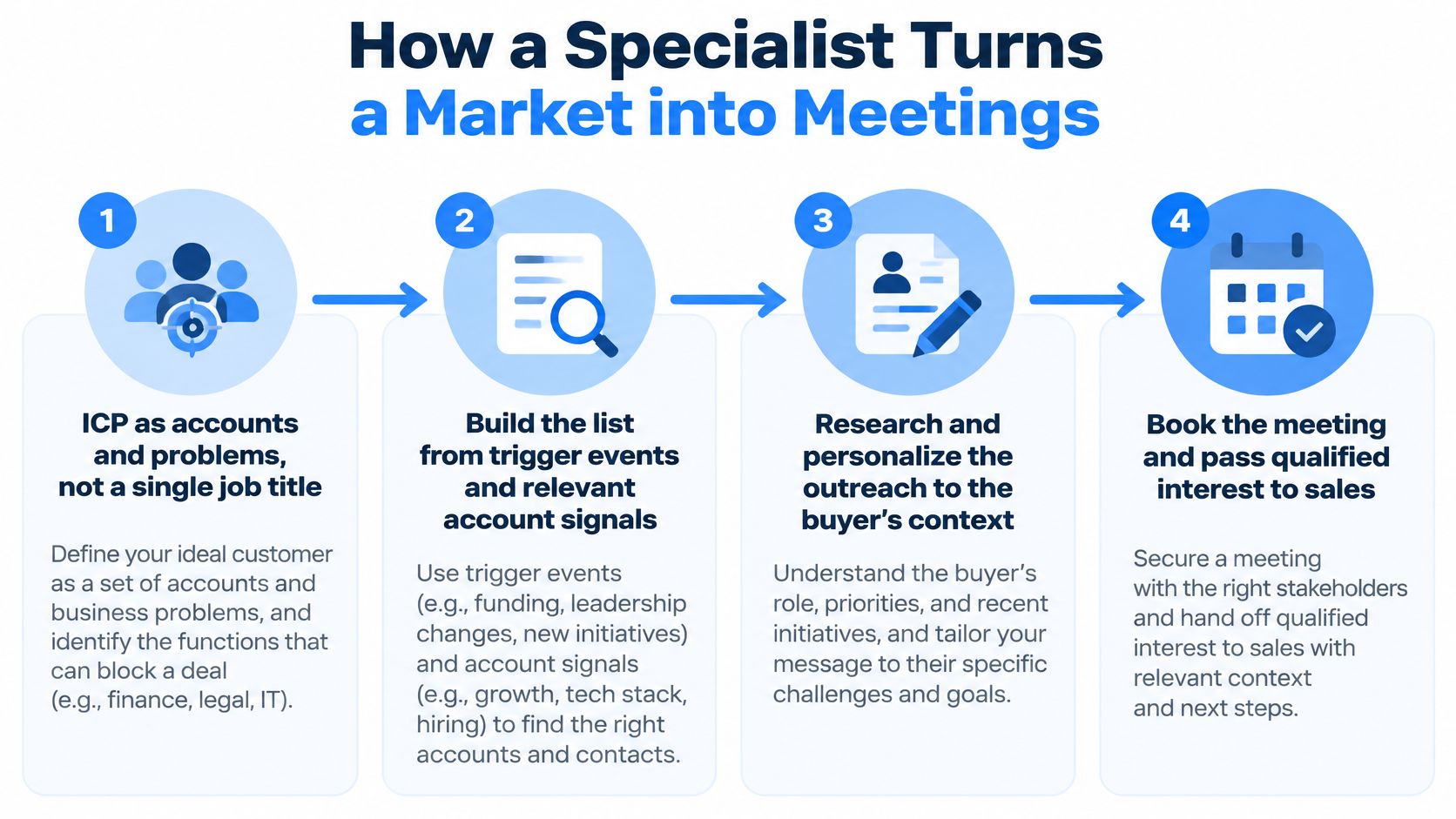
The operating loop below uses a simple example. Say a payments company sells to ecommerce operators who lose revenue to checkout failures and spend hours reconciling transactions. The specialist's job isn't to pitch faster. It's to move the right account from quiet research to a useful fit conversation.
The flow, from account targeting to a qualified handoff, looks like this.
The Seven Moves in Order
- Write the ICP as accounts and problems: Define company size, geography, tech stack, and the painful problem, then note which functions can block a purchase. For the payments example, that's the ecommerce lead, finance, and whoever owns the checkout stack. This prevents a list built around one flattering title.
- Build a verifiable list: Pull accounts and contacts from LinkedIn Sales Navigator, company sites, Google Maps, and business registries. Enrich the records, check that people still work there, and drop bad contacts before anyone is emailed. This prevents bounces and wasted personalization on people who left months ago.
- Stand up sending infrastructure: Set up separate sending identities, authentication, and warm-up before launch. This prevents the first real campaign from burning your main domain.
- Write for a self-directed buyer: Offer a fit check, a benchmark, or one implementation fact instead of a generic product pitch. A 2025 Gartner survey of 632 B2B buyers found 61% of B2B buyers preferred an overall rep-free buying experience, while buyers still preferred seller input for determining whether a solution fits their company. So the first email might cite checkout failure or reconciliation pain and offer a short way to check fit, not demand a demo.
- Launch small and test one variable: Send to a controlled segment first. Change the subject line, the opening observation, or the call to action, not all three. Suppress uninterested and invalid contacts quickly. This prevents you from scaling a message you can't diagnose.
- Qualify the reply, not the politeness: Ask what breaks today, who owns it, and who else feels it. A prospect who says "interesting, send info" hasn't given you a problem, an owner, or a path to others. The call gets offered when they ask how it would work in their stack, or when your questions confirm that context.
- Hand off with context, then review progression: Sales receives the calendar slot plus the problem, the owning function, relevant stack details, and any objection already raised. Afterward, track whether the account progressed, not only whether a meeting occurred.
What Done Looks Like Early
After two weeks, don't expect a flood of pipeline. Expect proof the machine is clean.
- A clean, sourced list: Every contact has a reason to be there.
- Authenticated, warmed mail: Sending identities are ready and separated by risk.
- Replies that name a problem: Even a "not now, we're mid-migration" tells you targeting is landing.
If you have sends but no problem language in replies, fix the ICP or the offer. Don't fix it by doubling volume.
Skills That Keep Outreach in the Inbox
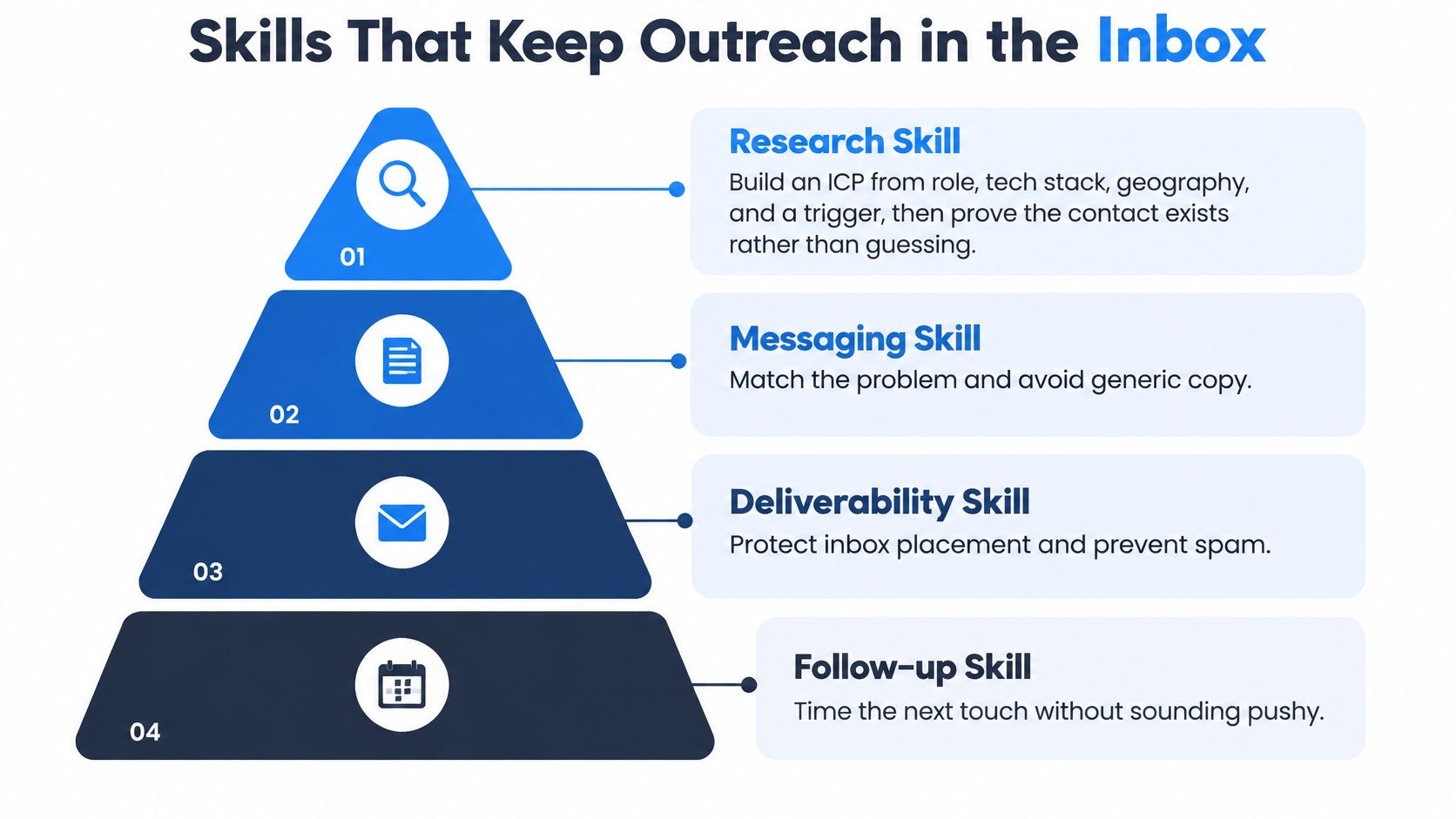
Four skills separate a lead gen specialist from someone who can operate a sequencing tool. Each one prevents a specific, expensive failure.
The hierarchy, from research at the top to follow-up discipline at the base, is summarized here.
Research and Infrastructure Come Before Copy
Research skill means building an ICP from role, tech stack, geography, and a trigger, then proving the contact exists. A trigger might be a new market launch, a hiring pattern, or a platform change visible on the company site. Buying a stale list skips that proof, so you pay for bounces, complaints, and personalization aimed at the wrong function.
Infrastructure skill treats deliverability as an engineering control, not a copy tweak. Google's sender guidance defines bulk senders as those delivering 5,000 or more messages per day to Gmail accounts and requires SPF, DKIM, and DMARC authentication, plus an aligned organizational domain in the visible From header. Google recommends keeping the user-reported spam rate below 0.1% and preventing it from reaching 0.3% or higher, monitored through Postmaster Tools.
In practice, the specialist validates authentication before launch, separates sending identities by client or campaign risk, watches complaint rates daily, suppresses bad contacts fast, and provides one-click unsubscribe for applicable promotional traffic. Poor targeting raises complaints. Complaints damage sender reputation. Future mail then lands in spam or gets rejected, even if your reply report looks fine.
Copy, Channels, and Qualification
Copy skill is relevance, not adjectives. A strong message has one observation tied to the reader's function, one proof point, and one low-friction next step. That's the core of effective email copywriting for outbound, and it's why "just checking in" follow-ups fail. They add pressure without adding information.
Pair email with a LinkedIn note only when the second channel adds context, such as a relevant post, a shared group, or a short resource the email referenced. Duplicating the same pitch in two places isn't multichannel. It's repetition with extra annoyance.
Qualification skill is knowing when a polite reply isn't an opportunity. Tools support that judgment, they don't replace it. Clay can enrich and segment, Sales Navigator can map accounts, and a sending platform can manage warm-up and sequences, but none decides whether a reply names a real problem.
Hiring test: Ask the candidate to walk a domain from authentication records to a suppressed contact. Reject a portfolio that only shows open rates.
Reaching the Buying Group Not One Contact
Say a director at a professional-services firm replies with real enthusiasm. She loves your mid-market SaaS tool, books a demo, and brings energy to the call. Three weeks later the deal is dead. Finance never saw a payback case, IT never reviewed access and data handling, and the consultants who'd use it daily think it'll slow client work.
Nobody lied. Your outreach never reached the people who could say no.
This view of the account, across finance, security, and operations rather than one inbox, is the working unit.

Map Six Seats, Then Write to Each Concern
The Gartner B2B buying report reports that the average enterprise B2B buying group contains five to 11 stakeholders spanning approximately five distinct business functions. It also found buying groups reaching consensus are 2.5 times more likely to report that their deal was high quality.
Map the account into six seats before you send anything.
- Economic buyer: Cares about utilization, margin, and whether the problem is worth budget now.
- Functional owner: Owns the workflow and will be blamed if adoption fails.
- Technical evaluator: Needs integration, access control, and data evidence.
- Procurement: Needs terms, vendor process, and a clean approval path.
- Security or compliance: Needs risk answered early, not discovered late.
- Daily user: Needs to know the tool won't slow client work.
For that services firm, the partner hears about utilization. Finance hears about payback and budget impact. IT hears about access and data. Consultants hear about minutes saved on client delivery, in plain workflow terms. Those are different notes, sent deliberately. Multi-threaded outreach isn't asking your champion to forward one generic pitch and hoping it survives.
The short walkthrough below shows how that stakeholder thinking changes a first conversation.
Count Functions Engaged, Not Just Replies
Reporting should record how many relevant functions have engaged, whether their objections point to the same problem, and whether an internal champion exists. A single-threaded "yes" with no path to finance or IT is weaker than two cautious replies from operations and finance asking different, specific questions.
Don't mark a meeting fully qualified until you have a credible business problem, an owning function, and a path to at least one more stakeholder.
Small companies are the edge case, not the exception to ignore. Two people may cover all six seats, so the map shrinks. The veto risk doesn't. Ask who else would need to be comfortable, even if the answer is "my co-founder, for budget."
Compare two pipelines. Ten meetings where one person showed curiosity is false pipeline. Three accounts where two functions have engaged, objections are known, and a champion will bring a colleague to the next call is progress sales can forecast.
Metrics That Prove Pipeline Not Activity
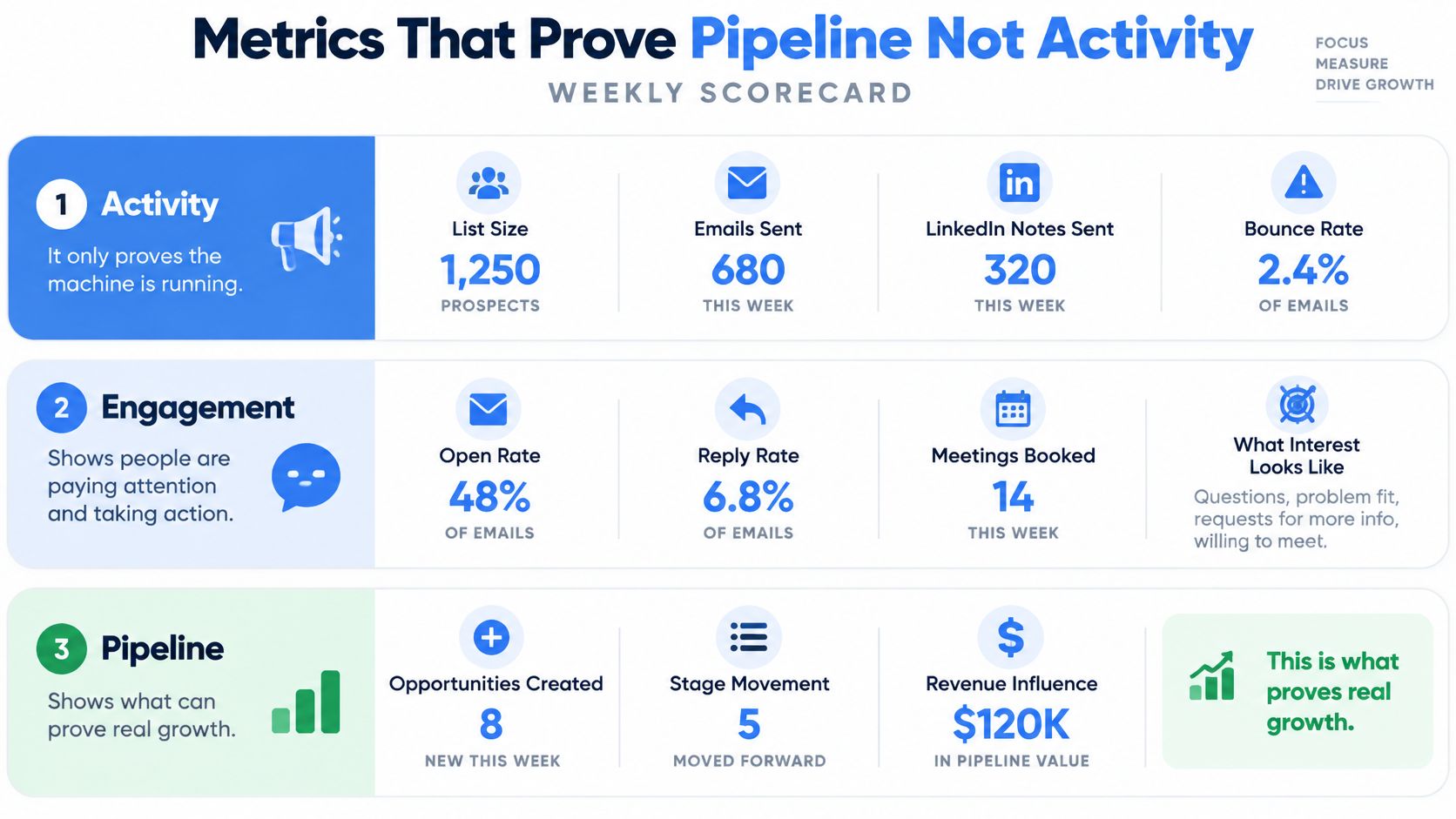
Most outbound dashboards prove effort. A weekly scorecard should separate what the machine did, whether the message mattered, and whether any commercial outcome followed.
The three layers, plus the two quality checks most reports skip, fit on one page.
Weekly Scorecard by Layer
| Layer | Metric | What it proves | What it cannot prove |
|---|---|---|---|
| Activity | List size, emails and LinkedIn notes sent, bounce rate | The machine is running | Relevance or revenue |
| Engagement | Reply rate and share of positive, out-of-office, or unsubscribe replies | Message relevance | Pipeline or revenue |
| Commercial outcome | Meetings held, share meeting the qualification bar, opportunities, pipeline value, cost per qualified opportunity | Pipeline created | Whether the deal will close |
| Account coverage | Relevant functions engaged per target account | Buying-group reach | Whether one contact will sign |
| Assisted progression | Researched prospects who later moved after the email | Self-directed buyers convert | Credit for a single touch |
Activity tells you the list was built and mail went out. It can't tell you anyone cared. Engagement is more useful, especially when you split replies into positive, out of office, wrong person, and unsubscribe. That split shows whether targeting or timing is off, which is central to qualified lead generation that sales accepts.
Commercial outcome is where arguments end. Track meetings held, not just booked, the share that meet your written qualification bar, opportunities created, pipeline value, and cost per qualified opportunity. A cheap meeting that sales rejects in five minutes isn't cheap. It consumed a closer's hour and taught the market your targeting is loose.
Two Checks and Three False Wins
Account coverage asks how many relevant functions at a target account have engaged. Assisted progression asks whether prospects who researched first later moved after your touch, because a self-directed buyer may convert weeks after reading, not on the first call to action.
Watch for three false wins.
- High opens, rising complaints: Curiosity or a misleading subject line is damaging reputation.
- A full calendar of unqualified demos: Booking skill is masking weak qualification.
- Low cost per lead: The definition counts every reply, including "wrong person."
Run a weekly operating check for list, deliverability, and reply quality. Run a monthly pipeline review with sales for opportunities and progression. Use the same definition of qualified in both rooms, or each team will declare victory on different numbers.
If meetings rise while opportunity creation stays flat, the specialist is booking conversations, not producing pipeline. Fix qualification and account coverage before you add volume.
Choose the Model and Brief It
Hire in-house or use an agency? Don't start with preference. Start with time, coaching capacity, and whether outbound is a permanent motion or a test you need answered this quarter.
In-House Lead Gen Specialist Versus an Outbound Agency
| Decision factor | In-house specialist | Outbound agency |
|---|---|---|
| Time to pipeline | About one to two quarters to hire, warm domains, and learn the ICP | Often weeks once the offer and ICP are agreed |
| Cash shape | Salary, benefits, tools, and management time | Retainer that replaces a hire |
| Control | Direct ownership of voice, CRM, and daily priority | Client sets ICP and closes; agency runs data, infrastructure, and sequences |
| Volume ceiling | One operator and the tools they can run well | A team and existing infrastructure that can run parallel segments |
| Best fit | Outbound is a core motion and someone can coach the hire | Need meetings now, no operator, or new US, UK, or EU segments |
Choose in-house when outbound will still matter in two years, a manager can coach list quality and messaging weekly, and you can absorb a ramp of one to two quarters while domains, data, and offers settle. You gain direct control of voice, CRM habits, and daily priorities. You also own every weak spot. If the hire is junior and nobody can review a list or a sequence, you've bought expensive trial and error.
Choose an agency when the calendar is empty now, nobody can be hired or managed well, or you're testing US, UK, or EU segments and need research, infrastructure, sequences, and optimization running together. In a clean B2B prospecting services arrangement, you still own the ICP, the offer, and the close. The agency operates the engine that gets qualified buyers into conversation.
Compare full cash shapes, not headlines. Put salary, benefits, tools, data, and management time on one side. Put written retainer quotes, plus your internal time for briefings and sales follow-up, on the other. Don't compare a salary alone against a retainer and call it analysis.
An agency is the wrong buy if you want one employee who'll also build inbound, run events, manage brand, and sit in product meetings. That's a different job. An in-house hire is the wrong buy if you need parallel tests across markets next month and have no one to coach the work.
Run Three Checks in Order
1. Is the constraint really first meetings? Look at where deals leak. If sales gets enough qualified conversations but win rates are poor, or onboarding fails and customers churn, more top-of-funnel volume will widen the mess. Fix the later leak first. Hire or brief for lead generation only when a shortage of qualified first meetings is the clear constraint.
2. Can someone coach the system for two quarters? Name the person who'll review list logic, domain health, message relevance, and the qualification bar every week. If that person exists, write the role against the specialist row, with lists, sequences, and qualified opportunities as outputs. Don't write a dial-counting SDR job and expect system ownership. If that person doesn't exist, don't hope a junior hire invents the system alone. Use an agency, a senior hire, or a fractional operator who brings the playbook.
3. Do you need durability or speed? A durable internal motion favors hiring, documenting, and building assets your team keeps. Pipeline this quarter, a new segment test, or entry into a new geography favors an agency that already has data workflows and sending infrastructure. Some companies sequence both. They validate segments with an agency, then hire once the ICP, offer, and qualification bar are proven. That sequence only works if the agency's lists, messages, and learnings are documented for handover.
Three Artifacts Before Anyone Starts
Whichever model you choose, require three artifacts before the first send. Vague artifacts produce vague pipeline, no matter how talented the operator sounds in an interview.
- The account list logic: Which companies, which functions, which triggers, and which exclusions, written so another person could rebuild the list.
- The first message: The exact opening for one segment, with the observation, proof point, and low-friction next step a real prospect will read.
- The 30-day metric: One primary measure you'll review, such as qualified opportunities created or functions engaged per target account, plus the guardrails for bounce and complaint rates.
If the list logic, the first message, and the 30-day metric are vague, don't start. You're funding activity and hoping it becomes a system.
Brief the qualification bar in writing at the same time. State the problem that must be present, the owning function that must be involved, and the stakeholder path that makes a meeting sales-ready. Give examples of replies that should not be booked. That last part feels negative, and it saves more sales time than any motivational target.
Finally, agree who owns follow-up after the handoff. The specialist or agency creates the qualified conversation. Your closer owns discovery depth, multi-stakeholder selling, and the proposal. If sales won't work the accounts that engaged across two functions, or won't report why opportunities stall, the loop breaks. No hiring model fixes a handoff nobody owns.
Pick the model that matches your constraint, coach it against qualified opportunities, and kill false pipeline early. That's how a lead gen specialist, internal or external, earns their cost.
If you need buying-group pipeline without spending two quarters hiring and building infrastructure, Lead Printer runs B2B outbound across email and LinkedIn, from prospect research and domain setup to personalized sequences, qualification, and calendar handoff for sales teams in the US, UK, and EU. Tell us your ICP and the qualification bar sales will accept, and we'll map the first segments and messages before launch. Start the conversation at Lead Printer.