The most popular advice about merchant services appointment setting is to offer a lower processing rate and ask for a statement. That's a weak opening when you haven't established what the merchant needs to fix. You're asking someone to consider a disruptive supplier change before you know whether pricing is even their main problem.
A stronger appointment starts with a payment-risk diagnosis: where payments fail, where disputes consume margin, and where the current setup creates unnecessary work. The setter's job isn't to promise an improvement. It's to establish a business case worth a seller's time, then refuse meetings that don't meet that standard.
Qualify Merchants Before You Book
Book only when you can verify meaningful card volume, decision access, and a named payment problem. A positive reply isn't enough. Neither is an owner who'll take any meeting offering cheaper processing.
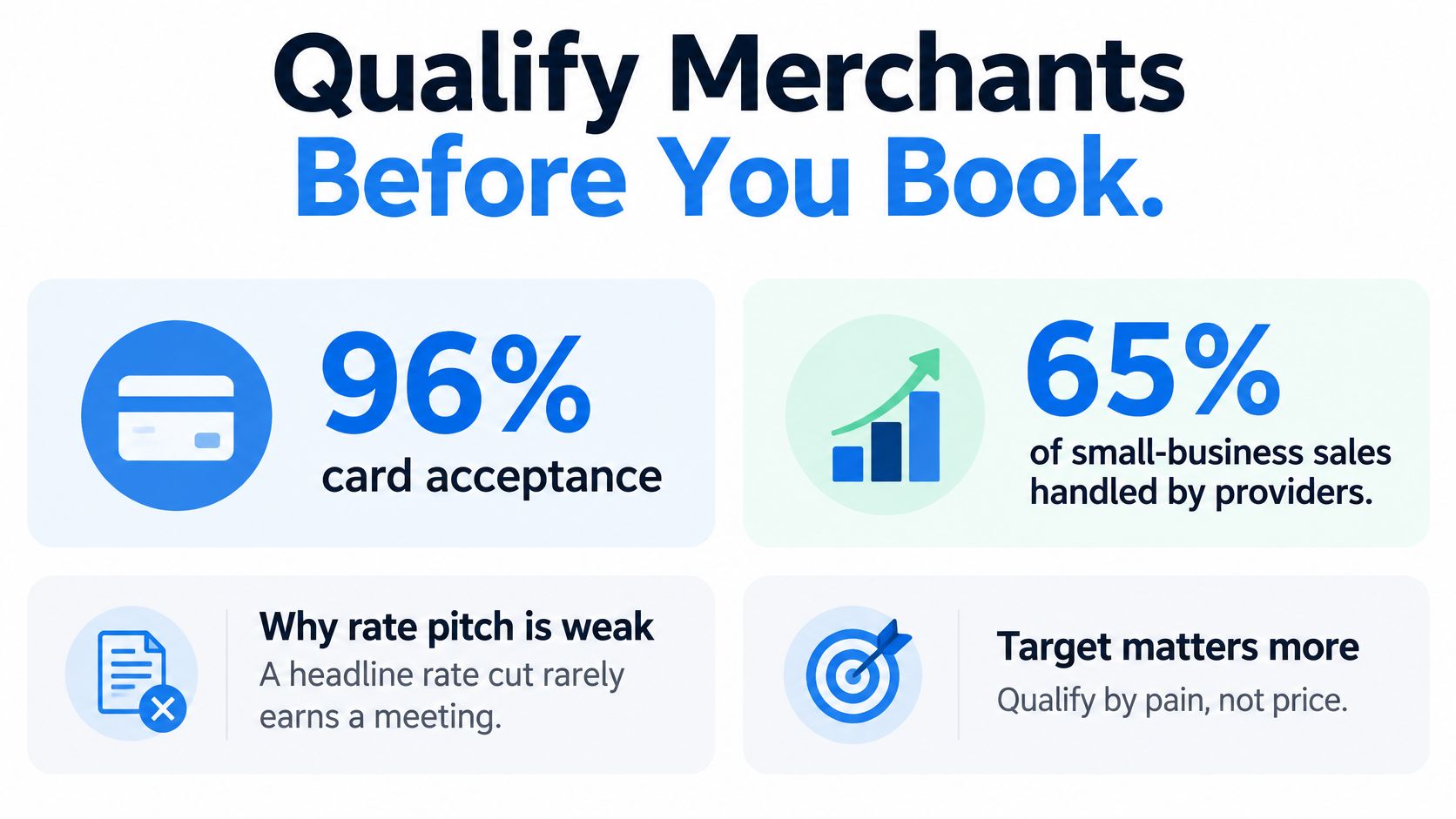
In the 2025 J.D. Power U.S. Merchant Services Satisfaction Study, card acceptance remained at 96%, while merchant-services providers processed 65% of small-business annual sales revenue. You're proposing a change to an established operating relationship, not introducing an unfamiliar capability.
The qualification priorities are straightforward.
Establish the Economics Before the Calendar
Start with card-present versus card-not-present exposure. The Kansas City Fed's chargeback working paper found significantly higher chargeback rates for card-not-present transactions and estimated that merchants bore roughly 70–80% of chargeback losses. Use that finding to justify discovery, not to imply that every online merchant has a fraud problem.
Capture monthly card volume, average ticket, effective processing rate, chargeback frequency, and the gateway or POS stack. Calculate the effective rate from processing fees against corresponding processed volume, with the treatment of refunds and exceptional fees made explicit. Don't compare a promotional headline rate with an all-in statement total.
Then identify who can authorize a change. An owner, CFO, controller, payments leader, or operations executive may control the decision, but titles alone don't establish authority. Ask who approves the processor agreement and who must sign off on integration work.
Booking rule: A setter can uncover uncertainty. A seller shouldn't inherit uncertainty disguised as qualification.
Book or Reject a Merchant Meeting
Use this comparison when reviewing replies. Nurture incomplete but credible opportunities; reject confirmed poor fits.
| Signal | Verify | Book if | Reject if |
|---|---|---|---|
| Channel mix | Card-present versus card-not-present share | Material CNP, ecommerce, or omnichannel volume | No card volume or cash-only |
| Economics | Monthly card volume, average ticket, effective rate | Volume supports the economics of statement review and acquisition | Volume remains unknown after clarification or is commercially trivial |
| Risk | Chargeback rate and fraud or refund pattern | Declines, disputes, PCI workload, or fraud loss is named | No operational pain, only curiosity |
| Buyer | Owner, CFO, controller, payments, or operations lead | Authority to change processor is confirmed | Contact cannot approve or introduce the buyer |
| Stack | Processor, gateway, POS, or ISV | Incumbent and switching trigger are known | No provider information and no trigger |
Set the minimum viable volume with your sales leader before launch. It should reflect implementation effort, expected contribution, and acquisition cost, not a universal threshold borrowed from another processor.
Target by incumbent, business age, vertical, and software need. A restaurant replacing its POS presents a different opportunity from an ecommerce merchant investigating authorization declines. OrderOut's guide to merchant account onboarding for restaurants is useful preparation for understanding restaurant-specific onboarding questions before approaching that segment.
Build your merchant service leads around those distinctions. Refuse the generic demo when nobody can explain what needs to change, and don't reject a healthy card-present business solely because its risk profile differs from ecommerce.
Diagnostic Copy and Objection Lines
Say an ecommerce merchant has introduced a new checkout. That's an observable trigger, not evidence of poor performance. Address the finance lead about revenue reconciliation and declines, the fraud manager about dispute patterns, and operations about settlement and workflow.
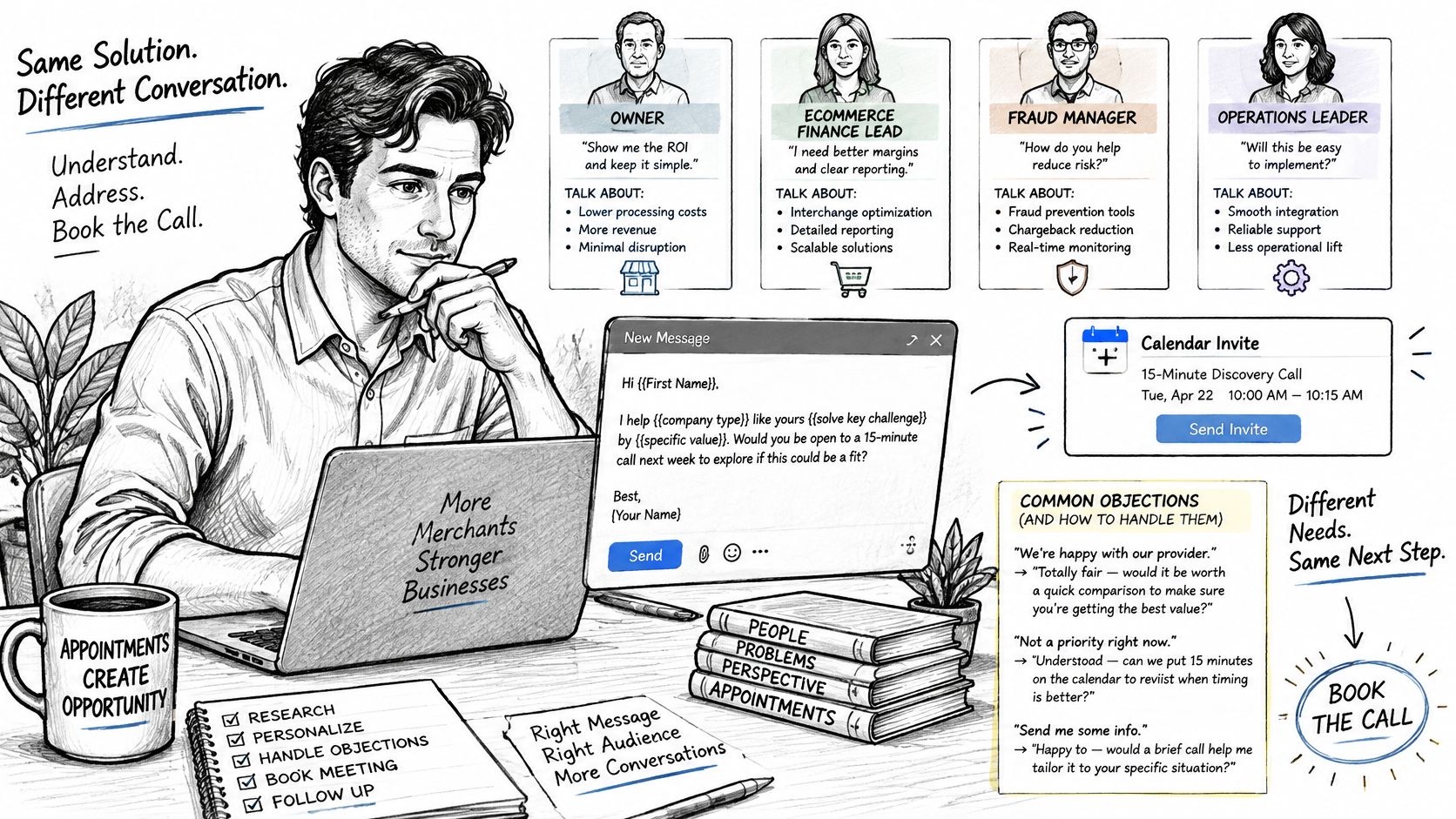
Use the stakeholder's responsibility to shape the opening.
An Email That Earns a Diagnostic Reply
Subject: Payments review after your checkout change
Hi Alex,
Your site appears to have a new checkout. Are you responsible for the processor relationship?
We offer a short payments-risk review covering authorization declines, disputes, and settlement delays. Which of those, if any, is creating work for your team?
If there's a specific issue, would a review with whoever owns payments be useful? We'd establish the baseline before discussing provider options.
This message doesn't claim access to private performance data. It gives the recipient room to say nothing is wrong, which helps distinguish relevance from polite interest.
For LinkedIn, shorten it to an observation and a question: Your checkout appears to use an embedded payment flow. Do you own payments, and is a review of declines or disputes relevant right now? Don't attach a deck before the person has established interest.
On a call, confirm responsibility first. Then ask for a monthly card-volume band and whether chargebacks or approval performance have changed enough to warrant investigation. Use the cold outreach email guide to refine the message structure without turning the diagnostic offer into a product brochure.
Replies a Setter Can Say Aloud
- Already have a processor. That makes sense. Has anything changed in your ecommerce setup, wallet acceptance, or BNPL requirements that your current arrangement doesn't handle comfortably?
- Just send pricing. I can explain the pricing structure, but an accurate comparison needs your payment profile. Could you share monthly card volume, average ticket, payment channels, and your current processor?
- Locked into a contract. Understood. When does the renewal decision happen? We can plan a review before that window, focused on authorization and disputes rather than an immediate switch.
- Rates are already low. Then fees may not be the reason to talk. Is there any unresolved issue with approvals, fraud controls, disputes, or payment-method coverage?
The risk angle has substance: a global 2025 merchant study reported that 98% experienced at least one form of fraud, with 47% affected by refund or policy abuse, according to the Times of India's coverage. That's context for asking better questions, not evidence that a particular prospect needs your product.
A merchant can rationally accept higher processing fees if the overall payment outcome improves. The seller must demonstrate that trade-off rather than assume it.
Use the video alongside role-play, not as a substitute for practicing the objection replies.
Keep Outreach Deliverable and Compliant
Deliverability belongs in the appointment-setting workflow. If messages don't reach the right inbox, changing the pitch won't tell you whether merchants value the offer. Assign an owner to infrastructure, suppression, and placement before launching outreach.
Complete the Pre-Launch Checks
- Authenticate the sender. Use a clearly branded sending domain separate from critical operational email, with SPF, DKIM, and DMARC configured. Separation isn't permission to use misleading lookalike identities.
- Prepare inboxes deliberately. Create inboxes in manageable batches and introduce legitimate sending gradually. Warm-up activity isn't proof that a campaign will reach the inbox.
- Set sending limits. Cap activity per inbox according to provider limits, delivery signals, and reply-handling capacity. Don't expand volume while the team is still struggling to qualify responses.
- Verify and suppress records. Remove invalid addresses, irrelevant role accounts, duplicate contacts, and anyone who has opted out. Keep suppression centralized across campaigns.
Fetchin's B2B data quality best practices provide useful context for keeping contact records usable across enrichment and outreach. Store the contact's role, source, geography, and the account-level observation that supports personalization.
Match language and sending schedules to the recipient's market. A US owner, UK finance director, and EU operations lead shouldn't receive identical copy just because they share an industry label.
Review Claims and Data Handling
Never invent savings, imply you've audited an unseen statement, or present an inferred technology signal as confirmed fact. Write appears to use when the stack identification is uncertain. Remove any claim the seller can't defend in a conversation.
Don't ask for full card numbers, login credentials, or customer-level payment records. When statement analysis becomes appropriate, provide an approved secure collection method and explain what should be redacted.
Have a qualified compliance owner review requirements for each target jurisdiction and channel. For UK and EU outreach, document the applicable lawful basis and any legitimate-interest assessment where relevant; legitimate interest isn't blanket permission to send. For US campaigns, provide accurate sender information, a working opt-out, and a process for applicable privacy requests.
Suppression is a continuing obligation inside your operating process, not a cleanup task after someone complains.
Use an email deliverability checklist before launch and after material changes. Pause sending to investigate deteriorating placement rather than adding more inboxes to compensate.
Test a single variable last: the subject, opening observation, or meeting ask, within a consistent segment. Judge the result by relevant replies that advance qualification, not by opens alone.
Route Nurture and Kill Decisions
A reply needs an owner and a disposition, not an indefinite place in the inbox. Give setters explicit authority to withhold calendar access when the commercial case is incomplete. Otherwise, they'll learn that booking anything is safer than exercising judgment.
Book the Merchant With an Actionable Problem
Consider an ecommerce brand whose finance lead confirms material online card volume and identifies a growing dispute workload. The buyer can involve the person responsible for fraud operations and agrees to bring an appropriate reporting summary.
Book it. Record the specific dispute issue, who will attend, and what the seller is expected to investigate. Don't describe the opportunity as interested in processing when the actual reason for meeting is dispute handling.
Nurture the Account With a Real Future Trigger
A restaurant group plans to replace its POS but hasn't chosen an implementation owner. The payment opportunity may be genuine, yet a processor meeting now would force the seller to speculate about integrations and buying authority.
Keep the account in nurture with a named trigger: the POS shortlist, appointment of the project owner, or confirmation of the renewal window. Review the record periodically, but re-contact with a reason tied to that event rather than a repetitive checking-in sequence.
- Record the trigger. State what must happen before outreach becomes relevant.
- Assign responsibility. Name who monitors the event or follows up with the contact.
- Define re-entry. Specify the missing evidence required before the account returns to active qualification.
Kill the Poor Fit Without Burning the Relationship
A café asks for a price sheet but won't discuss card volume, has no identified problem, and won't connect you with the owner. Send any suitable general information, then close the active prospecting record. Don't award a meeting because the reply sounds friendly.
Use concrete reason codes such as cash-only, below economic fit, no buyer access, or no business problem. Distinguish a poor fit from a prospect who has not yet supplied information.
A kill decision ends the current sales motion. It doesn't require a dismissive response or a permanent ban on future relevance.
Run the Outreach and Measure Meeting Quality
Build the campaign around an investigation your sellers can conduct. If your product can't address a merchant's fraud controls or authorization workflow, don't use those problems merely to obtain a pricing call. Match the diagnostic promise to the team's capabilities.
Execute a Controlled Account Sequence
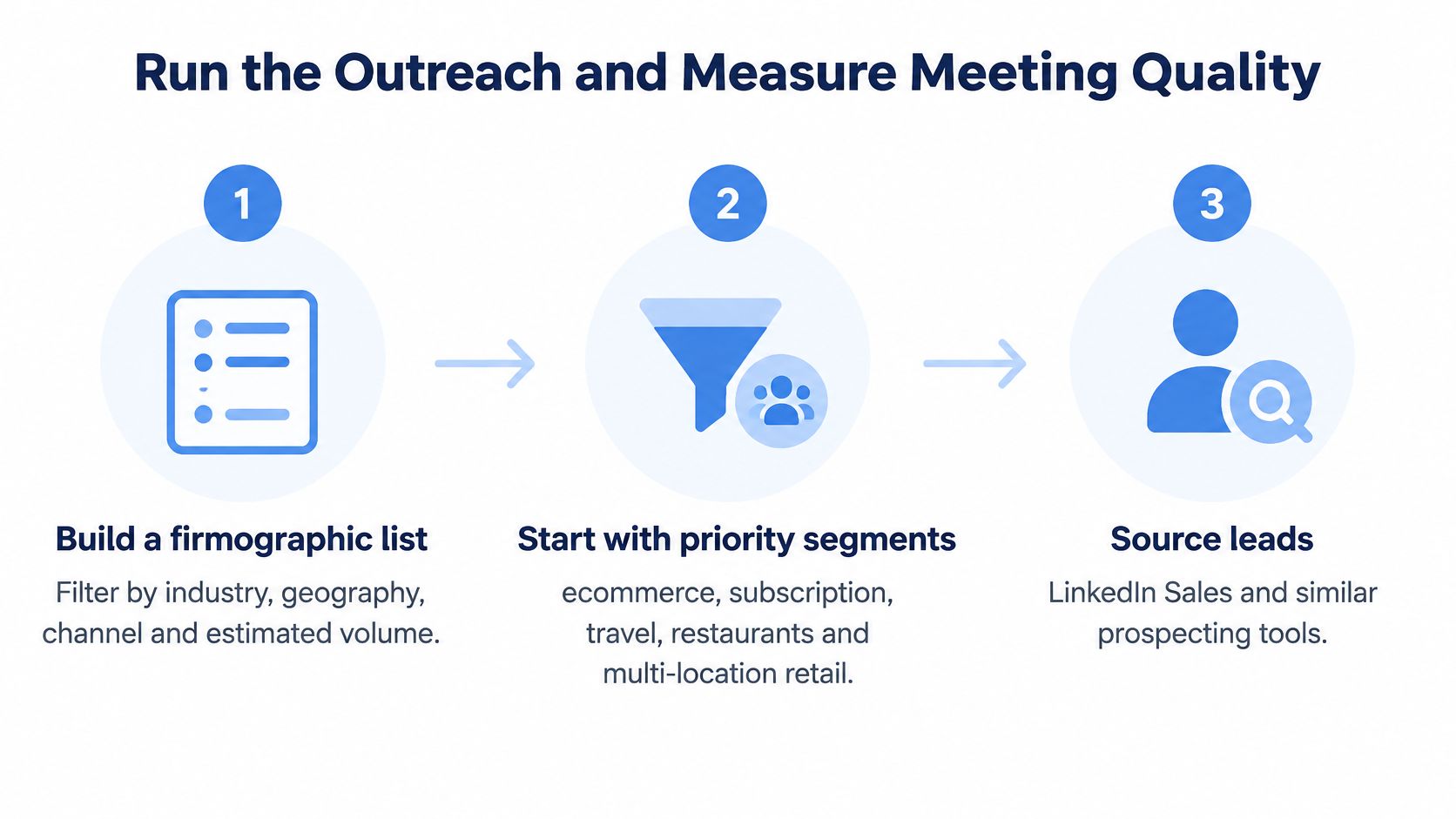
Choose a commercially coherent segment. Start with ecommerce, subscriptions, travel, restaurants, or multi-location retail where your offer fits. Filter by geography, sales channel, and likely processing economics rather than combining every card-accepting business into one list.
Source accounts through LinkedIn Sales Navigator, Google Maps, merchant websites, and national business registries. Use registries to verify the entity and location, then merchant sites to understand how the business sells. Estimated volume is a prioritization aid, not a verified qualification field.
Enrich the payment environment. In Clay or your research workflow, record checkout technology, visible wallet options, recurring billing, POS or gateway indicators, and signs of international selling. Include a confidence field and the page supporting each observation.
A missing wallet button may reflect browser behavior or checkout conditions, not a true acceptance gap. Have someone verify the observation before making it the opening line.
The prospecting workflow should remain simple enough for another operator to audit.
Run a restrained multichannel cadence. Begin with the diagnostic email, use LinkedIn to establish relevance with the same buyer, then follow with role-specific evidence. Add a short call where appropriate and finish with a message that closes the loop without manufactured urgency.
Keep the proof specific to your actual capabilities. A finance follow-up might explain how the review distinguishes processing charges from dispute-related costs. An operations follow-up might describe the information needed to assess settlement reconciliation.
Resolve qualification in the reply thread. Collect monthly card volume, average ticket, payment channels, and the current processor or gateway before scheduling. Ask for the missing information conversationally rather than sending a long intake form after every response.
If the merchant won't disclose exact volume, a credible band may support initial routing. Record it as a merchant-provided estimate and leave the seller a clear verification task.
Transfer an investigation, not a calendar invitation. The handoff needs the merchant's stated problem, payment profile, incumbent, buyer, decision process, and agreed review materials. Add relevant constraints, including integration dependencies and contract timing.
Write a proposed meeting outcome: determine whether the decline issue warrants technical analysis, for example. That gives the seller something more useful than a vague instruction to show the platform.
Card acceptance deserves this operational attention. The Federal Reserve's merchant-payments analysis cites credit cards at approximately 32% and debit cards at 30% of consumer retail payments. Those are consumer retail payment shares, not a forecast of your target account's processing mix.
Read the Calendar Metrics Without Mistaking Them for Revenue
Use an external meeting study as context, not a universal target. In a 2024–2026 study of 1,380 B2B meetings booked by cold calling, Growth Cab reported 69.6% held, 14.6% no-shows, 11.0% rescheduled, and 4.7% cancelled.
That sample isn't merchant-services-specific, and its held rate isn't a proven ceiling. Compare it cautiously with a similarly defined internal cohort, especially if your meetings come from email rather than cold calling.
Appointment quality metrics to report
| Metric | Reference point | Read it as | If it is weak |
|---|---|---|---|
| Meetings held | The cold-call study's held-meeting reference, with channel differences noted | Attendance context, not a payments norm or ceiling | Confirm the problem and required documents before the slot |
| No-shows | Separate no-shows, reschedules, and cancellations | Different forms of calendar friction | Simplify scheduling and reconfirm the buyer |
| Qualified share | Required payment fields plus a named pain and buyer access | Share of held meetings worth a seller's time | Stop booking curiosity replies |
| Opportunity rate | Buyer agrees to relevant statement or technical analysis | Advancement toward a commercial decision | Make the diagnostic offer match a problem you can solve |
| Expected volume | Merchant-confirmed monthly card volume on the handoff | Whether the segment supports the acquisition motion | Remove economically unsuitable accounts |
Define the denominator before reviewing performance. Held-meeting rate should use appointments whose scheduled date has passed; qualified share should use held meetings assessed against the same acceptance rules. Don't count a rescheduled appointment as both a fresh booking and a lost meeting without preserving its original record.
Track downstream close rate separately from opportunity creation. A segment can produce enthusiastic meetings but fail when implementation requirements emerge. Another may produce fewer conversations that advance because the buyer has a clear reason to change.
Optimize for the Verified Business Case
Review performance by vertical, payment channel, incumbent, and trigger. Don't combine a restaurant POS campaign with an ecommerce fraud campaign and conclude that the same message works for both. Their buyers, evidence requirements, and implementation costs differ.
Expected processing volume also needs discipline. Don't sum unverified website estimates and present the result as qualified pipeline. Separate estimated account potential from merchant-confirmed volume, then distinguish existing processing activity from volume your solution could realistically win.
Ask sellers to return structured feedback after each held meeting:
- Problem confirmed. Did the merchant describe the same issue the setter recorded?
- Evidence available. Could the buyer supply appropriate statements or operational reports?
- Decision viable. Is there an actionable route through approvals, integration, and contract constraints?
- Next step accepted. Did both parties agree to a specific investigation or commercial action?
If attendance is healthy but advancement is weak, more outreach won't fix the underlying mismatch. Examine targeting, qualification, and whether the review creates enough value to justify changing providers.
Finally, choose whether to build this operation internally or use a specialist partner. An internal team gives you direct control over technical discovery and seller feedback, but someone must own infrastructure, enrichment, reply handling, and reporting. A partner can run those functions, provided you retain control over qualification rules and reject unsupported meeting claims.
Lead Printer builds and runs researched email and multichannel campaigns, manages replies, and hands qualified opportunities to your sales team with context. Visit Lead Printer to discuss a merchant-services campaign built around payment-risk triggers, buyer access, and a verified business case rather than promises of lower rates.