In 2024, Deloitte reported that 50% of executives used outsourced services for front-office capabilities such as sales, marketing, and research and development, a finding carried in this Tam to Target briefing. Half the executive suite is already buying outside help for the work that fills a pipeline. A monthly fee on a proposal is no longer a side experiment. It is a line you have to defend the same way you defend a hire.
Headline retainers still hide the number that decides whether the program pays for itself. Judge sales outsourcing pricing by cost per qualified outcome, not the sticker. A guarantee, a loose definition of "qualified," and a refund that never triggers can turn two identical monthly fees into very different prices. Work the floor first. Then read the clauses that move that floor.
Typical Sales Outsourcing Prices at a Glance
You aren't paying for messages sent. A serious fee buys infrastructure, prospect data, campaign management, qualification, and accountability for pipeline creation. Without those, a low retainer is a subscription to activity.
| Pricing model | Reported price range | Source and year |
|---|---|---|
| Outsourced SDR retainer (dedicated team) | $6,000-$14,000 per month | Market analysis, 2025 |
| Hybrid retainer plus per-appointment fee | $3,000-$8,000 per month plus $100-$300 per qualified appointment | Market analysis, 2025 |
| Pure pay-per-meeting | $150-$600 per meeting | Market analysis, 2025 |
| Appointment-setting retainer | $3,000-$10,000 per month | Global BPO Index, 2026 |
| Appointment-setting per qualified appointment | $150-$500 per appointment | Global BPO Index, 2026 |
| Hourly appointment-setting | $16-$25 per hour | Global BPO Index, 2026 |
A 2025 market analysis summarized by Fortune Business Insights described common outsourced SDR retainers as approximately $6,000-$14,000 per month. Hybrid arrangements were reported at roughly $3,000-$8,000 per month plus $100-$300 per qualified appointment, and pure pay-per-meeting pricing at approximately $150-$600 per meeting. That analysis estimated dedicated outsourced sales-development teams accounted for 61.0% of revenue in the B2B sales-outsourcing-services market, with dedicated-team revenue projected to grow at 6.2% annually. A separate industry estimate on the same page valued the global business-process-outsourcing market at $327.01 billion in 2025 and projected it to reach $741.60 billion by 2034, with sales and marketing the fastest-growing segment at a projected 13.6% compound annual growth rate.
The Global BPO Index reported in 2026 that outsourced appointment-setting services cost $3,000-$10,000 per month on retainer, $150-$500 per qualified appointment, or $16-$25 per hour.
Why one band isn't a quote
These sources differ in year and scope, so treat every band as a reference point, not a number you can sign. The spread tracks target-account size, prospect seniority, industry complexity, geographic coverage, and how much of the message is written for one account rather than a segment. The largest single driver is the contractual definition of a qualified meeting. A $150 meeting and a $500 meeting can describe different products: a calendar hold with anyone who replied, versus a held conversation with a buyer who matches role, company size, and geography.
Place a likely quote in a band
- Name the model on the page. Retainer, hybrid, pay-per-meeting, or hourly. If the quote mixes two, split the base from the variable before you do any math.
- Note who is being pursued. Target-account size and prospect seniority move the quote more than the channel logo on the slide.
- Get the definition in writing before you compare any numbers. Until "qualified" is a checklist, the ranges above aren't comparable with each other, let alone with your proposal.
Pricing Models Compared and When Each Fits
The four common structures are different ways of splitting volume risk between you and the provider. The monthly number is the least informative line on the page. What the provider is paid for is what the team will optimize.
| Model | Who carries the volume risk | Fits best when | Main pitfall |
|---|---|---|---|
| Retainer | Buyer pays for capacity whether or not meetings land | Large market, proven offer, predictable pipeline goal | Fees continue through weak months unless guarantees apply |
| Pay-per-meeting | Provider carries volume risk | Offer is tested and the meeting definition is strict | Quantity of weak meetings can be rewarded if qualification is loose |
| Hybrid | Shared between buyer and provider | Mid-stage offer where you want a base plus a bonus for qualified output | Two sets of definitions must stay aligned or disputes follow |
| Commission on closed revenue | Provider shares the sales outcome | Short sales cycle and clean attribution | Renewals, channel influence and long cycles are hard to attribute |
A retainer buys predictable capacity. You pay whether meetings land or not, which suits a proven offer in a large market and a pipeline goal you can staff. The pitfall is quiet: fees continue through weak months unless a guarantee is in the contract. Our sales development outsourcing work is scoped as campaign capacity aimed at qualified leads, not as a bet on closed revenue.
Pay-per-meeting moves volume risk to the provider. It fits a tested offer with a strict definition, because you aren't funding empty weeks. Loose qualification flips the incentive. The easiest way to book more meetings is to widen the list and lower the bar, and you pay for every one of those meetings.
A hybrid pairs a base that covers infrastructure and research with a bonus per qualified meeting. That split suits a mid-stage offer, where the message is partly proven and you still want the provider invested in output. You now have two definitions to keep aligned: what the base includes, and what earns the variable fee. If those drift, you argue about invoices instead of pipeline.
Commission on closed revenue looks aligned and often isn't. Renewals, channel influence, and long sales cycles are hard to attribute, and the provider's income then depends on your pricing, your product, and your follow-up. We don't work on a pay-per-close model, and we don't guarantee closed revenue or a count of new clients. We generate leads. Your team closes them.
Match the model to how proven the offer is
- The offer is still unproven. Use pay-per-meeting, and only with a tight definition you can reject against. You are buying learning with a cap on wasted meetings.
- The ideal customer profile is clear and sales capacity is steady. Use a retainer with a pipeline target, not a log of emails sent.
- You want to share risk while the system is still being built. Use a hybrid, and tie the variable fee to one event both sides can see in the CRM.
Ask any provider three questions. What event triggers payment: capacity, a meeting, an accepted lead, or closed revenue? What happens in a weak month: does the fee stand, does a shortfall carry forward, or does a refund apply? Who can change the definition after launch? If "qualified" can be widened, the cheap model becomes the expensive one.
What Moves Your Quote Up or Down
Start with what an internal seller costs, then ask what the outsourced quote is replacing. The Bureau of Labor Statistics reported that wholesale and manufacturing sales representatives, excluding technical and scientific products, had median annual wages of $70,280 and mean annual wages of $81,990 in 2025. The occupation employed approximately 799,760 people. Technical and scientific sales representatives were more expensive: their 2025 median annual wage was $105,910, and the mean was $120,960.
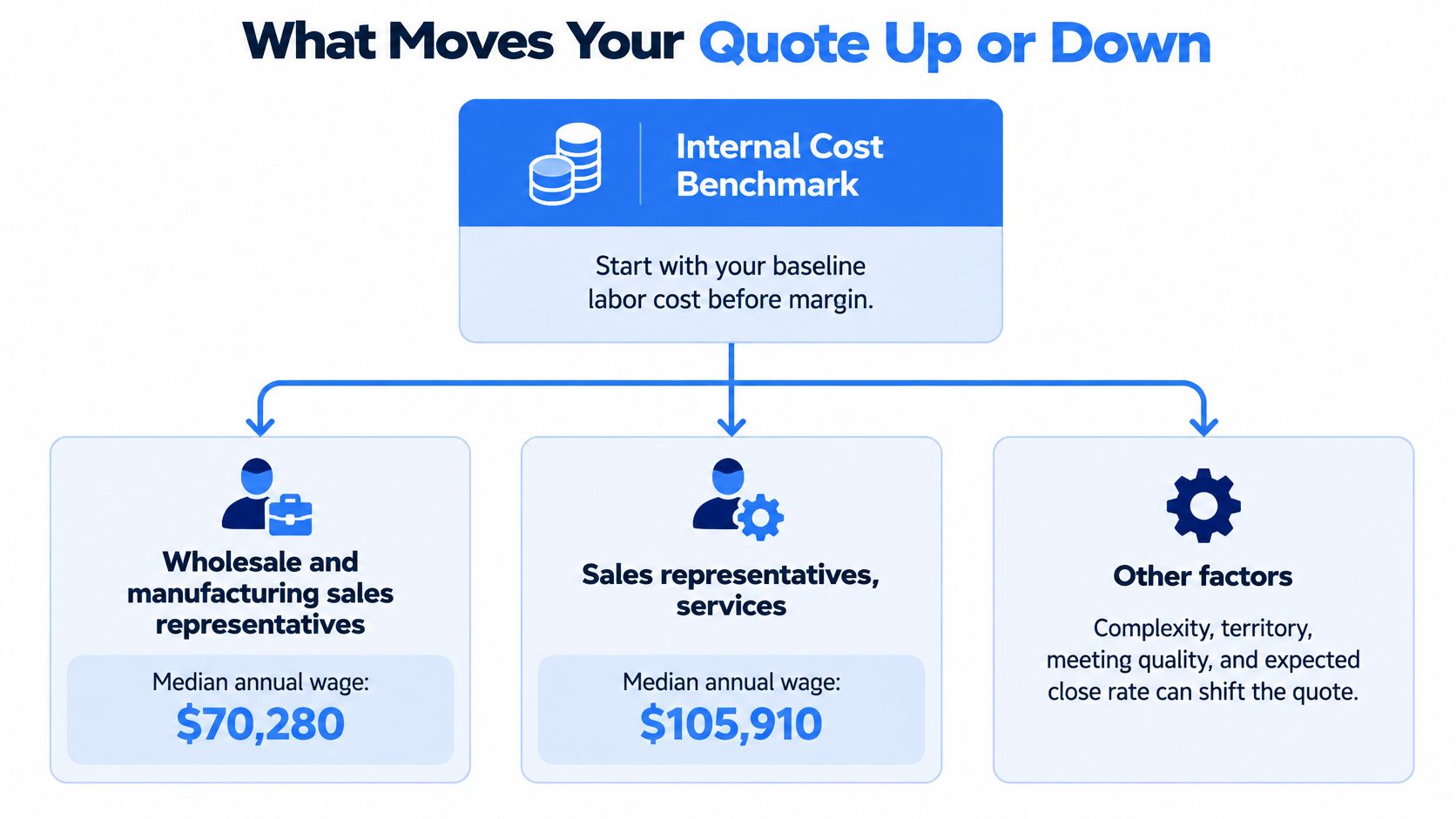
Those figures are wages only. An internal hire also needs payroll taxes, benefits, recruiting, training, management, sales technology, data, and months before the person is productive. A monthly outsourcing fee should not be set next to salary. The fairer benchmark is fully loaded cost per qualified opportunity or accepted meeting. The wage gap also explains price differences by market. Programs aimed at complex SaaS, industrial, or technical buyers need more research, specialized messaging, and more senior people than simple transactional outreach.
Complexity, territory, and the list
Buyer complexity is the first adder. Regulated sectors, technical manufacturing, and senior-executive targeting take more research than a standard English-language segment with abundant verified data. Message testing takes longer because a wrong note costs the domain, not just one reply.
Market size changes cost per lead even when the fee stays flat. Outbound fits a high-ticket B2B service that solves a real problem when at least 5,000 people sit in the target market. A medium-ticket product or service usually needs at least 50,000 people in the total addressable market. Below those floors, the same research effort yields fewer usable names, so the unit cost rises even if the invoice doesn't.
Several decision-makers and a long qualification path add steps before a lead can be handed over. Geography does the same. Multilingual EU campaigns cost more than English-only US outreach because each market needs its own copy, its own data sources, and its own compliance check.
Data and deliverability work is labor, not a software toggle. Verified lists, enrichment, mailbox setup, warm-up, and daily sending caps all have to be staffed. We cap each mailbox at 20 emails a day, and 60 emails a day per domain, so higher volume means more infrastructure, not a louder blast from one inbox. Campaigns that add inbox management, calendar qualification, and CRM handoff cost more than list delivery alone. Pricing pages usually list vendor deliverables and skip the adjustments for geography, language, account size, persona seniority, and data availability.
Practical rule: Each of those drivers should show up as a labelled line on the quote, never as a hidden surcharge after you have already compared monthly fees.
Turning a Monthly Fee into Cost per Lead and Meeting
Divide the monthly fee by accepted leads for cost per lead, by meetings for cost per meeting, and by closed sales for cost per sale. The sticker doesn't survive that division.
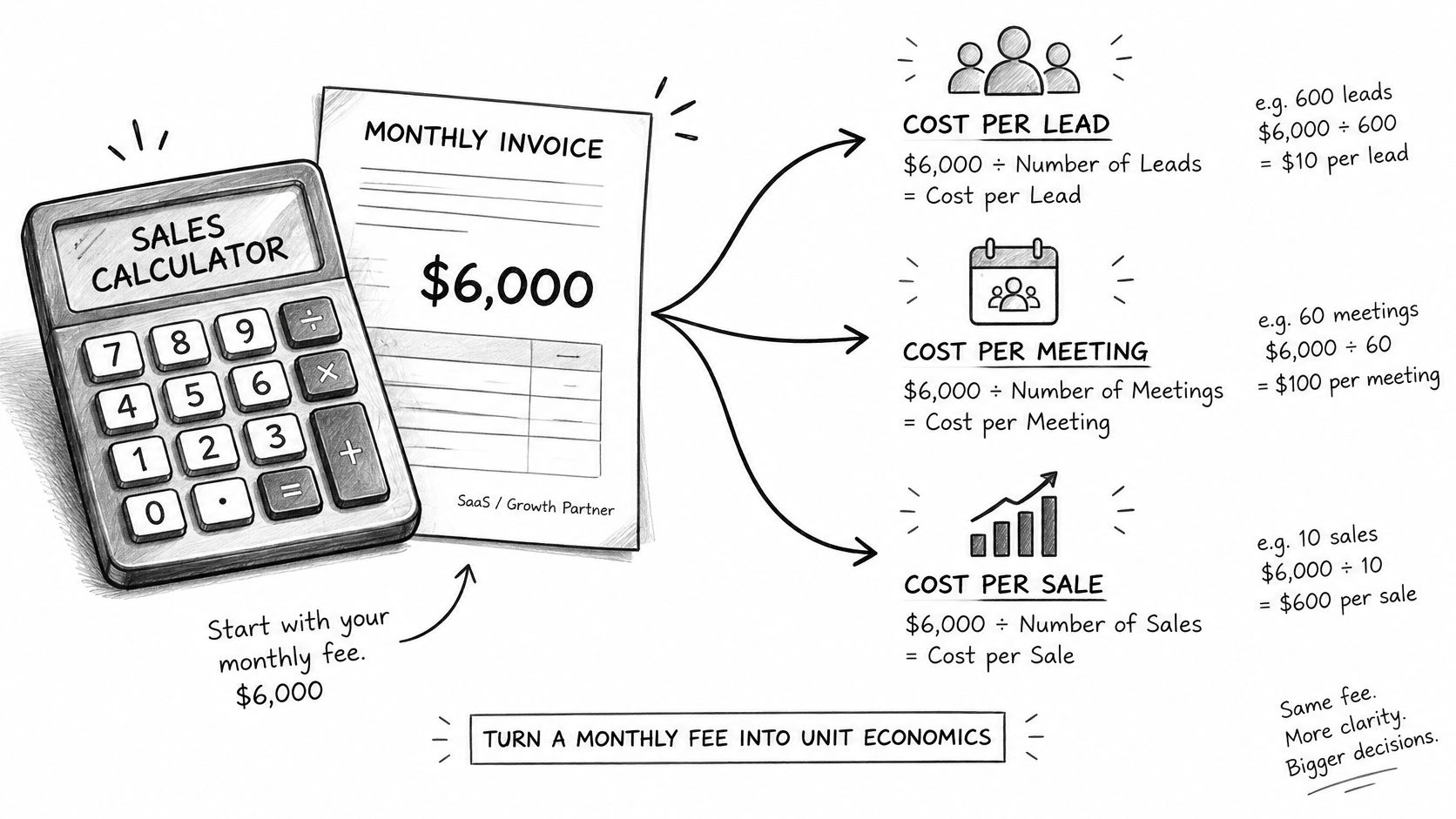
Use $6,000 a month as a worked example, inside the dedicated-team reference band, not as a published price of ours. Our clients book a meeting with every 3-4 leads, and they need 10-20 leads to close a sale. We send 200-300 emails on average to generate one warm lead, which is why volume and inbox health sit inside the unit cost.
| Scenario | Leads per month | Meetings (1 per 3-4 leads) | Sales closed (10-20 leads each) | Cost per lead | Cost per sale |
|---|---|---|---|---|---|
| Guaranteed floor | 20 | 5-7 | 1-2 | $300 | $3,000-$6,000 |
| Typical average | 50 | 13-17 | 2.5-5 | $120 | $1,200-$2,400 |
| Upside volume | 200 | 50-67 | 10-20 | $30 | $300-$600 |
At a floor of 20 leads, cost per lead is $300. Five to seven meetings put cost per meeting around $900-$1,200. At 50 leads, cost per lead falls to $120 and cost per meeting to roughly $350-$460. At 200 leads, cost per lead is $30. The same fee, three completely different acquisition costs. A cheaper retainer that only produces the floor can cost more per sale than a higher fee that produces the average.
The measures worth putting on one sheet
Mixology Digital's 2025 B2B research found that 69% of B2B buyers report frustration with unclear vendor pricing, while 57% want stronger demonstrations of ROI in vendor content. Broad ranges such as a few thousand to well into five figures a month rarely model setup, data quality, CRM integration, your review time, no-shows, sales-cycle length, or the cost of a campaign that annoys the market. Compare cost per accepted lead, cost per sales-qualified opportunity, cost per held meeting, and cost per pipeline dollar. Pay-per-meeting can look cheaper while rewarding weak qualification. Commission looks aligned until attribution, renewals, or a long cycle is disputed. The lowest nominal price can produce the highest effective acquisition cost when targeting and downstream conversion are poor.
Put margin on the same example
Assume a $5,000 average contract and a 40% gross margin, so gross profit per sale is $2,000. ROI equals gross profit from those sales, minus the fee, divided by the fee.
At 2.5 to 5 sales, gross profit is $5,000-$10,000 against the $6,000 fee, an ROI of about -17% to +67%. At the floor of 1 to 2 sales, gross profit is $2,000-$4,000, a loss of about 33% to 67% on the fee. The floor is where the financial risk sits. Confirm, before you sign, whether any refund applies when delivery lands there rather than at the average.
Rebuild the table with your fee, your show rate, and your close rate. A free guide and an ROI calculator on our site will take your numbers instead of a generic benchmark.
The same arithmetic is easier to see when someone walks the cases in order.
Guarantees, SLAs and Refunds to Negotiate
Any offer contains three numbers, and only one of them is a promise. The guaranteed minimum is what you can hold the provider to. The average and the upside describe what has happened for other clients, not what this contract owes you. We promise 20+ qualified leads within 30 days, or we refund the fee. Most clients land nearer an average of 50 leads a month, and some reach 200 to 300. Those higher figures are not the promise. Comparing a 20-lead guarantee with an average of 50, or with an upside of 200-300, only makes sense once each number is labelled as floor, typical, or best case.
Martal's guide to outsourcing lead generation cites buyer research in which 73% of B2B buyers actively avoid suppliers that send irrelevant outreach. A single cost-per-meeting figure that ignores geography, language, industry complexity, account size, persona seniority, data availability, and how much qualification you require will mis-state the work. Standard English-language segments with plenty of verified data should cost less than multilingual EU campaigns, regulated sectors, technical manufacturing, or senior-executive targeting. Inbox management, calendar qualification, and CRM handoff should cost more than handing over a list. Maximizing activity can cut commercial value and create brand costs a pricing calculator never shows.
Write the definition before you write the price
A qualified lead needs a written test: target role, company size, geography, and the criteria a lead must meet before it counts. If that test lives in a slide instead of the agreement, the floor can be met with names your reps will reject. Our page on what lead qualification is is the checklist we use so both sides count the same records.
Then read the refund clause as a buyer, not as a brochure. What triggers it, what window applies, and who measures the result are three different sentences. A refund that the vendor scores alone, against a definition the vendor can edit, doesn't change the price.
We generate the leads. You close them. There is no end-to-end sales engagement in the fee, and there is no guarantee of revenue.
Your side of the service level
Pricing pages dwell on vendor deliverables and skip client readiness. Delayed follow-up can make an otherwise qualified lead worthless, so response speed belongs in the contract: how fast your team works a new meeting, how fast you review a disputed lead, and how inbox handling is split. Offer strength, sales-cycle length, and market maturity still sit outside what a provider controls. Price the inputs you can specify. Set expectations for the rest.
Term and exit belong on the same page. Note the minimum contract length, the ramp-up period before the guarantee clock starts, and the cancellation notice. A short engagement that starts the guarantee during warm-up measures setup, not delivery.
- Floor, average, and upside written as three separate figures.
- Qualified-lead definition with role, company, geography, and acceptance rules.
- Refund trigger, window, and measurer.
- Your follow-up window, in hours or business days.
- Term, ramp-up, and exit, including what happens to domains, lists, and CRM data.
Compare Quotes on Equal Terms
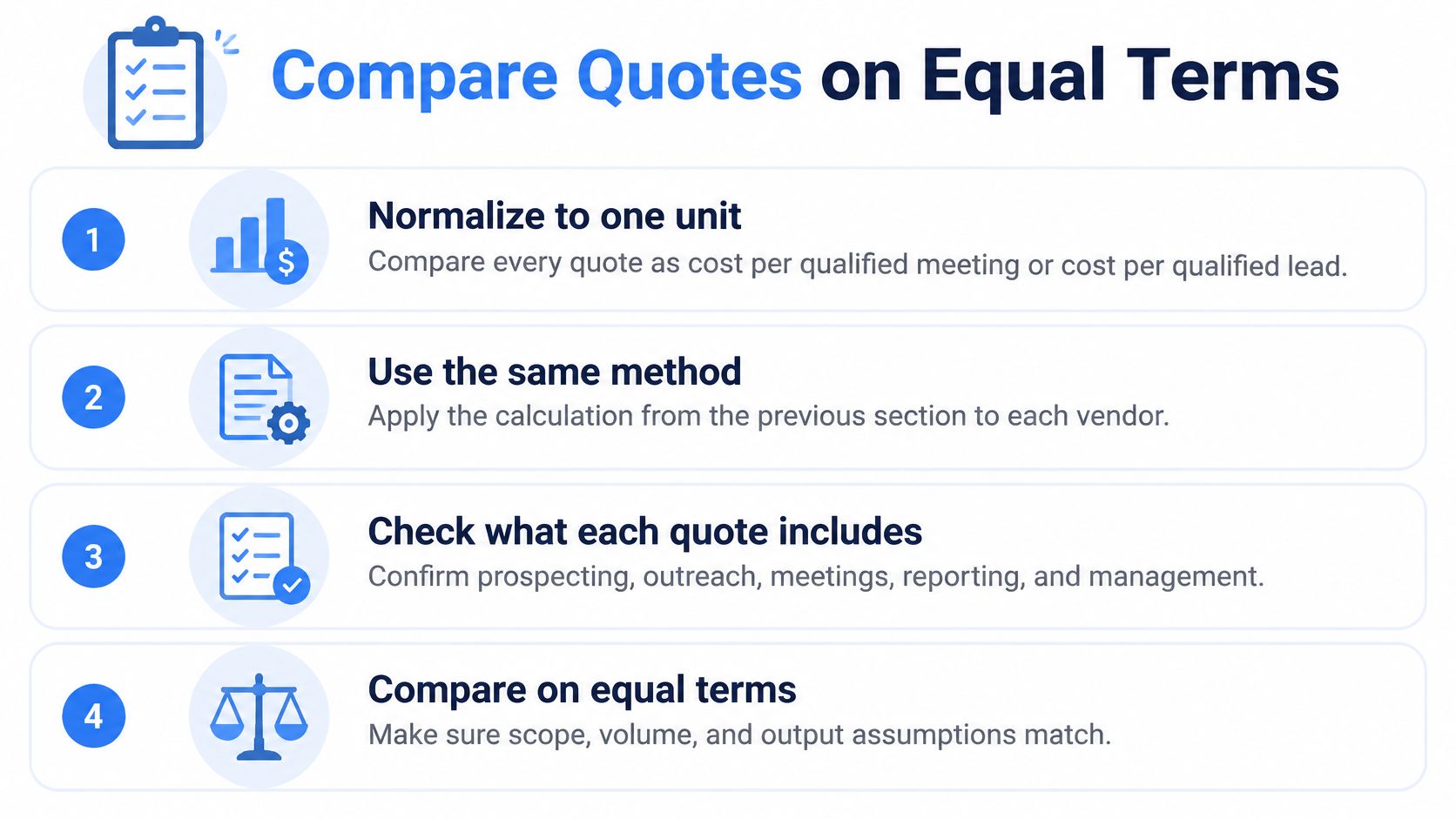
Normalize every quote to the same unit before you rank anyone. Cost per qualified meeting, or cost per qualified lead, using your own conversion rates, is the unit. Two monthly fees are not a comparison.
A scoring sheet you can mark in one sitting
Pricing basis. Is the fee a retainer, a price per meeting, or a hybrid, and what does the base cover? Infrastructure, data, copy, and management should be named. "Program management" with no contents is not a scope.
Setup. Setting up outbound takes 3-4 weeks and includes email infrastructure and warm-up, a strategy and onboarding meeting, copywriting, and list building. We charge only for the campaign period, when emails are going out and leads are coming in, and we don't charge separately for that set-up period. A one-month campaign can include an additional set-up fee instead. Ask every other provider whether setup is inside the monthly number or on a second invoice. A retainer that looks lower can be higher once warm-up, domains, and list building are added.
Qualification and safeguards. Use one definition across the quotes. Ask about per-mailbox sending caps, whether mail is plain text, and whether booked, held, and accepted results are reported as separate lines. We send plain-text email with no images, no links, and no open-rate tracking, because the metric that matters is a reply you can work, not an open pixel.
Refund window. If it isn't written, with a measurer, it isn't a term. Score it as absent.
Red flags that end the comparison
- Vague qualification. "Interested contacts" with no role, company size, or geography.
- No written refund. The floor is a marketing line, and the effective price is the full fee in a bad month.
- Monthly fees set side by side. Different definitions, different setup treatment, and different volume assumptions mean you are pricing different products.
If you can't restate both proposals as cost per accepted lead on one sheet, you don't have a comparison yet. You have two stories.
Go or No-Go Before You Sign
Three checks decide the signature. Each one fails closed: if you can't answer it from the agreement, you aren't ready.
- Run the floor case with your rates. Cost per qualified meeting and cost per sale at the guaranteed minimum have to be acceptable on your close rate and your margin. If only the average looks fine, you are buying a hope.
- Confirm the clauses are in the agreement. Qualified-lead definition, refund window, your follow-up standard, ramp-up, and exit terms have to be written. Implied terms don't change the price.
- Confirm the model matches the offer. An untested message on a pure retainer means you fund the learning. A loose pay-per-meeting deal means you fund bad meetings.
Sign only when the floor-case cost per qualified meeting is acceptable and your team can follow up inside the agreed window. If the floor fails, negotiate the floor, the definition, or the model. Don't negotiate the average.
Before the first send, run a free email deliverability check by mailX so a weak domain doesn't consume the opening month. Then book a 45-minute free pipeline audit. We map your ideal customer profile and estimate how many qualified leads outbound can bring each month. You can also book a short demo from the site. We review the business and tell you plainly whether outbound fits.
We build and run B2B outbound email and multichannel campaigns, and we price that work against qualified leads rather than a vague activity fee. If you want the floor, the qualification rules, and the refund terms in one place before you stack retainers against each other, start with a pipeline audit. Visit Lead Printer and we'll tell you whether the math works for your market.