Your pipeline probably doesn't look broken from the outside.
The website is live. The product is solid. Sales calls go well when they happen. But the calendar has too much white space, your internal team is juggling demos and follow-up instead of prospecting, and outbound keeps slipping to “next week.” That's the point where many B2B teams start looking at B2B lead generation outsourcing.
A lot of buyers approach it like they're shopping for lead volume. That's the wrong frame. You're not buying a pile of contacts. You're buying a system that has to protect sender reputation, reach the right people, create replies, and hand off sales-ready conversations without wasting your team's time.
Introduction Why Pipeline Stalls Without Outsourced Help
A familiar example looks like this. A SaaS company has one account executive, one founder still helping with sales, and a marketing manager who can produce content but can't run outbound infrastructure. They try cold outreach in bursts. One month they send campaigns. The next month they stop because replies are weak, deliverability looks shaky, and nobody has time to clean lists or rewrite messaging.
The result isn't just “not enough leads.” It's a stalled pipeline system.
That's why outsourcing has moved from a fallback option to a normal operating model. By 2028, the global lead generation services market is projected to reach $9.9 billion, up from $4.1 billion in 2022, implying a 17.5% compound annual growth rate, and the same industry compilation says 60% of B2B companies outsource at least part of lead generation activity according to this market overview.
When readers get confused here, it's usually because they mix up three different problems:
- Capacity problem: Your team knows who to target but can't do the work consistently.
- Systems problem: You have reps, but no reliable process for research, inbox setup, sequencing, and qualification.
- Market testing problem: You need to validate a new segment, region, or offer before hiring more people.
Outsourcing can help with all three, but only if the provider is set up to run outbound like an operating system, not like a list vending machine.
Some teams also need help refining positioning before they launch. If you're selling into premium accounts and need a practical Spanish-language perspective on atraer clientes de alto valor, that resource is useful because it focuses on message-to-buyer fit, not just lead count.
Pipeline usually stalls long before sales notices it. It stalls when prospecting becomes irregular, targeting gets loose, and inbox health starts slipping.
That matters whether you sell software, services, ecommerce infrastructure, or manufactured products to business buyers. The core question isn't “should we outsource?” It's whether an external team can build pipeline faster, with less operational drag, than your in-house setup can today.
How B2B Lead Generation Outsourcing Actually Works
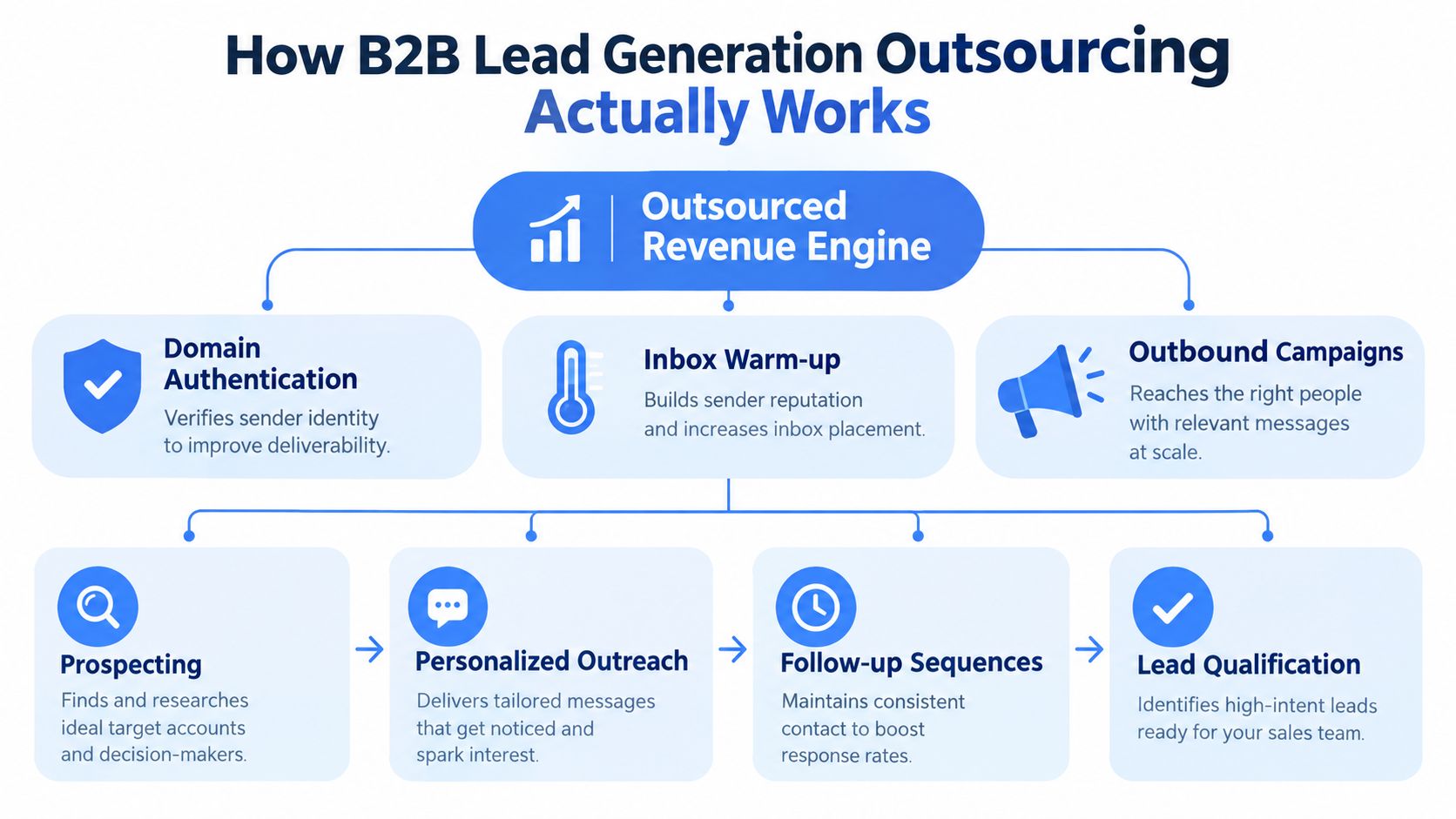
The easiest way to understand B2B lead generation outsourcing is to think of it as an outsourced revenue engine.
You still own the offer, the sales call, and the definition of a good opportunity. The agency owns the machinery that gets the right people into conversations with you.
Definition: B2B lead generation outsourcing means hiring an external team to run some or all of the prospecting system, including infrastructure, list building, outreach, response handling, and qualification.
The system starts before the first email
Most first-time buyers assume the work begins with copywriting. It doesn't.
A competent provider starts with sending infrastructure. That includes domain authentication, inbox setup, warming, and basic deliverability controls. If this layer is weak, even strong copy won't matter because messages won't reliably land where buyers can read them.
That's one reason outsourced lead gen should be viewed as an operations function. Teams that are evaluating broader call-center or outbound support models often compare email-first programs with phone-led models. For that context, this overview of driving revenue with AnyBPO helps clarify where call-center support fits versus digital outbound execution.
Then comes target selection and data work
After infrastructure, the provider builds the audience. This usually means:
Ideal customer profile definition
The client helps define industry, company size, geography, title, buying trigger, and exclusions.List building and enrichment
The agency uses tools like LinkedIn Sales Navigator, Clay, business registries, Google Maps, CRM exports, and custom sourcing workflows to build contact pools.Segmentation
A CFO at a mid-market manufacturer should not get the same message as a growth lead at a SaaS company. Good agencies split lists by role, vertical, and problem set before writing outreach.
Messaging, sequencing, and handoff
Now the campaign work starts.
The agency writes role-specific messaging, builds follow-up sequences, and often combines email plus LinkedIn. Replies come in, and someone has to sort them. Interested prospects need qualification. Bad-fit responses need filtering. Warm conversations need to move into calendar booking or CRM handoff quickly.
A simple division of labor usually works best:
- Client keeps: product expertise, pricing authority, sales discovery, closing, objection handling for late-stage deals
- Agency runs: outbound setup, audience research, data enrichment, sequence writing, campaign operations, inbox monitoring, early qualification
- Both share: ICP refinement, feedback loops, and quality review
Localization matters more than buyers expect
If you target the US, UK, and EU from one program, localization isn't just translation. It affects phrasing, compliance expectations, tone, and relevance signals.
A UK prospect may respond to a different style of opening line than a US founder. A buyer in the EU may expect local language outreach or region-specific examples. Good outsourcing partners treat this as part of targeting, not as an afterthought.
Benefits and Trade Offs of Outsourcing Your Pipeline
The upside of outsourcing is real, but it's not magic. It works when you need disciplined execution more than raw headcount.
Independent benchmark data covering 847 B2B technology companies found that outsourced outbound programs averaged a 12.5% sales-qualified lead rate from initial contact volume, an 18.2% appointment-to-opportunity conversion rate, a 32-day average time from first contact to SQL, and an average cost per sales-qualified lead of $1,847. The same benchmark reported a 4.3% average response rate for agency-managed cold email and found that 23% of outsourced lead generation contracts include performance guarantees, based on this benchmark summary.
Where outsourcing usually wins
Those numbers tell you something important. Good outsourced programs don't just generate activity. They can produce measurable movement toward opportunity creation.
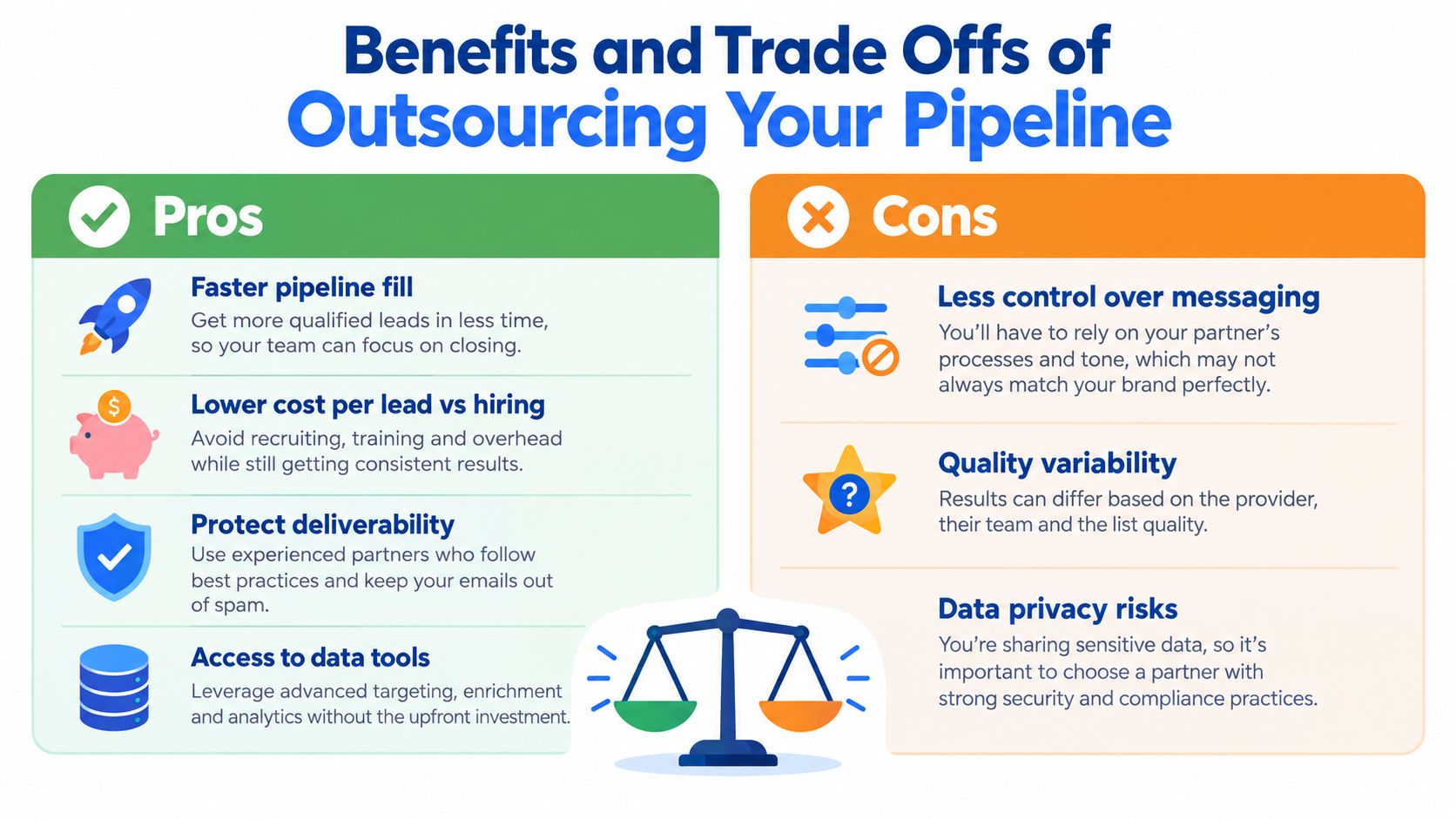
The main advantages tend to look like this:
- Faster launch speed: You don't have to hire, train, and manage an internal SDR function from scratch.
- Process depth: Specialist teams already know how to handle research workflows, sequence management, and qualification handoff.
- Better technical protection: Strong providers treat deliverability as part of campaign performance, not admin work.
- Market testing: If you want to test a new vertical or region, outsourcing lowers the operational burden of running that experiment.
If you're comparing this against a more complete SDR support model, sales development outsourcing is a useful adjacent category to review because it helps separate pure lead supply from broader outbound execution.
Where buyers get burned
The trade-offs are just as important.
You give up some direct control over tone, timing, and day-to-day campaign changes. If the provider uses weak data, generic copy, or sloppy qualification rules, your sales team ends up sorting noise instead of speaking with real buyers. And if the agency doesn't understand your offer, messaging can sound technically correct but commercially flat.
Practical rule: If a vendor talks mostly about lead volume and barely mentions inbox health, qualification criteria, or handoff rules, you're probably looking at an activity provider, not a pipeline partner.
When to keep work in house
Keeping prospecting internal often makes more sense when your sales motion depends on deep product fluency, highly technical discovery, or close coordination between outreach and account strategy.
A hybrid setup is common. The external team builds and runs outbound motion. Internal sales handles high-context follow-up and later-stage conversion. That split keeps the engine moving without asking your closers to become infrastructure operators.
Pricing Models and What Drives Cost Per Lead
Pricing confuses buyers because agencies often sell the same output under different labels. One vendor calls it meetings booked. Another calls it qualified leads. Another wraps everything into a monthly program fee.
The cleanest way to compare vendors is to ask two questions. First, what exactly are you paying for? Second, what work is required to produce that outcome?
Choosing Your Outsourcing Pricing Model
| Pricing Model | How You Pay | Best For | Watch Out For |
|---|---|---|---|
| Retainer | Fixed monthly fee for ongoing campaign work | Teams that want a managed outbound function | You need clarity on what's included in research, infrastructure, optimization, and qualification |
| Pay per lead | Fee for each lead that matches agreed criteria | Buyers testing outbound with strict unit economics | Lead definitions can get loose if qualification rules aren't written tightly |
| Pay per meeting | Fee when a meeting is booked | Teams focused on calendar output | Meetings can look good on paper and still be poor-fit opportunities |
| Performance hybrid | Base fee plus outcome-based component | Buyers who want shared risk and incentive alignment | Contracts can become hard to compare if guarantee language is vague |
If you want to compare this against a more prospecting-centered service scope, B2B prospecting services is the right category to look at.
What actually drives cost
Most first-time buyers assume cost is mainly about volume. In practice, cost is usually pushed around by a different set of variables.
- Audience difficulty: Selling to a narrow niche with hard-to-find contacts takes more research than broad targeting.
- Personalization depth: Generic sequences are cheaper to produce than messages shaped around role, trigger, stack, or market context.
- Infrastructure load: Providers that manage inbox creation, warm-up, monitoring, and deliverability protection are doing more than copywriting.
- Qualification standard: A positive reply is easier to generate than a lead your sales team will accept.
Advanced personalization matters. A large cold email benchmark reported an average reply rate of 3.43% across billions of sends, while emails with advanced personalization reached about 17% to 18% reply rates versus roughly 7% to 9% for basic or generic templates, according to this cold email benchmark.
That doesn't mean every campaign should chase hyper-custom writing for every prospect. It means the cheapest-looking outreach model can become expensive if it relies on high send volume to compensate for weak relevance.
Questions that sharpen a pricing conversation
Ask vendors things like:
- What counts as a lead? Positive reply, qualified reply, booked meeting, or sales-accepted opportunity?
- Who owns infrastructure? If inboxes and domains sit inside the agency's stack, ask how visibility and continuity work.
- How is personalization produced? Manual research, enrichment logic, AI drafting, or static templates?
- What happens to bad-fit leads? Replacements, exclusions, and quality review should be explicit.
Good pricing isn't about finding the lowest number. It's about understanding the labor and systems behind the result.
How to Choose a Vendor and Onboard Without Chaos
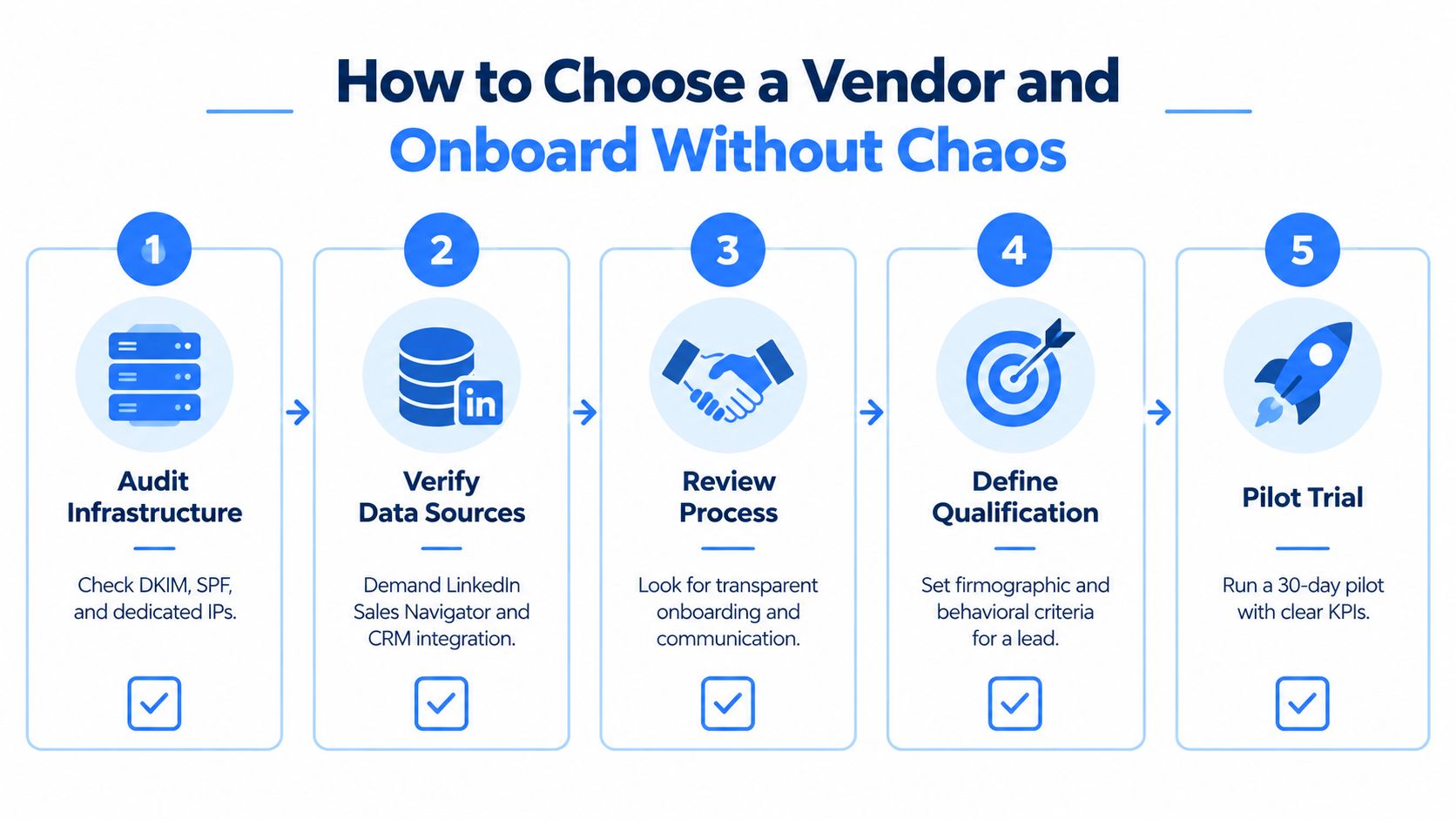
Vendor selection gets messy when teams skip straight to demos and pricing. Start with the machinery, then move to messaging.
One of the most overlooked buying criteria is whether the agency can protect your ability to reach inboxes as filters get stricter. Recent benchmark coverage found 98.16% delivery but only 83.1% inbox placement in one benchmark, and another report estimated that 17% of cold emails never reach inboxes because of authentication failures and spam filtering, as summarized in this deliverability analysis.
What to check before you sign
Use a shortlist checklist. Not every vendor needs the same tools, but every serious vendor should answer clearly.
- Infrastructure competence: Ask how they handle domain authentication, inbox warm-up, rotation logic, monitoring, and recovery when performance slips.
- Data sources: Look for specific answers such as LinkedIn Sales Navigator, business registries, CRM data, enrichment platforms, and manual verification steps.
- Personalization process: Ask who writes messaging, what variables shape copy, and how they avoid generic templates.
- Reporting depth: You want more than activity screenshots. Ask how they report on replies, qualification, pipeline movement, and reasons for disqualification.
- Credentials and process discipline: Certifications from platforms like Clay or Instantly can be useful signals, but the test is whether the team can explain its workflow in plain language.
If you're exploring one provider category in detail, outsource lead generation gives a good picture of what an end-to-end service scope can include.
How a clean onboarding should feel
A calm onboarding usually follows this sequence:
ICP and exclusions are agreed
Not just who you want, but who you don't want.Offer and proof are documented
The vendor needs your differentiators, objection handling, and examples of customer fit.Infrastructure is prepared
This happens before meaningful volume goes out.Lists are built and reviewed
Early feedback here prevents weeks of wasted send volume.Messaging is drafted by segment
Different personas should see different reasoning.Campaigns launch in controlled batches
Early testing protects deliverability and improves learning.Replies route into clear handoff rules
Sales should know who owns follow-up, timing, and CRM updates.
A weak onboarding usually sounds fast and easy. A strong onboarding sounds specific and slightly demanding.
One option among many
When you evaluate providers, look for a documented process that covers infrastructure, research, personalization, launch, optimization, and handoff. For example, Lead Printer operates in that model across the US, UK, and EU, using tools such as LinkedIn Sales Navigator and Clay to build localized outbound programs, but the same evaluation standard should apply to any vendor you review.
SLAs Guarantees and How to Measure Real ROI
Most outsourced programs fail in reporting before they fail in execution.
The vendor says leads are coming in. Sales says the leads aren't good. Marketing says meetings were booked. Finance asks what turned into pipeline. That argument usually means nobody agreed on definitions at the start.
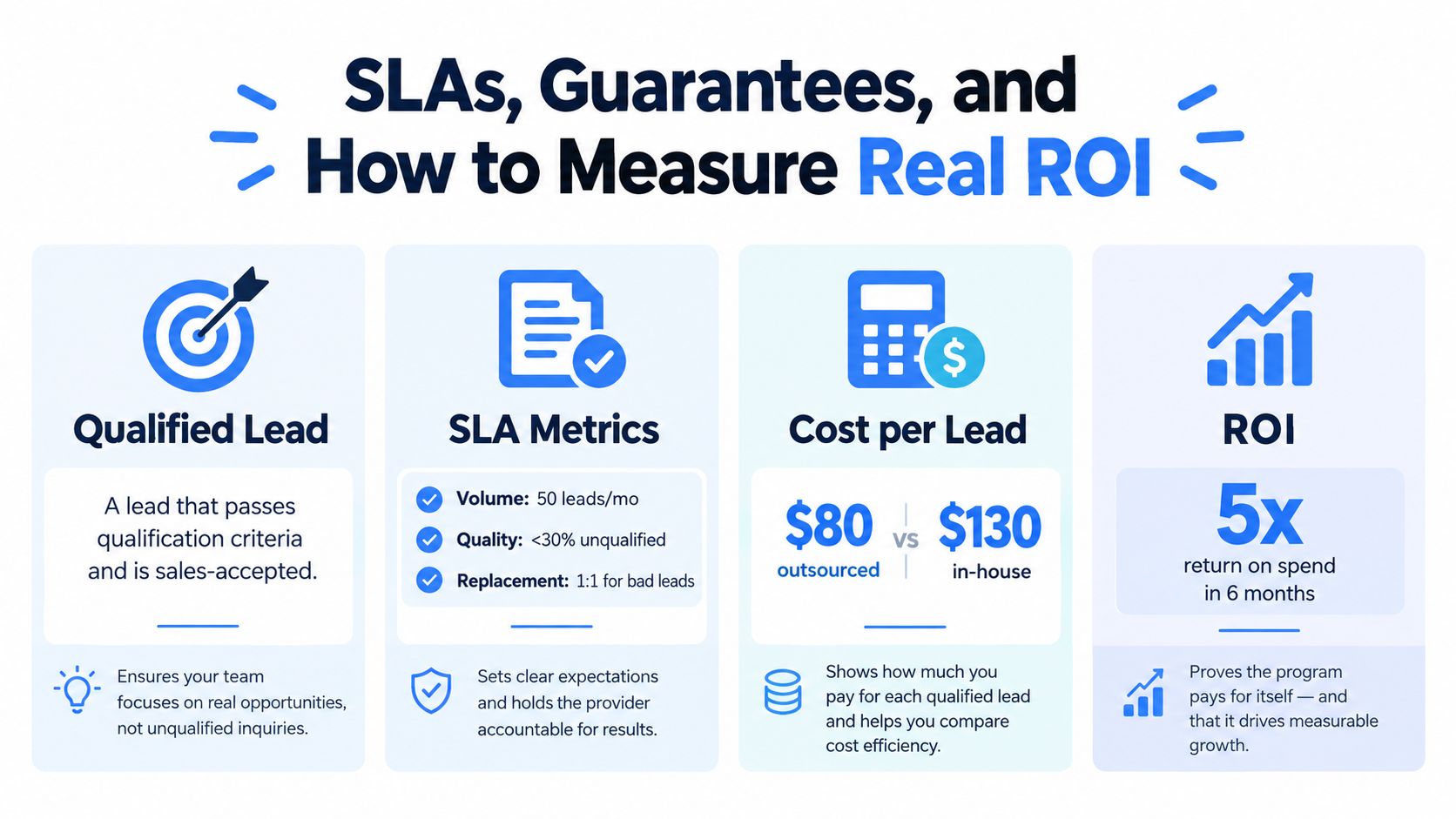
A better contract starts with a hard question: what counts as a qualified lead?
Build the SLA around quality first
An SLA should cover more than output. It should define fit, acceptance, and replacement.
Useful SLA terms often include:
- Qualification rules: Industry, company size, geography, role, use case, and level of expressed interest
- Acceptance process: How quickly sales reviews a lead and what makes it accepted or rejected
- Replacement logic: What happens when a lead is outside the agreed criteria
- Handoff timing: How fast warm leads reach your sales team
- Feedback loop: How campaign targeting and copy are adjusted from sales feedback
Lead quality now sits above raw volume in many buying conversations. Recent industry analysis also notes that B2B buyers often research across multiple sources before contacting sales, and complex purchases involve 6 to 10 stakeholders, based on this trend analysis.
Measure the full funnel, not just the meeting
A booked meeting is useful. It isn't the finish line.
Track a sequence of checkpoints:
- Reply quality: Are responses relevant, curious, and commercially plausible?
- Sales acceptance: Does your team agree the opportunity fits the ICP?
- Opportunity creation: Do meetings progress into real pipeline stages?
- Pipeline contribution: Which campaigns and segments create revenue-bearing opportunities?
If your SLA rewards booked calls but ignores sales acceptance, the vendor is incentivized to optimize for calendar density, not business value.
Where guarantees fit
Performance guarantees are becoming more common because buyers want outcome alignment, not just effort. In practice, the quality of the guarantee matters more than the existence of one.
A clear example is a minimum qualified lead commitment tied to agreed qualification criteria and replacement or refund terms. Lead Printer, for instance, states a guarantee of 20+ qualified leads per month. That isn't automatically good or bad by itself. The question is whether both sides define “qualified” the same way and review outcomes at the opportunity level.
Real Results and Your Next Move to Outsourced Growth
Real outcomes usually come from the same pattern. Tight targeting, strong infrastructure, useful personalization, and steady optimization. Not one flashy tactic.
Lead Printer's operating history gives a concrete example of what scale can look like in practice: 7.2M emails and LinkedIn DMs sent, 32k leads generated, and 2,500+ campaigns delivered. The company also cites specific outcomes including ÖÖD House with 687 warm leads, B2B Growth with €40k revenue and 237 qualified leads, ESTO with 7 new clients and 106 sales opportunities, and Noda ramping from about 50 to about 300 leads per month while maintaining targeting quality.
What should a first-time buyer take from examples like that?
The patterns to copy
- Targeting beats brute force: Better-fit lists create less waste for sales.
- Personalization works when it's tied to context: Role, market, and buying trigger matter more than clever wording.
- Optimization is part of delivery: Good providers don't “set and forget” campaigns.
- Volume only helps when the system is stable: More sends won't fix weak infrastructure or muddy qualification.
Your next move should be simple. Write down your ICP, define what sales will accept, list the proof points a vendor can use in outreach, and ask every provider how they handle infrastructure, targeting, personalization, and lead replacement. If the answers stay vague, keep looking.
Outsourcing works best when you buy a process, not a promise.
Lead Printer offers outsourced B2B outbound execution across email infrastructure, prospect research, list building, personalization, multichannel outreach, qualification, and handoff for teams selling across the US, UK, and EU. If you want a partner that treats lead generation as a deliverability and pipeline system instead of a volume purchase, visit Lead Printer.