Post more, connect more, pitch faster. That's the popular advice for B2B lead generation on LinkedIn, and it's why so many teams burn good accounts on weak lists. Posting doesn't fix bad targeting. A clever first line doesn't fix a market that's too small. I would treat LinkedIn as one layer in a pipeline system, alongside email, sales follow-up, and measurement that accounts for influence long before a meeting appears.
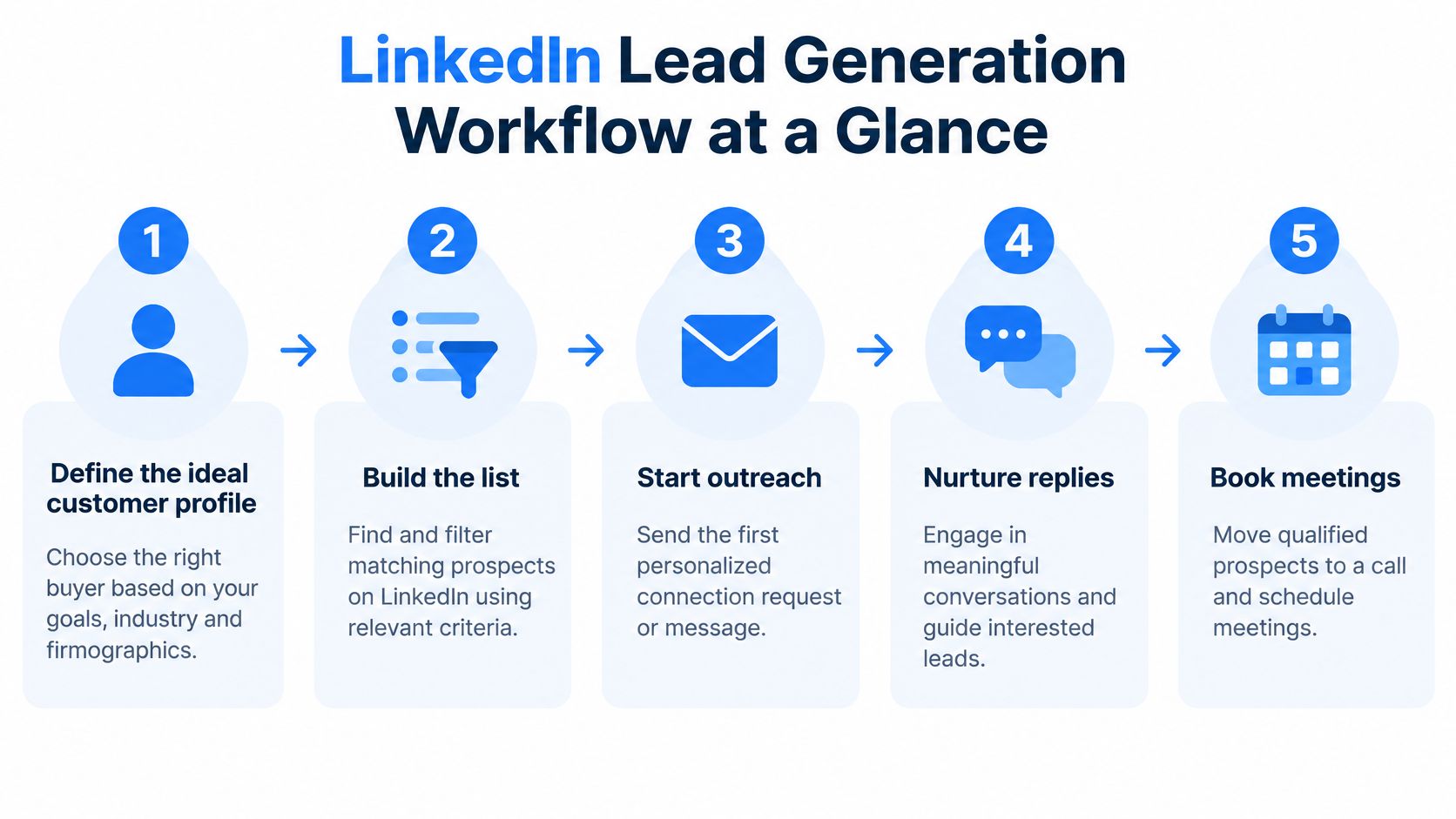
LinkedIn Lead Generation Workflow at a Glance
Many teams treat LinkedIn as a place to publish posts and send connection requests. The working version is a five-phase system where each phase produces something testable before the next one starts. Skip a check and you'll usually pay for it later as low replies, unqualified calls, or pipeline you can't attribute.
The workflow below maps the five phases from profiling to booked meetings.
| Phase | What You Produce | Check Before Moving On | Usual Owner |
|---|---|---|---|
| 1. Define the ICP | Account and role criteria | Target market holds enough people for the deal size | Founder or growth lead |
| 2. Build the list | Sales Navigator account and contact list | Each segment maps to one buyer role and one problem | SDR or agency researcher |
| 3. Write the sequence | Connection note, DM and email copy | Every message names one specific reason to reply | Copywriter |
| 4. Launch and sequence | Live multichannel outreach | Replies reach a named owner the same working day | SDR |
| 5. Measure and tune | Weekly pipeline report | Opportunities tagged by source and influence | RevOps or growth lead |
LinkedIn sits in the middle of this system because buyers are already there and competitors know it. LinkedIn Marketing Solutions, citing Wpromote research, reports that 89% of B2B marketers use LinkedIn for lead generation, while 62% say the platform generates leads for them, more than twice the result attributed to the next-highest social channel. The same source states that a typical buyer consumes 7 to 10 pieces of content before making a choice.
That second point changes how you should judge a message. One DM isn't supposed to close the gap by itself. It's one touch among profile views, posts, emails, referrals, and sales conversations. Broad adoption also means presence alone doesn't differentiate you. Targeting, personalization, and offer relevance decide whether activity becomes qualified conversation.
Practical rule: If a phase has no owner and no pass or fail check, it isn't a phase. It's a hope.
Do this now. Write down the current owner and check for each of the five phases, then mark any phase with no owner or no check. Fix that gap before you add volume.
How to Build a Targeting List That Fills Your Pipeline
Start with market size, because no filter, sequence, or personalization trick rescues a market that's too small for your price point. You'll exhaust the best accounts while you're still learning what message works, then you'll have nowhere clean left to test.
| Offer Type | Minimum People in Target Market | What It Means |
|---|---|---|
| High-ticket B2B service that solves a real problem | 5,000 people | Enough contacts to test several segments without exhausting the list |
| Medium-ticket product or service | 50,000 people in total addressable market | Fewer buyers per deal means a larger pool is needed to reach volume |
| Low-ticket self-serve product | No reliable outbound minimum | Outbound rarely pays back at this price, so test paid channels first |
Those thresholds match how we scope work. We suit high-ticket B2B services that solve a real problem when there are at least 5,000 people in the target market, and for medium-ticket products or services we suggest at least 50,000 people in the total addressable market. Below that, you're not running a repeatable outbound motion. You're doing named-account selling, which needs different tactics and patience.
Build the list in five steps
- Define the buyer before the account. Write the role that owns the problem, plus company traits that make a fit, such as headcount band, industry, geography, and tech stack. If two roles own different problems, split them now.
- Build accounts first in Sales Navigator. Filter by industry, company size, geography, seniority, and function. In our research step, we build prospect databases using Clay and scraping from LinkedIn Sales Navigator, Google Maps, and targeted websites, because one source rarely gives you clean account and contact data together.
- Add contacts by function, not title alone. Titles vary wildly between companies. A Head of Growth at one firm does the job a VP Marketing does at another, so search by job function and seniority, then sanity check titles manually on a sample.
- Remove paper fits with no visible problem. An account that matches your filters but shows no hiring, expansion, tech change, or operational pain your offer solves will dilute reply rates. Cut it or park it in a nurture segment.
- Enrich with a verified email and a recent signal. Add a checked work email plus one observable trigger, such as a leadership change, funding news, new location, or a job post that reveals a gap. That signal becomes your reason to write.
Scale isn't your constraint. LinkedIn's About page describes the platform as having more than 1 billion members across more than 200 countries and territories, so filtering discipline matters far more than raw reach. A smaller list of accurate fits will outperform a broad list of plausible ones, and it'll protect your sender reputation while it does.
Distribution matters at this stage too. Warming a segment through credible individuals often beats relying on a company page alone, a point made in Andrew Younger's LinkedIn benchmarks post, which reports that personal professional posts represented nearly 40% of desktop feeds, while company-page content occupied only about 1 to 2% of the average feed. Build your list with that in mind, and note which prospects already engage with people on your team.
Measuring Pipeline Beyond Form Fills and Meetings
A LinkedIn campaign can shape a deal months before anyone fills in a form or books a meeting. If you only credit the last touch, you'll cut the activity that made the buyer receptive and keep the activity that merely arrived last.
The buying timeline explains why. A LinkedIn Pulse analysis citing Dreamdata data reports that the average B2B buying journey spans 272 days, includes 88 touchpoints across four channels, and involves 10 stakeholders, with buyers spending roughly 220 days researching before entering an observable sales process. The same analysis cites 6sense research indicating that 94% of buying groups had already ranked preferred vendors before first contact and bought from that preliminary favorite 77% of the time.
Read that plainly. By the time a prospect replies, your LinkedIn posts, profile, and earlier messages may have already moved you onto, or kept you off, the shortlist. Measurement has to capture that pre-pipeline influence without pretending it's the same as sourced revenue.
Build the measurement setup in this order
- Add a self-reported source field. Put a free-text "Where did you first hear about us" field on the booking form and mirror it in the CRM. Free text beats a dropdown because buyers name podcasts, peers, and specific posts you'd never list.
- Tag sourced versus influenced. Mark an opportunity sourced when the first touch was an outreach reply. Mark it influenced when LinkedIn content, a profile view, or a DM touched the buyer before the opportunity opened through another route.
- Report by cohort month. Group results by month of first touch, not month of opportunity creation. A campaign judged after 30 days will look weak even when it's working, because the buying cycle hasn't caught up.
- Ask every qualified lead what they saw. Add one question to the first sales call and log the answer. You will hear about the founder post a colleague forwarded in a private channel, which no click tracker will ever show you.
Getting this right also depends on consistent definitions, so align your tags with a shared view of what lead qualification means before you start reporting numbers to leadership.
| Metric | Where to Find It | How to Read It |
|---|---|---|
| Sourced pipeline | CRM opportunity source field | Deals whose first touch was an outreach reply |
| Influenced pipeline | CRM plus self-reported source answer | Deals where LinkedIn touched the buyer before the opportunity |
| Reply rate by sequence step | Sequencing tool | Compare steps against each other, not only the total |
| Meetings booked per 100 contacts | Calendar plus CRM | Main efficiency check on list and message quality |
| Time from first touch to opportunity | CRM cohort report | Read with lagged cohorts, since long cycles need months |
Influenced pipeline is an estimate. Report it separately from sourced revenue and never add the two together, or you'll double count deals and lose credibility with finance the first time someone audits the numbers.
Outreach Timing and Message Rules That Get Replies
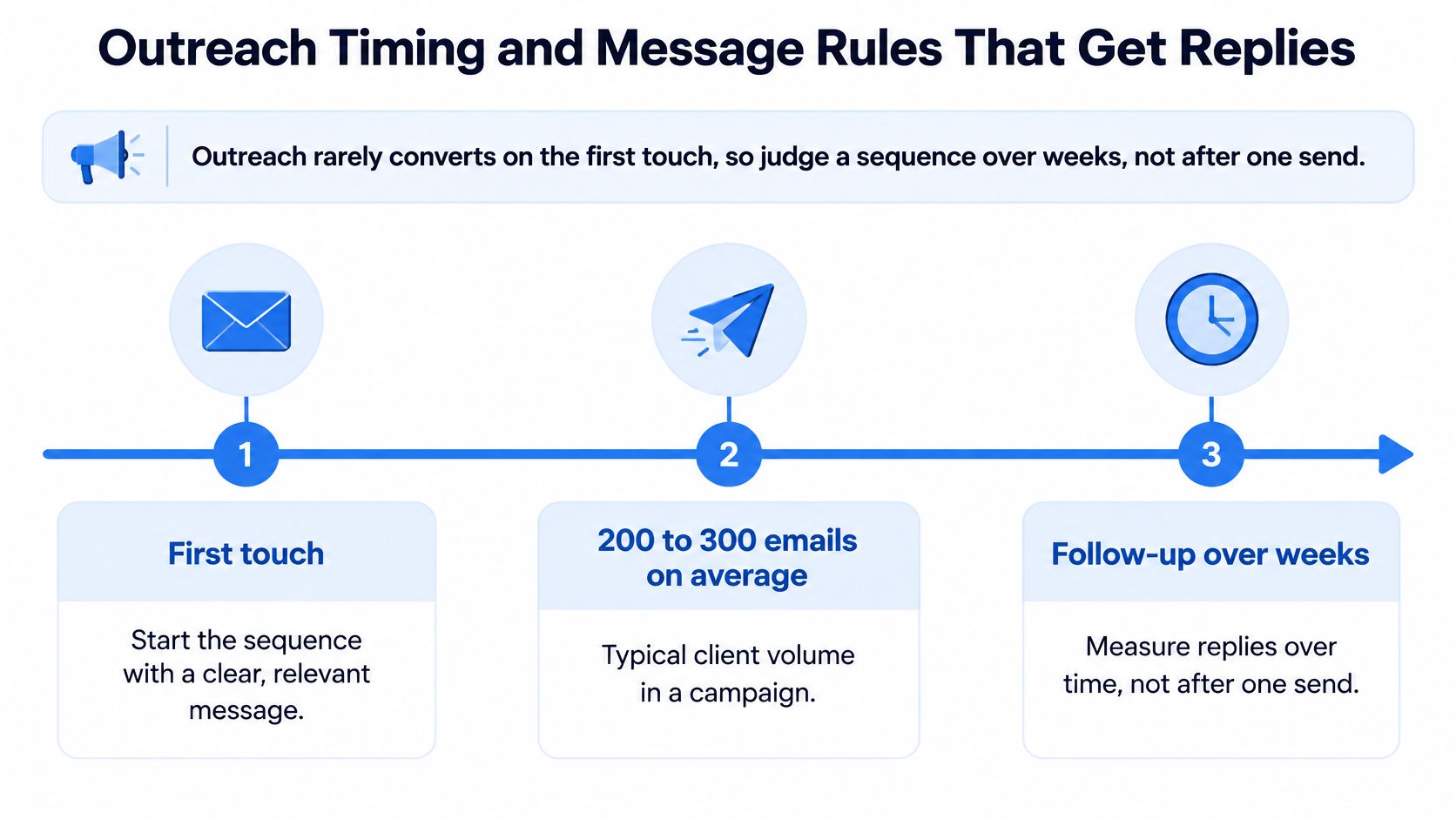
Outreach rarely converts on the first touch, so judge a sequence over weeks, not after one send. We need to send 200 to 300 emails on average to generate one warm lead for a client. If you expect a meeting from a single connection note to 40 people, your expectations, not your copy, are the first problem.
The diagram below sets out the timing mindset before you write a word.
Run the sequence in five steps
- Connection request with one specific line. Name a real reason, such as a shared market, a recent post, or a hiring move. Don't pitch here. You're earning the right to appear in their feed and inbox.
- Email a few days later, tied to something observable. Reference the prospect's tech stack, a job post, or a new market launch. We find prospects and use live buying signals to reach out when prospects are most likely to say yes, because timing beats volume.
- LinkedIn DM with one proof point. Keep it relevant to that role. A delivery leader cares about capacity, a founder cares about pipeline, and the same case detail won't move both.
- Short follow-up question. Ask something they can answer yes or no without homework. Low effort replies start more conversations than open-ended asks to busy operators.
- Engage, then close the loop. Comment substantively on a recent post, wait, then send one final note that gives them an easy out. Polite closure protects your reputation for the next cycle.
Match each step to the right channel. Connection requests work for building a reachable network, InMail suits prospects outside your network when you have credits and a strong reason, and Lead Gen Forms suit a clear asset or event offer inside an ad. Their limits and availability change, so check your account settings before you plan volume around any of them. A fuller breakdown of channel roles sits in this guide to LinkedIn outreach strategy.
Two message rules that prevent most failures
Rule one, one reason to reply per message. If your email mentions growth, cost, speed, and risk, the reader has to do the prioritization work for you. They won't. Pick the reason tied to the signal you found and cut the rest.
Rule two, don't ask for a meeting before the problem is agreed. A calendar ask to someone who hasn't acknowledged any pain reads as a cost, not an opportunity. Earn a reply about the problem first, then propose time.
Say you're writing to an operations lead who's just posted two SDR roles. "Saw you are hiring two SDRs, here is how similar teams cut ramp time" gives one observable trigger and one relevant payoff, with no meeting ask attached.
Set your downstream expectations just as plainly. Our clients typically book a meeting with every 3 to 4 leads and need 10 to 20 leads to close one sale. If your close rate on qualified conversations is weaker than that, generating more top-of-funnel volume won't rescue the quarter.
Employee-Led Posts That Feed Outbound Pipeline
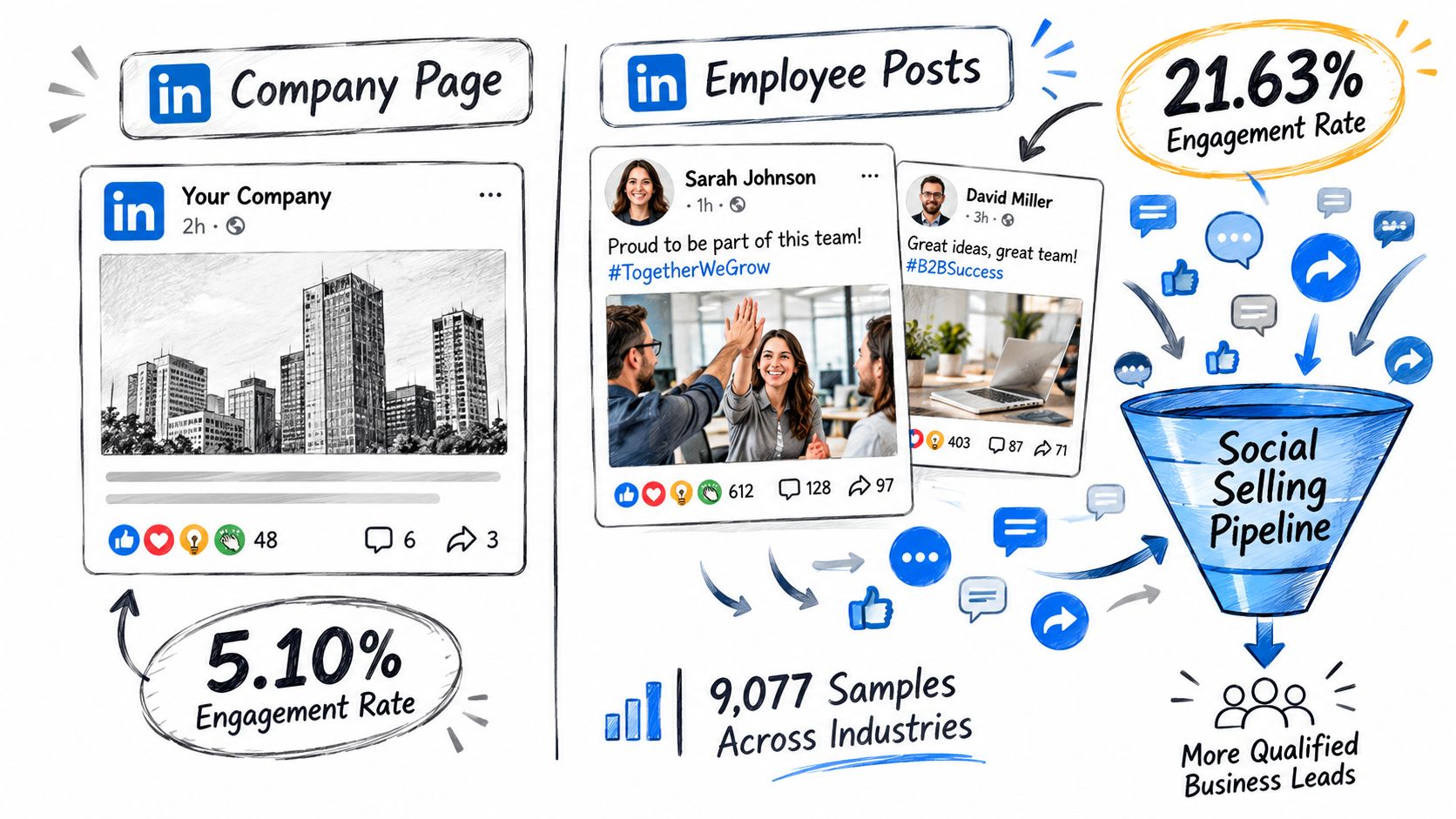
Company pages have a structural reach problem. Most buyers follow people, argue with people, and remember people. A logo posting product updates three times a week competes poorly against a founder or delivery lead explaining a real customer problem in plain language.
The comparison below shows why employee posts deserve a place in your outbound system rather than sitting in a separate brand plan.
Trust is the mechanism underneath the reach. LinkedIn's 2025 B2B Marketing Benchmark, produced with Ipsos from a sample of 1,500 senior-level B2B marketers, found that 94% of surveyed B2B marketers said trust was key to B2B success. A named expert showing their working builds that trust faster than branded claims do, because the buyer can judge the thinking directly.
Run it as a system, not a content calendar
- Pick two to four credible voices. Choose people whose role matches a buyer's problem, such as a founder, a delivery lead, or a product specialist. Don't draft whoever has spare time. Credibility with the target role is the selection filter.
- Assign editorial themes from customer problems. Give each person a short list built on questions buyers ask in sales calls, mistakes they see in audits, and trade-offs they explain weekly. Product features make weak themes because they invite no discussion.
- Set a comment rule. Reply to every comment that names a problem, a constraint, or a disagreement. You can safely let pure congratulations pass. The first group is where qualification starts.
- Qualify before you message. Check role, seniority, and company fit before moving an engaged commenter to a DM. Messaging everyone who liked a post turns a trust asset into spam within a month.
- Define the handoff in writing. Name the owner, set a response window within the same working day, and log a CRM note that links the post that started the conversation. Without that note, you'll never connect content to pipeline later.
The short video below walks through how this kind of expert-led visibility supports outbound rather than replacing it.
Measure the handoff, not the likes. Engagement from peers, job seekers, and other marketers inflates your numbers while adding nothing to pipeline. Count qualified comments, DMs started with target roles, and opportunities where the self-reported source names a person's post. Those three numbers tell you whether employee-led publishing is feeding outbound or just feeding the feed.
Common LinkedIn Lead Generation Problems and Fixes
Most LinkedIn lead generation failures aren't mysterious. They're measurement gaps and sequencing mistakes that repeat because nobody isolates one variable at a time. That difficulty is widespread. In LinkedIn research conducted with YouGov among 1,014 senior B2B marketers, 87% of B2B marketers surveyed across the United States, United Kingdom, France, and India said measuring the long-term impact of campaigns was becoming harder in 2024.
| Symptom | Likely Cause | Fix to Try First |
|---|---|---|
| Connections accepted but few replies | First message pitches the offer too early | Open with one specific observation and one question |
| Strong opens but no meetings | Offer is too vague for the buyer's role | Tie the offer to one problem that role owns |
| Emails bounce or land in spam | Weak domain setup or sends ramped too fast | Check domain authentication, warm up, and cap daily sends |
| Many likes but no pipeline | Engagement comes from people who cannot buy | Qualify commenters by role and move buyers to direct outreach |
| Pipeline credited to the wrong channel | Only last touch is tracked | Add a self-reported source and cohort view |
The most common symptom is the first row. Prospects accept your connection because your profile looks relevant, then your opening DM asks for 15 minutes to discuss a platform they've never thought about. The fix is cheap to test. Rewrite only the first line so it names something specific about their company, and end with one question about that thing. Check reply rate on that step alone over the next batch.
Strong opens with no meetings point somewhere else. Your subject line and sender name are doing their job, but the offer doesn't map to a problem that role owns, so there's nothing to forward internally and nothing to defend in a budget conversation. Rewrite the offer around one outcome that role gets measured on, then retest against the same segment.
If email bounces or lands in spam, stop volume first. Check domain authentication and warm-up status before you touch a word of copy, because copy changes can't fix a reputation problem and continued sending makes it worse.
Separate your fixes by test speed. First-line rewrites and offer sharpening can be tested within one week on a fresh batch of the same segment. Rebuilding a list, changing the target role, or reworking the offer itself needs a full sequence cycle before you can accurately assess the result. Mixing the two timelines is how teams declare a channel dead after nine days.
The last two rows aren't new tactics. They're reminders to apply the commenter qualification and self-reported source steps you've already set up. When likes don't convert or credit lands on the wrong channel, go back to those two mechanisms before you invent a third one.
Run a 30-Day Test Before You Scale Spend
Commit to scale only when a small test shows replies, meetings, and a clear fit for your offer. A 30-day test won't prove closed revenue on a long sales cycle, and it shouldn't try. It proves whether the list, message, and handoff work well enough to justify more volume.
The 30-day test in order
- Pick one buyer segment. Choose a segment with a market large enough for your deal size, using the sizing thresholds you've already set. One segment means one role, one problem, and one offer angle. Testing three segments at once with small numbers teaches you nothing about any of them.
- Build a list of 300 to 500 contacts. Write one sequence with one clear reason to reply, spread across LinkedIn and email. That volume is large enough to read reply patterns by step and small enough that a bad list doesn't burn your whole market.
- Set up measurement before the first send. Create the source field, the self-reported source question, and the cohort tags now. Retrofitting attribution after replies arrive means your earliest, often best, responses go untagged.
- Review by step in week two. Compare reply rate at each sequence step and fix the weakest message first. Don't rewrite the whole sequence because step three underperformed. Isolate, change one thing, and keep sending to the same segment profile.
- Decide at day 30. Compare meetings booked per 100 contacts and sourced pipeline against the target you set before launch. Then make one of three calls, scale, fix and retest, or stop. Write the decision down with the numbers that drove it.
For context on what a working program produces at steady state, most of our clients receive around 50 qualified leads per month. Your test month won't match that, and it isn't meant to. You're checking unit economics and fit, not final volume.
This kind of test works because LinkedIn doesn't operate alone. Coordinating it with email and sales follow-up, as set out in this overview of cross-channel lead generation, gives each prospect several credible ways to respond instead of one inbox they may rarely check.
Know the boundary before you start. We generate leads and book meetings, while the client's sales team closes the deal. We don't provide end-to-end sales, so judge the test on meetings held and sourced pipeline, not closed revenue alone. If meetings happen and deals don't progress, that's a sales process finding, and it's still useful.
If you want a structured starting point before you build your test, we offer a Free Lead Generation Guide on our resources page that you can work through against your own segment and sequence.
If you'd rather have a team build and run this system for you, Lead Printer creates targeted prospect lists from LinkedIn Sales Navigator and other sources, writes personalized multichannel sequences, and hands qualified conversations to your sales team to close. Start by reviewing your targeting and measurement against the 30-day test above, then visit Lead Printer to discuss whether your market size and offer fit the outbound model.